

What do you think?

Einstein's Shadow: The Inside Story of Astronomers' Decades-Long Quest to Take the First Picture of a Black Hole – A New York Times Editor's Choice on Testing Relativity and Understanding Reality
A NEW YORK TIMES EDITOR'S CHOICE Einstein’s Shadow follows a team of elite scientists on their historic mission to take the first picture of a black hole, putting Einstein’s theory of relativity to its ultimate test and helping to answer our deepest questions about space, time, the origins of the universe, and the nature of reality Photographing a black hole sounds impossible, a contradiction in terms. But Shep Doeleman and a global coalition of scientists are on the cusp of doing just that. With exclusive access to the team, journalist Seth Fletcher spent five years following Shep and an extraordinary cast of characters as they assembled the Event Horizon Telescope, a virtual radio observatory the size of the Earth. He witnessed their struggles, setbacks, and breakthroughs, and along the way, he explored the latest thinking on the most profound questions about black holes. Do they represent a limit to our ability to understand reality? Or will they reveal the clues that lead to the long-sought Theory of Everything? Fletcher transforms astrophysics into something exciting, accessible, and immediate, taking us on an incredible adventure to better understand the complexity of our galaxy, the boundaries of human perception and knowledge, and how the messy human endeavor of science really works. Weaving a compelling narrative account of human ingenuity with excursions into cutting-edge science, Einstein’s Shadow is a tale of great minds on a mission to change the way we understand our universe—and our place in it.
288 pages, Paperback
First published October 9, 2018
About the author
Seth Fletcher
3 books9 followersSeth Fletcher is a senior editor at Popular Science magazine. His writing has also appeared in Men's Journal, Outside, Salon, and other publications. He lives in Brooklyn."
Ratings & Reviews
Friends & Following
Create a free account to discover what your friends think of this book!
Community Reviews
Displaying 1 - 30 of 56 reviews

February 15, 2021
I became hooked on astronomy in a very big way. It’s just that idea that once you’ve passed the event horizon, then there is no escape from the black hole. So a book about taking a photograph of the supermassive black hole at the centre of our galaxy using a radio telescope assembled out of telescopes from around the Earth? Yes, please. Einstein’s Shadow tries to tell the story of this project, the Event Horizon Telescope or EHT, and particularly its founder, Shep Doeleman. However, somewhere along the way, Seth Fletcher’s attempts to combine the budgetary wrangling of an astronomical project with the astrophysical ideas behind the project lose their way, and we are left with a book lacking in heart.
From the beginning, I was nervous about Fletcher’s choice to follow Doeleman and portray him as the “hero” of this book. I understand that he was one of the visionaries for this project, that he brought it to life and shepherded toward its (eventual) successful photograph. Yet Fletcher readily admits that a project like this is really the work of hundreds of minds, not one. So the focus on Doeleman is odd, because you can’t have your cake and eat it too—don’t remind me that science is a collaborative enterprise and then spend a whole chapter telling me about Doeleman’s childhood. Is this a biography or isn’t it? In the same vein, there were points in this book where Fletcher lionizes Doeleman too much for my liking. Sure, he also points out Doeleman’s recalcitrance and flaws, so maybe that’s just balance. Nevertheless, I just walked away with an uneasy impression we’re supposed to see Doeleman as a visionary and a hero, and it’s just like … dude managed a big science project.
It feels like Fletcher is casting about for a story in the middle of events that are, in their own way, quite interesting, but for which there isn’t much story to be found. I did like the details on how the project was funded. I liked hearing about the behind-the-scences, backdoor wrangling. I liked the acknowledgement of the dearth of women in this field. More of these things. I didn’t mind Fletcher’s attempts to explain the physics behind black holes, although I have heard it done better and with more … I don’t know, flair? All in all, however, these two faces of the book never unified into a whole that I could appreciate. I would be excited for a few pages before the narrative returned to less interesting things, or bogged itself down in a few pages of scientific chat, and my interest level flatlined.
So I guess what I’m trying to say is that, in the end, Fletcher’s writing style just didn’t work for me. I also think it was so premature to finalize this book prior to the EHT actually releasing its data/images (I ended up looking up the EHT’s website and realizing I had seen its image of M87 in a science news article some time ago). I’m not sure if this was the publisher’s eagerness or what, but if you held off another year or so, hey, you would have a way better ending for this book. As it is, “They got data, but they need time to keep sifting through it, stay tuuuuuned” is literally a definition of anticlimax. This book is all science foreplay, no science orgasm, and I’m not here for that.
Originally posted on Kara.Reviews, where you can easily browse all my reviews and subscribe to my newsletter.

From the beginning, I was nervous about Fletcher’s choice to follow Doeleman and portray him as the “hero” of this book. I understand that he was one of the visionaries for this project, that he brought it to life and shepherded toward its (eventual) successful photograph. Yet Fletcher readily admits that a project like this is really the work of hundreds of minds, not one. So the focus on Doeleman is odd, because you can’t have your cake and eat it too—don’t remind me that science is a collaborative enterprise and then spend a whole chapter telling me about Doeleman’s childhood. Is this a biography or isn’t it? In the same vein, there were points in this book where Fletcher lionizes Doeleman too much for my liking. Sure, he also points out Doeleman’s recalcitrance and flaws, so maybe that’s just balance. Nevertheless, I just walked away with an uneasy impression we’re supposed to see Doeleman as a visionary and a hero, and it’s just like … dude managed a big science project.
It feels like Fletcher is casting about for a story in the middle of events that are, in their own way, quite interesting, but for which there isn’t much story to be found. I did like the details on how the project was funded. I liked hearing about the behind-the-scences, backdoor wrangling. I liked the acknowledgement of the dearth of women in this field. More of these things. I didn’t mind Fletcher’s attempts to explain the physics behind black holes, although I have heard it done better and with more … I don’t know, flair? All in all, however, these two faces of the book never unified into a whole that I could appreciate. I would be excited for a few pages before the narrative returned to less interesting things, or bogged itself down in a few pages of scientific chat, and my interest level flatlined.
So I guess what I’m trying to say is that, in the end, Fletcher’s writing style just didn’t work for me. I also think it was so premature to finalize this book prior to the EHT actually releasing its data/images (I ended up looking up the EHT’s website and realizing I had seen its image of M87 in a science news article some time ago). I’m not sure if this was the publisher’s eagerness or what, but if you held off another year or so, hey, you would have a way better ending for this book. As it is, “They got data, but they need time to keep sifting through it, stay tuuuuuned” is literally a definition of anticlimax. This book is all science foreplay, no science orgasm, and I’m not here for that.
Originally posted on Kara.Reviews, where you can easily browse all my reviews and subscribe to my newsletter.

October 7, 2020
Black Holes are mysterious objects where the laws of physics break down. We can theorize about them all we want, but we can't directly see them.
In 1905, an unknown patent office clerk named Albert Einstein formulated the theory of Special Relativity. He realized that it was incomplete, though, and began to work on the relativistic effects of gravity. In 1915 he succeeded with the help of Herman Minkowski and several other mathematicians. Einstein's Field Equations show that spacetime is a flexible sheet that bends in the presence of mass. Light should curve along the bend created by gravity. Einstein became a household name due to this prediction.
It is possible to predict Black Holes without Einstein's equations. All you have to do is look at the Escape Velocity of an object and set it to the speed of light.
Einstein's Shadow is by Seth Fletcher. He writes about what a Black Hole is and how we are trying to photograph one using radio telescopes. It is a fascinating story. He does go into the politics behind using a telescope array and the difficulty of obtaining funding for your observations.
In 1905, an unknown patent office clerk named Albert Einstein formulated the theory of Special Relativity. He realized that it was incomplete, though, and began to work on the relativistic effects of gravity. In 1915 he succeeded with the help of Herman Minkowski and several other mathematicians. Einstein's Field Equations show that spacetime is a flexible sheet that bends in the presence of mass. Light should curve along the bend created by gravity. Einstein became a household name due to this prediction.
It is possible to predict Black Holes without Einstein's equations. All you have to do is look at the Escape Velocity of an object and set it to the speed of light.
Einstein's Shadow is by Seth Fletcher. He writes about what a Black Hole is and how we are trying to photograph one using radio telescopes. It is a fascinating story. He does go into the politics behind using a telescope array and the difficulty of obtaining funding for your observations.
October 24, 2018
I really enjoyed this book about Shep Doeleman’s team working on this amazing project, the Event Horizon Telescope. All the trials and tribulations, the struggle for money and the politics involved really gave the amount of sweat and grit it takes to keep a project going like this that spans the globe, and involves many cultural differences. Plus the science involved was very absorbing and interesting. It wasn’t hard to understand, yet it gave you enough technical information to Google what you wanted to understand more about black holes, the shadow of the black hole in Sagittarius A* that they are trying to achieve, the physics involved, the various telescopes and why it will be such a groundbreaking discovery. I can’t wait to hear what the results will be on this project.
October 11, 2018
Missing images: And Not Just Sagittarius A*
This is a fascinating story, technically challenging even for most scientists. You certainly end up rooting for Shep and the whole gang. I can now peruse the scientific literature on line, waiting to see if the final analysis of the 2017 data set was definitive, and if so- what did they find?
I read the e-book version, downloaded on October 9. My sole complaint is that there are no illustrations of either the principal scientists or of the many observatories featured in the saga.
Has the Event Horizon Telescope assemblage ever been activated by another group, asking different questions? The concern by funding agencies for access is justifiable; what is the utility of the EHT going forward?
Author Fletcher has compiled a fine scientific yarn, with just the right amount of dumbing-down for a non-astrophysicist to follow the technical arguments.
This is a fascinating story, technically challenging even for most scientists. You certainly end up rooting for Shep and the whole gang. I can now peruse the scientific literature on line, waiting to see if the final analysis of the 2017 data set was definitive, and if so- what did they find?
I read the e-book version, downloaded on October 9. My sole complaint is that there are no illustrations of either the principal scientists or of the many observatories featured in the saga.
Has the Event Horizon Telescope assemblage ever been activated by another group, asking different questions? The concern by funding agencies for access is justifiable; what is the utility of the EHT going forward?
Author Fletcher has compiled a fine scientific yarn, with just the right amount of dumbing-down for a non-astrophysicist to follow the technical arguments.

November 24, 2018
It was interesting to see the difficulties that Shep and his group encountered in trying to get funding, calibrate the telescopes, etc. What a monumental task! I also appreciate that Fletcher made the scientific debates concerning blackholes understandable to someone who's not a scientist (i.e. me). But sometimes there was a bit too much detail about the funding and "political" issues, which got repetitive after awhile. Also, I know that the point was to document the *journey* that these groups underwent in trying to coordinate an earth-sized telescope to document black hole behavior, and not necessarily to tell us what they found, BUT I was disappointed that in the end we don't know what they found. Hopefully they are able to release the data and its implications soon!

October 19, 2018
This was published in 2018 after the initial black hole observation run in April of 2017, but before the results are made public. The Event Horizon Telescope is 7 or 8 specialized radio telescopes around the world organized to take a picture of the black hole in the center of our galaxy. It's a gripping story, years in that making, full of science and science politics. Politics because if successful, up to three people will win the Nobel physics from this. So there is lots of politics and maneuvering. The image was taken in April 2017, but it is taking a lot of time to process and correlate the image data to get a picture.
Loved the Audible book!
Loved the Audible book!

August 18, 2024
Albert Einstein published his General Theory of Relativity in 1915 and proposed three tests to validate it. They were the amount of precession in Mercury’s perihelion, gravitational lensing and gravitational redshift. However, in the hundred years following the theory, other scientists have predicted many fall-outs from it and proved or observed them as well. One phenomenon is the black hole which has captured popular imagination. This book follows astronomers on a quest for the first-ever black hole photograph. Their goal is to capture an image of Sagittarius A*, the supermassive black hole at the center of the Milky Way. To accomplish this task, they construct a ‘virtual telescope’ called The Event Horizon Telescope (EHT). Seth Fletcher, the author of this book, follows these astronomers, scientists and engineers over six years to construct the story of imaging the black hole. This book combines science, institutional politics, personal interest stories, and the complexities of coordinating and collaborating across ten major astronomical observatories worldwide. These observatories span from the south pole to Spain and France in the north.
First, we must clarify how anyone can photograph a black hole. It is important to understand what indeed the EHT project is trying to capture. The Event horizon of a black hole is an imaginary boundary that marks the point at which nothing, including light, escapes. A black hole does not glow because it does not emit light. So, the EHT cannot photograph the black hole itself. But the event horizon can glow because of the ‘accretion disk’. The accretion disk is a ring of gas and dust that swirls around a black hole, emitting energy as it falls into the black hole. The material in the accretion disk gets super hot and can have strong magnetic fields, which cause it to glow. It comprises plasma (super-heated gas) that swirls around the black hole at almost the speed of light. The glow comes from matter orbiting close at tremendous speeds, colliding and interacting with itself and emitting ample energy. A shadow forms against the accretion disk and Einstein’s equations tell us the size and shape of the shadow. The EHT images these magnetic fields spiraling from the edge of the black hole.
In telling us the EHT’s story, author Fletcher takes the approach of building the tale centered on the project’s founding director, Dr. Shep Doeleman of Harvard and Smithsonian. He emerges as the hero of the effort, though the narrative shows that hundreds of scientists collaborated in the project. We get almost a biographical sketch of Shep right from his days in elementary school. There are many details about the project’s funding and competition among the various observatories for the money. The book contains details of various conversations between the scientists and their frustrations. I tried following the thread of all this, but it is difficult to keep a focus on it because they did not grab my interest. Very Long Baseline Interferometry (VLBI) is a core idea of the project. In different parts of the narrative, the author discusses the scientific and technical details of VLBI and the software required to stitch the composite image of the black hole. The next paragraph summarizes some of those details.
VLBI is a method in which astronomers observe the heavens simultaneously with two or more geographically distant radio telescopes. They then combine the data using a supercomputer, simulating a single giant observatory, reaching extraordinary levels of resolution. The Event Horizon Telescope is a virtual telescope comprising a VLBI array of telescopes on several continents. After collecting telescope data, astronomers must ensure accurate reflection of what it saw in the sky. The author describes how they construct the image of a black hole shadow from sparse, noisy astronomical data from multiple telescopes spread across the world. The scientists use a computer algorithm called CHIRP (Continuous High-resolution Image Reconstruction using Patch-priors), developed by a graduate student, Katie Bouman, to generate the image. P in CHIRP stands for patch-priors. They are tiny pieces of existing images. The EHT collects astronomical data and feeds it to CHIRP, giving information on the conditions under which it collected the data. The conditions would specify the telescopes, their configuration, weather parameters, etc. CHIRP will sift through combinations of patch-priors until it finds the most realistic image that fits the data.
In the foreword, Fletcher suggests that the intense effort behind the EHT may solely be to win the Nobel Prize for this discovery. But Shep Doeleman and his team did not get the Nobel prize in physics for getting the first images of the M87* black hole in 2019. However, Shep got the 2023 Georges Lemaître International Prize for his work. The Nobel prize for breakthrough discoveries in black holes went to Roger Penrose of Oxford, Reinhard Genzel of the Max Planck Institute, Germany, and Andrea Ghez of the UCLA. Penrose proved black holes exist in reality while Genzel and Ghez discovered Sagittarius A*, the supermassive black hole at the center of the Milky Way galaxy.
Most people’s lives are unaffected by a black hole’s photograph. One could question the money spent on such ‘fancy projects’ of the physicists. However, the project can answer some hard questions in physics. It could reveal whether general relativity holds in extreme environments where no previous testing has occurred. We could learn if event horizons exist in reality. It could test the ‘no-hair theorem’, which states that its mass, angular momentum and electric charge suffice to describe a black hole. It could test the cosmic censorship conjecture which holds that the singularity at the center of a black hole cannot be ‘naked’, but always hidden by an event horizon. Considering that the entire EHT project cost just under $20 million, it is a bargain in scientific research terms and a significant return on investment. In contrast, projects like the Large Hadron Collider have cost upward of $20 billion without much success. However, the EHT has its limitations, as its design can observe only two objects - the black holes Sagittarius A* and M87*.
Readers who did not follow the progress of the EHT in real-time would feel disappointed by the book’s anti-climactic ending. The book got published in 2018, prior to processing the data from M87* and Sagittarius A*. Hence, it provides no information about the success or failure of the EHT project. Had the author waited one more year, he could have ended the book in a more victorious light. In April 2019, the EHT team released the iconic image of the supermassive black hole, M87*. They released the image of Sagittarius A* in 2022. Did the images confirm the predictions of General Relativity? Years spent tracking the orbits of stars around Sagittarius A* with infrared telescopes had already given astronomers an accurate measure of the black hole’s mass. It is approximately that of four million suns. We also know it is 26000 light years away from us. When we plug these two numbers (distance and mass) into equations derived from General Relativity, we calculate the expected size of the black hole’s shadow. Sure enough, the image matches the prediction. We can marvel at Einstein’s genius yet again!
The EHT is a phenomenal achievement of science, technology and engineering by the hundreds of scientists, engineers and computer programmers. This book tries to honor the effort by focusing on Dr. Shep Doeleman as the protagonist of the story, but does not produce an exciting narrative. The author’s efforts in telling this story are commendable, despite my uncertainty about the approach that would have made it exciting.
First, we must clarify how anyone can photograph a black hole. It is important to understand what indeed the EHT project is trying to capture. The Event horizon of a black hole is an imaginary boundary that marks the point at which nothing, including light, escapes. A black hole does not glow because it does not emit light. So, the EHT cannot photograph the black hole itself. But the event horizon can glow because of the ‘accretion disk’. The accretion disk is a ring of gas and dust that swirls around a black hole, emitting energy as it falls into the black hole. The material in the accretion disk gets super hot and can have strong magnetic fields, which cause it to glow. It comprises plasma (super-heated gas) that swirls around the black hole at almost the speed of light. The glow comes from matter orbiting close at tremendous speeds, colliding and interacting with itself and emitting ample energy. A shadow forms against the accretion disk and Einstein’s equations tell us the size and shape of the shadow. The EHT images these magnetic fields spiraling from the edge of the black hole.
In telling us the EHT’s story, author Fletcher takes the approach of building the tale centered on the project’s founding director, Dr. Shep Doeleman of Harvard and Smithsonian. He emerges as the hero of the effort, though the narrative shows that hundreds of scientists collaborated in the project. We get almost a biographical sketch of Shep right from his days in elementary school. There are many details about the project’s funding and competition among the various observatories for the money. The book contains details of various conversations between the scientists and their frustrations. I tried following the thread of all this, but it is difficult to keep a focus on it because they did not grab my interest. Very Long Baseline Interferometry (VLBI) is a core idea of the project. In different parts of the narrative, the author discusses the scientific and technical details of VLBI and the software required to stitch the composite image of the black hole. The next paragraph summarizes some of those details.
VLBI is a method in which astronomers observe the heavens simultaneously with two or more geographically distant radio telescopes. They then combine the data using a supercomputer, simulating a single giant observatory, reaching extraordinary levels of resolution. The Event Horizon Telescope is a virtual telescope comprising a VLBI array of telescopes on several continents. After collecting telescope data, astronomers must ensure accurate reflection of what it saw in the sky. The author describes how they construct the image of a black hole shadow from sparse, noisy astronomical data from multiple telescopes spread across the world. The scientists use a computer algorithm called CHIRP (Continuous High-resolution Image Reconstruction using Patch-priors), developed by a graduate student, Katie Bouman, to generate the image. P in CHIRP stands for patch-priors. They are tiny pieces of existing images. The EHT collects astronomical data and feeds it to CHIRP, giving information on the conditions under which it collected the data. The conditions would specify the telescopes, their configuration, weather parameters, etc. CHIRP will sift through combinations of patch-priors until it finds the most realistic image that fits the data.
In the foreword, Fletcher suggests that the intense effort behind the EHT may solely be to win the Nobel Prize for this discovery. But Shep Doeleman and his team did not get the Nobel prize in physics for getting the first images of the M87* black hole in 2019. However, Shep got the 2023 Georges Lemaître International Prize for his work. The Nobel prize for breakthrough discoveries in black holes went to Roger Penrose of Oxford, Reinhard Genzel of the Max Planck Institute, Germany, and Andrea Ghez of the UCLA. Penrose proved black holes exist in reality while Genzel and Ghez discovered Sagittarius A*, the supermassive black hole at the center of the Milky Way galaxy.
Most people’s lives are unaffected by a black hole’s photograph. One could question the money spent on such ‘fancy projects’ of the physicists. However, the project can answer some hard questions in physics. It could reveal whether general relativity holds in extreme environments where no previous testing has occurred. We could learn if event horizons exist in reality. It could test the ‘no-hair theorem’, which states that its mass, angular momentum and electric charge suffice to describe a black hole. It could test the cosmic censorship conjecture which holds that the singularity at the center of a black hole cannot be ‘naked’, but always hidden by an event horizon. Considering that the entire EHT project cost just under $20 million, it is a bargain in scientific research terms and a significant return on investment. In contrast, projects like the Large Hadron Collider have cost upward of $20 billion without much success. However, the EHT has its limitations, as its design can observe only two objects - the black holes Sagittarius A* and M87*.
Readers who did not follow the progress of the EHT in real-time would feel disappointed by the book’s anti-climactic ending. The book got published in 2018, prior to processing the data from M87* and Sagittarius A*. Hence, it provides no information about the success or failure of the EHT project. Had the author waited one more year, he could have ended the book in a more victorious light. In April 2019, the EHT team released the iconic image of the supermassive black hole, M87*. They released the image of Sagittarius A* in 2022. Did the images confirm the predictions of General Relativity? Years spent tracking the orbits of stars around Sagittarius A* with infrared telescopes had already given astronomers an accurate measure of the black hole’s mass. It is approximately that of four million suns. We also know it is 26000 light years away from us. When we plug these two numbers (distance and mass) into equations derived from General Relativity, we calculate the expected size of the black hole’s shadow. Sure enough, the image matches the prediction. We can marvel at Einstein’s genius yet again!
The EHT is a phenomenal achievement of science, technology and engineering by the hundreds of scientists, engineers and computer programmers. This book tries to honor the effort by focusing on Dr. Shep Doeleman as the protagonist of the story, but does not produce an exciting narrative. The author’s efforts in telling this story are commendable, despite my uncertainty about the approach that would have made it exciting.

October 12, 2019
Nicely written, briskly paced, if at times a bit technical account of the history and science of the Event Horizon Telescope (EHT) and its main goal, capturing the first ever image of a black hole (specifically Sagittarius A*, a supermassive black hole, pronounced Sagittarius A-star, though it could also be called – but isn’t – “the black hole at the center of our galaxy”). The book is the result of six years of reporting by author Seth Fletcher, who followed behind the scenes the trials and tribulations to get that image. A warning to readers, at least in the edition I read, the photograph wasn’t obtained yet, with the ending of the book the April, 2017 observation by the linked telescopes that form EHT that yielded the photograph (though there was another, later observation run just briefly discussed) and the book was published in 2018 before the photograph was released. I hope a later edition includes an additional chapter showing the famous image, going into some more of the work in post-processing imaging, and describing to the reader what they are looking at, but merely knowing it exists and reading about the history of the EHT project and the science behind black holes was more than enough for me.
There are two ways to enjoy the book. One is by reading the chapters and sections on the science of black holes (mostly towards the beginning but the subject comes up again and again) and the discussion of the science is helpfully illustrated with a number of black and white diagrams and a glossary. The reader is exposed to some of the history of the science of black holes (learning about for instance Karl Schwarzschild, who came up with the metric describing the spacetime around a nonrotating spherical mass, John Wheeler, who gave black holes their name in a 1967 lecture, and Karl Guthe Janksy, an experimental physicist working for Bell Laboratories in Holmdel, New Jersey who in trying to find the source of noise in transatlantic phone calls in 1930, invented radio astronomy) though much more time is spent on the actual science of black holes. Though sometimes I had to reread a few sections and maybe a little more of the science could have been discussed, the reader is introduced to such concepts as the event horizon (the boundary of a black hole, where neither light nor matter can escape, though it is a place and not a surface and lacks any “shimmering diaphanous science-fiction membrane displaying memories from your childhood”), Kerr black hole (a spinning black hole, which has not a knot-like singularity but a ring singularity, for when “a star collapses to form a Kerr black hole, the energy that vanished behind the event horizon keeps rotating”), the no-hair theorem (“the generally accepted idea that a black hole can be completely described by its mass, angular momentum, and electric charge” as black holes have no imperfections or “hair”), and the black hole information paradox (the paradox that forms from the prediction that black holes will eventually evaporate, destroying all information about their contents, despite the fact that quantum mechanics predicts that the destruction of information is forbidden). Also discussed is the science behind trying to glimpse Sagittarius A*, of the various veils that had to be pierced to get any data on it, including the galactic plane (“a sheet of gas and dust and dead-star ash between our planet and the center of the Milky Way,” a “fog of interstellar gunk”), the scattering screen (a churning, disruptive region, the exact nature of which is unknown, that can obscure light of certain frequencies), and the third layer, “the hot atmosphere surrounding the black hole,” the only reason a black hole shines but also obscuring the black hole itself.
The other way is to enjoy the saga of the EHT and the biography of the man most responsible for the entire project, Sheperd S. Doeleman (referred to as Shep in the vast majority of the book), who from his beginnings as a graduate student eventually became the director of the EHT, as the non-science portion is as much a Shep biography as it is a history of EHT. Other people certainly figure into the story, particularly Heino Falcke (a German astrophysicist at one point at the Max Planck Institute for Radio Astronomy in Bonn and for a good stretch of a time a real rival for resources to study and image a black hole with his own project, BlackHoleCam) and Katie Bouman (the enthusiastic MIT computer vision specialist who went viral when the black hole photo was publicized, she only appeared in the book towards the end but her contribution was vital, as she developed the CHIRP algorithm to piece together the data from the separate telescopes of EHT to produce the image).
I didn’t want to in my review gloss over the EHT, as it is not just another telescope. It in fact was 8 telescopes on 4 continents (including Antarctica) that had to be wrangled together by Shep and his team, who had to get observation time on these telescopes all at the same time, add equipment to these far flung telescopes for the project, and coordinate observations at all the telescopes all at the same exact time (dealing with equipment malfunctions, software errors, and most of all weather), and then later piece together the information gathered from the telescopes (the book is rather light on that last aspect but it is discussed some). Oh and arrange funding, which was an issue that came up again and again (with sadly in one case getting funding for EHT meant one of the telescopes they wanted to use had to shut down to the lack of funding). These were some dramatic stories, particularly centered on ALMA (the Atacama Large Millimeter/submillimeter Array), “the world’s most powerful telescope of its kind and, arguably the most complicated astronomical instrument ever built,” consisting of “sixty-six dishes planted on a virtually lifeless 16,600-foot plateau in Chile’s Atacama Desert,” mainly dramatic because this was the telescope that gave the most trouble as far as getting permission to use and once the permission was granted, as a condition of its agreement, set up a scenario that could allow other astronomers to in fact take over the entire EHT and use it for other projects, including imaging Sagittarius A* without Shep and his team, a real source of drama in the book, particularly with Shep’s difficult relationship with Pierre Cox, the director of the observatory) and the Large Millimeter Telescope (LMT) on “the summit of Sierra Negra, an extinct volcano on the eastern edge of the Mexican state of Puebla,” dramatic because of difficult roads, often bad weather, and extreme difficulty in getting complicated and sensitive scientific equipment to the site and then up a helical staircase (said staircase is included in a diagram of the telescope facility).
The book was quick reading, I loved reading a book about cutting edge and very recent scientific breakthroughs, and black holes are fascinating. I also recommend Black Hole Blues and Other Songs from Outer Space by Janna Levin for more cutting-edge black hole science (in this case the study of gravitational waves, not strictly speaking a black hole phenomenon). There is a really good bibliography at the end as well. The human interest aspects were very well written and the vivid description of LMT in Mexico was gripping and exciting. I think some of the science could have been explained a tiny bit better but I finished the book understanding enough to follow the story and the importance of the discovery.
There are two ways to enjoy the book. One is by reading the chapters and sections on the science of black holes (mostly towards the beginning but the subject comes up again and again) and the discussion of the science is helpfully illustrated with a number of black and white diagrams and a glossary. The reader is exposed to some of the history of the science of black holes (learning about for instance Karl Schwarzschild, who came up with the metric describing the spacetime around a nonrotating spherical mass, John Wheeler, who gave black holes their name in a 1967 lecture, and Karl Guthe Janksy, an experimental physicist working for Bell Laboratories in Holmdel, New Jersey who in trying to find the source of noise in transatlantic phone calls in 1930, invented radio astronomy) though much more time is spent on the actual science of black holes. Though sometimes I had to reread a few sections and maybe a little more of the science could have been discussed, the reader is introduced to such concepts as the event horizon (the boundary of a black hole, where neither light nor matter can escape, though it is a place and not a surface and lacks any “shimmering diaphanous science-fiction membrane displaying memories from your childhood”), Kerr black hole (a spinning black hole, which has not a knot-like singularity but a ring singularity, for when “a star collapses to form a Kerr black hole, the energy that vanished behind the event horizon keeps rotating”), the no-hair theorem (“the generally accepted idea that a black hole can be completely described by its mass, angular momentum, and electric charge” as black holes have no imperfections or “hair”), and the black hole information paradox (the paradox that forms from the prediction that black holes will eventually evaporate, destroying all information about their contents, despite the fact that quantum mechanics predicts that the destruction of information is forbidden). Also discussed is the science behind trying to glimpse Sagittarius A*, of the various veils that had to be pierced to get any data on it, including the galactic plane (“a sheet of gas and dust and dead-star ash between our planet and the center of the Milky Way,” a “fog of interstellar gunk”), the scattering screen (a churning, disruptive region, the exact nature of which is unknown, that can obscure light of certain frequencies), and the third layer, “the hot atmosphere surrounding the black hole,” the only reason a black hole shines but also obscuring the black hole itself.
The other way is to enjoy the saga of the EHT and the biography of the man most responsible for the entire project, Sheperd S. Doeleman (referred to as Shep in the vast majority of the book), who from his beginnings as a graduate student eventually became the director of the EHT, as the non-science portion is as much a Shep biography as it is a history of EHT. Other people certainly figure into the story, particularly Heino Falcke (a German astrophysicist at one point at the Max Planck Institute for Radio Astronomy in Bonn and for a good stretch of a time a real rival for resources to study and image a black hole with his own project, BlackHoleCam) and Katie Bouman (the enthusiastic MIT computer vision specialist who went viral when the black hole photo was publicized, she only appeared in the book towards the end but her contribution was vital, as she developed the CHIRP algorithm to piece together the data from the separate telescopes of EHT to produce the image).
I didn’t want to in my review gloss over the EHT, as it is not just another telescope. It in fact was 8 telescopes on 4 continents (including Antarctica) that had to be wrangled together by Shep and his team, who had to get observation time on these telescopes all at the same time, add equipment to these far flung telescopes for the project, and coordinate observations at all the telescopes all at the same exact time (dealing with equipment malfunctions, software errors, and most of all weather), and then later piece together the information gathered from the telescopes (the book is rather light on that last aspect but it is discussed some). Oh and arrange funding, which was an issue that came up again and again (with sadly in one case getting funding for EHT meant one of the telescopes they wanted to use had to shut down to the lack of funding). These were some dramatic stories, particularly centered on ALMA (the Atacama Large Millimeter/submillimeter Array), “the world’s most powerful telescope of its kind and, arguably the most complicated astronomical instrument ever built,” consisting of “sixty-six dishes planted on a virtually lifeless 16,600-foot plateau in Chile’s Atacama Desert,” mainly dramatic because this was the telescope that gave the most trouble as far as getting permission to use and once the permission was granted, as a condition of its agreement, set up a scenario that could allow other astronomers to in fact take over the entire EHT and use it for other projects, including imaging Sagittarius A* without Shep and his team, a real source of drama in the book, particularly with Shep’s difficult relationship with Pierre Cox, the director of the observatory) and the Large Millimeter Telescope (LMT) on “the summit of Sierra Negra, an extinct volcano on the eastern edge of the Mexican state of Puebla,” dramatic because of difficult roads, often bad weather, and extreme difficulty in getting complicated and sensitive scientific equipment to the site and then up a helical staircase (said staircase is included in a diagram of the telescope facility).
The book was quick reading, I loved reading a book about cutting edge and very recent scientific breakthroughs, and black holes are fascinating. I also recommend Black Hole Blues and Other Songs from Outer Space by Janna Levin for more cutting-edge black hole science (in this case the study of gravitational waves, not strictly speaking a black hole phenomenon). There is a really good bibliography at the end as well. The human interest aspects were very well written and the vivid description of LMT in Mexico was gripping and exciting. I think some of the science could have been explained a tiny bit better but I finished the book understanding enough to follow the story and the importance of the discovery.

November 8, 2018
Great read on astronomy and far more interesting than a lot of the pop-science books out there.

July 25, 2019
A great read, I found myself just cramming in pages wherever I could-half a page here/a few paragraphs there-just to find out what happened next.
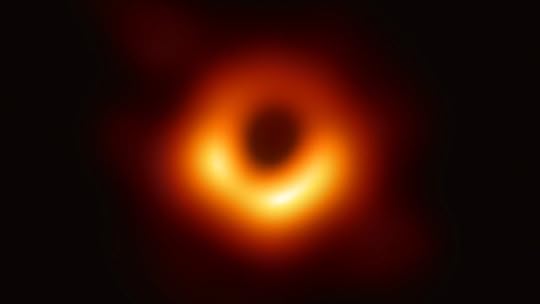
The story of how scientists were able to get the information for the image above is amazing, albeit probably more than a little difficult to tell due to the sheer complexity of the topic. Accordingly, Seth Fletcher has a laudable achievement to his credit with this book. He does a great job of explaining the personal stories, the technology, the challenges, and the existential struggle to keep the endeavor afloat for the many years it took, efforts that pre-date the formation of the EHT itself.
The book also provides a fair amount of insight into how dismally under-resourced we are in the sciences. Talented, dedicated, brilliant and highly trained teams of people, struggling to ascertain very difficult-to-reach sets of knowledge amidst tenuous, zero sum funding regimes and working within facilities themselves that may be shut down immediately once the funding already in-hand runs out. Among the many insights one can learn from Einstein's Shadow, is how these amazing discoveries are not in any way inevitable or even fully expected, but almost arise in defiance of a system that under-values scientific research and that often seems to punish or starve those who would ask sound questions, simply because the questions themselves do not capture the public's limited imagination.
The story of how scientists were able to get the information for the image above is amazing, albeit probably more than a little difficult to tell due to the sheer complexity of the topic. Accordingly, Seth Fletcher has a laudable achievement to his credit with this book. He does a great job of explaining the personal stories, the technology, the challenges, and the existential struggle to keep the endeavor afloat for the many years it took, efforts that pre-date the formation of the EHT itself.
The book also provides a fair amount of insight into how dismally under-resourced we are in the sciences. Talented, dedicated, brilliant and highly trained teams of people, struggling to ascertain very difficult-to-reach sets of knowledge amidst tenuous, zero sum funding regimes and working within facilities themselves that may be shut down immediately once the funding already in-hand runs out. Among the many insights one can learn from Einstein's Shadow, is how these amazing discoveries are not in any way inevitable or even fully expected, but almost arise in defiance of a system that under-values scientific research and that often seems to punish or starve those who would ask sound questions, simply because the questions themselves do not capture the public's limited imagination.

December 2, 2018
I enjoyed Seth Fletcher's book Einstein's Shadow. It is the tale of the building of the Event Horizon Telescope (EHT), a globe-spanning array of telescopes that hope to image the supermassive black hole at the center of the Milky Way Galaxy. Fletcher spent years hanging out with the key members of the collaboration, giving the reader an inside view of the trials and tribulations of the building of this amazing array. My only complaint is that the big result that the EHT is hoping to deliver doesn't yet exist, giving the book a feel that's a bit like a joke without a punchline. We have all the build up, but the final result does not yet exist. That's not really the fault of the author, but it like everyone else, I'm waiting to see what they've found.

April 26, 2021
I wanted to like this, but it just never really grabbed me. The coverage of the physics seems too surface level, the overarching narrative was basically “this guy thought imaging a black hole would be good but it costs money and he thought he was more important than anyone else”, and it really didn’t even explain the questions they thought the images would answer particularly well.
It’s not terrible. Most of the science is accurate enough and it does show some of the technical difficulties of capturing distant space objects. But I can’t recommend it unless you’re really interested in black holes, and if you are I’d look at Hawking’s Black Hole book (which I haven’t read yet) or the Black Hole War by Leonard Susskind (which I have and enjoyed) first.
It’s not terrible. Most of the science is accurate enough and it does show some of the technical difficulties of capturing distant space objects. But I can’t recommend it unless you’re really interested in black holes, and if you are I’d look at Hawking’s Black Hole book (which I haven’t read yet) or the Black Hole War by Leonard Susskind (which I have and enjoyed) first.

February 24, 2019
It started off with purpose. It had a plot, a mystery to be solved, but the author meandered, and got lost because the entire quest was unfinished. This was not the fault of the author, but he made his story about the find and there was no find. He tried to develop the characters, but could never do it. He tried to explain the complexity of big science, but he lost his way. Richard Rhodes did the job in the Making of the Atomic Bomb, but few can do this.
This entire review has been hidden because of spoilers.

June 19, 2019
I would recommend this book for anyone like myself who has more than a passing interest in astrophysics. I did learn quite a bit about the theoretical aspects of black holes that I didn't know before, but on the flip side, I found the technical descriptions of radio telescopes and the like quite uninteresting in comparison. So, overall, if you can get through all the jargon, this actually is a pretty compelling read.

December 5, 2018
I really enjoyed this book but would have love a more concrete ending. It was so unfinished. I would have thought if a book was written about the process there would be more concrete findings at the end. It seems more of a “to be continued” ending. Probably wouldn’t read it again.
This entire review has been hidden because of spoilers.

April 22, 2020
The end was disappointing as it was written before the results of the experiment were known. This book was published in October 2018 and only a few months later on April 10th 2019 they actually managed to take the first picture of a black hole.
March 14, 2021
Good book overall, but it ended up being more a story of the characters than of the science. The author glided over many of the science concepts without sufficient detail. And the book seems premature, since the ending doesn't actually include the results of the project's data analysis.

April 21, 2019
It would have been nice if the publishing of this book could have been held of for one year so that the focus of this book, capturing a picture of a black hole, could have come to actual fruition. It ends before the EHT team could actually take the photo, but you can tell that they have finally gotten their act together and were ready to scan for the first picture of a black hole. The whole concept of taking a "picture" of a black hole is fascinating. It takes much much more than simply flashing the shutter on a nice camera. It requires multiple radio telescopes simultaneously scanning the sky to receive sub-millimeter radio wavelengths. Next, they have to take the data from each involved telescope and parse through the mounds of information. It requires incredible coding to create a program that eliminates the noise, sorts through the false positives, and eventually delivers an actual visible image from all of the invisible wavelengths originally received by the telescope.
It was also interesting to read about all of the bureaucracy involved in creating the EHT team and process. In fact, I would say about half of the book revolved around the applications for grants, requesting time on the telescope, and worry about who would get their name on a supposed Nobel Prize.
It was also interesting to read about all of the bureaucracy involved in creating the EHT team and process. In fact, I would say about half of the book revolved around the applications for grants, requesting time on the telescope, and worry about who would get their name on a supposed Nobel Prize.

June 7, 2019
Effort to photograph a Black Hole shadow, millions of light years away from earth, is like trying to take a "portrait through a pool of water," so said Shep Doeleman, primary leader of the project to do just that. Atmospheric conditions at multiple radio-telescopes must be just right; "perfect" must exist at least three. Fletcher shadowed Doeleman, an intense goal-oriented guy, sometimes a "seething, whirling storm," for six years as he dealt with fundraising, arguments about who will take credit for success of the project if it succeeded and numerous coordination issues. Doeleman, first associated with MIT, later, Harvard, led an on and off staff of more than 200 researchers, grad students and postDocs, who battled weather conditions, often at high altitudes, to properly align the telescopes and their numerous parabolic disks. Though much of the mathematical and technical stuff eluded me (nanoseconds, curved spacetime, ho-hair theorem, holographic principle, quantum entanglement, etc.), nevertheless I found much of interest. OK, so the book comes out (2018) before the "the greatest achievement of astronomy" is accomplished (April 10, 2019). That doesn't detract from the previous drama.
June 18, 2019
A well presented overview over what the black hole photo is all about, a brief view in astrophysics, and the story of Shep Doeleman, the driving force behind the event horizon project. It really translates the amazing challenge (which is only partial a technological one) that has been overcome to come up with an actual image.
Sadly, since the book came out already in 2018, the narrative left the room right before the finale.
On the point the book ends they are still focusing mainly on sagittarius a* and not on the messier 87 center black hole (the one famously known by everyone now). So you have to imagine the ecstasy after the tremendous success following the data analysis of the 2017 observation run.
You don't have to be a full on astrophysics nerd to enjoy this documentary. it's pretty entertaining for everyone with an interest in the matter.
Sadly, since the book came out already in 2018, the narrative left the room right before the finale.
On the point the book ends they are still focusing mainly on sagittarius a* and not on the messier 87 center black hole (the one famously known by everyone now). So you have to imagine the ecstasy after the tremendous success following the data analysis of the 2017 observation run.
You don't have to be a full on astrophysics nerd to enjoy this documentary. it's pretty entertaining for everyone with an interest in the matter.

June 6, 2022
I did not enjoy reading this book. There is very little information about the physics of black holes. The book chronicles the efforts of the team working for the Event Horizon Telescope. It introduces many characters, including the post-docs, but a vast majority of them do not appear again after half page introduction. We do not hear much about the competitors. We also do not hear much about challenges in photographing the black hole. The first 50 pages were OK, but then it was more of a chronicle of the work done by the leader of the Event Horizon Telescope. And in the end, once the picture of the black hole was constructed, the book ended abruptly. While the black hole features on the cover of the book, there was no picture within the text. Overall, I did not learn much from this book. The book did not deliver to me.
September 20, 2020
A great story about black hole astronomy and science, and the efforts of the team that took the first picture of a black hole. An easy and pleasant read, but also full of interesting information about all sorts of things, ranging from the politics and interpersonal conflicts that can merge in science, to the mechanics of radio telescopes, to the history of how we've understood the physics of black holes. Most of the book centers on the steady efforts of Shep Doeleman to create a "telescope" by combining the powers of different observatories across the world, and the surprising amount of drama and suspense involved in the decades-long project. Overall, a great read about both physics, as well as the gritty day-to-day work of scientific research.

May 3, 2019
The Book I though was well written. It’s a quasi-first person account from behind the scenes. The way Fletcher was able to make you feel like you were there as a fly on the wall, to me, was a nice touch. Most of the time these books, even by journalists, tend to lean toward the academic in feel. But this was a light read and a good page turner.
The way you saw how people emotions ran and how the team, especially Shep, on his struggle to get the pearl of the telescopes, ALMA, to join, was fascinating. That part alone showed the cutthroat nature of academia.
I would recommend this, to me its brief and concise.
The way you saw how people emotions ran and how the team, especially Shep, on his struggle to get the pearl of the telescopes, ALMA, to join, was fascinating. That part alone showed the cutthroat nature of academia.
I would recommend this, to me its brief and concise.

July 18, 2020
This was a pretty good adventure story even though it was about a bunch of astronomers and engineers pursuing something no one had never done before. There was action, intrigue, politics and plenty of mystery. The science as presented was easy to understand, even though deep in my heart I know it isn’t easy at all. Like the Manhattan project, success was as much because of planning, coordinating and persuading as it was the result of science. The book ended kind of abruptly. Seems like more bragging was due.

March 27, 2022
This was an eye-opening read, not so much in regards to black holes/astronomy but in regards to astronomers (and it sounds like their lives f***ing suck). Large portions of the book dedicated to all the details of bureaucracy brought the rating down for me. And more importantly—the absolute foolishness of the decision to complete this book before all the data was processed and that image released to the public. WHY? We could have had a whole juicy section detailing the ramifications, conclusions, next research steps, etc. Now this book is outdated before it was even published.

November 12, 2024
3.5. Being married to an astronomer, a lot of the frustrations they encounter on a ginormous scale are ones he's encountered in smaller scale. This made it extremely easy for me to visual the frustrations with weather, hardware, and software, despite the scale difference. Add on top funding issues and grant deadlines and you have a sometimes dry, sometimes humorous adventure of trying to use current technology to further scientific understanding.
March 19, 2025
A nice example of pop science journalism. I would have liked a little less time on Shep Doeleman's biography and more on the details of the EHT. The information already within the book was so clear and helpful that I was a bit disappointed when some technical procedures didn't get much more attention than "they did this, and it worked." Seeing the interpersonal messiness involved in a project of this size was unambiguously interesting, though.

March 28, 2025
For a failed physics major who likes sci-fi, this book DELIVERED. It's everything you want from science journalism: well-researched, not repetitive, narrative style, bringing awe to an obscure topic. I am so pleasantly surprised.
My only complaint is that the successful capturing of an image of a black hole shadow occurred years after Fletcher stopped reporting on it. This is a "journey not destination" read. 4.5 stars if I'm being completely honest.
My only complaint is that the successful capturing of an image of a black hole shadow occurred years after Fletcher stopped reporting on it. This is a "journey not destination" read. 4.5 stars if I'm being completely honest.

February 17, 2019
3.75-4, easy and enjoyable read. A neat inside look into how science gets done. If you believe probing some of the most fundamental questions about the nature of reality is both important and achievable with science, you will appreciate this story. The ending feels a bit abrupt and unsatisfying, but only because the project is not yet complete and you want to know more!

February 19, 2019
An interesting story of how experimental physicists work. Developing, funding, and working on a project to image our galaxy central black hole. The author's long NY Times article might be enough for most people, but I especially enjoyed hearing the details of how radio astronomers set up their instruments and get data. The physics is explained clearly, too.
Displaying 1 - 30 of 56 reviews