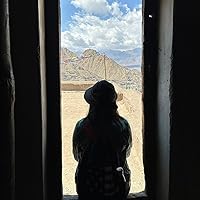
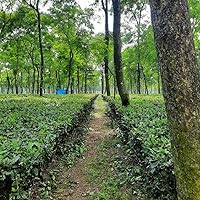
Will We Make It? That s the question Kavitha and her cousin, Pallu, ask themselves as they trek through Himalayan pine forests and unforgiving mountains in Nepal and Tibet. Their to reach Mount Kailash and Lake Manasarovar. The two women walk to ancient monasteries, meditate on freezing slopes, dance on the foothills of Kailash, and confront death in the thin mountain air. In Kailash and Manasarovar, the holiest of Hindu and Buddhist sites, they struggle to reconcile their rationalist views with faith and the beloved myths of their upbringing. Remarkably, it is this journey that helps them discover the meaning of friendship. Walking in Clouds is a beautifully crafted memoir of a journey to faraway places and to the places within. It mixes lyrical, descriptive storytelling with stunning photographs to bring to life a unique travelogue.
Kavitha Yaga Buggana lives in Hyderabad, India with her husband. They have two children and a very excitable golden retriever.
Her essays and short fiction have been published in The Hindu, River Teeth Journal, Tehelka, Out of Print Magazine, JaggeryLit, and Muse India Magazine. Her travel memoir, Walking in Clouds was released in December 2018 by HarperCollins, India.
In previous avatars, she was a software engineer in Chicago and a developmental economist doing field work in Angallu village, South India.
There are a two major reasons I read a travelogue: quality writing and interesting stories that teach you something. This book has both: beautiful turns of phrase that keep you reading line to line, and fascinating stories that keep you turning the page. It's a really lovely piece of travel writing: observations from author's travels spark anecdotes--about family lore, or tales of gods and heroes--all of them with a touch of magic.
The author's written the story of a trek to Mt. Kailash and Lake Manasarovar, and weaves through the account a deep knowledge of mythology, why we believe the things we do, and a number of other beautiful observations. The narrator is clearly someone who's thought about the religious and cultural traditions of the subcontinent, questioned, and sought to understand them, and come back with a distilled essence of why we believe what we believe. As a person of Indian origin in the states who often struggles to understand certain traditions, I really appreciated the modern perspective on ancient traditions and values: the narrator provides really helpful cultural context. Although the author is open about her religious leanings, she always treats her subject matter with respect, empathy, and wonder--all in all a great sherpa in this story of dreams and friendship, adventures and cultures.
'Travelogues' has become my recent favourite. I love them for its vividness and the feeling of true experience in the story. The details to everything authors see and write makes me feel it like I have felt everything by myself. In this book, Kavitha with her cousin made a trip to Mount Kailash and Lake Manasarovar which felt less like a pilgrimage and more of a modern perspectives on things which are considered as religious traditions. I am sure this book will inspire anyone to visit there irrespective of their religion because the author has made it simple with spirituality and understanding of the tradition rather than going deep into it. It really inspired me.
I loved how Kavitha has made the story as real as much as possible by even showing her vulnerability during the journey and not hiding them with fake enthusiasm and positivity. Of course everyone will have their doubts and drawbacks during a journey like this and I am glad that she is honest about it to us. That gives me a perspective that not every journey will be easy, there will be ups and downs, highs and lows but what we see as achievement and what we learnt from it makes everything worthy in the end.
I really enjoyed reading this book with Kavitha's writing and her vivid description of things. And I would highly recommend it.
A beautifully written account of travels to Mount Kailash and Lake Manasarovar. A must read for anyone with aspirations to travel to the region, and others who previously weren’t intending to travel, will have aspirations to do so. I have added this trip to my bucket list!
The first time I have read a travelogue that is a page turner. The author uses a light tone to describe an arduous and dangerous journey. The tone in no way undermines or understates the dangers involved on the trek. The honesty of the author’s account of her lack of preparedness for the trip is endearing and real.
The author strings words together beautifully , evoking images in the readers minds, and transports the reader into her world. You become part of the group undertaking the journey, feeling their tiredness, hope and elation at reaching milestones.
The author balances the physical aspects of the journey with the spiritual effortlessly. Rather than ignore the region’s sensitive history, the author cleverly weaves historical and political nuances of the region into personal and anecdotal descriptions, giving a complete and unbiased perspective of the region’s strife.
An extremely nice, simple and down-to-earth book written from the heart. I truly enjoyed the travels and the pains of the author. She did not shy away from writing about her vulnerabilities, making it so very easy to relate to. This is one the books where I might go back to re-read certain parts, especially the chapter about the 'stolen day' around the the moon-lake. An absolutely superb book that will lift your soul ! Thanks to the author for sharing her travel stories thru this book !
One begins this book, hoping and expecting beauty of Himaalayan ranges coming alive in descriptions, and is dismayed instead to find an account more personal, telling how it felt to trek through hard core region with little if any pampering.
Then, suddenly, there are photographs. One is delighted, but then, they too are more personal than bringing alive the grandeur one is thirsting for.
Until suddenly, amongst various photographs with Kailas in backdrop, one realises there is one of a lamaserie- and the latter looks tiny! Suddenly the majesty of Kailas is brought alive.
One wishes, dares not hope, seeing it.
Author talks about Ying, a fellow trekker, who is settled in U.S. and a citizen thereof, but born and brought up in China across border from Tibet. She acknowledges wrongs done by China in Tibet and to Tibetans, but says those wrongs were done to Chinese as well by the communist regime, and besides China had no option since West would have taken over Tibet.
It seems like an attempt by the authir to show "both dides", since she talks about Chinese aggression, I'll treatment of Tibetans, and more.
But then she has Ying talking of Chinese soldiers at border as lonely boys ftom her home who are happy to see her, bring there not their fault.
However true that is, one cannot help thinking that the Tibet cause is true, and rest is just muddling it, just as holocaust was a fact, and individual Germans claiming innocence or blaming Jews is all white noise to drown out the truth.
The Lake and the Mountain
"THERE ARE A LAKE and a mountain at the roof of the world where the air is thin and the clouds linger on cliffsides. ... "
" ... And the greatest of all adventures was a journey to that lake and the mountain that were so far away – so beautiful that they seemed to belong more to the sky than to the earth."
Travellers, Waiting
" ... Simikot is the starting point of the trek through Humla in northwest Nepal. The Humla trek forms the first leg of our journey to Mount Kailash and Lake Manasarovar in Tibet."
"After noon, when the winds in Simikot have turned heavy, Chhiring tells us it is unsafe to fly today. We head back to the hotel where Pallu, Prarthana, and I sink into our air-conditioned rooms. ... "
"In the evening, we gather at the hotel’s restaurant. The rectangular structure with over-lit interiors is, I learn, an Indian restaurant. I don’t know why I am surprised since the Indian border is only a few minutes’ drive away, but my heart sinks. Most small Indian restaurants serve over-spiced, oil-drenched, clichéd imitations of the real thing. I say nothing, as the foreigners seem excited. I don’t tell them that there is no such thing as ‘Indian food’. There is no such thing as ‘Telugu food’, even, or ‘Tamil food’. Each district has its microcosm of culinary traditions that use local ingredients for preparations, and they depend on the seasons, temperatures, and principles of Ayurveda. Therefore, even narrow geographic areas encompass a dizzying diversity of cuisine. My mother’s village, for example, is famed for its tangy, spicy tamarind curries eaten with rice, while in my father’s village they make steaming hot balls of ragi millets. In my husband’s village, a meal without pappu (zesty vegetable dals) and soft jonna rotis is not a meal at all. And these villages are all within a few hours’ drive of each other. In this over-bright restaurant in Nepalgunj, I run a sceptical eye over the ersatz ‘Indian food’ on the menu."
"After the plates have been cleared, Sperello opens his laptop and shows us pictures of his biking trip along the Silk Route. The journey from Italy to China looks spectacular. Temple grottos nestle in Chinese mountains, and Central Asian steppes of endless beige end in lakes of endless blue. Each carefully composed shot is accompanied by a small story."
Amid Giants
" ... While commercial airlines cruise at around 38,000 feet, we are at around 13,000 feet – the lowest altitude at which I have ever flown. As far as I can see, mountains and more mountains rise like giant frozen waves of earth. We glide over a green slope; I see small houses in clusters of twos and threes, and lonely single structures scattered here and there. The houses lie on acres of ledges cordoned into rectangular fields, and on terraced fields carved into slopes. Aside from these clusters, there is nothing – not a single house nor a single soul."
" ... Below, the mountains are spaced further apart.
"The wind is gentler. The plane curves gently around a slope. The valleys are narrow and shadowed, and rivers and streams etch their paths through the rocks. The clouds – some of them wispy tails, some, white cotton – touch the rocks and waterfalls and trees on mountain slopes. These places seem unreal, almost magical. ... "
Reality Hits
" ... I spent hours selecting the perfect, most expensive equipment, so I would have no proble"ms in my trek. Now, it turns out the biggest problem is my body."
" ... With only the moon and the stars to light our way through the muddy path and rain, I am intensely aware of the darkness all around, the precipitous slopes, and the roar of the river raging through the mountains."
Other Journeys
"THIS IS OUR THIRD attempt at making this journey. The first failed when everyone in our group dropped out before we even left Hyderabad. The second was aborted due to a combination of politics, history and unfortunate timing. We made it as far as Kathmandu, where our guide, a friendly, diminutive man called Sonam, introduced us to our fellow travellers: two courteous Austrian men, a pretty Swedish woman, and a serious, stocky Indian doctor from the Fiji Islands who had been planning the trip for years. One evening, over hot tea, Sonam broke the news that the Chinese authorities had cancelled all permits to Tibet.
"That year marked the 60th anniversary of the signing of the Seventeen Point Agreement for the Peaceful Liberation of Tibet. The signing had taken place in 1951, a year after Chinese troops had invaded Tibet. For the Chinese, this was a liberation, but for the Tibetans, it was an occupation. The signatories included Tibetan delegates and the central government of the People’s Republic of China. But the Tibetans disputed the legality of the agreement, claiming it had been signed under duress by unauthorised delegates. As the agreement was an important means to justify China’s authority over Tibet, it was a highly charged issue. Political tensions were running high, and the 60th anniversary coincided with the festival of Saga Dawa.
"We were to spend Saga Dawa in Darpoche, a sacred place at the foothills of Mount Kailash. Celebrated on the full moon day of the fourth Tibetan lunar month, Saga Dawa commemorates the birth, enlightenment and death of the Buddha Shakyamuni, and is one of the holiest days in Tibetan Buddhism. Saga Dawa celebrations in Darpoche in Kailash are famous. There are festivities, chanting, lines of praying monks and bustling crowds from all over Tibet – crowds too large to control and monitor. In this uncertain situation, the Chinese authorities would not let in any foreign visitors. I knew there were likely scores of people like us waiting in Kathmandu.
"When we heard the news, everyone was in shock. Sonam told us we had several options: we could cancel our trip, choose a different destination in Nepal, or we could go to Kailash via another route. But going to Kailash meant the tour company would keep our passports in Kathmandu to reapply for new permits with the amended dates. There was no guarantee that these permits would be granted, and for those few weeks we would be travelling through Nepal without passports.
"We discussed other options. There was the kingdom of Mustang and the beautiful Annapurana circuit. But the doctor from the Fiji Islands finally spoke up. He had come to see the lake and the mountain and he was not ready to give up. The others felt the same way. But Pallu and I were unwilling to risk travelling without passports or permits. It was decided that the others would take their chances, and my cousin and I would head home. ... "
First Camp
"THE DHARAPORI CAMPSITE IS nestled in a valley at the banks of the river Karnali. ... "
One More Day
" ... Karnali is the longest river in Nepal and starts in the Lake Manasarovar area and eventually merges with the River Ganga in India. Sometimes emerald, sometimes turquoise, it sparkles like a diamond. ... "
"We cross a narrow steel bridge over the Karnali to ascend the slopes on the other side. We walk past swaths of mountainside covered with green grass and rows of pine trees. I splash my face with the chilled water from the steep waterfalls that cascade like veils.
"Our path becomes a narrow tunnel carved into the edge of a cliff, one side opening up to a dizzying drop. ... "
" ... altitude makes all the difference and that no amount of training could prepare us for that. ... "
Readers
"THE MOUNTAINS APPEAR TO have been painted with an artist’s wild abandon. Along the slopes are terraced fields of red barley and yellow mustard, outlined with dark green hedges. The fields are like overlapping half-ringed designs on an embroidered skirt. ... "
" ... ‘Dante Alighieri is your ancestor?’
"‘Yes.’
"‘Wow!’
"I wonder if Sperello knows that the original manuscript of the Divine Comedy is in the Asiatic Society in Mumbai. The manuscript had been gifted to the society by Mountstuart Elphinstone, the British Governor of Bombay, in the early nineteenth century. In Mumbai I often passed the Asiatic Society and thought of Dante and the old manuscript that had travelled across the world from Italy to India. I smile at Sperello. Everyone in the world is connected in unexpected ways."
Along the Karnali
"A tribal woman, a member of our crew, pulls her horse behind her. As Pallu and I navigate the slippery path, the woman grows impatient. She says something, nods, and offers us her hands. Pallu and I each hold one of her hands. She begins to walk briskly, taking us with her, her grip reassuring and firm. Before we know it, we have descended a distance that would have surely taken us three times longer. Perhaps the key to the easy descent lay in the woman’s hands. They gave us confidence and set us free from having to wonder where to place our next steps. When we reach the banks of the river, it is still daylight."
"In the early evening sun, the water of the river is dappled with the light and shadow of leaves. ... "
"Pallu and I could have opted for an easier way. We could have been driven in Land Cruisers like many Indian pilgrims. None of the Indian travellers we know have taken the Humla route; they have all gone through Nyalam. But what is the point of being driven in boxy vehicles through busy Nyalam, with its built-up roads and small lodges, when we can walk through the pristine, breathtaking Humla with other trekkers from all over the world?"
"In these heights, the heavens seem to have drifted down, almost touching the earth. The air is cold. The river hums, invisible over rocks. This is the most brilliant sky I have ever seen in my life. As I gaze at the heavens, I feel I am falling and flying, and I become intensely aware of these wondrous stars illuminating a great infinity."
As Long As It Takes
"Through a line of spindly pine trees, sunlight sparkles off the waters of Karnali, which flows along the edge of the campsite. The forest is a perfect green. This green of pine forests is not the dense, flamboyant green of tropical jungles; it is softer and has space for air and patches of sky.
"Walking up, we leave the Karnali behind us. The forest gives way to subdued palettes of grey and various shades of brown. The sun is warm and the air is cool, an intoxicating combination. ... "
Deities
"THE SLOPES HAVE GROWN steeper and the green has given way to brown dust and grey stone. In the midst of these subdued and monotone shades stands the gateway to the Yalbang monastery. The gateway’s psychedelic red, yellow, and blue paintings, and gold carvings seem to explode against the starkness of the rocky surroundings.
"The two main paths in the Buddhist world are the Theravada path and the Mahayana path. The Theravada path is practised in Sri Lanka, Burma, and other southern Asian countries. Based on the Pali canon of Buddha’s teachings, Theravada is the stricter of the two and emphasises the goal of enlightenment and liberation from samsara or the material world. The Mahayana path is practiced in China, Japan, and other northern Asian countries. Based on the Pali cannon, it also draws from other Buddhist texts which are composed mainly in Sanskrit. Mahayana emphasises the attainment of the Bodhisattva state. Bodhisattvas are highly compassionate and spiritually evolved beings who delay their own enlightenment so they can help others. The Vajrayana path, a form of Mahayana that emphasises tantric practices, is prevalent in Tibet and the Himalayan region. The Yalbang monastery belongs to the Nyingma sect, which is the oldest sect of Vajrayana Buddhism."
" ... Lama Pema Riksal is the leader and spiritual head of Chhiring’s community, a sub-sect within the Nyingma sect. The founder of the Nyingma school is Guru Rinpoche, who is also known as Padmasambhava. Padmasambhava means ‘lotus born’, as he was found as a young child floating in a lake (in what could now be modern-day Afghanistan). An 8th-century Buddhist master, he was trained in India, where his magical powers became legendary. He came to Tibet along with the first wave of Buddhist teachers, who included Santarakshita, the Abbot of the famed Nalanda University in present-day Bihar. Padmasambhava was summoned by King Trisong Duetsen to conquer the demons that were plaguing the people of Tibet. Until his death, Padmasambhava roamed the length of Tibet, teaching Buddhism."
Crossing a Line
"‘Landslides are more common. This area, lots of mining. The soil is getting loose.’ ‘What do they mine for?’
"‘Gold,’ he says. ‘People say there is gold here, in these mountains.’
"‘Is it true?’ I ask.
"‘I don’t know. But there is too much mining. It is bad for the mountains.’"
Soldiers
"The group assembles and poses for photos. The assistant guide, along with three crew members, is to leave us. On the other side of the border we will have other assistants. The mules will be replaced by yaks. Chhiring warns us that we must not take photographs near the outpost. We must not carry any pictures of the Dalai Lama, nor any of his writings, and we must not speak his name."
"At the outpost, young Chinese soldiers with severe haircuts and stony faces search our luggage. They open every bag, riffle through every book, open every stick of lip balm, shake out every bra and pair of underpants and sanitary product. Pallu and I exchange looks, shaking our heads. Airport security checks seem benign compared to this pointed probing that feels less like a search and more like a violation. ... "
" ... We adjust our clocks; China is two hours and fifteen minutes ahead of Nepal."
"Our hotel is yet another indistinguishable Purang cement box. The interior looks basic but clean. One wall in the lobby corridor is lined with framed pictures of Mount Kailash, taken from various angles in different seasons. It reminds me that our destination is no longer remote – Kailash is only hours away. ... "
First Sight
"UNTIL WE REACH KAILASH we must not walk around unaccompanied within the restricted area of Tibet. We must be driven everywhere under the continuous supervision of our assigned guide, the unflappable Nyima. Any deviation from our plan must first be approved by the Chinese authorities. With these severe injunctions in mind, we set out for the day."
" ... In the distance, near the horizon, Mount Kailash stands outlined against a bright blue sky."
"The Tibetans call Kailash Gang Rinpoche (Precious Snow Mountain). Even from this distance, Kailash stands out. It is both physically removed from the other mountains and structurally unique, with its wide-based triangular shape. The colours, too, are different, as the snow shines brighter against the darkness of the stone. Formed from metamorphic rocks of the tertiary geological era, Kailash is made of stone that is darker, denser, and older than the stone of the surrounding mountains. Kailash, which existed even at the time of the Tethys Sea, is the tallest geological deposit of its kind in the world."
"At Rakshas Tal I expect to find gloom and grey waters, but I am wrong. The lake is breathtaking. Its salt water is so blue it seems almost unnatural. To our right is the south face of Mount Kailash, a dark monolith with a groove cut down the middle. The groove looks like an enormous ladder. ... "
Why We Worship the Gods We Worship
This chapter is written basically for a non-Hindu, non-Indian readership, and ought to have been left out.
Dipping, Cleansing
"ACCORDING TO HINDU MYTHOLOGY, divine beings had once appealed to Brahma, the Lord of Creation, for a place to ritually cleanse themselves before praying to Shiva, in nearby Kailash. Brahma then used the force of his Manas (consciousness) and willed the Sarovar (lake) into reality. The lake is believed to be of such purity that anyone who takes a dip in it will wash away a lifetime of sins. Heavenly beings, it is said, have been descending into the lake at night as lights gliding down from the sky. Every year there are reported sightings of strange lights hovering over Lake Manasarovar in the hours before dawn. People believe these lights to be divine beings."
" ... The two lakes are connected by the Ganga Chu channel and the same water fills them both. When the channel is full, it means things are good for Tibet.
"‘These days, Ganga Chu not as full before,’ Chhiring says.
"The Chinese are mining the mountains in Tibet for gold, minerals, and oil, he tells us. The rivers are being dammed, and the water is being diverted to China. There are rumours that the waters of Lake Manasarovar are also being suctioned off (though I cannot see any evidence of this). There is development, but it does not reach everywhere, and the environmental damage is extensive.
"‘And the Tibetans? What do they say?’ I ask him.
"‘What can they say?’ Chhiring shakes his head. The Tibetans are voiceless."
Lights on the Lake
"At around three in the morning, ... "
" ... I see a light hovering on the other side. It is big and round and it vibrates.
"‘Maybe someone camping on the other shore?’ I say as the light dims and glows bright. What else could it be?
Rest of the review is below, since the site won't allow it in this space. .
Such a wonderful and inspiring read. What's most inspiring about it I can't share, because it would spoil the ending for others. But what is really lovely about this memoir is the way that Kavitha weaves snapshots of her life into the journey she took with her cousin. She also deftly weaves in the contexts and mythological stories that illuminate the trek to Mount Kailash.
A journey to Mount Kailash and Mansarovar Lake evokes multiple emotions- right from its spiritual significance, the arduous conditions, the political implications between China and Tibet. All these are magnificently covered in this sort of initially unplanned travelogue from the eventual writeup by the author- Kavita Yaga Buggana.
The story is beautifully told from the time the author and her colleagues make the journey from Nepalgunj Airport to the return. The author pieces together the background of why the author and her cousin Pallu bit-by-bit and slowly you get the more complete picture which is great to know.
The narrative is quite smooth and she strikes a right balance between the descriptive nature of the journey and her thoughts evoking the different elements of the journey. She also captures the emotions and the stories of her fellow travellers briefly and succinctly. Additionally, the thought process of the local populace and the impact of development vs environment is also well-articulated.
The book is supplemented by excellent photographs (captured by her fellow travellers) which allow the readers to envisage the prose to the visual elements. This the visual symphony depicts not only the beautiful natural elements but the local arena as well.
A definite must read, this illustrative travelogue is fully worth your time, do go for it!
I love reading travelogues as they almost transport me to places that I've not visited in person. When I picked up the book didn't expect much but was pleasantly surprised. The details about the journey and the places are a bit lacking and the book feels like a sweet reminiscence of the author. The narrative is really good and almost felt like a novel. the lack of details cost it a star from me but overall a recommendable book.
Mount Kailash has always fascinated me. Lake Manasarovar has always fascinated me. Trekking has always fascinated me. Wandering around remote and tough places has always fascinated me. Achieving something, almost out of my capacity or capability, has always fascinated me. Am I a trekker? Or a mountaineer? Or an adventurous wanderer? No, I am not. I am, actually, the opposite of all that. The only reality in the above lines is the word 'fascination'. I am always fascinated by these places but I don't have the required stamina and strength to bear with the hardships these places and these wanderings require. That's the reason I pick every single book, I came across, that covers the journey to Kailash Manasarovar. I am fortunate that all of those books took me one step closer to my longing. This book is one of the finest travelogues I have ever read. This journey to the pillar of the world, to the abode of Shiva and Parvati, has been chronicled in such a convincing way that it makes you think about coming out of the shell of comforts of a cozy home and crossing the mental boundaries to take a step towards the land of your dreams. The book transported me to the beautiful land of Tibet via more beautiful landscapes of Nepal. After reading the masterpiece in the field of pilgrimage to Kailash Manasarovar, Bimal De's 'Mahatirth Ke Antim Yatri', I didn't expect much from this book. But after reading a few pages I was pleasantly surprised. The book is not only a sweet and memorable reminiscence of the writer, Kavitha, but it also chronicles the pain the native Tibetans are feeling because of the Chinese invasion and the loss of freedom to practice their religion and culture in the way they want to desperately. The mention of some native people asking whisperingly for any fragment of their beloved leader Dalai Lama: his words, an image, or even a scrap of news, shows the pain clearly. The mention of the name of Dalai Lama is prohibited in Tibet. The Chinese government has destroyed thousands of monasteries. 'Before the Chinese invasion there were more than 6000 monasteries in Tibet; by 1976, only thirteen remained'. Kavitha has described the effects in a heart-touching way: "The monastery was not only a place of worship but also a center for Tibetan cultural life; for its dance, music, and art; for its community events and its literature. With the destruction of the monasteries, an entire way of life had been wiped out. After the cultural revolution, a generation of Tibetans grew up without learning their own language in school, or their own history. This was not merely physical destruction of a place, but the erasure of a mental landscape." Besides these political implications between Tibet and China, the book evokes spiritual emotions. The author has very beautifully balanced her thought processes with the descriptive surroundings throughout the journey. This book is definitely a page-turner, but at the same time, it makes you go back to already-read pages. It is an honest narrative spiced up beautifully with a bit of spirituality and history. You'll definitely feel like a part of the group traveling to Mount Kailash, Highly recommended if you are interested in Kailash Manasarovar. If you are not one to consider this journey ever in your lifetime, the book is still recommended for its brave and beautiful description of a journey through arduous and unknown terrains.
Walking in Clouds – Journey to Mount Kailash and Lake Mansarovar by Kavita Buganna . Mount Kailash, located in Western Tibet, is 22,078 feet high and one of the most rugged parts of the Himalayas. Its peak is the highest among the surrounding Himalayan ranges giving it a shape of a lotus and sources for 4 rivers and 2 beautiful lakes are located at the base of the mountain. Lake Mansarovar and Rakshash Tal. Home of Lord Shiva and Parvati, Mount Kailash is also known to be the pillar of the world. Not just in this century, but back 1800 years ago people considered this place the holiest pilgrimage and would trek for months to reach Mount Kailash. The road is not an easy one and over the centuries, many died on the way due to acute climate conditions, scarcity of food, and altitude sickness.You might be surprised no one has ever reached the top of Mount Kailash. It has been said many have died trying to climb the peak of Mount Kailash. . Written in reader-friendly English, it is about the author and her cousin Pallu’s trek to the Kailash and Mansarovar at the age of 40. Being in school, both the girls dreamt of this journey , but life getting entangled with responsibility – education, carrier, marriage children, etc, their dream got lost somewhere. Though they planned for the trip many a time, it got cancelled somehow, but don’t we say, to undertake a holy journey one needs to be called by God. With growing age, and not having experience in trekking especially in such rough terrain both the women set with to a remarkable and memorable journey of a lifetime. With loads of information about the trekking routes, mythological stories, Tibetian religious practices, it was delightful to read. . A book that will make you determined, to go beyond the stuck-up mental boundary and explore dreams without fearing failure. A book that will force you to believe in childhood mythological stories and lastly in divine power, whether you are from this part (India) or Tibet.
I have always been captivated by the mysteries of Mount Kailash, and in the quest to know more about it, I’ve read countless articles, watched every documentary I could find, and that’s how I stumbled upon this book. For me, this book is not just a travelogue, it’s a special literary journey to one of my dream destinations. It was exactly what I didn’t know I was looking for.
Reading this book was such a beautiful and moving experience, one that words can barely capture. It came to me at the perfect time, right after I had fulfilled one of my most deeply held manifestations by finally visiting a place I had yearned for. The timing made it feel surreal!
Being from a hill town, nature has always been my companion. I’ve always preferred remote, faraway places to the chaos of urban areas, so reading this book felt more than just reading. It was an introspection, and in many ways, a fast forward through the journeys I’ve taken with the addition of deeper clarity and insight.
I loved how the author has seamlessly woven this beautiful narrative covering social, economic, political, geographical and cultural angles. The writing is lucid and raw, and that’s what makes it stand out, it just is. The book reminded me that a real journey is not just about crossing physical landscapes and reaching your destination, but also the inner ones ~ of self discovery.
P.S. That’s the thing about books, they let you travel without moving your feet.
I love the book, I love how she exposed us to कैलाश, and the journey was itself very beautiful and my most fav chapter is blue lights. Whenever I will think of Kailash this book will always come to mind.
It’s a good book but not exactly a travel story. Too much of emotional grind and lack to elements to explain the nature around. After reading authors like levison woods it’s little hard to digest.
But I enjoyed it, I will encourage folks to read with open mind.
Enjoyed it. Interesting insights about Tibet and Nepal. Breezy read with a blend of lighthearted humour and serious contemplation about our roots and culture.
Truly touches your soul and ignites a sense of compassion toward the wonders of the nature around us. Amazing descriptions, and details about the culture, religion, history and people of the regions described in the book.