Jump to ratings and reviews
Rate this book

One Minute Manager

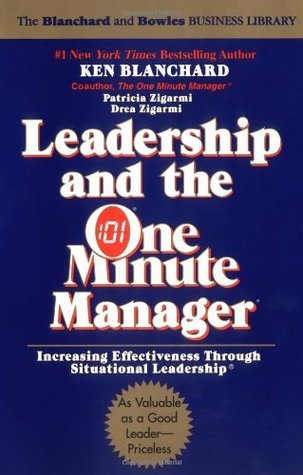
Leadership and the One Minute Manager: Increasing Effectiveness Through Situational Leadership

Rate this book
In clear, simple terms Leadership and the One Minute Manager® teaches managers the art of Situational Leadership®--a simple system that refutes the conventional management mandate of treating all employees equally. Here, you'll learn why tailoring management styles to individual employees is so important; why knowing when to delegate, support, or direct is critical; how to identify the leadership style suited to a particular person; and how consistent use of the One Minute techniques will produce better management and enhanced motivation on all levels. This remarkable, easy-to-follow book is a priceless guide to creative, personalized leadership that elicits the best performance from your staff--and the best bottom line for any business. If your management motto is "everyone should be treated equally," Leadership and the One Minute Manager. will show you why this style not only hinders workplace efficiency, but also frustrates your staff. In clear, simple terms, Ken Blanchard, co-author of the enormously popular The One Minute Manager., coupled with business gurus Patricia and Drea Zigarmi, teach managers the art of Situational Leadership.. You'll learn why tailoring management styles to individual employees is so important; when to delegate, support, or direct; how to identify the leadership style suited to a particular person; and how consistent use of the One Minute techniques will produce better management and enhanced motivation on all levels. This remarkable, easy-to-follow book is a priceless guide to creative, personalized leadership that elicits the best performance from your staff and the best bottom line for any business.

112 pages, Hardcover

First published October 6, 1985

597 people are currently reading
3677 people want to read

About the author

Kenneth H. Blanchard

314 books1,843 followers
Ken Blanchard, one of the most influential leadership experts in the world, is the coauthor of the iconic bestseller, The One Minute Manager, and 60 other books whose combined sales total more than 21 million copies. His groundbreaking works have been translated into more than 27 languages and in 2005 he was inducted into Amazon’s Hall of Fame as one of the top 25 bestselling authors of all time.

Ken is also the cofounder and chief spiritual officer of The Ken Blanchard Companies®, an international management training and consulting firm that he and his wife, Margie Blanchard, began in 1979 in San Diego, California.

When he’s not writing or speaking, Ken also spends time teaching students in the Master of Science in Executive Leadership Program at the University of San Diego. Ken can be found at www.kenblanchard.com.

Ratings & Reviews

What do you think?
Rate this book

Friends & Following

Create a free account to discover what your friends think of this book!

Community Reviews

5 stars
1,669 (35%)
4 stars
1,673 (35%)
3 stars
1,055 (22%)
2 stars
265 (5%)
1 star
93 (1%)
Displaying 1 - 30 of 286 reviews
Profile Image for Nicholas Karpuk.
Author 4 books76 followers
August 3, 2011
The only thing worse than being wrong is being useless, and this book is rather useless.

Much like "FISH!" this book is a fictional scenario meant to illustrate how their techniques can help you become a successful manager. The story centers around "the Entrepreneur" and "the One Minute Manager." Yes, that's the only way they're referred to in this volume, reminding me of the "Who Moved My Cheese" structure. Might I suggest that writing intended for grown men and women who are supposed to manage other grown men and women maybe shouldn't have the structure and writing style of "Go, Dog, Go!" or "Green Eggs and Ham"? It just reeks of condescension.

Beyond the spoonful of sugar reasoning for the fictional structure, a part of me has much more cynical theories about why it's not just a work of nonfiction. Allow me to number them corporate style.

1. Inflated Length - The actual guidance information could be condensed into a pamphlet. I bookmarked every page with concrete information, and I think I dog-eared maybe 10 pages out of 110. Fiction, especially with wide margins, diagrams, and many pages not completely filled for stylistic reasons, gives you something thick enough to slap an ISBN number on.

2. Avoiding Research - In nonfiction, especially responsible nonfiction, you'd have to bring evidence to back up your claims that this approach is practical and works. Studies and pier-reviewed articles would need to be cited, journals and news articles read, the whole thing might actually need a bibliography for god sakes! Why do all that when you can structure it like it's an Aesop's Fable for the corporate set?

3. Easy Examples - This somewhat ties into research, but the benefit of fiction, as I mentioned with works like Ayn Rand's and "FISH!" is that you can generate a picture-perfect scenario that fits all your theories. Blanchard doesn't give us real cases where his quadrant of methods worked, he gives us the almost hyperbolically successful, nameless Entrepreneur, who by the end of the book is a CEO overseeing multiple companies. The damning problem with this is the fictional scenario doesn't get specific enough to make the advice practical.

And that's the part that ultimately breaks Leadership and the One Minute Manager, the advice just isn't that useful. It's theoretical high-level wishful thinking. It doesn't help you when things go wrong, because like a lot of these books, it refuses to acknowledge bad employees, defiant employees, or even thoughtful dissent. You're either working with the program or you don't exist. Real-world success stories with interviews and working how-to data would have gone great lengths to help here.

I watched two different TED Talks, one by a former Brigadeer General, and another by a chinese scientist, and in different words they basically said the same thing. The military man outlined that leadership was about feeling for a person, understanding a person, and helping a person. The Chinese scientist was more concerned with it on a level of compassion, but stated the three basic areas:

Thinking, Feeling, Doing. The Brigadeer General spent his career learning this, the scientist researched this. They have working data to support their conclusions and cited it even in their brief talks.

All these books seem like a lame substitute for being a compassionate, thoughtful human being.
Profile Image for Chris.
873 reviews182 followers
Read
January 24, 2022
I am trying to cull my large leadership and management library I collected over the years. I left the stars blank because at this point in my life, I would say this short primer on situational leadership was OK, 2.5 stars. If I was a newbie getting into this topic for the first time, I would give it 4 stars as it is clear & to the point in its descriptions of this leadership theory. The story presentation is its real drawback for me. It reminded me of the awful training videos that accompanied many of the leadership and management programs that were required from time to time as I moved through the ranks of the organization.
629 reviews11 followers
September 22, 2011
Cheesy, but makes sense. I still haven't read the book this series is based on (The One Minute Manager). I think I really like reading this group of books backward to forward: first the outrageous gripes of another set of authors in The 59-Second Employee : How to Stay One Second Ahead of Your One Minute Manager (whose attitude I didn't agree with), followed by this book to explain how to go way beyond the cliches that 'goals, praising, and reprimands' are implied to have become.

I liked a lot of the more subtle points of this book, such as reprimands being for employees who are in a very specific situation, not ones who are learning or ones for whom there are extenuating circumstances explaining their poor performance. I'm really curious to see whether those points were made in the original book.
Profile Image for Andrew Armstrong.
4 reviews
February 25, 2020
Quote from the book:
“The golden rule,” said Randall.
“The golden rule?” Echoed the entrepreneur.
“Whoever owns the gold makes the rules,” laughed Randall.

This is a key problem with the world but, so many people celebrate and live their lives this way. Makes me sad.
(Reading it for work, case in point)
Profile Image for Andrea.
47 reviews10 followers
March 13, 2017
As a young university graduate I think I learned a lot from this book. It was short and up to the point, so it was nice to read. I also really liked how the whole book was a conversation between two people.
My favourite quote from the book was "There is nothing so unequal as the equal treatment of unequals"!! Taking a moment to analyze this phrase I realized it not only apply to businesses but to everyday life.
Profile Image for Nichole Smith.
43 reviews7 followers
July 28, 2016
Content fine, stylistically horribly grating
Profile Image for oldb1rd.
401 reviews17 followers
October 10, 2020
Очень лаконичная и ясная книга.

Если подрезюмировать её суть - в большинстве случаев, ваш сотрудник, партнёр, любой контрагент по деловым и не только процессам - это инструмент. Как инструмент он не плохой, и не хороший, он просто на определённом уровне качества способен выполнять некоторые необходимые вам функции.

И тут максимально важно подобрать к этому человеку правильный способ руководства. Не забивать микроскопом гвозди, не носить воду решетом. Не требовать того, что человек по той или иной причине не в состоянии сделать. А командовать, наставлять, поддерживать, а позже и доверять в нужном русле. Иногда меняя стили, иногда чередуя, а иногда и прекращая сотрудничество. Это тоже иногда полезно, причём для обоих сторон.

Всё это изложено максимально просто, сжато и по делу. Читается быстро. Рекомендую не пропускать.
3 reviews
February 20, 2020
Přečteno během jednoho nedělního odpoledne, první kniha ohledně Managementu jako takového, hodně inspirace a myšlenek, líbila se mi flexibilita Minutového Manažera, všímal jsem si věcí (viz 121 Meetingy), se kterými se setkávám v práci...Tuhle knížku určitě četli manažeři a team leadeři s kterými pracuji, každopádně sem si všiml věcí, na kterých by mohli zapracovat..

Ke knížce se určitě budu vracet, a celkově mě téma Managementu a rozvoje lidí do budoucna zajímá :)
Profile Image for Lucian.
333 reviews9 followers
May 1, 2022
3.90/5.00

Highly impressive that even after all these years, so many of the ideas and guidelines from the book stand the test of time in most of the corporate environments in 2022 and probably beyond.

Why only 3.90 then? Not the biggest fan of the chosen mode for narration, dialogue instead of more of an academic style of writing. Still, as I already mentioned, very solid stuff still.
Profile Image for S.Ach.
682 reviews207 followers
November 27, 2019
There is nothing in this book about effective leadership skills that I disagree with. But….

Recommended for the people who love to attend those corporate 'Leadership' trainings.

(Sadly, I am not one of them)

Pongalswamy asked, "Who asks you to read 'leadership' books, when you dislike those anyway?"
"I couldn't resist the offer in the last sales. And, moreover, see - my Goodreads reading challenge is ticking," I replied.
Profile Image for Stuart Smith.
276 reviews1 follower
August 7, 2024
Quick and Easy read about how to release your staff's potential. Nothing much new here but a good reminder on fitting the approach to the task.
Profile Image for Sophia.
359 reviews7 followers
March 5, 2023
A nice balance of strategy and tactics, and it's a fast read
Profile Image for Steven Mandeville.
134 reviews3 followers
May 5, 2023
Favorite book on managing that I've read yet - super helpful primer on using different styles
Profile Image for Jeff McLain.
51 reviews1 follower
August 12, 2023
This is a book review of Leadership and the One Minute Manager (updated edition). As a read, Leadership and the One Minute Manager explores a situation approach to leading others. This book by Ken Blanchard, Patricia Zigarmi, and Drea Zigarmi, was released through William Morrow, an imprint of HarperCollins Publishers.

In this book, the authors explore the role of a leader in what they have trademarked as Situational Leadership. For me, Situational Leadership is best described as another way of stewarding one’s leadership influence and it leans somewhere in-between the models of Technical Leadership and Adaptive Leadership. Though the book was updated in 2013, it first was released in 1985, and I think it is fair to say that the type of leadership organizations employ and the type employees desire to see in a workplace has evolved considerably since this book's release and rerelease.

In Patrick Lencioni fashion, the authors write this leadership book through the format of a novel-like story, embedding their insights and ideas into conversations between characters. Though, I would state that I find Lencioni’s narrative a little easier to follow. Blanchard employs the use of trademarked names and trademarked leadership terms in a way that feels clunky. Though, it still reads like a story and is fairly easy to grasp for almost any reader.

Most notable about the model of leadership presented in this book is perhaps the lack of proof or supporting data that the model works. There are no case studies, experiential data or research presented in this book. Through novel form, this book merely presents an idea and the reader is expected to take the word of the authors, but with little reasoning or evidence. As a leader, and as someone who has served in many senior leadership roles, I expect any presented methodology or paradigm to be backed up with actual and factual takeaways.

The basic approach of Situational Leadership is that you do not have to work closely with all of the people in your organization, only those who need specific direction and support to develop their competence and commitment. This idea of delegation is not only present in Situational Leadership, but other models as well. There are then four quadrants of grading that Situational Leadership uses to identify an employee's level of competence and commitment. In fact, competence and commitment is the only thing Situational Leadership recommends identifying and tracking. From the start of the book, I continually noted that there is a missing understanding of perhaps more important factors of an employee's performance. As a leader I would find the state of someone's heart or sense of calling to a context more coachable than competency. Competency at some level can be taught.

As a leader, when I coach someone, I always measure through a lens of calling, character, capability, and capacity. It may be that the authors might tie their sense of commitment to my understanding of calling, and in some way develop their idea of competency into what I refer to as capacity. However, dedication and ability are far from enough to make a good employee and the authors fail to name that at any level. The book does a fair job at least mentioning that our self-identified level of leadership (for them - commitment/competency) may be different than the perceptions of fellow employees, those we lead, or those that lead us. This would make a great argument for the use of 360 like review models. I am toying with adjusting my coaching model to include calling, character, capability, capacity, and commitment. I think competence is covered in capability (skill) and capacity (growth possibility).

The book sets up a straw-man of a form of leadership that is overwhelmed and with a singular approach and it’s breaking down the organization (though I have never actually seen a leader act this way). Though, the book does an injustice by failing to realize the shortness of its own model. In arguing for a Situational Leadership model, which treats employees differently, they fail to mention that most leaders naturally lead some employees differently, and that isn’t the problem. The problem is when an employer shows unequal favor, trust, investment and presence in an employee or group of employees. This is not mentioned in any fashion throughout the book. The way we consult and relate to one employee might differentiate or change, but we as leaders cannot fail to see that our capacity for equal relational equity must exist.

The model presented in this book says there are three parts of performance management in which a supervisor talks to an employee about. They present a performance planning conversation, a day-to-day coaching conversation, and a regular performance evaluation. Again, I think this model is good, but overly simplistic and lacks conversations that monitor and grow an employees sense of calling for the work they do, character on the job, capacity for the responsibilities of the role, and the capability in which they have and how they are growing in it. Additionally, these three suggested meetings alone will not be enough to build relational equity with employees, which is greatly needed in today’s time to be able to speak into the employees development and any transition in the system. I continue to find it incredible the amount of senior leadership who enacts change on authority alone, and not relational equity with frontline employees. To the authors, I would suggest that there needs to be additional meetings - and moments of investment - (1) to help call out new skills and giftings in the employee, (2) as well as to see them encouraged, equipped and empowered in new ways (personally and corporately). I think there is a much bigger role for encouragement than Situational Leadership allows for.

In trying to move an employee through the four quadrants, at each stage Situational Leadership suggests the employee to have performance evaluations that emerge with three to five goals, but we aren’t given a reason why three to five is the best way. The model argues that traditionally companies set similar goals and then never follow up on them, but I think without a reason behind the number and type of goal, the same historic trespass is possible. What makes goals in this method better than any other? It always comes back to the employee's heart which is missing from this equation. This easily can become another one-time meeting that will not be long lasting in the mind of an employee. Additionally, I think an alignment conversation must include more than conversations around commitment and competency. In these alignment meetings we must talk about deeper and more true alignment calling, character, capacity and competency. The heart of an employee must not be checked only at the door, seasons and situations change employees' hearts and sense of calling. An alignment conversation must analyze both goals that are good for the employee, and for his or her fit into the mission, vision, and values of the organization.

The authors continue to maintain that you need to look at just “two factors to determine a person’s development.” Those two factors are - Competency and Commitment. However, a model built around the competency and commitment metric is why we have employers, pastors and other highly influential leaders falling from grace with issues of character and calling. They were not in alignment in the most important aspects of leadership. For the authors, “commitment is a combination of confidence and motivation,” but they fail to show (what I believe) that it is more on the employer to make sure there is clarity and shared conviction on the responsibility the employee is carrying. I can only be competent and committed to what I fully understand. It would be too easy to lose a possible leader of great capacity, because we have only judged their commitment and competence and not their greater investments.

After naming goals and projects for the new year, the employee is to help identify where they fit in the four quadrant model of development models. Though this is at the crux of their model, there is almost no meaningful conversation on how to practically lead and mobilize an employee in each of these levels. There is little warning on how identifying an employee in a formulaic stage can create an unfair boxing of an employee, or identifying some as greater than. Through this model, I am forced to think of leaders who have recently been removed from churches and organizations for naming some people as part of their “A” team and giving them special privileges. It is human nature when using formulas to regulate people into the box we have created for them. That will lead to a truly disillusioned employee and work culture.

Lastly, this model also sets some highly irregular expectations. First, there is an underlying belief that becomes evident, that every manager will be able to lead an employee in all four quadrants well, making for a high capacity expectation on leaders. There also seems to be an expectation, silent but evidently on the employee, that every employee will have the capacity to move through all four levels and almost reach a senior leadership-like level of development. This expectation is literally called the performance curve.

In reading this book, I recommend it for those who need to believe it is okay to relate to each employee based on their needs. Perhaps I also recommend it for the leader who has never led an employee, or one who needs to see the importance of commitment to an organization. However, the book as a whole is an unproven model with some weaknesses that cannot be ignored. It is essential leaders look more into the transformative leadership models that have arrived as late.
Profile Image for Lindsay Dasin.
20 reviews
July 18, 2024
Super quick read - read it in 2 days. Kind of kindergarten writing style - a friend said it’s written for leaders who don’t like to read which is spot on. Nevertheless, I think the theory taught within the book is powerful and helpful to put leadership styles into perspective.
Profile Image for Jessica.
217 reviews5 followers
August 10, 2022
A conversational approach to teach situational leadership. A bit wordy and elementary but still succinct. The book uses large font and a lot of space within its 106 pages. A quick and easy to digest read.

Three (3) skillsets needed to be a situational leader: flexibility, diagnosis, partnering.

Four (4) leadership styles: directing, coaching, supporting, delegating.

As a manager, I question consistency and the challenge of treating teammates differently. On page 32, the book offers a lovely clarification on consistency: treat everyone the same vs use the same leadership style in similar situations. This is the first time I’ve heard this phrased this way, which is extremely helpful.

Page 49 defines the difference between competence and commitment with employees:
- Competence: knowledge, skill, can be gained from education, training, or experience.
- Commitment: a combination of confidence and motivation. One’s self-assurances that they’re able to do a task and a persons interest and enthusiasm for doing it well.

If there is a confidence problem, managers should provide support, encouragement, praise from their employee.

If there’s a motivation problem, leaders should listen and problem-solve.

Those who are highly competent and highly motivated usually just need to know what the goals are, they can handle the rest.

I found it interesting that all the managers employees understood the different types of management styles, and would openly talk about the style they needed or their manager should use with them.

I liked how the ending highlighted how these management skillsets positively impact the bigger picture, not just work and one’s success, but also relationships and growth.

Quotes:
Situational leadership is not something you do to people. Situational leadership is what you do WITH people.

Everyone is a potential height performer. Some people just need a little help along the way.
This entire review has been hidden because of spoilers.
Profile Image for Graham Hotchkiss.
19 reviews2 followers
January 7, 2022
Obligated to read this for work. Some of the concepts were sound, but the writing was painful. Felt weirdly targeted towards children? With a fairytale ending to boot.
Profile Image for J.T. Wilson.
Author 13 books13 followers
May 23, 2016
Pretty interesting idea but, as other commentators have noted, hardly enough to fill a book and the authors use every shortcut available to get to 140 pages. I could have done without the cheesy format as well (it's a fictional framework but apparently nobody could think of better names for the two main characters than The Enterpreneur and The One Minute Manager - even though there's three authors!).
Profile Image for John Paul Arceno.
125 reviews1 follower
September 26, 2021
Not bad. Very practical information. I like the conversational type of the book; it made me imagine like im just having a good conversation with the author.

It lacks the importance of data research and the current trends. Still, it is a good primer for lost and confused entrepreneurs.

I read the updated edition.
Profile Image for Edward Zeimis.
9 reviews
December 3, 2024
Adapting Your Leadership for Greater Impact

I read Leadership and the One Minute Manager in 2007, during a formative phase in my career. At the time, I was managing programs, leading projects, and improving processes, but I hadn’t yet stepped into a formal management role with direct reports. Eager to prepare for that next step, I was soaking up all the classic management books, and this one came highly recommended.

What stood out to me was how practical and immediately applicable the advice was. The book introduces the Situational Leadership model, which emphasizes adapting your leadership style based on the readiness and competence of your team members. This flexibility felt like a game-changer. For example, I realized that some of my project teams needed more directive leadership, while others benefited from a more supportive, coaching-oriented approach. Learning to assess those needs on the fly was an invaluable takeaway.

That said, the book does have its limitations. Its brevity, while a strength for busy professionals, means that some readers might find themselves wishing for more depth or examples in certain areas. Additionally, the scenarios presented are often idealized, which may not fully reflect the messiness of real-world workplaces.

Still, the book’s focus on building relationships and adapting to the needs of others is timeless. For young managers or aspiring leaders, this is an excellent introduction to the principles of leadership—especially if you’re looking for something clear and actionable to guide you in those early steps.

Recommended for: Aspiring leaders or new managers seeking a straightforward framework for adapting their leadership style to different situations.
Profile Image for Reading on a Jettplane.
120 reviews4 followers
April 15, 2020
I like to mix in some self-help and career development books here and there. I tend to not do this too often because I don’t want reading to ever feel like a chore - reading it very much my way of decompressing.

This was a quick read with some great insight into situation leadership and management styles. I don’t currently manage any people but I’m a big believer in always preparing for the future. This book also helped me understand situational leadership from my own perspective of being an employee. I’ve had 4 managers in the last 1.5 years so this book helped to put some things in perspective for me.


1. “The One Minute Manager’s symbol - a one-minute readout from the face of a modern digital watch - is intended to remind each of us to take a minute out of our day to look into the faces of the people we manage. And to realize that they are our most important resources.”

2. Don’t work harder - work smarter.”

3. “Different strokes for different folks.”

4. “When I slow down, I Go Faster.”

5. “Everyone has peak performance potential - you just need to know where they are coming from and meet them there.”

6. “The more I know, the more I realize I don’t know.”

7. “Leaders need to do what the people they supervise can’t do for themselves at the present moment.”

8. “You can expect more if you inspect more.”

9. “When the best leader’s work is done, the people say, we did it ourselves!”

10. “Reprimands do not teach skills, but are only effective in getting good performers back in line when they’ve developed a poor attitude toward their work.”

11. “Situational leadership is not something you do to people but something you do with people.”

12. “Everyone is a potential high performer. Some people just need a little help along the way.”
Profile Image for Mark Schleier.
219 reviews18 followers
January 13, 2019
Fun book to read with some simple, yet profound wisdom. It’s a simple narrative to express the meaning behind being a situational leader; such a powerful concept.

Being a situational leader basically means you adapt your leadership style to meet your people where they’re at. There are 4 leadership styles, which correspond to 4 developmental phases. Phase 1 follower, we have low competency, so we need high direction. Phase 2 follower, we have some competency, so we need a little less direction and lots of support. Phase 3 follower, we have moderate competency, and becoming more autonomous, so we need little direction and lots of support. Phase 4, the follower is running the show, so we need little direction and little support.

Bigger takeaway for me was that it’s very very important to discuss this upfront with your subordinate and align on exactly what phase you believe they are currently in. Once done, you need to align on the leadership phase you’ll manage with. Overtime, you follow up on these phases and how progress is being made. As subordinates become more competent and more autonomous, they need less leadership, so we adjust our style accordingly and realign.

Only feedback is just that the whole book could be condensed into a few pages, or at least wrapped up at the end with a great summary. The narrative is nice, but kind of trivial at moments.

Great read! Definitely putting this into practice!

This entire review has been hidden because of spoilers.
Profile Image for Alice.
287 reviews2 followers
December 25, 2018
This is a simple book about how to become a better manager. It's designed to be read efficiently so the busy working person can read it in-between meetings, at lunch, or during the week before holiday break when the office is mostly dead. Since that is it's goal, it achieves it, and I recommend this book to managers who don't have a lot of time on their hands.

While reading it, I found that I already do some of the techniques mentioned in the book, which was a relief, but now there was a fancy name attached to it. There's an attempt at narrative to keep the reader's interest while others might find it pedantic. A word of advice: don't expect a lot from this book, and you'll come away having learned something. I really do believe the material in here was interesting and valuable, even if I could've done without the imaginary employees.

What struck me the most was how Blanchard discusses that different people need different management styles, and sometimes people need a manager who's more encouraging and supportive than authoritarian. Even though this was written in the 80s, the time of big business and gluttonous commercialism, this was insightful. People make fun of millennials for constantly needing praise in the workforce, when this book illustrates that's not true. Everyone needs it at some point in their careers. Take that, grumpy old people.

Again, if you're a manager looking to spruce up your skills, I recommend reading this book. It's quick, easy, to the point, and the narrative isn't really that bad. Sure, the stories it presents are idyllic and don't illustrate scenarios with "bad" employees, but I still think managers can take the points raised in this book and apply them to those individuals as well as everyone else.
37 reviews
April 15, 2025
1) 3 Skills of a manager:
- Goal Setting
- Diagnosis
- Matching

2) 3 parts of performance management
- Performance Planning (Goal Setting using SMART. Specific. Relevant. Attainable. Motivating. Trackable. --- Page 32)
- Day to Day Coaching (Need Diagnosis Skill of A Manager)
- Performance Evaluation (Based on Goal Setting)

3) 4 Leadership Styles
- Directing (Tell them the goals, tell them the how to, Monitor the performance)
- Coaching (Set goals together, solicit suggestions, encourage involvement in decision making)
- Supporting (Hear them out. They give you options. You validate their options)
- Delegation (I trust you. Hands off. Just update me)

4) Who is it for?
- Directing - for a newbie
- Coaching - "Disillusioned Learners"
- Supporting - "Capable but Not Confident"
- Delegation - Seasoned Vet

5) Learning Curve of an employee
i) Tell them what to to do
ii) Show them how to do it
iii) Let them try
iv) Observe
v) Acknowledge or Redirect

6) Conversations
- Alignment Conversation (What SMART Goals, individual's development level, leadership style)
- Style Conversation
- One-on-one conversation (Whatever on her mind, goals, challenges, personal issues etc)
Profile Image for Julie K.
159 reviews10 followers
May 21, 2018
Ač se nezdá, jeden příběh kniha má, kde neúspěšná podnikatelka k Minutovému manažeru do firmy zavítá. K tomu, aby se úspěšnější ve svém oboru stala, musela pochopit, že nestačilo pouze delegovat. Minutový manažer Vám ukáže, že na to existují daleko efektivnější nástroje. Metoda situačního vedení je pro řízení firmy ideální, neboť je dostatečně flexibilní. Vysvětlí Vám, že pro lepší plnění cílů je nutné provést úrovňovou diagnostiku, díky které se manažer rozhodne, jaké vedení uplatní na své zaměstnance. 😊
---------------------------------------
Even though it doesn't seem, one story the book will give, where unsuccessful businesswoman comes to One Minute Manager's firm. In order to become more successful in her field, she has to get that is not enough to delegate. The One Minute Manager will show you, there are more effective tools to do. The method of situational leadership is the best for management of the firm, because it is very flexible. For better accomplishment of their goals, it is necessary to find their level diagnose, thanks to that the manager will decide, which kind of leadership on his employees will apply. 😊
315 reviews
June 4, 2020
I've met the Hersey-Blanchard model about Situational Leadership before and always found it a little bit hard to follow. This book however explains it very clearly straight from the original creators mouth. What I've realised is it isn't the model that's difficult to understand but rather that the previous descriptions haven't managed to explain it very well by starting in the wrong place.

This book is clever in that it explains the model through a series of conversations the "entrepreneur" has with "The one minute manager". Those conversations wind back from the model to the individuals being led and it is understanding this secondary part that I now realise is key to understanding how situational leadership really works.

The last part of the book looks at how it applies in practice looking at conversations and goal setting within performance management and clearly fits in with some of the other books in this series that I might look out.

In the past my experience of reading original explanations is that they are more complex, but on this occasion Blanchard does a great job of communicating his core ideas. Strongly recommended.
Profile Image for giordano scalzo.
8 reviews3 followers
March 14, 2024
Kenneth Blanchard's "Leadership and the One Minute Manager" dives into leadership styles and how to use them, but it doesn't quite hit the mark.

The cool part is how it breaks down the four leadership styles: Directing, Coaching, Supporting, and Delegating. Blanchard does a great job showing how to adjust your leadership based on what your team needs, which is super helpful for anyone looking to up their management game.

But then, the book gets a bit tangled up. The second half feels too formulaic and a bit hard to follow. The made-up chats between an entrepreneur and the "One Minute Manager" don't really work. They're meant to bring the ideas to life, but they end up feeling fake and don't help much.

So, while "Leadership and the One Minute Manager" lays out a good groundwork for understanding leadership styles, the way it's put together and its oversimplified stories don't make it the best read out there. If you're after some solid tips on leadership, there's good stuff here, but be ready for a bit of a mixed bag.
Profile Image for Darren Shaw.
90 reviews5 followers
February 18, 2021
It’s not that this book doesn’t have something helpful to share: it does. It’s just that there is so much here that... isn’t. The basic information is summed up in two very clear flow charts: one on leadership styles, and another on the development levels of those you lead. These flow charts are helpful and concise. Unfortunately, they are presented as part of a fiction narrative between two main characters.

Most of this book is the “One Minute Manager,” CEO of several fictional companies, leading “The Entrepreneur” through various conversations with fictional employees, who testify to the One Minute Manager’s effectiveness in leading them differently based on their roles, experience, and development levels. Few will need this in order to better understand two flow charts. Instead, it comes across as condescending and frustrating.

So, the content itself is probably worth more than two stars, but the presentation brings it right back down.
Displaying 1 - 30 of 286 reviews

Can't find what you're looking for?

Get help and learn more about the design.