Winner of Weatherford Award for Best Poetry Book about Appalachia
A poet acclaimed for "uncompromising, honest poems that sound like no one else" ( The Rumpus ) now offers considerations of the natural world and humans' place within it in ecopoetry of both ambitious reach and elegant refinement
Rose McLarney has won attention as a poet of impressive insight, craft, and a "constantly questioning and enlarging vision" (Andrew Hudgins). In her third collection, Forage , she continues to weave together themes she home, heritage, the South, animals, water, the environment. These intricately sequenced poems take up everything from animals' symbolic roles in art and as indicators of ecological change to how water can represent a large, troubled system or the exceptions of smaller, purer tributaries. At the confluence of these poems is a social commentary that goes beyond lamenting environmental degradation and disaster to record--and augment--the beauty of the world in which we live.
Rose McLarney’s collections of poems are Colorfast (2024), Forage (2019), and Its Day Being Gone (2014), from Penguin Poets, as well as The Always Broken Plates of Mountains (2012), published by Four Way Books. She is co-editor of A Literary Field Guide to Southern Appalachia, from University of Georgia Press, and the journal Southern Humanities Review. Rose has been awarded fellowships by MacDowell and the Bread Loaf and Sewanee Writers’ Conferences; served as Dartmouth Poet in Residence at the Frost Place; and is winner of the National Poetry Series, the Chaffin Award for Achievement in Appalachian Writing, and other prizes. Her poetry and essays have appeared in publications including American Poetry Review, The Kenyon Review, The Southern Review, New England Review, Prairie Schooner, Orion, and The Oxford American. Rose is a professor of creative writing at Auburn University.
so many good moments in this oooooh mmmm… such incisive passages that cleave through the book’s thinking, which was only sometimes epiphanic… these writings, below (stockpiled a bunch of quotes… sryyyy) and a few more i didn’t include, just really took me over! loved seeing appalachia rendered scientific, so real, but still studied and seen as a form of process—lives made synchronous to the ecology. i don’t think it goes all the way, and a strategy happens a couple times where the thinking deflates back into the imagery—appalachian defeatism, potentially? to sort of squander your own thinking, thinking that creates an objectivity which might separate you from your place and people, and then succumb to the territorial perspective / the tangible reality, so as to belong, so as not to betray… maybe this is happening / being performed? projecting…? probably!
connects to the idea of being rendered static, too, that happens a few times—how history is understood through still imagery, passed down to sometimes removed (are we ever really removed?…) listeners… aren’t we conditioned to return to the image? isn’t that how we’re most often taught to visualize change—through the adjustment of what’s seen around us? important! but also this then renders the problem with less dimension (literally). makes me rlly want to interrogate how i think and perform appalachian / appalachia in my own work—what imagery am i perpetuating? how can i replicate the psychology more? what’s under the space / the depictions of the space? why do we need to move toward that? something to the Audubon idea, too, here… understanding a space (!) as beautiful because of how it is depicted in a single, angled moment vs. the actual violence forced upon that space (in all its forms)—or even the opposite… understanding a space as entirely ruined because of how it’s depicted vs. the actual vitality of that space. i think she really makes the point that our thinking is hindered—that we’ve been conditioned to think ruin and vitality cannot simultaneously exist… we must believe one, we must ignore the other… meanwhile, the problem, ecologically (and all which stems from eco-problems) persists… real effect happens when we open ourselves to becoming un-singular. and when we have empathy, too. of course. such care in the words—for earth and life, here.
“But to put an animal on the page is to still it. To care for it is to cage it. Audubon had his birds printed on the largest pages ever made, at the time. Yet the birds are contorted, curled, and crushed into corners, the images always searching out more space, the subjects too vibrant to be bound in a book.”
“After Hearing Of His Passing / i kept sliding lemon under the skin / and herbs into the openings / of a chicken, its cold countering / / the recalled warmth of eggs / in the time when we / collected them fresh / / from beneath hens. Our hands, feather-brushed, found ways / to come near one another.”
“If boys drove back roads, bottles open, and swerved on bridges, if they did sink into rivers, silt bottoms softened the fall. They were saved by the depth. Deep like the registers new to their voices when they sang the old ballads.”
“Though it was the cattle that ate away the native grasses. Perhaps the impression is scenic because their necks are bent with the downward stroke of feeding. I could say the oil derricks too are feeding, with enormous avian pecks. Or that they are nodding in assent. Yes, yes, we are allowed so much. Let us strike, again, that pose of plenty.”
“Still there is some comfort to be taken from details: During storms, people kept close, clustered in one room.”
“But how hopeless the honesty of showing the dead, when, in a composition, trees can function as frame, form a place where tensions are only between background and fore. And the shattered buildings, the splintered beams—they thrust up into the shape of branches, growing back…”
This is Rose McLarney’s best book yet. It’s exciting partly because it’s truly excellent writing, down to the syllable, each poem trim and terse and moving, but also because this is the kind of Appalachian writing that I don’t run across very often: nuanced, trim, penetrative writing that just happens to be full of Appalachian imagery and a truly perceptive awareness of its tensions. This is not me saying I think most Appalachian writing is dull—not at all. But often, as I mentioned in my last McLarney review, “regionalism” (and I do need to revisit some of my grad school texts on this, bear with me) traditionally hedges Appalachian writers in, relegating them to audiences who appreciate their images and subjects but expect their work to fit a narrow idea of Appalachian culture. McLarney clearly never intended to write only about cantilever barns and red clay, and this collection showcases her ability to write incisively about barns and moonshine and Erwin Tennessee’s famous Murderous Mary AND to place herself, the places she’s lived, and her love for Southern Appalachia in the most important national (and international) cultural and ecological conversations of this very moment. Brava.
I think “Uncollected” is a great example of McLarney’s adherence to a ‘wabi-sabi’ principle of beauty and completion, one that celebrates imperfection and transience. IMO, the only principle of beauty worth loving, and one fitted to human experience and the experience of people from—you guessed it—Appalachia, people often still very close to a history (and current reality) of economic hardship and plundering of natural resources. I felt this in her previous collections, where poems left space open for unpronounceable desire to be met, but Forage brings a firmer acceptance of the imperfect (even in death, or decay) beauty as-is. In this poem, the symmetry of couplets is consciously broken, spaces of absence and decomposition conspicuously sweetened: “Best that some things are left in disuse, lustrously dangling” (50).
I savored McLarney's brief, clear evocations of unsayable enormity—grief, love, ‘terroir,’ abuse—in her first book; in Forage, the enormous has lost some of its power as the voice of the poet gained strength. Terrors remain—climate catastrophe, extinction and habitat loss, drying watersheds, human ignorance—but the poems fulfill what is, in my mind, a poem’s highest calling, which is to encapsulate the enormous in a clear orb. To be ruthless, to be direct, to be lucid, to discover what is beautiful, and to close no doors.
Another note is McLarney’s excellent pregnancy poem, “Little Monster, Masterpiece.” After an early poem in which she considers the revelation that she may not be able to have a child, stumbling upon this poem late in the collection was delightful. Like the best pregnancy/motherhood poems, it’s a reflection on maternal ambivalence and what it means to pull back a lever and set unknowable machinery in perpetual motion. Most of this collection is in fact a meditation on the vast mechanisms humanity has created but cannot (at present) control, and their irreversible destruction. But these aren't the words of a doomsayer or cynic—McLarney’s voice has the authority of a prophet, and grasps, for us, the hope extant in our unknowable future, in life’s infinite possibilities.
In Forage, McLarney crafts images that are both classically beautiful and strikingly off-putting. The result is a book that shifts beneath the reader’s feet. There is no level ground because there are no easy answers. Every part of the world’s natural beauty is implicated and compromised by the ugliness of human development. This is a gorgeous and urgent book--unfortunately timely in the age of the Anthropocene. I highly recommend it!
This collection focuses heavily on nature and eco-poetry with an undercurrent of social commentary in several of the poems. I enjoyed many of the poems, although I found a good number of poems in the latter third to half of the collection to be more confessional in style, which felt a bit off and disjointed with the themes of the rest of the volume. I also wish that the social commentary McLarney includes was more forceful and prominent throughout, as I think for the casual reader of poetry it would be easy to miss in poems that otherwise seem to have a strong nature focus. Almost seems like McLarney wants to include themes of social justice but feels timid about doing so. I would recommend it if you enjoy poetry about nature.
In response to the Oxford Junior Dictionary’s decision to winnow numerous nature words from future editions, the poet Robert McFarlane and illustrator Jackie Morris collaborated to create Lost Words: A Spellbook (2017) in order to draw, or recall, awareness to the important links between language, observation, and conservation. From page to page of this over-sized picture book, life forms (wren, otter, and kingfisher) flit amid lyrics that celebrate lives endangered by rhetorical erasure.
Rose McLarney’s latest poetry collection, Forage (2019), also acknowledges the scope of the threat in its opening selection, “After the Removal of 30 Types of Plants and Animals from the Junior Dictionary.” Why banish “acorn,” “blackberry,” or “cheetah,” McLarney wonders when such words are hardly archaic? (1). Why hasten extinction by marginalization? If the elimination of “almond” is justified by the prediction that “the young will use language for nature less,” if the word “bluebell” must be weeded out “because flowers are fleeting,” the poet worries that all transitory impulses could be justified out of existence (2, 4). After all “arousal” is merely a “brief surge of blood that cannot continue / but lets lives be conceived” (3-4). How might any mortal life be recognized as worthy of keeping? If we want “mother” to hold value, the poet offers a plea for retaining other “m” words like “mistletoe, minnow, and magpie” (8, 10).
Because she recognizes that writers who indulge in anthropomorphosis are less likely to impress sophisticated, adult readers, McLarney refuses to reduce doves to symbols of peace or raptors to emblems of rapaciousness. Even as she aims to describe the “animal itself” in “One Way of Posing,” she also resists objectification as twentieth-century imagists might have recommended or intended (6).
“But to put an animal on the page is to still it,” McLarney recognizes (13). Audubon shot the birds he illustrated. No matter how large the pages or how vibrant the colors, his birds remained “contorted, curled and crushed into the corners” (17). Mere words can never replace livingness any more than taxidermy can. Still, even if the poet does not hunt as Audubon did, McLarney recognizes her culpability in a culture that allows feathered lives to be “crammed into crates, stacked on semis” (23). The bird life she spies when she drives on the interstate is all “breast meat, no metaphor” (28). It may be easier to eat what isn’t humanized and even easier if, “misshapen[ed] by breeding,” chickens lose the ability to walk on two feet (27). Why did the chicken cross the road? It was being transferred for processing.
In choosing Forage for the title of her collection, which transcends the category of eco-poetry, McLanery invites us to contemplate multiple meanings for the term. On one hand, “foraging” can be perceived as closer to gathering than it is to hunting. But, on the other, the word still involves taking (scrounging, stealing) in order to sustain other life. The verbs “salvage” and “appropriation” also came to my mind as I read McLanery’s work.
The latter is suggested by context in the opening to “Signs May Say ‘Don’t Touch,” a short poem, in which McLarney invites us into any museum where patrons are admonished to keep their hands to themselves. While the first couplet recommends distance for better perspective, the poem’s conclusion acknowledges the damages, the smudging from too much touching of “antique busts” (10). Even statuary can be violated. In observing that “the paint of the pupils [can be] worn bare,” McLarney reinforces the impression of stolen agency (11). Whatever subjectivity a sculptor might have lent to his creation has not survived cultural or temporal appropriation.
Still, our museums benefit from the collecting motivated (sometimes) by the desire to remind us of what might otherwise be lost to future generations. But the middle section of the poem shifts the focus to a more intimate perspective as the speaker compares the roping off of exhibitions to the consequences of her own expressed desire for solitude. Watching family members as if in lit tableaux from a dark hillside, she regrets her previous request to be allowed to “walk alone” as she realizes that parents will “go on getting older” and lovers “to whom [she] would make vows for life” will not (and cannot) retain permanence no matter how determined their devotion (8, 4-5).
The poet recognizes how art depends on the griefs of our lives. In “Little Monster, Masterpiece,” McLarney invokes Mary Shelley’s Frankenstein, conceived in a “Year Without Summer,” in which “volcanic ash encircled / the earth in shadow” (10-12). In one stanza, we’re reminded of human dependence on nature’s survival in the world at large:
A sharp crust of frost covered all crops, ruining corn in America, wrecking Asia’s rice fields. Farmers foraged for nettles, then people ate clay, then they themselves froze. (13-17)
The following stanza—by juxtaposition—establishes the threat posed during the speaker’s own milieu, though the warning this time comes from global warming, not water in the form of frost. Throughout the poem, McLarney deftly shifts between her own efforts at conjuring (a child, her poetry) and Shelley’s construction of “a few hundred pages, a great book” amid so much loss (28). The child the novelist was carrying did not live long; “tens of thousands” of Shelley’s contemporaries succumbed to climate change, but her monster, a creature stitched from salvaged body parts, lives on (29).
Like Shelley, McLarney says, women continue to recognize the risks, the “monsters [that] humans can create” (34). Even so, not all would-be makers and mothers consign themselves to despair. They do not give up on nature or nurture. The poem ends with a hypothetical woman “strok[ing] the round / of her stomach,” attempting to extend “the radius / of wishfulness” to a future in which the word “nursery” can transform “empty space” into hope (37-38, 41-42). This woman could be the poet herself, who, despite erosion and depleted water levels, admits, “And Still I Want to Bring Life Into This World,” the title of another poem in the book. Ultimately, what is foraged is faith in words, in their capacity for serving as glimmers amid existential darkness, as charms against loss, disappointment, annihilation. In the wishful, wistful world, imagined in McLanery’s poetry, a child might be exposed to “lobster, leopard, lark” in a dictionary, then flip pages to discover “last—to lasting—to live” (“After the Removal . . . 12).
McFarlane, Rober. Lost Songs: A Spellbook. Illus. Jackie Morris. Hamish Hamilton, 2017.
I mean it was okay? I wasn’t blown away or anything. McLarney’s *really* pushing the ecopoetry thing - with neat turns of phrases, memorable images, the one about tobacco golding only when cut stands out in particular - but she arrives at predictably simple endings. This happens again, and again, and again, and again. This book’s best poems happen when the speaker moves through the world the poems describe instead of legislating from On High. The last poem in particular does this well. I’d read another McLarney book.
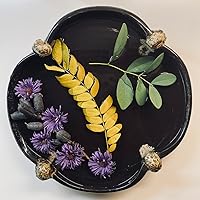
Thriftbooks recommended this to me and I bought it because the cover is beautiful. The poetry is equally beautiful, and has a complexness that further reflects the cover: inconspicuous, not flashy, but clearly intricate and intelligent. I honestly had a difficult time understanding some of the poetry (I'm so bad at reading poetry), but it truly made me feel something (especially "One Way of Posing") and I liked the overarching message about the environment/world/humanity that I was able to forage from the text.
'Such a beautiful cover which is why this review is so delayed, not wanting to shelf it. The cover speaks to the subject of the book, collected debris of the natural world. The first poem titled "After the removal of 30 types of plants and animals from the Junior Dictionary", "What survives" and so on... Particularly sad, "what kinds make the crowd" about the demise of a circus elephant in 1916.
In these poems about our time’s climate change, species extinctions, human kindness and human destructiveness, this book is powerful in its restraint and quiet, sharply perceptive humanity. I'm moved and admiring of this book’s quiet, focused, often austere, often stoically tender poems. This book is poised, haunting and deeply relevant to our time.
Rich poems of nature and paradise lost redolent with overripe fruit and premonitions of the heat and rising seas of climate change turn Virgil’s pastoral Georgics on their heads.
That particular sentiment sums up my feelings well when the topic is reviewing my favorite poetry collections. I want people to read the poets I love, but I rarely have the words to describe exactly what it is that excites me about a particular collection. There are skilled reviewers who can do this, and do it well, and for those I am grateful. However, the best I can usually do is say, "I love this one, and I think you will, too."
That is certainly the case with Forage, the new book by Rose McLarney. Not only did I enjoy this book immensely, I am excited about reading her other books which had escaped my attention before now. A good sign for me when discovering a new (to me) poet is how much I look forward to seeking out their previous published works. Read this one. I loved it, and I know you will, too.
Thank you to Netgalley and Penguin books for the electronic advance review copy.
Masterful positioning of words in beautiful irony. Sometimes humorous. More often nostalgic and wistful. Poems which evoke a sigh of resonance and admiration.