

What do you think?

Very Short Introductions #054
مقدمة قصيرة عن الثورة الفرنسية
يبدأ الكتاب بمناقشة الصور المعتادة للثورة الفرنسية من خلال مؤلفات "تشارلز ديكنز"والبارونة "أوركيزي" و"ليو تولستوي" ،بالاضافة الي أساطير مثل "فليأكلوا كعكاً" و"الألوان الثلاثة " ،بحيث يجعلنا المؤلف ندرك أننا مازلنا نعيش تطورات الثورة الفرنسية وعواقبها مثل النظام العشري في المقاييس والموازين وإيديولوجية حقوق الإنسان برمتها .يقدم المؤلف تاريخا قصيرًا للنظام السابق للثورة الفرنسية وكيف انهار هذا النظام ،ويوضح كيف حدثت الثورة ولماذا
اختلف الثوريون مع الملك والكنيسة وباقي دول أوروبا،ولماذا نتج عن هذا حكم الإرهاب ، وأخيرًا كيف وصلت الثورة إلي الحكم علي يد جنرال .لقد دمرت الثورة النظام الثقافي والمؤسسي والاجتماعي القديم في فرنسا وغيرها .يناقش هذا الكتاب كيف أصبح النظام القديم نظامًا قديمًا ، كما يعرض حالات فشلت فيها الانجازات أن تتماشى مع الطموح .يستكشف المؤلف إرث الثورة الفرنسية في شكل العقلانية في الشأن العام والحكومة المسئولة ،وينهي دراسته بمناقشة أسباب جدلية هذه الثورة.
اختلف الثوريون مع الملك والكنيسة وباقي دول أوروبا،ولماذا نتج عن هذا حكم الإرهاب ، وأخيرًا كيف وصلت الثورة إلي الحكم علي يد جنرال .لقد دمرت الثورة النظام الثقافي والمؤسسي والاجتماعي القديم في فرنسا وغيرها .يناقش هذا الكتاب كيف أصبح النظام القديم نظامًا قديمًا ، كما يعرض حالات فشلت فيها الانجازات أن تتماشى مع الطموح .يستكشف المؤلف إرث الثورة الفرنسية في شكل العقلانية في الشأن العام والحكومة المسئولة ،وينهي دراسته بمناقشة أسباب جدلية هذه الثورة.
189 pages, Paperback
First published August 23, 2001
About the author
William Doyle
157 books53 followersLibrarian Note: There is more than one author in the GoodReads database with this name.
William Doyle FBA is a British historian, specialising in 18th-century France, who is most notable for his one-volume Oxford History of the French Revolution (1989).
He is one of the leading revisionist historians of the French Revolution, obtaining his doctorate from the University of Oxford with his thesis The parlementaires of Bordeaux at the end of the eighteenth century, 1775–1790.
He is also professor emeritus of history at Bristol University, a fellow of the British Academy and a trustee of The Society for the Study of French History.
William Doyle FBA is a British historian, specialising in 18th-century France, who is most notable for his one-volume Oxford History of the French Revolution (1989).
He is one of the leading revisionist historians of the French Revolution, obtaining his doctorate from the University of Oxford with his thesis The parlementaires of Bordeaux at the end of the eighteenth century, 1775–1790.
He is also professor emeritus of history at Bristol University, a fellow of the British Academy and a trustee of The Society for the Study of French History.
Ratings & Reviews
Friends & Following
Create a free account to discover what your friends think of this book!
Community Reviews
Displaying 1 - 30 of 253 reviews

March 24, 2019
كتاب ممل جداً..إسلوب الكاتب صعب والترجمة غير موفقة بالمرة..
الميزة الوحيدة في الكتاب إنه حيستفزك إنك تسيب الكتاب وتدور إنت علي معلومات أو تتفرج علي أفلام وثائقية للتعرف أكثر علي تفاصيل الثورة الفرنسية اللي مش بس غيرت مجري التاريخ في فرنسا ولكن في بلاد كتير...
لا ينصح به..
الميزة الوحيدة في الكتاب إنه حيستفزك إنك تسيب الكتاب وتدور إنت علي معلومات أو تتفرج علي أفلام وثائقية للتعرف أكثر علي تفاصيل الثورة الفرنسية اللي مش بس غيرت مجري التاريخ في فرنسا ولكن في بلاد كتير...
لا ينصح به..
April 2, 2024
Excellent. Having just finished a much longer tome on the topic (A New World Begins: The History of the French Revolution), I gotta say, this is all you really need. It's particularly good on context, the revolution's historical legacy, and also on the changing academic discourse around it (the "classical" "revisionist" and "post-revisionist" schools of thought, if that's your thing haha).
Few quibbles. Like that longer work, sometimes the author assumes that you already know about things you are reading this book to find out. Terms like Sans-culottes, Montagnards, Girondins, Hébertistes, Père des Chenes, Physiocrats, &c are sometimes defined, sometimes cruised past, but Doyle is generally better than Popkin in this regard.
Couple of tidbits. In 1989, the Rev's bicentennial year,
https://i.postimg.cc/0jGFmTsR/French-...
For me, that's a troubling legacy, where Property has as much right, perhaps more, than citizens, the actual human variety, do. It's not just the Citizens United US Supreme Court decision, making corporations = people and money = free speech. There's a fundamental sense, beginning with Locke and going forward to Nozick, that the "improvement" of property (which justifies it being "enclosed", made private in the first place) is somehow more fundamental than other rights. And we see it too the 1791 Declaration of the Rights of Man and of Citizens of France, folks.
Few quibbles. Like that longer work, sometimes the author assumes that you already know about things you are reading this book to find out. Terms like Sans-culottes, Montagnards, Girondins, Hébertistes, Père des Chenes, Physiocrats, &c are sometimes defined, sometimes cruised past, but Doyle is generally better than Popkin in this regard.
Couple of tidbits. In 1989, the Rev's bicentennial year,
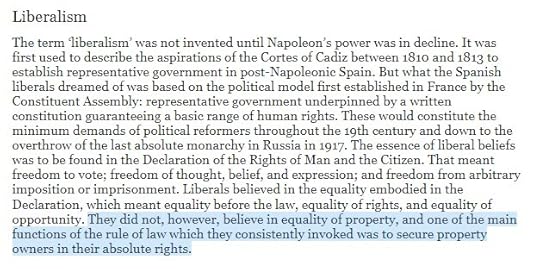
Margaret Thatcher declared that the rights of man were a British invention, and gave Mitterrand a lavishly bound copy of A Tale of Two Cities. A British historian working in America produced a vast chronicle of the Revolution which argued that its very essence was violence and slaughter (Citizens, by Simon Schama). It was a bestseller in a market where Burke, Carlyle, Dickens, and Orczy had clearly not laboured in vain.Also, liberalism: I never get tired repeating to Yanks that, for the rest of the world, it's not what they think. Here's our author on the term:
https://i.postimg.cc/0jGFmTsR/French-...
For me, that's a troubling legacy, where Property has as much right, perhaps more, than citizens, the actual human variety, do. It's not just the Citizens United US Supreme Court decision, making corporations = people and money = free speech. There's a fundamental sense, beginning with Locke and going forward to Nozick, that the "improvement" of property (which justifies it being "enclosed", made private in the first place) is somehow more fundamental than other rights. And we see it too the 1791 Declaration of the Rights of Man and of Citizens of France, folks.
XVII. The right to property being inviolable and sacred, no one ought to be deprived of it, except in cases of evident public necessity, legally ascertained, and on condition of a previous just indemnity.’

January 8, 2013
3 1/2
This wasreally an excellent just a decent overview (slightly over a hundred pages) of the Revolution.
The six chapters are Echoes; Why It Happened; How It Happened; What It Ended; What It Started; and Where It Stands.
The last chapter is an interesting (perhaps a little biased) review of the celebration of the bicentennial of the Revolution in 1989, and a summary of the schools of interpretation which have held sway in the last fifty years (the Classic interpretation, Revisionism, and Post-revisionism).
The index is serviceable, there is a nice timeline [actually the timeline is more useful than that rest of the book], a little end section on the Calendar which the Revolution produced (lots of details there), and, best of all, a great section of suggestions for further reading, with several dozen books fit into six categories. Some of the books are classic works fifty and more years old, but probably most of them have appeared in the period 1960-2000, and offer a selection of the top volumes written in that period.Can’t praise this book highly enough.
Well ... I have changed my view. The problem with the book is that if you're interested in a narrative of what happened in the revolution, when and how it happened, and who the main actors were ... the book is practically worthless. The way it's organized, even with help from the index, just doesn't answer those kind of questions. Yes, it does answer the questions as set forth in the chapter titles, which may be what you're looking for.
. . . . . . . . . . . . . . . . . . . .
Previous review: Consciousness VSI
Random review: Jerry Dantzic: Billie Holiday at Sugar Hill
Next review: The Lost Cellos of Lev Aronson
Previous library review: The Waning of the Middle Ages procrastination evidence
Next library review: The French Revolution Carlyle
This was
The six chapters are Echoes; Why It Happened; How It Happened; What It Ended; What It Started; and Where It Stands.
The last chapter is an interesting (perhaps a little biased) review of the celebration of the bicentennial of the Revolution in 1989, and a summary of the schools of interpretation which have held sway in the last fifty years (the Classic interpretation, Revisionism, and Post-revisionism).
The index is serviceable, there is a nice timeline [actually the timeline is more useful than that rest of the book], a little end section on the Calendar which the Revolution produced (lots of details there), and, best of all, a great section of suggestions for further reading, with several dozen books fit into six categories. Some of the books are classic works fifty and more years old, but probably most of them have appeared in the period 1960-2000, and offer a selection of the top volumes written in that period.
Well ... I have changed my view. The problem with the book is that if you're interested in a narrative of what happened in the revolution, when and how it happened, and who the main actors were ... the book is practically worthless. The way it's organized, even with help from the index, just doesn't answer those kind of questions. Yes, it does answer the questions as set forth in the chapter titles, which may be what you're looking for.
. . . . . . . . . . . . . . . . . . . .
Previous review: Consciousness VSI
Random review: Jerry Dantzic: Billie Holiday at Sugar Hill
Next review: The Lost Cellos of Lev Aronson
Previous library review: The Waning of the Middle Ages procrastination evidence
Next library review: The French Revolution Carlyle

February 12, 2019
As an English historian, William Doyle goes head on into the topic by reminding how the French Revolution was perceived in Britain - from Burke and Carlyle, to Dickens and Orczy. It's a nice way to go in, as it sandwiches the book really well with its ending, where he rewinds the main academical controversies that has been fuelling its interpretation for the past few decades.
His retelling of such 'sustained period of uncertainty, disorder, and conflict, reverberating far beyond the borders of France' is fair. In fact, he can't help but deploying his views only in the concluding chapter, about the legacy of it all. It could have been done without referring to the Russian Revolution though, as much as I acknowledge the potential parallels and the fact, coincidental, that the Berlin wall fell two hundred years sharp after the fall of the Bastille.
All in all then, considering it's a vast and complex topic, here's a clear cut account which worth in its straight simplification of the raging controversies surrounding it. Recommended.
His retelling of such 'sustained period of uncertainty, disorder, and conflict, reverberating far beyond the borders of France' is fair. In fact, he can't help but deploying his views only in the concluding chapter, about the legacy of it all. It could have been done without referring to the Russian Revolution though, as much as I acknowledge the potential parallels and the fact, coincidental, that the Berlin wall fell two hundred years sharp after the fall of the Bastille.
All in all then, considering it's a vast and complex topic, here's a clear cut account which worth in its straight simplification of the raging controversies surrounding it. Recommended.

November 25, 2021
كتاب مفيد جدا و موسوعي جدا جدا اكاديمي بحت ودعك من الناس الي بتقول الكتاب سيئة والكلام عديم النفع هذا الكتاب كتاب تاريخ مش حكاية الف ليلة وليلة
(المراجعة)الفيديو البتاعي عن الكتاب اهوه
: https://youtu.be/l-b-Lxp4m6o
(المراجعة)الفيديو البتاعي عن الكتاب اهوه
: https://youtu.be/l-b-Lxp4m6o

March 8, 2023
Since people write so much about the French Revolution, a short introduction seems out of the question. But I felt properly introduced.
The strength of this book is in the final three chapters that focus on the enduring effect and important changes brought about through the revolution and people's interpretations of it.
The author ends with a convincing argument that so many things can be traced back to the revolution that no one legacy can have a monopoly. The Soviet Union and China have some claim to continuing the revolution. But so do western liberal democracies. Painting with too broad a brush, especially moralistically, will probably get you into trouble.
Overall, a short introduction that respects the complexity of a huge political event while placing it in context.
The strength of this book is in the final three chapters that focus on the enduring effect and important changes brought about through the revolution and people's interpretations of it.
The author ends with a convincing argument that so many things can be traced back to the revolution that no one legacy can have a monopoly. The Soviet Union and China have some claim to continuing the revolution. But so do western liberal democracies. Painting with too broad a brush, especially moralistically, will probably get you into trouble.
Overall, a short introduction that respects the complexity of a huge political event while placing it in context.

February 22, 2017
متأسّفانه برای منی که تجربهی خواندن کتابی مختصر امّا بسیار عالی دربارهی تاریخ برههای از یکی کشورهای اروپا را کمی پیشتر داشتم، این کتاب بسیار مأیوسکننده بود. شروعی خوب داشت؛ نکاتی جالب درمورد انقلاب فرانسه و تأثیر آن بر کشورهای مختلف. همچنین مدّعای نویسنده برای اتّکا بر ادبیات و تاریخ ادبی فرانسه برای روایت انقلاب فرانسه جذاب مینمود. امّا از زمانی که روایت انقلاب شروع شد، ضربآهنگ روایت خواننده را همراه نمیکرد و اطّلاعات [شاید از نظر من نالازم] اقتصادی مانع دنبال کردن روایت میشد.
جز از این، ترجمه را هم من نپسندیدم.
جز از این، ترجمه را هم من نپسندیدم.

March 6, 2013
هدفي الأساسي من محاولة معرفتي عن الثورة الفرنسية وغيرها..هي معرفة إزاي الثوره دي قدرت تحول فرنسا من بلد فقير (أيوه فرنسا من 200 سنه كان الناس فيها فقراء ومش لاقيين يأكلوا عيش) إلى البلد اللي نعرفها حالياً
اللي أكتشفته... إن لو فضلنا ماشيين على ما نحن عليه حالياً يبقى لسه قدامنا (زي فرنسا) عشرات السنين علشان نوصل لحاجه مفيده إن شاء الله
ملحوظة: فرنسا بعد ما عملت ثوره على الملكية ...بعدها بكام سنه بس تحولت لإمبراطورية على إيد الأمبراطور الدكتاتور نابليون بونابرت
------------
الكتاب فيه تفاصيل وتواريخ كتير للي حابب يذاكر...لكن إجمالاً بسيط للي حابب يفهم الموضوع
ولقيت مجموعة فديوهات (فادتني أكتر) بتشرح الثورة الفرنسية بطريقة جميله جداً
https://www.khanacademy.org/humanitie...
اللي أكتشفته... إن لو فضلنا ماشيين على ما نحن عليه حالياً يبقى لسه قدامنا (زي فرنسا) عشرات السنين علشان نوصل لحاجه مفيده إن شاء الله
ملحوظة: فرنسا بعد ما عملت ثوره على الملكية ...بعدها بكام سنه بس تحولت لإمبراطورية على إيد الأمبراطور الدكتاتور نابليون بونابرت
------------
الكتاب فيه تفاصيل وتواريخ كتير للي حابب يذاكر...لكن إجمالاً بسيط للي حابب يفهم الموضوع
ولقيت مجموعة فديوهات (فادتني أكتر) بتشرح الثورة الفرنسية بطريقة جميله جداً
https://www.khanacademy.org/humanitie...

September 19, 2021
تحتفل فرنسا في الرابع عشر من يوليو من كل عام بعيدها القومي، وهو اليوم الذي سقط فيه سجن الباستيل عام ١٧٨٩م سجن فرنسا المنيع الذي اقتحمته الجماهير الثائرة ثم هدمته باسم الحرية. ولأن الثورة الفرنسية لم تكن حدثاً منفرداً بذاته، بل كانت سلسلة مترابطة من الأحداث والتطورات حيرت معظم معاصريها، حيث امتدت أحداثها وتطوراتها على مدى سنوات عديدة. فقد تتبع الكتاب أسباب حدوثها وكيفية وقوعها، وما قضت عليه الثورة وما ابتدعته، بأسلوب سلس ومنظم.

September 5, 2021
محتوى جيد ولكن ترجمة عقيمة
August 26, 2018
A good survey.
It fulfills its promise of short introduction to the French revolution including an outline of the many interpretations. I am looking forward to reading the recommended books.
It fulfills its promise of short introduction to the French revolution including an outline of the many interpretations. I am looking forward to reading the recommended books.

November 1, 2020
Very good overall introduction to the topic. Author is revisionist historian of French Revolution. I was pleasantly surprised to find in short introduction series commissioned by Oxford university a revisionist historian of FR.

March 14, 2021
"Before 1789 there was no such thing as a revolutionary. Nobody believed that an established order could be so comprehensively overthrown. But once it was shown to be possible, the history of France in the 1790s became the classic episode of modern history, whether as inspiration or warning, a model for all sides of what to do or what to avoid."
Very brief and interesting book about the French Revolution, viewed from the perspective of a British historian. William Doyle is the author of The Oxford History of the French Revolution and many other works. The book starts mainly from the Seven Years War and the consequences it bequeathed to Louis XV treasure. The conundrum of public deficit would extend until the reign of Louis XVI, but it seemed unsolvable. Jacques Necker was summoned to organize public finances for three times, along with Turgot, Calonne and Brienne (in different periods). Due to disagreements with the nobility and the clergy, the idea emerged, by Necker's proposal, of calling the États Généraux, which were not assembled since 1614. The Revolution began when the Third State decided to form a National Assembly in 1789.
The book brings many interesting details of the period, which are not mentioned in the many poorly written works about the French Revolution available in Brazil. I was very delighted to read the author's perspective. According to him, the Revolution was no innovation for its time, since the Thirteen Colonies had proclaimed their independence in 1776 and the British had overthrown absolutism in 1688, by the same principles (rights of men against tyranny and arbitrariness). There were only seven prisoners by the time of the storming of Bastille (July 14, 1789), so they had to state that the destruction of the "symbol of tyranny" was more of a symbolic act than anything else. After Louis XVI moved from Versailles to Paris, the Palais was never inhabited again, neither by Napoleon, nor Louis-Philippe. Doyle seems to view the French Revolution for what it was: instead of re-managing the monarchy who brought glory to France for more than a hundreds of years, the revolutionaries sought to destroy everything (even themselves). Few years after they proclaimed universal principles of fraternity, equality and liberty, the Terror (1793) was already out of control and the beheadings were full-throttle with the Comité De Salut Public. The bloodshed was contained only by the establishment of the Directory (1795), which, later, as a result of the Coup of 18–19 Brumaire along with Sieyès, brought about the advent of the young general Napoleon as First Consul (1799) and, then, as Emperor of France (1804). "Everybody recognised how much the vengeful demands of the sansculottes had done to precipitate terror a year later, so that when, after it ended, the Convention produced the constitution of 1795 it deliberately set out to exclude even more people from public life than in 1791."
Even the philosophers of the Enlightenment, from whom the Revolutionaries based their ideals, could not conceive the direction the movement was taking: "Robespierre, as proud a disciple as any of the Enlightenment, declares: 'Political writers... had in no way foreseen this Revolution.' They had expected a reform, if it came at all, would occur gradually and piecemeal, and would be the work of enlighten authoritarians rather than elected representatives. In these circumstances, the sort of headlong, comprehensive change undertaken by the revolutionaries was exhilarating." What the author concedes as the triumph of the Enlightenment, and I have to agree with him, is that nothing was sacred anymore; all power and institutions were now provisional, accepted only as long as they could be justified in terms of rationality and utility.
Babeuf's conspiracy of equals, which tried to overthrow the Directory in 1796, would serve as an inspiration to many socialist movements thereafter, including the Paris Commune of 1871, after French defeat at the Franco-Prussian War (1870-1871). These ideals would continue to crash with the established regimes throughout the nineteenth and twentieth centuries. Seeing the decay of communist regimes around the World, historian François Turet proclaimed in his essay of 1978 that "The French Revolution is finished".
The book has some interesting facts that I didn't know beforehand. Peerage was banished (1790) and, after fructidor (1797), nobles were made aliens and denied their rights as French citizens. An indemnity was only granted to the late émigrés in 1825 under Charles X. The generals who succeeded Napoleon in 1798 dissolved the papal states and proclaimed a secular Roman Republic (short-lived) and carried the pontiff Pius VI to France, where he died in August 1799. Many thought, then, that is was the end of papacy itself. The difference between "left and right" originated in the French Revolution. "(...) proponents of further change tended in successive assemblies to sit on the left of the president's chair, while conservatives congregated in its right. The right, in fact modern political conservatism, was as much a creation of the French Revolution as all the things it opposed."
I have to acknowledge, though, one good aspect of the Revolution, which was the abolition of corporation privileges and monopolies (August Decrees, 1789); organisations and trade guilds (Allarde Law, 1789); artisans primitive trade unions (Le Chapelier Law, 1791).
Many will praise the long lasting ideals bequeathed by the Revolution, but the ones who have more than two nerve cells working will recognise that the same privileges still exist in every other existent Republic nowadays, despite the change in nomenclature, with the difference that those who bear them now did nothing prior to their nation to deserve the privilege. It depicts perfectly the Orwellian maxim: "All animals are equal, but some animals are more equal than others". Napoleon himself, who had revived many of the institutions that the Revolution destroyed, used to see them as mere recognition of political realities. Even "Tocqueville saw the Revolution as the advent of democracy and equality but not of liberty. Napoleon and his nephew, whom this aristocrat of old stock hated, had shown how dictatorship could be established with democratic support, since the Revolution had swept away all the institutions which, in impeding the relentless growth of state power, had kept the spirit of liberty alive."
The last chapter presents an interesting conclusion. "The heaviest blows, however, were not delivered by scholarly revisionists or post-revisionists. They came from the spectacular collapse of Soviet Communism, and the repressive attempts of its Chinese variant, just a few weeks before 14 July 1989, to shore up its authority against students calling for liberty and singing the Marseillaise."
Very brief and interesting book about the French Revolution, viewed from the perspective of a British historian. William Doyle is the author of The Oxford History of the French Revolution and many other works. The book starts mainly from the Seven Years War and the consequences it bequeathed to Louis XV treasure. The conundrum of public deficit would extend until the reign of Louis XVI, but it seemed unsolvable. Jacques Necker was summoned to organize public finances for three times, along with Turgot, Calonne and Brienne (in different periods). Due to disagreements with the nobility and the clergy, the idea emerged, by Necker's proposal, of calling the États Généraux, which were not assembled since 1614. The Revolution began when the Third State decided to form a National Assembly in 1789.
The book brings many interesting details of the period, which are not mentioned in the many poorly written works about the French Revolution available in Brazil. I was very delighted to read the author's perspective. According to him, the Revolution was no innovation for its time, since the Thirteen Colonies had proclaimed their independence in 1776 and the British had overthrown absolutism in 1688, by the same principles (rights of men against tyranny and arbitrariness). There were only seven prisoners by the time of the storming of Bastille (July 14, 1789), so they had to state that the destruction of the "symbol of tyranny" was more of a symbolic act than anything else. After Louis XVI moved from Versailles to Paris, the Palais was never inhabited again, neither by Napoleon, nor Louis-Philippe. Doyle seems to view the French Revolution for what it was: instead of re-managing the monarchy who brought glory to France for more than a hundreds of years, the revolutionaries sought to destroy everything (even themselves). Few years after they proclaimed universal principles of fraternity, equality and liberty, the Terror (1793) was already out of control and the beheadings were full-throttle with the Comité De Salut Public. The bloodshed was contained only by the establishment of the Directory (1795), which, later, as a result of the Coup of 18–19 Brumaire along with Sieyès, brought about the advent of the young general Napoleon as First Consul (1799) and, then, as Emperor of France (1804). "Everybody recognised how much the vengeful demands of the sansculottes had done to precipitate terror a year later, so that when, after it ended, the Convention produced the constitution of 1795 it deliberately set out to exclude even more people from public life than in 1791."
Even the philosophers of the Enlightenment, from whom the Revolutionaries based their ideals, could not conceive the direction the movement was taking: "Robespierre, as proud a disciple as any of the Enlightenment, declares: 'Political writers... had in no way foreseen this Revolution.' They had expected a reform, if it came at all, would occur gradually and piecemeal, and would be the work of enlighten authoritarians rather than elected representatives. In these circumstances, the sort of headlong, comprehensive change undertaken by the revolutionaries was exhilarating." What the author concedes as the triumph of the Enlightenment, and I have to agree with him, is that nothing was sacred anymore; all power and institutions were now provisional, accepted only as long as they could be justified in terms of rationality and utility.
Babeuf's conspiracy of equals, which tried to overthrow the Directory in 1796, would serve as an inspiration to many socialist movements thereafter, including the Paris Commune of 1871, after French defeat at the Franco-Prussian War (1870-1871). These ideals would continue to crash with the established regimes throughout the nineteenth and twentieth centuries. Seeing the decay of communist regimes around the World, historian François Turet proclaimed in his essay of 1978 that "The French Revolution is finished".
The book has some interesting facts that I didn't know beforehand. Peerage was banished (1790) and, after fructidor (1797), nobles were made aliens and denied their rights as French citizens. An indemnity was only granted to the late émigrés in 1825 under Charles X. The generals who succeeded Napoleon in 1798 dissolved the papal states and proclaimed a secular Roman Republic (short-lived) and carried the pontiff Pius VI to France, where he died in August 1799. Many thought, then, that is was the end of papacy itself. The difference between "left and right" originated in the French Revolution. "(...) proponents of further change tended in successive assemblies to sit on the left of the president's chair, while conservatives congregated in its right. The right, in fact modern political conservatism, was as much a creation of the French Revolution as all the things it opposed."
I have to acknowledge, though, one good aspect of the Revolution, which was the abolition of corporation privileges and monopolies (August Decrees, 1789); organisations and trade guilds (Allarde Law, 1789); artisans primitive trade unions (Le Chapelier Law, 1791).
Many will praise the long lasting ideals bequeathed by the Revolution, but the ones who have more than two nerve cells working will recognise that the same privileges still exist in every other existent Republic nowadays, despite the change in nomenclature, with the difference that those who bear them now did nothing prior to their nation to deserve the privilege. It depicts perfectly the Orwellian maxim: "All animals are equal, but some animals are more equal than others". Napoleon himself, who had revived many of the institutions that the Revolution destroyed, used to see them as mere recognition of political realities. Even "Tocqueville saw the Revolution as the advent of democracy and equality but not of liberty. Napoleon and his nephew, whom this aristocrat of old stock hated, had shown how dictatorship could be established with democratic support, since the Revolution had swept away all the institutions which, in impeding the relentless growth of state power, had kept the spirit of liberty alive."
The last chapter presents an interesting conclusion. "The heaviest blows, however, were not delivered by scholarly revisionists or post-revisionists. They came from the spectacular collapse of Soviet Communism, and the repressive attempts of its Chinese variant, just a few weeks before 14 July 1989, to shore up its authority against students calling for liberty and singing the Marseillaise."

June 1, 2018
The book is good for what it is: An introduction. It kept me hooked up until the last page. The facts it tells are sometimes shocking. It clearly made me more aware of the horrendous violence of the revolution. Should I endorse Jacobinsm still? Most likely no. Also, although it does not mention stories of individual people, understandably so, I can well imagine that countless people were guillotined for no reason at all. But Doyle also shows the inevitability of the revolution; how the ancien regime was asking for it in the thirty years-period preceding the storming of the Bastille prison (only 7 people were imprisoned in it then but it was the symbolism that counted. The Bastille was notorious like Tazmamart perhaps).
Apart from the hurried narration of complicated stories, the introduction is outstanding. It contains very interesting facts. One that got me awestruck was Doyle's explanation of why French women only won suffrage in 1944 when the Revolution era constitution was all about equality (except in property!). It turns out that a lot of women, according to Doyle, were the beating heart of the Church's resistance against the National Assembly and the rational philosophers of the Enlightenment like Rousseau and their zealous followers like Robespierre. Not that women didn't take part in the revolution. A lot actually did and many were guillotined. De Gouges actually wrote the "Déclaration des droits de la femme et de la citoyenne" in 1791 and was guillotined in 1793 by the Jacobins. Even now it fills me with anger.
Towards the end, the book provides the curious and avid reader with valuable references. I wish I can have those books as well as the time to read them all. Sounds a phantasy rather than a wish, but it shows how much Doyle's got me in, and this is so not least because, actually, and this is a big actually–a lot of what is going on and perhaps of what is coming, at least in the case of Morocco, may resemble, goodness forbid, the worst excesses of the French Revolution. Perhaps we already started the thirty years preceding the French Revolution. If the first (and second) digital divide shrinks in the country as well as the city, and if this development is to catch the Moroccan system on traditional guards, probably all guards will be blown off by modern sansculottes equipped with smartphones and 2.0 guillotines. It will not end like the French Revolution, though. A Libyan stab-in-the-ass development combined with powerful foreign interference sending the revolution into a limbo is the better speculation.
Apart from the hurried narration of complicated stories, the introduction is outstanding. It contains very interesting facts. One that got me awestruck was Doyle's explanation of why French women only won suffrage in 1944 when the Revolution era constitution was all about equality (except in property!). It turns out that a lot of women, according to Doyle, were the beating heart of the Church's resistance against the National Assembly and the rational philosophers of the Enlightenment like Rousseau and their zealous followers like Robespierre. Not that women didn't take part in the revolution. A lot actually did and many were guillotined. De Gouges actually wrote the "Déclaration des droits de la femme et de la citoyenne" in 1791 and was guillotined in 1793 by the Jacobins. Even now it fills me with anger.
Towards the end, the book provides the curious and avid reader with valuable references. I wish I can have those books as well as the time to read them all. Sounds a phantasy rather than a wish, but it shows how much Doyle's got me in, and this is so not least because, actually, and this is a big actually–a lot of what is going on and perhaps of what is coming, at least in the case of Morocco, may resemble, goodness forbid, the worst excesses of the French Revolution. Perhaps we already started the thirty years preceding the French Revolution. If the first (and second) digital divide shrinks in the country as well as the city, and if this development is to catch the Moroccan system on traditional guards, probably all guards will be blown off by modern sansculottes equipped with smartphones and 2.0 guillotines. It will not end like the French Revolution, though. A Libyan stab-in-the-ass development combined with powerful foreign interference sending the revolution into a limbo is the better speculation.

February 3, 2019
A good decent book about the French Revolution it follows it chapters in:
- Echoes;
- Why It Happened ?
- How It Happened ?
- What It Ended ?
- What It Started ?
- Where It Stands ?
And answer most of these questions, a good book, informative and short.
The further reading part of the book is great!
3.5/5
- Echoes;
- Why It Happened ?
- How It Happened ?
- What It Ended ?
- What It Started ?
- Where It Stands ?
And answer most of these questions, a good book, informative and short.
The further reading part of the book is great!
3.5/5
Everybody knew and was shocked by the story of how Queen Marie-Antoinette, guillotined amid popular jubilation in 1793, had said ‘Let them eat cake’ when told that the people had no bread. (Everybody knows it still, and nobody cares that it was an old story even before she was born, heard by Jean-Jacques Rousseau as early as 1740.)
The Revolution was an explosion of popular violence, understandable if scarcely defensible resentment. Those who attempted to lead or guide it were mostly simpletons or scoundrels, all to be pitied for their presumption.
the Declaration of the Rights of Man and the Citizen. This was something entirely new in the history of the world. The English Bill of Rights of 1689 had only proclaimed the rights of Englishmen. The United States did not establish its own Bill of Rights until a year after the French.
For the left, the terror had been cruel necessity, made inevitable by the determination of the enemies of liberty and the rights of man to strangle them at birth. For the right, the Revolution had been violent from the start in its commitment to destroying respect and reverence for order and religion.
... the opening of the grim and mysterious Bastille release the expected host of languishing victims of despotism. There were only seven prisoners. But the medieval fortress was a symbol of royal power, and the spontaneous demolition of it which began at once was equally symbolic of the end of a discredited old order.

April 24, 2021
Good intro
Doyle's history is brief but clear and effective; however, the chapter that really makes the book is the one on the historiography and interpretation battles of the French revolution, particularly in light of the events of the late 80s and early 90s. There is also some subtle shade thrown at Simon Schama.
Doyle's history is brief but clear and effective; however, the chapter that really makes the book is the one on the historiography and interpretation battles of the French revolution, particularly in light of the events of the late 80s and early 90s. There is also some subtle shade thrown at Simon Schama.

March 18, 2020
الكتاب سئ وملئ بالتفاصيل الفرعيه ويغفل الاحداث الرئيسية ممل وصفر تشويق او اى شئ يدعوك للاهتمام والترجمة لا تساعد اطلاقا

June 11, 2020
Highly recommended. Very brief yet discussing every single point so well. Excellent way of delivering the info. A neutral discussion without being biased to either sides. One of a must read books!

July 10, 2025
Perfect introduction for someone like me (a layman). I assumed it would be too scholarly since it's from Oxford, but it was actually pretty accessible and easygoing. It covers a wide range of topics—from the roots of the revolution and the politics of the time to how it influenced modern political philosophies. There's also a very detailed timeline at the end of the book, stretching from before the revolution all the way to the post-WWII period and beyond. The last 3 chapters were pretty engaging.

March 26, 2024
when they said very short they meant very short

October 27, 2024
I didn't know much about the details of the French revolution. The book has no figures at all, but they would have been helpful. Like a simple timeline summarizing events, or showing the casualties of terror etc. would have been very helpful.

August 26, 2025
This offers a fairly good overview of the events of the Revolution itself, and a very good overview of the Historiography of the Revolution, with its controversies.

December 25, 2020
الكتاب جيد في المجمل فيه بعض التفاصيل الغير مناسبة لمقام المقدمة القصرة جدًا لكنه جيد في العرض التاريخي فقير أدبيًا جدًا في الترجمة.
الثورة الفرنسية واحدة من أكتر الأحداث دموية في التاريخ ، بداية من اختراع المقصلة اللي أطاحت برؤوس الجميع فلاحين وكنيسة وملوك ، لحد المدافع اللي استخدمها نبليون في فض مظاهرة لأول مرة في التاريخ
الجدير بالذكر ان الثورة فشلت ، وبعد كل الدماء دي نابليون غزا أوروبا ووزعها على قرايبه ورجع فرنسا أعلن رجوع الملكية تاني بنفس كل حاجة قامت الثورة علشانها
إلا ان اللي الثورة غيرته في المجتمع مفيش سلاح قدر يقتله .
ويظل كلام دكتور عزمي بشارة الجميل ان الثورة في المجتمعات الضعيفة تفرقها وتدمرها ، وأوقات كتير بتكون الثورة مش هي الحل ، لأن ثورة الاصلاح أصعب بكتير من ثورة الاطاحة
وده كان فرق جوهري بين الثورة دي وثورة الجمهورية التانية الاصلاحية بعد 60 سنة من ثورة المقصلة.
الثورة الفرنسية واحدة من أكتر الأحداث دموية في التاريخ ، بداية من اختراع المقصلة اللي أطاحت برؤوس الجميع فلاحين وكنيسة وملوك ، لحد المدافع اللي استخدمها نبليون في فض مظاهرة لأول مرة في التاريخ
الجدير بالذكر ان الثورة فشلت ، وبعد كل الدماء دي نابليون غزا أوروبا ووزعها على قرايبه ورجع فرنسا أعلن رجوع الملكية تاني بنفس كل حاجة قامت الثورة علشانها
إلا ان اللي الثورة غيرته في المجتمع مفيش سلاح قدر يقتله .
ويظل كلام دكتور عزمي بشارة الجميل ان الثورة في المجتمعات الضعيفة تفرقها وتدمرها ، وأوقات كتير بتكون الثورة مش هي الحل ، لأن ثورة الاصلاح أصعب بكتير من ثورة الاطاحة
وده كان فرق جوهري بين الثورة دي وثورة الجمهورية التانية الاصلاحية بعد 60 سنة من ثورة المقصلة.

January 21, 2019
This was a required reading for me, and really I do not have much to say about it, it is a decent history and for its short length it does tackle some of the most important ideas of the Revolution. The conservative/"anglo" lens through which Doyle sees the revolution is quite obvious upon reading, but it doesn't really skew the information enough to cause any serious qualms.
February 13, 2021
A short, straightforward history of the French Revolution and its legacy.
Doyle is a historian belonging to the revisionist camp in the historiography of the French Revolution, which opposes the classical (Marxist) view of the Revolution as a triumph of the bourgeoisie over feudalism. He also opposes those views he terms as "post-revisionist", which emphasize the role of culture. His approach is typified by his summary of the revisionist school in the last chapter of the book:
Therefore, this book will disappoint those who seek an interpretation of the cause and effect of the French Revolution, especially in materialist terms. It barely touches on the effect of the Revolution on the class structure and modes of production, for example. It is nonetheless a decent introduction to further reading.
Doyle is a historian belonging to the revisionist camp in the historiography of the French Revolution, which opposes the classical (Marxist) view of the Revolution as a triumph of the bourgeoisie over feudalism. He also opposes those views he terms as "post-revisionist", which emphasize the role of culture. His approach is typified by his summary of the revisionist school in the last chapter of the book:
The approach of Cobban, Taylor, and those who came after them has largely been empirical, undermining the sweeping social and economic claims of the classic interpretation with new evidence, but seldom seeking to establish new grand overviews. The most they claimed was that the Revolution could be more convincingly explained in terms of politics, contingency, and perhaps even accident.
Therefore, this book will disappoint those who seek an interpretation of the cause and effect of the French Revolution, especially in materialist terms. It barely touches on the effect of the Revolution on the class structure and modes of production, for example. It is nonetheless a decent introduction to further reading.
August 21, 2011
I didn't know much about the French revolution prior to reading this book. Now I know slightly more about the French revolution. :)
Seriously, though, I'm not in a position to judge whether or not the book is accurate, and whether or not it incorporates all the important elements of what happened. The book is well-written and very amenable to note-taking, if you're that kind of person, and it doesn't seem to require much background knowledge in order to follow the author's thread. My three stars may be unfair - it's possible that the book deserves four. I gave it three because in 108 pages, I ended up being bored multiple times. Maybe that's the author's fault, or maybe it's just confirmation that I am kind of a bonehead when it comes to empirical political science and history, and that I should just stick to theory and philosophy. Still, the French revolution is one of the most inherently exciting and interesting events in history... it just seems as though an introductory text about it should be gripping, even to someone like me!
I'm glad I read the book. At the very least I feel like I can bluff my way through conversations about the topic without making huge missteps.
Seriously, though, I'm not in a position to judge whether or not the book is accurate, and whether or not it incorporates all the important elements of what happened. The book is well-written and very amenable to note-taking, if you're that kind of person, and it doesn't seem to require much background knowledge in order to follow the author's thread. My three stars may be unfair - it's possible that the book deserves four. I gave it three because in 108 pages, I ended up being bored multiple times. Maybe that's the author's fault, or maybe it's just confirmation that I am kind of a bonehead when it comes to empirical political science and history, and that I should just stick to theory and philosophy. Still, the French revolution is one of the most inherently exciting and interesting events in history... it just seems as though an introductory text about it should be gripping, even to someone like me!
I'm glad I read the book. At the very least I feel like I can bluff my way through conversations about the topic without making huge missteps.

September 15, 2016
Sweeping survey that not only analyses the Revolution itself but also listens closely to its many echoes and reverberations over the next two centuries. Given the bounds of the VSI series, Doyle does a pretty good job, even if he does devote an inordinate amount of time to modern academic debate swirling around the revolt and the terror. Jacobino-Marxist Vulgate, anyone?
For me, this is primarily a primer prior to readings of Chris Hibbert and Hilary Mantel. Given the extreme complexity and confusion of these events, it will certainly take a good deal more study to make sense of 1789 and its aftermath.
For me, this is primarily a primer prior to readings of Chris Hibbert and Hilary Mantel. Given the extreme complexity and confusion of these events, it will certainly take a good deal more study to make sense of 1789 and its aftermath.

May 21, 2020
يختلف تناول الكتاب للثورة الفرنسية عن المعتاد، هي محاولة تحليليه أكثر منها محاولة لسرد الأحداث، يبدأ المؤلف في مقدتمه بشرح ذلك، منطلقًا من وعي بأن الناس لديها الحد الأني من المعرفة بالأحداث الشهيرة في الثورة، لم يعني ذلك غيابها عن الكتاب لكن لم تكن النقطة المحورية التي ينطلق منها، بل ما وراء الأحداث، وهو منظور متميز لكن ربما ليس الأفضل لكتاب بعنوان مقدمة قصيرة عن،. الترجمة في مجملها جيدة، ليست ممتازة، الكتاب مهم في كل الأحوال للباحثين عن رؤية واسعة ليست تفصيلية عن واحدة من أهم الثورات في تاريخ الإنسانية

February 27, 2021
Short and an enjoyable book about the french revolution, it cover most of the important events that happened tho there are some things that the writer doesn't explain the background of it well and leave you confuse and you have to search for it to understand. overall i recommend it for everyone want a short book about the topic and then read some more in-depth book like Citizens: A Chronicle of the French Revolution.

March 24, 2013
إني لأتعجب من قدرة البشر على صناعة الأصنام ثم السجود لها، وتحويل العمل الدموي إلى أوبرا أو لوحة. الثورة الفرنسية لم تكن إلا غضب أعمى ثم أمة كفرت بحالها وراحت تبحث عن مستقبل جديد تصنعه على هواها فسلمت أمرها لكل مغامر مختال فخور. الثورة الفرنسية التي يروج لها البعض على أنها أعظم عمل في تاريخ الانسان لم تكون إلا أكبر mess في تاريخ هذا الانسان.
Displaying 1 - 30 of 253 reviews