Jump to ratings and reviews
Rate this book

Terug naar huis

Rate this book
De beroemde Britse dichter Joe Jacobs brengt de zomer samen met zijn vrouw Isabel, die oorlogsverslaggeefster is, en hun dochter Nina door in een vakantievilla in Frankrijk. Een bevriend stel, Laura en Mitchell, voegt zich bij hen. Er is een zwembad in de tuin, een hippieachtige klusjesman loopt continu rond en op het balkon van een aangrenzende woning slaat de buurvrouw een en ander argwanend gade. Aan onderlinge spanningen ontbreekt het allerminst. Katalysator in het geheel vormt Kitty, een jonge vrouw die naakt in het zwembad wordt aangetroffen. Dood, lijkt het. Een boekingsfoutje, blijkt het. Ze laten haar blijven. De prachtige Franse zomer komt in schril contrast te staan met wat de villabewoners doormaken.

167 pages, Hardcover

First published October 6, 2011

760 people are currently reading
15703 people want to read

About the author

Deborah Levy

65 books3,703 followers
Deborah Levy trained at Dartington College of Arts leaving in 1981 to write a number of plays, highly acclaimed for their "intellectual rigour, poetic fantasy and visual imagination", including PAX, HERESIES for the Royal Shakespeare Company, CLAM, CALL BLUE JANE, SHINY NYLON, HONEY BABY MIDDLE ENGLAND, PUSHING THE PRINCE INTO DENMARK and MACBETH-FALSE MEMORIES, some of which are published in LEVY: PLAYS 1 (Methuen)

Deborah wrote and published her first novel BEAUTIFUL MUTANTS (Vintage), when she was 27 years old. The experience of not having to give her words to a director, actors and designer to interpret, was so exhilarating, she wrote a few more. These include, SWALLOWING GEOGRAPHY, THE UNLOVED (Vintage) and BILLY and GIRL (Bloomsbury). She has always written across a number of art forms (see Bookworks and Collaborations with visual artists) and was Fellow in Creative Arts at Trinity College, Cambridge from 1989-1991.

Ratings & Reviews

What do you think?
Rate this book

Friends & Following

Create a free account to discover what your friends think of this book!

Community Reviews

5 stars
2,529 (15%)
4 stars
5,652 (33%)
3 stars
5,652 (33%)
2 stars
2,191 (13%)
1 star
625 (3%)
Displaying 1 - 30 of 2,043 reviews
Profile Image for Ilse.
552 reviews4,440 followers
September 15, 2025
Life is only worth living because we hope it will get better and we'll all get home safely.

Learning from Real estate (the third part of her autobiographical trilogy) how crucial swimming is to Deborah Levy (“A life without swimming every day is not a life I wanted”), I imagined this to be the ideal book to finally make a start with her fiction. As it happens, this novel is mostly set in and around the swimming pool of a rented holiday home close to Nice and reading it in between coming back from and soon travelling again to the South of France (without any pool in sight), it certainly turned out a timely choice.

Disquieting and elegantly written, this is the kind of book that might be most enjoyed plunging in blindly and letting yourself simply sink into it. Because of its threatening atmosphere and recurring foreboding, it is pretty obvious it will all end up badly. Almost with sardonic pleasure, Levy immerses into the dark and bleak underneath the deceptive paradisiacal setting. A nightmare takes on the shape of an intruder –for whom? Maybe not for all the ones involved. Suicide, mental illness, anorexia, obsession, stalking, depression, loneliness– and counting - a lot of Issues are packed up in between the covers of this flimsy book, which however is paced so skilfully the pages kept on turning breezily.


(Photograph by Jeff Andersen - Ladybug holding on to a dead leaf in a swimming pool)

The novel has a strong cinematic quality. Levy generously provides details translatable into stage instructions for small interludes of horror scenes or to design the costumes to dress up the actors, lavishly focussing on their attire (or absence of it ) including green nail polish (nicely contrasting with red hair). I could also imagine this as a play - or even an opera.

Throughout the dazzling visuality of Levy’s prose, a closer look might invite to a less merciful analysis, risking to be sucked into the quicksand of the manifold Freudian and other psycho-analytical delicacies Levy wildly throws around (starting with her feasting on the many connotations the swimming pool evokes, suggesting the deep waters below the surface, the repressed desires and hidden truths, death, sex, dead leaves, rescuer’s complex). Just like Dr. Abott in Fawlty towers might sigh that Levy’s characters deliver enough material for an entire conference, digesting the abundance of symbols to chew on might fall somewhat heavy on the stomach – even if Levy’s irony and sarcasm work as the freshening sorbet that keeps it palatable. Levy feeds the reader with tiny pieces of impressions, dreams and reflections to puzzle the narrative together, now and then however presenting pieces this reader would have liked not to have been offered, preferring to draw conclusions by filling in some blanks myself (sketching a backstory, the haunting past of the poet before he migrated to Britain needn’t to be spelled out).

I have never got a grip on when the past begins or where it ends, but if cities map the past with statues made from bronze forever frozen in one dignified position, as much as I try to make the past keep still and mind its manners, it moves and murmurs with me through every day.

Nevertheless, I again enjoyed Levy’s peculiar sense of humour (for instance the witty and vicious way she toys with the narrative principle of Chekhov’s gun) and basked in the references, echoes, reminiscences and associations Swimming Home cunningly surges up: from the ones Levy mentions straightforwardly (the poem ‘It’s Raining’ by Guillaume Appolinaire) to Swimming Pool the superb film by François Ozon (with Charlotte Rampling and Ludivine Sagnier, the opening shot mirroring the first day in the holiday home, albeit with more clothes on), the story of John Cheever we read with the Short Story Reading Group, The Swimmer (1964), in which a middle-aged man, decides to “swim home”, pool by pool across his neighbours’ estates (echoed in this novel’s title and the mental illness), the carnage provoked by Cecile in Françoise Sagan’s Bonjour tristesse, some of the characters and plot elements from The Great Gatsby.

Even if lacks a welcome whiff of subtlety, this was a good and entertaining summer read, just like a good summer bringing a nice touch of sun, silk and the luxury of leisure (and sweat and insects, and maybe a murderous desire to change your life).
Profile Image for Orsodimondo.
2,458 reviews2,434 followers
August 13, 2022
STEALING BEAUTY


Dopo una misteriosa prima paginetta che serve da breve prologo, Levy sforna una scena degna d’essere ricordata: i turisti che hanno affittato una villa sulla riviera francese trovano qualcosa di inquietante in piscina. Chi lo scambia per un orso, chi per un morto: finché Isabel, che è una corrispondente di guerra ed è abituata alle situazioni critiche, s’immerge nell’acqua e afferra forte la caviglia dell’essere galleggiante a pancia in giù, che si rivela essere una ragazza.


L’ospite “sgradito” (proprio come nella favola nera di Edward Gorey) è una giovane che fa il bagno nuda e si rivela presto come Liv Tyler in Io ballo da sola.
Si chiama Kitty, dice di essere un habituée di quella villa, sua madre è amica della proprietaria, ma questa volta ha evidentemente confuso la prenotazione ed è arrivata troppo presto, o troppo tardi.
In realtà, più avanti si scopre che la mamma fa le pulizie della villa, e quindi Kitty è incline a contare balle.
È luglio, alta stagione, gli alberghi sono tutti pieni: Isabel risolve la situazione invitandola, chissà perché, a occupare la dépendance degli ospiti.
E così Kitty si aggrega alla comitiva composta da Isabel, suo marito Joe, famoso e ricco poeta, ebreo, nato polacco ma nazionalizzato inglese, e che fine hanno fatto i suoi genitori non è dato sapere ma interrogarsi sì, la loro figlia quattordicenne Nina, che presto avrà le sue prime mestruazioni, e una coppia di amici antiquari, il grassissimo Mitchell e la sua altissima moglie Laura, amica e compagna di Isabel dai tempi della scuola.


A completare il cast dei personaggi: Jurgen, custode che non custodisce, tuttofare che nulla fa, capelli rasta, molto portato per canne e spinelli, hashish e marijuana, non troppo segretamente innamorato di Kitty; Claude, il giovane proprietario di un bar del villaggio, che assomiglia a Mick Jagger, e sa dove comprare il fumo, sia hashish che marijuana, ma non sa come farsi pagare da Mitchell; Madeleine, l’ottantenne inglese vicina di casa, spiona e forse pettegola, non ben disposta verso Kitty, e dotata del dono dell’ubiquità (prezzemolina).
Come in una commedia.
E Deborah Levy, sudafricana trasferita in Inghilterra all’età di nove anni, di teatro se ne intende, ne ha scritto parecchio.


Essere invitata a restare è proprio quello che Kitty voleva: perché è segretamente innamorata del celebre poeta anglo-polacco, è convinta che le poesie che lui compone siano una diretta segreta comunicazione fra loro. Si è portata dietro una poesia che ha scritto proprio lei, dal titolo “A nuoto verso casa”, vuole che lui la legga e le dica cosa ne pensa.
Il celebre poeta anglo-polacco è incline alla frequentazione di giovani ragazze, frequentazione anche intima, lo sa bene sua moglie Isabel, e lo sa bene il mondo intero. Invece recalcitra davanti alla richiesta di Kitty, traccheggia, potrebbe coglierla subito e invece prende tempo, rimanda la lettura della poesia…


Kitty è giovane e bella, incorniciata da morbidi ricci color del rame che le scendono alla vita. Arrossisce con facilità, come rossa le diventa la pelle appena esposta al sole: ciò nonostante ha la tendenza ad andare in giro completamente nuda, e non solo intorno alla piscina. Balbetta, scrive e legge poesie.
Perché resisterle, perché non prenderla subito, accoglierla fra le braccia, respirarla…?
Tanto più che Joe, il celebre e ricco poeta anglo-polacco, che sua moglie Isabel s’ostina a chiamare sempre Jozef, è noto per essere un fan delle fanciulle in fiore, all’ombra ma anche in piena luce.
E infatti, Joe non ha intenzione di resisterle più di tanto, quel prologo lo suggerisce, lo rivela in anticipo.


Solo che Kitty è stata ricoverata contro la sua volontà in un ospedale psichiatrico del Kent – e forse c’è lo zampino della vecchia impicciona Madeleine. Le hanno fatto l’elettroshock. E lei ha smesso di prendere gli psicofarmaci.
È una mina vagante, una minaccia.
È un catalizzatore. È un agente agitatore.
E infatti, dopo il suo passaggio, niente sarà più come prima: saranno gli altri, tutti gli altri, a portare a galla dolore, inquietudine, disagio, problemi, nascosti, celati, non detti, segreti.
Come succede nel film di Pierpaolo Pasolini “Teorema” quando il Visitatore lascia la famiglia che l’ha accolto.

Deborah Levy inietta la sua narrazione di elettricità, e una dose di eccentricità. Sembra usare il naturalismo descrittivo, ma sparge elementi vagamente surreali, talvolta paradossali.
Il risultato è un effetto di mistero, di attesa, uno strano senso di “realismo surreale”: come se quel microcosmo fosse sospeso, in qualche modo attonito, calato in uno spazio assorto, inquietante, umoristico, magico.

Profile Image for Lynne King.
500 reviews829 followers
August 20, 2016
I’m really at a loss to understand why this novella shortlisted for the Man Booker Prize 2012 did not win it. This is a perfect book. The prose is magnificent and a tour de force by an author with an exquisite handling particularly of the mental state in human beings.

The setting is July 1994, in a villa up in the hills from Nice in the Alpes-Maritime, one of my favourite places in southern France. A famous poet, Jozef Jacobs, known as Joe, and his wife Isabel, a former war correspondent, are on holiday with their teenage daughter Nina. Other household guests are Laura and Mitchell, who own a shop in Euston, London. Isabel has known Laura for many years but they are certainly not close friends, if anything they are used to one another, and are comfortable together.

A mix-up in the letting of the villa sees the arrival of Kitty Finch, who is friendly with the Austrian caretaker Jurgen. He was rather taken with Kitty and called her Kitty Ket whilst thinking of any conceivable manoeuvre to get closer to her in more ways than one. Isabel, decides that the villa is more than large enough for them and Kitty is invited to stay by her. The reason for this is apparent later on. Pubescent Nina has become interested in Claude, a friend of Jurgen, who owns the only café in the village and looks like Mick Jagger.

Not a very exciting story you may think but think again. Slowly, the problems in Joe’s and Isabel’s marriage and its fragility become apparent, the worries that Nina has, the eighty year old retired Doctor Madeleine Sheridan who views from the balcony next door the development of the family’s encounter with Kitty and who knows the latter’s extraordinary background, and Mitchell and Laura.

Talk about bated breath with every single page I read, this book sizzled with secrets, sensuality, depression, depravity, deception, fear, insecurity and I cannot list all the other factors that came into the equation. Every single comment, be it regarding an insect or whatever, is enhanced. The descriptions are vivid. What to any individual would appear as trivia become of vital importance. Every utterance is an impact on life.

The theme centres around water and especially the swimming pool and the fact that Kitty had written a poem that she wished Joe to read. Kitty is a botanist and she is following a specific agenda in life. It was rather disturbing to find out what it was.

The poem of Sir Walter Scott springs to mind:

“Oh! What a tangled web we weave, when first we practice to deceive"…

The intensity of the writing and the attention to detail, never mind the style, are absolutely breathtaking.

The novella surges relentlessly towards its rather unexpected conclusion. The ending was not at all what I had envisaged.

Spectacular – that’s the only word I can possibly use.
Profile Image for Elaine.
964 reviews487 followers
April 16, 2019
I really wanted to love this book, and I did love Levy's writing, her prose is masterful - conveying character, setting, and insight in small spare beautifully crafted paragraphs. The entire book is quite lean -- a week of time, briefly, surgically told -- and yet there are 9 distinct, well drawn characters, each with backstory, plot and motivation. Levy's craftsmanship is rich.

The problem is that the book is cold at the core. The oddly comforting epilogue rings false in a book that so limpidly depicts layer upon layer of rejection, failure to connect, and selfishness. The overwhelming urge that you have as a reader is to slap everyone concerned as they solipsistically labor at their own undoing.

Also, and importantly, a little too writerly in the end. Much ado about a scribbled self-important poem as clue, as suicide note, as purloined letter; a father's pen (penis) that only a daughter can find until his lover seizes it and tattoos him, the Holocaust survivor; a cloudy amniotic swimming pool that gives birth to the plot... All a little too much the paint by numbers book I might have written (if I were as gifted as Levy) in the depths of my lit crit undergrad days. The introduction notes glowingly that Levy has read her Deleuze and Lacan, and I'd hazard a guess that all that weighs a little heavy on her for plain old-fashioned good novel writing.

So, not my choice for the Booker, although I have an itchy feeling that it will win.
Profile Image for Hugh.
1,293 reviews49 followers
April 30, 2021
Reread April 2021 for a discussion in 21st Century Literature
Coming back to this book four years after my first reading, it stands up very well, but the darker undertones of the story are far more obvious - on the first reading the seductive atmosphere, visual imagery and the apparent unpredictability of the characters, particularly Kitty, are dominant, and one can imagine it filmed, but this time the central theme of depression and how it scars not just its victims but also the people around them, was clear throughout, and everything is intricately plotted. On a sentence level there is so much going on. If we can get enough participants it will be a very interesting discussion.

Original review from December 2016:

This book is rather wonderful - cryptic, elusive, allusive and dreamlike, and very difficult to encapsulate or describe in a meaningful review.

My only previous exposure to Levy was reading her most recent book Hot Milk, and this book occupies similar territory, at least superficially. Both are full of symbolism and striking imagery, and share similar southern European settings, but ultimately depend more on what is not said than what is.

Levy toys with her characters and appears to understand them better than they do themselves. I won't even attempt to describe the plot, which seems almost irrelevant.
Profile Image for Fionnuala.
886 reviews
Read
August 6, 2019
Deborah Levy is an interesting writer. There is a visual quality to her work that makes the reader blink. Is this a novel, or is it a film, we ask ourselves? Are we reading or watching? We become immobile in front of the screen of her set pieces, watching passively as the events happen before our eyes, as if in a documentary or a piece of reality TV. But there is no voice over, hardly any backstory, and no linking of scenes. What we see is all there is so we have to make of it what we can.

There is also a baldness to the language which serves to shake us out of our passivity from time to time: The truth was her husband had the final word because he wrote words and then he put full stops at the end of them.
I thought the bluntness of the language matched well with the theme which predominated for me: the workings of fractured minds. There’s an absence of pronouns like ‘whom’ and ‘which’ and ‘that’ which make some of the sentences read as if there were an invisible twist in the middle but when you go back and reread them, you can’t find where the disjunction lies. It is as if, although it is a third person narrative, the writing itself is the product of a splintered mind.

Levy likes symbols. The swimming pool is very present and we are reminded of its shape and other qualities frequently. This works well, but some other symbolic references are perhaps unnecessary: a character’s green nails are underlined too often. We didn’t need to know she wore green nail varnish to understand her connection to the earth and her love of botany. There were also too many hints dropped in relation to the outcome so that when it came, it was almost without a surprise element, but not quite...
Profile Image for Adam Dalva.
Author 8 books2,160 followers
December 18, 2020
Strange, enticing, defiant little novel of refractions and repetitions - the central conceit is fascinating but also a massive spoiler, so I'll avoid it. Levy is a terrific writer, and I'm impressed with how many characters and situations she can put into 160 or so pages. The setting, a vacation home w/ two families, a peeping woman next door, and a mysterious visitor (manic pixie though she may be) is particularly memorable.
Profile Image for LA.
487 reviews587 followers
August 18, 2018
Move over, Truman Capote. Holly Go-Lightly has met her match and then some in Kitty Finch, the strange young botanist who insinuates herself into the vacation home rented by a renowned poet and his little family. Her allure tattoos itself into the thin skin of the poet's marriage, and we root for him as he works to resist her copper coils and long limbs.

She insists that they share the same mindset and perhaps if not thoughts, then emotions. They are 'in nerve contact,' she insists. In one of Levy's odd little metaphors, Kitty and Joe are like the boy Elliott and his Extra Terrestrial. This seems absolutely crazy and yet the reader cannot look away for fear that this mad and milky stalk of a young woman may be correct.

In an entrancing story line, soft white feathers plucked from a swan and made into a little cape are the counterbalance to a rouge red shawl around the shoulders of an elderly woman - Kitty's nemesis. Instead of feathers, it sports puffy red pompoms at its edges, making the elder Madeleine matador to the wild thing that is Kitty.

As the song Eleanor Rigby is played by lobby musicians, we aren't given the lyrics, but surely we all know them. Ah, look at all the lonely people. In a book loaded with symbolism and beautiful quirk, it is the perfect lead up to her Man Booker nominee Hot Milk (this one was nominated too). While this is not going to be popular with the commercial-fiction-reading-crowd, my God, what a writer this Levy is! Pay attention to dreams, and when you're finished with the book, look up the The Swimmer by John Cheever and the poem It's Raining by Guillaume Apollinaire. https://somaticsurrealist.wordpress.c...

Loved this.
Profile Image for Hilary.
133 reviews39 followers
March 16, 2013
Over the past few years, I’ve found the Man Booker shortlist to be a pretty reliable source of new, interesting books I wouldn’t have discovered otherwise, like 2011’s excellent Pigeon English and The Sisters Brothers, or, from 2010, Room, Andrea Levy’s amazing The Long Song, and Tom McCarthy’s weird-but-interesting C. This year, however, while Bring Up the Bodies was absolutely brills, the two shortlisted works I’ve read - this book and The Garden of Evening Mists - have been absolute Crap City. I know it’s only March, but this will almost definitely be the worst thing I read this year, even if I end up reading something like a Family Circus Compendium of Only Those Strips Where Jeffy Runs Around in a Circuitous Route as Opposed to a Much More Sensible Straight Line.

From the outset, Swimming Home is notably awkward and unbuyable, full of stilted dialogue and awkward phrasing that makes it read like a poorly translated Chekov play. For example, in the opening scene, where the five vacationers (Isabel Jacobs, famed war correspondent; Jozef “Joe” Jacobs, famed poet; their 14-year-old daughter, Nina; their friends, Laura and Mitchell) discover something in their pool, Isabel says something “in her detached war-correspondent voice,” not because she’s using a particular tone of voice, but because she’s a war correspondent, and the author couldn’t think of a better way to introduce this fact.

For some reason, although the thing in the pool is actually a naked young woman - Kitty, a young woman with mental problems and an aversion to clothes trying to play the part of a Manic Pixie Dream Girl - they think it might be a bear, because just the day before, they discussed an article where a bear swam in a Hollywood actor’s pool and was shot with a tranquilizer gun, leading the famous, renowned poet, Jozef, to go off on the following sub-Bania-from-Seinfeld “riff”: “Did [the bear] ever get home? Perhaps the barbiturate inserted inside the dart, also known as ‘chemical capture,’ had made the bear’s legs shake and jerk? Had the tranquilliser helped the bear cope with life’s stressful events, calming its agitated mind so that it now pleaded with authorities to throw it small prey injected with barbiturate syrups?” And there you have it: a ridiculous “is it a small, petite woman whose craziness and sensuality will further strain the Jacobs’ marriage or a huge, hulking bear that has never been seen in the French Riviera” mixup, a poet who apparently writes for Jay Leno, and the awkward writing (the forced “chemical capture” fact is so unnecessary).

It only gets worse from there: Joe quickly realizes that Kitty’s yet another one of his fawning young female fans who track him down and beg him to read one of the poems his greatness has inspired, which makes perfect sense, because everyone everywhere simply cannot get enough poetry. I had to quit my job because I am always so busy buying books of poetry and storing all my tons of similar books of poetry in my Oakland-sized warehouses devoted exclusively to all the books of poetry I own, and then there are all the poetry TV shows I watch, the lengthy Us and Ok! and InStyle features I read about poets and what they’re wearing, and all the poets I stalk. So a plot centered around young girls loving poetry and being totally enthralled by a guy whose “most famous poem” suggests that “a bad fairy made a deal with me, ‘give me your history and I will give you something to take it away’ ” makes perfect sense to me because that is some great-ass poetry and everyone loves poetry.

The only upside to this book is that it’s under 160 pages, and thus, is over relatively quickly, and there are a lot of poorly written lines to laugh at along the way. Like when that artsy poet totally sticks it to Mitchell by saying: “It’s rude to be so normal, Mitchell. Even you must have been a child once. Even you might have thought that there were monsters lurking under your bed. Now that you are such an impeccably normal adult you probably take a discreet look under the bed and tell yourself, well, maybe the monster is invisible!” OH SNAP! It’s great that someone whose whole conceit is that he’s great with words is so good with witty ripostes, right? Tersely worded bon mots that don’t at all sound like a German exchange student putting on the worst one-act black box play you could ever see about his depression and how his parents just don’t “get him” with their nine to five reality mentalities, man?

Simply awful.
Profile Image for Vanessa.
476 reviews335 followers
May 6, 2018
There’s just such an entrancing quality to Deborah Levy’s writing. I was immediately captured by the opening chapter and knew this was going to be my kind of read. Much like her other novel Hot Milk this book is brief but brimming with cryptic messages where dreams and reality mix to add to its dreamlike quality you visually “feel” this book. Most of all I was sucked in and fell under its magical little spell.
Profile Image for B the BookAddict.
300 reviews800 followers
August 30, 2019
Swimming Home is a steal: with just 157 pages, this little book packs an incredible punch. The pervading scent of menace in this novel is overpowering and disquieting.

Precise, concise, decisive sentences trap the reader. Nice (France) is overhung with a grey cloud of emotive intrigue. Only the child seems to see the pervading danger imminent in the holiday. The disintegration of relationships is everywhere; marriages, friendships, businesses. Back-dropped by the scenic atmosphere of Nice, the family's holiday gathering stealthily turning dangerous is almost perverse.

This novel is deliciously threatening and adeptly written. I seriously enjoyed this offering by Deborah Levy and will definitely pursue more of her talented craftsmanship.
Profile Image for Jola.
184 reviews441 followers
February 21, 2023
My first foray into Deborah Levy’s territory. I have not sailed through Swimming Home (2011), it was more like white-water rafting. This novel got under my skin from the very first sentence: When Kitty Finch took her hand off the steering wheel and told him she loved him, he no longer knew if she was threatening him or having a conversation. We are ruthlessly pushed into an emotional turmoil the second the book begins and then, like in Alfred Hitchcock's movie, the tension keeps on rising incessantly.

Swimming Home is an engrossing page-turner, a visceral psychological — sometimes psychoanalytical — vivisection of a group of characters who spend their holidays together in a villa in Alpes-Maritimes. Two married couples, a teenage daughter of one of them and an eccentric girl who arrives quite unexpectedly and, as you can easily guess, messes with the status quo. Even minor characters are depicted deftly. My absolute favourite was Madeleine Sheridan, an elderly neighbour, usually sitting on her balcony, staring at the young intruder as if she was scanning the ocean for a shark. I think her portrayal was a little masterpiece.

Despite the tourist brochure-like scenery of the French Riviera in the summer, the atmosphere is unsettling, even menacing, and nature sends warning signals also: An eagle was hovering in the sky. It had seen the mice that ran through the uncut grass in the orchard. Even the smell of lavender is suffocating. We are aware that something bad is going to happen but we do not know what direction the blow will be coming from so we keep looking around, feeling disoriented.

The structure of the novel is based on stark contrasts, like a baroque poem:
culture <---> nature
emotions <---> logic
male <---> female
poetry <---> life
past <---> present
old <---> young
ironically hilarious <---> bleak
mentally ill <---> sane
... to name just a few. It is not hard to predict that there are a lot of clashes because of these juxtapositions. Even the mere name of the region, Alpes-Maritimes, suggests a conflict between fluidity and solidness, the ephemeral and the substantial.

I liked the symbols in Swimming Home a lot albeit they could have been interwoven into the novel more subtly. At times, they seem to be screaming ‘Hey, I’m here! Please, interpret me!’. Kitty Finch was like a bird or something fairyish anyway which is emphasised not only by her surname but also by the feathery cape she is wearing in the hotel scene. By the way, she reminded me of Francis Scott Fitzgerald’s heroines a lot.

The novel ending did not enrapture me. I guess the finale was supposed to be an ultra-dramatic accord but it felt like taking a shortcut. The Holocaust subplot did not appeal to me either — I found it oddly superficial. Despite these downsides, I was entranced by Deborah Levy’s prose, its intensity, its edge. It took me a while to find out what specifically was so original about her novel and Ulysse’s stellar review of Things I Don't Want to Know came to the rescue: the perfect blend of pathos and humour. This is exactly what makes this book so unique.


Alpes-Maritimes, John Martin.
Profile Image for Violeta.
122 reviews158 followers
September 7, 2025
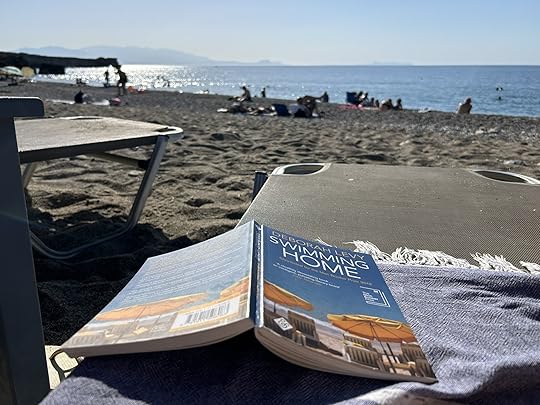
Recommended setting for reading this one:


Good enough for semi-intellectual vacation reading, not sure how it would work in a more urban landscape, unless an imaginary flight to sunnier climates is what you're aiming for.
Profile Image for Dea.
175 reviews724 followers
March 19, 2024
Another reviewer wrote “The only upside to this book is that it is only 160 pages, and thus is over relatively quickly” and that’s all I have to say.
Profile Image for Paula Mota.
1,665 reviews563 followers
July 19, 2024
Depois da chegada de Kitty Finch, para se aguentar só conseguia imitar alguém que costumava ser, mas quem essa pessoa era, quem ela costumava ser, já não parecia ser uma pessoa que valesse a pena imitar.

Tenho a impressão de que Deborah Levy é como eu: gosta é do verão. E que retemperador que foi sentir o calor da leitura nestes dias horrendos. Tal como o posterior “Hot Milk”, “Nadar para Casa” decorre no verão, no Sul da Europa, e é um livro extremamente sensorial, onde o calor irradia de cada capítulo. A luz refulgente da piscina, parte central na trama, é um contraste com a escuridão no interior das personagens, que as impede de se relacionar com transparência e afecto, bem como de ultrapassar traumas antigos.

Uma piscina era só um buraco na terra. Uma sepultura cheia de água.
E aí que entra a chuva...
- O meu poema preferido é de Apollinaire.
- Qual é?
(...)
ESTÁ SEMPRE A CHOVER.
(...)
- Está sempre a chover quando uma pessoa se sente triste.


Numa casa em que uma rapariga passa férias com o pai poeta, a mãe repórter e um casal amigo bizarro, o súbito aparecimento de uma jovem desequilibrada vem servir de acelerante àquilo que já estava corroído e a depressões latentes.
Não consigo explicar por que gosto da ficção de Deborah Levy, já que tem algo de inefável e difuso, mas parece-me escrita com a frescura de uma jovem aliada à sabedoria e ao pathos de uma mulher do alto dos seus 61 anos.

Não suporto os deprimidos. É como um emprego, é a única coisa em que trabalham no duro. Oh que bom a minha depressão está muito bem hoje. (...) Os deprimidos estão cheios de ódio e de bílis e quando não estão a ter ataques de pânico estão a escrever poemas. (...) Os poemas deles são ameaças. Sempre ameaças. Não há sensação que seja viva ou esteja mais ativa do que a sua dor. Não dão nada em troca a não ser a sua depressão.
Profile Image for MJ Nicholls.
2,275 reviews4,852 followers
August 22, 2012
This queer, disquieting novel blends a dark, surreal Topor-topos with a Hollywood noir of forties vintage. Taking place in 1994 over a week in a French holiday resort, the novel centres around stuttering botanist and exhibitionist depressive Kitty Finch and her interaction with a ragbag of unlikeable snobs, poets and snotty brats. Like her 1995 book The Unloved, Levy creates an unpleasant world with little empathy, where language is the only refuge, where the icy shimmer of the exacting prose keeps the reader entranced. The novel brought to mind This Mortal Coil’s Blood. For each moment of beautiful clarity, such as ‘Mr. Somewhere’ or ‘With Tomorrow’ there are oppressive, opaque instrumentals like ‘Andialu’ or ‘Loose Joints’ that create a stifling atmosphere, that strain to add layers of darkness to the already dreamlike beauty of the vocal-led songs ‘You and Your Sister’ or ‘Til I Gain Control Again.’ (I made my own version of Blood a few years ago, cutting out the floatier, drearier instrumentals to create a more ‘perfect’ LP). Anyway, a worthwhile investment and pleased to see this on the Booker longlist.
Profile Image for Cheryl.
330 reviews327 followers
September 11, 2012
The characters were flat, undifferentiated. They were faceless to me, doing nothing, being nothing, but somehow permeating the book with their unspoken whining. Intensely irritating. They all melted together as an amorphous mass of indecipherable...nothingness. I am so done with this book.
Profile Image for Diane S ☔.
4,901 reviews14.6k followers
October 20, 2012
3.5 Not quite sure what to make of this little gem of a book. A holiday, characters that are on course for a terrific crash of some sort, the insidious nature of depression all meet in this tightly structured, brilliantly worded novel. Every word, every scene means something, nothing is wasted. Strange but rather brilliant at the same time. Didn't quite manage to like it, but did admire it and the ending was not at all was I thought it was going to be. The tension in the novel is palpable and at times downright unconformable. So, so glad my holidays are not at all like this one.
Profile Image for Katya.
485 reviews
Read
September 17, 2023
Quando os casais oferecem abrigo ou uma refeição a pessoas perdidas ou solitárias, não as incluem realmente. Brincam com elas. Atuam para elas. E quando já lhes chega, dizem à convidada encalhada, das mais variadas formas astuciosas, que é altura de ela se ir embora.

Este Nadar para Casa passou-me completamente ao lado. A um terço estive para desistir, mas preserverei na esperança de lhe encontrar algum significado oculto, alguma ligação mais profunda. Isso não aconteceu, infelizmente.
A premissa é interessante: usar de um elemento fraturante para obrigar à ação é uma excelente ideia na maior parte das vezes. No entanto quando esse elemento fraturante é uma mulher jovem, culta e bela rotulada como mentalmente instável - por qualquer razão a nossa noção de perigo não muda ao longo dos séculos -, tentar sustentar praticamente 200 páginas com aquilo que é um mito atraente para os homens (para mim, nem por isso), isso é que, em minha opinião, não resultou, de todo.

-Porque é que toma pastilhas?
-Oh, decidi não tomar durante uns tempos. Sabe... é um alívio bastante grande sentir-me infeliz outra vez. Não sinto nada quando tomo as pastilhas.


Pegar numa família-tipo - mãe, pai, filha -, um casal amigo a puxar para o disfuncional (aparentemente), e juntar-lhe uma intrusa que virá a ser uma espécie de MacGuffin de um romance demasiado focado em si mesmo, resulta demasiado inócuo e batido para começar. Mesmo apesar de haver aqui muito material para trabalhar, sem dúvida: os estereótipos, o preconceito face não só às patologias mentais e emocionais, mas também às estruturas tradicionais (família, amor etc), e ao mister do artista e do poeta, todos estes elementos são abordados muito à superfície. Traições, falências, abuso emocional e crescimento são temas colocados no mesmo saco e que sofrem do mesmo tratamento básico: estão aqui apenas para fazer avançar a ação sem acrescentar grande coisa ao enredo.

Eu sei o que estás a pensar. Só vale a pena viver a vida porque temos a esperança de que ela melhore e de chegarmos todos a casa em segurança.

As motivações e reflexões das personagens pareceram-me inverosímeis e motivadas apenas pela necessidade de cumprir um guião; a ideia de fazer de todas elas criaturas emocionalmente imaturas, à deriva num mundo a preto e branco, não resultou comigo. À parte algumas citações mais profundas, tudo é dito e feito como por acaso, sem gravidade.

(...)ela penetrara demasiado na infelicidade do mundo para começar tudo de novo. Se pudesse optar por desaprender tudo o que supostamente a tornara mais sábia, começaria tudo de novo. Ignorante e com esperança(...).Era o melhor que se podia ser na vida.

Não resultou sobretudo a exploração de um elemento frágil para justificar um clímax que se pretende surpreendente, mas que senti apenas como politicamente correto. Como se Levy pretendesse uma espécie de justiça divina, uma ironia ex-machina que vem justiçar os estigmatizados com a doença mental apenas porque fica bem. Ninguém, em Nadar para Casa, tem verdadeiras opiniões, andam todos, uns e outros, a vogar ao sabor da corrente e por isso, quando alguém usa de uma opinião mais forte, essa afirmação, apesar de nociva, parece demasiado peregrina na sua boca para ser credível:

Não suporto OS DEPRIMIDOS. É como um emprego, é única coisa em que trabalham no duro. Oh que bom a minha depressão está muito bem hoje. Oh que bom hoje tenho mais um sintoma misterioso e vou ter outro amanhã. OS DEPRIMIDOS estão cheios de ódio e de bilis e quando não estão a ter ataques de pánico estão a escrever poemas. O que é que eles querem que os poemas deles FAÇAM? A depressão e a coisas mais VITAL neles. Os poemas deles são ameaças, SEMPRE ameaças. Não há sensação que seja mais viva ou esteja mais ativa do que a sua dor. Não dão nada em troca a não ser a sua depressão. É mais um item de primeira necessidade. Como a eletricidade e a água e o gás e a democracia. Não poderiam sobreviver sem ela.

Não acredito na sanidade mental tal como não acredito na loucura. Vivemos todos num espectro (diversos espectros de diversas coisas) e este tipo de literatura que fomenta a ideia de que as tendências suicidas e as jovens "perturbadas" são sexy porque são perigosas (o que justifica a sua exploração emocional e sexual) não me agradou nada.

(...)procurou a palavra... «perturbada»? A palavra ficou-lhe encravada na boca e ela desejou saber outra língua para traduzir o que queria dizer, porque as únicas palavras que tinha guardadas dentro de si eram do recreio da escola da sua geração, um léxico que, sem qualquer ordem particular, começava por avariada, aluada, alucinada, prosseguia com chanfrada, desatinada, com macaquinhos no sótão e depois saltitava pelo alfabeto outra vez para acabar em anormal.
Profile Image for Michael.
853 reviews636 followers
February 8, 2017
A group of tourists holidaying in the French Riviera arrive at their summer villa only to find something floating in the swimming pool. One of them thinks it’s a bear, but it turns out to be a very naked stranger. The woman Kitty, having nowhere else to go, joins the group and ends up being a big disruption to the group in this deeply psychology dark novel.

Ok, I’ll admit that the main reason I decided to read this book was because it was short listed for the Man Booker award but let’s face it, after reading what the book was about, I thought it was my type of book. These characters are rich and the addition of a very explosive character made for a fascinating read. At times during the book I felt reminded of that 90’s psychological thriller Wild Things; there was so many unanswered questions that really helped drive this story along. Sure, it is not as twisted as that movie but the psychological aspects are there; at times there are even shades of noir coming through.

Deborah Levy does so much with such a small book; the joy of reading the book is seeing what she doesn’t say. In this aspect I think I would compare her to someone like Kafka, where what she says has so much depth and meaning that it’s really what makes this book so great. Womanising and depression maybe the catalyst but my joy came from the dark and witty elements found throughout this writing.

I’ve not read any of the other books shortlisted for this year Man Booker but I’m hoping this book wins; it has so much in it and I think winning this award would give it the exposure that this book deserves. I’m sure there are many elements of this book I might have missed but I enjoyed the book so much that I’ve already started reading through it again. A literary highlight for my reading journey this year; Swimming Home is well worth picking up.

This review originally appeared on my blog; http://www.knowledgelost.org/book-rev...
Profile Image for Bonnie.
1,460 reviews1,094 followers
November 15, 2015
Swimming Home was kindly provided to me by Netgalley for Bloomsbury USA.

"Life is only worth living because we hope it will get better and we'll all get home safely."

After spotting this on Netgalley I found myself intrigued but ultimately willing to wait for it to be published. A few days later the Shortlist for the 2012 Man Book Prize was announced and Swimming Home was included, so I decided it was fate that I stumbled upon this book yet again so I went ahead and snagged it.

Kitty, botanist, poet, and part-time exhibitionist suffering from depression, travels to France to meet poet Joe Jacobs who she insists she has a connection with. His wife, Isabel, inevitably gets invited to stay with him and his family and the couple that traveled with them. Isabel Jacobs, a war correspondent, is married to Joe; however, their marriage is in shambles and is obvious to anyone in their proximate vicinity. It is unclear to everyone why Isabel would allow such a girl as Kitty to stay with them, especially considering her obvious fascination with Joe.

"When Kitty Finch took her hand off the steering wheel and told him she loved him, he no longer knew if she was threatening him or having a conversation."

Swimming Home is a short yet trying read that could almost be considered a novella or even a vignette; a snapshot of that fateful week in France. The writing was intermittently lovely but I found myself unclear as to where the story was going. I can't help but feel I'm lacking in something by not being able to appreciate these 'literary masterpieces' as they should be. Comments were made by the judges of the Booker Prize this year that they're steering clear of mainstream books and that readability isn't high on their list of importance. Sir Peter Stothard was quoted as saying: “I felt very, very strongly that I wanted to avoid that thing where people say, ‘Wow, I loved it, it’s terrific’.” Suffice it to say, I did not finish this book and say, "Wow, I loved it, it's terrific," so I guess they got something right. I think it's safe to say I won't be venturing into anything else this man considers 'literary masterpieces', they're simply not for me.
Profile Image for Karen·.
682 reviews900 followers
Read
October 18, 2013
Note: this review is not very original, since it uses a deal of quotation. And it isn't about the book much either. Please feel free to flag it.

Kitty takes fourteen year old Nina pony riding. I'm not sure why, really, as it seems a little unlikely (Nina is fourteen going on twenty, and not the horsy sort). But there's rather a lot of the unlikely here, so all par for the course. Anyway, it provides us with this memorable scene:

(Kitty) was waving at someone, trying to get the attention of a woman sitting alone on the terrace outside the café.
'It's Dr Sheridan. Let's go and say hello.'
She walked the pony straight off what remained of the trail and led it up the three shallow concrete steps towards Madeleine Sheridan, who had taken off her spectacles and placed them on the white plastic table next to her book.
Nina found herself stranded on the pony as Kitty led her past the bemused waitress carrying a tray of Orangina to a family at a nearby table. The old woman seemed to have frozen on her chair at the moment she was about to put a cube of sugar into her cup of coffee. It was as if the sight of a slender young woman in a short blue dress, her red hair snaking down her back, leading a grey pony on to the terrace of a café was a vision that could only be glanced at sideways. No one felt able to intervene because they did not fully know what it was they were seeing. It reminded Nina of the day she watched an eclipse through a hole in coloured paper, careful not to be blinded by the sun.


I found this particularly memorable because I read it on the evening of a day when I had had a vision of my own, one that left me unable to move or react because I did not fully know what it was I was seeing. Last weekend, the man in my life and his twin brother celebrated their 60th birthday, so we went away with the whole family to a charming old town called Celle, full of olde worlde half timbered houses and a town church that was built some two hundred years before America was discovered.

Photobucket Pictures, Images and Photos

Lovely place.

After a fascinating guided tour on Saturday morning, the two family groups split up as our nieces had planned a little treat for their Dad. We, that is husband, daughter number one and I, took my father-in-law for a spot of lunch in one of the old town restaurants, and just as we were starting our meal, I looked up to see someone standing at our table, grinning all over her face. I stared and stared because she looked so similar to daughter number two, and yet it couldn't possibly be, as she lives in Canada.

But it was!

It took a while for the old brain to understand what it was seeing. My older daughter said afterwards she'd have loved to have recorded on camera the facial expressions that expressed that process of initial disbelief, then growing astonishment - thank god she didn't as I'd have had to blackmail her into destroying the pictures. My riposte was that it's just as well none of us have a weak heart, even my 89 year old father-in-law.

Unfortunately, this was about the only truly memorable incident in this book, and that was purely personal to me. None of the characters really came to life. Describing their hair colour and what they're wearing doesn't really cut it. Even the green nail varnish didn't help. Unfathomable people doing unfathomable things. Yes, they are all so terribly damaged and having such a hard time. Does that make me sound heartless? Aye, I daresay, but then this didn't succeed in going past the fictional.
Profile Image for Bianca.
1,318 reviews1,146 followers
October 25, 2018
Hot Milk was one of my favourite reads of last year, so I was beyond delighted to discover that I had on my bookshelves another Levy novel and one that was nominated for the Man Booker Prize, no less.

It's a very small novel, more like a novella.

I'm not sure what to make of it. I really like Levy's writing style, it's stark but there's an ethereal quality about it. Swimming Home is definitely a work of literary fiction, as style and characterisations are more important than the plot. It's a very atmospheric novel, I found myself seeing everything and everyone very clearly as if I was watching a film.

I have some grumbles as well: there are quite a few secondary characters that are put there just as fillers, I didn't think they added that much to the story. It's a good story, albeit I would have liked a bit more meat to it.

In my view, it's not as accomplished as Hot Milk, but it definitely showcases Levy's talent.

3.5 stars rounded up
Profile Image for Caroline.
243 reviews194 followers
July 30, 2020
What a peculiar little book? Being on the Man Booker long list, this is a quintessential Booker type book; Beautiful writing, weird ‘literary’ type characters and a half finished plot filled with unease. A family holiday turns to a disaster when a stereotypical ‘manic, dream pixie girl’ turns up as a crazy fan of the poet father. It’s all quite predictable but full of suspense. It’s a weird read. Still not sure if I liked it or not?!
Profile Image for Trish.
1,422 reviews2,711 followers
February 2, 2013
Shortlisted for the 2012 Man Booker Prize, this slim book reads like a play, the action centered on a small group of people gathered at a tourist villa in seaside France. Levy is a playwright and poet as well as a novelist, and this informs her fiction. Description is given like stage direction: ”His daughter, Nina Jacobs, fourteen years old, standing at the edge of the pool in her new cherry-print bikini, glanced anxiously at her mother.” The poetry comes through in the spare and precise language.

Consider the name Kitty Finch. Both predator and prey, she is our protagonist. Her eyes are the grey of “the tinted windows of the [Mercedes] hire car,” harder to see into than it is to see out. She is quite mad: “touched…barmy, bonkers, barking…” And she likes to be naked, which is where we first see her, floating in the pool of the tourist villa in the Alpes-Maritimes.

She is not dead, when they find her, the family that takes her in. She is off her meds, and stalking the famous poet in the family, though they don’t know that at first. What they all seem to understand at a glance, and we readers also, is that this young woman is going to be trouble.

The truth is, in Deborah Levy’s hands, all of the characters are naked, even young Nina Ekaterina in her cherry-print bikini is naked at the end. Isabel, her mother, is a hyper-kinetic TV journalist who dreams of leaving her famous poet husband, “JHJ, Joe, Jozef, the famous poet, the British poet, the arsehole poet, the Jewish poet, the atheist poet, the modernist poet, the post-Holocaust poet, the philandering poet,” after another of his trysts. The friends Laura and Mitchell wear their defeat like an empty wallet or a fat-padded suit. Madeline, the doctor, is old and close to death: “her nails were crumbling, her bones weakening, her hair thinning, her waist gone forever. The smell of burnt sugar made her greedy for the nuts that would at last, she hoped, choke her to death.” For all of these characters, “ITS RAINING.”

But they all realize, eventually, that there really isn’t anything they would change about each other. Isabel wanted to tell Jozef that “she would have liked to feel his love fall upon her like rain. That was the kind of rain she most longed for in their long unconventional marriage.” And Nina finds herself talking to her father long years later, on a bus when “rain is falling on the chimney of Tate Modern.” “Life must always win us back” from our dreams, especially when it rains.

My favorite passage, given to Joe, is quoted here at length:
”I can’t stand THE DEPRESSED. It’s like a job, it’s the only thing they work hard at. Oh good my depression is very well today. Oh good today I have another mysterious symptom and I will have another one tomorrow. The DEPRESSED are full of hate and bile and when they are not having panic attacks they are writing poems. What do they want their poems to DO? Their depression is the most VITAL thing about them. Their poems are threats. ALWAYS threats. There is no sensation that is keener or more active than their pain. They give nothing back except their depression. It’s just another utility. Like electricity or water and gas and democracy. They could not survive without it. GOD, I’M SO THIRSTY. WHERE’S CLAUDE?”

Profile Image for Umut.
355 reviews161 followers
July 14, 2019
The individual sentences, the laters peeling slowly were the aspects I liked in this book.
But, specifically it's not a style I enjoy reading. So, it's safe to say it just wasn't for me.
Profile Image for Rita.
905 reviews185 followers
May 15, 2023
A tênue linha entre a sanidade e a loucura.

Nadar para Casa narra a história de um grupo de personagens problemáticos durante umas férias de verão na deslumbrante Riviera Francesa. O enredo gira em torno do impacto provocado pela chegada de uma jovem enigmática e psicologicamente instável chamada Kitty Finch.
À medida que a presença de Kitty se torna cada vez mais invasiva, as tensões entre as personagens intensificam-se.
Todo o enredo possui uma pitada surrealista que não me cativou completamente, talvez as minhas expectativas fossem ficar mais impressionada do que realmente fiquei.
Profile Image for Literatursprechstunde .
196 reviews93 followers
July 14, 2024
Dieser kurze Roman dreht sich um einen Ehemann, eine Frau, ihre Tochter im Teenageralter und zwei Freunde der Familie, die in einer Villa an der französischen Riviera Urlaub machen. Als sie ankommen, finden sie eine schöne junge Frau, Kitty Finch, die nackt im Pool des Hauses schwimmt, das sie gemietet haben.

Der Roman erzählt die Geschichte sehr detailreich und in experimenteller Form - die nächsten Tage werden geschildert und die Nachwirkungen, die Kittys Eindringen in ihren Urlaub auslöste.

Der Mann im Mittelpunkt der Geschichte ist Joe Jacobs, ein Dichter und Romantiker mit einem Hinweis auf eine traumatische Vergangenheit. Die Frau ist seine Frau Isabelle, die sich ihrem Job als Kriegskorrespondentin widmet und mehr Zeit damit verbringt, über tragische und gewalttätige Ereignisse im Ausland zu berichten, als mit der Familie.

Es wird schnell klar, dass Kitty ein Fan von Joes Poesie ist und dieses Wochenende wegen ihrer Besessenheit von ihm forciert hat. Es steht auch von Anfang an der Vorschlag einer Affäre zwischen Jo und Kitty im Raum (das passiert auf der ersten Seite, kein Spoiler, versprochen)

Dieses Buch ist unglaublich immersiv. Es besteht aus einer kleinen Konstellation von Charakteren und nur ein paar Orte für Szenen, die Villa und ein Café in der Stadt. Es gibt keinen Firlefanz, keine Extras, die Geschichte spielt vollständig in der Welt dieses Urlaubs. Die Welt dieser Geschichte steht sinnbildlich für die Welt im Ganzen.

Levy achtet auf jedes Detail und beschreibt sie anschaulich, von der Art und Weise, wie die Villa bröckelt, bis hin zu den Joghurtflecken, die im Schnurrbart eines Mannes zurückgelassen werden, während er spricht. Der Erfolg der Form dieser Geschichte spiegelt sich in ihren Wiederholungen und Mustern. Einige Beobachtungen und gelegentlich ganze Szenen werden mehrmals mit subtilen Perspektivwechseln überarbeitet, die die Subjektivität der Realität hervorheben. Dies ist auch ein Expertenwerkzeug, um zu zeigen, wie das Ereignis, das die Erzählung auslöst, Kitty im Pool, jeden Charakter anders beeinflusst. Sie sind alle zusammen zu Beginn, wenn sie Kitty entdecken, aber das ist das letzte Mal, dass alle zusammen an einem Ort sind. Es ist der Punkt der Divergenz und dann bekommen wir, die Leser, die nächsten Tage die Figuren mehrmals aus verschiedenen, unzusammenhängenden Perspektiven zu sehen.

In diesem Buch gibt es Themen wie Untreue, psychische Gesundheit, Klassismus und Gier, Voyeurismus und Generationentrauma. Aber die Frage, die es aufwirft, die ich am interessantesten finde, ist welche Rolle die Worte spielen können in Bezug auf die Traurigkeit der Welt.

Diese Frage ist in der zentralen Beziehung zwischen Joe und Isabelle entstanden.

Jo repräsentiert die Verwendung von Wörtern, um Kunst zu schaffen in Form von Poesie. Wir erfahren, dass er in seinem Leben erhebliche Schmerzen erlebte, aber die Poesie sein ständiger Begleiter war. Isabelle hingegen verwendet Worte, um über die Fakten zu berichten und Wissen als Journalistin zu verbreiten. Joe erlebt seine Traurigkeit tief, lässt sie an sich ran. Isabelle hingegen bleibt stoisch, gefühllos und während der gesamten Geschichte verhärtet. Sie lässt sich nicht einmal durch die Drohung ihres Mannes beirren, sie zu betrügen.

Der Journalismus wirft ein Licht auf die Welt. Die Poesie hingegen wirft ein Licht auf das Innere des Autors.

Man kann entweder die Welt in Fakten sehen und weiterhin über die Tragödien der Welt berichten, oder man kann die Welt als ein schönes Durcheinander sehen und auch die ihr innenwohnende Traurigkeit hereinlassen, ihre Grenzen durchbrechen und ein Teil von ihr werden.

Letztendlich kommt dieses Buch zu dem Schluss, dass die Traurigkeit der Welt zu sehen und sie an sich ranzulassen, gleichzeitig bedeutet schöne Kunst zu schaffen (in Form von Literatur und Poesie) und unerträgliche Schmerzen zu haben.
Profile Image for Jennifer.
748 reviews114 followers
October 23, 2012
I've been putting off this review because Swimming Home has me a little stymied. Two families on holiday in a villa in Nice are surprised when a naked woman is found swimming in the pool one morning. Kitty Finch, the story's catalyst, has no where to stay and is invited to take a room with the in the villa. We soon learn that she is not there by accident but that she is there to meet Joe, a famous poet, to have him read one of her poems. The plot unfolds through the eyes of several different characters, each of whom have their own secrets and insecurities that are revealed over the week as they interact with Kitty and with each other.

I enjoyed Levy's writing style and her economy of language. The epilogue, however, did not ring true to me and felt out of place with the rest of the story. I closed this book feeling generally flat and with little care for the characters or what happened to them. My strongest emotion on finishing was a curiosity that the book has struck such a chord with people. It left me wondering what I'm missing that everyone else seems to have gotten out of this book - including the Booker Prize judges who short listed it this year. Just another good book that didn't work for me.
Profile Image for Mike.
113 reviews241 followers
May 12, 2014
The antiquarian bookstore I most often frequent has two sections: "Fiction and Literature," where you'd find Michael Ondaatje and Grace Paley and Lorrie Moore, and "General Fiction," where you'd find Nicholas Sparks and Jodi Picoult and Candace Bushnell. I found Swimming Home in the latter section. Don't blame the staff. Blame the covers of the most recent editions, with their benevolent blues and suburban lawn greens. Blame the title (which serves in the novel as the title of a poem-cum-suicide note), with its evocation of a slow return to domestic security. But for the record, the novel itself exists as far from the world of "General Fiction" as a Lucretia Martel film. It's a savage, lucid text, deserving comparison with DeLillo's The Body Artist, Ballard's High-Rise (though in Ballard all the swimming pools are empty), and Joy Williams's grossly undervalued The Changeling: deceptively quiet narratives in which normality is shattered by the arrival of an unpredictable alien intelligence. Levy's extraordinary prose still lingers in my memory, haunting me a week after I finished the book.

He slipped his hands around her neck and untied the white satin ribbon of her feather cape. The four-poster bed draped in heavy white gold curtains resembled a cave. She heard a car alarm go off while seagulls screamed on the window ledge and her eyes were fixed on the wallpaper. The white feathers of her cape lay scattered on the sheet as if it had been attacked by a fox. She had bought it in a flea market in Athens but had never worn it until now. A swan was a symbol of the dying year in autumn, she had read that somewhere. It had stuck in her head and made her think of the way swans stick their heads in the water and turn themselves upside down. She had been saving the cape for something, perhaps for this; it was hard to know what she had had in mind when she exchanged money for the feathers that had insulated this water-bird from the cold and were also made from quills that were once used as pens. He was inside her now but he was inside her anyway, that was what she couldn't tell him but she had told him in her poem which he had not read and now the car alarm had stopped and she could hear voices outside the window. A thief must have broken into a car, because someone was sweeping up broken glass.

After a while he ran her a bath.
Displaying 1 - 30 of 2,043 reviews

Can't find what you're looking for?

Get help and learn more about the design.