

What do you think?
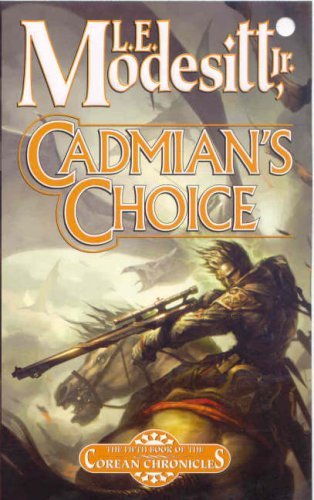
Corean Chronicles #5
Cadmian's Choice
Cadmian's Choice, book five of the Corean Chronicles, continues the epic fantasy series by L. E. Modesitt, Jr., author of the bestselling Saga of Recluce. Enter this new and exciting world.
Millennia ago, a magical disaster caused the fall of a civilization, the end of a golden age. New civilizations emerged from the ancient destruction and chaos, knowing little of the past or the disaster. Corus today is a world of contending countries, humans, and supernatural creatures. It is a place of magical powers, and of a few people who are talented enough to use them.
The time approaches for the transfer of the entire population of the old world, nearly bled dry of life force, to Corus. But neither Dainyl and the other Alectors, who face a reduced status, nor Mykel and the local humans, destined to become little more than cattle, are ready.
The Corean Chronicles
Legacies
Darknesses
Scepters
Alector's Choice
Cadmian's Choice
Soarer's Choice
The Lord-Protector's Daughter
Lady-Protector
Other series by this author:
The Saga of Recluce
Imager Portfolio
The Spellsong Cycle
The Ghost Books
The Ecolitan Matter
Millennia ago, a magical disaster caused the fall of a civilization, the end of a golden age. New civilizations emerged from the ancient destruction and chaos, knowing little of the past or the disaster. Corus today is a world of contending countries, humans, and supernatural creatures. It is a place of magical powers, and of a few people who are talented enough to use them.
The time approaches for the transfer of the entire population of the old world, nearly bled dry of life force, to Corus. But neither Dainyl and the other Alectors, who face a reduced status, nor Mykel and the local humans, destined to become little more than cattle, are ready.
The Corean Chronicles
Legacies
Darknesses
Scepters
Alector's Choice
Cadmian's Choice
Soarer's Choice
The Lord-Protector's Daughter
Lady-Protector
Other series by this author:
The Saga of Recluce
Imager Portfolio
The Spellsong Cycle
The Ghost Books
The Ecolitan Matter
609 pages, Paperback
First published January 1, 2006
About the author
L.E. Modesitt Jr.
188 books2,657 followersL. E. (Leland Exton) Modesitt, Jr. is an author of science fiction and fantasy novels. He is best known for the fantasy series The Saga of Recluce. He graduated from Williams College in Massachusetts, lived in Washington, D.C. for 20 years, then moved to New Hampshire in 1989 where he met his wife. They relocated to Cedar City, Utah in 1993.
He has worked as a Navy pilot, lifeguard, delivery boy, unpaid radio disc jockey, real estate agent, market research analyst, director of research for a political campaign, legislative assistant for a Congressman, Director of Legislation and Congressional Relations for the United States Environmental Protection Agency, a consultant on environmental, regulatory, and communications issues, and a college lecturer and writer in residence.
In addition to his novels, Mr. Modesitt has published technical studies and articles, columns, poetry, and a number of science fiction stories. His first short story, "The Great American Economy", was published in 1973 in Analog Science Fiction and Science Fact.
-Wikipedia
He has worked as a Navy pilot, lifeguard, delivery boy, unpaid radio disc jockey, real estate agent, market research analyst, director of research for a political campaign, legislative assistant for a Congressman, Director of Legislation and Congressional Relations for the United States Environmental Protection Agency, a consultant on environmental, regulatory, and communications issues, and a college lecturer and writer in residence.
In addition to his novels, Mr. Modesitt has published technical studies and articles, columns, poetry, and a number of science fiction stories. His first short story, "The Great American Economy", was published in 1973 in Analog Science Fiction and Science Fact.
-Wikipedia
Ratings & Reviews
Friends & Following
Create a free account to discover what your friends think of this book!
Community Reviews
Displaying 1 - 30 of 30 reviews

November 13, 2017
This is the second book in the second trilogy of the Corean Chronicles. These should definitely be read in order. I'm not sure if the first trilogy shouldn't be read last on a reread since it is the last chronologically, though. I never have, but I might next time. Yes, these are rereadable since it's a complex world with even even more political & magic systems that we slowly learn more about in each book.
It's so cool to get more information & see this complex world slowly emerge as the characters learn more. In the first trilogy, these days are long gone, so the main character can only look at the ruins & try to imagine what might have been, but there isn't enough information. Now we're seeing what & how all that happened & left the world in that state. Items that were so important then are occasionally mentioned now, often as minor things of interest.
This book, like the previous one alternate between an Alector's & a Cadmian's point of view. They're both honorable men trying to get by in pretty tough world with events escalating & that generally makes them uneasy allies. That tension is at least as engaging as anything else. We're rooting for both even though one might have to destroy the other.
On to the next! Can't wait. Highly recommended, of course. Well narrated.
It's so cool to get more information & see this complex world slowly emerge as the characters learn more. In the first trilogy, these days are long gone, so the main character can only look at the ruins & try to imagine what might have been, but there isn't enough information. Now we're seeing what & how all that happened & left the world in that state. Items that were so important then are occasionally mentioned now, often as minor things of interest.
This book, like the previous one alternate between an Alector's & a Cadmian's point of view. They're both honorable men trying to get by in pretty tough world with events escalating & that generally makes them uneasy allies. That tension is at least as engaging as anything else. We're rooting for both even though one might have to destroy the other.
On to the next! Can't wait. Highly recommended, of course. Well narrated.
July 5, 2012
I liked this book the best of the 1st five in the series. The dynamic between the Cadmian major and the Alectors was very interesting to me. You definitely should read the 1st books in the series before this one. I started with the last of the 3 trilogies in this series (far in the future) because Book 7 was available in the library, but have enjoyed going back and filling in the blanks about this world. I still have a few books to go in the Recluce series, but I have liked this Corus series at least as well, perhaps better. The Imager series is great too.

July 21, 2008
Another fine read from this prolific author.

May 6, 2020
The planet Corus, invaded by a parasitic race that migrates from planet to planet, totally depleting a world’s life force before moving on, is being redesigned to become the new home when the currently occupied planet, Ifra, is exhausted. This redesign is overseen by the Duarchy, two officials who rule Corus on behalf of the Autarch of Ifra. Their staff of psychically Talented Alectors use superior armaments to control the non-Talented settlers, whom they call “steers”. The time is now fast approaching for the transfer of the whole race from Ifra to Corus. But neither the Alectors (who will lose status when the full Talents arrive) nor the local population (uninformed of their apparent future as prey) are ready. Surrounded by plots, Dainyl, the Alector SubMarshal of Myrmidons, the third-highest-ranking military officer of the Duarchy, tries to do his duty, as does young Major Mykel, a psychically talented young officer commanding a Cadmian [settler] battalion. Both the SubMarshal and the major are in contact with the ancient soarers, an indigenous race of flying beings thought extinct. Mykel and Dainyl must struggle to discover what lies behind the power plays in which they are entangled before being destroyed, and neither can afford to reveal the extent of his Talent for fear of retribution. Both strive to understand what is occurring around them, and what their choices and moral responsibilities are. "Cadmian’s Choice" is the transitional book of 3 that tell the story of the original settlement of Corus.

June 3, 2017
This is the fifth book in "The Corean Chronicles," a series that feels like fantasy, while containing science fiction elements. It continues the story of Mykel and Dainyl, switching between these two main characters, who were both introduced in book four. As with book four, I found Mykel considerably the more appealing character, and wanted to hurry on to his sections whenever it was Dainyl's turn. This is always a risk with stories that have more than one protagonist. (I think, for me, this is at its most extreme with George R. R. Martin's "A Song of Ice and Fire.") As a result, I enjoyed this less than most of the thirty-something books that I've read by Modesitt. But that's a high bar for me. He's one of the authors I find most consistently entertaining.

January 25, 2018
I found this riveting and just wanted to keep reading the story. The strange, ambivalent relationship between Mykel and Rachyla adds spice; and the relentless build-up of tension between the alien Ifrits and the native Ancients keeps one turning the pages…

May 28, 2020
Still a lot of killing but detailed plots, intrigue and plenty of deviousness. Who will come out on top is a mystery. Everyone is keeping secrets but some hide guile while others are working towards a unity and clarity of vision.

February 20, 2019
I liked the adventure.

September 19, 2022
A reread, and not disappointed.
May 12, 2023
fine. fun enough.
February 11, 2013
In this second book of the prequel trilogy, we continue to follow the dual stories of Dainyl, the alector near the top of the military command, and Mykel, now in command of a battalion of mounted rifles. As in the earlier book, both are admonished by the mysterious "ancients" to develop their own "talent" and become more connected to the land. In Mykel's case, he must do this without being discovered by other alectors, since the nation's laws forbid talented "landers" like Mykel: he will be killed outright. Dainyl suspects Mykel's talent, but has his own reasons for not killing him or turning him in. At least, not yet.
In this book, we finally learn more of what is going on, and who is aligned with whom in the political power games among the high alectors running the nation. Well, some of what is going on. In any case, the motivations for most of these players remain unknown. Dainyl must do his best to quell unrest and prevent further bloodshed that some (for reasons not yet known) seem to want to encourage. One of his most useful tools is Mykel and his battalion.
At the end of this book, Dainyl joins with Mykel's battalion to put down a revolt of alectors. That they do so successfully makes Mykel and his men especially dangerous to the powers that be, since they have learned firsthand how to kill alectors (who have spent centuries building up an impression of invulnerability to lander attacks). However, since it is not clear that this is the last alector revolt, Mykel's command is ordered directly to the next hotspot and not eliminated out of hand. Meanwhile, Dainyl's success has interfered with the Machiavellian plans of other alectors high in government. Since personal attacks seem to be permitted between government alectors, provided the survivor can present a palatable explanation (no matter how flimsy) for the death of their opponent, Dainyl must quickly learn to use his talent to survive these attacks.
In this book, we finally learn more of what is going on, and who is aligned with whom in the political power games among the high alectors running the nation. Well, some of what is going on. In any case, the motivations for most of these players remain unknown. Dainyl must do his best to quell unrest and prevent further bloodshed that some (for reasons not yet known) seem to want to encourage. One of his most useful tools is Mykel and his battalion.
At the end of this book, Dainyl joins with Mykel's battalion to put down a revolt of alectors. That they do so successfully makes Mykel and his men especially dangerous to the powers that be, since they have learned firsthand how to kill alectors (who have spent centuries building up an impression of invulnerability to lander attacks). However, since it is not clear that this is the last alector revolt, Mykel's command is ordered directly to the next hotspot and not eliminated out of hand. Meanwhile, Dainyl's success has interfered with the Machiavellian plans of other alectors high in government. Since personal attacks seem to be permitted between government alectors, provided the survivor can present a palatable explanation (no matter how flimsy) for the death of their opponent, Dainyl must quickly learn to use his talent to survive these attacks.
March 3, 2015
Cadmian's Choice by L.E. Modesitt, jr
This is book five of the Corean Chronicles. The origins of Corus's problems are further exposed in this book. Book four focused on the Alector's point of view. This book presents more of the Cadmian officer, Majer Mykel's viewpoint.
Point of view may be somewhat simplistic. This volume shows some of the origins of the problems faced by Alucius, the main protagonist, in the first three books. This book is set several thousand years before the first three books.
Dainyl, of the ruling class, is forced to enhance his own talent and to reassess his feelings on steers. Mykel, the steer discovers he is not one of the herd. His latent talent continues to grow after one of the native Soarers points it out to him. Talented refers to the ability to manipulate time, energy or matter.
Modesitt has the ability to take contrary points of view from book to book in the same series. I find that quite thought provoking. He deals with arrogance and prejudice in an inoffensive manner but still provokes the questions of human motivation. The failure of life on a distant planet underlines the motivation of perceived villainy. The husbanding of resources and the care of the environment is subtly promoted by Modesitt's work.
I am an admitted admirer of Modesitt's style and work. There is a common thread of honor and responsibility through his work. His characters struggle to maintain their core identities and to remain truly humble in spite of increasing power.
I highly recommend.
Site: http://www.lemodesittjr.com/
This is book five of the Corean Chronicles. The origins of Corus's problems are further exposed in this book. Book four focused on the Alector's point of view. This book presents more of the Cadmian officer, Majer Mykel's viewpoint.
Point of view may be somewhat simplistic. This volume shows some of the origins of the problems faced by Alucius, the main protagonist, in the first three books. This book is set several thousand years before the first three books.
Dainyl, of the ruling class, is forced to enhance his own talent and to reassess his feelings on steers. Mykel, the steer discovers he is not one of the herd. His latent talent continues to grow after one of the native Soarers points it out to him. Talented refers to the ability to manipulate time, energy or matter.
Modesitt has the ability to take contrary points of view from book to book in the same series. I find that quite thought provoking. He deals with arrogance and prejudice in an inoffensive manner but still provokes the questions of human motivation. The failure of life on a distant planet underlines the motivation of perceived villainy. The husbanding of resources and the care of the environment is subtly promoted by Modesitt's work.
I am an admitted admirer of Modesitt's style and work. There is a common thread of honor and responsibility through his work. His characters struggle to maintain their core identities and to remain truly humble in spite of increasing power.
I highly recommend.
Site: http://www.lemodesittjr.com/
August 20, 2013
I am always worried about not stopping with the first book in the series if it was good because I don't want to be disappointed later, but no book in this series disappointed me, and I feel best for having read them all. The story comes full circle and answers any questions and loose ends by the end of the series.
One of my favorite series ever. I loved the main character and seeing how he would outsmart his troubles. I loved a lot if the descriptions about the world, and the magic is genius and fairly original. I don't usually care for political/war issues, but they were do character-centered that I felt it added to the story considerably. The author clearly spent a long time organizing the backstory. I've had a hard time finding books I like this much except with this author.
One of my favorite series ever. I loved the main character and seeing how he would outsmart his troubles. I loved a lot if the descriptions about the world, and the magic is genius and fairly original. I don't usually care for political/war issues, but they were do character-centered that I felt it added to the story considerably. The author clearly spent a long time organizing the backstory. I've had a hard time finding books I like this much except with this author.

June 3, 2015
Cadmian’s Choice is the fifth book in L.E. Modesitt Jr’s COREAN CHRONICLES and the second in the trilogy about Mykel and Dainyl. You don’t need to read the first trilogy in the COREAN CHRONICLES (Legacies, Darknesses, Scepters) before reading this one. In fact, I think it makes more sense to read this trilogy first since it focuses on events that occur generations before Legacies. However, you do need to read Alector’s Choice before starting Cadmian’s Choice.
In Alector’s Choice we met Mykel, a “lander” who lives on the planet Corus. He, like most of Modesitt’s protagonists, is ultra-honorable and ultra-competent, and he has risen remark... Read More: http://www.fantasyliterature.com/revi...
In Alector’s Choice we met Mykel, a “lander” who lives on the planet Corus. He, like most of Modesitt’s protagonists, is ultra-honorable and ultra-competent, and he has risen remark... Read More: http://www.fantasyliterature.com/revi...

January 16, 2009
For some reason, this trilogy just isn't as interesting as the previous Legacies trilogy. It could just be that I don't like the two protagonists in this series as much as I liked Alucius in the previous series. This book especially is politics-heavy, with only infrequent bits of action. One thing that Modesitt tends to do, that has become slightly annoying, is to spend more time in description than in actual action. It is nice to see how this prequel fits in with the Legacies trilogy, seeing where and how various things came about.

July 17, 2009
I assumed this book would be like the author's Recluce series, meaning I could read the books in any order and it wouldn't matter. Maybe it's meant to be the same for this series but personally I felt like I was missing a lot of the references and the back-plot.
Too much politics in this book for my liking. Normally I can't put LE Modesitt's books down however this one took a long time to get finished so I don't think I'll bother reading the series from the start.
Too much politics in this book for my liking. Normally I can't put LE Modesitt's books down however this one took a long time to get finished so I don't think I'll bother reading the series from the start.

May 1, 2016
On the world of Acoros a power struggle is occurring over life-force and Submarshal Dainyl and Meyer Mykel are caught in the middle. The ancients have returned and troops are disappearing along with weapons. Rebellions are being fermented in the East. The story becomes a little difficult to follow as it bounces between the two heroes.

July 18, 2016
Fantasy series
Fifth book in the Corean Chronicles. Getting a bit old and still do not understand what the alectors are all about. Despite a separation of thousands of years from the first trilogy they still have calvary charges and no change in technology. What gives?
No Canadian or pharmacy references.
Fifth book in the Corean Chronicles. Getting a bit old and still do not understand what the alectors are all about. Despite a separation of thousands of years from the first trilogy they still have calvary charges and no change in technology. What gives?
No Canadian or pharmacy references.

January 1, 2014
I enjoyed this installment of the Corean Chronicles. The pace was slower, and there was a ton of set up and political maneuvering. The payoff was well worth it. I'm interested to see what Soarer's Choice adds to the stories of Mykel and Dainyl.

September 2, 2015
A joy to read
The detail and forethought put in to this book is amazing. I love the world and the characters in it. Both Dainyl and Mykel are strong and honorable men. Trying to do what is best for their world. Loved every word!
The detail and forethought put in to this book is amazing. I love the world and the characters in it. Both Dainyl and Mykel are strong and honorable men. Trying to do what is best for their world. Loved every word!
Read
January 28, 2009Corean Chronicles

March 23, 2009
One more after this but its not at my Library. Have to wait to finish the tril and truthfully its hardly worth it

September 17, 2009
The Recluse saga is better developed and gives many of the same plot points.

February 12, 2012
Re-read
Re-read, 8/14. Upped to 4 stars.
Listened, 3/22 ; 1/24 ; 2/26.
Re-read, 8/14. Upped to 4 stars.
Listened, 3/22 ; 1/24 ; 2/26.
August 9, 2012
A strong sequel. Lots of action, good expansion of the world, fun characters. The Corean Chronicles in general are some of my favorite work by Modesitt, and this lives up to that high bar.

March 31, 2013
Retroactive Review (12 Jun 2022): Please see my review of the subseries
here
under the first volume.

September 5, 2013
fifth book in the series. I will read the sixth. But his series are beginning to sound the same.

March 31, 2014
I listened to this for my second reading, the plot is fairly straightforward, it's easy not to loose track of what's going on. A decent listen.

November 15, 2011
Just grinding through the series.

April 30, 2019
Decent story
Displaying 1 - 30 of 30 reviews