"An extraordinary record of a great artist in his studio, it also describes what it feels like to be transformed into a work of art." ― ARTnews
Lucian Freud (1922–2011), widely regarded as the greatest figurative painter of his time, spent seven months painting a portrait of the art critic Martin Gayford. The daily narrative of their encounters takes the reader into that most private place, the artist's studio, and to the heart of the working methods of this modern master―both technical and subtly psychological. From Man with a Blue Scarf emerges an understanding of what a portrait is, but something else is also a portrait, in words, of Freud himself. This is not a biography, but a series of the artist at work and in conversation in restaurants, taxis, and his studio. It takes one into the company of the painter who was a friend and contemporary of Pablo Picasso, Alberto Giacometti, and Francis Bacon, as well as writers such as George Orwell and W. H. Auden.
Now for the first time as a compact paperback, this book is illustrated with works by Lucian Freud, telling photographs of Freud in his studio, and images by great artists of the past, such as Vincent van Gogh and Titian, who are discussed by Freud and Gayford.
Full of wry observations, the book reveals how it feels to pose for a remarkable artist and become a work of art.
Martin Gayford is an art critic and art historian. He studied philosophy at the University of Cambridge, and art history at the Courtauld Institute of Art at the University of London. Over three decades, he has written prolifically about art and music in a series of major biographies, as well as contributing regularly to newspapers, magazines and exhibition catalogues. In parallel with his career as an art historian, he was art critic of The Spectator magazine and The Sunday Telegraph newspaper before becoming Chief Art Critic for the international television network, Bloomberg News. He has been a regular contributor to the British journal of art criticism, Modern Painters.
His books include a study of Van Gogh and Gauguin in Arles, The Yellow House: Van Gogh, Gauguin, and Nine Turbulent Weeks in Arles (Little Brown, 2006), which was published in Britain and the USA to critical acclaim, and has been translated, to date, into five languages; Constable in Love: Love, Landscape, Money and the Making of a Great Painter (Penguin, 2009), a study of John Constable’s romance with Maria Bicknell and their lives between 1809 and 1816; and A Bigger Message: Conversations with David Hockney (Thames and Hudson, 2011).
A friend of mine popped in to see me at work last week and asked which were the best books I’d read this year. He is one of the very few people I actually know in real life who reads my reviews. Since I tend to give everything 5 stars, asking me which books I would actually recommend to read isn’t such a bad idea once I’ve had time for the books to settle a bit. That said, and given I’ve finished this book far too quickly, This has quickly become one of the best books I’ve read in years and one I wish I’d read before I’d made my recommendations to him.
When I was doing a course as part of my undergraduate degree which even at the time I thought was pretentiously titled innovations in fiction writing (when it was more or less a creative writing course) there was a woman, maybe 20 years older than me, who wrote a story about her passion other than writing short fiction – which was life drawing. After we had read the story – in which there was, inevitably enough, I guess, both nudity and sex – and had discussed it as a group, she outed herself as the author and said the only part of the story that was literally true was her life drawing part, and that if anyone was interested in posing for her… I’ve always known I’m not particularly attractive, and so the idea of posing for someone would be impossible. That said, the woman who got me to join Good Reads many years ago said once about some of my writing that I was one of the most naked writers she knew – something I took as the highest of praise.
The person who bought this book for me has the initials LF – and the whole way through Gayford refers to Lucian Freud by his initials. An otherwise meaningless coincidence, that I struggled to shrug off as such.
The idea behind this book is rather simple – an art writer is going to have his portrait painted by someone who was one of the greatest living portrait painters. The book is a diary of sorts, it documents his sittings, although at the start he says he has compressed some of the events into dates and so on – I suspect he has done this to match in his words on the page LF saying that likeness is the least important point of a portrait. In a sense this book is a portrait of the painter doing a portrait of the author. Since a portrait is likely to say as much about the artist as it does about the subject, we are about to walk into a pretty damn interesting hall of mirrors. Along the way there are some fantastic observations about the nature of portraiture and about the nature of art. This is a seriously good book. It was a joy to read, a total bloody joy. I feel in love with it from about 5 pages in and it held me throughout.
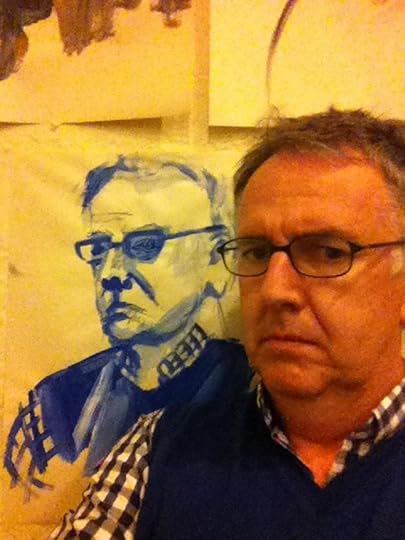
Once I went to a local fate where a life drawing school were doing lightning fast portraits of random people strolling past. These people were asked to stand in front of half a dozen or so painters who would spend 5 minutes doing a portrait. This is one of those that was done of me. I’ve always thought it makes me look like a Latin American dictator. Which is, oddly enough, not particularly how I generally think of myself.
I spent a lot of this book wondering how LF made his money. Towards the end it became clear that this was by selling his paintings. But it also seems that between the ages of 40 and 60 his work appears to have become quite out of fashion. At this time, it seems he turned to gambling. Now, I wouldn’t have thought gambling would be the most obvious or sure-fire way to fix your money troubles. Perhaps that says more about me than it does about him. I guess he must have been already well enough off for money issues to not really be something that would distract him from his ‘passion’. Half his luck, obviously.
As I was reading I decided it might be nice to spend the day at the National Gallery of Victoria. In between reading, I wandered around looking at the portraits and became a bit obsessed with how the people in them almost invariably looked quite smug. One of the things that is said early on in the book is that for much of the history of portraiture the person looking out at you is also the person who paid the bills for the painter. So, portrait painting has a long history of an artist being someone who can guess how the person paying for the painting would like to be seen. If that is the case, you have to say that people, for a very long time, seem to have liked the idea of having themselves shown looking rather self-satisfied.
LF was a remarkably slow painter – but I suspect this had to do with a whole range of things. Not the least that he had more in common with his famous grandfather than might otherwise be immediately apparent. Repeatedly throughout this it is clear that his observations for the painting are not merely those where he is in his studio with a brush in his hand. His manner of painting clearly involved him needing to like the person he was painting, or at least to find them interesting enough to chat with for upwards of 100 hours.
My LF also does life drawing – although I can see a likeness in some of the drawings she has done of me, often I’m not quite sure. She tells me off. Apparently, I’m a poor sitter – one who moves too much.
There is something very strange involved in being looked at intensely for a long period of time. I’ve fallen in love with people and, at least in the early phase of what that means, tried to drink in every detail of them. This has sometimes resulted in me being asked to stop doing that. It was easier with my daughters, when they were first born – it is the part of becoming a parent that no one ever really says to you, but you get to stare and stare at your child in a way it would be odd to do ever with anyone else. In fact, that kind of close observation is very unusual – it can even feel threatening, it can fill us with fear or erotic charge – flight, fight or fuck. LF notices things about his subjects that you might not want to have noticed. The least of it is the paunch you have been sucking in when you remember or your jowls. He says to the author that he is hard to paint because his mood changes so frequently and that each day it is a bit like having to paint a different person. And these changes become fascinating as the painting goes on. Should you get a hair cut? Are you sitting in the exact same spot you were last time? Are the hairs in your ears in need of a good trim, and should you mention that to LF – because, one of the things LF makes very clear is that if you mention something you would like him to hide, he is just as likely to exaggerate it. Like a poor, ugly man who later put his foot through his own portrait, an what became expensive waste of time and money after he implied LF should be making him look good in this portrait.
LF makes it very clear that none of us are really beautiful and none of us are really ugly, but that our personalities bring this to the fore. I like this idea, even if I don’t fully believe it. I know some of us are pretty attractive even if we are boring as bat shit and dull as dishwater. And other of us can have the most delightfully fascinating personalities, and that still not really be enough to make us physically attractive.
This book reminded me a lot of The Sight of Death – the other book about a painting that I loved to bits. I can’t recommend this book too highly.
Some quotes:
“On Dante Gabriel Rossetti: ‘He’s the worst of the Pre-Raphaelites, his work seems the nearest painting can get to bad breath’.” p.52
“What LF means by pictures ‘rhyming’ is a graceful flow of forms, each interlocking or echoing another.” p.56
After bringing some English sailors to a restaurant in Marseilles to try some ‘cuisine au beurre’. “The thing is, Lu, we don’t like food with all them flavours in it”. p.76
“With bad painters all their pictures look like self portraits, except the actual self portraits” p.81
“Goya is one of the most mysterious of painters. For me, his prints and graphic works are enormously more interesting than his paintings. But all his work is filled, as so much great art is, with a sort of jokiness. You find the same thing in Ingres, in Courbet, in anyone who is marvellous. Their work is filled with jokes.” p.88
“I think a lot of my sitters are girls who have some sort of hole in their lives that is filled by posing for an artist. I think it also helps if in some way, no matter how nervously, they are pleased with themselves, with their physical appearance.” p.113
‘You look different every day’. ‘More than most people?’ ‘More than almost anyone I’ve ever encountered. The features don’t change, it’s more the way they are worn.’ p.136
“David Hockey puts it like this, the painting by him by LF has over a hundred hours ‘layered into it’, and with them innumerable visual sensations and thoughts.’ p.145
“Once again, for him quality in art is inextricably bound up with emotional honesty and truthfulness’. p.147
“’Rot them for a couple of rogues. They have everyone’s face but their own’. “Although the range of LF’s sitters is vast, there are few, if any, pictures of actors. The closest he has come is fashion models.” p.168
“This is an interesting demonstration of the effect the physical space of the studio has on the works that are made in it.” p.178
“Never having looked at myself before with this level of intensity and in such detail and through the objective eye of another, I am at first puzzled by what I see.” p.183
ترجمهی فارسی که نشر نظر درآورده رو خوندم. چاپ تر و تمیزی داره به همراه کلی عکسهای رنگی از نقاشیهای فروید و دیگرانی که دربارهشون حرف زده میشه. خود ترجمه قابل استفاده بود و یکی دوتا سوتی بیشتر نداشت. کتاب سبک و خوشخوانی بود که دو روزه خوندمش. کاری که باید بکنه رو میکنه: سرگرم کردن آدم. نویسنده که یه منتقد هنریه آشناییای با لوسین فروید داره و با حال تیری در تاریکی به فروید پیشنهاد میده که پرترهش رو بکشه و در کمال تعجب فروید هم قبول میکنه. توی کل کتاب این ذوقزدگی از «مدل پرترهی فروید بودن» بصورت آرومی زیر سطور جاریه، گرچه نویسنده تلاشش رو کرده پنهانش کنه. خاطراتی که خود فروید میگه یا تکههایی که از زندگیش نقل میشه جالبن. یه سری انکدوت بامزه، یه سری اطلاعات دائرهالمعارفی. یا جاهایی که فروید از علایقش میگه هم خوبن؛ از داوینچی و رافائل خوشش نمیاد، تیسین و دگا و ونگوگ رو دوست داره. کتابخون هستش و مثلاً اشاره به اینکه جرج اورول فاقد حس زیباییشناسیه خیلی مختصر و مفید و بهجا بود. میگه وقتی به اورول میگفتم فلان چیز زیباست ضربتی میپرسید یعنی چی؟ زیبا یعنی چی؟ ثابتش کن. و این رو که خوندم یهو فهمیدم چرا بعد از سالهای جوانی هروقت به اورول فکر می کنم دست و پام سرد میشن. جاهایی که خود نویسنده شروع میکنه تحلیل هنری چیز خاصی نیست. بیشتر صفحهپرکن هستن. این شکل «ناداستان»ها الآن مد شدن دیگه. مثال دیگهش کتاب جف دایر هست دربارهی فیلم استاکرِ تارکوفسکی. نویسنده معمولاً یه حالت قفلی و نِردی داره دربارهی یه هنرمندی یا یه اثر هنری و بعد از تجربهش دربارهی مواجههش با اون موضوع مینویسه. مخاطبش هم ماعوامیم. انگار نوعی درس «چگونه با هنر مواجه شویم و آنرا بفهمیم» درشون هست. در بهترین حالت سرگرمکنندهن و کتاب فروید هم همینطور بود.
The eyes appear first. Then the eyebrows. They tell us more than anything. The nose will grow organically. We may have to shrink the head a bit. Let's talk. Eat. And drink. Days. Hours. Minutes. Sometimes just staring. Not provocatively, as in a bar. But trying to see the layers, the dimensions. And transpose them. Months. A sitter and an artist.
Sitting is a pleasure, an ordeal, and also a worry.
This is a wonderful, gorgeous book. Gayford, an art critic, sits for a portrait by Lucian Freud, grandson of Sigmund and a vibrant octogenarian. Freud's paintings are here and beautifully reproduced. In particular, the self-portraits are revealing, perhaps the equal of (dare I say it) a certain Dutch master. There is also a friendship between sitter and painter, which allows Freud to expound on other artists, subjects and the artist's unique worldview.
But this is fundamentally a book about two things. First, it tells about the unique symbiosis between artist and subject. There is surprisingly much that the sitter does, or at least there's plenty of time for an observant soul to ponder. But this is also the story of a painting. I really felt a part of the creation. And it's a wonderful painting. A half-smile, unruly hair, searching eyes. As Gayford sees it:
It's me looking at him, looking at me.
And he's right.
A wonderful point the author makes is that all created art must necessarily have part of the artist (writer, painter) inside it. So, Gayford says, this book is a bit of a self-portrait. And he's right there too.
Here, you can learn about all the muscles in the human face and what they accomplish and whether Da Vinci or Van Gogh was the greater artist. And you will never see, in the index of any book, a cooler entry than this one:
Ik zou dit boek spontaan nooit gekozen hebben, het werd me gesuggereerd toen ik eens rondvroeg naar goede non-fictieboeken. En het is een aanrader. Martin Gayford, kunstcriticus, poseert voor Lucian Freud en is de man met blauwe sjaal. Dankzij zijn dagboekfragmenten krijg je niet alleen een inkijk in het leven, de werkwijze en overtuigingen van LF, maar krijg je ook een beeld van andere kunstenaars uit verschillende periodes. In een ruk uitgelezen en een paar mooie quotes onthouden.
Fascinating, lucid, beautifully illustrated. This is a gem if you are interested in one of the two great painters of British Art in the Twentieth Century, although this memoir is written between 2003 and 2004. And if you are not, you will still find it illuminating and entertaining. The man who knew Picasso, Mondrian, his grandfather Sigmund, Frank Auerbach, and the new stars like Damien Hirst and Tracey Emin. Head and shoulders above any other text I have read on a contemporary artist.
Lucian Freud is more popular than Oprah around our house, so it should have been no surprise that TWO copies of this book appeared under the tree on Christmas Eve. Since Zach opened his copy from Dad before he opened his copy from me, I handily snatched my gift back before boarding the plane home to D.C.
The insights and personality in this book are great. (And for the grandson of Sigmund, a man who dances till dawn with Kate Moss, paints the Queen, and hasn't talked to his brother since their falling out at age 12 -- it damn well should be.) It was both chatty and philosophical -- like a cool survey of the Philosophy of Human Nature. Basically, art critic Martin Gayford sat for a portrait with Lucian Freud over hundreds of hours and lived to tell about it. I loved the book's generous color pictures and all they taught me about art appreciation. But what I REALLY loved was having strangers on the plane and subway glance over my shoulder to see Freud's naked sprawling nudes. Posing with things like fried eggs... and cherries... and dogs.
This book presented all kinds of interesting ideas about art and identity that will forever change the way I think about portraiture. Highlights include:
1) One philosopher argued that there is really no such thing as a persisting individual identity. All that truly exists in our brains is connectedness -- memories, character traits, associations, etc.
2) LF gets excited about the creative process, but not necessarily the product. Ergo, "So, for example, I didn't feel downcast at all when the director of the Tate rang me up to say that my portrait of Francis Bacon had been stolen. In general, I don't like to see my work after I have finished it, although sometimes I go to the houses of people who own my pictures, and I can't blame them for hanging them on the wall."
3) LF admires some photographers, but generally thinks the medium has little in it to help him as a painter. Photography, he says, provides a great deal of information about the fall of the light, but not about anything else. (Think about it. This is crazy.)
4) [On LF's creepy portrait of suicidal artist John Minton:] This was a case where a painter who spent months or years observing his subject quite naturally records vastly more information than a camera lens can see. It is thus a matter of accumulated experience, or memory, rather than technical perfection.
5) LF: "I always thought that an artist's was the hardest life of all. Its rigour - not always apparent to an outside observer - is that an artist has to navigate forward into the unknown guided only by an internal sense of direction, keep up a set of standards which are imposed entirely from within, meanwhile maintaining faith that the task he has set himself to is worth struggling constantly to achieve. This is all contrary to the notion of bohemian disorder."
6) In the battle of best of the 20th century between Matisse and Picasso, LF thinks Matisse was the greater by far -- because Matisse was essentially concerned with the life of forms, which art is really about. Picasso on the other hand, was out just to "amaze, surprise, astonish."
7) LF is the kind of guy who goes through something scary, but only remembers it as exciting. Like once when he fell through the ice of a lake. Or in his early career where he carried on painting despite the fact that his work was thoroughly out of fashion in the era of pop and mod, and he became extremely poor.
Some have said The Man in the Blue Scarf is very sensual or jovial. But in my view, Lucian Freud nailed Martin Gayford for his true art critic self: a lone wolfish figure, with the glimpse of a gold dollar sign in his left eye.
4,5* I loved the experience of reading this book, that did not feel like lying in my bed at home but like standing right there in LF’s studio and soaking in all of this artist’s (often surprisingly witty) portraiture wisdom. Being able to follow an artist’s process so closely felt intimate, so rare as to be almost forbidden.
Gayford takes the reader on an incredible journey thst starts with a sketch and crawls over months of anecdotes, brushstrokes, hesitation, correction and the pure joy of painting. LF seems so much more than (forgive me) what I was expecting. His takes on art and painting are refreshing, reassuring and unmistakably real.
The inclusion of so many different original works of LF and other fellow artists, including van Gogh and Titian, make this book so extra special. I marked it all over and I will surely come back to it again and again.
As a painter I was curious about the working methods of Lucian Freud, whose work I love. I am fully aware of his flaws as a husband & father - which Gayford avoids, instead focusing on his experience & observations whilst sitting for his portrait & etching (a very brief chapter at the end, but interesting all the same).
I was delighted at many of Freud's observations & comments, least not my shared opinion on Rosetti being overrated, his commitment to his subjects & his keen eye for drawing & admiration for Chardin.
The illustrations are well placed & really engage along the way. I even looked up a few people I was less familiar with, thus taking my love of painting further, discovering new works with great pleasure. For once I was glad to have the internet handy to quickly see specific images by others (I imagine there was a limit to how many would be too many) which broadened the scope of the book.
If you paint yourself this is a real treat. In a world where glancing is more encouraged over really looking it was a tacit reminder to see the world with our eyes more rather than our iPhones.
Martin Gayford art critic and friend of Lucian Freud one evening tentatively broaches the subject of perhaps sitting for a portrait and is surprised when he recieves an affirmative response. The result is wonderful. First of all the hardback edition is well presented with plenty of top quality illustrations of Freud's work. Also we get a mini biography of Freud, his early life is really interesting, he knew Ronnie Kray, Francis Bacon etc..
Lucian Freud hardly ever sleeps, spends hours on his feet. We learn so much about his modus operandi and what he disliked/ liked about other painters. He almost without exception only painted in his studio and liked going for lunches with his subjects in order to examine them more thoroughly. The book is peppered with insights about sitters - 'eyes' orthodox church icons, noses are geographically important, ears are equally as important. Lucien Freud examines sitters so closely like a diagnostician - "maybe 'the brutality of fact' isn't a phrase that precisely suits what he does. Perhaps 'the awkwardness of truth' would be nearer the mark" - Gayford. Lucien Freud is a visual philosopher.
This book is extraordinary, we are privy to an intimate closed session.
Fascinating, diary-like account of over a year the author, an art critic, spent sitting for Lucian Freud to produce the titular portrait. It's an odd and illuminating look at the artistic process, and at Freud, made no less compelling by the fact that I think I would have found him off-putting and I don't really like his work.
I really wanted to like this one but it was a a bunch of rambling. I truly enjoyed the parts where he talked about Freud’s process and feelings about other artists etc but overall it just dragged.
This is quite possibly one of the best books I’ve read in a long time! Over a period of seven months, the reader gets to be a fly on the wall in Lucian Freud’s studio as he’s painting a portrait of the art critic Martin Gayford. Man with a Blue Scarf is Gayford’s memory of that period, a diary of sorts that provides profound and surprising insights about the process of creating a work of art. The man who emerges from these pages was a truly brilliant artist and a stellar conversationalist whose wry sense of humor kept the sitter (and this reader) engaged. Some of the conversational tidbits are pure gold, like Freud’s opinion of Leonardo (“someone should write a book about what a bad painter [he] was”) or Dante Gabriel Rossetti (“the nearest painting can get to bad breath”). These seemingly derogatory remarks provide a fresh perspective on the very qualities that Freud pursued in his own art: emotional honesty and truthfulness. “Rightly and inevitably artists see all other art in relation to their own.”
The intense determination to get a painting exactly right was reflected in Freud’s working method, which was notoriously slow and involved many months of sittings. Freud spent an inordinate amount of time selecting brushes, mixing pigments, and so on – all while keeping his subjects under close observation. Once ready, the paint would go on the canvas in teeny-tiny increments. Forty minutes into one sitting, Gayford peeked at the painting and discovered that “despite what seemed to be plenty of vigorous activity with the brush, little seems to have changed on the canvas.” It gradually dawned on him that Freud spent much of the time thinking and concentrating intently. Even minute details were carefully examined. There is a scene, about halfway through the book, that illustrates this perfectly:
“It is time to tackle the blue scarf, it seems, but something goes wrong. Lucian Freud makes repeated efforts, three or four times, to mix royal blues on the palette. Always, however, something seems to go awry when he comes to put a touch on the canvas, the brush never quite makes contact or he applies a stroke or two then stands back, cocking his head and muttering. ‘No, that’s not it, definitely not.’
When I get home, I mention this difficulty with the scarf colour to [my wife], who replies, ‘Which one were you wearing?’ Apparently, I have two royal blue scarves – a fact that was news to me. When we get them out and examine them, I see what I had never noticed – that one of them is about half a tone darker than the other, although the discrepancy is slight. Obviously, for the last sitting I had been wearing the lighter one, which LF wasn’t used to seeing.
This accidental experiment seems to prove the extreme precision of his sense of tone and colour, and the degree to which the whole picture is a carefully judged harmony. LF noticed this difference, though he couldn’t explain it, just as some conductors are able to register one off-key woodwind from an entire orchestra.”
This book will change the way you think about portraiture!
Brushing up against greatness. A good insight into the portrait painting process which - leaving out gossip or judgements about LF’s more malevolent side - leaves one with a sense of amazement and great respect for the painter’s absolute dedication. As usual with anything written about Freud, the best bits are quotations from the man himself, whose strident opinions and spicy anecdotes never fail to raise an eyebrow or two. Gayford’s insights are fairly pedestrian but he keeps things simple and honest at least. There’s only a couple of pretentious art-writer turns of phrase which irk me as a painter, such as referring to Freud mixing pigments on his palette, pigments being smeared on the wall - it’s not pigment (dry powder), it’s paint, just call it paint! The book is beautifully put together with plenty of good reproductions.
I bought this on the way out of the National Gallery’s 2022 Lucian Freud exhibition and immediately regretted not having read it before I went in.
It’s a wonderful introduction to Freud. And beyond that it’s also entertaining, witty, beautifully written and, as I find Gayford’s books typically are, insightful about art generally. Freud and Gayford share a deep understanding of the history of portraits and portraiture, a subject which helps appreciate the richness of Freud’s own work.
Gems throughout this marvelous look at the process of an artist, and the revealing and thought-provoking musings of the art critic and sitter for a portrait:
“A great deal of what is normally thought of as intelligence, he points out, is actually imagination—that is, an ability to see things as they are.”
“Physiologically, and psychologically, a living being is always in a state of flux. Moods shift, energy levels go up and down, the body itself slowly ages…. when you have the sort of temperament that is always looking for flaws and trouble [his temperament in other words], it might stop you from having what you always want, which is to be audacious as possible. One has to find the courage to keep on trying…. ‘I suppose if one didn’t vary from day to day one could not be what one always wants to be — exceptionally daring.’”
“‘… preferences in food, as in art and life and everything, come down to the mystery of individual temperament, emotion and mood…. In the end, one can’t explain why one likes food in a certain way, just as in the end you can’t say why we like a certain person, because it’s always possible to imagine another person behaving in the same way, doing the same things, and not liking them.’”
“The reason why everybody sees differently is that each of us perceives a given sight from the vantage point of their own past thoughts and feelings.”
“‘… an artist has to navigate forward into the unknown guided only by an internal sense of direction, keep up a set of standards which are imposed entirely within, meanwhile maintaining faith that the task he or she has set for him or herself is worth struggling constantly to achieve. This is all contrary to the notion of bohemian disorder.’”
Ik vond Man met blauwe sjaal echt een geweldig boek. Daarstraks in bed bedacht ik me hoe ik mij écht voelde bij het lezen van dit boek. Ik voelde me als de dieren (meestal honden) die Freud in combinatie met zijn menselijke onderwerpen schilderde: in een innige verstrengeling met het onderwerp - maar hier dan met de auteur (Martin Gayford) en met Lucian Freud (eigenlijk ook onderwerpen, maar dan van het boek). Ik heb Martin en Lucian tot op een vrij persoonlijke hoogte "leren kennen" zonder met hen te converseren, als een (huis)dier. Fijn.
Toevallig was Gayford tijdens het poseren voor het schilderij (en de ets naderhand) onderzoek aan het voeren naar Van Gogh, een schilder en persoon die mij tegenwoordig al een tijdje interesseert. Martin Gayford is namelijk een kunstcriticus, wat ook naar boven is gekomen in dit boek. De combinatie "model-zijn" en "kunstcriticus" werkte goed in dit boek. Ik heb veel bijgeleerd.
Also: Freud is best wel een held, zijn persoonlijkheid sprak me erg aan. Also²: Er zijn heel wat interessante onderwerpen naar boven gehaald in dit boek. "De mens als naakte met kleren aan", bijvoorbeeld - dat het echt een kunst is om kleren "goed" te dragen, vind ik erg interessant. (Mensen zijn ook meer zichzelf wanneer ze naakt zijn, vind ik, en dat vind Lucian Freud ook.)
Echt een aanrader. De foto's van David Dawson (ik had ze ongeveer een halve maand geleden online ontdekt en wist niet dat ze ook in dit boek zouden verschijnen - ook fijn) waren zeker een meerwaarde.
Martin Gayford, the critic for Bloomberg News and Spectator, had the extraordinary opportunity to sit for one of today's most important portrait painters - Lucien Freud. MAN WITH A BLUE SCARF is a moment by moment and day by day conversation between these two important men, an opportunity to understand the mechanics of portrait painting like few other books have offered.
The book not only gives fascinating inside information as tot he artist/model relationship complete with sketches and in progress images of the sessions, but it also provides an intelligent well written dissertation on the process Gayford observed of the portrait building atmosphere. He also reflects on the various practices of other painters such as Mondrian, Goya, Chardin, Michelangelo, Vermeer and others and provides a treasure trove of anecdotes of the famous people Freud has encountered and at at times painted such as Francis Bacon, WH Auden, Picasso, and even Freud's grandfather, the great Sigmund Freud. The numerous photographs and reproduction of Freud's paintings are well presented. This is one of those 'art books' that is as successful a study of art technique as it is a memoir and biography and study of the history of art. Highly Recommended.
Fascinating insight into the process of sitting and into Freud's painting and ideas. The booking well written and well illustrated. There was just an overtone of egotism and hero worship, which would be difficult to avoid in the context but which I didn't like. Interesting stories about other artists and celebrities, but a smidgen name-dropping-ish. Possibly slightly sexist and unjudgmental about the sixties 'let's mix with the underworld' thing. So an interesting book, but I didn't warm to the author.
I'm tickled to have this particular (used) book, which turned out to be signed by the author and came with a bookmark ribbon. The illustrations are plentiful and of high quality. This was recommended by watercolor portraitist, Ted Nuttall. Freud's method involves months of sittings and conversation and slow evolution of the portrait. This seems a more revealing approach than working from a photograph.
Remarkable insight into the personality and working methods of the greatest British painter of the past 50 years. Eminently readable, profound, humorous and enlightening: Gayford has a light, self-deprecating touch which in no way diminishes - in fact, rather strengthens - his intellectual credentials. And he was plainly very fond of his subject, both as an artist and a human being.
Martin Gayford - an art critic - sat for Lucien Freud seven months for a painting and later for an etching. This is no a biography, but reflections of the process Freud used and recollections of conversations they had about art. I understand Freud's paintings better now and have a much better appreciation of them.
Great idea, fantastic execution - it's a beautiful tome - but ultimately bit disappointing. Too much vapid namedropping, too little in-depth analysis...
Outstanding account of sitting for a Freud portrait. Full of artistic insight from Freud, gnarly hard won truths expressed straightforwardly and amusingly. Loved this book - inspiring and deep.
What, then, is a portrait painter painting? An individual who persists through time, or merely the way a ceaselessly mutating human organism appears in a particular time and place? It is a good question.
when you have the sort of temperament that is always looking for flaws and trouble [his temperament, in other words], it might stop you from having what you always want, which is to be as audacious as possible. One has to find the courage to keep on trying.’ ‘How?’ ‘Not painting in a stale or predictable way.
I begin to feel a slight apprehension as to what this picture will look like. Will I look ugly? Will I look old? Facing up to the facts of life, such as ageing and mortality, are precisely the point of LF’s type of painting – of course, we applaud it in Rembrandt, but I’m not sure how I feel about the policy when it is applied to myself.
‘In a way I work the way I do because I can’t see what I’m doing. I decided long ago not to wear reading glasses when I painted, although I do when I make etchings because that is very close work. It’s only by stepping back that I can see what I’ve been painting, so it’s more like aiming at a target while I’m actually putting the paint on. But I’m sure if I wore glasses it would affect the way I paint.
Evidently, painting is a physical activity like playing the piano or violin. Touch comes into it, and personal tastes in questions such as the tightness of the canvas, its texture, the variety of brush, and so forth.
Last July, six years after the final sitting, and two years since I wrote the last word of this book, LF died. His had been an epic life, full of achievement. I shall miss him – his wit, his presence, his intelligence – tremendously. But because he was an artist, and an extraordinary one, quite a lot of his thought and his feelings survive, embedded in his paintings.
I really enjoyed this. I will preface my remarks by saying that I am both a huge fan of Lucian Freud’s painting, and an enthusiastic reader of any and all writing to do with the lives and (particularly) the working methods of artists, so the book is right up my street to begin with, but it is an excellent example of the type in any case.
The book takes the form of a pretty straightforward linear re-counting of the experience of the author in posing for a portrait (and then an etching) by Freud over a period of 7 or 8 months. The two are already pretty well acquainted with each other - Gayford is a well-established and well-regarded art critic who has known Freud for years. The guts of the story is that it is a portrait of Freud at work - his methods, his preferences, his theories on light and painting, his materials, the ambience of his studio, his choosing of models etc. There’s also a fair bit of anecdotal stuff about Freud’s history and personal life, some pungent opinions on other artists, some interesting observations on human life and nature, and some funny stories about Freud’s life in bohemian London.
Parallel with the stuff on Freud run Gayford’s own opinions on the whole process from his point of view as the sitter.
Gayford has a very engaging and polished style, and does a very professional, readable job at weaving the various threads into a highly readable whole.
Such a beautiful, sincere oeuvre d’art! Most certainly this book must be placed alongside Freud’s work, as “The brutality of fact” interviews are along with Bacon’s. What a fantastic man Lucian Freud was, and what an abyss somewhat appears between Hockney’s colorful, lovely and cheery pictures and Freud’s, so dark and fleshy yet so commited to truth. Really, I didn’t know Lucian Freud so well and now I think of him highly, and getting to know such a painter really is an amazing gift that both him and Gayford made us. How much you wouldn’t pay for something like this from van Gogh or Vermeer! Furthermore, there are many, many thoughts from Freud that are simply marvellous if you’re doing any kind of research regarding painting.
“For LF, everything he depicts is a portrait. His peculiarity in the history of art is that he is aware of the individuality of absolutely everything. He has a completely un-Platonic senst-bility, to put it in philosophical terms. In his work, nothing is generalized, idealized or generic. He insists that the most humble and - to most people - nondescript items have their own characteristics.”