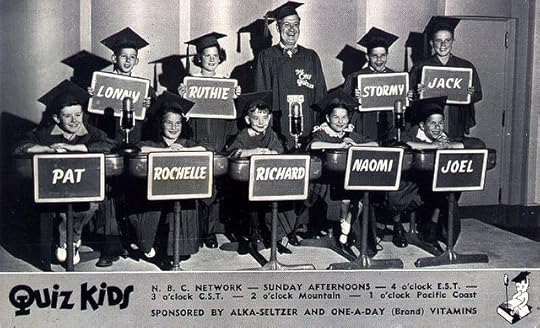
Joel Kupperman fue el niño maravilloso, el consuelo yanqui durante la Segunda Guerra Mundial, conocido en cada casa estadounidense gracias a sus apariciones estelares en el famoso programa Quiz Kids. Resolvía los problemas matemáticos en un tiempo récord, pero nadie le explicó la solución de otro problema: qué haría cuando envejeciera. Cuando era un niño se sabía todas las respuestas, pero ahora, aquejado de demencia, le resulta difícil contestar a las preguntas que le hace su hijo. Aun así, el galardonado con un Premio Eisner Michael Kupperman, escribirá la inolvidable biografía de su padre.
Michael Kupperman is an American cartoonist, illustrator and comedy writer, based in New York City. Kupperman created comics and strips for various magazines and anthologies in the 90's. Many were collected in the book Snake'N'Bacon's Cartoon Cabaret (2000). Since 2005 Kupperman has published his own comic anthological series Tales Designed to Thrizzle through Fantagraphics Books. In particular, the story Moon 1969: The True Story of the 1969 Moon Launch, first appeared in Tales Designed to Thrizzle Vol. 2 Issue 8, won an Eisner Award in 2013. His longer comic stories include the humorous Mark Twain's Autobiography 1910-2010 (2011) and the graphic novel All The Answers (2018), a bio of Kupperman's father as a child celebrity in the 1940s.
This is a very different graphic novel. I cannot say for sure who will like it and who will not. If you have had success with non-fiction graphic novels, you may enjoy this. However, be prepared for a somewhat sad and dark story about the destructive results of the pressures of child stardom. There is no humor here. There is no happy ending. This is real. This is raw.
I feel like the author telling this story for his father was cathartic for him. It is the result of his search for reasons as to why his relationship with his father had always been strained. While the author already knew about his father's participation on the 40s-50s radio/TV show Quiz Kids, he did discovered exactly how much it affected the rest of his life. It is very heart-breaking.
The art is interesting. Some of the panels are an artistic recreation of actual photos or TV broadcasts. In most cases the artist tries to recreate people fairly close to how they look. When it comes to images not from actual footage, specifically when the author is depicting himself, the images get a bit more cartoonish. I cannot say that I found the art particularly engaging, but it worked well for the story here.
If you are looking for a quick, non-fiction story - especially if you like the graphic novel format - this is worth checking out. But, as I have previously warned, it is not a feel good story!
A graphic memoir of the author / illustrator's father. Joel Kupperman was a child celebrity on a radio show called Quiz Kids that swept the nation during World War II. Kupperman goes on to tell how being a child star ruined his father's life as he retreated into himself for the rest of his life. There's a lot to unpack here about absentee fathers as Michael's dad even though he was around, didn't inject himself into his son's life. The way the story is told left me with a feeling of detachment, like the author was talking about someone else relationship with their father. It kept me from really connecting with the material either as there's a severe lack of emotion in the retelling.
A terribly sad, critically historic, psychologically riveting book written by a son searching for the remnants of, or reasons for, a father that never was. Searching as fast as he can - before his father’s blow-it-away-Stanford-Binet brain is lost to dementia, and all those secrets go wherever it is that sacred text goes. It is a layered story - a little boy used for familial survival, to create adorably brilliant Jewish children at a time of rampant antisemitism, and all-American multi-generational familial dysfunction and misunderstanding on a grand (televised!) scale. Genocide, bigotry, selfishness, Asperger’s, family, wrung-out love and a discarded son looking for his own answers...All in a hurry, a frightening rush, as our quantifiable genius is clearly becoming rapidly demented, and the memories, the ones he’ll admit to, are melting away.
Initially on the radio, then transitioning successfully to TV a show called Quiz Kids, starring primarily Jewish children of exceptional (albeit well practiced) intelligence spanned WW2. Joel Kupperman, the father of the author, was the longest (too long by far - it turns out) lasting kid. He really was a math genius, answering spontaneously and authentically. What's the square root of 6,289? A few seconds later (and without a slide rule!) he has the correct answer. Whew. From our retrospectoscope, it seems clear he had Aspergers and, as is known to occur in some of these autism-spectrum children - who are really incredibly intelligent - they have amazing gifts in narrow areas; music or math or memory for certain historical areas. Joel’s mother, unfortunately for him (and his son) was an overbearing stage-mom who pushed her little genius - even when it was clear he was miserable. And for years beyond the time he should have “retired” from the show.
I’ve known many Jews who felt conflicted; growing up post WW2. They are educated, want to follow their dreams and talents; but feel obligated, as half of the world’s Jews have just been exterminated, to settle down and have families. Which decision will make them most content? How can they live their own lives?
Little Joel? He traveled with the show and sold amazing amounts (millions!) of war bonds, while putting an adorable face on Jewishness - how much better can a Good Boy be? The price of the complete destruction of his autonomy and absence of normal development, at the hands of his mother (who really should have known better - and probably did) may have seemed small. She successfully beat out any resistance, emotion, year by year until he was still taking orders about basic life decisions into his college years. I imagine her laying out his underwear and socks for his morning classes at University of Chicago.
But perhaps the early specialness, the “felt love” from his mother, her constant attention and affection, allowed him to develop beyond the stage of diagnosable psychopathy (mpd*). But he never made his own decisions, never learned to negotiate anything.
Eventually post college he makes a temporary escape to the UK (someone else’s idea, of course) but returns to learn that game shows are now rigged and concludes his entire life has been a fraud. But he couldn’t call his Sainted Mother an abuser, right? Right!?? It and everything else is carefully locked up in his head. And his past is completely discarded. He is playing with a very narrow sentiment skill set; has very few reactions, feelings, to choose from. i’d imagine akin to the few emotions children of alcoholics allow themselves.
We see this from the sweet innocence of the son a decade or so later: p 76 “He left his Jewishness behind .... It was something else that was never discussed in our house.” He also flushed his childhood love of baseball and skill, maybe affection, for piano.
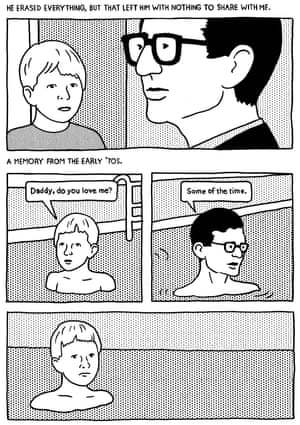
“He erased everything, but that left him with nothing to share with me”
Followed by the author drawn as a 5 or 6 year old in a pool with his blank faced father: “Daddy do you love me?”
never looking at his son, “Some of the time”
Leaving a blank faced son . I had to put the book down. My heart squeezed out thru my eyes and blurred my vision.
By then any semblance of “Daddy’s” human response was gone. He’d replaced one robotic responder with another.
Or, perhaps, even more visceral, is an exchange sans words when the author was very young, in diapers. He fell down the entire length of a staircase, resulting in wounds that drew blood, and landing a few feet from Joel, who was seated, reading a paper. His father's response was to glance momentarily at the wounded infant, and return to the paper. Nothing. Nothing
pg 81 “The idea I’d had - that my father no longer cared about his childhood - had obviously been untrue. I gradually stopped mentioning it again. I still suspected that he hadn’t erased his childhood, but had rather sealed it in a bubble deep inside his mind.”
Locking pain in compartments. Things that create cognitive dissonance can precipitate this:- ’my mother loves me - my mother repetitively does things she knows will hurt me’ Or in more extreme abuse cases (not this one): 'fathers love their children, my father rapes me, am i...me?' Some abused children consciously create characters who are undergoing the abuse, so the abuser isn't hurting them. The ability to compartmentalize these moments, these times that are too painful for a child to explain, might be the beginnings of *multiple personality disorder seen in cases of severe abuse begun at an early age. Perhaps Joel’s coping mechanism, and his son’s recognition of his father’s “bubble” was recognition of a mild form of this well described phenom.
As the writer, who it is clear, is SO different than his parents is trying to find out why his father is so distant, seems so uncaring - it dawns on the father, Joel, the Quiz Kid - that perhaps he should have been more involved, (father first, then son) “...construct a relationship, and nobody suggested I do that…”
“Construct a relationship?”
“With you.”
“No one suggested you should do that.”
“No one at all. It just didn’t occur to me. I’m sorry….you’re making me feel almost guilty, that i should have been spending time with you.”
Leaving a blank faced son, who agrees that, indeed, he should have been. What is remarkable is the presence of abundant normal love in the next generation, the power of instinct, the author’s crazy-normal love for his son, his love & respect and wow-i-got-lucky re his wife (note his son’s last name) without having received any of that from his own paternal unit. Impressive. Seems some things are truly (lack of) nurture. Wonder if the author ever asked his father the “love” question again.
i found this book to be unique in many ways and feel tremendously fortunate to have been a Goodreads Give-Away recipient. It caused me to travel down many roads of thought - the origins of psychosis, the conflicts of post-WW2 American Jews, the many Holocaust survivors i was privileged to take care of as a physician at Mount Sinai in New York City almost 40 years ago, and their stories, the ways families love each other - or don't - & the mistakes made as mothers (my mistakes, mostly), Aspergers, children in theater, the pathology of TV, slide rules, the gifts of living abroad, and most of all, parental dementia. Highly recommended.
Michael Kupperman is the son of Joel Kupperman, of Quiz Kids fame. The Quiz Kids were likely before your time--they were certainly before mine. QK started as a radio program in the 40’s, before moving to television in the early days of the medium. The Kids were a panel of child prodigies--Kupperman’s father was with the program from the ages of eight through sixteen--who would answer listener-submitted questions with dazzling mental acuity. Joel was one of the stars of the show, renowned for his ability to work complex mathematical equations in his head. After leaving the program, he spent the rest of his life retreating from his early fame …
This book deals with what little Kupperman is able to piece together about his father's past, as well as his present reluctance to talk about it, and his descent into senile dementia. The book provides a glimpse of the beginnings of celebrity culture, as well as a story of a man trying to connect with a father who has spent most of his life resisting connections. Probably the entire book can be summed up in the following exchange:
Michael: How do you feel when you see other kids presented as child prodigies?
Joel: I feel sorry for them.
Followed by a silent panel as they regard each other.
This is some of the best work I’ve seen from Kupperman. Recommended!
If you know me, you know that I tend to have issues with memoirs. While I think they make lovely books for friends and family, most of them do not translate as well for strangers. This graphic memoir is one such example.
Before reading this graphic memoir, I had never heard of Joel Kupperman or The Quiz Kids. I understand the fascination of trying to figure out your parents, and in this case, Dad was once really famous, and hung out with celebrities. I didn't particularly care about these people as they were not fleshed out enough for me to think of them as real, even though they were. I found the author himself rather annoying, and was not a fan of the illustration style of this one either. Not one I'd recommend.
This was very interesting as a historical and cultural picture of America in the 1940s and 50s as game shows swept to national prominence and radio transitioned into television, but it is ultimately a sad personal story about one of the child stars of those days and the effect his fame had upon his life and his family, especially his son who is the author/illustrator of this graphic memoir.
My rating wavers between 3 and 4 as the ending was not as impactful as I’d hoped and expected, but that is kind of the point when you remember this is as much, if not more, the son’s story as it is his father’s.
Certainly an interesting read about someone who became a child celebrity through a radio quiz show. I felt kind of disconnected the whole time I was reading this book though. None of the people/characters really captured my attention. Art seemed appropriate for the nature of the book.
Even after taking time to process this book, I’m still not sure what I’m taking away from this read.
A man has his childhood stolen from him because of a parent who believes this is how you get ahead, and then has the rest of his life stolen from him because the culture of Americans was to resent people who had a talent. Then dementia steals his final years.
The son doesn’t get anything out of this discovery from what I can tell except that he has a better idea about how screwed his father’s life was and that he feels that, in a way, excuses why he felt left out of their lives.
Again, I’m left wonder, why is this story told. What am I expected to learn from this?
The author gives a fascinating look into the life of his father, a child prodigy on a quiz show in the '40s and '50s, who spent a lifetime traumatized by the experience and now faces memory loss and dementia in his old age. As someone who values intellect highly, I was engrossed by this sad tale of one man's (boy's?) rise and fall and how it effected his relationship with his family for decades afterward. Highly recommended.
A wide reaching tale involving history, media, propaganda, anti-Semitism, ethics and much more. Author/artist Michael Kupperman delves into his father's childhood as a Quiz Kids genius and how it shaped his father and by extension himself. By turns informative, meditative and poignant, I was engrossed in the story beginning to end. The minimalist illustrations help the stripped down nature of the prose.
Wow! A moving account of Kupperman's famous Quiz Kid father, Joel Kupperman. If you're a fan of Kupperman, as I am -- and a very big one, at that -- then be aware that this is nothing like Snake 'n' Bacon or Tales Designed to Thrizzle. Tonally, this is a dramatic shift from the wry playfulness, even the absurdity, that we've come to expect from Kupperman. From the opening pages, there is a much more serious, even dark, tone. Unlike the comedic narratives that have largely defined Kupperman's career, All the Answers is the author's life experiences laid bare, even to the point of rawness. But it's as it should be. This is a deeply personal story, not only about Joel Kupperman's experiences, and ensuing problems, as a brainy child celebrity, but, perhaps more significantly, about Michael Kupperman's relationship with his father, and how his father's past has gone on to define the author's own life. There's a lot to digest here, and I need to reread in order to take it more completely in.
Michael Kupperman digs into his father's untold history as a Quiz Kid in the 50s and 60s and it is riveting. Joel Kupperman rose to wild fame as a Quiz Kid, something I did not know existed until I read this graphic memoir. He also experienced great tragedy - a lost childhood. Now, as an old man slowly drifting into Alzheimer's, he wants less and less to bring up that past. Michael's attempts to contact his distant father are both deeply sad and instantly relatable. When faced with the revelation that your parent was once immensely famous, who wouldn't want to know more? If this book was simply a history of the Quiz Kids, I would have been satisfied. But the family dynamic makes it so much more.
There are certain memoirs written which are not interesting beyond family and friends, and in my mind this is one of them. The subject matter could have been entertaining for the general reader if it had been written from a less personal point of view. It's like when someone tells a story at a dinner party and there ends up being a bunch of blank faces around the table and the teller has to follow up with, "I guess you had to be there."
The artwork was okay.
I was sent an unsolicited physical review copy by the publisher.
If you want a book that's like an intellectual version of "Dance Moms," this is your bag.
I'm putting this on my NPR-y bookshelf. That's where comics go that I think appeal to what I call the NPR Comics Audience. Catchy name, right?
Stuff like Maus and Persepolis, of course, but also Tiny by David Small, Chris Ware stuff, Craig Thompson maybe, Chip Zdarsky.
Okay, not Chip Zdarsky. But he's my favorite comics guy, so I try to give him a mention whenever comics come up.
What was that one book...Here? Is that the one where it was like an historical view of one spot and all the shit that happened there? Which turned out to be just about anything historically significant?
Did you like how it was "an" historical view? See, once I'm in NPR mode, no going back.
Poignant story about an adult son who is trying to learn about his father's past as his parent struggles with early dementia. I didn't know about the program Quiz Kid and the celebrity that his father endured since age 10, but learned more about this time period, early antisemitism prior to WWII, Henry Ford and the struggle child stars have with fame.
Interesting graphic novel - not at all what I had expected. Well done.
I like to think I know all about radio int he 1930-1950s. I have listened to, and still listen to, recordings of shows gone by, such as the Jack Benny Show, or Burns and Allen, or the Loan Ranger. And yet, I have never heard of the Quiz Kids, of which this story is about.
The author does, what good children do, and try to find out their family history before it is swallowed up by time, and memory. In this case, Michael, is trying to find how his father, who was a child prodigy on a game show during the war years, went from those heights of fame, to a reluctant, and introvert teacher. Micheal does as much research as he can on his own, but also talks to his father about it. There is deep pain from being a performing monkey, and it is something he has carried with him all his life.
The pictures, drawn from photographs, depict the time of his father's childhood. When he draws in the present time, the pictures still keep that angular style, so that his father loks as though he came from a photograph.
It is a moving and sad biography, as sometimes happens when children lose their childhood due to their stage mother's ambition to get them out there. In doing the work, his son learns about himself.
Fairly quick read, but sad and poignant.
Thanks to Netgalley for making this book available for an honest review.
From the artwork to the exploration of who his father, Joel Kupperman, was as one of America's "Quiz Kids" during WWII, Michael Kupperman's exploration of his father is deep even though it is short. While written in much of the style of Fun Home, Persepolis, and Maus--As a graphic novel biography, the art is very much Kupperman's style. This is a story about a man trying to learn about his absent father, and why he was absent before dementia takes him away completely, and so much of this book really makes one think about family, history, child stars, and how we all connect or do not connect to those in our lives. I would recommend this to anyone who enjoys biographies, graphic novels, history, and family. Seriously, this work is much deeper than it appears at first, give it a chance. * I received an E-galley from NetGalley and the publisher in exchange for an honest review.
i was pretty underwhelmed by this. i don't know if having listened to a couple of interviews with kupperman about the book deflated my experience of it (or maybe over-inflated my expectations?), but i was never really impressed by the book. the history of the Quiz Kids show was interesting and kupperman seems to have done a lot of research, but as a reader the book never seemed to actually bring me in and offer the intimate experience i was expecting. kupperman's lifelong struggle with his father and family life is interesting, but even as kupperman gets more honest and vulnerable as the book progresses, a distance remains between the author and reader. maybe, on a performative level, that's the point, that distance always remains and the mere desire to overcome it is not enough to defeat it.
Un cómic chulísimo acerca de la exploración mediática infantil. Marionetas de carne y hueso que al crecer quedaron obsoletas. Vacías. Engañadas.
Como consumidor patológico de la mal llamada "caja tonta", he sigo testigo de la exploración mediática de niños y niñas. Programas como Menuda Noche hasta Masterchef Junior, pasando por diversos programas musicales y series infantiles. Mucho tiene que contarnos las chicas Disney acerca de este tema.
Niño Prodigio narra de forma valiente y (a mí parecer) dolorosa la vida de su progenitor. Un niño explotado a nivel mediático en constante estado de evitación. La mente intentando escapar de sí misma. La utilización del "talento" con otros fines y la veracidad de los concursos son ejes centrales de esta obra.
Unlike Kupperman's usual comix style, this book is devoid of color, whimsy, humor, or weirdness. But its somber, starkly bolded, b/w style matches the heartbreaking deep dive into his father's previously hidden life as a "boy genius" on radio and early TV. Fascinating and masterful. I ate it up.
This graphic memoir from the son of a 40's celebrity has an interesting premise. Kupperman's father was a child prodigy who appeared on the radio program "Quiz Kids" and had considerable fame during WWII. Now, the man with a brilliant mind has dementia. However, this novel lacks a lot of depth. It's super short (I finished within a few hours), so I didn't get to know the characters very well or what the true conflicts were. I've seen this genre done very well (see "Fun Home"), but this one just doesn't make the grade, even with some great subject material.
'All The Answers' by Michael Kupperman is a graphic novel memoir about his father Joel Kupperman. It's touching and difficult to read.
Michael Kupperman's father Joel was a child radio star on a show called Quiz Kids. It's something he rarely talks about, and now that he has the beginnings of dementia, Michael wants to know more about this aspect of his life. He pieces things together through the course of the book. Joel's mother was behind his career, which included meeting celebrities and even a movie role, but never really that much money. Joel was forced into staying in the career for far too long, and eventually some people came to hate him. When he escaped that life, he didn't want to talk about it, even though there were really good aspects. As Joel's memory fades, Michael finds that the answers aren't easy or that they can be non-existent.
I really enjoyed the chance to read this. The art is good, and I liked the quotes that start each chapter, many of them about Joel. The story feels a bit detached from it's subjects, and that may be based on the relationship that father and son had with each other. Some readers might find this to give the story a lack of depth, but as |I finished this book and reflected on this aspect, it brings even more tragedy to the story.
I received a review copy of this graphic novel from Gallery 13, Pocket Books, and NetGalley in exchange for an honest review. Thank you for allowing me to review this graphic novel.
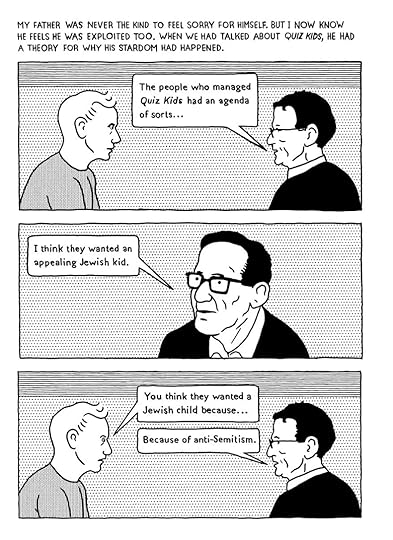
Michael Kupperman presents a brief but informative biography of his father, Joel Kupperman. Prior to picking this up, I had no idea about the cultural phenomenon of the Quiz Kids in World War II. The book explores the ways in which the Quiz Kids were manufactured to be something of a propaganda item, presenting the friendly faces and voices of Jewish kids to Americans in an attempt to counter the anti-Semitism of the day.
Michael Kupperman speculates a bit about his father's past, which is unavoidable due to his father's gaps in memory - something Michael believes to be a result of the trauma he endured as a result of being presented for so long as a public spectacle. This is a valuable slice of history (especially if you have even the slightest interest in the origins of radio and television game shows) and a bittersweet biography, as you can see Kupperman longing to know his father on a deeper level but finally having to reconcile himself to the fact that this may not be possible.
I received access to this title via NetGalley in exchange for an honest review.
Michael Kupperman is my all-time favorite comic artist and writer. His absurdist humor and his nuclear-era parody artistic style sometimes make it seem as if he’s above sentimentality. That’s not the case here. This memoir of his father is almost gut-clenchingly raw in its honesty. The public celebrity history and the subsequent traumatic repression his father undergoes is fascinating, yes, but it’s the conversations between Michael and his mentally ailing dad that shot right like a familiar arrow into my heart. I love this author so much more than I thought I could, as a result.
Al principio no me gustó nada el dibujo, pero la historia es tan buena que se puede pasar por alto. El autor, en busca de respuestas sobre la infancia de su padre siendo un "niño prodigio de las matemáticas" que participaba en un programa de preguntas y respuestas en la época de la Segunda Guerra Mundial, se encuentra con una historia de explotación infantil, de soledad, que termina explicando mucho de lo que fue su padre (su desconexión) y su propia infancia, aunque termine construyendo esta historia en base a preguntas sin muchas respuestas. Muy bueno.
Kupperman’s drawings are stark black and white arrangements of facts and personal impressions of a son’s inquiry. Lined with the themes of memory, exploitation, and father-son relationships, All the Answers is an excellent memoir detailing American history and family dynamics.
The premise of this (Quiz Kids! Childhood lost! Subtle trauma handed down!) but Kupperman was so careful and dry with his subject matter that ... it lost any zip it might have had (and there was potential!). In the end it suffers from the same mental block that his father had about all that time as a child star -- its just, static...and not quite there. Dang.
Did not care about this book at all. I did not care about the narrator or the fact his father wasn't as emotionally available as the narrator would have liked. And while I learned a lot about the Quiz Kid, I didn't care that much.
Graphic novel memoir about the author's dad, who was a "Quiz Kid" for most of his childhood--with lifelong bad memories and some dysfunctional behaviors.