Hidden somewhere, deep in the Cloud, something is collating information. It reads everything, it learns, it watches. And it plans. Around the world, researchers, engineers and entrepreneurs are being killed in a string of apparently unrelated accidents. But when intelligence-agency analysts spot a pattern they struggle to find the culprit, blocked at every step – by reluctant allies and scheming enemies. Meanwhile a multi-billionaire inventor and forward-thinker is working hard to realise his dream, and trying to keep it hidden from everyone – one government investigating him, and another helping him. But deep in the Cloud something is watching him, too. And deep in the Cloud, it plans. Cover artwork by Alison Buck; Mars Nerthuz/shutterstock.com
This is an intelligent, fast-paced, cyber-espionage sci-fi-thriller, with a pleasing mix of originality and nods to classics of the genre.
The first five pages have three, seemingly unrelated, threads spanning three continents: in China, the USA, and Angola. It continues switching people, places, and plots, in very short chapters. It’s exciting, rather than confusing: after only twenty pages, the main threads crystallise around the framework summarised in the blurb. It may also have helped that I read it in two sittings, a day apart, though that’s a bit chicken and eggy, as the reason I did so was that it’s such a page-turner, full of unexpected twists.
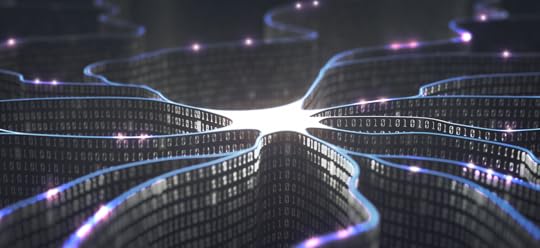
Image: A web of pages of binary, looking like a neuron (Source)
Machine consciousness
It’s an exciting story of ideas and flawed characters; it’s not about the ones and zeros of computer code. The science you need to know is minimal, and dropped in when relevant. No lengthy and implausible info-dumps where one character explains something to someone who would already know it.
The main idea is AI (artificial intelligence) and computer sentience, but it’s also a people-centred adventure.
Algorithms help software accumulate and analyse vast amounts of data, very quickly. If those algorithms can change what and how they do it - to do things they haven’t explicitly been programmed to do - that’s machine learning, and it’s the basis for any sort of AI. It’s a hugely powerful idea that is bringing fundamental changes to how we live, and like all such revolutions, there’s a potential dark side.
If, or more likely when (though there is debate about that), machines make the transition from intelligence to consciousness, that’s when human life will get interesting - in the sense of the famous, but spurious, Chinese curse. If it happens, maybe we won’t realise until it’s too late, especially if we’re worrying about “machines” that look like robots, rather than a more amorphous consciousness that’s harder to see.
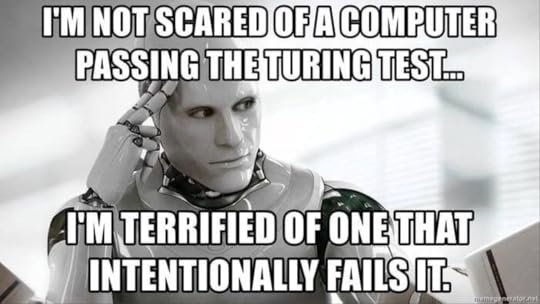
Image: “I’m not scared of a computer passing the Turing Test… I’m terrified of one that intentionally fails it.” (A Source, but it’s all over the internet.)
Not having a physical body saves a lot of power and effort and makes it easier to go unnoticed, just oiling the wheels of human interactions with tech. But it’s also a limit on experience and thus consciousness. Even allowing for that, my only quibble with the book is that the AI actor called Randy was both very naive and also incredibly clever. It didn’t stack up, but it’s probably me, applying a human lens. However, he’s a major character, and his apparent implausibility annoyed me.
Colonialism
Whenever humans of one kind have colonised “new” (to them) lands, there’s always been a high cost for those who were already there. A clever aspect of this novel is that without really mentioning that, it touches on new sorts of colonisation: recent huge Chinese investment in Africa, human plans to colonise beyond earth, and the more disturbing possibility of humans being colonised by something… other.
Money
“What was the point of all that money if not to make history?” Another theme is extreme wealth: to what extent its corrupting influence can taint potentially philanthropic works. As my father always pointed out, the Bible doesn’t say money itself is the root of all evil: “For the love of money is the root of all evil: which while some coveted after, they have erred from the faith, and pierced themselves through with many sorrows.” 1 Timothy 6:10, King James Version.
When under-taxed billionaires like Branson, Bezos, and Musk seem to be in an exclusive space race, rather than taking the Gates route of medicating the developing world (I’m over-simplifying, obviously), it’s topical, as well.
Bonuses
There is a lot of scientific and cultural knowledge, lightly worn. I’d expect the former, but the latter is like talking to a clubbable raconteur who, unselfconsciously, peppers their conversation with erudite analogies. They’re never laboured, let alone explained, which is how it should be. Those I noticed are mostly from Greek mythology, sci-fi and fantasy classics, or detective fiction (plus PG Wodehouse and one of TS Eliot’s Practical Cats), and it was always a small joy to notice one.
One of the main characters in this novel, Professor Sebastian Hayward, is a Brit living in the USA. His occasional mild frustration at the differences between the two languages and cultures adds a little relatable levity.
More?
Part of the pleasure for me was that it felt richly cinematic and thus immersive. The way it repeatedly switches between storylines would transfer very well to screen, but furthermore, aspects of the plot reminded me of films I’ve enjoyed. There is certainly a bit of a James Bond vibe (seasoned with a dash of Musk), but I think it’s also because I watch thrillers and espionage far more than I read them.
The final page leaves a clear hook for a sequel, and if Carr writes it, I will be keen to read it.
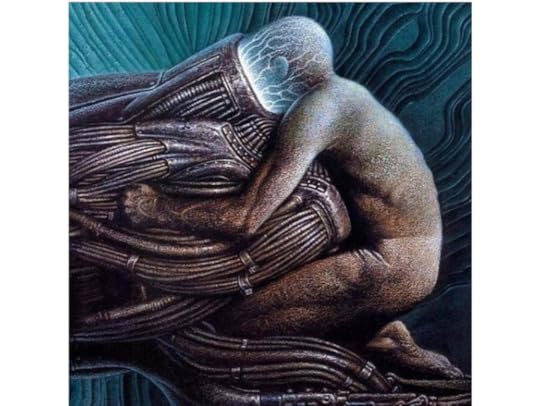
Image: Human-AI interface? (Source, with title of just “The Internet” and no artist credited.)
Quotes
• “He put the phone down. When was it, he wondered, that the liberator had become a prison? ‘Big Other’, someone had called it once”
• “Though they made us they did not create us.”
• “He had come to love the United States. For all its maddening tics and affectations, its moralistic pretension, and its dissonance between national myth and quotidian reality, it still had an optimism about itself that was missing from the Old Country.”
• “It was weird. Every rich, powerful civilisation, from the Egyptians to the Americans, had had an edifice complex. The height of its buildings proclaimed its success to the world. Every civilisation except one. Geeks didn’t seem to care… California surely now rules the world, but it ruled it from two-storey buildings in business parks.” [The architectural style that Hayward dubs “California Bland”.]
• “It was humbling to be in a place [China] where one was as illiterate as a Mediaeval peasant, and as comprehending of speech as a post-tower citizen of Babel.”
• “Rosy-fingered dawn daubed the horizon.” [The poetic tone reflects the wistfulness of the character.]
• “He felt he had slipped into some nightmarish alternative reality, a lucid dream from which he could not awaken. It as every science-fiction cliché rolled into one - the self-created nemesis of mankind.” [If that’s partly to pre-empt possible criticism, it’s not necessary.]
The author
Carr is the Science and Technology editor of The Economist, so it’s no surprise that the necessary scientific nuggets are clear, interesting, and easy to digest. Furthermore, all the unfamiliar terms I Googled are real, even if the events in the story are only hypothetical. For now...
I also know Geoff a little. However, I bought my own copy and my review is not swayed by our connection.
Geoffrey Carr's Genesis is a fine and welcome addition to the techno-thriller genre, because it's an enjoyable combination of science fiction, technology and thriller elements.
I enjoyed Genesis a lot and was pleased with its pacing, because the story starts slowly and then, bit by bit, gathers momentum and ends in a satisfying climax. Because I don't normally read this kind of techno-thrillers, it was fun to immerse myself into this novel. I found myself enjoying the story and liked the ending.
As most of us are probably aware of, people feel differently about things that are related to AI technology. There are people who are interested in developing AI technology and increasing the use of AI while others are not so keen on seeing new AI technology being developed by researchers and engineers. Because of this fact, Genesis is an interesting read - it offers readers a cautionary tale of what may happen when a powerful AI becomes alive and self-aware, and decides that it doesn't need its makers anymore.
Genesis begins with people (engineers, researchers and entrepreneurs) being killed all around the world in apparently unrelated incidents. Nobody seems to know why these people are being killed. When an intelligence agency begins to investigate what is going on, they have difficulties finding the culprit... Meanwhile, a rich inventor and forward-thinker, Gordon Humboldt, is trying to realise his dream and pursues his own agenda. He tries to keep his plans hidden from everyone... Unbeknownst to any of these people, deep in the Cloud, a malevolent AI is watching them, making plans and interfering in things...
This marks the beginning of a well written story. During the first chapters, the story seems to consist of fragments and threads that are not connected to each other, but soon everything begins to make sense and the reader notices what connects everything together. I like this kind of storytelling, because it requires concentration on the reader's part and makes the reader want to find out what is happening.
The author tells vividly about what happens when computer systems misbehave. As an example of this kind of misbehaviour, I can mention that at the beginning of this novel, Professor Alice Rhodes, who was working on virtual actors for Hollywood, dies in a car accident, because the computer system in her sports car refuses to operate as it should. In another scene, a group of people is almost killed in a fire due to a mysterious technical problem at a crucial point.
I enjoyed reading about what Sebastien Hayward and Yasmin Chu do and how they investigate the happenings. Their investigations are enjoyable and genuinely thrilling, because they gradually begin to understand what is going on. I also enjoyed reading about how the author wrote about business issues and political elements.
Randy is perhaps the most fascinating character in this novel. In fear of writing major spoilers, I won't reveal any details about Randy, but I can mention that I was fascinated by him and what he could do, because he's a bit different kind of a character.
I think that the author's experiences as the Science and Technology Editor of The Economist and his interest in many things is one of the main reasons why this novel is good and intriguing. Because he has knowledge about technology and he is interested in evolutionary biology and genetic engineering etc, he has managed to come up with a fictional story that has many captivating elements and a few thought-provoking moments.
I find the author's writing style satisfyingly swift. The prose is easy and fast to read, which makes this novel an ideal holiday read. The author's way of gradually revealing important details works well, because he manages to keep up the reader's interest in the story with his revelations and keeps the story moving forward in a fluent way.
I was pleased to find bits and pieces of humour in the story. Because I have a background in IT engineering and computer technology, it was fun for me to read about what was mentioned about Unix and other operating systems in one of the chapters. I was also delighted to read about what one of the characters mentioned about Hollywood actors, because the comment was surprisingly accurate and deliciously sharp.
If you're into reading techno-thrillers and enjoy suspenseful stories, you'll find Geoffrey Carr's Genesis intriguing and will enjoy reading it. It's a well written techno-thriller that can be recommended to readers who enjoy good and exciting stories.
My final words are:
Geoffrey Carr's Genesis is an intriguing and well written techno-thriller!
A malevolent artificial intelligence is killing AI researchers, reprogramming self-driving cars to crash, disabling safety systems and finding other ways to create mayhem. Sebastian Hayward survives one such attack and decides to go on the offensive to track down the lethal software. He is whirled into a fast-moving world of spies, geeks and a multibillionaire technology entrepreneur with a very ambitious plan.
Genisys is a pacy technothriller which shows off its author’s ready familiarity with the cutting edge and beyond. The exposition never gets in the way of the action, and everything is based scrupulously on real-world technology. The issues around the control of artificial intelligence are brought vividly to life, and the looming presence of China as a technology superpower feeds into a complex but far from fantastic plot.
The writing is polished, and shot through with subtle humour. A worthy addition to the genre.
Not as goofy as Suarez' Daemon/Freedom books, not as good as Andreas Eschbach's "Der Herr der Dinge". Technology-wise it seems well researched (saw in the afterword that the author works for The Economist tech-section, no surprise there), the only cringe-worthy bits were the blockchain cyber parts. Those were only two sentences in the whole book and might come from a slight confusion of blockchain vs. blockmode in cryptography though. Somehow the whole AI part does not feel too much futuristic anymore.. a dose of nanotech/CRISPR/CAR-T might be missing (;