Jump to ratings and reviews
Rate this book

Dreamerika!: A Surrealist Fantasy

Rate this book
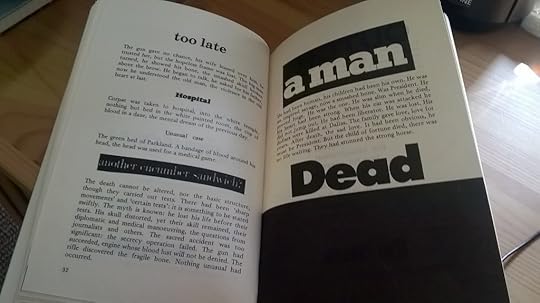
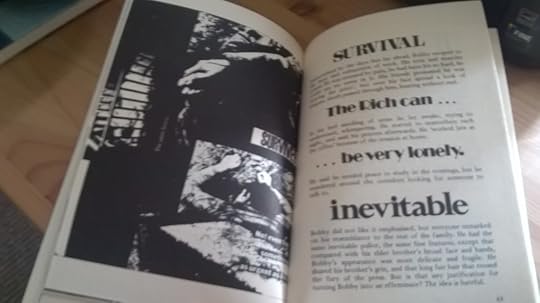
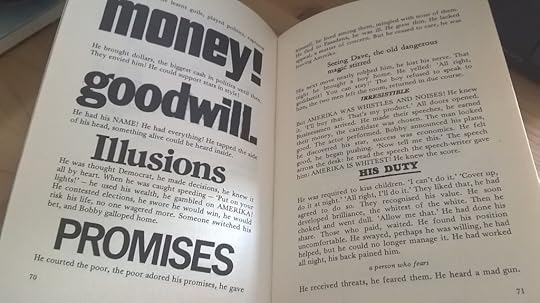
Dreamerika!, Alan Burns's fourth novel, first published in 1972, provides a satirical look at the Kennedy political dynasty, serving up an idiosyncratic hotch-potch of history that gives an old tragedy new meaning. For this book, Burns collected newspaper clippings, headlines, cartoons and photographs, cut them up, filed them and then interspersed them throughout his text to create a collage of contrasting effects.


Presented in a fragmented form that reflects society's disintegration, Dreamerika! fuses fact and dream, resulting in a surreal biography, an alternate history which lays bare the corruption and excesses of capitalism just as the heady idealism of the 1960s has begun to fade.

154 pages, Paperback

First published January 1, 1972

2 people are currently reading
184 people want to read

About the author

Alan Burns

37 books10 followers
Alan Burns published eight novels, two essay collections, a play, and a short story collection. Major works include Europe After the Rain, Celebrations, Babel, and Dreamerika! A Surrealist Fantasy. From the 1960s on, he was associated with the loosely-constituted circle of experimental British writers influenced by Rayner Heppenstall that included Stefan Themerson, Eva Figes, Ann Quin and its informal leader, B. S. Johnson.

In 1982 he co-edited (with Charles Sugnet) The Imagination on Trial: British and American Writers Discuss Their Working Methods, which the Washington Post "Book World" called "diverting, iconoclastic, and compulsively readable". The book included interviews with 11 authors (as well as Burns himself): J. G. Ballard, Eva Figes, John Gardner, Wilson Harris, John Hawkes, B. S. Johnson, Tom Mallin, Michael Moorcock, Grace Paley, Ishmael Reed, and Alan Sillitoe.

Angus Wilson called Burns "one of the two or three most interesting new novelists working in England."

Ratings & Reviews

What do you think?
Rate this book

Friends & Following

Create a free account to discover what your friends think of this book!

Community Reviews

5 stars
5 (22%)
4 stars
9 (40%)
3 stars
4 (18%)
2 stars
2 (9%)
1 star
2 (9%)
Displaying 1 - 6 of 6 reviews
Profile Image for MJ Nicholls.
2,300 reviews4,866 followers
March 31, 2016
Burns’s fourth novel (or fifth counting Buster) is a splendid example of the cut-up/collage technique at its most meaningful and potent. Having previously considered the technique a passé relic of sixties pomo excess, Burns has shown me that an explosion of meaning can be compressed into each page with creative and playful juxtapositions of text and newspaper clippings. Dreamerika! nods to Kafka’s Amerika (which Kafka wrote without having visited—Burns moved to America in the 70s, after publishing this novel), except this is ‘A Surreal Fantasy’ involving the namesake of the Kennedys, satirising the rampant reign of corruption and capitalism after the peace-love dream of the sixties died. Described in the blurb as a ‘novel of lies, surreal-biography, fantasy-history, fusion of fact and dream’ Dreamerika! resembles (and is as successful as) Ann Quin’s similarly satirical Tripticks, J.G. Ballard’s The Atrocity Exhibition, and Michel Butor’s demented road trip Mobile, and its surreal text mingles in perfect sync with the cut-out headlines and paper pages, the prose having a more “ordered” feel than in a novel such as Babel while still retaining an original weirdness. The only problem is there are literally no copies of this book in existence available to purchase. Here’s a little help.

description
description
description
Profile Image for Fede.
220 reviews
February 3, 2022
Remember?

https://m.youtube.com/watch?v=Q6vwl8o...

I confess: I've often fantasised about Jacqueline Kennedy Onassis née Bouvier, courtesy of Zapruder and Chanel - and Lee H. Oswald, of course.
This book is the sickest, wittiest, dirtiest and scariest retelling of those events and their social/political/cultural background. No wonder I enjoyed it so much.
It's a masterpiece of British experimentalism: few chapters made of short, almost poetic paragraphs, the titles of which are authentic though decontextualised newspaper and magazine scraps ranging from high-brow to crap publications. Thus Alan Burns desecrates the American dream by portraying its icons (the Kennedy clan) in all their public glory and private misery. Ambition, meanness, crimes, scandals, tragedies - merging with the all-pervasive violence of the media; the foetid nigredo stewing in the melting pot of the Sixties.

Some obvious parallels can be drawn between Burns' book and JG Ballard's The Atrocity Exhibition, in which JFK's murder is also eroticised as a symbol of the modern world's obsessions. Ballard's viewpoint is cold, intellectually detached and conceptually convoluted, whereas Burns' use of the language is utterly different. In fact it's not the psychopathology of his time that interests him, but rather its atmosphere of grotesque doom, embodied by post-Dealey Plaza Jacqueline Kennedy:

"Jackie leant against a table looking tanned, her eyes brimming with eyebrow pencils, dipping a cocktail Kleenex in her tears, a frankfurter between her thighs, more detailed tears along her lips, the circles of her breasts surrounded by questionnaires, the rough-cut fingers dipped in diamonds."

Patriarch Joseph's rise to (and lust for) power, John's ambition, Robert's controversial personality, Ted's disreputable exploits - not to mention mama Rose's sex drives, Jacqueline's not-so-reluctant morphing into Jackie O, Ted's hipster son joining a commune, Oswald and Sirhan and Charles Manson and the hydrogen bomb - Burns' parody is merciless precisely because he sticks to the facts while at the same time letting his visionary mind turn them into a postmodern Grand Guignol. Just like in Goya's portraits of the Spanish royals, the veil of wealth and success can hardly conceal the streak of decay eroding the American dream, an orgy of madness and violence leading to the racial riots, student protests, Vietnam war atrocities and unfettered corruption of the Johnson/Nixon years.

All this in 150 pages.
This book is a condensed history lesson and a razor-sharp satire of a world that is inexorably derailing. It's a short but intense read, disquieting and thought-provoking; and, last but not least, it's an experimental masterpiece.

Read this instead of wasting your time with the crap we're being fed nowadays.
Profile Image for S̶e̶a̶n̶.
990 reviews594 followers
December 13, 2016

Sure, the book plays on the Kennedys and their string of tragedies/scandals/conspiracy fodder throughout the 1960s, but I took the liberty of using Burns’ cut-up techniques on his own text in order to paint a more contemporary political portrait…

THE RISE OF THE CAPITALIST

He rebuilt Manhattan which had fallen, he grew richer than himself. With his fortunes in his hands he moved in and out, he created values brilliantly.

He spread his name all over.

He offered to buy* America [Puerto Rico] [...] and received assurances that '[he] doesn't know what he's talking about.'

After he bought Texas for charitable purposes, the oil-men approached him and offered their help.

[He] could be generous when it sounded good.

[He] pokes his finger into people, then stamps on them.

A hundred candidates lose momentum, only WE can win.
The electrifying sense of collective reputation, it is this that is dazzling, that is why [his] victory is fantastic. His revolution is rapid innovation. The public appreciates public relations, the democratic republic has gone into show business. The new President shares this mass experience.
He had studied the chemistry of crowds.

THE PRESIDENTIAL PROCESS WAS INSEPARABLE FROM MASS CONVERSION.

Do not underestimate the grasp of his hand.


...to be revisited for future insights as the Trump Presidency™ continues to unfold...

*Fascinating to see how many things he has offered to buy...
Profile Image for Paul Dembina.
727 reviews171 followers
April 29, 2020
I'm a sucker for this kind of thing. "Experimental" fiction from the late-60s/early-70s
It's very much in the same vein as Ballard's Atrocity Exhibition collection (as already mentioned by several people).
Profile Image for Al Wright.
166 reviews
October 15, 2021
By employing a Burroughs-style cut up technique, Alan Burns has captured the nationwide transition from Modernist ideals to Postmodern paranoia catalysed by the JFK assassination.
The fragmented fairy tale prose, interspersed with punchy newspaper clippings, serves to highlight this cultural reset; the American Dream in decay, the gradual tragic destruction of the Presidential family both at the hands of outside forces and its own internal vices.
This in turn mirrors the fragmentation of American society at the time, this was the 9/11 of the 1960s and Burns' treatment of the subject matter reminds us that reality, while stranger than fiction, ultimately resembles it before reflecting it back on itself in a chicken-and-egg scenario.
This novel (untainted by bias, yet retaining the passion of an engaged outside perspective in that Burns was a UK author), serves as a defining bridge between two eras of culture: Modernism and Postmodernism. The latter of which persists to this day, its trademark cynical wit and irony kicking the dead horse that is the American Dream.
Profile Image for Simon Howard.
732 reviews18 followers
March 8, 2020
I've no doubt that this has artistic merit, and it was certainly very clever, but the collage style of cut-out headlines interspersed with paragraphs of discontinuous text was just not my kind of thing. I'm glad I tried it, but it made me realise that I need a good bit of prose to get stuck into a book.
Displaying 1 - 6 of 6 reviews