

What do you think?
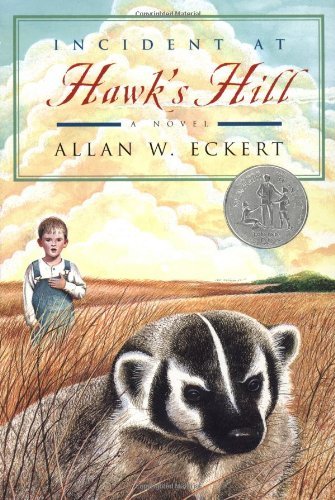
Hawk's Hill #1
Incident at Hawk's Hill
A Newbery Honor Book
An ALA Notable Book
Six-year-old Ben is very small for his age, and gets along better with animals than people. One June day in 1870, Ben wanders away from his home on Hawk's Hill and disappears into the waving prairie grass. This is the story of how a shy, lonely boy survives for months in the wilds and forges a bond with a female badger.
An ALA Notable Book
Six-year-old Ben is very small for his age, and gets along better with animals than people. One June day in 1870, Ben wanders away from his home on Hawk's Hill and disappears into the waving prairie grass. This is the story of how a shy, lonely boy survives for months in the wilds and forges a bond with a female badger.
207 pages, Paperback
First published May 1, 1971
About the author
Allan W. Eckert
86 books326 followersAllan W. Eckert was an American historian, historical novelist, and naturalist.
Eckert was born in Buffalo, New York, and raised in the Chicago, Illinois area, but had been a long-time resident of Bellefontaine, Ohio, near where he attended college. As a young man, he hitch-hiked around the United States, living off the land and learning about wildlife. He began writing about nature and American history at the age of thirteen, eventually becoming an author of numerous books for children and adults. His children's novel, Incident at Hawk's Hill, was a runner-up for the Newbery Medal in 1972. One of his novels tells how the great auk went extinct.
In addition to his novels, he also wrote several unproduced screenplays and more than 225 Mutual of Omaha's Wild Kingdom television shows for which he received an Emmy Award.
In a 1999 poll conducted by the Ohioana Library Association, jointly with Toni Morrison, Allan W. Eckert was voted "Favorite Ohio Writer of All Time."
Eckert died in his sleep on July 7, 2011, in Corona, California, at the age of 80.
Eckert was born in Buffalo, New York, and raised in the Chicago, Illinois area, but had been a long-time resident of Bellefontaine, Ohio, near where he attended college. As a young man, he hitch-hiked around the United States, living off the land and learning about wildlife. He began writing about nature and American history at the age of thirteen, eventually becoming an author of numerous books for children and adults. His children's novel, Incident at Hawk's Hill, was a runner-up for the Newbery Medal in 1972. One of his novels tells how the great auk went extinct.
In addition to his novels, he also wrote several unproduced screenplays and more than 225 Mutual of Omaha's Wild Kingdom television shows for which he received an Emmy Award.
In a 1999 poll conducted by the Ohioana Library Association, jointly with Toni Morrison, Allan W. Eckert was voted "Favorite Ohio Writer of All Time."
Eckert died in his sleep on July 7, 2011, in Corona, California, at the age of 80.
Ratings & Reviews
Friends & Following
Create a free account to discover what your friends think of this book!
Community Reviews
Displaying 1 - 30 of 265 reviews

April 2, 2016
For me, this is the best book by Eckert. He has not only captured the world as seen from the point of view of toddler Ben, but also from the point of view of the badger!!
Being a biologist, he has made the scene involving the badger completely realistic in all details, including the emotions of the badger as reflected through her actions.
The interactions between Ben and the badger is appropriately progressive from the beginning, starting with a lack of trust to a growth of trust. Both do the right things to approach each other.
The incident where the badger is trapped and she hears her babies dying wrenched my heart. Then, when Ben is hungry, and she proposes her milk is equally moving.
Ben’s survival in the underground didn’t stretch credibility, and when the badger tickles his feet to push him out made me laugh.
The scene where the badger fights the dog to save Ben, and when she shows up at his parents house are not only touching but also perfectly credible.
The end of the story left me uncertain, with a mix of joy and sadness.
Being a biologist, he has made the scene involving the badger completely realistic in all details, including the emotions of the badger as reflected through her actions.
The interactions between Ben and the badger is appropriately progressive from the beginning, starting with a lack of trust to a growth of trust. Both do the right things to approach each other.
The incident where the badger is trapped and she hears her babies dying wrenched my heart. Then, when Ben is hungry, and she proposes her milk is equally moving.
Ben’s survival in the underground didn’t stretch credibility, and when the badger tickles his feet to push him out made me laugh.
The scene where the badger fights the dog to save Ben, and when she shows up at his parents house are not only touching but also perfectly credible.
The end of the story left me uncertain, with a mix of joy and sadness.

January 13, 2016
The little one and I both highly enjoyed this story. I had read it myself back when I was her age, and remembered only that I thought it was 'gnarly.' (Leave me alone, man, it was the mid-eighties.)
It's a well-written and excellently-paced story of survival, acceptance, and perseverance. And, now that I read it with adult eyes, it may be the first novel I'd ever read that had an autistic protagonist.
Did I cry at the end? Maybe. Hey, shut up, my daughter did, too.
It's a well-written and excellently-paced story of survival, acceptance, and perseverance. And, now that I read it with adult eyes, it may be the first novel I'd ever read that had an autistic protagonist.
Did I cry at the end? Maybe. Hey, shut up, my daughter did, too.

December 28, 2007
First re-read of this since I was a kid. I loved it with my whole heart then, and was relieved to find that I still love it.
This story, allegedly based on a true incident, is about a boy who lives with a badger for a period of time. The natural history details are glorious- everything you ever wanted to know about badgers, their habits, their diets, and their vocalizations! The story itself is good, though a touch on the melodramatic side.
Recommended for natural history people and animal lovers with a high tolerance for exhaustively detailed descriptions of the omnivorous badger's diet (which included lots of cute furry things).
This story, allegedly based on a true incident, is about a boy who lives with a badger for a period of time. The natural history details are glorious- everything you ever wanted to know about badgers, their habits, their diets, and their vocalizations! The story itself is good, though a touch on the melodramatic side.
Recommended for natural history people and animal lovers with a high tolerance for exhaustively detailed descriptions of the omnivorous badger's diet (which included lots of cute furry things).

May 11, 2020
Wow, amazing book! 2020 is already shaping up to be a great read-aloud year...first Shiloh, now this book. I highly recommend it. I read it to my 11, 9, 7, and 5-year-old boys.

April 19, 2008
My reading group just finished this book today. It's high praise when a fifth grader hands you the book and says, "Best book ever." with eyes shining. It's the (possibly) true story of a young boy who wanders away from home and bonds with a badger in the wild. The author writes about the animals and humans in a very realistic way. And the ending, while kind of manipulative, tugs at you even after you've finished the book. It will be on my class reading list every year.

October 1, 2015
This book is about a young boy who is able to copy animal sounds and then one day gets lost in the woods and it starts to storm so he seeks shelter in a badger hole then soon the badger comes back soon they develop a friendship that will be put to the test.
I loved this book because every thing was described so well that you would think that you were there!
I learned that true long lasting friendship is a road with a lot of hardships and happiness.
I loved this book because every thing was described so well that you would think that you were there!
I learned that true long lasting friendship is a road with a lot of hardships and happiness.

July 30, 2020
I just need to know one thing ... WHAT HAPPENS TO THE BADGER?????? Seriously, I feel like the book ended one chapter too soon. Ugh! I see there is a sequel to this, but it doesn't sound like the badger plays much of a part in it. I feel deprived.
This is definitely not the type of book that I would normally pick up, but my husband came home this month super excited after finding this book at our local Goodwill, and he begged me to read it. It was one of his favorites from his childhood, and since I love him dearly, I decided to read it.
I loved it.
It's a weird little story about a little boy who is way better at communicating with the animals around him than he is at communicating with people. His family is worried about him, and there is strain in his relationship with almost all of them. But one day he gets lost out on the prairie and hides himself in a large underground burrow that ends up belonging to a female badger. He has had a previous encounter with this badger, an animal who has just barely escaped a trappers trap and has lost all of her young offspring. This previous encounter probably saves young Ben's life, and this badger adopts him and cares for him through the following two months.
Yeah. It's a weird story, but it is strangely compelling. Allen W. Eckert obviously has a love for nature and wildlife, and his descriptions of this badger mom was beautiful at times and always fascinating. It made me sad that man's ever expanding push into the prairies of the northern US has decimated the population of many of these creatures. I guess this is a bit spoilerish, so stop reading if it would ruin your life to know this next bit, but I have to say that one of the most beautiful moments of this story for me was after Ben's family finds him and brings him home, this lovely badger mom fights to protect him and follows them all the way to his home so that she can protect him from his family. That was such a sweet moment for me. Loved it.
I loved the growth in the relationship between Ben and his family that occurs after he returns. I love the ways they showed their deeper love for him and his giant badger companion. Ben is an odd duck, but his love for the little creatures around him and his unique ability to communicate somehow with them was touching. This is a book with heart. I can see why it is a Newberry Award winner. I enjoyed it. ...And I choose to believe that the badger lived forever after with Ben, no matter what the author may have intended. Loved this! Five stars!
This is definitely not the type of book that I would normally pick up, but my husband came home this month super excited after finding this book at our local Goodwill, and he begged me to read it. It was one of his favorites from his childhood, and since I love him dearly, I decided to read it.
I loved it.
It's a weird little story about a little boy who is way better at communicating with the animals around him than he is at communicating with people. His family is worried about him, and there is strain in his relationship with almost all of them. But one day he gets lost out on the prairie and hides himself in a large underground burrow that ends up belonging to a female badger. He has had a previous encounter with this badger, an animal who has just barely escaped a trappers trap and has lost all of her young offspring. This previous encounter probably saves young Ben's life, and this badger adopts him and cares for him through the following two months.
Yeah. It's a weird story, but it is strangely compelling. Allen W. Eckert obviously has a love for nature and wildlife, and his descriptions of this badger mom was beautiful at times and always fascinating. It made me sad that man's ever expanding push into the prairies of the northern US has decimated the population of many of these creatures. I guess this is a bit spoilerish, so stop reading if it would ruin your life to know this next bit, but I have to say that one of the most beautiful moments of this story for me was after Ben's family finds him and brings him home, this lovely badger mom fights to protect him and follows them all the way to his home so that she can protect him from his family. That was such a sweet moment for me. Loved it.
I loved the growth in the relationship between Ben and his family that occurs after he returns. I love the ways they showed their deeper love for him and his giant badger companion. Ben is an odd duck, but his love for the little creatures around him and his unique ability to communicate somehow with them was touching. This is a book with heart. I can see why it is a Newberry Award winner. I enjoyed it. ...And I choose to believe that the badger lived forever after with Ben, no matter what the author may have intended. Loved this! Five stars!

July 20, 2021
The end touched my heart. I liked the human parts of the book. What I didn't like was all the cruelty to animals, both by other animals and by the trapper. That made the book very hard for me to read.
This book was written by a naturalist for adults but somehow the Newbery committee that year chose it as an honor book for children! The cover advises it is for ages ten and up. I think some children, especially those who live in a situation where hunting is commonplace, would not be so distressed by reading this as I was. I didn't enjoy the scenes of animals being harmed and devoured. Okay, I'll confess, I'm a vegetarian and this was way out of my wheelhouse.
The human interest part of the book was much better. I liked the relationships between the family members. Even though Ben (the youngest child) seemed a bit autistic in his approach to life, his family stood behind him, especially his mother. No matter how strangely Ben acted, he was a valued member of the family. His obsession with acting like animals and communicating with them was probably an important part of his development in life. We can't all be alike.
Altogether, a good-enough book but too much animal death to be a favorite of mine. I read this because I want to read all the Newbery list books - medal winners and honor books. Sometimes I have to suffer through a book to get through it. This was one of those times.
This book was written by a naturalist for adults but somehow the Newbery committee that year chose it as an honor book for children! The cover advises it is for ages ten and up. I think some children, especially those who live in a situation where hunting is commonplace, would not be so distressed by reading this as I was. I didn't enjoy the scenes of animals being harmed and devoured. Okay, I'll confess, I'm a vegetarian and this was way out of my wheelhouse.
The human interest part of the book was much better. I liked the relationships between the family members. Even though Ben (the youngest child) seemed a bit autistic in his approach to life, his family stood behind him, especially his mother. No matter how strangely Ben acted, he was a valued member of the family. His obsession with acting like animals and communicating with them was probably an important part of his development in life. We can't all be alike.
Altogether, a good-enough book but too much animal death to be a favorite of mine. I read this because I want to read all the Newbery list books - medal winners and honor books. Sometimes I have to suffer through a book to get through it. This was one of those times.

July 30, 2011
We read this book as a class in 8th grade and I remember hating it. I don't think I read it on my own, so either it was read during class, or I started to read it and gave up.
I've been completing a "pre-baby reading challenge" and needed to read a book from my childhood, and a book I read in school. This covers both of those categories. I also wanted to revisit it to see why I hated it so much and to see if I could figure out why a teacher would include it in their lesson plans.
After a second reading I can honestly say that I really hate this book.
To begin with, I don't typically enjoy nature, adventure stories. More than anything this is the story about a little boy who finds a way to survive in the wilderness, and that's simply not my cup of tea.
The other main factor that contributes to my dislike is the hard reality the wildlife animals in the story portray. I love animals, and while I understand life in the wild is very dangerous, I don't enjoy reading about it. Most of the animals characters in the story die, usually in very painful and distressful ways. It's not a fun read.
So why would a teacher have a class read this book? Why do (did) librarians recommend it? And why did it win Newbery Honor Book and ALA Notable Children's Book awards?
I think one because of the author. Allan W. Eckert is a highly esteemed natural historian and writer who was nominated for the Pulitzer Prize several times. He also lives in Ohio and was involved in several well-known productions such as Tecumseh, which having grown up in Ohio, I remember being very popular. So I can see how his influence and locality would impact local teachers and librarians in their choices.
I was also interested with his depiction of the main character, Ben. Ben is a six year old boy who doesn't fit in with his peers or family. He is small, quiet, and withdrawn. He has trouble communicating and relates more to animals than to fellow humans. Today, I am almost positive he would be identified on the Autism spectrum, but this book was written in 1971 when such a thing didn't exist, and neither did stories with Autistic protagonists. Certainly all children can relate to feeling small and sometimes unimportant. We have all experienced what it feels like when people don't listen to us, or discount us, and in this way Ben is relatable to all. But he is more than that, he is truly separate, and my guess is that not many stories in the 70's depicted children this way.
While lost in the wilderness, Ben befriends and becomes adopted by a female badger who essentially keeps him alive for two months. The climax is when both Ben and badger take on a local dog, Lobo. Lobo is described as scary and unpredictable, and belongs to the story's antagonist, so when the badger succeeds in viciously killing him, we're supposed to rejoice, or at least be relieved. I was horrified. Again, I understand that wildlife must kill or be killed, but I don't enjoy reading about it. And as a reader I never felt threatened by Lobo, even though Ben does, so I was not happy about his death.
Once Ben is reunited with his family, things change for him socially. He finds he is able to communicate more openly because he believes he has things to say. His family realizes he has always been intelligent, and not so different from them as they once believed. He is still different though. He also has a feral badger as a pet. The family accepts that he does not fit the mold, but can succeed. That's a message I can see educators wanting to share.
And through the lives of the animals, as I've mentioned, the book explores mortality and children's understanding of death. At the end of the story, badger is shot and most likely going to die. Ben asks his father if she will live:
"Ben's lower lip trembled but he said nothing and MacDonald squeezed his shoulder, wishing there were words he could say to make it easier, wishing there was some way to put across to a little six-year-old that life is such a fragile thing and that, painful though it may be, death is a part of life...It came as a shock to MacDonald to realize that Ben did understand..."
It doesn't make for a fun read, but it's a good and true message for children and adults, and most certainly a reason why the book is so popular. I appreciate it, but don't feel glad to have read 13 chapters about painful animal death to reach it.
I also felt the vocabulary used throughout the story would certainly make it a pick for teachers.
So overall, while I appreciate the messages and the writing, I really dislike the story and will find other ways to explore the concepts with my own kids.
I've been completing a "pre-baby reading challenge" and needed to read a book from my childhood, and a book I read in school. This covers both of those categories. I also wanted to revisit it to see why I hated it so much and to see if I could figure out why a teacher would include it in their lesson plans.
After a second reading I can honestly say that I really hate this book.
To begin with, I don't typically enjoy nature, adventure stories. More than anything this is the story about a little boy who finds a way to survive in the wilderness, and that's simply not my cup of tea.
The other main factor that contributes to my dislike is the hard reality the wildlife animals in the story portray. I love animals, and while I understand life in the wild is very dangerous, I don't enjoy reading about it. Most of the animals characters in the story die, usually in very painful and distressful ways. It's not a fun read.
So why would a teacher have a class read this book? Why do (did) librarians recommend it? And why did it win Newbery Honor Book and ALA Notable Children's Book awards?
I think one because of the author. Allan W. Eckert is a highly esteemed natural historian and writer who was nominated for the Pulitzer Prize several times. He also lives in Ohio and was involved in several well-known productions such as Tecumseh, which having grown up in Ohio, I remember being very popular. So I can see how his influence and locality would impact local teachers and librarians in their choices.
I was also interested with his depiction of the main character, Ben. Ben is a six year old boy who doesn't fit in with his peers or family. He is small, quiet, and withdrawn. He has trouble communicating and relates more to animals than to fellow humans. Today, I am almost positive he would be identified on the Autism spectrum, but this book was written in 1971 when such a thing didn't exist, and neither did stories with Autistic protagonists. Certainly all children can relate to feeling small and sometimes unimportant. We have all experienced what it feels like when people don't listen to us, or discount us, and in this way Ben is relatable to all. But he is more than that, he is truly separate, and my guess is that not many stories in the 70's depicted children this way.
While lost in the wilderness, Ben befriends and becomes adopted by a female badger who essentially keeps him alive for two months. The climax is when both Ben and badger take on a local dog, Lobo. Lobo is described as scary and unpredictable, and belongs to the story's antagonist, so when the badger succeeds in viciously killing him, we're supposed to rejoice, or at least be relieved. I was horrified. Again, I understand that wildlife must kill or be killed, but I don't enjoy reading about it. And as a reader I never felt threatened by Lobo, even though Ben does, so I was not happy about his death.
Once Ben is reunited with his family, things change for him socially. He finds he is able to communicate more openly because he believes he has things to say. His family realizes he has always been intelligent, and not so different from them as they once believed. He is still different though. He also has a feral badger as a pet. The family accepts that he does not fit the mold, but can succeed. That's a message I can see educators wanting to share.
And through the lives of the animals, as I've mentioned, the book explores mortality and children's understanding of death. At the end of the story, badger is shot and most likely going to die. Ben asks his father if she will live:
"Ben's lower lip trembled but he said nothing and MacDonald squeezed his shoulder, wishing there were words he could say to make it easier, wishing there was some way to put across to a little six-year-old that life is such a fragile thing and that, painful though it may be, death is a part of life...It came as a shock to MacDonald to realize that Ben did understand..."
It doesn't make for a fun read, but it's a good and true message for children and adults, and most certainly a reason why the book is so popular. I appreciate it, but don't feel glad to have read 13 chapters about painful animal death to reach it.
I also felt the vocabulary used throughout the story would certainly make it a pick for teachers.
So overall, while I appreciate the messages and the writing, I really dislike the story and will find other ways to explore the concepts with my own kids.
This entire review has been hidden because of spoilers.

July 15, 2020
Spare prose, well done, I think. Maybe worth 3.5 or 4, to be fair. I'm undecided.
It's funny... I didn't read this genre when I was younger; I read the animal story versions.
BTW I like badgers. American badgers, like this one.
It's funny... I didn't read this genre when I was younger; I read the animal story versions.
BTW I like badgers. American badgers, like this one.

September 17, 2018
Twenty miles north of Winnipeg, in the year 1870, there stood the farm of William MacDonald, his wife, Esther, and their four children. They named their farm Hawk’s Hill and for many years, the family thrived on the land. Everyone thrived except the youngest child, Ben. At six years old, he was much smaller than other children his own age. He was also quiet, withdrawn, and seemed to get along better with the surrounding animals than with his own family. Ben would often imitate the animals he came in contact with—mimicking their sounds and movements. The folks in town called him strange, odd, and different. But Ben derived a certain amount of comfort when he was with the animals—and in turn—the animals drew comfort from him. One day, Ben wandered a bit too far from home and found himself hopelessly lost. Little did he realize that his rescuer would be a female badger who needed him almost as much as he needed her.
The author’s note states that this book “is a slightly fictionalized version of an incident which actually occurred at the time and place noted.” Intrigued, I did a little research and found that this claim could neither be substantiated nor does the author provide any further documentation. Some believe Eckert’s story is based on legend while others think that it came from an article about a boy who, in 1873, lived in a badger hole for 10 days. Regardless, Eckert gives us an interesting main character who is part Dr. Dolittle and part John Audubon and, through his exploits in and around his farm, offers readers a fascinating insight into the natural world. Eckert also provides a greater understanding of the hunting, nesting, and breeding habits of the badger sow. Although the book is filled with many interesting facts and details, the pace doesn’t lag and the story never feels weighted down.
Through the unimaginable and unlikely bond formed between a boy and a badger, we are treated to a story of survival, friendship, and devotion. I truly enjoyed this book, but deducted a rating point since this is one of those rare children’s books that lacks a sufficient ending. Because of the emotional commitment required on the reader’s part, the author should have provided a definitive ending merely out of a sense of obligation…especially given the age of the intended audience. But rather than acquiring a sense of closure, we are left feeling deserted, confused, and rather perturbed. There are stories that purposely leave the ending open-ended in order to encourage further thought and reflection. This is not one of those stories and will undoubtedly leave the reader growling, chittering, wailing, and hissing and sounding very much like an angry badger.
The author’s note states that this book “is a slightly fictionalized version of an incident which actually occurred at the time and place noted.” Intrigued, I did a little research and found that this claim could neither be substantiated nor does the author provide any further documentation. Some believe Eckert’s story is based on legend while others think that it came from an article about a boy who, in 1873, lived in a badger hole for 10 days. Regardless, Eckert gives us an interesting main character who is part Dr. Dolittle and part John Audubon and, through his exploits in and around his farm, offers readers a fascinating insight into the natural world. Eckert also provides a greater understanding of the hunting, nesting, and breeding habits of the badger sow. Although the book is filled with many interesting facts and details, the pace doesn’t lag and the story never feels weighted down.
Through the unimaginable and unlikely bond formed between a boy and a badger, we are treated to a story of survival, friendship, and devotion. I truly enjoyed this book, but deducted a rating point since this is one of those rare children’s books that lacks a sufficient ending. Because of the emotional commitment required on the reader’s part, the author should have provided a definitive ending merely out of a sense of obligation…especially given the age of the intended audience. But rather than acquiring a sense of closure, we are left feeling deserted, confused, and rather perturbed. There are stories that purposely leave the ending open-ended in order to encourage further thought and reflection. This is not one of those stories and will undoubtedly leave the reader growling, chittering, wailing, and hissing and sounding very much like an angry badger.
June 4, 2026
WOW!!! This book is AMAZING!!! I loved it for it's story, but also... I loved learning a lot about badgers! There is a TON of info about that animal in this book. The best part is, the author didn't just state facts, he told them as part of the story in a fun and interesting way! I would highly recommend this book for both the story and the facts!

October 17, 2010
This is a great book. Very detailed. I may have learned more than I ever wanted to know about badgers, but I did fall in love with little Ben and his adopted badger-mom.
As a side note, it's very interesting to see the differences in children's literature since this book was published (1972) and now. This book by today's standards would be very slow and boring, with not much action. It's really too bad that our children are growing up on Captain Underpants instead of quality books like this one.
As a side note, it's very interesting to see the differences in children's literature since this book was published (1972) and now. This book by today's standards would be very slow and boring, with not much action. It's really too bad that our children are growing up on Captain Underpants instead of quality books like this one.
February 9, 2026
A book from my childhood; read aloud to my son. I thought he would enjoy the nature descriptions and the way that Ben observed, learned from, and bonded with the badger. Unfortunately, it didn't work out that way.
The book has very interesting and detailed descriptions of the natural environment, the animals, and their behaviors. However, if you're coming to this because you're an animal lover, you may find some of the descriptions rather violent and brutal, not only animal and nature, but also human brutality. There are parts that are very unpleasant to read.
The book has very interesting and detailed descriptions of the natural environment, the animals, and their behaviors. However, if you're coming to this because you're an animal lover, you may find some of the descriptions rather violent and brutal, not only animal and nature, but also human brutality. There are parts that are very unpleasant to read.
September 2, 2021
Read for Children's Books group: Newbery Club, Sept. 2021.
This article, http://ozandends.blogspot.com/2020/07..., is much more interesting than the book. I found it looking for information about the truth that inspired the novel and learned that the enhancements Eckert added varied as to their relevance & implausibility, that the novel was written for adults, that the Kirkus reviewer did not like it, and much more.
The treatment of the previous occupants of the land, the assorted Indian nations, is brief, and not sufficiently regretful or apologetic, but not inaccurate either.
" One such Prairie dog town began in the Dakota territory and stretched far out into the land of the Cheyennes. It was just over 100 miles in width and fully 250 miles in length. Within its confines lived the staggering population of over 400 million black tailed prairie dogs."
Early in the book Burton shows off a badger he had trapped. Ben looks for the notch on the ear: "This was not the badger he had encountered out in the prairie and a wave of relief flooded through him." Even Ben is biased towards the known, the immediate... whereas the truth is, of course, that one badger is just as valuable as another.
Sometimes the writing is delightful:
A kingfisher "trilled it's rattling cry as even discussed over its own poor aim and then bounced off through the air on inconstant wingbeats."
And: "[Rose hips] did little to satisfy his hunger, but at least his stomach had something to work on."
This article, http://ozandends.blogspot.com/2020/07..., is much more interesting than the book. I found it looking for information about the truth that inspired the novel and learned that the enhancements Eckert added varied as to their relevance & implausibility, that the novel was written for adults, that the Kirkus reviewer did not like it, and much more.
The treatment of the previous occupants of the land, the assorted Indian nations, is brief, and not sufficiently regretful or apologetic, but not inaccurate either.
" One such Prairie dog town began in the Dakota territory and stretched far out into the land of the Cheyennes. It was just over 100 miles in width and fully 250 miles in length. Within its confines lived the staggering population of over 400 million black tailed prairie dogs."
Early in the book Burton shows off a badger he had trapped. Ben looks for the notch on the ear: "This was not the badger he had encountered out in the prairie and a wave of relief flooded through him." Even Ben is biased towards the known, the immediate... whereas the truth is, of course, that one badger is just as valuable as another.
Sometimes the writing is delightful:
A kingfisher "trilled it's rattling cry as even discussed over its own poor aim and then bounced off through the air on inconstant wingbeats."
And: "[Rose hips] did little to satisfy his hunger, but at least his stomach had something to work on."

August 8, 2024
This book was my favorite book in middle school, and I had to reread it cause I’ve only read it the 1 time. If I could give this book 10 stars I would. It shines light on kids who are slightly “different” and prevents a very fictional story that captivates and moves a reader. I also just found out it is a Disney movie from the 70s. Who knew….
April 22, 2023
Enjoyed reading this with the kids. Great nature descriptions and though a little slow, still kept the older ones engaged. Didn’t skirt around some of the hard parts of real life in the wild. Reading it as a mom had me tearing up a bit at the end.

March 5, 2021
Such a great kids story!
May 23, 2023
It’s not Where the Red Fern Grows but I liked it. It’s based on a true story so after you read it go online and read about that. It’s short, emotionally charged and is a wonderful love and nature tale.

July 29, 2022
I was 10 years old when I first read this book. It was the only time I had read it and though I could not remember the name, over the years I have googled what I could remember of the book, hoping to find it. This is one of those books that just sticks with you. When I finally found the title I knew I had to read it again. And in doing so I feel like I got to know 10 year old me a little bit and it feels like such a sweet gift.

July 22, 2011
I read the book at about the age of 13, and I wouldn't recommend it for kids under 12 unless they have a more advanced vocabulary. It did leave a lasting impression, to be sure. I enjoyed things about the wilderness, animals, and survival. The base relationships in it both fascinated and uplifted me. The ending was even satisfying, which isn't something I could say about many of the required reading books. Although, I do sympathize with those who were -forced- to read this or any book. I just happened to find it when I was bored.
I don't really think it's fair of those giving this book poor marks for being a good book, but a reading requirement for perhaps slightly too young of an age. There's no more excessive or graphic detail depicted here than one would get from a nature show, and the human factor of it is quite gratifying.
I don't really think it's fair of those giving this book poor marks for being a good book, but a reading requirement for perhaps slightly too young of an age. There's no more excessive or graphic detail depicted here than one would get from a nature show, and the human factor of it is quite gratifying.
November 28, 2016
1.Six-year-old Ben is very small for his age, and gets along better with animals than people. One June day in 1870, Ben wanders away from his home on Hawk's Hill and disappears into the waving prairie grass. This is the story of how a shy, lonely boy survives for months in the wilds and forges a bond with a female badger.
2. This book would be a good read for 3rd-5th grade
3. I would use this book when discussing wildlife or with a history lesson on life before the 1900's.
4. All students would benefit from reading this book but students who enjoy nature would love this book.
5. Kids could use this book to do a literature circle or a jackdaw project with.
6. This book could be fun to read to the class aloud but I don't think I would use it.
7. Shiloh is the closest book I could find to this one.
8. There are no multimedia connections for this book.
2. This book would be a good read for 3rd-5th grade
3. I would use this book when discussing wildlife or with a history lesson on life before the 1900's.
4. All students would benefit from reading this book but students who enjoy nature would love this book.
5. Kids could use this book to do a literature circle or a jackdaw project with.
6. This book could be fun to read to the class aloud but I don't think I would use it.
7. Shiloh is the closest book I could find to this one.
8. There are no multimedia connections for this book.
December 2, 2012
This might be the best book you never read. Maybe you saw the movie during primary school. Maybe someone read it to you when you were young and you have this vague recollection of a story about a little boy and a badger... but you can't quite recall...
I originally read Incident at Hawk's Hill when I was eight and loved it. It inspired my love of nature. It's the first book that evoked emotion from me, anger, fear, grief, joy. Of course, as a kid I believed that it was all true and hoped that I could live with the animals if I ever got lost.
I just reread this story, and though I know that it's fiction (POSSIBLY based on local legend) it still moves me. It is definitely going on my "All time loves" shelf.(l
I originally read Incident at Hawk's Hill when I was eight and loved it. It inspired my love of nature. It's the first book that evoked emotion from me, anger, fear, grief, joy. Of course, as a kid I believed that it was all true and hoped that I could live with the animals if I ever got lost.
I just reread this story, and though I know that it's fiction (POSSIBLY based on local legend) it still moves me. It is definitely going on my "All time loves" shelf.(l

January 31, 2010
We picked this book because Joshua is writing his 3rd grade Mammal Report on badgers. In this true story, a 6 year old boy wanders away from home and gets lost on the prairie in 1870. A mother badger who just lost her babies finds the boy and cares for him for 2 months until he is found. We learned all we ever wanted to know about badgers (and much more). Joshua was mesmerized by the story and all the details of nature. Rachel liked the story line but wasn't as interested in all the badger details. There is some "nature violence" and death, and Josh was in tears when the badger ate baby mice. But overall, a fascinating story for those who love the great outdoors.

September 30, 2018
If you liked "Old Yeller," read this book. If you liked Jody and Fodder-wing in "The Yearling," read this book. If you cried in the last few pages of "Where the Red Fern Grows," you'll be crying in the final pages of this story. Six-year old Ben is a fragile, introspective wild child, more at ease with barnyard animals than with people, even his own parents and siblings. Time and circumstances bring Ben and a ferocious badger together as allies licking each other's wounds. Read this book. It will be good for your soul.

February 17, 2011
This book brought to mind Walt Whitman's "Sometimes I think I could turn and live with animals." It's lovely to know that the story's based on a true incident of a badger caring for a boy. Here the author develops that intriguing germ of an idea into a book that also speaks about acceptance and understanding of those who don't conform to expected norms and about the power of love to bridge distances and bring healing to a troubled family. Especially recommended for animal and nature lovers.

September 27, 2023
I'm DNFing this one. It's not for me. Historical/natural fiction, based on a true story and VERY full of nonfiction nature detail. I read a summary of the actual story after reading to page 65. The people are so mean to Benjamin that the people chapters are painful, and the nature chapters are so, so dense. One review I read said this was not initially intended to be for children, and it makes sense to me that this would be aimed at adults.

September 4, 2012
An old favorite ... accompanied by appealing "like" reviews. A frequent library "reco"
If you like animal stories ...
If you like animal stories ...

October 22, 2015
Sometimes you just wanna live with badgers.
Read this as a child. Can't remember much, other than wanting to hang out with badgers. Little me couldn't get enough of these types of books.
Read this as a child. Can't remember much, other than wanting to hang out with badgers. Little me couldn't get enough of these types of books.
December 9, 2016
Book was incredible...highly recommend. Left me hanging at the end which was really tough to sleep after reading this.
Displaying 1 - 30 of 265 reviews