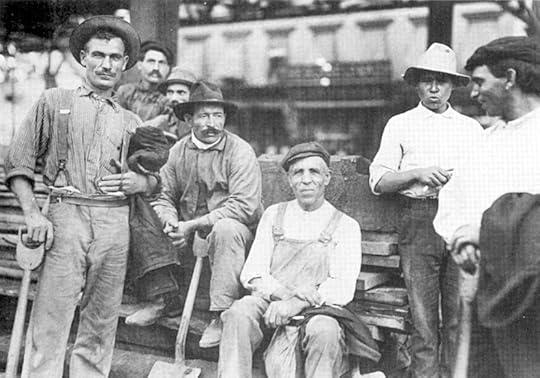
Pour qu'il y eût ce livre, il a fallu d'abord deux continents, et que des Piémontais, poussés par la pauvreté, émigrent et aillent défricher un coin de cette plaine illimitée que l'on appelle pampa . Il a fallu aussi qu'un enfant promis, tout naturellement, aux travaux des champs, saisisse la seule chance alors offerte aux gens de son état : le séminaire, où l'attendent, pêle-mêle, amitiés particulières, musique, les livres, qu'il espérait tant, et la découverte de la langue française. Il a douze ans. Là-bas, en Europe, la guerre bat son plein, tandis qu'ici s'installe et prospère la dictature, celle de Peron et d'Eva Duarte, sous laquelle nul n'échappe à la surveillance et à la délation. Et c'est le meilleur ami qui, se révélant soudain être un mouchard haut placé, et voulant se le faire pardonner, offre à l'ancien séminariste le billet de bateau salvateur.
Hector Bianciotti was an Argentine-born French author and member of the Académie française.
Born Héctor Bianciotti in Calchin Oeste in Córdoba Province, Argentina, Bianciotti's parents were immigrants from Piedmont, who communicated among themselves in the dialect of that region but who forbade its use with their son. Instead, they spoke Spanish to him. Bianciotti began his study of French in 1945. He arrived in France in 1961 and completed his French naturalization in 1981. In 1982, he stopped writing in any language but French, his favorite.
Bianciotti was elected to the Académie française on 18 January 1996 to Seat 2, succeeding André Frossard.
This is a very well-written, literary work that is a fictionalized autobiography. I like the memorable opening line: “Today, my own life has come looking for me.”
The blurbs tell us that it is about a young man discovering that he is gay, but it is more correct to say that he discovers his bisexuality, since much of the story is about his relations with an underage girl, and later, his love affair with a woman. As a child he is attracted to his sisters’ dressmaking and fashion magazines. He delights in dressing a manikin and making clothing patterns for it from newspaper. At 14 his parents send him to a boarding school, and against their objections he insists on going to a seminary to become a monk
In a broader sense, the novel is about memory – it’s Proustian. There are many passages about the fallibility of memory. “Of course, the person who experiences things is not the same one who remembers them. I suspect the present of nourishing the memory more than memory nourishes it; things have imprinted themselves on us without our noticing them at the time, and their reviviscence transforms them into magnets for all sorts of relics and impressions that come to cling there like shellfish on a rock.”
Another passage about memory: “Among the things that insist for no good reason on being remembered in the course of a lifetime, it is a rare one that does not require some editing by the mind, which is subject to the changes in distance and lighting forgetfulness may bring.” And another “…other memories of other Sundays have clustered around that one, so that they all fuse into a single day.”
There area lot of vivid characters: a girl who has a hunchback; a priest wresting with his attraction to young girls; a young farmhand who engages in a performance suicide; a crazy aunt who is clairvoyant and holds religious seances. Of the last character, “She simply took advantage of the fact that Hell was on her side.”
Several times the author mentions feeling, to the effect, ‘like a second-class citizen’ in Argentina. He grew up in a rural all-Italian community in Spanish Argentina. As in most immigrant groups, the immigrants import their home-grown prejudices with them, so his Piedmontese compatriots demean and shun southern Italians. As a geographer, I know that Argentina has more people of Italian than Spanish ancestry.
Like the character in the book, the author’s parents spoke Italian between themselves but had the children grow up learning only Spanish. Bianciotti apparently rebelled by learning French, moving to France, and writing only in French. In that sense the author is like Conrad or Nabokov, earning literary fame by writing in another language. To this list I would add Andreï Makine, a Russian-born writer who writes dreamy prose in French.
The vast featureless agricultural plain that surrounds our narrator looms over him. No place to hide – just a sea of alfalfa waving in the breeze. It reminds me of the classic novel of Norwegian immigrants set in the American Dakotas – Giants in the Earth by A. E. Rolvaag, or of works by Willa Cather.
One additional theme: politics. As the narrator tells us, the torture and the ‘disappearances’ of Argentina have not yet started, but it’s the time of Peron and Evita and the ‘special police’ who check IDs, working on commission if they find persons of interest. They terrorize the narrator and his companions in their nightly doings.
Some examples of good writing:
“I do not know if everything is permitted in defense of one’s life, but in one’s defense against life – yes everything.”
“He was impassive, like the models for those portraits in museums who seem to have waited too long for you to come see them.”
“Fate takes care not to let us know too much about what is in store for us…”
“We are creatures of mystery: we think we are moving forward, stepping into the future, and all the while time carries us toward the past…memory, the shifting changeable thing that makes us what we are.”
After the crazy aunt dies, her brother (the main character’s father) “[holds] her up as an example to us all, and in this he was consistent with the time-honored habit of families who expect their dead – particularly those who were never understood while they were alive – to furnish them with precepts for the living.” (A wonky translation but we get the point.)
The author (1930-2012) wrote a dozen novels that have been translated into many languages but from what I can see on GR this appears to be his only work translated into English. I liked this book, both the story and the dreamy, memory-oriented theme, and I’ll give it 4 (4.5). But I note that it has a low overall rating on GR (3.3) which may reflect its few ratings and only 5 reviews.
Top photo of Italian farm immigrants in Argentina from thinglink.com Soybeans growing on the Pampas from flagtheory.com The author from babelio.com
Gotta love some gorgeous dreamlike prose, no matter what the setting or context. Gimme all ya got, fuckers. Bianciotti, it turns out, has quite a bit.
Most of the verbiage on this particular site seems to focus on the Bianciotti stand-in's discovering he likes boys. Which, OK, fair enough, especially given the dreamlike prose, I was fully expecting him to masturbate into a peach at some point, but that felt strangely secondary to me. Rather, it was a more universal artistic soul's coming-of-age story, just one that happened to be grounded in a very specific place – the Italian immigrant communities of the Pampas – and in a specific person, who, as it turns out, liked boys. And I rather loved it.
The book is exquisite, peopled with unforgettable characters. It's shocking, beautiful, and painful. Bianciotti is a compromised, complex narrator whose (possibly sole) redeeming quality is his ability to articulate desire and a kind of fatigued regret in brilliant prose. The creepy rise of Peron is depicted subtly, then almost farcically, as characters begin to rat on each other. In this world in which everyone is disloyal, it's not surprising that the narrator is no moral beacon. I'd recommend it to anyone who wants to write or teach memoir. It ranks with Nabokov's "Speak, Memory" and Mishima's "Confessions of a Mask."
What the Night tells the day by Hector Bianciotti, translated from the French by Linda Coverdale
This is a coming of age tale narrated in the first person by Mr. Bianciotti. Born to Piedmontese Italian immigrants in a farm in the Pampas, Argentina, the author starts with his youth in the farm. Fascinated by his great aunt - Pinotta, the author soon discovers masturbation as he interacts with one of the farm helpers: Florencio.
His mother and father are poor and proud Italian immigrants. His mother was a pious Catholic, his father probably an atheist. However, his father wants the author to be educated. Thus he is shipped to Córdova, Argentina where he starts education by the Franciscans. It is clear that he continues having issued with masturbation - as he confesses to Father Salgado, his spiritual director.
Somehow, the author decides he has a calling to be a priest, and after getting the required permission from his family, he moves to Moreno, Argentina,where he continues his studies under the auspices of the Franciscans, but goes to school with the "Maristas." The author takes pain in describing how on his arrival to Moreno there was a solar eclipse - at the ending of which he sees the face of an older seminarian who he falls madly in love.
After succeeding in his studies he realizes that he can't become a priest, so he's sent back to live with his family - who now live in Villa del Rosario. There he becomes the clerk for the local notary.
He doesn't last long there and he moves to Buenos Aires. There he fathers a son by Judith, and has numerous lovers, the most prominent one being Matías. The book ends as the author is about to move to Europe, where he currently resides in Paris.
The book is quite boring. In spite of narrating the coming out experiences of a teen in Latin Argentina, the author never gets the reader involved in the story. Perhaps because none of the main characters are developed: we never get the name of the author, nor the name of his parents. There is no climax and no suspense - there is a minimal plot which is poorly developed. I was very disappointed with the book.
Comment décrire ce roman… Écrit, il me semble dans un langage trop littéraire, ce récit est peu intéressant. L’auteur effleure quelques thèmes assez sérieux sans rien véritablement développer. On a du mal à suivre, à comprendre les motivations du personnage. J’ai dû me faire violence pour le terminer. Pour ceux et celles qui aiment des histoires bien ficelées, ce livre ne vous comblera pas. Il est plus destiné aux lecteurs aimant les beaux mots, la poésie, les impressions plutôt que affirmations.
"Quando più ci si sente al sicuro, può accadere qualcosa di più forte di qualsiasi tentazione: la bellezza, un tramonto, una rima felice, la prima frase di un notturno di Chopin, e ci si trova di nuovo perduti, dannati." (p. 122)
"Non ho scelto una strada, ho seguito i miei passi." (p. 160)
"La vita si sottrae a qualsiasi previsione. Confortati dall’illusione della scelta e dalle virtù della pazienza, passiamo il tempo a farne, del tutto inutilmente." (p. 243)
Je me souviens juste que l'auteur détaille de manière assez dérangeante la naissance de sa petite soeur au début du livre, puis j'ai oublié la suite (c'était ennuyant)
"Hoy, mi vida es quien me busca". París, un hombre, en el ocaso de su vida, decide buscar en su pasado."Ahora que, el invierno tras el cual no habrá más verano"dice en el comienzo. Nunca sintió la necesidad de volver la vista atrás, pero en este momento donde parece que "el plazo vence mañana", sin quererlo, comienza a bucear en su pasado. Éste lo trae a la llanura pampeana, donde nació y vive con su familia. Descendiente de piamonteses que cruzaron el océano para hacerse la América, viven en la mas austeras de las existencias en pleno campo. Recuerda esos días en medio de la nada, su adolescencia, los primeros acercamientos sexuales, los bailes de pueblo. Para escapar de un destino no deseado se interna en el seminario. Cambia una cárcel por otra. Luego la escapada a Córdoba para aterrizar después en Buenos Aires. Estamos en pleno gobierno peronista y se siente en la calle. Aquí nos cuenta el anclaje en la gran ciudad, la vida del que no tiene un mango, las primeras amistades, sus primeras experiencias sexuales hetero y homosexuales, y esa sensación de peligro constante. Se nota que cuesta el recuerdo, no porque duela sino porque en algún momento decidió enterrarlo en lo más profundo de la memoria. Por momentos el narrador cambia de una primera a una tercera persona, como si el narrador del presente le hablara a aquel que alguna vez fue. La prosa es exquisita, no busca empatizar con el lector, por momentos se vuelve poco simpático, pero está muy bien, no podemos caer bien a todo el mundo. Héctor Bianciotti, escritor argentino radicado en Francia desde 1955, llegó a ocupar una silla en la Academia Francesa, por alguna razón no muy conocido por el público argentino. Vale mucho la pena meterse en su historia, que al mismo tiempo es la historia de un país en tiempos turbulentos.
"What the Night Tells the Day" is a beautiful, novelized gay memoir of growing up in the Argentinian countryside. Told in a flowing, poetic language, much like Jorge Luis Borges's insomniac Poems of the Night, it evokes, among many, Bianciotti's memories of riding bareback across the plain in the arms of a fellow teenage cowherd, sexual tension in his years of Franciscan education, and an intricate dance in the dim light of a streetlamp with a cruising priest, who "switching his cigarette over to his left hand, automatically held out the right one for the baisemain; realizing how strange that seemed under the circumstances, he pulled his hand back as I bent to kiss it." Bianciotti moves on to Buenos Aires, grand, stifling, and Peronist, where he meets many lovers, until he'd follow one of them to France.
This entire review has been hidden because of spoilers.
Outstanding account of young man from impoverished countryside of Argentina, Late years of Peron regime, becoming educated, leaving home,relationship with the Church, discovering and coming to terms with his homosexuality