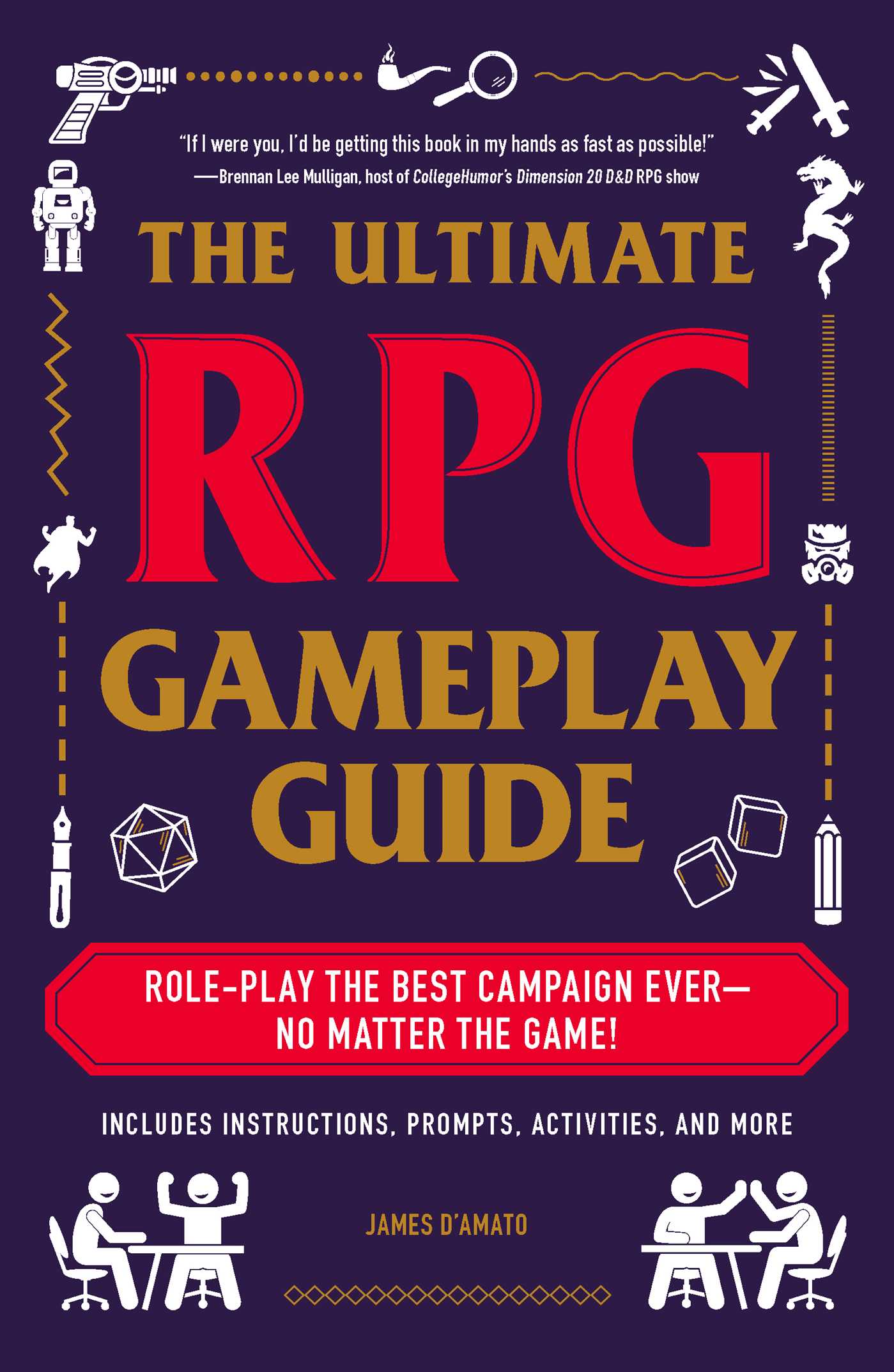
Improve your RPG campaign with this comprehensive and interactive guide to making the most out of your gaming experience.
Whatever RPG game you play, from D&D to Call of Cthulu to licensed games like Star Wars, every detail is important. From setting the scene to choosing the right music or even adjusting the lighting to create the right atmosphere, every choice helps maximize your gaming experience.
The Ultimate RPG Gameplay Guide provides practical advice for everything from pre-game preparations and in-game improvisation to working out a plan of attack with your teammates to learning how to lean into the setting of your game. Including instructions, prompts, and activities, it offers everything you need for successful, fun role-playing with your friends every time you play.
Create hours of narrative and make the most out of your storytelling skills by setting the perfect scene for your adventure. Whether you need advice on your character or working better with your gaming group, James D’Amato includes everything you’ll need to take your game to the next level.
James D'Amato is trained in improvisational comedy, and in this book he collects advice on the general concept of role play. This contains advice for GM and player, but really both are working together on a creative writing exercise over multiple sessions.
This book contains some history, some exercises, and some reasons for the authors direction. It is a quick read, and definitely seems like the sort of thing to keep players involved in a game. I am interested in trying out some of these techniques, though it seems like a majority of the group would need to go along for some of them.
Not a bad selection for a book I chose more or less at random from the gaming section of the library before they closed for a few months.
This is the first text on roleplaying games I've read that really look at the general concept of role playing as an act of ensemble creative writing. But it's not just a simple improv group, each player is writing a character over multiple sessions rather than just one night.
D'Amato focuses a lot of how a good group will keep in mind details like spotlight, upbeats, and downbeats of both the story as a whole and as a balance between all players at the table. It contains specific advice for navigating conflicting goals of players in a way that lets both of them play the game they want.
It's a really insightful book, but also full of exercises to put many of these ideas into practice. Anyone from a new player to the most seasoned game master could get something out of this book.
This is for players or GMs who want to make better worlds, be better players, and make a better experience for everyone. There is an emphasis on improv techniques for cooperative creativity but also a lot of introspective workshopping of characters and world. There was no conclusion to the book, which was a bit jarring, but overall, had a lot of things to consider.
This is a really solid book and I recommend it for anyone who wants to improve their tabletop role-playing gaming experience. There's just so many great bits in here!
I read this book as a result of having read The Ultimate RPG Character Backstory Guide and finding it amazing. This one... not so much. What it presents is great, though a lot of the content seems like it could be general knowledge to anyone in the hobby. Like its predecessor, the Gameplay Guide shines when it is prompting you through scenarios and exercises that help you expland your thinking. Unfortunately, I didn't walk away from the Gameplay Guide with an epiphany, surrounded in shing golden light (I totally got that from Backstory Guide). In my opinion, this book is just ok.
Genuinely fantastic. I often look down on books with names like "The Ultimate" or "The Essential" but this guide takes you through the basics of play into more advanced techniques and finally into practical guides on scene planning, scenario improv, and character depth for both players and GMs.
It really goes into topics I didn't expect like collaborative worldbuilding and tone resulting in a better holistic understanding of play. Can't recommend it enough for new players or vets.
If you wanted to pick up a general "How to Be Better and Have More Fun with TTRPs," book, this should be your first stop. This book not only covers a wide range of topics, but also is inclusive to different styles of play for all prompts and advice. D'Amato takes his background of improv and applies it beautifully to TTRP with easy to follow prompts to encourage collaborate story telling and world building, better table banter, approaching character voices, as well as general writing advice for creating hooks and tension.
Read this book if you want to elevate your tabletop RPG sessions. The lessons and excercises are mostly aimed for game masters but some (especially the core philosophies of the book) can be of interest to players as well. Not everything in here will feel applicable to your GM style, but if you approach them with an open mind you will surely leave with a new perspective on things, or at the very least a few ideas on how to bring your game to the next level and make it an entertaining experience for everyone at your table.
Interesting read on TTRPG's. It had some helpful tips on how to get more out of your role-playing games as well as some exercises to help create characters and stories with more depth.
To any of my podcast lovers, check out D'Amato's podcasts, One Shot, Campaign, and Skyjacks!
Well ... the search for that really good DM guide continues. This work suffers from trying to be too many things: it bops back and forth between tips and ideas for DMs and for Players, sometimes inscrutably so. In trying to be a helpful guide for everyone, it touches on too many things lightly, being too superficial for either DM or Player to really feel like this is the work for them.
Another significant flaw in this is Mr. D'Amato bizarre assumption throughout that since he has experience playing RPGs in front of an audience, and since Critical Role is popular with the kids these days, a great deal of his advice and tips are aimed for playing RPGs in front of live audiences. Now, as the rest of us know, 99.9997% of people who play RPGs will never be playing in front of live audiences, and of those who do, close to that same percentage probably shouldn't be doing it. Thus, much of the discussion on playing in front of people is wasted. Similarly, Mr. D'Amato never hesitates to remind us he had some experience with improv, and proceeds to give us half-remembered, poorly implemented exercises and techniques. It's like that one guy who went to that one workshop that one time whose life was "totally changed" by it, then comes back and tries to spread the good news of improv without really remembering all the important background and just shares the activities ... and most of it makes little to no sense, nor are they very practical for most players.
This constant emphasis on "audience" further confuses the reader, as, like many contemporary "how to play RPGs the right way" guides suffer, the pervasive "you are all audience members and you are all storytellers" requirement continually pokes us in the shoulder. This doesn't have the same bizarre notion as the Kobold Guide does of "of course you are playing with total strangers" (which surely almost never happens), but this guide does give the impression you are playing either with amoral "anything goes ever" players or "wholly insecure people who never can handle not being the center of attention." There's some pressure to keep people constantly engaged, but won't your friends, the ones you enjoy playing with, be okay if they aren't the center of attention for a session or two? Aren't they there because they like being a part of the overall story, seeing where it goes for their friends as well as for them? It's like the "audience" has to be entertained all the time, mainly by being a part of creating a story. And by jingo, it better be fun for everyone every second, or it's all a total failure!
This guide does have a fair number of brainstorming worksheets and question guides, which at first seem like the saving grace of this work. Yet, if you buy this book, are you really going to write in it? And the binding is so tight it'd be tough to photocopy the worksheets. Maybe there's a link to them on-line, so you can download them and reuse them for different games, but that just means you are paying for a lot of empty space in this book.
And the color scheme is atrocious. The black/dark blue and red colors throughout are so irritating to look at - how did that possibly get through the editor team? Why in the world would you make red one of the dominant colors you need to read for an entire book? Bad decision, that.
I realize I've given you the impression this work is a complete waste of your time, but that was not my intention. The flaws are just so egregious: the inability to commit to who the audience for the work is, the pervasive misunderstanding of who is playing these RPGs and why (and who is watching them do it), the bizarre worksheets who may be good ideas but end up wasting space, the atrocious color scheme ... all make for a disappointing package.
If, however, you take the time to read a few of these chapters, and maybe all of them, it's quite possible you will glean from this overall mess a few useful kernels of gameplay tips. You certainly won't get as many as you want, especially from a purported "ultimate guide," but you may get two or three little ideas that could improve your approach to your character or the kinds of encounters you craft as a DM. Definitely read it from the library for free before spending any money on it.
Someone (maybe Mark Twain) once said words to the effect that the only crime in fiction is to be boring. You can be crass, resort to Deus ex Machina and red herrings, but you can't afford to bore the paying audience (or the freeloading illegal downloader).
If you play RPGs (role playing games), you've experienced the joy that comes with crafting an immersive story that works...and you've undoubtedly experienced the opposite, that sinking feeling that comes when no imaginative faculty or enthusiasm can save a game. Something's off, but you're not sure exactly what it is.
"The Ultimate RPG Gameplay Guide," serves as a guidebook for how to make a game better, both for the Gamemaster and for the players. There are helpful exercises that allow players to get in character and shed the inhibitions that silently whisper "This is stupid, you're an adult," when we first try to set the imaginative faculty free. There are parts of the book that work as a diagnostic tool, helping the GM troubleshoot those patches of a game that aren't working, the way an owner's manual aids a motorist in getting back on the road.
Trying to enter the altered, almost hypnotic state required to play a role-playing game is hard; trying to balance the egos and character arcs of several different players once you've reached that state is even harder. "The Ultimate RPG Gameplay Guide," helps simplify a very complicated task. Recommended.
Fun to read and very useful. Applicable to most if not all RPG systems. As a DM I think I'm going to photocopy some exercises to hand to my players, because I believe it will benefit our game and lift it to greater height. The reason for 4 stars instead of 5 is that I would've liked to see more GM-specific advice. The GM is of course a player too, but as GM you run into different issues on top of player issues. This is addressed in the book, but could've been a bit more elaborate.
I wasn’t going to get, let alone read, this book, until Quinn Murphy praised it on Twitter. I enjoy listening to James D’Amato on podcasts, and the seminars I’ve attended in which he appeared have always been enjoyable, so it’s not that I have anything against the author. It’s just that I’ve been playing and studying RPGs for a while now, and I didn’t think I would gain much from a book that is angled toward readers only just entering the hobby.
But it’s not just for readers only just entering the hobby. D’Amato did a great job of creating a book that is applicable and inspirational to folx who are curious about the hobby and want to play the kinds of games they’ve been hearing about or seeing through actual plays while also addressing those players who have been playing for however long but who have not steeped themselves in the techniques being explored in indie games over the last 15 years. Even if you have been active in the indie rpg scene, it doesn’t mean you necessarily know how to apply the lessons from those games to whatever game your friends are playing.
D’Amato sits at what I think is a fantastic intersection of practicality, rpg theory, and improv techniques. This means that he takes the best of all these areas and never overwhelms the reader by leaning too heavily on any one discipline. Of course, this also means that at some points, he doesn’t go far enough into a subject for my tastes or explains things in ways that I think miss the mark of the important ideas underpinning the behavior, but I completely get why he does so. Just because a thing interests and is important to me, doesn’t mean that that understanding is critical to affecting the way you play. For example, his discussion of the unique-to-rpgs phenomenon of players and audience being one fell flat for me, and his chapter on “Understanding Text” got at some critical ideas about roleplaying without ever going into what is, to me, the crucial thing to understand when playing an RPG—that the conversation is the play itself. The “Understanding Text” chapter is a solid one, and the first one to move beyond the introductory stuff, but its examples are written examples and not examples out of play. If I were new to the game, looking at these examples, I’d want to imitate this writerly language in my game, thinking that’s what the text were about. The same points about perspective and focus, atmosphere and action, and all of it, could be better made with conversational examples from play rather than the equivalent in a book. The text in a book is fundamentally different from the text in RPG play, and I think having so few examples model RPG play is a disservice to the reader.
For my strong opinions on that front, it is a rather nit-picky criticism. There are chapters in this book that I want everyone I play with to read. The “Make Choices Important” chapter is a gem of a chapter, and I think worth the price of the book alone. Similarly, the chapters on “Themes,” “Playing to Change,” and “Looking for Trouble” are all chapters I would recommend heartily.
It is amazing to me that we are in a time that such a book could be published by a major publisher and distributed in what few bookstores remain, right there on the shelves with the D&D books and whatever other RPGs manage to get mass distribution. A player’s game (and enjoyment of that game, whatever game it is) can only be increased by reading this book and applying its lessons. I cannot imagine this was an easy book to write and organize, but D’Amato did a bang up job of it.
This book would be easier to appreciate if the author did not appear to have an agenda with regards to how one should role play. In the author's mind, there are certain right or better ways to roleplay that match his own personal and political biases. To be sure, there is certainly plenty of good advice here, enough that the book deserves a cautious recommendation so long as one recognizes its biases but also the worthwhile advice it provides. What is good about this book is more its legitimizing of role playing games as a means for which people who might not always be considered to be the most sociable can learn how to deal empathetically with others. That said, the author has his own specific views about emotional vulnerability that may not be to everyone's taste, and so not as much about this book is ultimately as valuable to readers as the author thinks and believes. This is frequently the case, though. It is all too easy for people to write books thinking that they are the be all and end all when they are merely part of a greater conversation, and that is certainly the case here, not that this is by any means a bad thing.
This book is between 200 and 250 pages and it is divided into three parts. The book begins with an introduction and defining terms and is closed by a glossary, acknowledgements and additional resources, and an index. The first part of the book discusses basic storytelling, including the need to understand one's audience, have a conversation before the game actually starts so that the group can work together, deal with pacing as well as making choices important applying improv to games. The second part of the book consists of advanced playing techniques--at least advanced in the mind of the author--including using themes, imagery, playing to change (because the author has some progressive biases), looking for trouble, and encouraging the GM to delegate creativity to the player. The third part of the book then discusses how one plays for experience--again, the sort of experience the author would enjoy--including unpacking desire, dealing with narrative rewards, shifting genre, limiting choices, mood lighting, using a pacing scorecord, and looking at side scenes again with influence from improv.
What things allow one to be a good roleplayer? In the eyes of the writer, being a good role player is akin to being a good improv comedian, having the ability to work well with others and give enough information in one's bits that other people can combine their own observations with your own, creating a collaborative world that is full of rich detail that allows others the chance to interact and show off their own roleplaying skills. The author's approach to roleplaying begin akin to theater or comedy carries with it some obvious assumptions about the sort of viewpoint one is to have, and the author certainly has his own ideas about good roleplaying that not everyone is going to share. If the author seems a bit down on power fantasies, it is because he does not view roleplaying in a really ecumenical way, but sees role playing as a means in order to develop certain habits and patterns of thinking and interacting that correspond to the author's own preferences and biases. The extent to which these are shared by the reader may vary wildly and this book is likely to be more of a contentious subject than the author would appear to think.
Going to start my first PNP campaign soon and thought I read up on some theoretical things to get started! Was not disappointed at all.
What I liked: + Good overview over all the different aspects of being a GM + Ideas on how to self-reflect + Good mix of theory and practical execution
What I didn't like: - Since the author tried to include as many different genre as possible, it often was kept very general and superficial - Some approaches were very specific in how to approach topics with players and I didn't like them
As always, I needed to remind myself that a Guide does not mean that they want you to do things 1:! as described, it's not an instruction. I really liked all of the theory points and how you can use to self-reflect. However, some approaches were too specific for my taste; I did not agree with some execution of how to turn theoretic situations in more satisfying ones for the GM. I felt like these were too player-oriented, e.g. "How could we make this situation turn more into a situation you can justify your character to follow the plot?" is not a phrase I want to use in the PNP, I think it takes away some PNP magic. But still, it's important to note that after reading a guide, you know what you like and what possibilities you have, so work done 10/10!
This is a useful look at a wide variety of techniques for improving RPG play (basing "improvement" on what the players want out of it...so for example if you want a more complex PC, how can you do that?). It includes material for both players and GMs, but mostly players (natch).
The tone is a bit pedantic at times, but that's mostly because it's aimed at such a wide audience of player types and experience levels.
I particularly appreciated that it includes specific, practical tools, both for use in-play and as out-of-play exercises. I think my favorite is "Looking For Trouble." If you feel the group is playing too defensively (always taking the safest route), it's a set of advice for prompting the group to take a few more dramatic risks in a way that doesn't threaten to turn cartoonish.
It won't blow away experienced players, who will probably skim a fair amount. But any RPG player will almost certainly find something useful; probably a couple of things.
Kieron Gillen's newsletter brought me to this book- he said it was a rare example of an in-depth book about improving your RPG gaming that isn't solely targeted at GMs. It gave me a lot of useful tools, especially because he frequently breaks up the text with example dialogues showing how these kinds of techniques (some random examples: giving focus, competence spotlights, establishing tone) would be applied in a real game. I want to loan it to all the members of my RPG group and create some one-pager reference sheets for the material- some of it is most applicable during "session zero" worldbuilding (e.g. useful questions to establish how the game will treat violence), some is most important for character creation (e.g. tables for rolling up a character voice) and some is useful during play (e.g. use invest / elaborate / connect to make choices important).
Useful if you want to build on your roleplaying skills and specifically storytelling skills. This book feels like a course in creative writing and improv, which of course is a big part of rpgs; however, I found it only gave advice on roleplaying and not really any other aspects of gameplay.
As a new GM this book, actually makes everything feel so much harder to me. I'm not dedicated enough to read this book cover to cover and in order to be a great GM, I feel like I need a lot more experience in improv and creative writing! It shone a light on my weaknesses in storytelling - yeah, I suck at narrating combat, and reading this book makes me feel like I will never be good enough at improvising an intriguing narrative.
Yeah, I'm really torn here. Does this book make roleplaying too hard or am I just not the right person to GM our family game night? Or is it a little of both?
Bringing in assets from improv theatre and fan fiction, this book is a great and well-designed (in the literally sense too, as it has a nice design!) toolkit for RPGs (roleplaying games), with fun exercises and tricks for how to improve gameplay both for GMs (game master) and PCs (player characters).
The book also delves into the difference between the story of a movie/novel and that of a RPG, which I appreciate as playing diminishes by forcing RPG sessions into a movie plot line.
But I think you get the most of out if as a repair kit for people playing RPGs. If you have never tried RPG, this book is like reading a book about how winds and waves affect sailing when you never have been put to sea. Sure, you can use your imagination, but the best is to get your sea legs first so you know the problems/challenges before reading about the solutions.
Just a super useful, incredibly accessible, and also deeply informative all at the same time. D'Amato manages to draw together all these different parts of storytelling theory, improvisational theory, and practical solutions to figure out both how you want to play, how you can better your play with others, and how you can turn your tabletop roleplaying into the kind of narrative play that makes popular shows like The Adventure Zone (and D'Amato's own show, One Shot so compelling.
Really strongly encourage folks looking to get more out of their roleplaying, or even just explore other possibilities for telling stories at the table, to check this book out!
Got this one out of the library after Kieron Gillen recommended it. It was certainly a good, brisk read, and if most of the value I got was from reassurance that the groups I play in are mostly already doing the kind of thing he suggests, that doesn't mean this isn't a great read whether you want to play D&D because of the TV or if you've been running the same homebrew GURPS campaign since the 80s. I liked a lot of the exercises, too.
Helt okej bok med många olika övningar etc. Dock är problemet med denna bok samma som när man söker tips för sitt skrivande. Massa olika övningar, tankekartor etc. men inget kommer faktiskt att göra dig till en bättre GM, om inte annat kommer du, om du följer alla tipsen, bli distraherad från spelledandets helhet. Sedan verkar författaren ha en filosofi om hur man spelar rollspel som inte stämmer överens med hur jag är van att spela. Därför var det inte en jätte hjälpsam bok.
I learned more from this book than I expected to about how to facilitate interaction between players in my dnd games and how to make stories more meaningful using themes. Have been recommendeding it to all my friends. Best part was the advice : connect, invest and elaborate. (when you're looking for how to respond)
Dude, just 10 out of 10. Incredibly thoughtful discussion of how to make RPG playing great. Taking insights from other media forms, as well as improv, and applying them to roleplay.
I've read a lot of these, and some lean heavily toward D&D style play, some lean heavily AWAY, but this one seemed right in the middle.
Hit and miss. Some interesting concepts and ideas, and I appreciate the opportunity to take a step back and reconsider the general approach. At the same time, the exercises feel very tacked on and offer little concrete advice. Reading this book gave me the impression that the author is an amazing DM and player, but imparting these skills on others might be hard to do through writing alone.
I think I went into this thinking I would get "Top 10 ways to speed up combat in 5e" but what's inside are more so narrative and character building fundamentals that I think can be applied to more places than TTRPG's.
I had a lot of fun too with the writing exercises in the end. They give a reason to open the book again after the first reading.
“It’s important to remember that all artistic work was once a living process.”
The Ultimate RPG Gameplay Guide was a great way to start reconceptualizing my role and responsibility as an RPG player towards contributing to a meaningful and compelling story for everyone at the table.