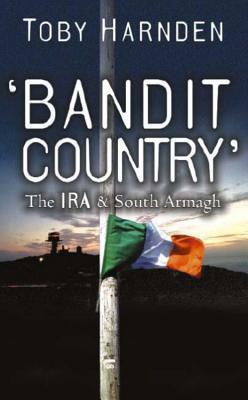
South Armagh was described as "Bandit Country" by Merlyn Rees when he was Northern Ireland Secretary, and for nearly three decades it has been the most dangerous posting in the world for a British soldier. Toby Harnden has stripped away the myth and propaganda associated with South Armagh to produce one of the most compelling and important books of the Troubles. Drawing on secret documents and interviews in South Armagh's recent history, he tells the inside story of how the IRA came close to bringing the British state to its knees. Additionally, for the first time, the identities of the men behind the South Quay and Manchester bombings are revealed.
Toby Harnden is a winner of the Orwell Prize for Books. A former foreign correspondent for the Sunday Times of London and the Daily Telegraph who reported from thirty-three countries, he specializes in terrorism and war. Born in England, Harnden was imprisoned in Zimbabwe, prosecuted in Britain for protecting confidential sources, and vindicated by a $23 million public inquiry in Ireland. A dual British and US citizen, he spent a decade as a Royal Navy officer before becoming a journalist. He holds a First Class degree in modern history from Oxford and is the author of Bandit Country: The IRA & South Armagh and Dead Men Risen: An Epic Story of War and Heroism in Afghanistan. Previously based in London, Belfast, Jerusalem, Baghdad, and Washington, DC, he lives in Virginia.
Quite possibly the best book I've ever read on the troubles. I live in this area and although the book doesn't speak for everyone in South Armagh it's still very good. I grew up in this area during this period and it was scary at times, but we got used to seeing the army and their helicopters, even became very friendly with a few of them. I'll never forget the night Stephen Restorick was shot just round the corner from me or hearing the bomb explosion that killed Lord Justice Gibson and his wife. Looking back now it's amazing how normal we thought everything was.
An engaging and revealing book on the modus operandi and spectacular armed capabilities of the South Armagh Brigade of the Provisional IRA, which might be, on a pound-for-pound basis, perhaps the peak 'domestic' 'terrorist' grouping of all time (i.e. excluding para-state factions like the Tamil Tigers, ISIS or the PLO that essentially operated in de facto sovereign or 'liberated' territory).
Unlike the rest of the six counties where the Provos had been contained to a great extent by the '90s, and where sectarian violenced loomed large, the conflict in South Armagh amounted to a much more "pure" guerrilla war between the British Army and the PIRA, and concluded in almost perfect military stalemate, with neither side able to decisively defeat the other. In a border region that was over 90% nationalist and in which defiance of colonial/state authority was a cultural tradition stretching back hundreds of years, the IRA in South Armagh truly could behave as "fish" among the "sea" of the local community and conduct a shockingly effective unconventional armed campaign.
Given the level of detail on various operations - successful and unsuccessful - one can't help but marvel at the sheer scale of the inventiveness and determination that a small group of individuals could display in the face of Empire, regardless of how one feels on the political or moral logic of the armed campaign.
Loses points for its slight - and in the light of recent conclusive official confirmation of systematic British Army-RUC-UDR-Loyalist collusion, absolutely ridiculous - bias towards 'official' viewpoints on the sources of violence and evidence of security force misconduct and injustice towards the Nationalist community. One example is the ludicrous suggestion that the Fergal Caraher shooting was justified, or that individual examples of Garda-PIRA collusion are in some way comparable to the systematic and endemic collusion across all ranges of the security forces in the North with loyalist death squads.
Growing up where I did, this book was always a source of fascination in my household. My copy originally belonged to my father, and then passed to my eager hands when I was 15 years old -- before, I'd had to read sneaky passages of it whenever I was in my parents' room for some rare, legitimate reason. At 15 years old I was finally deemed old enough and mature enough to be able to read the book with its context and not just the "up the 'RA" kind of attitude that I had been exposed to in school, and since I came into possession of this book I must have read it maybe 10-12 times. My copy is damn near falling apart. Still, it's just as fascinating to read now as it was the first time.
I've done a lot of reading about the Troubles and the IRA specifically; from my teens it's been a passionate area of study for me. Anything from 1916 onwards, I was all over; I'd read everything I got my hands on. Nothing has grabbed my attention like this book, and nothing has ever quite held up to it. This book is absolutely masterfully crafted: the research, the writing, the amount of quotations and the breadth of people who were consulted to write it. It's one of those rare books written on this subject that truly doesn't seem to have an agenda. Both sides are equally represented, no details are glossed over or excused, and where there isn't neutrality there's a profound empathy that comes across regardless of what's being discussed. That's not easy to do even when presenting two viewpoints or opinions with fictional characters; how Harnden managed it with real people in a real situation is beyond me. It's always been something I deeply appreciated about this book, and considering I read it at such an impressionable age, this attitude has stuck with me even into my own historical research.
If I had to pick a top ten most influential books from growing up, this would undoubtedly be on the list. It's still one of the best examples of research I've ever read, being both thorough and incredibly easy to follow. This is about something I grew up with, but I can safely say that somebody with absolutely no knowledge of the situation past "the English invaded Ireland at some point and people got mad about it" could read this and have no trouble at all -- and not to mention a fairly comprehensive knowledge when they came out of it. This is an incredibly important piece of work, and this most recent reread has proven to me that it's aged impeccably well, too.
This book is super intense... lots of descriptions of violence, bombings, attacks and counter attacks that went on in the last 25 years in South of Armagh of "Northern Ireland" by the police, British Army, IRA, UVF (a little) and other groups. I chose to read it because I wanted to better understand the significance of the current peace process by learning more about the turmoil and what exactly is being overcome.
This is not a book for the squeamish. It is a detailed and at times grizzly account of the strongest of Irish Republican strongholds in Northern Ireland, the border region in the south of County Armagh. Though it is not entirely about him the figure that keeps coming up again and again is that of Thomas "Slab" Murphy, currently awaiting appeal for his conviction in British court on tax evasion and related charges. He is portrayed as the de facto leader of the IRA in its various guises in South Armagh. The book draws lines connecting the region to almost every major event throughout the Troubles, even those that occurred elsewhere, such as the Omagh bombing in 1998 and the killing of Lord Mountbatten in the Irish Republic in 1979. By telling the story of the IRA's activities in South Armagh, the author does an impressive job of detailing the complexity of the conflict while illustrating the stakes with gruesome accuracy. What is missing here is the point of view of Ulster Unionists and the paramilitary groups that take up their cudgels, and any sharp sense of whence the outrage and dogged determination that drives the Republican struggle comes. That of course would require another book with a different focus. This book ends on a somewhat ominous note, strongly suggesting that Sinn Fein participation in the Stormont government is simply a Trojan Horse for the continued goal of Irish unification and the "Brits Out" campaign--war by other means, if you will.
If you have any interest in the troubles, the IRA, or just unconventional warfare this is a remarkable read. I have to confess that as an American I knew very little of the conflict outside of Tom Clancy's Patriot Games. However , this information heavy book at least gives some insight into what the conflict is about and how it is fought. It was an amazing book and I look forward to reading Mr Hardens other works.
This is a fascinating book. The depth of detail and research is astonishing, and the openness and candour on show is commendable. Focussing almost exclusively on PIRA in South Armagh it plots an uncomfortable but intriguing path through the activities and history of the most notorious of PIRA elements. Essential reading for anyone with an interest in the Province it has an unrivalled level of information. However... it's not terribly well written. The structure is disjointed, and it jumps around in a distracting and confusing manner, always trying to squeeze in more stuff than it can manage. If it were better planned it would be clearer, and if it were clearer it would be better.
This is a good book, be in no doubt - but it could have been better.
Toby Harnden is a former British Navy Officer. Which should be known before you read this.
Sure, it’s well sourced and obviously contains a lot of interviews from both sides. But it’s the official British perspective that constantly gets the easy ride.
The American desire to support anyone fighting the a British.
The American desire to hate communism - and those who turn to Communists, Totaltarians or evil Dictators for support.
The great brotherhood the Nation of England has with the Greatest nation, the United States of America.
So many controversies and both sides did bad things while fighting for what they felt was right.
I’d first learned about the Troubles as a kid when I learned my grandpa emigrated from Ireland at 10 years old and due to the conflict didn’t want to talk about it, violence or war at all.
Like many, I read Andy McNabb’s Bravo Two Zero followed quickly by Immediate Action. This spawned a curiosity into the troubles and what the SAS did to combat it. Eventually a inter library loan located a copy of then out of print, The Operators: 14 Company. More fascinating stories were learned, but nothing that told the why it all began or told the stories of The IRA.
I recently finished Fishers of Men and Undercover War. They told so much more about the UC work done to combat a violent insurgency. But still, only one side so to speak.
Toby Harnden came to my attention with his timely must read about 9-11 and the US response with the untold tale of Mike Spann and his team in First Casualty. In the media blitz he mentioned writing a long out of print book called Bandit Country. Based on the quality of First Casualty, I knew this would be a solid story with in depth interviews of as many people on both sides.
I learned so much from this book. Nothing will change a centuries old desire to be an independent nation. I didn’t know that the IRA was working with a NASA engineer to make their own SAM after FBI stings stopped attempts to buy 3 Redeye SAM and a Stinger. I didn’t know that by the end of the Trouble, the .50 Barrett was the IRA symbol and most effective weapon, not the Armalite. I also didn’t know all the details about their bombing campaign and how it spread to include highly accurate mortars and attacks in London including one on #10 Downing Street as the Cabinet planned a response to Saddam Hussein in 1990.
Thanks to TA for buying this out of print book at an outrageous price and loaning it out.
This entire review has been hidden because of spoilers.
I read this for the first time a few years ago. Then, I knew very little about the situation in Northern Ireland and even less about the IRA, except for what I heard from my then-fiance/now-husband, who grew up there. So from the perspective of going into this subject with almost no context, I found that this book did a good job explaining everything, giving a lot of details and a lot of context about a complex situation with many different perspectives. Definitely I would recommend it on those grounds alone.
Re-reading it now, I can only confirm everything that I initially thought. The detail here is incredible, and I really appreciate the care and attention that Harnden has gone through to provide context for what it is like for people within the situation, why it is that people have to approach the situation as they do, which is completely different to what conclusions can be drawn living outside of that environment. As I said, my husband is Irish and so has his own perspective and opinions, and I'm lucky enough that I can just go over my thoughts with someone who has more experience than me. That makes me all the more aware of how much care has been taken to really explain certain things that I don't think would make sense otherwise, apart from a perspective.
Overall I find the topic interesting in general, so I really enjoyed just the sheer amount of information provided, all in a book that is really easy to read and that is written very straightforwardly. Again, the amount of detail is good, as are the quotes taken directly from sources themselves. I'm honestly so impressed at how much research must have gone into this.
This is a difficult book to track done and is long overdue a second edition. However, its worth finding a copy as its one of the best books about the troubles and the stories of South Armagh are incredibly interesting.
South Armagh, for those not in the know, is a rural location which saw a decades long battle between the PIRA and the British Army who, depending on your point of view, were either invaders continuing an imperialist agenda or people simple defending their fellow countrymen.
Regardless of the semantics, the cat and mouse games, the watch towers, the endless measures and countermeasures make for a fascinating read.
The author, rightly, does not give his writing any political slant and simply narrates the tit for tat exchanges in a neutral voice. Quite simply, the power of the events speak for themselves and require no embellishment.
I encourage anyone with even a passing interest in the troubles to read this book. I grew up watching the troubles on the news and never really understood what was going on, this book goes some way to redressing my lack of knowledge.
The weird thing about this book is that I cycled through South Armagh in May, and thought nothing of it, besides it being rather beautiful. Then I discovered that my church's minister, who served in Northern Ireland, referred to this part of NI as "bandit country" when talking to an Irishman. I set out to figure out why, and this book was the result. It's very, very interesting - and provides the stories and tales of how the IRA in South Armagh were the worst of the worst in NI. There was a major smuggler who had a property on both sides of the border, using it to his advantage. But there are too many unpleasant and bloodthirsty tales in here. The IRA are evil upon evil, and I don't think the book was sufficiently negative about them.
This book purports to be critical reading for anyone wanting to “understand Northern Ireland and the knife-edge stumble along the precipice to peace.” In reality, it’s a sort of pulp crime paperback detailing the many horrific events that have taken place in South Armagh, the characters who perpetrated them, and the regional cultural backdrop that made South Armagh particularly ungovernable for the British. While this book will indeed bring you up to speed on the unique nature of South Armagh, it’s a meandering digressive read, jumping all over the place, making for a somewhat ponderous experience.
I bought this as a non-fiction book. During reading I came to regard it more as fiction, but on checking, it is stated as non-fiction. Well, it does not matter. The book is excellent, intense, harsh and real.
This is one of the best books about The Troubles, and I would classify it as a must-read for anyone interested in the conflict. Unlike most books, which focus on Derry, Belfast and the Sinn Fein/IRA leadership, Toby Harnden focuses on the tiny, 200-square-mile area of South Armagh. Even as an Irishman, it is easy to forget just how small Northern Ireland is (roughly the size of Connecticut), and South Armagh is a veritable pinprick. Yet, as Harnden points out, 42 RUC officers were murdered in South Armagh and the British Army suffered almost 20% of its casualties there. Some of the best-known and most notorious incidents of The Troubles also took place in and around South Armagh, so by any measure it is a hugely significant part of the story of the conflict.
One particularly strong aspect of the book is the time and space Harnden dedicates to showing how South Armagh has always been a place apart, suspicious of outsiders and resistant to any outside authority. Sitting astride the main route between Dublin and Belfast, it is a region that has been frequently contested and where violence has been commonplace throughout history. Since partition, it has also been a border region where smuggling and related criminality are endemic. This goes a long way to explaining the effectiveness of the South Armagh brigade during The Troubles, already accustomed as they were to planning, logistics, and operational security. The border was also highly useful from a military perspective, as the IRA could easily retreat to (if not launch attacks from) what was effectively a safe zone, out of bounds to the UK security forces.
The military effectiveness of the South Armagh IRA is undeniable, and what was surprising was how often the security forces veterans interviewed by Harnden expressed a reluctant admiration for the military ability of their opponents. The experience of The Troubles in South Armagh was also somewhat different from that in most of the rest of the province, for several reasons. For one thing, the IRA campaign had more of a military focus than elsewhere, as the South Armagh brigade was self-funding and could operate semi-autonomously from the Derry and Belfast IRA leadership, which was much more influenced by the political leadership of Sinn Féin. Generally speaking, there was less sectarian violence in South Armagh than elsewhere because of the lack of Loyalist paramilitaries and Protestants generally. While one of the largest and most notorious sectarian atrocities of The Troubles (the Kingsmill massacre, which resulted in the SAS being deployed) was perpetrated by South Armagh volunteers, it is fair to say that the vast majority of the violent incidents there were between the IRA and the security forces. Further, because security forces personnel didn’t live in South Armagh, confrontation and violence also tended to occur while they were on duty and so, while by no means justifiable, it did have a different flavour to The Troubles elsewhere. It may be going too far to call it a purer conflict, but perhaps it is fair to understand it as less bitter and hate-fueled.
I mentioned that many of the most well-known incidents during The Troubles happened in South Armagh, or were perpetrated by South Armagh volunteers. It was striking to read how cautious they were, calling off attacks much more frequently than they carried them through, but, conversely, their successful operations were often highly effective. The highest number of British Army casualties in a single incident were inflicted by the South Armagh brigade, at Narrow Water in 1979, and along with the Newry brigade they murdered the highest number of RUC officers in a single incident in 1985, when they launched a mortar attack on Newry police station. Captain Robert Nairac was abducted in South Armagh, and Lord Mountbatten’s assassination in Co. Sligo was a South Armagh operation. So was the murder of Superintendent Buchannan and Chief Superintendent Breen, the two most senior police officers killed during The Troubles. As an aside on the latter incident, former Chief Constable Sir John Hermon let himself down badly in his interview with the author, in which he blamed Buchannan’s belief in predestination for his and Breen’s murders (Buchannan was a lay preacher in his Reformed Presbyterian church). This contention is baffling, and it seems to me that Hermon is deflecting systematic RUC security failures and collusion between the Gardai and the IRA by shifting the blame to a murdered officer’s religious beliefs - beliefs, moreover, that he doesn’t seem to understand (the Reformed doctrine of predestination is not fatalism). In all, this position on what happened that day and why is bizarre, and it is noteworthy that Breen had left instructions that Hermon should not attend his funeral if he was killed in the line of duty.
Turning back to the military effectiveness of the IRA in South Armagh, Narrow Water in particular was a meticulously planned and executed operation. Along with the 1981 Glasdrumman and 1990 Operation Conservation counter-ambushes, it evidences a high degree of sophistication in the South Armagh brigade’s tactics, and a well-thought-through understanding of the tactics employed by the British Army. The sniper team that was so effective through the 1990s also demonstrates a willingness to confront a militarily superior enemy who could shoot back, which again is not something that frequently characterised IRA violence elsewhere. The paramilitary violence of The Troubles has always and will always revolt me, but it is also possible to appreciate the skill and commitment of these men to prosecute their campaign. It would certainly be a mistake to look at men such as Thomas ‘Slab’ Murphy and ‘The Surgeon’ and to see mere farmers, or simple country folk. These were patient, dedicated, highly skilled, and ruthlessly violent paramilitary fighters. While less steeped in insurgency theory than others in the Republican movement, they were no less effective for it.
Harnden also draws out the wider significance of the South Armagh brigade. They effectively ran the ‘England branch’ from the early 1990s, and were responsible for the massive car bombs that rocked London and Manchester on either side of the 1994 ceasefire. They were also central to the importation of arms from Libya, and the attempts to source more sophisticated weaponry (and particularly Stingers) from the USA. The latter, and the technological sophistication the IRA pursued with their American contacts, read like something from a spy thriller.
In summary, this is a massively enjoyable and memorable book that provides important insight into a hugely significant aspect of The Troubles.
If you have even a passing interest in the history of the Troubles, Bandit Country is essential reading. The story of South Armagh - long a crucible of insurgency and defiance - is gripping in ways that transcend the usual shorthand: watchtowers, IRA snipers, the Omagh bombing. Toby Harnden is not only courageous - entering a world where trust is scarce and truth is elusive - but also a remarkably gifted writer, with a keen eye for detail and a knack for crafting paragraphs that linger.
As an Englishman delving into the heart of a war in which his own country was the occupying power, Harnden faced the almost impossible challenge of objectivity. And yet, he manages to depict the moral ambiguities of the conflict with uncommon clarity - exposing the brutalities on both sides without slipping into false equivalence or demonization.
Still, one cannot read "Bandit Country" without acknowledging a core truth: in this particular conflict, there was only one invader. Harnden doesn’t let you forget that.
This book, on top of the books I've already covered in the context of the IRA, is a must read especially in the context of the contributions of the Provisional Irish Republic Army towards influencing the mindset of the Catholic community of South Armagh. Whilst the Provos are significant in the overall influence of The Troubles in Northern Ireland, this book also highlights, in minute detail, why the Provos are more nuanced than what they are portrayed to be.
The situation in South Armagh is given depth here also. I recommend reading this on top of the other books which talk about Ireland as well. Whilst Tim Pat Coogan is the better known author as far as authorities of The IRA are concerned, this is also an equally important analysis of The Ra.
This account of the IRA activities in South Armagh in Northern Ireland was recommended to me by a former colleague and dear friend. I found it thoroughly engrossing and difficult both to read, and difficult to put down. Regardless of one's point of view toward the cause of the conflict, it is almost unbearably sad to read about the violence wreaked upon the people of this beautiful land. May we never need to experience that time again.
This book lifted the veil on a subject I didn't know much about. The focus was on the IRA activities, but it also covers "dirty deeds" by the crown and local government, as well as Protestant militias. Easy to read, but very informative.
Harnden is a brave man to have written this book so clearly identifying IRA kingpins in South Armagh to anyone who would care to take a second look. Fascinating account of a region that became ungovernable and the lengths the British Army went to in order to change that
This book is a great review of the Irish troubles. It is presented as a true journalist should approach their job. No agenda, no bias, no judgements, and all facts. Toby Harden did a fantastic job teaching me about these trying times; their causes, and the villainy from both sides.
For those of us who have served in South Armagh it gives a unique insight into PIRA and their murderous campaign against British military and the RUC. All this in the name of Republican!!it's new
This book hits the nail on the head in every way, having personally served a tour in 'bandit country', I can honestly say that you will find no better book on this remarkable place.