

What do you think?

The Lizard
A story by Nobel Prize-winning writer Jose Saramago, gorgeously illustrated in woodcuts by one of Brazil's most famous artists.
When a lizard appears in the neighborhood of Chiado, in Lisbon, it surprises passers-by, and mobilizes firefighters and the army. With a clear and precise style, the fable offers a multitude of senses, reaching audiences of all ages. "The Lizard" is a short story included in A Bagagem do Viajante (1973), a volume that brought together the Saramago chronicles for the newspaper A Capital and the weekly Jornal do Fundão between 1971 and 1972. Translated by Nick Caistor and Lucia Caistor, José Saramago's The Lizard is an illustrated version of the chronicle by J. Borges.
When a lizard appears in the neighborhood of Chiado, in Lisbon, it surprises passers-by, and mobilizes firefighters and the army. With a clear and precise style, the fable offers a multitude of senses, reaching audiences of all ages. "The Lizard" is a short story included in A Bagagem do Viajante (1973), a volume that brought together the Saramago chronicles for the newspaper A Capital and the weekly Jornal do Fundão between 1971 and 1972. Translated by Nick Caistor and Lucia Caistor, José Saramago's The Lizard is an illustrated version of the chronicle by J. Borges.
24 pages, Hardcover
First published January 1, 1973
About the author
José Saramago
265 books17.2k followersJosé de Sousa Saramago (16 November 1922 – 18 June 2010) was a Portuguese novelist and recipient of the 1998 Nobel Prize in Literature, for his "parables sustained by imagination, compassion and irony [with which he] continually enables us once again to apprehend an elusory reality." His works, some of which have been seen as allegories, commonly present subversive perspectives on historic events, emphasizing the theopoetic. In 2003 Harold Bloom described Saramago as "the most gifted novelist alive in the world today."
https://en.wikipedia.org/wiki/Jos%C3%...
https://en.wikipedia.org/wiki/Jos%C3%...
Ratings & Reviews
Friends & Following
Create a free account to discover what your friends think of this book!
Community Reviews
Displaying 1 - 30 of 39 reviews

October 29, 2020
Who knew that Saramago wrote a children’s book? It’s a fable that you can read in five minutes. There are lovely colorful woodcut illustrations by J. Borges, a Brazilian artist. Here’s the story from the blurb:
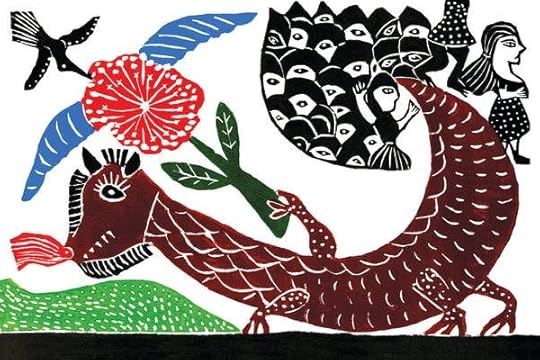
When a lizard appears in the neighborhood of Chiado, in Lisbon, it surprises passers-by, and mobilizes firefighters and the army. With a clear and precise style, the fable offers a multitude of senses, reaching audiences of all ages. The Lizard is an illustrated version of the chronicle by J. Borges.
Chiado is a neighborhood in the center of old Lisbon.

As I said in my review of Saramago’s Tale of the Unknow Island, also a fable, I wonder if this Nobel Laureate author wrote these fables to compete with his linguistic countryman, Paulo Coelho, who is a megaseller of simple allegorical tales. (Saramago is Portuguese; Coelho is Brazilian.)

If you are a fan of Saramago you will enjoy the Portuguese documentary Jose e Pilar (Jose and Pilar, subtitled in English). The video, directed by Miguel Gonçalves Mendes, follows the last years of Nobel Prize winner Saramago. It the story of the last few years of the author’s life and his relationship with his devoted wife and business manager, Pilar del Río. Wow did she push him even in his 80’s! They were constantly traveling, giving talks and working on book deals. Even after a severe illness – out of the hospital – back on the road! But it probably kept him going – he died at 88.
Saramago is one of my favorite authors and I have read seven or eight of his novels. Below are links to my reviews of other novels of his:
Blindness
The Double
All the Names
The Stone Raft
Death with Interruptions
The Cave
Cain
Raised from the Ground
The Tale of the Unknown Island – short story
Graphics:
A woodcut in the book from nyt.com
Chiado neighborhood from tripadvisor.com
The author and his wife from telesurenglish.net
When a lizard appears in the neighborhood of Chiado, in Lisbon, it surprises passers-by, and mobilizes firefighters and the army. With a clear and precise style, the fable offers a multitude of senses, reaching audiences of all ages. The Lizard is an illustrated version of the chronicle by J. Borges.
Chiado is a neighborhood in the center of old Lisbon.
As I said in my review of Saramago’s Tale of the Unknow Island, also a fable, I wonder if this Nobel Laureate author wrote these fables to compete with his linguistic countryman, Paulo Coelho, who is a megaseller of simple allegorical tales. (Saramago is Portuguese; Coelho is Brazilian.)
If you are a fan of Saramago you will enjoy the Portuguese documentary Jose e Pilar (Jose and Pilar, subtitled in English). The video, directed by Miguel Gonçalves Mendes, follows the last years of Nobel Prize winner Saramago. It the story of the last few years of the author’s life and his relationship with his devoted wife and business manager, Pilar del Río. Wow did she push him even in his 80’s! They were constantly traveling, giving talks and working on book deals. Even after a severe illness – out of the hospital – back on the road! But it probably kept him going – he died at 88.
Saramago is one of my favorite authors and I have read seven or eight of his novels. Below are links to my reviews of other novels of his:
Blindness
The Double
All the Names
The Stone Raft
Death with Interruptions
The Cave
Cain
Raised from the Ground
The Tale of the Unknown Island – short story
Graphics:
A woodcut in the book from nyt.com
Chiado neighborhood from tripadvisor.com
The author and his wife from telesurenglish.net
![Profile Image for s.penkevich [hiatus-will return-miss you all].](https://i.gr-assets.com/images/S/compressed.photo.goodreads.com/users/1735525095i/6431467._UX200_CR0,11,200,200_.jpg)
April 26, 2024
We often fear the unfamiliar, but in our worry of falling prey to the Other we fall prey to the impulses of fear that descends into violence. Such is the warning in Nobel Prize winning author José Saramago’s brief picture book The Lizard, which draws inspiration from Brazilian folklore—or encantados—of a town erupting in chaos when a lizard trots in. Translated from the Portuguese by Nick and Lucia Caistor and illustrated through beautiful and colorful woodblock prints by Brazilian folk-artist J. Borges, this is a lovely little picture book suitable for both children and adults. It is brief and spares, but the message sings loud.
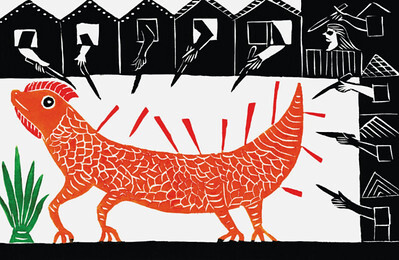
I liked the story here and it’s emphasis on being a fairy tale, even playing with the aspect of fairy tales how fairies just…suddenly make something happen and thats all the explanation you need. The rather abrupt ending makes a good point about how knee-jerk reactions to Otherness are usually pretty awful (they roll in the artillery pretty fast here) and how underneath appearances something or someone can have great beauty. I found the framing fascinating too, how the story seems to empathize with the fearful and their plight in trying to escape while only presenting the lizard as this strange, beastly idea only attached to feelings of revulsion and terror. It’s a nice digestible message that makes you consider fear-mongering in news and culture and how Othering people is harmful.
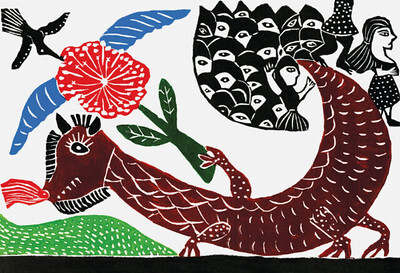
Its a bit slight and probably more enjoyable for adults, but I do have a soft spot for being able to capture childlike whimsy through simple yet moral stories with pictures and showing why its a valid format for adults to enjoy. Yay fun. It’s a cute book and I like Seven Stories Press for putting stuff out like this.
3.5/5
'A story like this can only end in verse:
Silently, many remember,
In the prose of their houses,
The lizard that was a rose
The white rose with wings.
You don’t believe me?
As I was saying:
Fairies aren't what they used to be.'
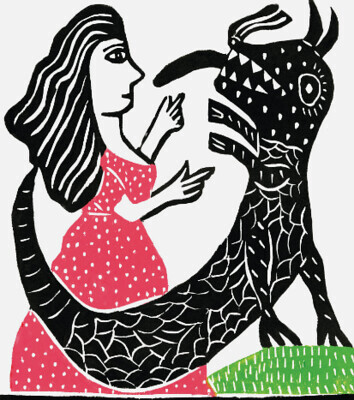
I liked the story here and it’s emphasis on being a fairy tale, even playing with the aspect of fairy tales how fairies just…suddenly make something happen and thats all the explanation you need. The rather abrupt ending makes a good point about how knee-jerk reactions to Otherness are usually pretty awful (they roll in the artillery pretty fast here) and how underneath appearances something or someone can have great beauty. I found the framing fascinating too, how the story seems to empathize with the fearful and their plight in trying to escape while only presenting the lizard as this strange, beastly idea only attached to feelings of revulsion and terror. It’s a nice digestible message that makes you consider fear-mongering in news and culture and how Othering people is harmful.
Its a bit slight and probably more enjoyable for adults, but I do have a soft spot for being able to capture childlike whimsy through simple yet moral stories with pictures and showing why its a valid format for adults to enjoy. Yay fun. It’s a cute book and I like Seven Stories Press for putting stuff out like this.
3.5/5
'A story like this can only end in verse:
Silently, many remember,
In the prose of their houses,
The lizard that was a rose
The white rose with wings.
You don’t believe me?
As I was saying:
Fairies aren't what they used to be.'

March 23, 2021
To be honest, this is my first kind-of-dissapointing Saramago. I knew it was a short story, but I did not expect a nano one. A giant lizard appears in Chiado, in the middle of Lisbon old town, and scares the hell out of people .
Of course it's an allegory, we are talking about Saramago after all, but I'm not quite sure of its meaning. Could be an homage to Antonio Ribeiro, nicknamed Chiado, the satirical poet from 16th century; there is also a statue representing him in the Chiado square (I did not remember this from my trip to Lisbon, although I have some pictures in that very square, I had to look it up).
Could be a representation of people's fear of the unknown, or maybe the fall of Salazar authoritarian regime. Or who knows...
Anyway, whatever its meaning, for Saramago did have one in mind for sure, I would only recommend it for his fans; I don't think it could be regarded as a book for children. Illustrations are done through woodcutting technique which children might enjoy, but for me they seemed rather naive.
Nonetheless, I am glad I bought it, my Saramago shelf has one more now.
Of course it's an allegory, we are talking about Saramago after all, but I'm not quite sure of its meaning. Could be an homage to Antonio Ribeiro, nicknamed Chiado, the satirical poet from 16th century; there is also a statue representing him in the Chiado square (I did not remember this from my trip to Lisbon, although I have some pictures in that very square, I had to look it up).
Could be a representation of people's fear of the unknown, or maybe the fall of Salazar authoritarian regime. Or who knows...
Anyway, whatever its meaning, for Saramago did have one in mind for sure, I would only recommend it for his fans; I don't think it could be regarded as a book for children. Illustrations are done through woodcutting technique which children might enjoy, but for me they seemed rather naive.
Nonetheless, I am glad I bought it, my Saramago shelf has one more now.

November 14, 2023
#voltaraSaramago

August 31, 2021
O medo do desconhecido e a necessidade de nos adaptarmos ao mundo para que ele nos aceite. Ou a morte como a libertação. Ou a imaginação como porto seguro. Ou ainda a mudança interior e o abrir das amarras. Ou o ignorar das expectativas dos outros. Ou ainda...

December 16, 2022
Livros que se lêem em poucos minutos. Cheio de humor e com xilogravuras muito bonitas.

February 4, 2020
This is the perfect book to read after watching CNN for more than twenty minutes!

June 3, 2023
Este é um pequeno texto de José Saramago, uma espécie de fábula alegórica, que foi publicado no livro de crónicas "A Bagagem do Viajante" (1973), e que nesta edição ganha outra vida com as bonitas xilogravuras do artista brasileiro J. Borges.
É a história de um grande lagarto que apareceu no Chiado e que causou um grande alvoroço. Uma alegoria com muitos significados e diferentes interpretações, para miúdos e graúdos.
É a história de um grande lagarto que apareceu no Chiado e que causou um grande alvoroço. Uma alegoria com muitos significados e diferentes interpretações, para miúdos e graúdos.

November 27, 2020
Review O Lagarto, de José Saramago
78/2020
Esta é uma história de fadas, das fadas em quem já ninguém acredita.
Esta é uma história sobre um lagarto cujo único erro é ser ele próprio e estar no mundo, como tantos de nós, humanos.
E esta é, acima de tudo, mais uma alegoria esplêndida de Saramago. Com uma crítica aguçada e um estímulo ao pensamento a que sempre nos habituou. É sobre a injustiça e a falta de imaginação e de mente aberta de grande parte da Humanidade.
É uma história para miúdos que, tal como todas as boas histórias de miúdos, é uma excelente história para graúdos.
E vocês, já leram? Conheciam esta pequenina pérola do Mestre?
78/2020
Esta é uma história de fadas, das fadas em quem já ninguém acredita.
Esta é uma história sobre um lagarto cujo único erro é ser ele próprio e estar no mundo, como tantos de nós, humanos.
E esta é, acima de tudo, mais uma alegoria esplêndida de Saramago. Com uma crítica aguçada e um estímulo ao pensamento a que sempre nos habituou. É sobre a injustiça e a falta de imaginação e de mente aberta de grande parte da Humanidade.
É uma história para miúdos que, tal como todas as boas histórias de miúdos, é uma excelente história para graúdos.
E vocês, já leram? Conheciam esta pequenina pérola do Mestre?

December 29, 2022
As 3 estrelas são pela ilustração.

February 17, 2020
Another picture book that is not actually for children but is marketed as if it is (Example passage: "Of course, the situation was untenable. A lizard standing there, a pallid crowd on the sidewalks, automobiles abandoned in neutral.") Again, that's fine, but I just think it should be marketed more honestly (I found it in journal under children's books, after all). As to the story itself, I think it's a magical little fable that resonates in this time of political discord and anger and fear. I absolutely love the woodcut artwork- that is my favorite part.
July 17, 2019
One and a half stars as far as goodreads stars goes. I really thought I'd find much to like in this tiny tale from such a fabulous and fable-accented author, but the obscurity of it, added to some heinous design, meant I found something I really could not love.
For my full review, please click on:-
http://www.thebookbag.co.uk/reviews/i...
For my full review, please click on:-
http://www.thebookbag.co.uk/reviews/i...

April 9, 2019
Borges’in enfes ahşap baskıları ve Saramago’nun kısacık bir öyküsü.
“Pek duyulmasa da hatırlayan çoktur,
Evlerde anlatılan bu hikayeyi,
Kertenkeleydi güle dönüşen,
Şu kanatlı güle hani.”
“Pek duyulmasa da hatırlayan çoktur,
Evlerde anlatılan bu hikayeyi,
Kertenkeleydi güle dönüşen,
Şu kanatlı güle hani.”

October 15, 2025
Brevísimo libro de Saramago. El relato en sí, es una historia fantástica, además de bella por su simpleza. Cuenta la historia de la aparición de un lagarto en la ciudad, que causa sorpresa y pánico entre la población; cuando está apunto de ser agredido por las personas, se convierte en rosa y después extiende sus alas como paloma que emprende el vuelo.
El gran atractivo del libro, es la serie de xilografías (grabados en relieve), hechas con colores en los que predomina el rojo, café, blanco y negro; todas alusivas a la trama.
El gran atractivo del libro, es la serie de xilografías (grabados en relieve), hechas con colores en los que predomina el rojo, café, blanco y negro; todas alusivas a la trama.

January 1, 2023
This lovely and strange picture book is a fairy tale for adults: "You don't believe me? / As I was saying: / fairies aren't what they used to be." Anyone, adult or child will surely be pulled into the story by J. Borges's stunning woodcuts. My urge is to leave it on a coffee table before a party, to watch people's reactions.

November 26, 2021
This is an adult book disguised as a children's book! It tells the sad tale of a city reacting with hostility to a visiting lizard, and the change of the lizard, by fairies, into a dove. An allegory of militarism.
October 13, 2023
percebo a ideia do bizarro no chiado, escrito em 1972/73, de assustar as gentes de lisboa. a transformação do lagarto para apelar a fantasia das fadas, ao milagre ao desconhecido. as ilustrações do borges tornam o livro numa obra de arte.
This entire review has been hidden because of spoilers.

July 31, 2024
This book has beautiful art, expressive woodcuts, that convey the drama in José Saramago's allegory about mob violence, acceptance, and peace. This book offers a way to teach 5 to 9 year olds about the social metaphysics of violence and memory.

April 7, 2025
Hangimizi önyargılar bir kertenkeleye dönüştürüp öldürmedi ki..
Saramago bir avuç peri tozu ile güle dönüşen, hani şu kanatlı gülün masalını anlatıyor.. J.Borges ise ahşap baskılarla bir evren yaratıyor... Çok yaratıcı bulduğum ahşap baskı detayı benim için masalın önüne geçti diyebilirim.
Saramago bir avuç peri tozu ile güle dönüşen, hani şu kanatlı gülün masalını anlatıyor.. J.Borges ise ahşap baskılarla bir evren yaratıyor... Çok yaratıcı bulduğum ahşap baskı detayı benim için masalın önüne geçti diyebilirim.

April 17, 2018
Interesting art to accompany the unusual tale, and with a nice little summary about both author and artist.


January 30, 2020
I honestly had no idea what the point of the story was. The art never felt fleshed out and the story seem to have no point to it.


February 12, 2020
I did not like it at all. I feel like there was something there in the story that I was missing. If an adult feels that way, will a child feel the same?
Not for me.
Not for me.

April 20, 2020
Tatlı, kısacık bir çocuk kitabı.
September 26, 2020
Kitap şehre zarar veren bir kertenkelenin önce kırmızı bir güle sonra beyaz bir güvercine dönüşmesini anlatan bir peri masalı...

November 26, 2020
A pensive fable about fear featuring the arrival of a giant, fork-tongued but seemingly harmless lizard illustrated with striking woodcut art. Originally published in Portugese.

March 14, 2022
Ahşap baskılara bayıldım.

August 14, 2022
Cuento corto que no entendí. Saramago me parece genial así que le daré una nueva oportunidad a este libro en el futuro.

April 14, 2023
li porque meu aluno de 5 anos escolheu para mim e foi bem qualquer coisa. um grande tanto faz. não foi ruim, mas amanhã já não vou lembrar mais.
Displaying 1 - 30 of 39 reviews