

What do you think?

Inégalités mondiales
Ce livre de Branko Milanovic est devenu un classique à l'échelle mondiale, cité dans tous les débats sur les inégalités, notamment pour son graphique en forme d'éléphant, très largement commenté ces dernières années. Enfin disponible pour le public francophone, il permet de prendre la mesure des inégalités globales, et de connaître les périls qui menacent nos démocraties.
Ce livre dresse un panorama unique des inégalités économiques au sein des pays, et au plan mondial. Avec un talent pédagogique certain, il met en évidence les forces " bénéfiques " (accès à l'éducation, transferts sociaux, progressivité de l'impôt, etc.) ou " néfastes " (guerres, catastrophes naturelles, épidémies, etc.) qui influent sur les inégalités. Il identifie les grands gagnants de la mondialisation (les 1 % les plus riches des pays riches, les classes moyennes des pays émergents) et ses perdants (les classes populaires et moyennes des pays avancés).
Ce travail, fruit d'une analyse empirique sur une longue période et à grande échelle, permet notamment de comprendre les évolutions majeures de nos sociétés, comme les dérives ploutocratique aux États-Unis et populiste en Europe. En effet, Branko Milanovic est plus qu'un très bon économiste : tirant profit d'une culture historique et politique impressionnante, il montre l'imbrication des facteurs économiques et politiques (par exemple, pour expliquer les guerres ou les révolutions). Car tout n'est pas joué. Aux réactions défensives contre une mondialisation impérieuse, l'économiste préfère l'offensive, n'hésitant pas à réhabiliter l'État dans son rôle distributif, et à prôner une politique migratoire originale, ouverte et réaliste.
Devenu un classique dans de nombreux pays, cité dans maints débats, notamment pour son célèbre graphique en forme d'éléphant, cet ouvrage est enfin disponible pour le public francophone. Une lecture édifiante.
405 pages, Kindle Edition
First published January 1, 2007
About the author
Branko Milanović
28 books272 followersBranko Milanović (Serbian Cyrillic: Бранко Милановић, IPA: [brǎːŋko mǐlanoʋitɕ; milǎːn-]) is a Serbian-American economist. He is most known for his work on income distribution and inequality. Since January 2014, he is a visiting presidential professor at the Graduate Center of the City University of New York and an affiliated senior scholar at the Luxembourg Income Study (LIS). He also teaches at the London School of Economics and the Barcelona Institute for International Studies. In 2019 he has been appointed the honorary Maddison Chair at the University of Groningen.
Ratings & Reviews
Friends & Following
Create a free account to discover what your friends think of this book!
Community Reviews
Displaying 1 - 30 of 114 reviews

March 7, 2018
This is a major work in current events, forecasting, and economics. It offers powerful ideas for understanding the present, recent history, and the medium term future. I fear people won't read it.
That's because Global Inequality: A New Approach for the Age of Globalization attempts a tricky thing. First, it looks hard at economic inequality, which is a subject that already appalls most people, or just skates over their heads. Second, it places the subject on an international level. This means that many people who see a world limited by their nation's borders for whatever reason - nationalism, xenophobia, education, lack of time - will stop paying attention. Third: it's macroeconomics, usually guaranteed to miss most people's attention.
That's a shame, because the findings are very, very important.
Branko Milanović is famous among some policymakers for identifying a crucial fact: that while incomes rose in many nations over the past generation (from 1988: 3), they did so unevenly. Poor and middle class people experienced serious income growth in the developing world, starting to catch up with the rest (economic convergence), while those in some advanced nations (including the US) saw their incomes stagnate. Meanwhile, the richest everywhere got richer.
This appears very clearly in what has been nicknamed "the elephant graph":
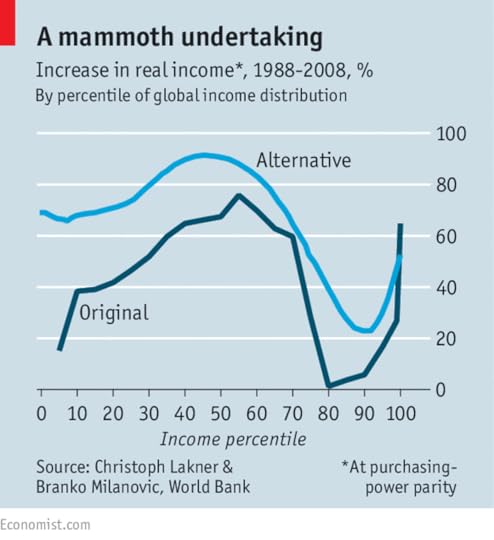
(source)
To be too reductive, Milanović derived these findings from using several rich datasets from multiple nations, than analyzing them in comparison.
What can we learn from this data?
It helps explain populism and panic in certain advanced nations - i.e., Trump, Brexit, the Euro right's resurgence. If you're watching the rich get richer while you go nowhere, you won't be happy about those in charge, to be blunt. "People... belong[ing] to the lower halves of their countries' income distributions... are certainly not the winners of globalization." (20) And it might feed xenophobia, if people link their stagnant or declining condition to people doing better elsewhere.
China's extraordinary post-Mao economic boom played a huge role in this transformation. So did globalization (although Milanović takes care to distinguish between the free flow of capital across borders, versus labor).
There's also a bit of macroeconomic argument over the Kuznets cycle. This is a famous idea, stating that economic growth tends to grow income inequality, but then the gaps start to fade. Apparently this model has been controversial for decades.
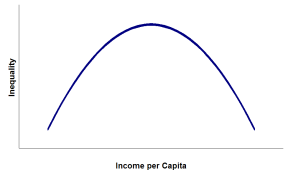 Milanović argues that the cycle is broken now - or rather that there's a new model, where development (income growth) now means steady inequality rising in the post-industrial era (4).
As examples of this Milanović dwells on arguably the two biggest and most influential nations, China and the United States, and offers a sobering analysis of why income inequality is likely to keep growing in both. (176ff) In China, urban concentration of wealth is widening a gap with the countryside, and a centralized authority structure might not decide to act against inequality for reasons of self-interest. For the United Staters, reasons include: substituting capital for labor (i.e., automation); concentrating wealth with education; assortative mating; the fierce political power of the economic elite. Corruption plays a role in both, albeit in different forms.
The author also does a great job of distinguishing between economic inequality within nations (rich versus poor in Italy), economic inequality between nations (average income in Kazakhstan versus Brazil), and comparing economic strata across nations (118ff). I've rarely seen anyone do this. Among other things, this leads Milanović to see Frantz Fanon's model of a world separated by colonial and colonized nations are a better guide to present day global inequality than Marx's description (128-9), while suggesting class will overwhelm geography in this sense in the future, as inequality between nations (weighted for populations!) seems to be declining (131, 166).
As a futurist I found much to appreciate in Global Inequality, starting with his bracing review of economic forecasting in the mid- and late 20th century. Based on a range of books, Milanović argues that futurists all too often fall into certain errors: overstating present-day factors; failing to account for dramatic changes, up to black swans; paying too much attention to certain actors, while failing to account for others - China is a great example of the latter, largely missing from these forecasts (155ff).
After a great deal of hedging, the author offers up some tentative forecasts. Perhaps the darkest is this:
There's also an interesting note about different attitudes towards economic growth in developed and developing nations. A rising argument in the former holds that we should consider restraining GDP growth, as it contributes to carbon emissions. However, as the author points out, without growth the latter nations won't catch up with the former. This implies a very interesting global tension to anticipate. (233)
The book offers some policy solutions, but, as with Thomas Piketty's great work, isn't happy about their prospects. Intriguingly, Milanović is less interested in states redistributing wealth through income taxes than in having them address "endowments" - i.e., taxing personal fortunes through inheritance and getting companies to give more shares to workers (221; this comes close to advocating for worker-owned and -run enterprises). In a breathtaking challenge to American education, the author calls for equalizing educational access, including
I was surprised by a few items missing from Global Inequality. There isn't a discussion of financialization, which has played an enormous role in the American economy. That sector grew enormously over the past generation and now has not only great wealth but vast political clout... and it's a key factor in generating inequality. I was also surprised that the book relies heavily on the Gini method of measuring inequality, as Piketty - cited many times here - took great care to slam it as a poor measurement.
Then again, this is a very short book, just around 240 pages, and very accessible. It's a good sign when you leave a book wanting it to say more.
Strongly recommended.
That's because Global Inequality: A New Approach for the Age of Globalization attempts a tricky thing. First, it looks hard at economic inequality, which is a subject that already appalls most people, or just skates over their heads. Second, it places the subject on an international level. This means that many people who see a world limited by their nation's borders for whatever reason - nationalism, xenophobia, education, lack of time - will stop paying attention. Third: it's macroeconomics, usually guaranteed to miss most people's attention.
That's a shame, because the findings are very, very important.
Branko Milanović is famous among some policymakers for identifying a crucial fact: that while incomes rose in many nations over the past generation (from 1988: 3), they did so unevenly. Poor and middle class people experienced serious income growth in the developing world, starting to catch up with the rest (economic convergence), while those in some advanced nations (including the US) saw their incomes stagnate. Meanwhile, the richest everywhere got richer.
This appears very clearly in what has been nicknamed "the elephant graph":
(source)
To be too reductive, Milanović derived these findings from using several rich datasets from multiple nations, than analyzing them in comparison.
What can we learn from this data?
It helps explain populism and panic in certain advanced nations - i.e., Trump, Brexit, the Euro right's resurgence. If you're watching the rich get richer while you go nowhere, you won't be happy about those in charge, to be blunt. "People... belong[ing] to the lower halves of their countries' income distributions... are certainly not the winners of globalization." (20) And it might feed xenophobia, if people link their stagnant or declining condition to people doing better elsewhere.
China's extraordinary post-Mao economic boom played a huge role in this transformation. So did globalization (although Milanović takes care to distinguish between the free flow of capital across borders, versus labor).
There's also a bit of macroeconomic argument over the Kuznets cycle. This is a famous idea, stating that economic growth tends to grow income inequality, but then the gaps start to fade. Apparently this model has been controversial for decades.
Milanović argues that the cycle is broken now - or rather that there's a new model, where development (income growth) now means steady inequality rising in the post-industrial era (4).As examples of this Milanović dwells on arguably the two biggest and most influential nations, China and the United States, and offers a sobering analysis of why income inequality is likely to keep growing in both. (176ff) In China, urban concentration of wealth is widening a gap with the countryside, and a centralized authority structure might not decide to act against inequality for reasons of self-interest. For the United Staters, reasons include: substituting capital for labor (i.e., automation); concentrating wealth with education; assortative mating; the fierce political power of the economic elite. Corruption plays a role in both, albeit in different forms.
The author also does a great job of distinguishing between economic inequality within nations (rich versus poor in Italy), economic inequality between nations (average income in Kazakhstan versus Brazil), and comparing economic strata across nations (118ff). I've rarely seen anyone do this. Among other things, this leads Milanović to see Frantz Fanon's model of a world separated by colonial and colonized nations are a better guide to present day global inequality than Marx's description (128-9), while suggesting class will overwhelm geography in this sense in the future, as inequality between nations (weighted for populations!) seems to be declining (131, 166).
As a futurist I found much to appreciate in Global Inequality, starting with his bracing review of economic forecasting in the mid- and late 20th century. Based on a range of books, Milanović argues that futurists all too often fall into certain errors: overstating present-day factors; failing to account for dramatic changes, up to black swans; paying too much attention to certain actors, while failing to account for others - China is a great example of the latter, largely missing from these forecasts (155ff).
After a great deal of hedging, the author offers up some tentative forecasts. Perhaps the darkest is this:
[S]ocial separatism [or c]lass bifurcation has many implications: politically, the middle class becomes increasingly irrelevant; production shifts toward luxuries, and social expenditures change from being directed toward education and infrastructure to policing. (198-9)Moreover, accidents of birth are starting to eclipse the American Dream's potential for economic mobility (216).
While the political system remains democratic in form because the freedom of speech and the right of association have been preserved and elections are free, the system is increasingly coming to resemble a plutocracy. (199)
There's also an interesting note about different attitudes towards economic growth in developed and developing nations. A rising argument in the former holds that we should consider restraining GDP growth, as it contributes to carbon emissions. However, as the author points out, without growth the latter nations won't catch up with the former. This implies a very interesting global tension to anticipate. (233)
The book offers some policy solutions, but, as with Thomas Piketty's great work, isn't happy about their prospects. Intriguingly, Milanović is less interested in states redistributing wealth through income taxes than in having them address "endowments" - i.e., taxing personal fortunes through inheritance and getting companies to give more shares to workers (221; this comes close to advocating for worker-owned and -run enterprises). In a breathtaking challenge to American education, the author calls for equalizing educational access, including
mak[ing] access to the best schools more or less equal regardless of parental income and, more importantly, to equalize the quality of education across schools. (222)
I was surprised by a few items missing from Global Inequality. There isn't a discussion of financialization, which has played an enormous role in the American economy. That sector grew enormously over the past generation and now has not only great wealth but vast political clout... and it's a key factor in generating inequality. I was also surprised that the book relies heavily on the Gini method of measuring inequality, as Piketty - cited many times here - took great care to slam it as a poor measurement.
Then again, this is a very short book, just around 240 pages, and very accessible. It's a good sign when you leave a book wanting it to say more.
Strongly recommended.

September 14, 2019
This is an excellent perspective on worldwide inequality. Countries are no longer moving together, but rather the super rich are pulling away from the world's poor and this trend is only intensifying. The American middle class is falling as the world's middle class increases. I need to read Milanovic's new book to hear the update.

August 2, 2021
I am always a bit sceptical about reading macro-economic books. To me, many scholars of this discipline fall into what I would term ‘statistics fetishism’, i.e., failing to see the underlying social relations causing the observed event or phenomenon. Agency, antagonisms and political struggle can herein often be overlooked, and trends are assumed to live a life of their own. However, although still rooted in (neo)positivist thinking, I think this book provides a useful methodological exercise in how difficult it is to try and theorise the issues around global inequality.
Speaking of, Milanović does throw his hat in the ring by introducing his concept of ‘Kuznets waves’. The original ‘Kuznets curve’ (or “paradox”, as Hickel briefly discusses it in his book Less is More: How Degrowth Will Save the World) postulated that as an economy grows, the magical forces of the market will at first increase, and then decrease inequality. Well, that did not turn out to be true, and here is Milanović attempt to save what seems to be a personal idol’s reputation. Kuznets waves simply continue the curve ad infinitum, and we are now apparently experiencing a second Kuznets wave.
If this is the delivery to the book’s promise of ‘a new approach', I am somewhat disappointed. It did not serve a major explanatory role in the book, but the author draws on other interesting theories (such as Rawls' A Theory of Justice) that I would deem to be much more valuable to expand on. The concept of Kuznets waves also falls into the neopositivist fallacy of assuming the Humean notion of constant conjunctions, i.e., that observed causal links are universally applicable across space and time. Maybe some symptoms of statistics fetishism after all…
For a book about globalisation, I am also missing a definition of globalisation. Seemingly, the author takes the process as a given and is somewhat proficient in explaining the trends surrounding the conventional understanding of the term. He talks about how globalisation creates the conditions for certain trends and events, but the natural follow-up question would then be what created the condition of globalisation (as conventionally understood by the Global North)? (Spoilers: imperialism and post-colonial relations, but this is not at all discussed to an adequate degree in the book).
Some observations I did find interesting in the book was how past projections and anticipations (e.g., Fukuyama’s The End of History and the Last Man) almost always fails due to, among others, researchers being too embedded within the common sense of their time, place and practice, and thus failing to anticipate historically altering events cancelling current trends (one wonders then what epistemological value the concept of Kuznets waves has).
The other (far from being a new observation) is how the wealthiest 1% today appropriate incomes both from wages and capital. Historically, aristocrats were only concerned with the latter (think of Veblen’s The Theory of the Leisure Class), thus maintaining a more apparent cultural gap between the workers and capitalists. Consequently, today billionaires maintain the charade that anyone can climb the ladder of corporate success via hard work and commitment, but Milanović is careful not to dig too deep into the implications of this.
My final judgement is a recommendation to instead turn to Jason Hickel’s The Divide: A Brief Guide to Global Inequality and its Solutions or Piketty’s Capital in the Twenty-First Century (or Capital and Ideology). They provide a deeper and more critical discussion around the systemic drivers of inequalities (social, economic, political, and ecological).
Speaking of, Milanović does throw his hat in the ring by introducing his concept of ‘Kuznets waves’. The original ‘Kuznets curve’ (or “paradox”, as Hickel briefly discusses it in his book Less is More: How Degrowth Will Save the World) postulated that as an economy grows, the magical forces of the market will at first increase, and then decrease inequality. Well, that did not turn out to be true, and here is Milanović attempt to save what seems to be a personal idol’s reputation. Kuznets waves simply continue the curve ad infinitum, and we are now apparently experiencing a second Kuznets wave.
If this is the delivery to the book’s promise of ‘a new approach', I am somewhat disappointed. It did not serve a major explanatory role in the book, but the author draws on other interesting theories (such as Rawls' A Theory of Justice) that I would deem to be much more valuable to expand on. The concept of Kuznets waves also falls into the neopositivist fallacy of assuming the Humean notion of constant conjunctions, i.e., that observed causal links are universally applicable across space and time. Maybe some symptoms of statistics fetishism after all…
For a book about globalisation, I am also missing a definition of globalisation. Seemingly, the author takes the process as a given and is somewhat proficient in explaining the trends surrounding the conventional understanding of the term. He talks about how globalisation creates the conditions for certain trends and events, but the natural follow-up question would then be what created the condition of globalisation (as conventionally understood by the Global North)? (Spoilers: imperialism and post-colonial relations, but this is not at all discussed to an adequate degree in the book).
Some observations I did find interesting in the book was how past projections and anticipations (e.g., Fukuyama’s The End of History and the Last Man) almost always fails due to, among others, researchers being too embedded within the common sense of their time, place and practice, and thus failing to anticipate historically altering events cancelling current trends (one wonders then what epistemological value the concept of Kuznets waves has).
The other (far from being a new observation) is how the wealthiest 1% today appropriate incomes both from wages and capital. Historically, aristocrats were only concerned with the latter (think of Veblen’s The Theory of the Leisure Class), thus maintaining a more apparent cultural gap between the workers and capitalists. Consequently, today billionaires maintain the charade that anyone can climb the ladder of corporate success via hard work and commitment, but Milanović is careful not to dig too deep into the implications of this.
My final judgement is a recommendation to instead turn to Jason Hickel’s The Divide: A Brief Guide to Global Inequality and its Solutions or Piketty’s Capital in the Twenty-First Century (or Capital and Ideology). They provide a deeper and more critical discussion around the systemic drivers of inequalities (social, economic, political, and ecological).

January 7, 2017
Nice economics book with and on the famous elephant graph showing global income growth 1988-2008:

"Wealth inequality is greater than inequality of income or consumption in almost every country" (p39) The global top 1 percent has 29% of income share, but 46% of wealth share. Piketty is mentioned a few times in this book.
Very good about this book is that it has a very data/evidence-based approach to globalization and its effects. And Milanovic is honest about the consequences: "The reader needs to be constantly aware that globalization is a force both for good and bad" (p30). He ends the book (p239):
And some interesting historic facts on inequality: based on data from Spain from 1280-1850 there is no relationship between mean income (GDP) and income equality. "over the long term, growth does not require rising inequality" (p89).
At the end of the Roman Empire (700 AD), Gini was ~15; incomes were so low, there was no "space" for inequality, there was a common state of poverty. That is also why wars will create equality.
"the Industrial Revolution was similar to a big bang that launched part of mankind onto the path of higher incomes and sustained growth, while the majority stayed where they were, and some even went down. This divergence of paths widened global inequality." (p120).
The Citizenship Premium: "Just by being born in the United States rather than in Congo, a person would multiply her income by 93 times" (p133)
New capitalism:
The rich have influence
Tax less effective in lowering inequality
Migration have an economic net-positive effect
The great winners have been the Asian poor and middle classes; the great losers the lower middle class of the rich world" (p20) (...)
They [globally very rich] too are the winners of globalization, we call them the "global plutocrats". (p22) (...)
44 percent of the absolute gain has gone into the hands of the richest 5 percent of people globally, with almost one-fifth on the total increment received by the top 1 percent (p24)
"Wealth inequality is greater than inequality of income or consumption in almost every country" (p39) The global top 1 percent has 29% of income share, but 46% of wealth share. Piketty is mentioned a few times in this book.
Very good about this book is that it has a very data/evidence-based approach to globalization and its effects. And Milanovic is honest about the consequences: "The reader needs to be constantly aware that globalization is a force both for good and bad" (p30). He ends the book (p239):
Will inequality Disappear as Globalization Continues?
No. The gains from globalization will not be evenly distributed.
And some interesting historic facts on inequality: based on data from Spain from 1280-1850 there is no relationship between mean income (GDP) and income equality. "over the long term, growth does not require rising inequality" (p89).
At the end of the Roman Empire (700 AD), Gini was ~15; incomes were so low, there was no "space" for inequality, there was a common state of poverty. That is also why wars will create equality.
"the Industrial Revolution was similar to a big bang that launched part of mankind onto the path of higher incomes and sustained growth, while the majority stayed where they were, and some even went down. This divergence of paths widened global inequality." (p120).
"in 1820 only 20 percent of global inequality was due to differnce among countries. Most of global inquality (80 percent) resulted from differences within countries; that is, the fact that there were rich and poor people in England, China, Russia, and so on. It was class that mattered. (...)
By the mid-twentieth century, 80 percent of global inequality depended on where one was born (or lived, in the case of migration), and only 20 percent on one's social class. (p128)
The Citizenship Premium: "Just by being born in the United States rather than in Congo, a person would multiply her income by 93 times" (p133)
decision (based on economic criteria alone) about where to migrate will also be influenced by the expectation regarding where he may end up in the recipient country's income distribution, and thus about how unequal the recipient's country's distribution is. Suppose that Sweden and the US have the same mean income. If a potential migrant expects to end up in the bottom part of the country's distribution, then he should migrate to Sweden rather that the US: poor people in Sweden are better of compared to the mean than they are in the US, and the citizenship premium, evaluated in the lower parts of the distribution, is greater. The opposite conclusion follow if he expects to end up in the upper part of the recipient country's distribution: he should then migrate to the US.
This last result has unpleasant implications for rich countries that are more egalitarian: they will tend to attract lower-skilled migrants who generally expect to end up in the bottom parts of the recipient countries' income distributions. (p135)
New capitalism:
"capitalism has moved from being a system with complete separation between capital and labor incomes to a variant where the correlation between the two was negative (those who had labor incomes had very little capital income) to the "new capitalism," where this correlation is positive" (p186).
The rich have influence
Larry Bartels finds that US senators are five to six times more likely to respond to the interests of the rich than to the interests of the middle class. Moreover, Bartels concludes, "there is no discernible evidence that the views of low-income constituents have any effect on their senators' voting"behavior." (p194)
Tax less effective in lowering inequality
Globalization makes increased taxation of the most significant contributor of inequality -namely, capital income- very difficult (p217)
Migration have an economic net-positive effect
International Migration Outlook 2013 (OECD), the most comprehensive study of the costs and benefits of migration in Europe, finds that, on average, an immigrant household contributed €2,000 more in taxes than it received in benefits" (footnote 41, p206)

August 6, 2021
Read this for a politics of globalization class last year and it was gay. Maybe I’ll reread it next and it’ll be less gay

October 14, 2017
Milanovic is the expert on global inequality. In this book he explains the effects of globalisation on global inequality. As most people know, the answer lies in the Elephant curve. So the poor people and middle class of the developing world has seen their wages went up, together with the global 1%. Unfortunately, the middle class in the rich world has seen not much growth at all. In absolute terms, however, the gains in the middle were very small compared to the outsized gain of the 1%! Despite all the economic growth, however, global inequality between countries had not really budged, unless population weighted inequality is taken into consideration, because most of the growth had come from Asia, eapecialy China.
Milanovic proposed the Kusnets Wave. The original Kusnets curve proposed by Kusnets in the 1950-60s showed that at least for the rich world, inequality increased and then decreased as workers get rich and demand more rights politically. However, he did not foresee that inequality in the rich world would increase again. The Kusnets Wave hypothesis states that inequality will rise again, as automation, globalisation and free market ideology work together. He agrees with Piketty that technology allows for the substitution of capital (and machines) for labor, and he does not see the new upward movement of inequality to abate any time soon in the rich world, as even the Nordic countries are having rising inequality. For the developing countries, as they get richer, inequality rises dramatically, and then it might drop like what happened in the rich world 50 years ago. Or they might not!
Sobering for people in the rich world. Milanovic expects even more anger, nationalism and anti-globalisation in future as the stagnant middle class in the rich world shows their displeasure.
Milanovic proposed the Kusnets Wave. The original Kusnets curve proposed by Kusnets in the 1950-60s showed that at least for the rich world, inequality increased and then decreased as workers get rich and demand more rights politically. However, he did not foresee that inequality in the rich world would increase again. The Kusnets Wave hypothesis states that inequality will rise again, as automation, globalisation and free market ideology work together. He agrees with Piketty that technology allows for the substitution of capital (and machines) for labor, and he does not see the new upward movement of inequality to abate any time soon in the rich world, as even the Nordic countries are having rising inequality. For the developing countries, as they get richer, inequality rises dramatically, and then it might drop like what happened in the rich world 50 years ago. Or they might not!
Sobering for people in the rich world. Milanovic expects even more anger, nationalism and anti-globalisation in future as the stagnant middle class in the rich world shows their displeasure.

December 1, 2018
A few years ago, Thomas Piketty brought the study of economic inequality back to the limelight with his acclaimed "Capital in the 21th century".
While Piketty's book looked only at inequality at the national level, Branko Milanović goes one step further. Building on detailed data at the household level collected over the last decades, Milanović studies global inequality between individuals (as opposed to global inequality between nations). This book is a non-technical summary of his key findings, followed by a series of policy considerations. The most famous result of the book has started living a live of its own: Milanović's elephant. https://www.economist.com/finance-and...
Essentially, this is the graphical representation of the observations that the big winners of the two last decades are the new middle classes in countries such as China (the rump of the elephant) and the top 1%-ers (the upper part of the elephants' trunk). Those who are left behind are those at the absolute bottom of the world's income distribution and the lower middle class in the richer countries (who are of course still in the top deciles at the world level - the point is not that they have become much poorer, but that they are no longer part of the winners). Although Milanović's book has preceded the big populist revolts of the last two years, he was prescient enough to anticipate them as part of the backlash against globalisation.
As I am a regular reader of Milanović's blog (and occasionally of his tweets), I cannot say I have learned much from the book. However, this should not discourage anyone from reading a highly accessible and lively book on a highly topical subject.
Maybe two comments though (I do not dare call them 'criticisms' as I know that addressing them would be extremely demanding in terms of data collection).
A first point is that Milanović addresses mainly inequality of income. (There is also some discussion of inequality of wealth) However, one could argue that what really counts is inequality in consumption. If the 'typical' goods consumed by the poor or the lower middle classes are different from those consumed by the rich or the upper middle classes, then maybe the conventional indexes of consumer prices (which are essential for tracing evolutions over time) are not representative. Recent research in the US has shown that this is not a purely theoretical matter, and actually affects key conclusions on the evolution of median incomes https://www.economist.com/finance-and...
(A more technical discussion of consumption inequality is https://www.aeaweb.org/articles?id=10...).
A second point (which is not unrelated to the previous) is that income redistribution does not only take place through explicit taxes and transfers, but also through goods that are made available to the public at a reduced price (or even free of charge): subsidised schools, cultural goods and sports; road infrastructure and subsidised public transport; parks and recreational areas, etc. Clearly, this also has effects, but which are much more difficult to measure. It would be interesting to learn how these have evolved over time and affected inequality.
While Piketty's book looked only at inequality at the national level, Branko Milanović goes one step further. Building on detailed data at the household level collected over the last decades, Milanović studies global inequality between individuals (as opposed to global inequality between nations). This book is a non-technical summary of his key findings, followed by a series of policy considerations. The most famous result of the book has started living a live of its own: Milanović's elephant. https://www.economist.com/finance-and...
Essentially, this is the graphical representation of the observations that the big winners of the two last decades are the new middle classes in countries such as China (the rump of the elephant) and the top 1%-ers (the upper part of the elephants' trunk). Those who are left behind are those at the absolute bottom of the world's income distribution and the lower middle class in the richer countries (who are of course still in the top deciles at the world level - the point is not that they have become much poorer, but that they are no longer part of the winners). Although Milanović's book has preceded the big populist revolts of the last two years, he was prescient enough to anticipate them as part of the backlash against globalisation.
As I am a regular reader of Milanović's blog (and occasionally of his tweets), I cannot say I have learned much from the book. However, this should not discourage anyone from reading a highly accessible and lively book on a highly topical subject.
Maybe two comments though (I do not dare call them 'criticisms' as I know that addressing them would be extremely demanding in terms of data collection).
A first point is that Milanović addresses mainly inequality of income. (There is also some discussion of inequality of wealth) However, one could argue that what really counts is inequality in consumption. If the 'typical' goods consumed by the poor or the lower middle classes are different from those consumed by the rich or the upper middle classes, then maybe the conventional indexes of consumer prices (which are essential for tracing evolutions over time) are not representative. Recent research in the US has shown that this is not a purely theoretical matter, and actually affects key conclusions on the evolution of median incomes https://www.economist.com/finance-and...
(A more technical discussion of consumption inequality is https://www.aeaweb.org/articles?id=10...).
A second point (which is not unrelated to the previous) is that income redistribution does not only take place through explicit taxes and transfers, but also through goods that are made available to the public at a reduced price (or even free of charge): subsidised schools, cultural goods and sports; road infrastructure and subsidised public transport; parks and recreational areas, etc. Clearly, this also has effects, but which are much more difficult to measure. It would be interesting to learn how these have evolved over time and affected inequality.

February 19, 2022
This is the book with the famous "elephant graph", showing that globalization has mainly been a boon to the globally middle-income people (=people not in extreme poverty, but still quite poor in Western standards) and the wealthy, while leaving the poorest of the poor and the Western middle classes (especially lower middle class) treading water or even worse off than before.
Therefore globalization is not "good" or "bad" per se: it is good for some people, less good for others, and bad for still others.
Milanovic has a good writing style and he presents his points with minimal padding. Thus, this book is surprisingly short for such a complex topic, but it's not unpleasantly dense, either. You rarely encounter information density this good.
If I had read this book when it first came out, this would've been a five-star book. But now many of its ideas were already so familiar to me, it was hard to get excited about them anymore. But that is only a credit to this book: it has such good ideas they have spread beyond its covers.
Therefore globalization is not "good" or "bad" per se: it is good for some people, less good for others, and bad for still others.
Milanovic has a good writing style and he presents his points with minimal padding. Thus, this book is surprisingly short for such a complex topic, but it's not unpleasantly dense, either. You rarely encounter information density this good.
If I had read this book when it first came out, this would've been a five-star book. But now many of its ideas were already so familiar to me, it was hard to get excited about them anymore. But that is only a credit to this book: it has such good ideas they have spread beyond its covers.

March 30, 2016
An erudite and wide ranging summary of the past, present and future of inequality--including inequality across all people in the world and over long periods of time within countries and between countries.

June 24, 2020
مقدمة قصيرة حول الامساواة بين الدول و داخلها

October 30, 2018
Milanovic'in beş bölümden oluşan kitabı, seksenlerde başlayan neoliberal politikalar ve küreselleşme sonucu oluşan gelir eşitsizliği değişimini ele alıyor.
Satın alma gücüne çevrilmiş olan gelir verileri (1980-2008) kullanılarak yapılan ayrıntılı analizlerin sonuçlarının ele alındığı kitapta, oldukça ilginç sonuçlar vurgulanmakta.
Küreselleşmenin - ve küresel ekonomideki büyümenin- sonuçlarınından hangi gelir kesimlerinin yararlandığı (Fil eğrisi), geliri azalan kesimlerin gelir dağılımındaki şaşırtıcı yeri, ulusal-uluslar arası eşitsizlikler ve Piketty'nin "21. yüzyılda kapital" çalışmasında da vurgulanan artan eşitsizlik sonucu olası senaryolar Milanoviç'in ele aldığı konular arasında...
Sürdürülemez olan eşitsizlikleri elbette Plütokrasi sürdürmeye çalışacaktır. Buna karşı, %99 ne yapacak? Demokratik mücadele hangi politikalarla sürdürülmelidir? Bu soruları tartışan, düşünen okurlara önerilir...
Satın alma gücüne çevrilmiş olan gelir verileri (1980-2008) kullanılarak yapılan ayrıntılı analizlerin sonuçlarının ele alındığı kitapta, oldukça ilginç sonuçlar vurgulanmakta.
Küreselleşmenin - ve küresel ekonomideki büyümenin- sonuçlarınından hangi gelir kesimlerinin yararlandığı (Fil eğrisi), geliri azalan kesimlerin gelir dağılımındaki şaşırtıcı yeri, ulusal-uluslar arası eşitsizlikler ve Piketty'nin "21. yüzyılda kapital" çalışmasında da vurgulanan artan eşitsizlik sonucu olası senaryolar Milanoviç'in ele aldığı konular arasında...
Sürdürülemez olan eşitsizlikleri elbette Plütokrasi sürdürmeye çalışacaktır. Buna karşı, %99 ne yapacak? Demokratik mücadele hangi politikalarla sürdürülmelidir? Bu soruları tartışan, düşünen okurlara önerilir...

March 29, 2025
When I started this I thought my driller Branko was queening out with his third concept of inequality. As I was getting to the end I realised Branko sacked off any attempt at looking at absolute poverty.
As a famous philosopher once said, “if my nan had wheels, she would’ve been a bike”. Once again neo-liberalism has manipulated the data to show how the Washington consensus has led to a fall in communism. Nice try diddy, that’s not going to work on this diva.
Concluding thoughts: if you believe in convergence theory you have played yourself. If inequality is really falling, how come I never see anyone flexing a 2005 PG Tips promotional Gromit mug?
As a famous philosopher once said, “if my nan had wheels, she would’ve been a bike”. Once again neo-liberalism has manipulated the data to show how the Washington consensus has led to a fall in communism. Nice try diddy, that’s not going to work on this diva.
Concluding thoughts: if you believe in convergence theory you have played yourself. If inequality is really falling, how come I never see anyone flexing a 2005 PG Tips promotional Gromit mug?

July 4, 2021
Interesting analysis of how global inequality works and what can be done to solve it

March 17, 2018
This is an interesting book in which the author makes some good points. However, some of the stuff he writes is completely retarded. He doesn't understand a lot of what is going on. He assumes, for example, if you allow immigrants to flood the job markets of rich countries this will help to end income and wealth inequality because these new migrants will bring their wages up in doing so. That, no doubt, is true.
However, what Milanovic doesn't understand is that this will make stagnate or drive the wages of the 99 percent down in the rich nations of the world, thereby exacerbating income and wealth inequality in the rich nations.
Milanovic also doesn't comprehend that a mild rise of a Chinese middle class is largely because of the tens of millions of US jobs that used to support middle wage lifestyles in the US and other developed nations have been exported to China. Exporting jobs has been one of the primary ways the rich of the USA have created massive income and wealth inequality in the United States. On this issue, the author appears to be completely clueless.
Milanovic appears to be totally ignorant about how Chinese currency manipulation plays a significant role in exacerbating income and wealth inequality throughout the world.
Milanovic, for example, doesn't seem to comprehend such issues as; jobs in the maquiladora district of Mexico have been exported by the hundreds of thousands to China, Vietnam, and Pakistan. This, of course, has increased income and wealth inequality, an issue which the author appears to be clueless. Are we to believe that Mexican workers will follow their former jobs to China, Vietnam, and Pakistan so that they can work for less than they had been?
Globalization is the primary cause of income and wealth inequality throughout the world, and that is what this policy has been constructed to do. We're supposed to believe that more globalization is the remedy for this. On this point, Milanovic is completely idiotic.
These are just a few of the reasons why Milanovic's book is largely based on absurdities.
However, what Milanovic doesn't understand is that this will make stagnate or drive the wages of the 99 percent down in the rich nations of the world, thereby exacerbating income and wealth inequality in the rich nations.
Milanovic also doesn't comprehend that a mild rise of a Chinese middle class is largely because of the tens of millions of US jobs that used to support middle wage lifestyles in the US and other developed nations have been exported to China. Exporting jobs has been one of the primary ways the rich of the USA have created massive income and wealth inequality in the United States. On this issue, the author appears to be completely clueless.
Milanovic appears to be totally ignorant about how Chinese currency manipulation plays a significant role in exacerbating income and wealth inequality throughout the world.
Milanovic, for example, doesn't seem to comprehend such issues as; jobs in the maquiladora district of Mexico have been exported by the hundreds of thousands to China, Vietnam, and Pakistan. This, of course, has increased income and wealth inequality, an issue which the author appears to be clueless. Are we to believe that Mexican workers will follow their former jobs to China, Vietnam, and Pakistan so that they can work for less than they had been?
Globalization is the primary cause of income and wealth inequality throughout the world, and that is what this policy has been constructed to do. We're supposed to believe that more globalization is the remedy for this. On this point, Milanovic is completely idiotic.
These are just a few of the reasons why Milanovic's book is largely based on absurdities.

April 26, 2019
قليل من الكتب تجمع رصانة الفكرة وإيجاز الأسلوب ومتعة التجربة في آن واحد ، وهذا منها !

December 26, 2018
It was interesting to read a book on Globalization or should I say Global inequality in post-brexit, trump world. Globalization is the invisible force which affects our income, employment prospect, knowledge and our cost of living. The gain of globalization will be unevenly distributed.
Global inequality = Sum of all national inequalities + Sum of all gap in mean incomes among countries
According Branko Milanovic, we will continue to the below trends due to globalization.
1. Rise of the "global middle class" whom are mostly located in china and other countries in "resurgent Asia"
2. The stagnation of the groups in the rich countries that are gloablly well-off but nationally middle or lower middle class.
3. Emergence of global plutocracy.
Effects on Rich countries:
1. Top earners will make more money from cheap labors.
2. Middle class will squeeze by automation and globalization.
3. Continued polarization of the western world. Populism and Nativism will grow in Europe and US will become plutocratic society.
4. National accounts will becomes less relevant and monetary policies will not be conducted by states. (private monies such as Bitcoin may play a bigger role.)
Effects on Resurgent countries:
1. Although the globally inequality is decrease, there will be increase in income inequality with countries. In some years, there will not be rich Americans and poor Chinese. Instead there will be rich Americans and poor Americans, rich Chinese and poor Chinese, rich Russians and poor Russians.
2. Horizontal inequality will not be solved by providing existential equality(policy followed in countries like India). Instead resurgent countries should focus on income inequality.
Effects on Individuals:
1. People with scalable jobs will be the real winner of globalization. In these jobs where a person's same unit of labor can be sold many times.
2. Chance and family background will play a much bigger role than ever before.
Global inequality = Sum of all national inequalities + Sum of all gap in mean incomes among countries
According Branko Milanovic, we will continue to the below trends due to globalization.
1. Rise of the "global middle class" whom are mostly located in china and other countries in "resurgent Asia"
2. The stagnation of the groups in the rich countries that are gloablly well-off but nationally middle or lower middle class.
3. Emergence of global plutocracy.
Effects on Rich countries:
1. Top earners will make more money from cheap labors.
2. Middle class will squeeze by automation and globalization.
3. Continued polarization of the western world. Populism and Nativism will grow in Europe and US will become plutocratic society.
4. National accounts will becomes less relevant and monetary policies will not be conducted by states. (private monies such as Bitcoin may play a bigger role.)
Effects on Resurgent countries:
1. Although the globally inequality is decrease, there will be increase in income inequality with countries. In some years, there will not be rich Americans and poor Chinese. Instead there will be rich Americans and poor Americans, rich Chinese and poor Chinese, rich Russians and poor Russians.
2. Horizontal inequality will not be solved by providing existential equality(policy followed in countries like India). Instead resurgent countries should focus on income inequality.
Effects on Individuals:
1. People with scalable jobs will be the real winner of globalization. In these jobs where a person's same unit of labor can be sold many times.
2. Chance and family background will play a much bigger role than ever before.
September 28, 2025
Ondanks dat het niet altijd even berust op feiten is, en een eigen opinie wordt gegeven. Laat het wel een heel duidelijk beeld zien van de stromingen van de economie door de jaren heen, zowel de ongelijkheid binnen als buiten een land.

March 30, 2022
I'm Branko-pilled

Read
April 19, 2023Izuzetno interesantna knjiga za prvi susret sa temom nejednakosti. Obuhvacen je sirok spektar ekonomskih, drustvenih i politickih tema, i sve to prikazano je na jedan prijemciv nacin cak i za one koji nisu ekonomisti. Jedino mi se cini da ima nekoliko opstih mesta i preporuka.


May 29, 2016
While Globalization has had the benevolent impact of bestowing much needed economic, political and social advantages to the underprivileged class, it brings with it its own set of discontents. The most visible scourge of globalisation has been the increasing in-congruence of both wealth and income - a phenomenon that has birthed the undesirable consequence of inequality. One of the pioneers in this domain of Economics has been Branko Milanovic.
In this essential book, Milanovic employs the powerful mechanism of the Kuznets Curve or the Kuznets Waves as he himself prefers to term it (with his own innovative modifications) to lay out the cause and consequences of Inequality. Not restricting himself to the study of inequalities within nations, - which of course have a substantial and significant bearing on the overall Global Inequality - Milanovic using a wide body of research dissects both the usual as well as unusual suspects that are primarily responsible for a rise in inequality.
Concentration of capital in the hands of a chosen few; income from capital as well as labour accruing to the same individuals; assortative mating (the act of two highly qualified and top income grossers deciding to bind themselves into the bond of matrimony) and the political influence that is the prerogative of the top "1 percenters" who hold within their possession a cumulative wealth of close to US$3 trillion are all factors which inexorably lead to a wide swathe when it comes to the distribution of income as well as the dispersal of wealth.
The most captivating feature of the book lies in its simplicity. Abhorring esoteric equations that in addition to making the reader feel inferior and causing a headache, also give a perception of the condescension of the author, Milanovic prefers to use a narrative that is easy to grasp, and a style that is free flowing. Jargon mongering is resorted to only when absolutely necessary and even there a more comprehensible explanation immediately follows. Graphs and tables supplement the text admirably.
However, it is surprising to see the omission of the role which India as an emerging economy could play in reducing inequalities of both income and wealth. While China has a fair share of coverage as is wont to be in any book dealing with Economics on account of its superstar status as an economic super power, trends such as an increasing spate of corruption, non existent human rights, complete disdain to ecological imbalance and rumblings of a return to democracy all combine to pose a real threat to China's economic future even though prospects of a China imploding from within are just far fetched theories. India's burgeoning youth population, Information Technology capabilities, intellectual capital and the advantage of an English speaking citizenry all bode well for a strong and significant future. Maybe in the coming editions of this book, Milanovic would devote more space to the Economic prospects of India and the country's role in stopping the relentless march of inequality. Notwithstanding this fact, Milanovic's work is a superb expression of his craft.
"Global Inequality" - A Great Leveler of a work that warrants compulsory reading by everyone wanting to understand the current gap between the haves, have-mores and the have-nots!
In this essential book, Milanovic employs the powerful mechanism of the Kuznets Curve or the Kuznets Waves as he himself prefers to term it (with his own innovative modifications) to lay out the cause and consequences of Inequality. Not restricting himself to the study of inequalities within nations, - which of course have a substantial and significant bearing on the overall Global Inequality - Milanovic using a wide body of research dissects both the usual as well as unusual suspects that are primarily responsible for a rise in inequality.
Concentration of capital in the hands of a chosen few; income from capital as well as labour accruing to the same individuals; assortative mating (the act of two highly qualified and top income grossers deciding to bind themselves into the bond of matrimony) and the political influence that is the prerogative of the top "1 percenters" who hold within their possession a cumulative wealth of close to US$3 trillion are all factors which inexorably lead to a wide swathe when it comes to the distribution of income as well as the dispersal of wealth.
The most captivating feature of the book lies in its simplicity. Abhorring esoteric equations that in addition to making the reader feel inferior and causing a headache, also give a perception of the condescension of the author, Milanovic prefers to use a narrative that is easy to grasp, and a style that is free flowing. Jargon mongering is resorted to only when absolutely necessary and even there a more comprehensible explanation immediately follows. Graphs and tables supplement the text admirably.
However, it is surprising to see the omission of the role which India as an emerging economy could play in reducing inequalities of both income and wealth. While China has a fair share of coverage as is wont to be in any book dealing with Economics on account of its superstar status as an economic super power, trends such as an increasing spate of corruption, non existent human rights, complete disdain to ecological imbalance and rumblings of a return to democracy all combine to pose a real threat to China's economic future even though prospects of a China imploding from within are just far fetched theories. India's burgeoning youth population, Information Technology capabilities, intellectual capital and the advantage of an English speaking citizenry all bode well for a strong and significant future. Maybe in the coming editions of this book, Milanovic would devote more space to the Economic prospects of India and the country's role in stopping the relentless march of inequality. Notwithstanding this fact, Milanovic's work is a superb expression of his craft.
"Global Inequality" - A Great Leveler of a work that warrants compulsory reading by everyone wanting to understand the current gap between the haves, have-mores and the have-nots!

December 31, 2017
I worried that a book on global inequality of income and wealth would be boring, but I was wrong: Milanovic offers new insights and sound analysis. Here's a few notable observations. Global inequality has gone down recently, but only because the Asian middle class is doing well and Western middle class is hurting. (Indeed, it may soon happen that the rise of China will contribute to increasing global inequality, as it becomes one of the rich countries.) Within countries, limits of inequality are set by the need for the poor to have enough for subsistence; historically, most of the surplus from economic growth has been appropriated by the powerful. The Industrial Revolution gradually led to the first "Kuznets wave" of shrinking inequality, both for benign reasons like a more educated workforce and the rise of leftist politics, and for malign reasons like wars that reduced the wealth of the rich.
Now inequality is rising again within Western countries: technology like robots and IT reduces the need of capital for labourers (and shifts the workforce to low-skill service jobs); globalization increases the profits of large companies by adding markets and allowing production where labour is cheap while making it practically impossible to tax capital; and politics especially in the US is controlled by rich donors, for whom the welfare state is a hindrance, while precarious service workers are disunited and incapable of political action.
Still, in global terms, people in the West are doing well, enjoying an unearned "citizenship premium" - if you're poor in Sweden, you're a hundred times better off than being poor in the Congo. This creates an incentive for people in poorer countries to move the Europe and the US. Milanovic has harsh words for "the global inequality of opportunity" that results from closed borders - capital and profits can move, but workers can't. He favours proposals to the effect that there should be different levels of citizenship with different rights, so that migrants would legally be treated as second-rate citizens (rather than illegally exploited, as they actually are, or barred altogether). It would still be in the self-interest of many to migrate (and it would maximize the efficiency of the economy), but resistance from native-born might be reduced, if migrants lacked entitlements or were subject to special taxes.
In the final chapter, Milanovic hazards some tentative predictions about the future of global inequality. He's largely pessimistic, given the pro-inequality forces, and the unprecedented global domination of capitalism, which no longer has realistic alternatives (though, sadly, it doesn't entail democracy, which is on the wane as the economic and political power of the middle class is reduced in comparison to the super-rich). Even education doesn't help, as there is already an oversupply of educated labour, and small skill differences can make a huge difference when the same labour can be sold many times (e.g. musical performance distributed to millions rather than a small audience at a time). Since traditional income transfers are no longer feasible, the best solution would be a more equitable distribution of capital - but how could we get there from here?
Now inequality is rising again within Western countries: technology like robots and IT reduces the need of capital for labourers (and shifts the workforce to low-skill service jobs); globalization increases the profits of large companies by adding markets and allowing production where labour is cheap while making it practically impossible to tax capital; and politics especially in the US is controlled by rich donors, for whom the welfare state is a hindrance, while precarious service workers are disunited and incapable of political action.
Still, in global terms, people in the West are doing well, enjoying an unearned "citizenship premium" - if you're poor in Sweden, you're a hundred times better off than being poor in the Congo. This creates an incentive for people in poorer countries to move the Europe and the US. Milanovic has harsh words for "the global inequality of opportunity" that results from closed borders - capital and profits can move, but workers can't. He favours proposals to the effect that there should be different levels of citizenship with different rights, so that migrants would legally be treated as second-rate citizens (rather than illegally exploited, as they actually are, or barred altogether). It would still be in the self-interest of many to migrate (and it would maximize the efficiency of the economy), but resistance from native-born might be reduced, if migrants lacked entitlements or were subject to special taxes.
In the final chapter, Milanovic hazards some tentative predictions about the future of global inequality. He's largely pessimistic, given the pro-inequality forces, and the unprecedented global domination of capitalism, which no longer has realistic alternatives (though, sadly, it doesn't entail democracy, which is on the wane as the economic and political power of the middle class is reduced in comparison to the super-rich). Even education doesn't help, as there is already an oversupply of educated labour, and small skill differences can make a huge difference when the same labour can be sold many times (e.g. musical performance distributed to millions rather than a small audience at a time). Since traditional income transfers are no longer feasible, the best solution would be a more equitable distribution of capital - but how could we get there from here?

September 22, 2016
Branko Milanovic’s Global Inequality is an intense examination, though a relatively short book, of economic and political inequality in the developed world (the OECD) but focuses mostly on the West and not very closely on Asia…which is one of the weaknesses of this otherwise compelling read.
The upshot of the book is that economic and political inequality will continue and in the wake of this political instability may well rise as well. Milanovic, however, does not seem to take the next step with this instability and examine the ways in which the disenfranchised will fight back. The author does acknowledge populism and nativism, but not what must be the ultimate consequences of this: civil disobedience, crime, tax revolts, strikes, armed revolt, and insurrection.
If inequality continues, if Americans wake up one day and realize they are living not in a representative democracy but a plutocracy who’s to say what will happen. More than likely, the Hamptons will be stormed and the dead will litter the beaches. This is not something to look forward to, but it is what the world, not simply America, is heading for if global economic and political inequality is not brought under control.
Mr. Milonovic does not offer any suggestions as to how this will play out, that are believable. Here is the great weakness of the book and his other book, The Haves and the Have-Nots. Unless someone comes up with a solution to this problem, and quickly, the world is heading into a very near-future Dark Age.
Not an upbeat message, for a decidedly downbeat book.
3 out of 5 Stars…because no solutions were offered and the book was a bit of a slog.
The upshot of the book is that economic and political inequality will continue and in the wake of this political instability may well rise as well. Milanovic, however, does not seem to take the next step with this instability and examine the ways in which the disenfranchised will fight back. The author does acknowledge populism and nativism, but not what must be the ultimate consequences of this: civil disobedience, crime, tax revolts, strikes, armed revolt, and insurrection.
If inequality continues, if Americans wake up one day and realize they are living not in a representative democracy but a plutocracy who’s to say what will happen. More than likely, the Hamptons will be stormed and the dead will litter the beaches. This is not something to look forward to, but it is what the world, not simply America, is heading for if global economic and political inequality is not brought under control.
Mr. Milonovic does not offer any suggestions as to how this will play out, that are believable. Here is the great weakness of the book and his other book, The Haves and the Have-Nots. Unless someone comes up with a solution to this problem, and quickly, the world is heading into a very near-future Dark Age.
Not an upbeat message, for a decidedly downbeat book.
3 out of 5 Stars…because no solutions were offered and the book was a bit of a slog.

December 7, 2019
Global Inequality is a sobering and effective “big picture” analysis of global wealth and income inequality, the forces that drive and diminish it, and the potential future developments that could impact inequality between nations and within them.
The neoliberal period, beginning in the late 1970s and extending to this day, ushered in profound economic changes that affected the global and intranational distribution of wealth and income. The last forty years have seen major developments in information technology that reward high-skilled and specialized labor, an efflorescence of globalization characterized by the “opening” of China to foreign investment and a newfound ability of Western corporations to outsource their labor costs to the developing world, automation, and the transition of wealthy nations from a Fordist, industrial economic model to a new model in which domestic workers are predominantly employed in a heterogeneous, precarious, and often poorly-compensated “service sector”.
The winners and losers of this Second Technological Revolution are clearly demonstrated by Milanović’s famous Elephant Graph, which indicates that most income growth since 1988 has accrued to the middle classes of developing countries (like China, India, and Brazil) and the global top 1%, while people around the 80th global percentile of income distribution—the middle and lower classes of Europe and North America—have seen virtually no income growth at all. Globalization has been a profound success for the developing world and the wealthiest people on Earth, but a formidable challenge for those in the middling and lower strata of income distribution within the wealthy West.
Global inequality has declined since 1988—marking the first time since the industrial revolution that the global Gini value has stopped increasing—but inequality in the West, between a flourishing capitalist class and a labor force that is seeing its value decline due to forces outside of its control, is increasing. The global economy is approaching a situation somewhat analogous to that of the early nineteenth century, when inequalities within nations were more pronounced than inequalities between nations. To use Milanović’s terminology, we’ve gone from the world of Marx, where the perceived antagonism was between labor and capital without reference to nationality, to the world of Frantz Fanon, in which inequality was driven by the exploitation of the colonized by wealthy colonial metropoles and was thus racially and geographically determined; but now we seem to be returning to the Marxian paradigm.
Inequality in Europe and North America peaked in the late nineteenth and early twentieth centuries, but declined steadily between roughly 1914 and 1980; a phenomenon known colloquially as the Great Levelling. The destruction of physical and financial capital in the world wars, mass military conscription, the end of the rush to the cities in the nineteenth century that exacerbated inequalities between rural and urban workers, improved public education, and heavy taxation on the rich to fund wars and burgeoning welfare states all contributed to a decline in Gini values.
That inequality rose sharply in the wake of the industrial revolution and declined in the short twentieth century aligns neatly with the Kuznets hypothesis: one of the most familiar, if oft disputed, predictive models for financial inequality in industrialized societies. Simon Kuznets predicted that as premodern agrarian economies industrialized and grew, the relationship between economic growth and income inequality would be graphed in an inverted U-shape; inequality would rise dramatically as wealth grew beyond bare subsistence levels due to urbanization and the fact that wealth surpluses allowed elites to obtain disproportionate levels of wealth without driving others to starvation, but would then level off and decline as median incomes rose, the rural/urban dichotomy softened, improved public education created broader access to specialized industries, and state policies of welfarism and progressive taxation redistributed wealth.
What Kuznets did not anticipate was what appears to be the upward slope of a second Kuznets cycle that has appeared in the West since the 1980s; and so Milanović amends the Kuznets hypothesis to introduce the concept of Kuznets Waves. Post-industrial inequality is not an inverted U-shape that flattens at either end, but a continuously undulating line that moves upward as technological and political changes create (or revive) new classes of the super-rich, and then downward again as the internal contradictions of the new paradigm are either resolved benignly (political reform, reduction of rents as the rest of society catches up with the early innovators, etc.) or discharged malignantly (wars, revolutions, famines).
Rather depressingly, Milanović seems to have little faith that benign forces will significantly curtail the rise in income inequality in Western countries any time soon. The inexorable processes of globalization and automation will continue to squeeze the American and European working classes between the economic elites of their own countries and their proletarian counterparts abroad. Greater educational access may play some small egalitarian role, but it is unlikely to be a major factor because even if educational opportunity is fully equalized, there is an upper limit to the interests and aptitudes of the average person that cannot be surmounted by more schooling. As high-paying jobs become more scarce and education is more equalized between socio-economic classes, Western societies will become more nepotistic, as employment decisions will increasingly be made on the basis of personal relationships instead of meritocratic achievement (indeed our elite universities already play this role, because the social status of being an Ivy League graduate is more significant to economic success than the actual quality of education students receive). The mobility of capital has made it more difficult to tax and redistribute by states.
The downward slope might only come with global income convergence; when the average incomes of developing nations become similar to those of developed ones. Such a development would presumably end the hollowing out of the first-world middle classes.
Or there may be some unforeseen technological development that somehow favors low-skilled workers over high-skilled ones.
Or, failing that, we could always have a good old-fashioned civilizational collapse.
The neoliberal period, beginning in the late 1970s and extending to this day, ushered in profound economic changes that affected the global and intranational distribution of wealth and income. The last forty years have seen major developments in information technology that reward high-skilled and specialized labor, an efflorescence of globalization characterized by the “opening” of China to foreign investment and a newfound ability of Western corporations to outsource their labor costs to the developing world, automation, and the transition of wealthy nations from a Fordist, industrial economic model to a new model in which domestic workers are predominantly employed in a heterogeneous, precarious, and often poorly-compensated “service sector”.
The winners and losers of this Second Technological Revolution are clearly demonstrated by Milanović’s famous Elephant Graph, which indicates that most income growth since 1988 has accrued to the middle classes of developing countries (like China, India, and Brazil) and the global top 1%, while people around the 80th global percentile of income distribution—the middle and lower classes of Europe and North America—have seen virtually no income growth at all. Globalization has been a profound success for the developing world and the wealthiest people on Earth, but a formidable challenge for those in the middling and lower strata of income distribution within the wealthy West.
Global inequality has declined since 1988—marking the first time since the industrial revolution that the global Gini value has stopped increasing—but inequality in the West, between a flourishing capitalist class and a labor force that is seeing its value decline due to forces outside of its control, is increasing. The global economy is approaching a situation somewhat analogous to that of the early nineteenth century, when inequalities within nations were more pronounced than inequalities between nations. To use Milanović’s terminology, we’ve gone from the world of Marx, where the perceived antagonism was between labor and capital without reference to nationality, to the world of Frantz Fanon, in which inequality was driven by the exploitation of the colonized by wealthy colonial metropoles and was thus racially and geographically determined; but now we seem to be returning to the Marxian paradigm.
Inequality in Europe and North America peaked in the late nineteenth and early twentieth centuries, but declined steadily between roughly 1914 and 1980; a phenomenon known colloquially as the Great Levelling. The destruction of physical and financial capital in the world wars, mass military conscription, the end of the rush to the cities in the nineteenth century that exacerbated inequalities between rural and urban workers, improved public education, and heavy taxation on the rich to fund wars and burgeoning welfare states all contributed to a decline in Gini values.
That inequality rose sharply in the wake of the industrial revolution and declined in the short twentieth century aligns neatly with the Kuznets hypothesis: one of the most familiar, if oft disputed, predictive models for financial inequality in industrialized societies. Simon Kuznets predicted that as premodern agrarian economies industrialized and grew, the relationship between economic growth and income inequality would be graphed in an inverted U-shape; inequality would rise dramatically as wealth grew beyond bare subsistence levels due to urbanization and the fact that wealth surpluses allowed elites to obtain disproportionate levels of wealth without driving others to starvation, but would then level off and decline as median incomes rose, the rural/urban dichotomy softened, improved public education created broader access to specialized industries, and state policies of welfarism and progressive taxation redistributed wealth.
What Kuznets did not anticipate was what appears to be the upward slope of a second Kuznets cycle that has appeared in the West since the 1980s; and so Milanović amends the Kuznets hypothesis to introduce the concept of Kuznets Waves. Post-industrial inequality is not an inverted U-shape that flattens at either end, but a continuously undulating line that moves upward as technological and political changes create (or revive) new classes of the super-rich, and then downward again as the internal contradictions of the new paradigm are either resolved benignly (political reform, reduction of rents as the rest of society catches up with the early innovators, etc.) or discharged malignantly (wars, revolutions, famines).
Rather depressingly, Milanović seems to have little faith that benign forces will significantly curtail the rise in income inequality in Western countries any time soon. The inexorable processes of globalization and automation will continue to squeeze the American and European working classes between the economic elites of their own countries and their proletarian counterparts abroad. Greater educational access may play some small egalitarian role, but it is unlikely to be a major factor because even if educational opportunity is fully equalized, there is an upper limit to the interests and aptitudes of the average person that cannot be surmounted by more schooling. As high-paying jobs become more scarce and education is more equalized between socio-economic classes, Western societies will become more nepotistic, as employment decisions will increasingly be made on the basis of personal relationships instead of meritocratic achievement (indeed our elite universities already play this role, because the social status of being an Ivy League graduate is more significant to economic success than the actual quality of education students receive). The mobility of capital has made it more difficult to tax and redistribute by states.
The downward slope might only come with global income convergence; when the average incomes of developing nations become similar to those of developed ones. Such a development would presumably end the hollowing out of the first-world middle classes.
Or there may be some unforeseen technological development that somehow favors low-skilled workers over high-skilled ones.
Or, failing that, we could always have a good old-fashioned civilizational collapse.

January 10, 2024
Cerati llamaría "una bocanada" a este libro. Porque de eso se trata, de airecito fresco para la época, en que los economistas argentos pululan por medios de comunicación con el recetario único de cocina made in USA. Repiten y repiten hasta el horror show las mismas tres cosas: que la emisión genera inflación, que hay que buscar múltiples equilibrios imprescindibles en la economía y que todos los países serios hacen lo mismo y se desarrollaron de una única manera. La evidencia empírica mostraría el evidente triunfo del mercado vs el estado (como antagonistas), y los premios nobel de la disciplina le otorgarían ese carácter científicamente mágico que le gusta a las wachas. Los economistas somos indios latinos con guitarra eléctrica, somos físicos de la mente y expertos en todo lo que existe. Estas cosas se repiten tanto que son sentido común y que cualquier otra cosa que un economista pueda decir será tildada de "Ser un burro" y "buscar la cuadratura del círculo". Cuánto riesgo. Mejor decir lo mismo que todos e irme a mi casa a ver Dragon Ball. Porque ser economista es eso: no ser un burro y sacar promedios de cosas que tienen que estar equilibradas.
Según esta versión dominante, el capitalismo sería pura virtud y armonía. Porque sí, cuando se lo compara con el comunismo stalinista, no hay medias tintas ni matices, porque del otro lado "hay asesinos". Al final del día ¿el capitalismo no ha sacado a mucha gente de la pobreza? ¿no ha desarrollado vacunas contra enfermedades? ¿ no ha extendido la esperanza de vida? Del otro lado, tenemos el abismo, gente moralmente repugnante. Por lo tanto, de lo que se trata es de desregular y generar mayores instancias de valorización para el capital, de manera tal que los precios de los mercados competitivos (el mecanismo más perfecto de la humanidad, según Hayek) den las señales más propicias para la inversión. Las inversiones privadas generarían aumentos en la productividad y mayor demanda de trabajo, y, por lo tanto un efecto derrame extraordinario en salarios, para compartir las ganancias de este sistema estético y moral con todos los habitantes. Un cuento de Disney maravilloso. Un libro de Bucay sobre el autoestima.
(Nota mental: 1) lo curioso es que ningún país del mundo se desarrolló haciendo eso exactamente; y 2) para colmo, los años dorados del capitalismo fueron en la segunda posguerra, con mayor intervención estatal, consumo interno y redistribución del ingreso que otra cosa).
Por suerte, Milanovic tiene una visión realista y menos basada en promedios, preconceptos y nubes de wonder boy. Como él dice, algunos seres dedicados a la teoría económica se están pasándo al lado oscuro, midiendo desequilibrios y heterogeneidades en lugar de pajas mentales basadas en la fórmula average. Se parte de la base de que siempre hay problemas, porque así es la vida. Por eso, nuestro amigo serbio estudia la historia reciente del capitalismo en base a tensión y conflicto, reviviendo las enseñanzas de Carlitos Marx. Toma entonces la desigualdad mundial como clave de análisis a lo largo de la historia, lo que incluye tanto la desigualdad hacia adentro de países, como la desigualdad entre los países.
Contra la teoría habitual en materia de crecimiento y desarrollo económico, que plantea la existencia de una curva llamada "Curva de Kusnetz" (una U invertida), en la cual la desigualdad tiende a aumentar en una primera instancia en la historia de los países exitosos, para decrecer una vez que el PBI per cápita aumenta (y con este, la educación y la demanda de los trabajadores), el autor serbio señala la existencia de "ciclos de curvas de Kusnetz", al estilo de los "ciclos Kontratiev".
En este sentido, es evidente cómo en países como Estados Unidos, luego de la reducción en la desigualdad originada luego de las guerras mundiales y a través de las políticas de bienestar, el coeficiente de Gini comenzaría a crecer fuertemente en la década del '70, profundizándose la falta de igualdad como consecuencia del desplazamiento de las funciones estatales, el acceso del capital a nuevas actividades, la creciente financiarización de la economía y la sustitución del trabajo por el capital. Entonces, la renta del capital habría crecido, al tiempo que los asalariados mega especializados se constituían en dueños de acciones. Como consecuencia: la clase media se habría empobrecido y la clase alta se habría hecho más rica.
Pese a esto, al mismo tiempo que la desigualdad hacia adentro sube, la desigualdad "entre países" tiende a disminuir debido a la convergencia de los países en desarrollo con los países centrales. Esto es: debido al crecimiento económico de China, India, Brasil y Sudáfrica, que tienden a acortar el gap con Estados Unidos.
Vamos a lo importante y que todos queremos saber: ¿hacia dónde vamos? La perspectiva del serbio a futuro es bastante fulera. Las nuevas tecnologías (inteligencia artificial) van a tender a incrementar aún más la sustituibilidad entre el trabajo y el capital. Asimismo, los fuertes vínculos entre las clases políticas, clases económicas dominantes y medios de comunicación difícilmente no socavarán las virtudes de la democracia de mercado. En este sentido, Estados Unidos se habría convertido en una plutocracia, en la que los partidos políticos reciben grandes cheques de las empresas más importantes del país, al tiempo que las clases bajas recrean una "falsa conciencia" en la que defienden los intereses del capital como propios. Del otro lado, en Europa, tenemos el surgimiento de nacionalismos populistas muy fuertes, que buscan culpables en factores ajenos a lo económico (es decir: en vez de quejarse del sistema, se la agarran con los migrantes).
Nota mental 3: Cualquier similitud entre ambos casos con Argentina es pura coincidencia.
¿Hay alguna alternativa? El autor entiende que no se puede saber ni pronosticar el futuro con nuestros ojos de hoy. La realidad es que si hasta la búlgara Baba Vanga la pifió con sus profecías, ¿cómo un economista va a saber exactamente para dónde va el viento? Pero, al final del libro, Milanovic se pregunta lo siguiente: ¿la desigualdad desaparecerá conforme continúe la globalización?.
Llegado a este punto, y para cerrar poéticamente, responde: "No. Las ganancias de la globalización no se distribuirán equitativamente". Y ahí termina el libro. El humor eslavo nunca falla.
Según esta versión dominante, el capitalismo sería pura virtud y armonía. Porque sí, cuando se lo compara con el comunismo stalinista, no hay medias tintas ni matices, porque del otro lado "hay asesinos". Al final del día ¿el capitalismo no ha sacado a mucha gente de la pobreza? ¿no ha desarrollado vacunas contra enfermedades? ¿ no ha extendido la esperanza de vida? Del otro lado, tenemos el abismo, gente moralmente repugnante. Por lo tanto, de lo que se trata es de desregular y generar mayores instancias de valorización para el capital, de manera tal que los precios de los mercados competitivos (el mecanismo más perfecto de la humanidad, según Hayek) den las señales más propicias para la inversión. Las inversiones privadas generarían aumentos en la productividad y mayor demanda de trabajo, y, por lo tanto un efecto derrame extraordinario en salarios, para compartir las ganancias de este sistema estético y moral con todos los habitantes. Un cuento de Disney maravilloso. Un libro de Bucay sobre el autoestima.
(Nota mental: 1) lo curioso es que ningún país del mundo se desarrolló haciendo eso exactamente; y 2) para colmo, los años dorados del capitalismo fueron en la segunda posguerra, con mayor intervención estatal, consumo interno y redistribución del ingreso que otra cosa).
Por suerte, Milanovic tiene una visión realista y menos basada en promedios, preconceptos y nubes de wonder boy. Como él dice, algunos seres dedicados a la teoría económica se están pasándo al lado oscuro, midiendo desequilibrios y heterogeneidades en lugar de pajas mentales basadas en la fórmula average. Se parte de la base de que siempre hay problemas, porque así es la vida. Por eso, nuestro amigo serbio estudia la historia reciente del capitalismo en base a tensión y conflicto, reviviendo las enseñanzas de Carlitos Marx. Toma entonces la desigualdad mundial como clave de análisis a lo largo de la historia, lo que incluye tanto la desigualdad hacia adentro de países, como la desigualdad entre los países.
Contra la teoría habitual en materia de crecimiento y desarrollo económico, que plantea la existencia de una curva llamada "Curva de Kusnetz" (una U invertida), en la cual la desigualdad tiende a aumentar en una primera instancia en la historia de los países exitosos, para decrecer una vez que el PBI per cápita aumenta (y con este, la educación y la demanda de los trabajadores), el autor serbio señala la existencia de "ciclos de curvas de Kusnetz", al estilo de los "ciclos Kontratiev".
En este sentido, es evidente cómo en países como Estados Unidos, luego de la reducción en la desigualdad originada luego de las guerras mundiales y a través de las políticas de bienestar, el coeficiente de Gini comenzaría a crecer fuertemente en la década del '70, profundizándose la falta de igualdad como consecuencia del desplazamiento de las funciones estatales, el acceso del capital a nuevas actividades, la creciente financiarización de la economía y la sustitución del trabajo por el capital. Entonces, la renta del capital habría crecido, al tiempo que los asalariados mega especializados se constituían en dueños de acciones. Como consecuencia: la clase media se habría empobrecido y la clase alta se habría hecho más rica.
Pese a esto, al mismo tiempo que la desigualdad hacia adentro sube, la desigualdad "entre países" tiende a disminuir debido a la convergencia de los países en desarrollo con los países centrales. Esto es: debido al crecimiento económico de China, India, Brasil y Sudáfrica, que tienden a acortar el gap con Estados Unidos.
Vamos a lo importante y que todos queremos saber: ¿hacia dónde vamos? La perspectiva del serbio a futuro es bastante fulera. Las nuevas tecnologías (inteligencia artificial) van a tender a incrementar aún más la sustituibilidad entre el trabajo y el capital. Asimismo, los fuertes vínculos entre las clases políticas, clases económicas dominantes y medios de comunicación difícilmente no socavarán las virtudes de la democracia de mercado. En este sentido, Estados Unidos se habría convertido en una plutocracia, en la que los partidos políticos reciben grandes cheques de las empresas más importantes del país, al tiempo que las clases bajas recrean una "falsa conciencia" en la que defienden los intereses del capital como propios. Del otro lado, en Europa, tenemos el surgimiento de nacionalismos populistas muy fuertes, que buscan culpables en factores ajenos a lo económico (es decir: en vez de quejarse del sistema, se la agarran con los migrantes).
Nota mental 3: Cualquier similitud entre ambos casos con Argentina es pura coincidencia.
¿Hay alguna alternativa? El autor entiende que no se puede saber ni pronosticar el futuro con nuestros ojos de hoy. La realidad es que si hasta la búlgara Baba Vanga la pifió con sus profecías, ¿cómo un economista va a saber exactamente para dónde va el viento? Pero, al final del libro, Milanovic se pregunta lo siguiente: ¿la desigualdad desaparecerá conforme continúe la globalización?.
Llegado a este punto, y para cerrar poéticamente, responde: "No. Las ganancias de la globalización no se distribuirán equitativamente". Y ahí termina el libro. El humor eslavo nunca falla.

April 17, 2016
Global Inequality: A New Approach for the Age of Globalization es una lectura sumamente entretenida y enriquecedora que presenta la problemática de la desigualdad desde una perspectiva distinta. Introduce el concepto de los ciclos u olas de Kuznets con el cual el autor intenta modificar la teoría de la curva de Kuznets para explicar los cambios recientes en la desigualdad dentro de los países.
También elabora sobre las diferencias entre la desigualdad entre países y la desigualdad dentro de los países y como la suma de estos dos conceptos nos ofrece una perspectiva sobre la naturaleza actual de la desigualdad global. Al mismo tiempo dentro de este debate y elaboración teórica, Branko Milanovic es provocador invitando al lector a pensar sobre el futuro del mundo si las tendencias actuales de la economía continúan y ofrece una serie de ideas poco convencionales sobre como se le puede aminorar, por ejemplo, al cambiar la actitud de los países ricos sobre la migración, con un sesgo tecnológico pro pobre y la redistribución del capital ( propiedades, educación etc) más que la del ingreso.
Es una gran lectura, con un enfoque económico técnicamente solido sin dejar de lado las cuestiones políticas y sobre todo la historia.
También elabora sobre las diferencias entre la desigualdad entre países y la desigualdad dentro de los países y como la suma de estos dos conceptos nos ofrece una perspectiva sobre la naturaleza actual de la desigualdad global. Al mismo tiempo dentro de este debate y elaboración teórica, Branko Milanovic es provocador invitando al lector a pensar sobre el futuro del mundo si las tendencias actuales de la economía continúan y ofrece una serie de ideas poco convencionales sobre como se le puede aminorar, por ejemplo, al cambiar la actitud de los países ricos sobre la migración, con un sesgo tecnológico pro pobre y la redistribución del capital ( propiedades, educación etc) más que la del ingreso.
Es una gran lectura, con un enfoque económico técnicamente solido sin dejar de lado las cuestiones políticas y sobre todo la historia.

December 5, 2018
In Global Inequality: A New Approach for the Age of Globalization, Branko Milanovic tackles the increasingly salient issue of economic inequality at a global scale, examining the factors which contribute to its growth and decline. Many in the field of development have attempted to characterize this process. Some, like Simon Kuznets, hypothesized that as a nation industrializes, income inequality first increases then decreases, resulting in projections (dubbed Kuznets curves) for ultimately unrealized reductions in economic inequality in industrialized countries. Famously, Thomas Piketty later argued in Capital in the Twenty-First Century that the long-term result of business as usual under capitalism, where the rate of return on capital is larger than the rate of economic growth, instead leads to increased economic inequality through the concentration of wealth. Piketty’s influential theory effectively displaced Kuznets’s, yet, proposing no practically attainable factors which limit inequality, presented a depressing future. Many, however, disagreed with Piketty’s focus on the difference between rate of return and growth, arguing instead that the distribution of resources in a society depends more on political and economic institutions than economic returns. It is into this debate that Milanovic steps, bringing a stark but clear perspective on a topic that is shaping power and justice considerations globally – a critical topic for development practice.
Milanovic, drawing from an extensive data set from as far back as the Middle Ages, identifies forces which contribute to the rise and fall of economic inequality – both within and among nations. While much work has been focused on post-industrial societies, where income growth presents a tempting explanation for inequality, Milanovic expands his analysis to include pre-industrial societies with stagnant income. Through this, he establishes two kinds of forces that drive inequality down: “malign” forces (natural catastrophes, wars, and epidemics) and “benign” forces (social transfers, progressive taxation, and accessible education). Noting that Picketty’s theory does not explain the increase in inequality present in the United States and the United Kingdom in the 18th and 19th centuries, Milanovic’s central work is to propose an extension of the Kuznets hypothesis. He argues that the current upswing in inequality is simply the second Kuznets curve in modern times. And, much like the first, this curve driven primarily by a technological revolution and the transfer of labour from manufacturing into a heterogenous range of skilled services (limiting the ability of workers to organise), but also by globalisation. In a now famous analysis of global growth from 1988-2008, he shows the winners and losers of globalization; while the middle emerging classes of primarily Asia and the very richest globally made huge gains, the poorest globally and the middle-class of rich countries were left behind.
Applying this lens, Milanovic addresses our current situation of inequality. He shows that for the first time since the Industrial Revolution, global inequality is being driven by rising gaps within nations rather than being driven by rising gaps among them. Alarmingly Milanovic links inequality, which he predicts to rise in the rich world, to the conditions that precipitated WWI and broke the first Kuznets cycle. These conditions, he claims, which “set the rich world’s inequality on a downward path for the next seventy years were contained in the unsustainably high domestic inequality that existed before.” One would hope this would be a motivation to reduce inequality for even the winners of globalization, but Milanovic is quick to point out how the plutocracy already profits from war.
In assessing global inequality, Milanovic connects the problems with migration and the negative impacts of globalization with the disparate value of citizenships due to corollary economic and social benefits. As such, he proposes an intermediary level of citizenship that could entail greater taxes and reduced access to social services. While this may seem anathema to our purported desire for equality within countries, he contends that, not only is this hypocritical since we countenance inequality between countries, tiered citizenship is the de facto case anyway. Though correct in his assessment of our acceptance of international inequality, Milanovic stumbles on what may be core value of the concept of citizenship. From this sincere focus on optimization, he approaches what may be a critical existential question for citizenship in this era: do we strip away rights of some citizens in response to globalization and recognize de facto policy or do we hold fast to an aspiration of equality? Interestingly, Milanovic arguably promotes the latter when he opposes an exclusive focus on “horizontal” inequality. Instead, he contends that such equality will follow from the narrowing of economic classes, an argument reminiscent of Marx. While this has merit, some, like bell hooks, would maintain that the exclusive focus on income misses the heart of such battles for equality, as income disparity is just one of many intersecting forms of oppression.
Lately, many popular books on development are either derivative, simply rehashing already established practices like randomized controlled trials, or so extreme as to be practically inapplicable, like the call to cease all aid. Milanovic bucks this trend, starting from scratch to build a robust understanding of inter and intra-national inequality. The picture he paints is mostly bleak, but for those who would hear it, it is a call to arms. Though some his policy recommendations are at times reductive in their focus on the economic aspects inequality, others could provide the foundation for a new image of development funded by rich countries. Regardless of political leanings or opinions on the future of development, this compelling book should be read by any interested in the field.
Milanovic, drawing from an extensive data set from as far back as the Middle Ages, identifies forces which contribute to the rise and fall of economic inequality – both within and among nations. While much work has been focused on post-industrial societies, where income growth presents a tempting explanation for inequality, Milanovic expands his analysis to include pre-industrial societies with stagnant income. Through this, he establishes two kinds of forces that drive inequality down: “malign” forces (natural catastrophes, wars, and epidemics) and “benign” forces (social transfers, progressive taxation, and accessible education). Noting that Picketty’s theory does not explain the increase in inequality present in the United States and the United Kingdom in the 18th and 19th centuries, Milanovic’s central work is to propose an extension of the Kuznets hypothesis. He argues that the current upswing in inequality is simply the second Kuznets curve in modern times. And, much like the first, this curve driven primarily by a technological revolution and the transfer of labour from manufacturing into a heterogenous range of skilled services (limiting the ability of workers to organise), but also by globalisation. In a now famous analysis of global growth from 1988-2008, he shows the winners and losers of globalization; while the middle emerging classes of primarily Asia and the very richest globally made huge gains, the poorest globally and the middle-class of rich countries were left behind.
Applying this lens, Milanovic addresses our current situation of inequality. He shows that for the first time since the Industrial Revolution, global inequality is being driven by rising gaps within nations rather than being driven by rising gaps among them. Alarmingly Milanovic links inequality, which he predicts to rise in the rich world, to the conditions that precipitated WWI and broke the first Kuznets cycle. These conditions, he claims, which “set the rich world’s inequality on a downward path for the next seventy years were contained in the unsustainably high domestic inequality that existed before.” One would hope this would be a motivation to reduce inequality for even the winners of globalization, but Milanovic is quick to point out how the plutocracy already profits from war.
In assessing global inequality, Milanovic connects the problems with migration and the negative impacts of globalization with the disparate value of citizenships due to corollary economic and social benefits. As such, he proposes an intermediary level of citizenship that could entail greater taxes and reduced access to social services. While this may seem anathema to our purported desire for equality within countries, he contends that, not only is this hypocritical since we countenance inequality between countries, tiered citizenship is the de facto case anyway. Though correct in his assessment of our acceptance of international inequality, Milanovic stumbles on what may be core value of the concept of citizenship. From this sincere focus on optimization, he approaches what may be a critical existential question for citizenship in this era: do we strip away rights of some citizens in response to globalization and recognize de facto policy or do we hold fast to an aspiration of equality? Interestingly, Milanovic arguably promotes the latter when he opposes an exclusive focus on “horizontal” inequality. Instead, he contends that such equality will follow from the narrowing of economic classes, an argument reminiscent of Marx. While this has merit, some, like bell hooks, would maintain that the exclusive focus on income misses the heart of such battles for equality, as income disparity is just one of many intersecting forms of oppression.
Lately, many popular books on development are either derivative, simply rehashing already established practices like randomized controlled trials, or so extreme as to be practically inapplicable, like the call to cease all aid. Milanovic bucks this trend, starting from scratch to build a robust understanding of inter and intra-national inequality. The picture he paints is mostly bleak, but for those who would hear it, it is a call to arms. Though some his policy recommendations are at times reductive in their focus on the economic aspects inequality, others could provide the foundation for a new image of development funded by rich countries. Regardless of political leanings or opinions on the future of development, this compelling book should be read by any interested in the field.

November 10, 2024
Alorsss, il utilise la courbe de Kuznets pour expliquer les inégalités de revenu et essaie également d’adopter une approche globale. Ensuite, il observe deux forces qui réduisent les inégalités : l’une maligne et l’autre bénigne. La première concerne les guerres et les conflits civils. La seconde est la pression sociale exercée par la politique, le bien-être, l’éducation généralisée… En interprétant le graphique des deux courbes de Kuznets, il montre que la classe moyenne mondiale émergente en est le principal bénéficiaire (ex. les riches en Chiiiiiine). Ensuite, les plutocrates mondiaux sont les vrais gagnants, tandis que la classe moyenne inférieure du monde riche est bien sûr perdante !!!

June 27, 2018
"El aumento del interés en la desigualdad también ha impulsado un cambio ideológico importante en el que no sólo vemos las similitudes entre los pueblos, sino también las diferencias. Ya no tratamos de cubrir las diferencias entre agentes económicos, compañías o individuos mediante el proceso de hacer promedios (...); más bien, hacemos justamente lo opuesto: tratamos de descubrir las diferencias. Una vez que comenzamos a ver el mundo de esta manera no podemos volver a la antigua forma de verlo ".
Y esa es la razón por la que deben leer este libro.
Y esa es la razón por la que deben leer este libro.

June 6, 2016
Probably the best book I'll read this year. Milanovic provides plenty of data, presents plausible hypotheses regarding the evolution of national equality and the current rise of populism, and asks provoking philosophical questions, in particular about migration and the citizen premium. It has made me question some of my own core beliefs, which only the best books do. Highly recommended.
Displaying 1 - 30 of 114 reviews