

What do you think?
Detective Comics (2016)
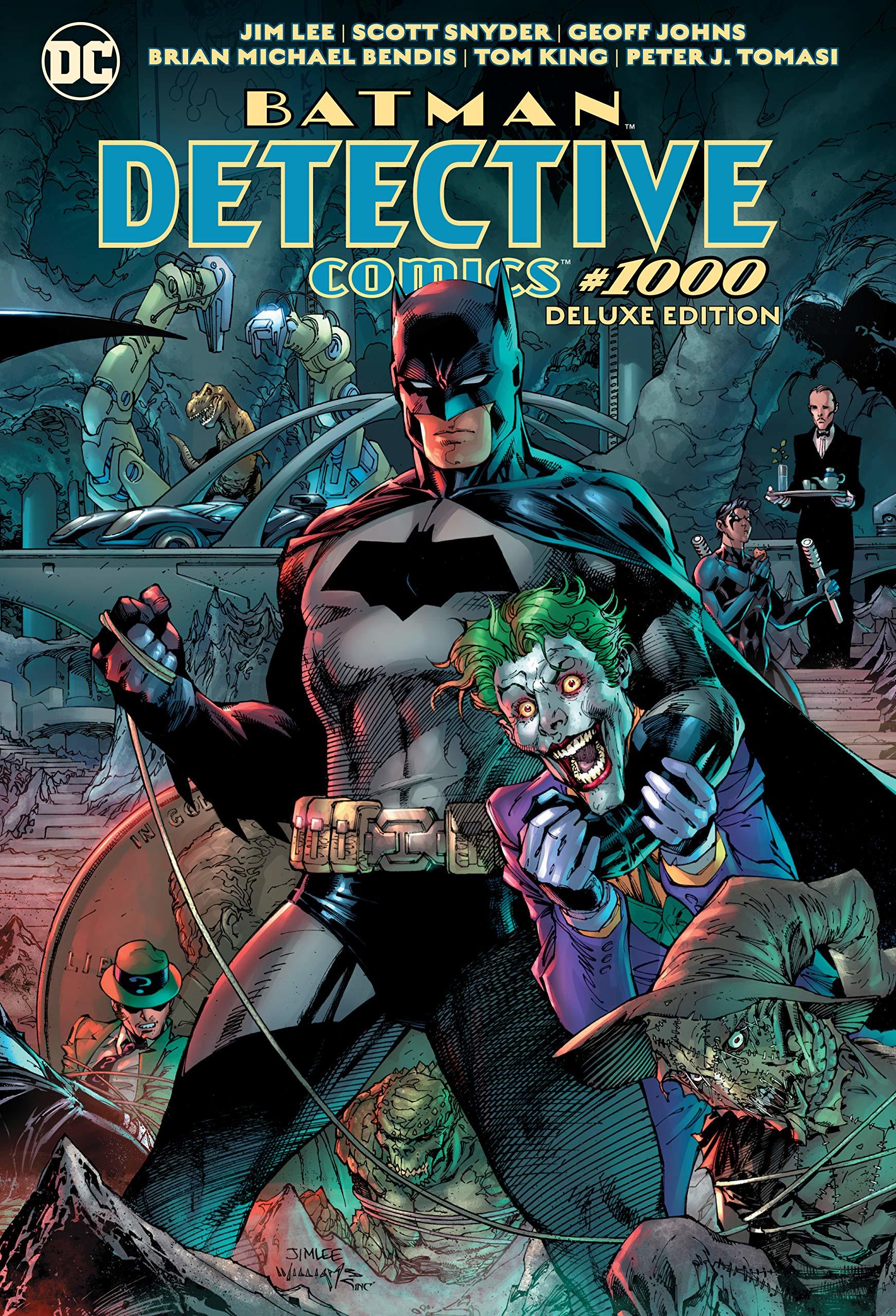
Batman: Detective Comics #1000 Deluxe Edition
DETECTIVE COMICS TURNS 80!
After 80 years, it's here--the 1000th issue of Detective Comics, the title that defines DC!
This incredible landmark issue is stacked with an unbelievable lineup of talent that will take you on a journey through Batman's past, present and future...plus a sensational epilogue that features the first-ever DC Universe appearance of the deadly Arkham Knight! But who is under the mask? And why do they want Batman dead? The incredible future of Batman adventures begins here! This unforgettable collector's edition features stories and art by:
Neal Adams, Brian Michael Bendis, Greg Capullo, Becky Cloonan, Tony S. Daniel, Paul Dini, Warren Ellis, Steve Epting, Geoff Johns, Joëlle Jones, Kelley Jones, Tom King, Jim Lee, Doug Mahnke, Alex Maleev, Alvaro Martinez-Bueno, Dustin Nguyen, Denny O'neil, Christopher Priest, Kevin Smith, Scott Snyder, Peter J. Tomasi, James Tynion IV...and more!
Detective Comics #1000: The Deluxe Edition collects the much-lauded landmark issue Detective Comics #1000, as well as an uncollected Batman story by Robert Venditti and an original story from the legendary Batman writer Alan Grant. This edition also features a bonus gallery loaded with variant covers.
After 80 years, it's here--the 1000th issue of Detective Comics, the title that defines DC!
This incredible landmark issue is stacked with an unbelievable lineup of talent that will take you on a journey through Batman's past, present and future...plus a sensational epilogue that features the first-ever DC Universe appearance of the deadly Arkham Knight! But who is under the mask? And why do they want Batman dead? The incredible future of Batman adventures begins here! This unforgettable collector's edition features stories and art by:
Neal Adams, Brian Michael Bendis, Greg Capullo, Becky Cloonan, Tony S. Daniel, Paul Dini, Warren Ellis, Steve Epting, Geoff Johns, Joëlle Jones, Kelley Jones, Tom King, Jim Lee, Doug Mahnke, Alex Maleev, Alvaro Martinez-Bueno, Dustin Nguyen, Denny O'neil, Christopher Priest, Kevin Smith, Scott Snyder, Peter J. Tomasi, James Tynion IV...and more!
Detective Comics #1000: The Deluxe Edition collects the much-lauded landmark issue Detective Comics #1000, as well as an uncollected Batman story by Robert Venditti and an original story from the legendary Batman writer Alan Grant. This edition also features a bonus gallery loaded with variant covers.
176 pages, Hardcover
First published June 18, 2019
About the author
Peter J. Tomasi
1,308 books475 followersPeter J. Tomasi is an American comic book writer, best known for his work for DC Comics, such as Batman And Robin; Superman; Super Sons; Batman: Detective Comics; Green Lantern Corps; and Superman/Wonder Woman; as well as Batman: Arkham Knight; Brightest Day; Green Lantern: Emerald Warriors; Nightwing; Black Adam, and many more.
In the course of his staff career at DC Comics, Tomasi served as a group editor and ushered in new eras for Batman, Green Lantern, and the JSA, along with a host of special projects like Kingdom Come.
He is also the author of the creator-owned titles House Of Penance with artist Ian Bertram; Light Brigade with artist Peter Snejbjerg; The Mighty with Keith Champagne and Chris Samnee; and the critically acclaimed epic graphic novel The Bridge: How The Roeblings Connected Brooklyn To New York, illustrated by Sara DuVall and published by Abrams ComicArts.
In 2018 New York Times best-selling author Tomasi received the Inkpot Award for achievement in comics.
In the course of his staff career at DC Comics, Tomasi served as a group editor and ushered in new eras for Batman, Green Lantern, and the JSA, along with a host of special projects like Kingdom Come.
He is also the author of the creator-owned titles House Of Penance with artist Ian Bertram; Light Brigade with artist Peter Snejbjerg; The Mighty with Keith Champagne and Chris Samnee; and the critically acclaimed epic graphic novel The Bridge: How The Roeblings Connected Brooklyn To New York, illustrated by Sara DuVall and published by Abrams ComicArts.
In 2018 New York Times best-selling author Tomasi received the Inkpot Award for achievement in comics.
Ratings & Reviews
Friends & Following
Create a free account to discover what your friends think of this book!
Community Reviews
Displaying 1 - 30 of 220 reviews

March 28, 2019
Batman looks good for 80, doesn’t he? Oh that’s right, he’s a drawing! And Detective Comics reaches its 1000th issue this month. Unlike Action Comics’ 1000th last year though, this bumper 96-page comic of Batman short stories isn’t half bad.
My favourite story was “Batman’s Greatest Case” by current Batman writer Tom King. The Bat family banters while posing for a photo op, and I thought it was very amusing. King captures their voices so distinctly that, even though most of the dialogue bubbles are floating around a moody Bruce Wayne elsewhere, you have a good idea who’s talking. Dick and Damian continue to have the most fun sibling relationship and I loved Batwoman’s stoicism – I want to read a King-scripted Batwoman series now!
The story highlights how Detective Comics has always been an ensemble title with Batman as part of that cast. It remains so today albeit the entire ensemble are all now derivative of Batman! Tony S. Daniel and Joelle Jones’ art is dependably gorgeous and the ending is sweet without being sappy.
Kevin Smith surprisingly writes the second best story here, with art from the legendary Jim Lee, in “Manufacture for Use”. Bruce as Matches Malone tracks down the gun that killed his parents and puts it to good use. Clever, quietly moving and enjoyable, a story about protecting the heart is especially pertinent from Smith given that he recently suffered a near fatal heart attack – glad you’re still with us, Kev!
Continuing the tradition of this title having the more detective-y Batman stories (as well as living up to its name) is “Batman’s Longest Case” by celebrated New 52 Bat-team, Scott Snyder and Greg Capullo. It’s not amazing but some of the clues are very clever and it was cool to see Slam Bradley make an appearance, a private detective character who was around the same time as Batman when he made his 1939 debut.
Paul Dini and Dustin Nguyen tell the story of inept henchman Knute Brody which was kinda dull but had an unexpected punchline. Warren Ellis and Becky Cloonan’s “The Batman’s Design” was a dreary story about Batman herding mercs into a warehouse deathtrap and having his fun with them. Denny O’Neil and Steve Epting’s “Return to Crime Alley” was a snoozy downer about how sad and hollow Batman’s life is - way to kill the celebratory buzz, Denny! Christopher Priest and Neal Adams’ “Heretic” is some rubbish about The League of Shadows.
Brian Bendis and Alex Maleev’s “I Know” is a load of nothing about how Penguin figures out Batman is Bruce Wayne. James Tynion IV and Alvaro Martinez-Bueno’s “The Precedent” is the worst story here, about Batman and Robin’s beginnings, a story that’s been told far too many times to be remotely interesting, particularly without variation on the details. Geoff Johns and Kelley Jones’ “The Last Crime in Gotham” was dull though I liked the (very brief) introduction of The April Fool, the Joker’s son, and the close-up panel of his face was genuinely creepy – well done Kelley Jones!
The issue closes out with Peter J. Tomasi and Doug Mahnke’s “Medieval”, which is the beginning of a new story arc starting in Detective Comics #1001: the Arkham Knight’s debut in the DCU. Paaaaaaaaarp. The Arkham Knight is this terrible character from one of the Arkham games who had a boring run in the Arkham spin-off comics. Can’t wait to not read that!
By no means a must-read for anyone but the fans, Detective Comics #1000 is a semi-successful collection of stories, some of which are fun. Anyhoo - well done on reaching 1000 issues DC and happy 80th Batman!
My favourite story was “Batman’s Greatest Case” by current Batman writer Tom King. The Bat family banters while posing for a photo op, and I thought it was very amusing. King captures their voices so distinctly that, even though most of the dialogue bubbles are floating around a moody Bruce Wayne elsewhere, you have a good idea who’s talking. Dick and Damian continue to have the most fun sibling relationship and I loved Batwoman’s stoicism – I want to read a King-scripted Batwoman series now!
The story highlights how Detective Comics has always been an ensemble title with Batman as part of that cast. It remains so today albeit the entire ensemble are all now derivative of Batman! Tony S. Daniel and Joelle Jones’ art is dependably gorgeous and the ending is sweet without being sappy.
Kevin Smith surprisingly writes the second best story here, with art from the legendary Jim Lee, in “Manufacture for Use”. Bruce as Matches Malone tracks down the gun that killed his parents and puts it to good use. Clever, quietly moving and enjoyable, a story about protecting the heart is especially pertinent from Smith given that he recently suffered a near fatal heart attack – glad you’re still with us, Kev!
Continuing the tradition of this title having the more detective-y Batman stories (as well as living up to its name) is “Batman’s Longest Case” by celebrated New 52 Bat-team, Scott Snyder and Greg Capullo. It’s not amazing but some of the clues are very clever and it was cool to see Slam Bradley make an appearance, a private detective character who was around the same time as Batman when he made his 1939 debut.
Paul Dini and Dustin Nguyen tell the story of inept henchman Knute Brody which was kinda dull but had an unexpected punchline. Warren Ellis and Becky Cloonan’s “The Batman’s Design” was a dreary story about Batman herding mercs into a warehouse deathtrap and having his fun with them. Denny O’Neil and Steve Epting’s “Return to Crime Alley” was a snoozy downer about how sad and hollow Batman’s life is - way to kill the celebratory buzz, Denny! Christopher Priest and Neal Adams’ “Heretic” is some rubbish about The League of Shadows.
Brian Bendis and Alex Maleev’s “I Know” is a load of nothing about how Penguin figures out Batman is Bruce Wayne. James Tynion IV and Alvaro Martinez-Bueno’s “The Precedent” is the worst story here, about Batman and Robin’s beginnings, a story that’s been told far too many times to be remotely interesting, particularly without variation on the details. Geoff Johns and Kelley Jones’ “The Last Crime in Gotham” was dull though I liked the (very brief) introduction of The April Fool, the Joker’s son, and the close-up panel of his face was genuinely creepy – well done Kelley Jones!
The issue closes out with Peter J. Tomasi and Doug Mahnke’s “Medieval”, which is the beginning of a new story arc starting in Detective Comics #1001: the Arkham Knight’s debut in the DCU. Paaaaaaaaarp. The Arkham Knight is this terrible character from one of the Arkham games who had a boring run in the Arkham spin-off comics. Can’t wait to not read that!
By no means a must-read for anyone but the fans, Detective Comics #1000 is a semi-successful collection of stories, some of which are fun. Anyhoo - well done on reaching 1000 issues DC and happy 80th Batman!

August 9, 2019
Everything you could ask for in a milestone anniversary issue. This is a collection of 8 to 10 page stories by today's top creators. My only complaint is that only the opening Scott Snyder and Greg Capullo story focused on the Batman's detective work given that the title is Detective Comics. For a landmark issue like this, I would have liked to have seen more detective based stories. That being said these stories are great. My favorite was the Kevin Smith and Jim Lee tale. Kevin showcases why he's a brilliant comic book writer when he finds the time away from writing and directing movies and making podcasts. Other standouts include those by the teams of Paul Dini / Dustin Nguyen and Brian Michael Bendis / Alex Maleev.

September 25, 2019
Holy One-Thousandth Issue, Batman!
And just 80 years later...
...Detective Comics, the comic book that introduced Batman in its 27th issue, back there in 1939,...
...came to reach its 1000th issue!
Obviously, while in the beginning the comic book title had several other characters, once the Dark Knight arrived, soon enough took over the book and it became basically a "Bat-title" featuring stories of Batman, and the 1000th issue is a special of 96 pages containing several different tales about Batman, made by different creative teams.
As in any anthology-like presentation, not all are that good, but happily I can say that you get more good ones than not, and even the not so good ones is just because they rested more in the "tribute" angle than trying to developed a more ambitious story, something quite understandable in a comic book issue like this one in particular.
There are several covers, per each decade and others, I chosen the one of 70's (that it's not this one featured, but it was the best option to choose here in GR), and certainly it's an essential issue to collect to any Batman fan.
Here, here, Dark Knight, well done in these 80 years!
And just 80 years later...
...Detective Comics, the comic book that introduced Batman in its 27th issue, back there in 1939,...
...came to reach its 1000th issue!
Obviously, while in the beginning the comic book title had several other characters, once the Dark Knight arrived, soon enough took over the book and it became basically a "Bat-title" featuring stories of Batman, and the 1000th issue is a special of 96 pages containing several different tales about Batman, made by different creative teams.
As in any anthology-like presentation, not all are that good, but happily I can say that you get more good ones than not, and even the not so good ones is just because they rested more in the "tribute" angle than trying to developed a more ambitious story, something quite understandable in a comic book issue like this one in particular.
There are several covers, per each decade and others, I chosen the one of 70's (that it's not this one featured, but it was the best option to choose here in GR), and certainly it's an essential issue to collect to any Batman fan.
Here, here, Dark Knight, well done in these 80 years!

February 2, 2021
This is an Awesome anniversary issues. This is one going to be the measuring stick for all other anniversary issues for me.
The book contains 13 short stories. Each worked on by a different Bat writing and Bat artistic team. Usually it is difficult to rate a book of short stories as I might like one and not a couple of others. I think this is the first time I have liked every single one.
On top of the bonus Pinup pages the book contains covering gallery that contains full page spreads of all the varient covers. This is must have for all Batfans.
The book contains 13 short stories. Each worked on by a different Bat writing and Bat artistic team. Usually it is difficult to rate a book of short stories as I might like one and not a couple of others. I think this is the first time I have liked every single one.
On top of the bonus Pinup pages the book contains covering gallery that contains full page spreads of all the varient covers. This is must have for all Batfans.

September 23, 2019

You can find my review on my blog by clicking here.
With last year marking the 80th anniversary of Superman, coinciding with the release of its 1000th issue, it was only a matter of time before another iconic superhero saw his birthday celebrated with the same enthusiasm—if not more—by fans all around the world: Batman. A similar 80th-anniversary commemorative collection was then released earlier in the year and saw us counting down the days until the original Detective Comics series—the same comic book series that gave us the DC Comics brand—slowly but surely reached its 1000th issue milestone. Inevitably, this issue was not to be a disappointment in any shape or form. Batman has changed the lives of many with his heroism, his resolve, and his history. What he represents is far greater than an idea and his impact on people is bound to be remembered throughout countless generations to come.
What is Batman: Detective Comics #1000 about? This special issue invites an incredible line-up of talented creative teams (writers and artists) to deliver short stories featuring the Dark Knight. These adventures take a look at the hero’s legacy by highlighting his detective skills or by visiting his archnemesis and family members for us to see how Batman is perceived by others. From writers like Scott Snyder and Geoff Johns to artists like Greg Capullo and Jim Lee, this stunning deluxe edition elevates the quality of this landmark issue and also incorporates a collection of various variant covers that were released by talented artists to celebrate this historical issue in all of its glory and beauty.
This special issue was delightful for all the right reasons. The lineup of talent brought on this project couldn’t have been better as they knew how to showcase the World’s Greatest Detective’s best traits in all the right angles and colours. While some of the stories explored his detective skills—although sometimes the mysteries were in fact quite obvious, linear or accelerated, with some plotting shortcuts—others looked into highlighting the hero’s influence on others, whether they are vigilantes or villains. It’s even more impressive when you look at how much love is shown to this hero in the most subtle ways possible, through his relationships with others and through his mannerism as the guardian of Gotham. After all, the sacrifices he has had to make for the people of his city can’t be overlooked, especially when you know that his life was essentially the result of a tragedy that forged his destiny as the Caped Crusader.
To accompany the fantastic stories that were presented in this special issue are some of the best artwork at DC Comics. This issue doesn’t just invite us to go down a trip through memory lane as we see various different Batman costumes, shapes and forms. It’s also a look at how every creator envisions the hero and how the Dark Knight still manages to create fear in anyone and everyone, while looking to save the world from the lurking villainy in the streets of Gotham. The colours are also incredible, vibrant and mesmerizing. This landmark issue simply does everything perfectly to ultimately deliver an entertaining read that reminds us exactly why Batman is such a fascinating character with the best lore in the game. The collection of variant covers at the end of this volume also offers some of the best pin-ups possible, showcasing incredible artistic talents.
Batman: Detective Comics #1000 is a phenomenal landmark issue with artwork that leaps from the pages, stories that glide through Batman’s rogue gallery and ideas that pack a punch.
Yours truly,
Lashaan | Blogger and Book Reviewer
Official blog: https://bookidote.com/

March 28, 2019
To be completely honest, this was a mixed bag of stories. My favorite was the Penguin story I think, or of Batman buying the gun used to kill his parents. The “story” introducing the Arkham Knight was cringey to me, so hopefully next issue and his story over all will he more interesting and well done.

March 28, 2019
Last year Superman reached milestone 1000 issues of Action Comics, and this year Detective Comics got to the same number. I was fully planning to go on the same Batman binge as I did last year with Superman, but truthfully my heart wasn't in it this year, and anyway I just don't love Batman as much as I do Superman. Maybe that's why I didn't get as much of a kick out of 'tec 1000, or maybe the stories really just weren't that good.
So just like last year, this issue is just an extra-thick collection of short Batman stories from a variety of creators. The talent involved is pretty standard if you know your DC of recent years — Tom King, Paul Dini, James Tynion, Geoff Johns, Scott Snyder, Peter Tomasi, Christopher Priest, Brian Bendis. Two surprise writers involved were Warren Ellis and Kevin Smith, and the obligatory classic creator this time around was Denny O'Neil. If I had to pick the best stories from the bunch, I'd say Kevin Smith shockingly wrote the most memorable one about Batman seeking out the gun that killed his parents and repurposing it into a bulletproof plate for his chest. Warren Ellis wrote a very Warren Ellis story that could have been part of any of his recent comics and didn't have a lot to do with Batman himself, but was still pretty cool. Tom King's story was sweet and actually involved the entire Bat-family for a change. The rest of them was okay to meh, and most I already forgot despite having just read them. The worst of the bunch were by far the ones by Geoff Johns and Peter Tomasi, which is unsurprising since they're some of the worst current DC writers, and Johns's story was also accompanied by absolutely abysmal artwork from Kelley Jones — this guy can go join Frank Miller and Tim Sale in the exclusive club of Worst Batman Artists Ever Who Are Bizarrely Still Loved By Fans.
But I guess my biggest problem with this issue is that it's too focused on Batman despite this not really even being his anniversary. Batman first appeared in Detective comics #27, and while he's definitely the most prominent and important character to have originated from the series, he's far from the only big one. I would have loved this issue to spend more time on some other fantastic characters who first appeared in this series, like Martian Manhunter, Batwoman, a variety of Robins, Jim Gordon, Renee Montoya, Crispus Allen and so many others. Instead it was a full on Batman-fest, with only brief appearances by his most well-known villains and the supporting cast.
And, unlike with Action 1000 which signalled a big and hopeful shift for Superman with the introduction of Bendis on both titles (which paid off incredibly well so far), there's no sense that something great is coming up for Batman. Tom King's run is still very good and not going anywhere anytime soon, but Detective Comics has been overtaken by Tomasi who has once again been writing some of the worst Batman comics I've ever read (I've been reading his current run in preparation for issue 1000, which was a huge mistake — it's so bad that I can't even force myself to review it, and I'm definitely not planning to read any more of it past this issue). But let's be real, Batman will always be DC's MVP, he'll be just fine no matter how many crappy directors and writers will do him disservice on the big screen or in comics. He will always be THE superhero in the public eye, and that's definitely something worth celebrating. While this milestone may not actually be 1000 issues of Batman, 2019 is still his 80th anniversary, so happy birthday, Batman — here's to 1000 more.
So just like last year, this issue is just an extra-thick collection of short Batman stories from a variety of creators. The talent involved is pretty standard if you know your DC of recent years — Tom King, Paul Dini, James Tynion, Geoff Johns, Scott Snyder, Peter Tomasi, Christopher Priest, Brian Bendis. Two surprise writers involved were Warren Ellis and Kevin Smith, and the obligatory classic creator this time around was Denny O'Neil. If I had to pick the best stories from the bunch, I'd say Kevin Smith shockingly wrote the most memorable one about Batman seeking out the gun that killed his parents and repurposing it into a bulletproof plate for his chest. Warren Ellis wrote a very Warren Ellis story that could have been part of any of his recent comics and didn't have a lot to do with Batman himself, but was still pretty cool. Tom King's story was sweet and actually involved the entire Bat-family for a change. The rest of them was okay to meh, and most I already forgot despite having just read them. The worst of the bunch were by far the ones by Geoff Johns and Peter Tomasi, which is unsurprising since they're some of the worst current DC writers, and Johns's story was also accompanied by absolutely abysmal artwork from Kelley Jones — this guy can go join Frank Miller and Tim Sale in the exclusive club of Worst Batman Artists Ever Who Are Bizarrely Still Loved By Fans.
But I guess my biggest problem with this issue is that it's too focused on Batman despite this not really even being his anniversary. Batman first appeared in Detective comics #27, and while he's definitely the most prominent and important character to have originated from the series, he's far from the only big one. I would have loved this issue to spend more time on some other fantastic characters who first appeared in this series, like Martian Manhunter, Batwoman, a variety of Robins, Jim Gordon, Renee Montoya, Crispus Allen and so many others. Instead it was a full on Batman-fest, with only brief appearances by his most well-known villains and the supporting cast.
And, unlike with Action 1000 which signalled a big and hopeful shift for Superman with the introduction of Bendis on both titles (which paid off incredibly well so far), there's no sense that something great is coming up for Batman. Tom King's run is still very good and not going anywhere anytime soon, but Detective Comics has been overtaken by Tomasi who has once again been writing some of the worst Batman comics I've ever read (I've been reading his current run in preparation for issue 1000, which was a huge mistake — it's so bad that I can't even force myself to review it, and I'm definitely not planning to read any more of it past this issue). But let's be real, Batman will always be DC's MVP, he'll be just fine no matter how many crappy directors and writers will do him disservice on the big screen or in comics. He will always be THE superhero in the public eye, and that's definitely something worth celebrating. While this milestone may not actually be 1000 issues of Batman, 2019 is still his 80th anniversary, so happy birthday, Batman — here's to 1000 more.

May 29, 2022
Detective Comics released its first issue in 1937. For its 1,000th issue, it released a Deluxe hardcover issue. I snagged this attractive copy for my library.
It is a collection of short stories with batman written by some good authors from Bendis to Tom King and Paul Dini. The artists are similarly spread across the DC lineup. The mixture works quite well. The vast majority of the stories fall between excellent to quite good, a few aren't that good but they are a small minority. Most all of the artwork is well done and some are superb.
A great addition to any Batman fan's collection. My Deluxe HC had a ton of cool cover art at the end and I quite enjoyed some of the panels. Highly Recommended.
It is a collection of short stories with batman written by some good authors from Bendis to Tom King and Paul Dini. The artists are similarly spread across the DC lineup. The mixture works quite well. The vast majority of the stories fall between excellent to quite good, a few aren't that good but they are a small minority. Most all of the artwork is well done and some are superb.
A great addition to any Batman fan's collection. My Deluxe HC had a ton of cool cover art at the end and I quite enjoyed some of the panels. Highly Recommended.

April 18, 2019
This, just like action comics 1000, is a bunch of stories all put together by different artist and writers.
The running theme is basically talking about Bruce. Who he is, why does he fight crime, who his family is, and what he stands for. Most of the stories here actually range from good to great. The highlights being Bendis story about Penguin and Batman relationship, King's story about the Bat Family, and Denny O’Neil darker take on what it cost Bruce to be batman. Also, like to shout out to Kevin Smith for bringing and really solid addition to the collection since his Batman stories are not usually loved but here it hit the nail on the head.
While there's a few I didn't like (Snyder's and John's) they all still capture what it is to be Batman. All the artist bring their A game and the warren Ellis script with Cloonan art is awesome.
Overall, Detective Comics 1000 does a great job of reminding us who Batman is and why he writes. A lot of stories worth reading here! A 4 out of 5.
The running theme is basically talking about Bruce. Who he is, why does he fight crime, who his family is, and what he stands for. Most of the stories here actually range from good to great. The highlights being Bendis story about Penguin and Batman relationship, King's story about the Bat Family, and Denny O’Neil darker take on what it cost Bruce to be batman. Also, like to shout out to Kevin Smith for bringing and really solid addition to the collection since his Batman stories are not usually loved but here it hit the nail on the head.
While there's a few I didn't like (Snyder's and John's) they all still capture what it is to be Batman. All the artist bring their A game and the warren Ellis script with Cloonan art is awesome.
Overall, Detective Comics 1000 does a great job of reminding us who Batman is and why he writes. A lot of stories worth reading here! A 4 out of 5.

March 28, 2019
The gun-as-an-armor story is the best part of this very special issue. It's the most Batman thing ever: super emo, super powerful, super symbolic, super over-the-top use of his detective/disguise skills and of his money, super Alfred-is-done-master-Bruce. I love everything about it. And it arrived just in time to shut up all those Snyder stans trying to retcon 70+ years of Bruce trying his best to be a top notch dude even though he's super fucked up. From now on, he's always wearing this underneath his costume unless the story explicitly tells me he isn't <3

March 27, 2019
It's almost funny how a few days ago Zach Snyder said some really provocative, but mostly stupid things about Batman, modern world and "we live in a society" BS and today 1000th issue of Detective Comics came out and it's full of heart. I'm not even sure I could handle this level of love to the characters, lore and readers. This is one of those comics that will inspire many to learn, write and draw.

April 13, 2019
Last year, Superman turned eighty years old and DC celebrated this special anniversary with the publication of Action Comics #1000, in which multiple writers and artists tell their own short stories that celebrates the Man of Steel. Since Supes’ super friend from Gotham City tuns eighty this year, it would seem appropriate to give the Dark Knight a similar treatment with the release of Detective Comics #1000. Since his origin began in the pages of the title’s 27th issue published in 1939, Batman has long been known as the World’s Greatest Detective as evident in some of the stories in the 1000th issue.
Beginning with the creative team that took over the main Batman title during DC’s New 52 initiative, writer Scott Snyder and Greg Capullo tell the tale of “Batman’s Longest Case”, in which Batman finally solves the first case he ever took. Told in just six pages, Snyder and Capullo gives us a globe-trotting adventure with clues ranging from technology to ancient hieroglyphics, all of which climaxes with Batman encountering the Guild of Detection, comprising of familiar faces from Detective Chimp to Slam Bradley, a private detective developed by Superman creators Jerry Siegel and Joe Shuster. Seeing this classic character who gives advice towards Batman presents something human and universal as the aim of detection is not so much reach the end, but going through the journey itself, as Batman’s journey will never end.
Whatever ending there is to Batman, his journey began with tragedy as we all know, and so it depends on whatever creative team shapes the Dark Knight on whether he does achieve happiness or even more tragedy. With art by the great Jim Lee, Kevin Smith (yep, that one!) tells the story of Matches Malone purchasing the gun that took the lives of Thomas and Martha Wayne. Now of course Malone is actually the Bat in disguise and nicely evokes a piece of Bat-history, the story may sound grim in why would Bruce Wayne keeps hold of a weapon that has scarred him for years. However, Smith cleverly makes this tale a triumphant one by retconning the significance of the Bat-symbol, which has always been a target on his chest. It's by far the best thing Kevin Smith has done in years, which isn’t saying much, considering his recent filmography.
The sense of triumph in the company of friends and family rarely happens when it comes to Batman, when it does, it feels great as explored in “Batman’s Greatest Case” from the current creative team on the main Batman title. Written by Tom King, he coincides with two time frames, one featuring Bruce walking towards his parents’ graves on a rainy night (drawn by Joëlle Jones), and the other taking place on a Gotham rooftop consisting of the many sidekicks that are among Batman’s family (drawn by Tony S. Daniel). King has maintained his sense of humour during his time on Batman and it shows here among the interactions with the Bat-Family, whilst continuing with this theme throughout his current run, which is the possibility of happiness for our hero.
In showing both the light and the dark towards Batman, some of the stories aren’t doing anything groundbreaking, as evident in “The Precedent” by James Tynion IV and Alvaro Martinez-Bueno, which is a conversation between Bruce and his trusted butler Alfred, who discuss about the future of a young Dick Grayson, who will become fight alongside the Dark Knight as the first Robin will shed a new light for Bruce himself. On the dark side, “Return to Crime Alley” reunites Batman and Dr Leslie Thompkins during an anniversary of his parents’ murder. Written by Denny O’Neil, the story isn’t saying much with Thompkins is the voice of reason and explains why Bruce should do more than wearing the cape and cowl, which embodies the tragedy that he has defined him. However, Steve Epting illustrating eight pages is proof that he is ideal to draw more of the crime-ridden streets of Gotham.
Some of the stories may not be much, but are worth reading due to the artwork, such as Alex Maleev reuniting with former Marvel writer Brian Michael Bendis on a future story about the Penguin, which is Bendis once again trying to be self-aware towards playing with a superhero mythos. Considering they made a brilliant run on Marvel’s Daredevil, I’m excited to see what Bendis and Maleev do together on future DC titles. When it comes to the return of veteran Bat-artists such as Kelley Jones and Neal Adams, their stories here suffer the worst with their art-styles are not up to today’s standards, whilst the stories themselves are rather lacklustre.
If I was to say what is the best that this issue offers, it would be “The Batman’s Design” by Warren Ellis and Becky Cloonan. Being no stranger to Batman and his world, the two creators present a bleak examination of the Bat himself, who narrates whilst taking down some gunmen in a warehouse. As well as being a brilliantly crafted action sequence (drawn by Cloonan and coloured by Jordie Bellaire), it is reminiscent of when Ellis was writing Moon Knight for Marvel, where he explored the psychology and theatricality of the hero. Batman doesn’t not kill, but through some form of performance, he takes some enjoyment out of taking down the bad guys.
Concluding the issue, is a story told entirely through twelve splash pages, each showcasing a piece of Batman’s history, stunningly drawn by Doug Mahnke. Written by Peter Tomasi, who is currently writing Detective Comics, he is essentially doing what the same thing he did with Action Comics #1000, which is to celebrate the character’s long history. The final page sets up what he is planning to do with his run, which is the comic book debut of the Arkham Knight, a villain who was introduced in the last of Rocksteady’s Batman: Arkham games, marketed poorly as an “original character”. Overall, I am not excited about this new take on the Arkham Knight, but as for this issue alone, it succeeds exactly what Superman went through last year, which is to be celebrated as an iconic superhero who has lived longer than I have and will continue to exist long after I’m dead.
Long live the bat!
Beginning with the creative team that took over the main Batman title during DC’s New 52 initiative, writer Scott Snyder and Greg Capullo tell the tale of “Batman’s Longest Case”, in which Batman finally solves the first case he ever took. Told in just six pages, Snyder and Capullo gives us a globe-trotting adventure with clues ranging from technology to ancient hieroglyphics, all of which climaxes with Batman encountering the Guild of Detection, comprising of familiar faces from Detective Chimp to Slam Bradley, a private detective developed by Superman creators Jerry Siegel and Joe Shuster. Seeing this classic character who gives advice towards Batman presents something human and universal as the aim of detection is not so much reach the end, but going through the journey itself, as Batman’s journey will never end.
Whatever ending there is to Batman, his journey began with tragedy as we all know, and so it depends on whatever creative team shapes the Dark Knight on whether he does achieve happiness or even more tragedy. With art by the great Jim Lee, Kevin Smith (yep, that one!) tells the story of Matches Malone purchasing the gun that took the lives of Thomas and Martha Wayne. Now of course Malone is actually the Bat in disguise and nicely evokes a piece of Bat-history, the story may sound grim in why would Bruce Wayne keeps hold of a weapon that has scarred him for years. However, Smith cleverly makes this tale a triumphant one by retconning the significance of the Bat-symbol, which has always been a target on his chest. It's by far the best thing Kevin Smith has done in years, which isn’t saying much, considering his recent filmography.
The sense of triumph in the company of friends and family rarely happens when it comes to Batman, when it does, it feels great as explored in “Batman’s Greatest Case” from the current creative team on the main Batman title. Written by Tom King, he coincides with two time frames, one featuring Bruce walking towards his parents’ graves on a rainy night (drawn by Joëlle Jones), and the other taking place on a Gotham rooftop consisting of the many sidekicks that are among Batman’s family (drawn by Tony S. Daniel). King has maintained his sense of humour during his time on Batman and it shows here among the interactions with the Bat-Family, whilst continuing with this theme throughout his current run, which is the possibility of happiness for our hero.
In showing both the light and the dark towards Batman, some of the stories aren’t doing anything groundbreaking, as evident in “The Precedent” by James Tynion IV and Alvaro Martinez-Bueno, which is a conversation between Bruce and his trusted butler Alfred, who discuss about the future of a young Dick Grayson, who will become fight alongside the Dark Knight as the first Robin will shed a new light for Bruce himself. On the dark side, “Return to Crime Alley” reunites Batman and Dr Leslie Thompkins during an anniversary of his parents’ murder. Written by Denny O’Neil, the story isn’t saying much with Thompkins is the voice of reason and explains why Bruce should do more than wearing the cape and cowl, which embodies the tragedy that he has defined him. However, Steve Epting illustrating eight pages is proof that he is ideal to draw more of the crime-ridden streets of Gotham.
Some of the stories may not be much, but are worth reading due to the artwork, such as Alex Maleev reuniting with former Marvel writer Brian Michael Bendis on a future story about the Penguin, which is Bendis once again trying to be self-aware towards playing with a superhero mythos. Considering they made a brilliant run on Marvel’s Daredevil, I’m excited to see what Bendis and Maleev do together on future DC titles. When it comes to the return of veteran Bat-artists such as Kelley Jones and Neal Adams, their stories here suffer the worst with their art-styles are not up to today’s standards, whilst the stories themselves are rather lacklustre.
If I was to say what is the best that this issue offers, it would be “The Batman’s Design” by Warren Ellis and Becky Cloonan. Being no stranger to Batman and his world, the two creators present a bleak examination of the Bat himself, who narrates whilst taking down some gunmen in a warehouse. As well as being a brilliantly crafted action sequence (drawn by Cloonan and coloured by Jordie Bellaire), it is reminiscent of when Ellis was writing Moon Knight for Marvel, where he explored the psychology and theatricality of the hero. Batman doesn’t not kill, but through some form of performance, he takes some enjoyment out of taking down the bad guys.
Concluding the issue, is a story told entirely through twelve splash pages, each showcasing a piece of Batman’s history, stunningly drawn by Doug Mahnke. Written by Peter Tomasi, who is currently writing Detective Comics, he is essentially doing what the same thing he did with Action Comics #1000, which is to celebrate the character’s long history. The final page sets up what he is planning to do with his run, which is the comic book debut of the Arkham Knight, a villain who was introduced in the last of Rocksteady’s Batman: Arkham games, marketed poorly as an “original character”. Overall, I am not excited about this new take on the Arkham Knight, but as for this issue alone, it succeeds exactly what Superman went through last year, which is to be celebrated as an iconic superhero who has lived longer than I have and will continue to exist long after I’m dead.
Long live the bat!

March 28, 2019
Some good ,some meh. Nothing too spectacular.

April 10, 2019
I almost skipped this one. You know how I feel about standalones that don't stand up. Heck, for that matter, it is almost hard to tell if this "96 Page Issue" is all new material or a host of reprints.
Still, it's a pretty stellar cast for Batman, who with all of his versatility, might be America's greatest hero. There's some of the recent Batman names of all stripes (Snyder, King, Dini, Tomasi, Tynion, Johns, Kevin Smith), the legend (Denny O'Neil), the "hot" name (Bendis) and a few wild cards (Warren Ellis, Christopher Priest). The exclusion (for whatever reason, I don't know) of Grant Morrison particularly sticks out.
I figured I should try it, even if I was not particularly impressed with DC's similar 1000 issue of Superman. I also am not a big fan of annuals, but this felt like it could be a decent enough stand-alone, and for that, it does actually work.
Let's talk about the stories.
Given the impact Scott Snyder and Tom King have had with this character in recent years, they get book-end stories. Both make their effort worthwhile.
Snyder has a likeable "Don't think about it too hard" story that is generally memorable and enjoyable. King's story is less memorable, but he essentially has 6 pages to work with, so he uses it to capture a really good Batman feel and show off his strengths.
Unlikely as it might seem, but Kevin Smith has the best story and it's pretty straight forward. At 8 pages, it goes quickly. Not only is it a good payoff, but the build up really grabs the reader, captures the right mood and is complimented by Jim Lee's art.
Paul Dini does what Dini does, and it is a fairly memorable and likely story. At six pages, it is maybe overlong. It's a great story, but he telegraphs the ending, so the mystery is solved fairly easily and before Dini gets to it.
Brian Michael Bendis tells a future Penguin/Batman story that seems like a logical fit for a book like this, though it probably falls under an Elseworlds story or something similar. It is pretty good, maybe only let down by an ending that doesn't feel all that original. The real hero is Alex Maleev who's art and colors give it particular staying power. I was happy with both Bendis and Dini putting their particular marks on here, though the ending of both stories strike me as plots I've known before.
Warren Ellis is given 8 pages, though his part is unexpectedly forgettable. Seeing Ellis's name, I expected either a new plot that no one had thought of, or some deep characterization that would resound. Neither is there. This is a light piece, almost poetry, whose best feature is Becky Cloonan's art and Jordie Bellaire's colors by a mile.
From there, it tends to be a lot of filler. This is like the golden age of Compact Discs when you might buy an album for 3 or 4 songs. Like CD's, the $10 price tag is pretty steep, and undoubtedly, the company wanted to make sure they were providing enough content for the money. Also like those albums of the past, this comic is heavily front loaded with all of the good stuff near the start. It ends with Peter Tomasi's intro into the next Detective Comics art, which was not nearly enough to get me to want to pick #1001 up,
The art is pretty good through without (Capullo, Joelle Jones and Tony Daniel and the ones I mentioned and didn't mention). DC does a weird job of sequencing in that is hard to tell when the story has ended and the next (and very different) story has started. It also does a bad job of advertising the creators inside. Overall, I keep going back to the CD analogy. I was satisfied enough that I bought this, and it will likely only appreciate with age, but it wouldn't be a complete review, without acknowledging there's plenty of filler, too.
Still, it's a pretty stellar cast for Batman, who with all of his versatility, might be America's greatest hero. There's some of the recent Batman names of all stripes (Snyder, King, Dini, Tomasi, Tynion, Johns, Kevin Smith), the legend (Denny O'Neil), the "hot" name (Bendis) and a few wild cards (Warren Ellis, Christopher Priest). The exclusion (for whatever reason, I don't know) of Grant Morrison particularly sticks out.
I figured I should try it, even if I was not particularly impressed with DC's similar 1000 issue of Superman. I also am not a big fan of annuals, but this felt like it could be a decent enough stand-alone, and for that, it does actually work.
Let's talk about the stories.
Given the impact Scott Snyder and Tom King have had with this character in recent years, they get book-end stories. Both make their effort worthwhile.
Snyder has a likeable "Don't think about it too hard" story that is generally memorable and enjoyable. King's story is less memorable, but he essentially has 6 pages to work with, so he uses it to capture a really good Batman feel and show off his strengths.
Unlikely as it might seem, but Kevin Smith has the best story and it's pretty straight forward. At 8 pages, it goes quickly. Not only is it a good payoff, but the build up really grabs the reader, captures the right mood and is complimented by Jim Lee's art.
Paul Dini does what Dini does, and it is a fairly memorable and likely story. At six pages, it is maybe overlong. It's a great story, but he telegraphs the ending, so the mystery is solved fairly easily and before Dini gets to it.
Brian Michael Bendis tells a future Penguin/Batman story that seems like a logical fit for a book like this, though it probably falls under an Elseworlds story or something similar. It is pretty good, maybe only let down by an ending that doesn't feel all that original. The real hero is Alex Maleev who's art and colors give it particular staying power. I was happy with both Bendis and Dini putting their particular marks on here, though the ending of both stories strike me as plots I've known before.
Warren Ellis is given 8 pages, though his part is unexpectedly forgettable. Seeing Ellis's name, I expected either a new plot that no one had thought of, or some deep characterization that would resound. Neither is there. This is a light piece, almost poetry, whose best feature is Becky Cloonan's art and Jordie Bellaire's colors by a mile.
From there, it tends to be a lot of filler. This is like the golden age of Compact Discs when you might buy an album for 3 or 4 songs. Like CD's, the $10 price tag is pretty steep, and undoubtedly, the company wanted to make sure they were providing enough content for the money. Also like those albums of the past, this comic is heavily front loaded with all of the good stuff near the start. It ends with Peter Tomasi's intro into the next Detective Comics art, which was not nearly enough to get me to want to pick #1001 up,
The art is pretty good through without (Capullo, Joelle Jones and Tony Daniel and the ones I mentioned and didn't mention). DC does a weird job of sequencing in that is hard to tell when the story has ended and the next (and very different) story has started. It also does a bad job of advertising the creators inside. Overall, I keep going back to the CD analogy. I was satisfied enough that I bought this, and it will likely only appreciate with age, but it wouldn't be a complete review, without acknowledging there's plenty of filler, too.

October 24, 2020
Oslava Batmana... která měla na víc. Od tohohle spíš booku než sešitu jsem očekával, že bude oslavovat takové ty klasické elementy Batmana které postupně vykrystalizovali za těch 80 let. Věc co mě strašně zklamala je, že kresba se díky spojení do booku strašně často překrývá a ztrácí takže reálně je nejlepší to číst digitálně.
První příběh Batman's Longest Case od Snydera s Capullem je fajn. Capullo se mi tady po dlouhý době hodně líbí (hlavně když je ve stínu/tmě, na světle je to hrozný). Po stránce scénáře je začátek dobrej ale pointa celého story jen potvrzuje to co dělá Scotty, neumí napsat konec.
Manufacture for Use je fakt super. Smith když umí napíše super věc a tady se mu to povedlo. Překvapilo mě, že ho dali do kupy s Jimem Lee ale ten tu je celkem fajn, překvapilo mě, že na pár stránkách použil trademark Bruce Timma, tedy rudé nebe.
Legend of Knute Brody mě zklamalo ačkoliv jej psal můj oblíbenec Paul Dini. Není to vyloženě nic špatného ale zároveň nic z čeho bych skákal radostí. Spíš to tady zachraňoval Dustin Nguyen se svou příjemnou kresbou.
Batman's Design mě překvapil. Jako jasně píše to Ellis ale vykašlal se na to, že bude nějak filozofovat a prostě ukázal sílu té postavy což dostalo ode mě body na víc. Krom pojetí příběhu mě zaskočila Becky Cloonan která mě fakt sere protože její kresba se mi nelíbí. Ale tady? Super. Samozřejmě velký kredit za to musí dostat láska Jordie Bellaire která s barvami čaruje víc než Gandalf ale obě v krásně perfektní práce.
Return to Crime Alley je super. Denny napsal dost netradičně Batmana a zatraceně to tomu sedlo. Epting se dost stylizoval do kresby Neala Adamse a strašně moc to na mě fungovalo, krásná temná balada.
Heretic. Co to kurva bylo? Priest neumí psát ale tohle bylo tak ubohý, že věřím, že si to Adams psal sám. Co víc Neal prostě nemůže kreslit normálně a tak vše vypadá jak zaostalé sedmdesátky (nefunguje to ani jako stylizace tý doby na rozdíl od Eptinga). Když jsem tím zpětně listoval tak jsem nepochopil jak je možný, že barvy dělal Dave Stewart, ten člověk je genius, jak je možný, že to je tak vybitý? Jednoznačně nejhorší příběh.
I Know od Bendise se mi líbilo. Příjemný příběh s boží kresbou Alexe Maleeva.
Last crime in Gotham je po stránce scénáře o parník nejlepší příběh. Prostě perfektně představuje fázi jak bych si představoval konec temného rytíře. Kresba je, řekněme si odporná až na jeden panel s Jokerem. Dost mi to připomíná Corbena kterýho já fakt nemůžu.
The Precedent je průměr. Neurazí, nezklame. Nepřišlo mi to ničím zajímavý, ani barvama který dělal Brad Anderson.
Batman's Greatest Case od Toma Kinga. Jop bylo to super a řadím to k nejlepším věcem co tu byly. Tradičně Kingovsky ukecaný ale přišlo mi to příjemné a tím, že to je jediný příběh kde je i Batfamily.
No a Medieval kterej je hroznej (a jedinej kanonickej vzhledem ke směrování Detective Comicsu). Tomassi mě fakt zklamal, bylo mi celkem jasný kudy chce jít ale napsal to dost nešťastně. A Dough Mahnke? Fakt ho nemám rád takže další důvod nemít rád i tohle.
Ale co, spíš z toho cítím zklamání ale aspoň mám cover od Bruce Timma kterej je boží!
První příběh Batman's Longest Case od Snydera s Capullem je fajn. Capullo se mi tady po dlouhý době hodně líbí (hlavně když je ve stínu/tmě, na světle je to hrozný). Po stránce scénáře je začátek dobrej ale pointa celého story jen potvrzuje to co dělá Scotty, neumí napsat konec.
Manufacture for Use je fakt super. Smith když umí napíše super věc a tady se mu to povedlo. Překvapilo mě, že ho dali do kupy s Jimem Lee ale ten tu je celkem fajn, překvapilo mě, že na pár stránkách použil trademark Bruce Timma, tedy rudé nebe.
Legend of Knute Brody mě zklamalo ačkoliv jej psal můj oblíbenec Paul Dini. Není to vyloženě nic špatného ale zároveň nic z čeho bych skákal radostí. Spíš to tady zachraňoval Dustin Nguyen se svou příjemnou kresbou.
Batman's Design mě překvapil. Jako jasně píše to Ellis ale vykašlal se na to, že bude nějak filozofovat a prostě ukázal sílu té postavy což dostalo ode mě body na víc. Krom pojetí příběhu mě zaskočila Becky Cloonan která mě fakt sere protože její kresba se mi nelíbí. Ale tady? Super. Samozřejmě velký kredit za to musí dostat láska Jordie Bellaire která s barvami čaruje víc než Gandalf ale obě v krásně perfektní práce.
Return to Crime Alley je super. Denny napsal dost netradičně Batmana a zatraceně to tomu sedlo. Epting se dost stylizoval do kresby Neala Adamse a strašně moc to na mě fungovalo, krásná temná balada.
Heretic. Co to kurva bylo? Priest neumí psát ale tohle bylo tak ubohý, že věřím, že si to Adams psal sám. Co víc Neal prostě nemůže kreslit normálně a tak vše vypadá jak zaostalé sedmdesátky (nefunguje to ani jako stylizace tý doby na rozdíl od Eptinga). Když jsem tím zpětně listoval tak jsem nepochopil jak je možný, že barvy dělal Dave Stewart, ten člověk je genius, jak je možný, že to je tak vybitý? Jednoznačně nejhorší příběh.
I Know od Bendise se mi líbilo. Příjemný příběh s boží kresbou Alexe Maleeva.
Last crime in Gotham je po stránce scénáře o parník nejlepší příběh. Prostě perfektně představuje fázi jak bych si představoval konec temného rytíře. Kresba je, řekněme si odporná až na jeden panel s Jokerem. Dost mi to připomíná Corbena kterýho já fakt nemůžu.
The Precedent je průměr. Neurazí, nezklame. Nepřišlo mi to ničím zajímavý, ani barvama který dělal Brad Anderson.
Batman's Greatest Case od Toma Kinga. Jop bylo to super a řadím to k nejlepším věcem co tu byly. Tradičně Kingovsky ukecaný ale přišlo mi to příjemné a tím, že to je jediný příběh kde je i Batfamily.
No a Medieval kterej je hroznej (a jedinej kanonickej vzhledem ke směrování Detective Comicsu). Tomassi mě fakt zklamal, bylo mi celkem jasný kudy chce jít ale napsal to dost nešťastně. A Dough Mahnke? Fakt ho nemám rád takže další důvod nemít rád i tohle.
Ale co, spíš z toho cítím zklamání ale aspoň mám cover od Bruce Timma kterej je boží!

June 29, 2021
DC did a nice job of assembling artists and writers old and new and presenting friends and foes both classic and current and gave many members of the Bat-mythos at least a nice cameo. It's not comprehensive, of course, nor was that their purpose. Bruce has been been my reading buddy, off and on, since the mid-1960's, and I remember watching West and Ward and crew on the tv show when the episodes were first run. Eighty years, 1000 issues, and they marked the anniversary pretty well. Lots of luscious art in the old-school, pin-up tradition. Holy millennial number!

March 28, 2019
A neat collection of new short stories by creators from across the character's history that all make some sort of statement about what makes this character and his world interesting, the standout stories to me were The Precedent and Batman's Greatest Case which both are right next to each other in the books reading order. Overall I wouldn't say this is a must buy unless you're a collector of big landmarks like this but I don't regret giving it a read.

March 29, 2019
Minus a very few shining moments...
That was one of the most lackluster, boring, meaningless collection of short stories I've read in a long, long time.
Cut that down to like the 4 good ones and be done with it.
That was one of the most lackluster, boring, meaningless collection of short stories I've read in a long, long time.
Cut that down to like the 4 good ones and be done with it.
April 1, 2019
What a great way to celebrate an 80 year old guy who has issues, lots of issues.

April 21, 2019
Batman for 80 years! This was an okay issue, some of the stories by Bendis and Warren Ellis were good, but the rest were just okay stories.

May 5, 2019
Anthology of short Batman stories by A-list writers and artists. Kevin Smith’s was really nice, rest was okay and the introduction of Arkham Knight was total crap.

September 10, 2019
IS THE BATMAN IMMORTAL?
1,000 issues of Batman is truly a milestone. But this issue was not worth 5 stars. More like a few short episodes of Batman: The Animated Series!

May 7, 2019
Ювілейний випуск про Бетмена видався ще слабшим, аніж недавній про Супермена. Напрочуд слабкі, банальні історії, позбавлені як цікавих акцентів, так і не менш цікавих художніх рішень. Із усієї колекції можна виокремити від сили дві-три історії, а це, погодьтесь, майже катастрофа. Тепер більш детально (або не зовсім) про кожну історію.
Історія від Снайдера/Капуло мені сподобалась, відгукнулась ностальгійним ехо із часів "Суду Сов". Снайдер традиційно зловживає монологом, але читається без роздратування. Історія Сміта/Лі нічим оригінальним не вирізняється теж. Це такий собі огляд усіх злодіїв Бетса без жодного сюжету чи акценту. Мовляв, давайте перерахуємо усіх і згадаємо, що є такий художник як Джим Лі. Далі пропускаємо Пола Діні й жахливий малюнок прекрасного художника Дастіна Нгуєна. Далі теж пропускаємо. А от історія від Уоррена Елліса класна, хоча я сумнівався у тому, що із цього щось може вийти. Усе ж, Елліс специфічний, суто "альтернативний" автор, тому не знав як він впишеться у мейнстрім. Вписався чудово! На декількох сторінках передав нуарну атмосферу, тобто те, що й варто передати у Detective Comics.
Врешті, найкращою історією є наступна - це оповідь про вбивство батьків очима Леслі Томпкінс від Денні О'Ніла й Стіва Ептінґа. Точніше, відбиток цієї події на подвійній ідентичності Бетмена, його непростому ставленні до злочинного світу. Мені все тут сподобалось, тому раджу. Історія від Крістофера Пріста, розмальована метром Нілом Адамсом, є ще однією посередністю. Далі - великий і страшний Бендіс. Непогано, але не більше. Так само розчарував Джефф Джонс. Можливо, дні слави Джонса вже справді минули. Що вже казати про маньєрестичний малюнок Келлі Джонса. Далі пропускаємо, абсолютно необов'язковий нарис від Джеймса Тиніона IV. Тоді багато слів, багато болі від Тома Кінга. Якщо ви ще втомились від скиглінь Бетмена пера Кінга - читайте. Мені давно вже не цікаво. І закриває цей ювілейний номер Пітер Дж. Томасі, який власне відновив свій ран на Бетмені із #993 і продовжить вже у #1001. Це більше загальна панорама із різних картинок, образів і флешбеків, аніж повноцінна історія. Ще вірю у талант Томасі, який прекрасно себе показав на "Бетмені й Робіні" у New 52, а також Супермені вже в перезапусці Rebirth.
Як підсумок, ювілейний випуск видався дуже строкатим, більше поганим і ніяким, аніж блисаучим. Якщо чесно, блискучої історії тут нема. Навіть Елліс міг би видати щось більш оригінальне, знаючи його можливості. Що вже казати про інших авторів. Натомість складається враження швидкої роботи, тому комікс лишається надбанням для колекціонерів, а читачі, більше за все, розчаруються. Хіба вони не безнадійні фанати Бетмена, які готові читати усе, що виходить із вухастим героєм.
Історія від Снайдера/Капуло мені сподобалась, відгукнулась ностальгійним ехо із часів "Суду Сов". Снайдер традиційно зловживає монологом, але читається без роздратування. Історія Сміта/Лі нічим оригінальним не вирізняється теж. Це такий собі огляд усіх злодіїв Бетса без жодного сюжету чи акценту. Мовляв, давайте перерахуємо усіх і згадаємо, що є такий художник як Джим Лі. Далі пропускаємо Пола Діні й жахливий малюнок прекрасного художника Дастіна Нгуєна. Далі теж пропускаємо. А от історія від Уоррена Елліса класна, хоча я сумнівався у тому, що із цього щось може вийти. Усе ж, Елліс специфічний, суто "альтернативний" автор, тому не знав як він впишеться у мейнстрім. Вписався чудово! На декількох сторінках передав нуарну атмосферу, тобто те, що й варто передати у Detective Comics.
Врешті, найкращою історією є наступна - це оповідь про вбивство батьків очима Леслі Томпкінс від Денні О'Ніла й Стіва Ептінґа. Точніше, відбиток цієї події на подвійній ідентичності Бетмена, його непростому ставленні до злочинного світу. Мені все тут сподобалось, тому раджу. Історія від Крістофера Пріста, розмальована метром Нілом Адамсом, є ще однією посередністю. Далі - великий і страшний Бендіс. Непогано, але не більше. Так само розчарував Джефф Джонс. Можливо, дні слави Джонса вже справді минули. Що вже казати про маньєрестичний малюнок Келлі Джонса. Далі пропускаємо, абсолютно необов'язковий нарис від Джеймса Тиніона IV. Тоді багато слів, багато болі від Тома Кінга. Якщо ви ще втомились від скиглінь Бетмена пера Кінга - читайте. Мені давно вже не цікаво. І закриває цей ювілейний номер Пітер Дж. Томасі, який власне відновив свій ран на Бетмені із #993 і продовжить вже у #1001. Це більше загальна панорама із різних картинок, образів і флешбеків, аніж повноцінна історія. Ще вірю у талант Томасі, який прекрасно себе показав на "Бетмені й Робіні" у New 52, а також Супермені вже в перезапусці Rebirth.
Як підсумок, ювілейний випуск видався дуже строкатим, більше поганим і ніяким, аніж блисаучим. Якщо чесно, блискучої історії тут нема. Навіть Елліс міг би видати щось більш оригінальне, знаючи його можливості. Що вже казати про інших авторів. Натомість складається враження швидкої роботи, тому комікс лишається надбанням для колекціонерів, а читачі, більше за все, розчаруються. Хіба вони не безнадійні фанати Бетмена, які готові читати усе, що виходить із вухастим героєм.

July 13, 2019
3 stars - Batman's Longest Case, Written by Scott Snyder, Pencils by Greg Capullo, Inks by Jonathan Glapion Colors by FCO Placencia, Letters by Tom Napolitano
2 stars - Manufacture for Use, Written by Kevin Smith, Pencils by Jim Lee, Inks by Scott Williams, Colors by Alex Sinclair, Letters by Todd Klien
2 stars - The Legends of Knute Brody, Written by Paul Dini, PEncils by Dustin Nguyen, Inks by Derek Fridolfs, Colors by John Kalisz, Letters by Steve Wands
1 star - The Batman's Design, Written by Warren Ellis, Art by Becky Cloonan, Colors by Jordie Bellaire, Letter by Simon Bowland
1 star - Return to Crime Alley, Written by Denny O'Neil, Art by Steve Epting, Colors by Elizabeth Breitweiser, Letter by Andworld Design
2 stars - Heretic, Written by Christopher Priest, Art by Steve Epting, Colors by Dave Stewart, Letters by Willi Schubert
3 stars- I Know, Written By Brian Michael Bendis, Art and colores by Alex Maleev, Letter by Josh Reed
3 stars - The Last Crime in Gotham, Written by Geoff Johns, Art by Kelley Johns, Colors by Michelle Madsen, Letters by Rob Leigh.
3 stars The Precedent, Written by James Tynion IV, Pencils by Alvaro Martinez Bueno, Inks by Raul Fernandez, Colors by Brad Anderson, Letter by Sal Cipriano.
4 stars Batman's Greatest Case, Written by Tom King, rt by Tony S. Daniel and Joelle Jones, Colors by Tomeu Morey, Letters by Clayton Cowles
3 stars - Medieval, Written by Peter J. Tomasi, Pencils by Doug Mahnke, Inks by Jaime Mendoza and Doug Mahnke, Colors by David Baron, Letters by Rob Leigh
3 stars - Table for Two, Written by Robert Venditti, Art by Stephen Segovia, Colors by Ulises Areola, Letters by Dave Sharpe
3 stars - Through the Keyhole, Written by Alan Grant, Pencils by Scott McDaniel, Inks by Rob Hunter, Colors by John Kalisz, Letter by Andworld Design
2 stars - Manufacture for Use, Written by Kevin Smith, Pencils by Jim Lee, Inks by Scott Williams, Colors by Alex Sinclair, Letters by Todd Klien
2 stars - The Legends of Knute Brody, Written by Paul Dini, PEncils by Dustin Nguyen, Inks by Derek Fridolfs, Colors by John Kalisz, Letters by Steve Wands
1 star - The Batman's Design, Written by Warren Ellis, Art by Becky Cloonan, Colors by Jordie Bellaire, Letter by Simon Bowland
1 star - Return to Crime Alley, Written by Denny O'Neil, Art by Steve Epting, Colors by Elizabeth Breitweiser, Letter by Andworld Design
2 stars - Heretic, Written by Christopher Priest, Art by Steve Epting, Colors by Dave Stewart, Letters by Willi Schubert
3 stars- I Know, Written By Brian Michael Bendis, Art and colores by Alex Maleev, Letter by Josh Reed
3 stars - The Last Crime in Gotham, Written by Geoff Johns, Art by Kelley Johns, Colors by Michelle Madsen, Letters by Rob Leigh.
3 stars The Precedent, Written by James Tynion IV, Pencils by Alvaro Martinez Bueno, Inks by Raul Fernandez, Colors by Brad Anderson, Letter by Sal Cipriano.
4 stars Batman's Greatest Case, Written by Tom King, rt by Tony S. Daniel and Joelle Jones, Colors by Tomeu Morey, Letters by Clayton Cowles
3 stars - Medieval, Written by Peter J. Tomasi, Pencils by Doug Mahnke, Inks by Jaime Mendoza and Doug Mahnke, Colors by David Baron, Letters by Rob Leigh
3 stars - Table for Two, Written by Robert Venditti, Art by Stephen Segovia, Colors by Ulises Areola, Letters by Dave Sharpe
3 stars - Through the Keyhole, Written by Alan Grant, Pencils by Scott McDaniel, Inks by Rob Hunter, Colors by John Kalisz, Letter by Andworld Design

April 13, 2019
Este, tinha de o ter em papel. Bem sei que a Action Comics #1000 era a grande edição comemorativa dos heróis mais longevos da DC, mas por muito que Superman me divirta, não sou especialmente fã. Prefiro o humanismo distorcido do Cavaleiro das Trevas. a sua eterna luta contra inimigos externos, e a tragédia dentro de si. Algo que as histórias desta edição número mil da Detective Comics, que se estreou há oitenta anos com as aventuras do Homem-Morcego, sublinham bem. São homenagens escritas e ilustradas por alguns dos maiores argumentistas e ilustradores, clássicos e contemporâneos, dos comics. Cada história foca a visão destes autores sobre a personagem, puxando muito pelo seu lado fortemente icónico. Bruce Wayne, o mordomo Alfred e todas as outras personagens que ramificaram do Batman inicial são aqui bem homenageadas, numa edição cuidadosamente estruturada para se tornar um clássico.

December 19, 2019
I love these special anthology/celebration editions. When done right they are amazing and when done poorly...they are bland. I was happy with what I read here (compared to the two other Batman-related comics I have read of late), but of course I have to be "that guy" and point out the obvious. They are celebrating 27 issues too soon. Batman debuted in Detective Comics #27 not issue number one. So it would have made more since to celebrate the 1,027 issue of this comic book--but eh, whatever: Happy early-Birthday to Batman.

March 28, 2019
After action comics hitting #1000, detective comics hits #1000 and it’s way better than the action comics one
Detective comics #1000 - like action conics it’s full of short stories written by various writers like Scott Snyder or Tom king and drawn by tony Daniels and Greg Capullo.
My thoughts - this was way better than action comics, I think all the stories were entertaining and a lot more enjoyable to read than action comics. Some of the best ones were the ones by Kevin smith, Greg Capullo and Tom king, and Geoff johns. I really love the variant covers which I also think are better than the action comics ones.
Overall good book
Detective comics #1000 - like action conics it’s full of short stories written by various writers like Scott Snyder or Tom king and drawn by tony Daniels and Greg Capullo.
My thoughts - this was way better than action comics, I think all the stories were entertaining and a lot more enjoyable to read than action comics. Some of the best ones were the ones by Kevin smith, Greg Capullo and Tom king, and Geoff johns. I really love the variant covers which I also think are better than the action comics ones.
Overall good book

September 12, 2020
It is really hard to make these big anniversary things work. And big anniversarys do not get much bigger than 1000th issue of Detective Comics. I'm happy to see that this time things worked quite well. Not perfect but really dams well.
Bunch of nice wee stories about Batman, all with art from top notch artist that capture the feel of the story so well. So good to see fresh Neal Adams art also.
Why not prefect? Some stories do not work for me. Like the Paul Dini one. That was just stupid.
Bunch of nice wee stories about Batman, all with art from top notch artist that capture the feel of the story so well. So good to see fresh Neal Adams art also.
Why not prefect? Some stories do not work for me. Like the Paul Dini one. That was just stupid.

April 6, 2019
Just another uninspired anniversary issue.
A dozen of small tribute stories, from which I consider decent the first, the second and the third. Afterwards, it's all downhill from there and the only thing worth mentioning is a large team-up of Batman's family for... a photo, and the teaser for the upcoming Arkham Knight's story arc in DC.
A dozen of small tribute stories, from which I consider decent the first, the second and the third. Afterwards, it's all downhill from there and the only thing worth mentioning is a large team-up of Batman's family for... a photo, and the teaser for the upcoming Arkham Knight's story arc in DC.

April 6, 2019
A few five star contributions but most of these are just awful
Displaying 1 - 30 of 220 reviews