

What do you think?
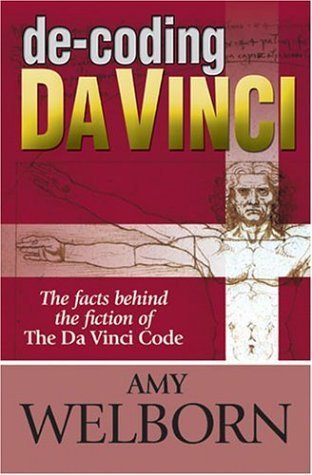
De-Coding Da Vinci: The Facts Behind the Fiction of The Da Vinci Code
Looks at the theories about Christian origins and church history suggested in the novel, "The Da Vinci Code," and explains how they ignore or misinterpret the available information as it has been understood in Catholic tradition.
124 pages, Paperback
First published January 1, 2004
Ratings & Reviews
Friends & Following
Create a free account to discover what your friends think of this book!
Community Reviews
Displaying 1 - 18 of 18 reviews

January 19, 2010
I have no way to rate this "book" at zero stars. It's really not a book, it's a pamphlet.
Despite it being a short book (124 pages), I couldn't read more than a dozen or so pages at a time before having to put the book down out of sheer distaste. So I took to leaving it in the car, reading a few pages at a time at occasional stoplights. This copy was lent to me by a co-worker, who owns two copies. After she found out that I'd not only read Dan Brown's "The Da Vinci Code," but enjoyed it, she really wanted me to read this. I tried.
The subtitle is "The facts behind the fiction of The Da Vinci Code." Despite having finished Amy Welborn's "book," I remain... skeptical. Dan Brown used sources whose scholarship is certainly questionable—I'm not arguing that-but if a text or author is going to dispute the accuracy of another author's work, and criticize it on academic grounds, I have to be able to respect the text and author—in part, by the use of academics and scholarly efforts to disprove the assertions made. I might have had less issue with Welborn's text if it weren't so very defensive. Much of the text had an air of, "Brown says X, and The Bible says Y, so we know that Y is right." Umm, no? She opens with a comparison to a traffic accident. People may have differing accounts of what happened in a traffic accident, but it doesn't mean the accident didn't happen. I agree—to a point. She misses her own irony, though—it doesn't mean that either account is guaranteed to be more-correct than the other. Brown doesn't dispute that Jesus was born, lived, and died, and that people began to worship him, among other things. Her allegory doesn't actually fit what she wants it to fit.
Part of Welborn's criticism stems from her belief about what authors "should" do. She states that writers of historical fiction are beholden to present an accurate reporting of historical detail, and that their characters and plots may diverge from known history. According to Welborn, Brown is an irresponsible author because his recounting of historical detail is intentionally flawed. This is the foundation on which she argues against the common assertion that "It's just a book," or "It's just fiction." Brown is misleading people, she contends, by mucking about with things they should expect to be accurately recounted. She contends that authors of historical fiction promise that a historical framework is correct, and that Brown's writing violates the reader's trust that the author is 'telling the truth about history.' (Ms. Welborn is going to be fighting a losing battle against the entire "speculative fiction" genre. Rage against that machine, Ms. Welborn, rage on.) She feels Brown is also irresponsible because he presents a character, Sir Leigh Teabing, who is "supposed to be" a scholar; she criticizes Langdon, the main character—a fictional character—'s credentials: a "Harvard professor of religious symbology (there is no such field, by the way)..." Perhaps she's unfamiliar with iconography? Or semiotics?
I find Welborn's accounting of facts and figures about many topics as questionable as Brown's about the foundations of Christianity. Among her statements:
• “There is ... no mention of a death-resurrection motif in Mithraic mythology."
• "In the Roman world, Isis was strongly associated with promiscuity, and the 'miraculous' conception [alluded to:] happened either by Isis reconstructing the body parts of her dead husband or by magic."
• ... "Most forms of Gnostic thinking were... anti-material (they viewed the corporeal world, including the body, as evil)."
• The truth is that all ancient religions used altars, made of piles of rocks, or wood or stone, for sacrifice."
• “By the second century, Christians in the West had settled on March 25 as the date that Jesus was crucified. Using an old Jewish tradition that the great prophets died on the same day on which they had been born or conceived, in the West, March 25 also came to be understood as the day Jesus was conceived by the Holy Spirit in Mary's womb.... Counting forward nine months, we arrive at December 25."—This? This is Welborn's "proof" that is supposed to counter Brown's claim that Constantine placed the date of Christ's birth to coincide with an extant pagan practice. ::blink::blink:: For real?
• "... there is no art scholar who thinks that the baby kneeling there with his hands folded isn't John the Baptist." (re: the painting Madonna of the Rocks)
Welborn spends no small amount of this brief text disputing the validity of various other historical writings on Christianity as being historically inaccurate or impossible, for instance, that the Gnostic Gospels must be completely disregarded, as they cannot have any "direct and independent insight into the actual words and deeds of Jesus." The Gospel of Philip is 'reflective of Gnostic thinking,' so must be disregarded in its entirety, along with the Gospel of Mary. Welborn asserts that Brown's mention of the Dead Sea Scrolls is, effectively, both superfluous and specious, because they were written by a Jewish sect called the Essenes, and irrelevant to the development or reporting of Christianity. (Some pages later, Welborn cites the Essenes as an example of Jewish men who did not marry, indicating that Jesus being unmarried was not at all uncommon for a Jewish man at that time. She does not make any indication that Jesus might have been an Essene, mind you—as they're irrelevant, remember?) Despite the word "rabbi" meaning "teacher," and that Jesus was called a teacher by his disciples, contends Welborn; there is no evidence he was a "Rabbi" in the formal institutional sense. Ooookay. The Essenes practiced celibacy, and mostly lived at Qumran, near the Dead Sea, and left the Dead Sea Scrolls... But Jesus wasn't from there, likely didn't go there, and the Essenes are irrelevant, as per Welborn's earlier assertions... Which is it?
Welborn spends an entire page criticizing Brown for referring to Leonardo da Vinci as "da Vinci" in his text, and how foolish that is, as it'd be like constantly referring to Jesus as "of Nazareth," this being further proof that Brown is unable to get anything factually correct, ever. I'd be more likely to consider it a modern adaptation of our use of "last names" to refer to people in the third person, and that, while technically a descriptor, many people use whatever comes after a "first name" as a "last name." Oh, and don't forget—Brown is "wrongheaded."
Welborn spends an entire chapter 'discrediting' the concept of the 'sacred feminine,' but in a subsequent chapter defends Catholicism for including it, in the worship of Mary, mother of Jesus. She quotes Charlotte Allen's 2001 Article in _Atlantic Monthly_ about how Western Europe was peopled with nature-attuned, woman-respecting, peaceful, and egalitarian culture for thousands of years, and how Indo-European invaders introduced warrior-gods, human-killing weapons, and patriarchal civilization...
Welborn continues on her own, that "the discovery of weapons and clear evidence of traditional gender-based division of labor in many of these sites has driven a stake into the myth of the Mother Goddess. There is no evidence to suggest that such an era ever existed." Overall, Welborn seems quite happy to discount the entire fields of archaeology, anthropology, and cultural history. Welborn's core assertion is that the only accurate source on Christian history is the New Testament, and that the New Testament, in its modern translation, is infallibly correct. She seems very upset that Brown doesn't cite the New Testament at all in his discussion of Jesus' identity.
Another part of Welborn's writing that was particularly distasteful was stylistic. I was taught, lo these many moons ago, that an educated writer does not begin any sentence with "Well, ..." After Welborn disputes Brown's assertion that the Emperor Constantine picked four Gospels out of eighty or more, and that in the aftermath of Nicaea, writings about Christ's human life were repressed, she opens her criticism on these topics with, "That's so wrong, it's beyond wrong." Academic? Scholarly? Are you joking? This is from someone with a Master's Degree from Vanderbilt? Egads. (That degree, the bio claims, is in Church history. She seems to have more citations from _Atlantic Monthly_ and _New York Times_ articles than from full-fledged books, to compare to Brown's disputed sources.) "Well, that's simply not what happened" doesn't give us much to go on. Welborn states that the four Gospels we have today were considered 'normative' by the Christian community by the mid-2nd-Century, and because of that, any and all other writings are not only irrelevant, but apparently didn't exist. She cites William Lane Craig, who contends that "97-99% of the New Testament can be reconstructed beyond any reasonable doubt." Sure, okay. That constitutes neither concrete proof of her stance, nor outright negation of Brown's claims. (Craig is one of the best-known Apologists writing in modern times.) Welborn ends other sentences with phrases like, "... and anyone who believes that is stupid." Academic? Scholarly? Hardly. Insulting? Absolutely. An assertion such as this is more than enough to dismiss this text on the grounds of academics, and Welborn's own 'credentials' on the grounds of writing that goes beyond 'colloquial' to paranoid.
Summary: Save your money and read a real book.
Despite it being a short book (124 pages), I couldn't read more than a dozen or so pages at a time before having to put the book down out of sheer distaste. So I took to leaving it in the car, reading a few pages at a time at occasional stoplights. This copy was lent to me by a co-worker, who owns two copies. After she found out that I'd not only read Dan Brown's "The Da Vinci Code," but enjoyed it, she really wanted me to read this. I tried.
The subtitle is "The facts behind the fiction of The Da Vinci Code." Despite having finished Amy Welborn's "book," I remain... skeptical. Dan Brown used sources whose scholarship is certainly questionable—I'm not arguing that-but if a text or author is going to dispute the accuracy of another author's work, and criticize it on academic grounds, I have to be able to respect the text and author—in part, by the use of academics and scholarly efforts to disprove the assertions made. I might have had less issue with Welborn's text if it weren't so very defensive. Much of the text had an air of, "Brown says X, and The Bible says Y, so we know that Y is right." Umm, no? She opens with a comparison to a traffic accident. People may have differing accounts of what happened in a traffic accident, but it doesn't mean the accident didn't happen. I agree—to a point. She misses her own irony, though—it doesn't mean that either account is guaranteed to be more-correct than the other. Brown doesn't dispute that Jesus was born, lived, and died, and that people began to worship him, among other things. Her allegory doesn't actually fit what she wants it to fit.
Part of Welborn's criticism stems from her belief about what authors "should" do. She states that writers of historical fiction are beholden to present an accurate reporting of historical detail, and that their characters and plots may diverge from known history. According to Welborn, Brown is an irresponsible author because his recounting of historical detail is intentionally flawed. This is the foundation on which she argues against the common assertion that "It's just a book," or "It's just fiction." Brown is misleading people, she contends, by mucking about with things they should expect to be accurately recounted. She contends that authors of historical fiction promise that a historical framework is correct, and that Brown's writing violates the reader's trust that the author is 'telling the truth about history.' (Ms. Welborn is going to be fighting a losing battle against the entire "speculative fiction" genre. Rage against that machine, Ms. Welborn, rage on.) She feels Brown is also irresponsible because he presents a character, Sir Leigh Teabing, who is "supposed to be" a scholar; she criticizes Langdon, the main character—a fictional character—'s credentials: a "Harvard professor of religious symbology (there is no such field, by the way)..." Perhaps she's unfamiliar with iconography? Or semiotics?
I find Welborn's accounting of facts and figures about many topics as questionable as Brown's about the foundations of Christianity. Among her statements:
• “There is ... no mention of a death-resurrection motif in Mithraic mythology."
• "In the Roman world, Isis was strongly associated with promiscuity, and the 'miraculous' conception [alluded to:] happened either by Isis reconstructing the body parts of her dead husband or by magic."
• ... "Most forms of Gnostic thinking were... anti-material (they viewed the corporeal world, including the body, as evil)."
• The truth is that all ancient religions used altars, made of piles of rocks, or wood or stone, for sacrifice."
• “By the second century, Christians in the West had settled on March 25 as the date that Jesus was crucified. Using an old Jewish tradition that the great prophets died on the same day on which they had been born or conceived, in the West, March 25 also came to be understood as the day Jesus was conceived by the Holy Spirit in Mary's womb.... Counting forward nine months, we arrive at December 25."—This? This is Welborn's "proof" that is supposed to counter Brown's claim that Constantine placed the date of Christ's birth to coincide with an extant pagan practice. ::blink::blink:: For real?
• "... there is no art scholar who thinks that the baby kneeling there with his hands folded isn't John the Baptist." (re: the painting Madonna of the Rocks)
Welborn spends no small amount of this brief text disputing the validity of various other historical writings on Christianity as being historically inaccurate or impossible, for instance, that the Gnostic Gospels must be completely disregarded, as they cannot have any "direct and independent insight into the actual words and deeds of Jesus." The Gospel of Philip is 'reflective of Gnostic thinking,' so must be disregarded in its entirety, along with the Gospel of Mary. Welborn asserts that Brown's mention of the Dead Sea Scrolls is, effectively, both superfluous and specious, because they were written by a Jewish sect called the Essenes, and irrelevant to the development or reporting of Christianity. (Some pages later, Welborn cites the Essenes as an example of Jewish men who did not marry, indicating that Jesus being unmarried was not at all uncommon for a Jewish man at that time. She does not make any indication that Jesus might have been an Essene, mind you—as they're irrelevant, remember?) Despite the word "rabbi" meaning "teacher," and that Jesus was called a teacher by his disciples, contends Welborn; there is no evidence he was a "Rabbi" in the formal institutional sense. Ooookay. The Essenes practiced celibacy, and mostly lived at Qumran, near the Dead Sea, and left the Dead Sea Scrolls... But Jesus wasn't from there, likely didn't go there, and the Essenes are irrelevant, as per Welborn's earlier assertions... Which is it?
Welborn spends an entire page criticizing Brown for referring to Leonardo da Vinci as "da Vinci" in his text, and how foolish that is, as it'd be like constantly referring to Jesus as "of Nazareth," this being further proof that Brown is unable to get anything factually correct, ever. I'd be more likely to consider it a modern adaptation of our use of "last names" to refer to people in the third person, and that, while technically a descriptor, many people use whatever comes after a "first name" as a "last name." Oh, and don't forget—Brown is "wrongheaded."
Welborn spends an entire chapter 'discrediting' the concept of the 'sacred feminine,' but in a subsequent chapter defends Catholicism for including it, in the worship of Mary, mother of Jesus. She quotes Charlotte Allen's 2001 Article in _Atlantic Monthly_ about how Western Europe was peopled with nature-attuned, woman-respecting, peaceful, and egalitarian culture for thousands of years, and how Indo-European invaders introduced warrior-gods, human-killing weapons, and patriarchal civilization...
Welborn continues on her own, that "the discovery of weapons and clear evidence of traditional gender-based division of labor in many of these sites has driven a stake into the myth of the Mother Goddess. There is no evidence to suggest that such an era ever existed." Overall, Welborn seems quite happy to discount the entire fields of archaeology, anthropology, and cultural history. Welborn's core assertion is that the only accurate source on Christian history is the New Testament, and that the New Testament, in its modern translation, is infallibly correct. She seems very upset that Brown doesn't cite the New Testament at all in his discussion of Jesus' identity.
Another part of Welborn's writing that was particularly distasteful was stylistic. I was taught, lo these many moons ago, that an educated writer does not begin any sentence with "Well, ..." After Welborn disputes Brown's assertion that the Emperor Constantine picked four Gospels out of eighty or more, and that in the aftermath of Nicaea, writings about Christ's human life were repressed, she opens her criticism on these topics with, "That's so wrong, it's beyond wrong." Academic? Scholarly? Are you joking? This is from someone with a Master's Degree from Vanderbilt? Egads. (That degree, the bio claims, is in Church history. She seems to have more citations from _Atlantic Monthly_ and _New York Times_ articles than from full-fledged books, to compare to Brown's disputed sources.) "Well, that's simply not what happened" doesn't give us much to go on. Welborn states that the four Gospels we have today were considered 'normative' by the Christian community by the mid-2nd-Century, and because of that, any and all other writings are not only irrelevant, but apparently didn't exist. She cites William Lane Craig, who contends that "97-99% of the New Testament can be reconstructed beyond any reasonable doubt." Sure, okay. That constitutes neither concrete proof of her stance, nor outright negation of Brown's claims. (Craig is one of the best-known Apologists writing in modern times.) Welborn ends other sentences with phrases like, "... and anyone who believes that is stupid." Academic? Scholarly? Hardly. Insulting? Absolutely. An assertion such as this is more than enough to dismiss this text on the grounds of academics, and Welborn's own 'credentials' on the grounds of writing that goes beyond 'colloquial' to paranoid.
Summary: Save your money and read a real book.

May 17, 2020
Since I have a day off, I've decided to revisit this book, which was my first view into the phenomenon that is known as ''The Da Vinci Code'' (next was the movie directed by Ron Howard, which is among my top 100 favorite movies, and then the book by Dan Brown). It's short, simple and takes into consideration actual materials, by which the historical events really happened (not like they're described in the novel) while discussing the key details referenced in the book. By order, it would be recommended to read the novel first, then watch the movie and, finally, this title, while keeping your own opinion about the works (for each one and overall) at the end. Do I think those works are educational? In some way, yes, as it's something to think about when giving the fact that much of the history is full of blanks and, thus, interesting to fill it. Will it make me think twice about the religion from now? No, as it's my own decision and perception of what I want to do with what I've learned (for example, trying to be a good person to others). Was ''De-Coding The Da Vinci Code'' interesting? Sure, but I think the author took it too seriously, by exaggerating the effect of the novel into situation that the people would lose their faith. Would reading this book make me not want to reread or rewatch ''The Da Vinci Code''? Certainly not, as I do this for fun and relaxation. Should someone by offended by watching ''Monty Python and the Holy Grail'' or ''Jesus Christ Superstar'' (I know they're comedies, but even there are limits)? Just enjoy in books, movies, music and art.

December 26, 2021
A Catholic scholar’s short refutation of the several myths and theories exposed in Dan Brown’s The Da Vinci Code.
September 24, 2023
A CATHOLIC CRITIQUE OF THE POPULAR NOVEL
Author Amy Welborn wrote in the Preface to this 2004 book, “there seems to be something different about ‘The Da Vinci Code’---it’s got people talking in a way that [most] novels… don’t. What’s going on?... Once people started reading ‘The Da Vinci Code,’ they couldn’t help but wonder about some of the puzzling assertions author Dan Brown makes in the novel: *Did Leonardo da Vinci really use his art to communicate secret knowledge about the Holy Grail? *Is it true that the Gospels don’t tell the true story of Jesus? *Were Jesus and Mary Magdalene married? *Did Jesus really designate Mary Magdalene as the leader of his movement, not Peter? What seems to intrigue readers is that the characters in ‘The Da Vinci Code’ have answers to these questions, and they are expressed in the book as factually based, supported by the work and opinions of historians and other researchers. Brown even cites real books as sources within the novel. Readers are … also wondering, if what Brown says is true, what are the implications for their faith could be. After all, if the Gospels are false accounts, isn’t all of Christianity as we know it a lie?” (Pg. 9-10)
She continues, “This book is intended to help you unpack all of this and to explore the truth behind ‘The Da Vinci Code.’ We’ll look at Brown’s sources and see if they’re trustworthy witnesses to history. We’ll ask is his characterization of early Christian writings, teaching, and disputes… are accurate. We’ll look at Jesus and Mary Magdalene… and see if anything at all that ‘The Da Vinci Code’ has to say about them is based on historical record. And along the way, we’ll find a startling number of blatant, glaring errors on matters great and small that should send up red flags to anyone reading the novel as a source of facts, rather than pure fiction.” (Pg. 10)
She states, “what Brown has done here is weave a number of different strands of speculation, esoteric lore, and pseudo-history published on other books, cramming them all onto the pages of his novel… Brown provides a bibliography on his website… His sources fall into three basic categories: 1) ‘Holy Blood, Holy Grail’ and … ‘The Templar Revelation’ [books] …The entire Jesus-Mary Magdalene-Holy Grail-Priory of Sion element of ‘The Da Vinci Code’ is derived from these two books…. 2) the ‘sacred feminine’: Since the nineteenth century, some have speculated about a lost age of the goddess… a period that was supplanted by a war-mongering patriarchy… 3) Gnosticism… most forms of Gnostic thinking were esoteric… and anti-material… There are some writings from the second through fifth centuries that are clearly syntheses of Gnostic and Christian thinking… but most [scholars] date them far later than the Gospels, with… little, if any, direct independent insight into the actual words and deeds of Jesus.” (Pg. 16-17)
She goes on, “in ‘The Da Vinci Code,’ Brown uses ‘history is written by the winners’ to suggest that the whole history of Christianity, beginning with Jesus himself, is a LIE, written by those who were determined to suppress Jesus ‘real’ message… Brown claims that Jesus wanted the movement that followed him to be about a greater awareness of the ‘sacred feminine.’ He says that this movement, under the leadership and inspiration of Mary Magdalene, thrived the first three centuries until it was brutally suppressed by the Emperor Constantine. There’s no evidence to suggest that this is true. It didn’t happen.” (Pg. 18-19)
She continues, “‘It’s only a novel,’ some folks say… But… the author of this particular book suggests that there really is more at work here than just imagination, and he encourages his reads to accept certain problematic assertions about history as factual… In [the book] imaginative detail and false historical assertions are presented as facts and the fruit of serious historical research, which they simply are not.” (Pg. 20-21) She adds, “all of Brown’s assertions about Christian origins are put in the mouths of his scholar characters…who often… frame their statements in phrases such as, Historians marvel that…’ ‘Many scholars claim…’ These discussions function as a device for communicating the ideas from ‘Holy Blood, Holy Grail' … to the reader… in a way that implies they are factual… Moreover, Brown has been rather up from … about his method and purpose. He has repeatedly stated that … he wants to participate in the telling of this ‘lost history’… And to a startling extent, readers are accepting these theories as facts.” (Pg. 21-22)
She explains, “If you’re going to learn early Christian history from ‘The Da Vinci Code,’ here’s the lesson… “Jesus was a wise, moral teacher, about whose life there were … ‘thousands’ … of accounts during those first centuries. More than eighty gospels… But only four were chosen for inclusion in the Bible! … works that described Jesus’ life as a human teacher were suppressed, out of raw political motivation…” … This is … beyond wrong… not even the most secular scholar … would give any support to Brown’s account of the formation of the New Testament. It’s not serious history, so don’t be taken in by it.” (Pg. 31) She counters, “There is absolutely no doubt that … the four Gospels we have today were considered normative by the Christian community by the middle of the second century…” (Pg. 35)
She explains, “the need for definition came because the consequences of accepting … the Gnostics’ understanding of Christianity were grave… Gnostic-Christian writings … were profoundly at odds with the picture that is … recorded in the four Gospels, in Paul, and in the ongoing life of the Church… Christian leaders began to define more clearly the books appropriate for use by Christian churches… Which books best embody the reality of who Jesus was and is for the entire Church? Do these books come from the age of the apostles?... Eventually, as Christianity became more established, and the threat of persecution lifted, Christian leaders were able to … make decisions for the broader Church.” (Pg. 39) She summarizes, “Yes, human hands played a role in the establishment of the canon, but those decisions weren’t motivated by a desire to oppress women or hold on to power. They were grounded in the obligation … to ensure that the Jesus’ life and message were accurately and thoroughly preserved for future generations, and, Christians believe, inspired by the Holy Spirit.” (Pg. 41)
She states, “just about everything Brown says about this aspect of Christian history is incorrect. He says that up until the fourth century, ‘Christianity’ was a movement formed around the idea of Jesus as a ‘mortal prophet.’ A simple reading of the New Testament, written a few decades after Jesus’ resurrection, shows that this is not so. Early Christians preached Jesus as Lord. He says that the Council of Nicaea invented the idea of the divinity of Christ. It did not. It acted to preserve the integrity of the ancient testimony to Jesus.” (Pg. 50-51)
She notes, “Brown’s use of the Gnostic documents is highly selective. Gnostic texts that have come down to us are a diverse thought… But, besides occasional echoes of the ‘sacred feminine,’ you will more frequently find abstruse, esoteric systems of though… You will also find anti-Judaism and … some misogyny, as well.” (Pg. 55)
Was Jesus married? “the best ‘historical records’ we have to reveal the life of Jesus are the canonical Gospels, which were written just decades after his death and resurrection… they don’t mention Jesus being married. Ever. Now, there’s an argument related to this silence…. Brown suggests that … If he weren’t married, Gospel writers would have taken a minute or two to explain or defend it because it would have been so unusual… [scholar John] Meier critiques the argument from silence because the Gospels are not at all silent about Jesus’ other relationships. They mention his parents and his other relatives… Given this definite non-silence about … the women who followed him, there’s no reason for a wife to go unmentioned.” (Pg. 59-60)
She observes, “Brown suggests… that Mary Magdalene was… demonized by traditional Christianity, which painted her as … a prostitute… in an effort to diminish her importance…this is not only wrong---it simply makes no sense. Christianity … has honored Mary Magdalene as a saint… Even those parts of Christianity that did link Mary Magdalene with the ‘woman… who was a sinner’ in Luke 7… her sin was not emphasized… [she] was remembered primarily in his role as a witness to the risen Jesus.” (Pg. 67-68)
She states, “Brown, using the work of … contemporary writers … suggests that there was a branch of the Jesus movement that was woman-centered. In Brown’s scenario, this is what we see … [in] the Gnostic writings that put Mary Magdalene at front and center. These were, however, systems removed from the mainstream of Christianity. They used the figure of Christian … as a means for expressing essentially Gnostic ideas. They had no direct ties to … a continuous ancient tradition centered on the ‘sacred feminine.’” (Pg. 76)
She says, “Brown blithely claims … that Constantine simply shifted the Christian day of rest from Saturday to the Day of the Sun. This is willy. We have ample evidence that Sunday was special to Christians from the first century. They did not call it that, of course… it is called ‘the Lord’s day’… By the middle of the second century, the Christian pattern of gathering for Eucharist on Sunday, already related in [Acts 20:7]… was firmly established.” (Pg. 88-89)
She argues, “The story that Brown tells about the Knights Templar and the Priory of Sion are based on material from… ‘Holy Blood, Holy Grail’ and ‘The Templar Revelation.’ Most of what he says about them has no basis in fact… the Priory of Sion was NOT a real organization in the way that Brown describes it… There seems to be evidence of a Priory of Sion emerging in late nineteenth-century France… In the mid-1950s, [Pierre] Plantard started claiming he was the heir to the French throne, from the Merovingian line. He formed a group called ‘the Priory of Sion’ … and propagated the ‘royal bloodline of Jesus’ myth.” (Pg. 107)
She acknowledges, “Brown does get a few things right about Opus Dei… Yes, its members are devoted to traditional piety… And yes, some members practice corporal mortification. But that’s about it… Opus Dei does not have ‘monks.’ … [It] is an association of lay people and priests… Opus Dei does have different levels of membership... this reflects varied levels of commitment… corporal mortification … certainly seems odd to many modern people, but … bodily mortification, as a spiritual practice, is found in EVERY WORLD RELIGION in some form or another…” (Pg. 114-116)
She concludes, “Curious about Jesus?... Don’t let a novelist with an agenda instruct you in the ways of faith… go to the source: Pick up that Bible. You might be surprised at what you find.” (Pg. 124)
This book will be of great interest to those seeking critiques of Brown’s novel.
Author Amy Welborn wrote in the Preface to this 2004 book, “there seems to be something different about ‘The Da Vinci Code’---it’s got people talking in a way that [most] novels… don’t. What’s going on?... Once people started reading ‘The Da Vinci Code,’ they couldn’t help but wonder about some of the puzzling assertions author Dan Brown makes in the novel: *Did Leonardo da Vinci really use his art to communicate secret knowledge about the Holy Grail? *Is it true that the Gospels don’t tell the true story of Jesus? *Were Jesus and Mary Magdalene married? *Did Jesus really designate Mary Magdalene as the leader of his movement, not Peter? What seems to intrigue readers is that the characters in ‘The Da Vinci Code’ have answers to these questions, and they are expressed in the book as factually based, supported by the work and opinions of historians and other researchers. Brown even cites real books as sources within the novel. Readers are … also wondering, if what Brown says is true, what are the implications for their faith could be. After all, if the Gospels are false accounts, isn’t all of Christianity as we know it a lie?” (Pg. 9-10)
She continues, “This book is intended to help you unpack all of this and to explore the truth behind ‘The Da Vinci Code.’ We’ll look at Brown’s sources and see if they’re trustworthy witnesses to history. We’ll ask is his characterization of early Christian writings, teaching, and disputes… are accurate. We’ll look at Jesus and Mary Magdalene… and see if anything at all that ‘The Da Vinci Code’ has to say about them is based on historical record. And along the way, we’ll find a startling number of blatant, glaring errors on matters great and small that should send up red flags to anyone reading the novel as a source of facts, rather than pure fiction.” (Pg. 10)
She states, “what Brown has done here is weave a number of different strands of speculation, esoteric lore, and pseudo-history published on other books, cramming them all onto the pages of his novel… Brown provides a bibliography on his website… His sources fall into three basic categories: 1) ‘Holy Blood, Holy Grail’ and … ‘The Templar Revelation’ [books] …The entire Jesus-Mary Magdalene-Holy Grail-Priory of Sion element of ‘The Da Vinci Code’ is derived from these two books…. 2) the ‘sacred feminine’: Since the nineteenth century, some have speculated about a lost age of the goddess… a period that was supplanted by a war-mongering patriarchy… 3) Gnosticism… most forms of Gnostic thinking were esoteric… and anti-material… There are some writings from the second through fifth centuries that are clearly syntheses of Gnostic and Christian thinking… but most [scholars] date them far later than the Gospels, with… little, if any, direct independent insight into the actual words and deeds of Jesus.” (Pg. 16-17)
She goes on, “in ‘The Da Vinci Code,’ Brown uses ‘history is written by the winners’ to suggest that the whole history of Christianity, beginning with Jesus himself, is a LIE, written by those who were determined to suppress Jesus ‘real’ message… Brown claims that Jesus wanted the movement that followed him to be about a greater awareness of the ‘sacred feminine.’ He says that this movement, under the leadership and inspiration of Mary Magdalene, thrived the first three centuries until it was brutally suppressed by the Emperor Constantine. There’s no evidence to suggest that this is true. It didn’t happen.” (Pg. 18-19)
She continues, “‘It’s only a novel,’ some folks say… But… the author of this particular book suggests that there really is more at work here than just imagination, and he encourages his reads to accept certain problematic assertions about history as factual… In [the book] imaginative detail and false historical assertions are presented as facts and the fruit of serious historical research, which they simply are not.” (Pg. 20-21) She adds, “all of Brown’s assertions about Christian origins are put in the mouths of his scholar characters…who often… frame their statements in phrases such as, Historians marvel that…’ ‘Many scholars claim…’ These discussions function as a device for communicating the ideas from ‘Holy Blood, Holy Grail' … to the reader… in a way that implies they are factual… Moreover, Brown has been rather up from … about his method and purpose. He has repeatedly stated that … he wants to participate in the telling of this ‘lost history’… And to a startling extent, readers are accepting these theories as facts.” (Pg. 21-22)
She explains, “If you’re going to learn early Christian history from ‘The Da Vinci Code,’ here’s the lesson… “Jesus was a wise, moral teacher, about whose life there were … ‘thousands’ … of accounts during those first centuries. More than eighty gospels… But only four were chosen for inclusion in the Bible! … works that described Jesus’ life as a human teacher were suppressed, out of raw political motivation…” … This is … beyond wrong… not even the most secular scholar … would give any support to Brown’s account of the formation of the New Testament. It’s not serious history, so don’t be taken in by it.” (Pg. 31) She counters, “There is absolutely no doubt that … the four Gospels we have today were considered normative by the Christian community by the middle of the second century…” (Pg. 35)
She explains, “the need for definition came because the consequences of accepting … the Gnostics’ understanding of Christianity were grave… Gnostic-Christian writings … were profoundly at odds with the picture that is … recorded in the four Gospels, in Paul, and in the ongoing life of the Church… Christian leaders began to define more clearly the books appropriate for use by Christian churches… Which books best embody the reality of who Jesus was and is for the entire Church? Do these books come from the age of the apostles?... Eventually, as Christianity became more established, and the threat of persecution lifted, Christian leaders were able to … make decisions for the broader Church.” (Pg. 39) She summarizes, “Yes, human hands played a role in the establishment of the canon, but those decisions weren’t motivated by a desire to oppress women or hold on to power. They were grounded in the obligation … to ensure that the Jesus’ life and message were accurately and thoroughly preserved for future generations, and, Christians believe, inspired by the Holy Spirit.” (Pg. 41)
She states, “just about everything Brown says about this aspect of Christian history is incorrect. He says that up until the fourth century, ‘Christianity’ was a movement formed around the idea of Jesus as a ‘mortal prophet.’ A simple reading of the New Testament, written a few decades after Jesus’ resurrection, shows that this is not so. Early Christians preached Jesus as Lord. He says that the Council of Nicaea invented the idea of the divinity of Christ. It did not. It acted to preserve the integrity of the ancient testimony to Jesus.” (Pg. 50-51)
She notes, “Brown’s use of the Gnostic documents is highly selective. Gnostic texts that have come down to us are a diverse thought… But, besides occasional echoes of the ‘sacred feminine,’ you will more frequently find abstruse, esoteric systems of though… You will also find anti-Judaism and … some misogyny, as well.” (Pg. 55)
Was Jesus married? “the best ‘historical records’ we have to reveal the life of Jesus are the canonical Gospels, which were written just decades after his death and resurrection… they don’t mention Jesus being married. Ever. Now, there’s an argument related to this silence…. Brown suggests that … If he weren’t married, Gospel writers would have taken a minute or two to explain or defend it because it would have been so unusual… [scholar John] Meier critiques the argument from silence because the Gospels are not at all silent about Jesus’ other relationships. They mention his parents and his other relatives… Given this definite non-silence about … the women who followed him, there’s no reason for a wife to go unmentioned.” (Pg. 59-60)
She observes, “Brown suggests… that Mary Magdalene was… demonized by traditional Christianity, which painted her as … a prostitute… in an effort to diminish her importance…this is not only wrong---it simply makes no sense. Christianity … has honored Mary Magdalene as a saint… Even those parts of Christianity that did link Mary Magdalene with the ‘woman… who was a sinner’ in Luke 7… her sin was not emphasized… [she] was remembered primarily in his role as a witness to the risen Jesus.” (Pg. 67-68)
She states, “Brown, using the work of … contemporary writers … suggests that there was a branch of the Jesus movement that was woman-centered. In Brown’s scenario, this is what we see … [in] the Gnostic writings that put Mary Magdalene at front and center. These were, however, systems removed from the mainstream of Christianity. They used the figure of Christian … as a means for expressing essentially Gnostic ideas. They had no direct ties to … a continuous ancient tradition centered on the ‘sacred feminine.’” (Pg. 76)
She says, “Brown blithely claims … that Constantine simply shifted the Christian day of rest from Saturday to the Day of the Sun. This is willy. We have ample evidence that Sunday was special to Christians from the first century. They did not call it that, of course… it is called ‘the Lord’s day’… By the middle of the second century, the Christian pattern of gathering for Eucharist on Sunday, already related in [Acts 20:7]… was firmly established.” (Pg. 88-89)
She argues, “The story that Brown tells about the Knights Templar and the Priory of Sion are based on material from… ‘Holy Blood, Holy Grail’ and ‘The Templar Revelation.’ Most of what he says about them has no basis in fact… the Priory of Sion was NOT a real organization in the way that Brown describes it… There seems to be evidence of a Priory of Sion emerging in late nineteenth-century France… In the mid-1950s, [Pierre] Plantard started claiming he was the heir to the French throne, from the Merovingian line. He formed a group called ‘the Priory of Sion’ … and propagated the ‘royal bloodline of Jesus’ myth.” (Pg. 107)
She acknowledges, “Brown does get a few things right about Opus Dei… Yes, its members are devoted to traditional piety… And yes, some members practice corporal mortification. But that’s about it… Opus Dei does not have ‘monks.’ … [It] is an association of lay people and priests… Opus Dei does have different levels of membership... this reflects varied levels of commitment… corporal mortification … certainly seems odd to many modern people, but … bodily mortification, as a spiritual practice, is found in EVERY WORLD RELIGION in some form or another…” (Pg. 114-116)
She concludes, “Curious about Jesus?... Don’t let a novelist with an agenda instruct you in the ways of faith… go to the source: Pick up that Bible. You might be surprised at what you find.” (Pg. 124)
This book will be of great interest to those seeking critiques of Brown’s novel.

November 15, 2018
La autora, Amy Welborn hace una gran y entusiasta labor en el estudio y análisis, primero de las obras de Da Vinci, que Dan Brown utiliza para construir una trama fantasiosa, y después en comparar lo mostrado precisamente por Brown en su obra "El Código Da Vinci" con la realidad y siglos de estudios teológicos e históricos.
El libro de Welborn invita a una reflexión profunda por medio de un escrito fluido e interesante, otorga datos, notas, fuentes e incluso propone realizar algunas preguntas para el debate y el diálogo.
La autora hace un gran trabajo en varias dimensiones de la creación de la obra.
Dejo parte del artículo de Adolfo Torrecilla que ilustra muy bien lo que deseo expresar:
"Resulta muy útil la publicación de "Descodificando a Da Vinci", de Amy Welborn, columnista, crítica de arte y experta en Sagrada Escrituras. Este libro contribuirá a conocer las mentiras que propaga esta novela y a poner en su sitio la larga lista de incorrecciones que ha esparcido Dan Brown. Welborn afirma que Dan Brown manipula las Sagradas Escrituras y el mensaje de Cristo; que da mayor importancia a los textos gnósticos sobre la vida de Jesús que a los testimonios que aparecen en el Nuevo Testamento (y que no se mencionan ni una sola vez en la novela); dice también que sus fuentes son muy limitadas y que se ha dedicado a airear en clave de ficción las conclusiones esotéricas de discutibles ensayos sobre la figura de Jesús y la historia de la Iglesia. "Descodificando a Da Vinci" proporciona eficaces y sencillos argumentos para desmontar los numerosos errores e inexactitudes que aparecen en la novela".
Adolfo Torrecilla
El libro de Welborn invita a una reflexión profunda por medio de un escrito fluido e interesante, otorga datos, notas, fuentes e incluso propone realizar algunas preguntas para el debate y el diálogo.
La autora hace un gran trabajo en varias dimensiones de la creación de la obra.
Dejo parte del artículo de Adolfo Torrecilla que ilustra muy bien lo que deseo expresar:
"Resulta muy útil la publicación de "Descodificando a Da Vinci", de Amy Welborn, columnista, crítica de arte y experta en Sagrada Escrituras. Este libro contribuirá a conocer las mentiras que propaga esta novela y a poner en su sitio la larga lista de incorrecciones que ha esparcido Dan Brown. Welborn afirma que Dan Brown manipula las Sagradas Escrituras y el mensaje de Cristo; que da mayor importancia a los textos gnósticos sobre la vida de Jesús que a los testimonios que aparecen en el Nuevo Testamento (y que no se mencionan ni una sola vez en la novela); dice también que sus fuentes son muy limitadas y que se ha dedicado a airear en clave de ficción las conclusiones esotéricas de discutibles ensayos sobre la figura de Jesús y la historia de la Iglesia. "Descodificando a Da Vinci" proporciona eficaces y sencillos argumentos para desmontar los numerosos errores e inexactitudes que aparecen en la novela".
Adolfo Torrecilla

August 25, 2014
Normally, I never leave the house without the book I`m currently reading. To me, it`s the same as leaving the stove on or forgetting to lock the door - it is something I need to do. Yesterday, I went to my Gran`s place because she needed some help. I thought I was only going to stay there for a while and my bag was already so heavy, that I decided to leave Hugo home. By the time we finished moving the furniture and painting, I was so tired that I decided to stay and sleep there. The problem is that I can`t fall asleep unless I read a bit first, no matter how tired I am. So, I approached my Gran`s bookshelves and took the first book I could reach (because her shelves are placed very high). It ended up being this one. I wanted to read a few chapters, then go to sleep, but I ended up reading the entire thing under two hours.
I knew that The Da Vinci Code was full of historical inaccuracies, but I didn`t mind, since I enjoyed the book so much. I thought de-Coding was going to point out those inaccuracies and flaws in a polite and professional tone. So much for that. This `book` seemed like an angry outburst written in a day. The author is clearly a very angry lady.
I am not a believer in the traditional sense of the word, but I respect all religions and, above all, I respect that people feel the need to practise their faith by going to church, praying, etc. That`s one thing and I completely respect that. It`s another thing to attack, not only the work, but the writer as well, in the way that Amy what`s-her-name did. To me, this looks like a pathetic way to earn money and get attention that is fuelled by jealousy and anger. So much for Christian values.
If you don`t like a certain book, don`t read it. Or read it and send a letter to the author. Or write a review like we, Goodreads brethen, do. You don`t have to write a book about it.
Moreover, there`s been controversy after controversy after the release of the Code, primarily by the church and its followers. Why is that so? Is your faith so unstable and shakable that a book can sway it? By reacting so violently, the author of de-Coding didn`t seem to protect her religion, but express a needy and desperate fear. That`s ridiculous. If I believe in something truly and firmly, then no book, movie, organization, etc. can shake my faith in that particular thing. And, I probably wouldn`t even get angry, because everyone has the right to speak their mind.
I don`t recall a single sentence from the Code where Brown told us, the readership, his audience, that his version of the events was the correct one and that we should embrace it. He spoke through his characters, true, but take a closer look at them - his characters are open minded ones who never tried to persuade anyone that their `way` is the right one. That`s more than I can say for the author of de-Coding, who didn`t even try to hide her anger and remain impartial. She didn`t leave the reader with the freedom to make his or her own choice. She kept imposing her own beliefs and in the end, told us to read the Bible, whereas Brown never made any similar demands. de-Coding was obviously written for the people who were angered by the Code, aimed at people who would read her book and nod in approval with stern expressions on their face. It wasn`t written for people who wanted to find out more about history and get an impartial, just review.
Last, but not least, Welborn bases all her criticism of the Code and Dan Brown on historic inaccuracies. Please. This is history we`re talking about. History is full of lies, whether accidental or deliberate. A thousand years from now, people will know exactly what life in the 21st century was like, because today we have the internet, we have photos, videos, satellites and so forth. But, the proofs of what we consider history are very unstable. The eyewitnesses of the great historic battles could have been wrong, could have been lying, could have just about anything and there isn`t a damn thing we today can do to find out the exact truth. Even recent events from contemporary history i.e. the 18th, 19th and 20th century can never be fully grasped because these is no guarantee, only a bunch of guys who wrote it down, making up their own stories, embellishing them, lying. Let alone something that happened two thousand years ago. For all we know, the apostles could have been just a bunch of bored guys who decided to write fantasy stories while getting high on some sort of ancient LSD. For all we know, Brown`s version of events could have been closer to the truth of that of the `standard` one. But, neither version is probably what really happened. It is ridiculous to base our faith on something like that, at least for me. But, as I`ve already mentioned, it`s everybody`s choice and I respect that.
Brown never set out to write a history novel. He set out to write a thriller and, in that aspect, succeeded admirably. His story is full of adventures, mysteries and breathtaking plot twists. de-Coding is a jealous and pathetic attempt to get attention and earn money on the popularity of another work.
I knew that The Da Vinci Code was full of historical inaccuracies, but I didn`t mind, since I enjoyed the book so much. I thought de-Coding was going to point out those inaccuracies and flaws in a polite and professional tone. So much for that. This `book` seemed like an angry outburst written in a day. The author is clearly a very angry lady.
I am not a believer in the traditional sense of the word, but I respect all religions and, above all, I respect that people feel the need to practise their faith by going to church, praying, etc. That`s one thing and I completely respect that. It`s another thing to attack, not only the work, but the writer as well, in the way that Amy what`s-her-name did. To me, this looks like a pathetic way to earn money and get attention that is fuelled by jealousy and anger. So much for Christian values.
If you don`t like a certain book, don`t read it. Or read it and send a letter to the author. Or write a review like we, Goodreads brethen, do. You don`t have to write a book about it.
Moreover, there`s been controversy after controversy after the release of the Code, primarily by the church and its followers. Why is that so? Is your faith so unstable and shakable that a book can sway it? By reacting so violently, the author of de-Coding didn`t seem to protect her religion, but express a needy and desperate fear. That`s ridiculous. If I believe in something truly and firmly, then no book, movie, organization, etc. can shake my faith in that particular thing. And, I probably wouldn`t even get angry, because everyone has the right to speak their mind.
I don`t recall a single sentence from the Code where Brown told us, the readership, his audience, that his version of the events was the correct one and that we should embrace it. He spoke through his characters, true, but take a closer look at them - his characters are open minded ones who never tried to persuade anyone that their `way` is the right one. That`s more than I can say for the author of de-Coding, who didn`t even try to hide her anger and remain impartial. She didn`t leave the reader with the freedom to make his or her own choice. She kept imposing her own beliefs and in the end, told us to read the Bible, whereas Brown never made any similar demands. de-Coding was obviously written for the people who were angered by the Code, aimed at people who would read her book and nod in approval with stern expressions on their face. It wasn`t written for people who wanted to find out more about history and get an impartial, just review.
Last, but not least, Welborn bases all her criticism of the Code and Dan Brown on historic inaccuracies. Please. This is history we`re talking about. History is full of lies, whether accidental or deliberate. A thousand years from now, people will know exactly what life in the 21st century was like, because today we have the internet, we have photos, videos, satellites and so forth. But, the proofs of what we consider history are very unstable. The eyewitnesses of the great historic battles could have been wrong, could have been lying, could have just about anything and there isn`t a damn thing we today can do to find out the exact truth. Even recent events from contemporary history i.e. the 18th, 19th and 20th century can never be fully grasped because these is no guarantee, only a bunch of guys who wrote it down, making up their own stories, embellishing them, lying. Let alone something that happened two thousand years ago. For all we know, the apostles could have been just a bunch of bored guys who decided to write fantasy stories while getting high on some sort of ancient LSD. For all we know, Brown`s version of events could have been closer to the truth of that of the `standard` one. But, neither version is probably what really happened. It is ridiculous to base our faith on something like that, at least for me. But, as I`ve already mentioned, it`s everybody`s choice and I respect that.
Brown never set out to write a history novel. He set out to write a thriller and, in that aspect, succeeded admirably. His story is full of adventures, mysteries and breathtaking plot twists. de-Coding is a jealous and pathetic attempt to get attention and earn money on the popularity of another work.

February 11, 2014
Stekla sam dojam da je svrha ove knjige iskoristiti frazu to nije istina do nemogućnosti. Jezik knjige je vrlo, vrlo jednostavan i podsjeća na knjižice za samopomoć te vam metodom ispiranja mozga poručuje da sve ono što Brown tvrdi u Da Vincijevom kodu što?- nije istina. OK- primljeno na znanje.
Tu i tamo naleti se na nekakve podatke (i samo zato 2 zvijezdice), no sve što se nauči može se svesti i na desetak stranica- možda sam i velikodušna s ovom brojkom.
Uglavnom, ako Vas zanima "popis za kupovinu" svega onoga što možete u nekoj stručnijoj literaturi potražiti o određenim povijesnim i vjerskim tvrdnjama, a koje su "obrađene" u Da Vincijevom kodu ovo je prava knjiga!
Tu i tamo naleti se na nekakve podatke (i samo zato 2 zvijezdice), no sve što se nauči može se svesti i na desetak stranica- možda sam i velikodušna s ovom brojkom.
Uglavnom, ako Vas zanima "popis za kupovinu" svega onoga što možete u nekoj stručnijoj literaturi potražiti o određenim povijesnim i vjerskim tvrdnjama, a koje su "obrađene" u Da Vincijevom kodu ovo je prava knjiga!

September 8, 2025
Very happy to see someone took the time to research and effectively debunk the joke that is "The Da vinci Code." Amy Welborn shows up with hard evidence putting Dan Brown and his claims about Catholicism to shame.
If you are a Catholic who believes that "the da vinci code" is simply harmless fiction, please read this book. Catholics who actively work on feeling NOTHING when The Church of Christ and the Mother of God are insulted should be ashamed of themselves. If we stand for nothing, we will indeed fall for anything. Defend the Faith or don't bother claiming to be Catholic. 💙
If you are a Catholic who believes that "the da vinci code" is simply harmless fiction, please read this book. Catholics who actively work on feeling NOTHING when The Church of Christ and the Mother of God are insulted should be ashamed of themselves. If we stand for nothing, we will indeed fall for anything. Defend the Faith or don't bother claiming to be Catholic. 💙

March 10, 2026
Es muy interesante, aunque me parece que se inclina demasiado hacia la religión y solo la biblia, pienso que existen más posibilidades de la vida de Cristo más alla de solo la biblia o escrito reconocidos por el Vaticano. Explora otros textos históricos de una buena manera, sin embargo me hubiera gustado que fuera más parcial en el tema de la religión
This entire review has been hidden because of spoilers.

May 31, 2017
Prisel do drugega poglavja...

June 11, 2024
This was a fascinating and detailed dive into the phenomenon that was The Da Vinci Code. Welborn clearly backs up her assertions with evidence and passion, and I really enjoyed this book.

February 6, 2025
A book that refutes the fictional inventions of the Da Vinci Code with history and well-supported arguments.

March 23, 2026
Fine as a ripsote

January 20, 2016
If you are looking for a book that goes in search of the truth and proves without a doubt that the DaVinci Code is a figment of someone's imagination and based on eronous data and sloppy research than this book is for you. A lie is a lie regardless of how well it appears in evening clothes. The assumptions are built on a house of cards! They did not stand up to scrutiny, which the de-coding DaVinci book points out! But some writers disregard facts and say its all fiction... well why call it truth when it is a lie! A well dressed lie in evening clothes is still a lie in evening clothes! Did I repeat myself? Yes, because if you start with a lie, if repeat it one thousand times and even write it in a book with a fancy cover it is still a lie! Nothing can change that fact! So if you want the truth then read this account of de-coding DaVinci... you will be glad you did!

December 7, 2010
I liked this book. I would have given it a fourth star if it were longer, and not so obviously standing with one foot in "pop culture" and the other in "fodder for book clubs." To put the same objection a little differently, I'm known for losing patience with any manuscript that includes study questions, as this one does.
Still, the book reads smoothly and is definitely worth any reader's time. Welborn makes entertaining work of rebutting both Dan Brown's research and the literary (not to say lucrative) speculation loosely tied to that research.
My original review of the book was for American Spectator Online.
Still, the book reads smoothly and is definitely worth any reader's time. Welborn makes entertaining work of rebutting both Dan Brown's research and the literary (not to say lucrative) speculation loosely tied to that research.
My original review of the book was for American Spectator Online.

August 7, 2010
A pretty decent refutation of The Da Vinci Code. It's short, but does a good job of pointing out where Dan Brown was wrong. Since it's short, though, it sometimes felt like the author breezed through some things too quickly, but not so quickly that I felt like she wasn't backing up her statements.

January 6, 2014
one of the most horrible and boring books i've ever read.

January 7, 2014
Otkrovenje.
Displaying 1 - 18 of 18 reviews