

What do you think?
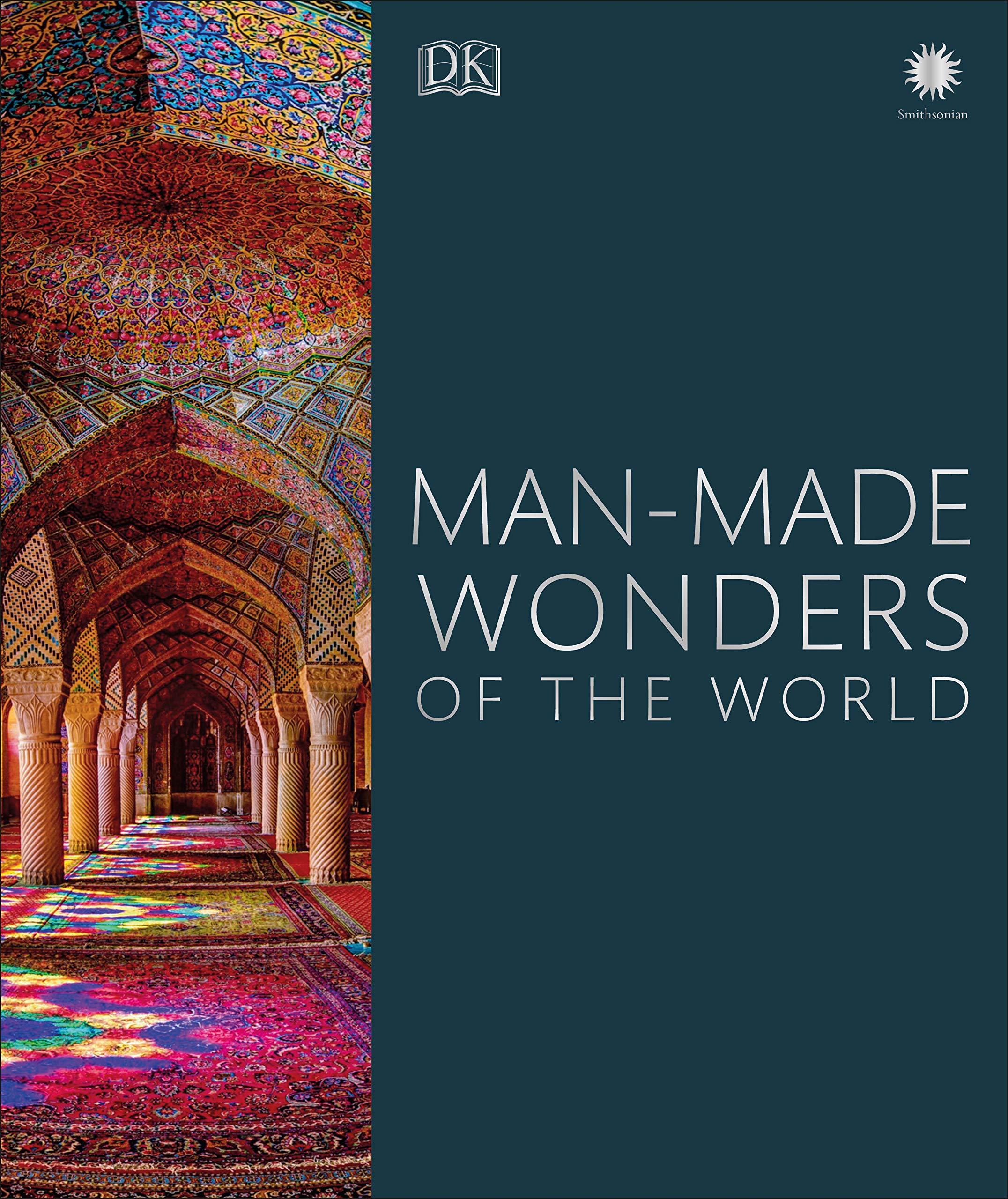
Man-Made Wonders of the World
Discover the most incredible man-made wonders, from Stonehenge to Burj Khalifa, with this unparalleled catalog of the most famous and intriguing buildings and monuments created by humans.
Manmade Wonders of the World features a range of structures from buildings to monuments, statues, and bridges, including the Golden Gate Bridge and Hoover Dam.
It opens with a foreword by Dan Cruickshank and then takes the reader on a continent-by-continent journey, exploring and charting the innovations, ingenuity, and imagination employed by different cultures to create iconic buildings such as the Great Pyramid of Giza. This truly global approach reveals how humans tackled similar challenges, such as keeping the enemy out, in vastly different parts of the world, from the Great Wall of China to the defensive walls of Central American cities. Illustrations explain how the structures were built, while explanations cover the history, architecture, and unique stories behind their construction.
Featuring breathtaking images, Manmade Wonders of the World is a complete celebration of the world humans have built over thousands of years.
Manmade Wonders of the World features a range of structures from buildings to monuments, statues, and bridges, including the Golden Gate Bridge and Hoover Dam.
It opens with a foreword by Dan Cruickshank and then takes the reader on a continent-by-continent journey, exploring and charting the innovations, ingenuity, and imagination employed by different cultures to create iconic buildings such as the Great Pyramid of Giza. This truly global approach reveals how humans tackled similar challenges, such as keeping the enemy out, in vastly different parts of the world, from the Great Wall of China to the defensive walls of Central American cities. Illustrations explain how the structures were built, while explanations cover the history, architecture, and unique stories behind their construction.
Featuring breathtaking images, Manmade Wonders of the World is a complete celebration of the world humans have built over thousands of years.
416 pages, Hardcover
Published October 8, 2019
About the author
D.K. Publishing
10.2k books2,236 followersDorling Kindersley (DK) is a British multinational publishing company specializing in illustrated reference books for adults and children in 62 languages. It is part of Penguin Random House, a consumer publishing company jointly owned by Bertelsmann SE & Co. KGaA and Pearson PLC. Bertelsmann owns 53% of the company and Pearson owns 47%.
Established in 1974, DK publishes a range of titles in genres including travel (including Eyewitness Travel Guides), arts and crafts, business, history, cooking, gaming, gardening, health and fitness, natural history, parenting, science and reference. They also publish books for children, toddlers and babies, covering such topics as history, the human body, animals and activities, as well as licensed properties such as LEGO, Disney and DeLiSo, licensor of the toy Sophie la Girafe. DK has offices in New York, London, Munich, New Delhi, Toronto and Melbourne.
Source: Wikipedia.
Established in 1974, DK publishes a range of titles in genres including travel (including Eyewitness Travel Guides), arts and crafts, business, history, cooking, gaming, gardening, health and fitness, natural history, parenting, science and reference. They also publish books for children, toddlers and babies, covering such topics as history, the human body, animals and activities, as well as licensed properties such as LEGO, Disney and DeLiSo, licensor of the toy Sophie la Girafe. DK has offices in New York, London, Munich, New Delhi, Toronto and Melbourne.
Source: Wikipedia.
Ratings & Reviews
Friends & Following
Create a free account to discover what your friends think of this book!
Community Reviews
Displaying 1 - 19 of 19 reviews

January 13, 2024
I bought this today and found out it’s one of a four-volume series. For my purposes I think this is the only one I want.
I’ve been struggling for a few hours to read but it’s an ebook so the type is tiny with no way to blow it up, and I cannot tell you how badly my entire head hurts right now. I do appreciate all of the sketches and photos. And the captions are wonderfully detailed. I think the author/publishing house wanted to assure as much information as possible is included. I’m not cheating; I’m going in order.
1/21/24: so I see where I made a comment re the typeset. I can find no way on my iBooks app to enlarge the print. This is very difficult to read. There is so much information, little additional facts around the edges that are so tiny I just give up sometimes. I wear progressives which make it worse. I suggest to anyone who wants to read this definitely have your reading glasses on the top of your head. The pics are beautiful, but the typeset is aggravating. I’m wondering if it would be any better with a physical copy.
1/29: well I figured out that I could turn the brightness waaay up and that helped with reading. Which makes sense and I should have thought of that.
What’s weird is I’ve read South America, North America, Central America and a few chapters re the growth of intelligence along with the development and usage of building materials…and I’m only 22% thru I think it’s 22. BUT I STILL HAVE ALL OF EUROPE. there is the entire continent of Africa too. That I’m very curious about. Europe starts page 89 and Asia ends page 314, so that’s the chunk of the book. No peeking though.
2/4 just scratching europes surface now. It’s one of those things when I spend so much time studying the photos and whatnot that when I’m ready to move to my next read I’ve only gone ahead about 5%. I’m glad I own this though. I can pace myself.
2/11 finally! Out of Europe into Africa! I’m thinking that narrowing the choices in Europe was probably fairly difficult. It was certainly the largest section. I’m very curious about Africa’s wonders!
I’ve been struggling for a few hours to read but it’s an ebook so the type is tiny with no way to blow it up, and I cannot tell you how badly my entire head hurts right now. I do appreciate all of the sketches and photos. And the captions are wonderfully detailed. I think the author/publishing house wanted to assure as much information as possible is included. I’m not cheating; I’m going in order.
1/21/24: so I see where I made a comment re the typeset. I can find no way on my iBooks app to enlarge the print. This is very difficult to read. There is so much information, little additional facts around the edges that are so tiny I just give up sometimes. I wear progressives which make it worse. I suggest to anyone who wants to read this definitely have your reading glasses on the top of your head. The pics are beautiful, but the typeset is aggravating. I’m wondering if it would be any better with a physical copy.
1/29: well I figured out that I could turn the brightness waaay up and that helped with reading. Which makes sense and I should have thought of that.
What’s weird is I’ve read South America, North America, Central America and a few chapters re the growth of intelligence along with the development and usage of building materials…and I’m only 22% thru I think it’s 22. BUT I STILL HAVE ALL OF EUROPE. there is the entire continent of Africa too. That I’m very curious about. Europe starts page 89 and Asia ends page 314, so that’s the chunk of the book. No peeking though.
2/4 just scratching europes surface now. It’s one of those things when I spend so much time studying the photos and whatnot that when I’m ready to move to my next read I’ve only gone ahead about 5%. I’m glad I own this though. I can pace myself.
2/11 finally! Out of Europe into Africa! I’m thinking that narrowing the choices in Europe was probably fairly difficult. It was certainly the largest section. I’m very curious about Africa’s wonders!

August 19, 2020
This work, published by DK, is all that you would expect from this excellent publisher, and more!
The "Wonders" that DK and the Smithsonian focused on have been examined for their innovative design and the materials used to create them.
This book is divided into continents. For each Wonder, there is the name of the place, a brief description, a general map of the location, and then a little bit of a history of the place.There is also a color or b&w photograph, and sometimes a schematic design of the building / place.
At the end of the book is a Directory of Other Sites, a WELL ILLUSTRATED Glossary (visually showing design terminology), a detailed Index, and a long list of Acknowledgements (photo credits, etc.).
Well Done!
The "Wonders" that DK and the Smithsonian focused on have been examined for their innovative design and the materials used to create them.
This book is divided into continents. For each Wonder, there is the name of the place, a brief description, a general map of the location, and then a little bit of a history of the place.There is also a color or b&w photograph, and sometimes a schematic design of the building / place.
At the end of the book is a Directory of Other Sites, a WELL ILLUSTRATED Glossary (visually showing design terminology), a detailed Index, and a long list of Acknowledgements (photo credits, etc.).
Well Done!


May 16, 2022
If this book had existed in my house as a kid, I would have spent hours poring over it.
An enthusiastic introduction to some of the most amazing structures in the world, both famous and obscure.
Ah, architecture! 💕
An enthusiastic introduction to some of the most amazing structures in the world, both famous and obscure.
Ah, architecture! 💕

December 4, 2020
You know what? This book rocks. Five stars. The kind of book I would have loved as a kid and still love as an adult.
It was interesting to me that I knew (and have even visited) many of the European and North American sites... had heard of them, at least. Most of the ones elsewhere... well, it was a bit embarrassing how unfamiliar I am with these modern world wonders.
Super fun!
It was interesting to me that I knew (and have even visited) many of the European and North American sites... had heard of them, at least. Most of the ones elsewhere... well, it was a bit embarrassing how unfamiliar I am with these modern world wonders.
Super fun!

February 28, 2024
impossible to read
The kindle version of this book is literally impossible to read. It’s all over the place. Grammar and punctuation don’t really exist. It’s a huge mess of a book. Is really like to read this book in another format though one day. If u want to read this book DONT get the kindle version. It’s literally impossible.
The kindle version of this book is literally impossible to read. It’s all over the place. Grammar and punctuation don’t really exist. It’s a huge mess of a book. Is really like to read this book in another format though one day. If u want to read this book DONT get the kindle version. It’s literally impossible.
November 8, 2019
And now I want to travel the world

December 22, 2020
Beautiful. Sparks further study. Oh, the places I'd love to go.

May 20, 2020
Love this book. It's not an in-depth introduction to architecture though it has a brief introduction to how building techniques have changed through the centuries from earth and timber to brick and stone, and to iron, steel, and beyond. It's organized by geographical area: North America, Central and South America, Europe, Africa, Asia and Australasia and within each grouping is arranged chronologically from prehistoric to 21st century. The main section features well-known buildings and constructions, but even here there are places that are new to me. There are interspersed pages of new methods of construction. All entries in this section rate at least one photograph or drawing, some entries given a 2-page spread, others sharing that space with others. The last entry in this section on pages 312-313 is a library in China, which opened in 2017.
The following section, Directory of Other Sites and Glossary, covers lesser-known places with much shorter entries and most have no photographs at all, usually 2 photos per 2-page spread, but about 7 entries in that space. The 19-page glossary covers many architectural terms with many diagrams
I found it all fascinating, but I had to keep my internet connection handy to look up the items not pictured. Even here I knew some, and didn't know others.
If you like architectures, of whatever style, this book is for you. If you want to know about places to visit when we can travel again, this book is for you, at least as an introduction, especially of places that don't get a lot of publicity or place in the usual architectural histories.
This is a book to dip into or read at leisure. Reading too many pages at once would make things blur into one another.
Highly recommended. This will open up the world but you'll have to look elsewhere for more pictures and more details and history.
The following section, Directory of Other Sites and Glossary, covers lesser-known places with much shorter entries and most have no photographs at all, usually 2 photos per 2-page spread, but about 7 entries in that space. The 19-page glossary covers many architectural terms with many diagrams
I found it all fascinating, but I had to keep my internet connection handy to look up the items not pictured. Even here I knew some, and didn't know others.
If you like architectures, of whatever style, this book is for you. If you want to know about places to visit when we can travel again, this book is for you, at least as an introduction, especially of places that don't get a lot of publicity or place in the usual architectural histories.
This is a book to dip into or read at leisure. Reading too many pages at once would make things blur into one another.
Highly recommended. This will open up the world but you'll have to look elsewhere for more pictures and more details and history.

December 6, 2019
This book covered the many still-existing buildings that have a historically significant design. The book started by briefly discussing the history of using different building materials (mud, brick, wood, steel, etc.). Then the book was divided by geographical location (North America, Europe, etc.). Under each geographical location, the selected buildings were discussed in the order that they were built in history. For each building, there was one or more full-color photographs, a diagram showing significant building features, a map showing the location, and a brief description of where the building was built, its purpose, some history, and the significant design features. It's a beautiful and interesting book to read. It's a good book to interest people in learning more about these buildings and structures. My only complaint is that so little was said about each building. I had been expecting a little more depth about the engineering marvels and fewer buildings rather than a bunch of historically significant buildings but some buildings only receiving 1/2 to 1/3 of the page. Overall, I'd recommend this book to those who are interested in unique buildings and history.
I received a review copy of this book from the publisher through Amazon Vine.
I received a review copy of this book from the publisher through Amazon Vine.

November 16, 2020
Here I am, mid-pandemic, recovering after knee-replacement surgery. I can't go anywhere, but I CAN dream of all the places I'd like to go someday, and this book is a nice tool for that! The photographs are amazing, many of them from angles and elevations a tourist could never reproduce (though my husband and travel-buddy would certainly try!). I enjoyed the text as well, particularly all the information about architectural styles from around the world and throughout time.
Based on this book, the Man-Made Wonders of the World I absolutely MUST see during my lifetime, include Machu Picchu, Angkor Wat, Mont Saint-Michel, Petra, and the Taj Mahal. But what's really fun is to remember the visits I've already made to so many of the sites in this book. I love travel so much, and I miss it!
4 stars.
Based on this book, the Man-Made Wonders of the World I absolutely MUST see during my lifetime, include Machu Picchu, Angkor Wat, Mont Saint-Michel, Petra, and the Taj Mahal. But what's really fun is to remember the visits I've already made to so many of the sites in this book. I love travel so much, and I miss it!
4 stars.

February 1, 2024
This book provides detailed explanations of world heritage sites and historical buildings with powerful photographs. Each photo is powerful and will make you feel as if you are there.
If you purchase a Kindle e-book, you can double the enjoyment by viewing it on a larger screen using your Kindle library in your browser.
If you purchase a Kindle e-book, you can double the enjoyment by viewing it on a larger screen using your Kindle library in your browser.

March 16, 2022
There are wonderful photos of gorgeous and unique buildings and structures from around the world. There are also some brief descriptions of the buildings as well. I enjoyed looking through the book, while I didn’t read every entry I really enjoyed the photos!

November 5, 2019
The evolution of humankind and our capacity for ideas can be appreciated in this book. So many places, so many wonderful creations, absolutely inspiring!

November 22, 2019
Beautiful book perfect for lovers of travel or architecture.

October 22, 2024
5/5 stars
Beautiful book
Beautiful book

September 12, 2022
not for kindle
This book has not been adapted for kindle. Formatting makes it totally unreadable. Picture captions are spread one word per line on as many pages as there are words/lines in a caption. Plans and photos are divided in two and separated by pages of text. Thanks heavens it’s on Unlimited or I’ll be shooting myself.
This book has not been adapted for kindle. Formatting makes it totally unreadable. Picture captions are spread one word per line on as many pages as there are words/lines in a caption. Plans and photos are divided in two and separated by pages of text. Thanks heavens it’s on Unlimited or I’ll be shooting myself.
April 6, 2023
Check the reviews before purchasing
The e version is one worse I have attempted to read . Amazon must have failed to review the format of this book prior to offering it.
The e version is one worse I have attempted to read . Amazon must have failed to review the format of this book prior to offering it.

October 26, 2023
Please Reupload
DK books are usually quite excellent; however, I suspect the digital version of this book needs to be uploaded again, as certain sections have one word or even one letter per line.
DK books are usually quite excellent; however, I suspect the digital version of this book needs to be uploaded again, as certain sections have one word or even one letter per line.
Displaying 1 - 19 of 19 reviews