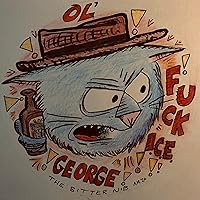
Krazy Kat adores Ignatz Mouse. She sees the bricks he hurls at her head as tokens of love, and each day Ignatz arranges a cunningly different method of delivery for his missile. But when Ignatz and Krazy witness the mega-brick explosion in the desert, Krazy becomes depressed, and refuses to perform. To coax her back to work so they can regain their lost limelight, Ignatz invents his own brand of psychotherapy, orchestrates her kidnapping, and tries to seduce Krazy with promises of stardom from a Hollywood producer. As the mouse confronts the Kat with bewildering new concepts like sex, death, and politics, Ignatz and Krazy begin yearning to become round, for a fullness of body and spirit beyond their two-dimensional realm.
Forming an altogether witty and winning counterpoint to George Herriman’s classic comic strip, Jay Cantor’s kinetic novel has become a classic in its own right, one of those masterpieces that creates its own unforgettable universe.
I swear I can't quite properly criticize this book because I obtained it in junior high, hidden with a stack of actual Krazy Kat comics. I read it obsessively, and it became a sort of pattern over which my adolescence was formed. I only understood about half of the content, but what I could understand was like a drink of water after a long walk. And I found Mr. Cantor attractive in a way far more predatory than society admits young women feel.
Cantor's "Krazy Kat" is still the only book I have ever found that convinces me of fanfiction as an art form. If only it were all this good. The overlay of the atomic tests on Krazy's desert, on the casts' world, created a chord that resonated with my own adolescent rage. If the book reads, at times almost embarrassingly casual and indulgent, it comes from the motif that all our personal facets are valid, not just the most popular ones.
On first read, as a kid, I felt justified in feeling wrong and weird, because the wrong and weird is the right and lovely at the very same time. As an adult having had actual experiences, it reminded me that no matter how perfect my life feels, someone's going to see it as a nuclear disaster - and to stop trying to save people who need nothing more than a brick to the head.
An experimental novel. Cantor takes George Herriman's early 20th century comic strip characters and imagines them after they're no longer appearing in newspapers across the country. They want to go back to "work" and regain their popularity and become "round" instead of two-dimensional. Intriguing ideas that don't pan out as the book deals with psychoanalysis, Hollywood moviemaking and the changes it brings to good ideas, gaining the "rights" back to the characters themselves, and finally devolves into a long, final section that's basically little more than pornography. Disappointing.
I'm an old fan of the comic, so I was certainly willing to give it a look. It was definitely interesting, a fascinating exploration by walking outside the panel walls and seeing what was out there. There were some times where it seemed a little too much for fun, and others where it seemed a little academic, but overall it was an interesting book to contemplate.
I can already tell that I'm going to sink into a bit of a depression when the last page of this book is turned: ornate without being fussy, surreal without lopping over into confusionland...it does make one wonder if some wiseass writer will give Garfield the postmodern touch in(doing the math) 2049.
What an eerie sensation
If the comicstrip cat became "servile" from the time of Krazy Kat's inception to the 80s; in what direction will papercats evolve? Back (but, really, forward) to their status as outside observers of an alien world, or further down the scale: window dressing (no lines, save for perhaps a cute Question Mark over its head as the Title Character tries to decide which Dress to Wear on Tonight's Date); I'd say that Bucky Katt is bridging the two worlds - his head is full of sillreal ideas - but the wallpaper is still always Rob's apartment, the far limits the hallway.
This doesn't feel like my home
No doubt, Bucky sees a different landscape (he's closer to the dust, the mites and the arousing-hackle smell of the ferret) but it is the duty of the artist to let us see their own versions, sidestreets and alleys, of Coconino County.
But will the artist be replaced? Already, our daily chuckle has been replaced by forwarded links to Youtube videos, LOLcat pages. The comicstrip cat of the future - the adventures we follow - will be streamlined, commercially edited (down to 30 seconds) videos of cats doing "funny" things with "funny" commentary by the "author". There will be no illusion, no immersion into another world. No worldbuilding 52 ink-bricks per year. The next step for the comicstrip cat is to become real, a reality show. And while daily video of a cat (streamlined, timestamped and copywritten product only: The Uh-Oh! Alistair Channel, the Klumzy Katz, Scarfield - "Say hello to my lasagna, friend!") falling off a chair with a pop-up "OhNOes!" may become the comicstrip cat we receive next (and keep, until scientists create cats genetically altered to be clownish - raiding my fridge, capturing my sleeping breath in an empty mayonnaise jar and marking it "R.'s Soul" and offering to sell it back to me -, walk upright; situated with a microchip to say - or "say" - wiseass things) it's not the one we really deserve.
This is by far the weirdest book I've read. Weird because its vantage point (its "point of you") is distinctly post-modernist. Chapters are five panels with only loose correlation; the shrink's couch is told through increasingly aggressive epistles; the last panel features anal sex through to moving reflections on the pains of love. Comekissthedoors are conquistadors, while the ettomic bomb is symbol of the post-war world's struggle to reconcile itself to a new age of newclear fizzsticks.
This book isn't for the feint of heart, but persistence, an appreciation for comic books and old-era Hollywood, and an opener-than-open-mind will yield fruitful results!
Awful awful awful. I'm surprised this is still in print. Perhaps not as awful as Moebius' surprisingly vile version of Batman, it really has no resemblance to the world created by George Herriman. Perhaps it would have been interesting if he hadn't used those characters as his protagonists.
A Hot Mess. I'm certainly no alarmist when it comes to sex/racism in literature, but this book has both in spades, no pun intended. It flat out sucked.
I think I have to give up on this one. In the first 60 pages, the author has introduced an overwhelming number of half-threads and quarter-concepts that I can't find the energy to follow. Here are a few: Krazy Kat has "retired" from her comic strip. (I must assume that this retirement coincided with the death of the strip's creator, but this is not explained in the text.) She doesn't like it anymore when Ignatz hits her with a brick. She and Ignatz are at Alamogordo for Oppenheimer's nuke test. She falls in love with Oppenheimer and becomes his pen pal. She feels responsible for the bomb. She has a nervous breakdown. She goes to therapy, with Ignatz as her "doctor." There is also some stuff about how men kill cats because men hate women. And, Krazy and Ignatz want to become "round," i.e. three-dimensional, rather than being flat comic characters. And, and, and...
If the author had stuck with one or two of these ideas, this could have been interesting. As it stands, it's a jumbled, confusing mess. And hey, I'll be the first to say that maybe I'm just too dense to get it. Fans of the Herriman strip might want to give it a whirl.
Krazy Kat was drawn by a black man passing and gets the neurotic treatment by a Jewish novelist who puts the characters on the site of the first atomic bomb treats in Arizona. Ignatz and the rest are trying to get Krazy out of retirement and depression by any means necessary, such as psychoanalysis, militant kidnapping and kinky sex. It reads like an intellectual vaudeville act, with pratfalls, word play and smarty pants cultural relevance. Not a bad combo, but it eventually sent me back to the original strips. You can’t top perfection.
I probably ought to have read this when I first bought it, 30 or so years ago. It might have seemed better to a much younger me. As it is, it stuck me as a fairly amateurish effort by a writer who was still in the stage where the topics of dorm room bull sessions seemed very deep and meaningful. I never did understand the connection between Cantor's obsessions and Herriman's characters. I'd say skip it unless you happen to be a 20-year-old who just got a copy of the collected Krazy Kat strips.
This was a re-read that I didn’t finish. I first read it 30-35 years ago, and hated it, due to the BDSM and all that vulgar bullshit. Some things should be left alone in their special place of genius. I looked at the remaining pages and thought “nah, this ain’t working for me “…..
Starts off strong, but goes off the rails about three quarters of the way through in a miasma of weirdness about sex and gender and rapidly becomes unreadable as Cantor starts to hallucinate about trans identity
A Hot Mess. I'm certainly no alarmist when it comes to sex/racism in literature, but this book has both in spades, no pun intended. It flat out sucked.
This is a book I've wanted to read for a while, being a fan of the comic strip and a fan of books that try to do this kind of thing, to explode things that exist in a weird pop cultural parallel dimension. And this does that pretty well, but it's also strangely of its time (the eighties)-- there's the persistent fascination with nuclear war, for one, that seems, I don't know, not quite quaint but still a little overblown. Ditto for the sections on Freud-- even by the eighties, wasn't that a dead letter? The explicit sex is there, too, taken I think from Kundera but maybe goosed by reading Sukenick or someone like that? It's hard to say.... That isn't to say there's not lots to like here, including some pretty amazing wordplay, some real moving sections about death and dying in the book's final movement, and finally, the portrait and words of the Producer are truly amazing, really funny riveting stuff. So, a mixed bag.
probably the most fascinating and weird and uncomfortable yet intriguing book i've read. it definitely helped to know the background upon which this book was written first. incredibly interesting in how it dives into the deep flaws of ourselves as humans through a controversial and before-its-time story line.
occasionaly, i'll get to thinking about long chain synthetic molecules. this naturally leads to Neil Diamond. and shit, that's funny. and then "Love On the Rocks" worms through my ears into my brain and then i'm doomed.
The first two-thirds of this were brilliant, as Cantor deconstructed the comic strip by creating and destroying new rules, vocabularies, etc.. But he totally lost me during the last chapters. Thankfully, being all pomo, you can totally stop reading before then without any ill effects.
You know that there are too many books in your to-read list on Goodreads if you can't recognize an author / title you've been keen on when browsing the stacks in the local second hand shop.