An extraordinary exploration of old age in words and pictures, by the much-loved author of The Snowman and Ethel & Ernest.
In his customary pose as the grumpiest of grumpy old men, Raymond Briggs contemplates old age and death… and doesn’t like them much. Illustrated with Briggs’s inimitable pencil drawings, Time for Lights Out is a collection of short pieces, some funny, some melancholy, some remembering his wife who died young, others about life with his partner Liz, the joy of grandchildren, of walking the dog… He looks back at his schooldays and his time as an evacuee during the war, and remembers his parents and the house in which he grew up. But some, like this one, are about his home in Sussex:
Looking round this house, What will they say, The future ghosts? There must have been Some barmy old bloke here, Long-haired, artsy-fartsy type, Did pictures for kiddy books Or some such tripe. You should have seen the stuff He stuck up in that attic! Snowman this and snowman that, Tons and tons of tat.
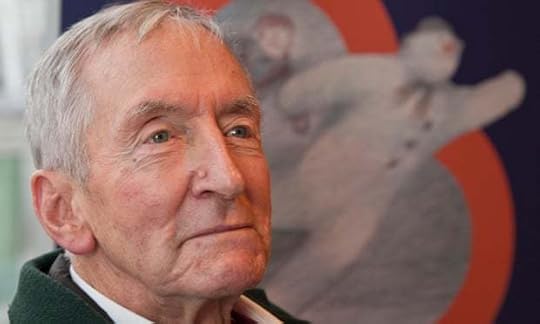
Raymond Redvers Briggs was an English illustrator, cartoonist, graphic novelist, and author who had achieved critical and popular success among adults and children. He was best known for his story "The Snowman", which is shown every Christmas on British television in cartoon form and on the stage as a musical.
His first three major works, Father Christmas, Father Christmas Goes on Holiday (both featuring a curmudgeonly Father Christmas who complains incessantly about the "blooming snow"), and Fungus the Bogeyman, were in the form of comics rather than the typical children's-book format of separate text and illustrations. The Snowman (1978) was entirely wordless, and illustrated with only pencil crayons. The Snowman became Briggs' best-known work when in 1982 it was made into an Oscar nominated animated cartoon, that has been shown every year since on British television.
Briggs continued to work in a similar format, but with more adult content, in Gentleman Jim (1980), a sombre look at the working class trials of Jim and Hilda Bloggs, closely based on his parents. When the Wind Blows (1982) confronted the trusting, optimistic Bloggs couple with the horror of nuclear war, and was praised in the British House of Commons for its timeliness and originality. The topic was inspired after Briggs watched a Panorama documentary on nuclear contingency planning, and the dense format of the page was inspired by a Swiss publisher's miniature version of Father Christmas. This book was turned into a two-handed radio play with Peter Sallis in the male lead role, and subsequently an animated film, featuring John Mills and Peggy Ashcroft. The Tin-Pot Foreign General and the Old Iron Woman (1984) was a scathing denunciation of the Falklands War. However, Briggs continued to produce humour for children, in works such as the Unlucky Wally series and The Bear.
He was recognized as The Children's Author of the Year in 1993 by the British Book Awards. His graphic novel Ethel and Ernest, which portrayed his parents' 41-year marriage, won Best Illustrated Book in the 1999 British Book Awards.
I don't know how to rate this, as a book about death, depression, getting old and dying, which this is, it couldn't have done a better job, so 5 stars for achieving what the author set out to do.
I just didn't enjoy this, it is so negative and depressing, this is hard to read without sobbing or at least feeling really down afterwards.
There are poems, letters, facts and drawings all about death, dying and getting old. Descriptions of Raymond's wife's illness and death, his parents deaths. We even meet a well loved dog character but only as she is at the vets being put down. I can see that this is the aim of this book but I would have loved to have shared a nice memory of his dog or wife but no, literally nothing positive in the whole book. He talks as if he longs for death to relieve him of his horrible life but at the same time he complains of the things he has to do to live longer. Ironically he has lived quite a long life so far.
There was a horrible page joking about himself as an old man lusting after some young girls (aged from 13yrs to 15yrs) on their Duke of Edinburgh award, when they said they were on the Duke of Edinburgh and he says he wishes they were on his. Yuk. Really inappropriate, somebody should have advised him not to include this.
I wish I had kept a different picture in my head of this illustrator.
Raymond Briggs is now in his eighties and apparently contemplating life’s end. He has stated that he expects Time for Lights Out to be his last book – it took him over a decade to create. Given the subject matter it may sound depressing but this is not the case. Although searingly honest about an aging body’s failings and inevitable future, the tone is more reflective than bleak.
Throughout the varied entries the author demonstrates an awareness of his increasing frailty. He writes of eating healthy food and taking regular exercise. He still indulges in the wine he enjoys, trying to temper concerns without becoming obsessive. He lives in rural Sussex where the countryside is teeming with life but also deaths, such as road kill. Briggs visits a local cemetery and notes the prevalence of young people buried in his parents’ time. He reads newspaper obituary pages and feels a sense of achievement when he is older than the recently deceased.
The contents of the book are a mixture of: pencil drawn illustrations, comic strips, poems, photographs, quotes, lists, and short opinion pieces. All are based around the author’s personal memories and experiences. Divided into three sections – Now, Then, Soon – they offer a picture of the life Briggs has lived and his concerns about its end. His wry musings cover day to day activities including: walking his dog, habits when at home, interactions with friends and neighbours. Certain memories are triggered by items kept for decades, often unused but hard to throw away due to their history.
“Old people are always absorbed in something. Usually themselves.”
The ‘Now’ section presents Briggs as a seventy-something year old who surveys himself as an old man and is somewhat annoyed that this is what he has turned into. On walks he finds the hills are harder to climb. His days are marked out by routines he and his partner doggedly adhere to. He observes that he has become less tolerant of other people’s appearance and behaviour. All of this is written with unflinching insight and wry humour. Briggs recognises his foibles and failings. Although poignant in places there is no expectation of sympathy.
‘Then’ looks back at: Briggs’ parents, his own childhood, the death of his wife, visiting grandchildren. Much has changed in the world during each of their lifetimes. The lasting effects of the two world wars are remembered along with more welcome advances – illustrated by conversations Briggs has with the young children. He remembers those who have died but acknowledges also that they are sometimes forgotten – that life goes on for those who remain.
“Death hovers around us every day. Somehow, we close our minds to its closeness, even when it is just outside the window or is staring at us from the television.”
‘Soon’ is wound around a fear the author has about ending up in a care home for the elderly. He ruminates over personal possessions that are dear to him and how these would have to be disposed of. He recalls the deaths of acquaintances and that this must one day happen to him. Yet all of this is contemplated without rancour. I found Briggs’ willingness to confront what is inevitable refreshing. Contemporary society is so often eager to avoid acknowledging the prospect of death.
“He who is not anxious has no imagination”
Briggs’ inimitable illustrations are a mix of finely rendered drawings and more blurred images – appropriate when conveying the speed at which time passes (and perhaps the deterioration of eyesight) when on life’s downhill trajectory. The importance of memory in old age, especially of childhood, is given thoughtful consideration. The structure of the book allows the reader to peruse pages without the necessity of reading in order from cover to cover.
A frank and originally presented memoir depicting what living day to day feels like having exceeded one’s allotted three score and ten years. If this is Briggs’ swansong it is a fitting tribute to his artistic talent and percipient story telling.
The great illustrator Raymond Briggs, who died in 2022, rounded off his career with this unblinking look at ‘age, and then the only end of age’ in Philip Larkin’s famous phrase. Like Larkin, Briggs pulls few punches about what’s in store. That may sound like a bleak prospect, and while Time for Lights Out is undoubtedly clear-eyed about the indignities of old age and approaching death, it is also a celebration of a creative and fulfilled life and a loving family. Jonathan Cape have done Briggs proud with top quality production: thick, creamy paper, generous space, and excellent reproduction of his stark pencil drawings. A fitting conclusion to a long and illustrious career.
Unflinchingly staring old age and death down, Briggs has produced something so far beyond the irascible Father Christmas or the lugubrious Fungus the Bogeyman that, while his work is noticeably in a similar vein, comparison is impossible. It is intriguing to see the artwork from sketch to full picture, and to follow a sort of meandering meditation which can be comic and tragic by turns. There are snippets from poets and other writers - "Today the world changes so quickly that in growing up we take leave not just of youth but of the world we were young in" ""And I looked, and behold a pale horse: and his name that sat on his was Death" - and poems and comments of Briggs own that make this an engrossing read on death and dying, on being forgotten or incapacitated. Overall, this is a hard read but actually none the worse for that. A grim masterpiece.
I always loved Briggs's books as a boy, especially classics like Fungus the Bogeyman and Father Christmas. Now in middle age, I was really looking forward to what seemed to promise some more mature reflections on life and death along with more of Briggs's beautiful drawings.
I was really disappointed on both counts, though.
Firstly, the book is largely made up of bits of writing that are shaped like poems on the page, but don't really rise to the level of poetry - they're just quite flat, humdrum reflections on the more miserable aspects of growing old; complaints broken up into short lines. While a few are mildly amusing, and a couple are certainly moving (such as those on the illness and death of his wife), the bulk of them are pretty uninteresting and bleak.
Secondly, the art is deeply disappointing - it seems as though Briggs and his publishers planned to do a more comprehensively illustrated book, but Briggs gave up on the idea and just decided to send in the roughest graphite scribbles from his sketchbook instead - and they get rougher and more scribbly and harder to decipher as the book goes on. If you're thinking of buying this because you're hoping for the kind of lovingly shaded pencil work found in Briggs's classic books, be warned that other than a handful of more finished drawings in the early pages, the rest look like doodles done by a drunk person while they were on the phone. Quite often you can't read the speech bubbles either. And towards the end, the scribbles cease altogether, just leaving you reading blocks of dull text.
Finally, I had always assumed Briggs was a gentle, kindly, innocent old gentleman - so I was unsettled to find him depicting himself ogling a bunch of teenage backpackers on a Duke of Edinburgh scheme trekking through his village, and making a lewd joke ('They're on the Duke of Edinburgh's? Lucky him. I wish they were on mine.'). If he really felt the need to share that dirty-old-man thought, why was he allowed to publish such crap in this day and age, when the tides are finally turning against the normalisation of sexual objectification in our culture - especially when Briggs is primarily a children's author?
A brutal reviewer once said that reading Martin Amis's notoriously self-indulgent novel Yellow Dog was 'like catching your favourite uncle masturbating in a school playground.' In this book, you will actually find Briggs depicting himself doing something not a million miles away from that, and doing so as if it's simply just a bit of fun.
So I'm sad to say this book is quite disappointing, depressing and disgusting, and I wouldn't recommend it.
This is a beautiful book but you have to be in a particular kind of mood to read it. It is a collection of Briggs's musings and drawings about age and death. At 86 years old, he has an awful lot to look back on but not much is clear ahead aside from the inevitable fate.
Fortunately though he has enjoyed a rich life, which shows vividly in this book. He has loved and lost (his mother, father and wife in a two-year span) and of course has had an illustrious career in illustration. Then again he keeps any ego in check with the amusing Prodnose, a rather snooty personification of the critical voice so many of us have in the back of our heads.
The drawing varies from hasty sketches to beautiful drawings with purposeful shading and depth. I believe this is representative of how Briggs felt throughout composing this book, moving from unsettled to focused philosophy. He also shows off his poetic side in Time For Lights Out with some witty and plain-speaking free verse. Rhymes do sometimes occur and normally for a good reason.
It is a poignant work that deserves its place among the best of bittersweet later-life graphic memoir alongside Maus by Art Spiegelman and Our Cancer Year by Harvey Pekar. I recommend Time for Lights Out for fans of Briggs's books for adults and who don't mind macabre meditations on mortality.
Notable Poems
• Playroom Picture – a lovely anecdotal poem about a grandchild’s description of colour.
• Morning Tea – a darkly-amusing verse about being found to be laid up in bed.
• Life Time Idioms – a clever rhythmic poem utilising common expressions of ‘time’.
"So perhaps you should not feel guilty. You have to go on, even if it means forgetting, and feeling guilty when you remember."
Briggs may be forgetting how to draw because his backgrounds are devoid of that great filth that renders a room really real. And his handwriting doesn't press hard enough sometimes so there's a bunch of stuff typed in. Also, he seems to have taken to just photocopying a few ideas and illuminating them with his own fading persona, such as his hand holding a bewildering TV remote with "a flap on our first remote control accidentally opened and 21 more --buttons-- were revealed, 129 buttons in all." All this deft self-awareness of his aging self is populated by a sort of commonplace book of quotes spanning thousands of years, compiled by an artist who spend the post war era explaining to people of all ages what despair looks like. As Ionesco puts it, and Briggs chooses to include it:
"We haven't the time to take our time."
Briggs has given us some of his and the least we could do is read it. He's all set with the criticism, too, because ol' Prodnose is here to spell it out for him, within him, and my god is it funny and beautiful and just LIFE.
We should all take the time to contemplate life and death as Raymond does in this book. It makes life that bit sweeter, more colourful and vibrant. The artwork is incredible as always.
A poignant read, given new significance after the recent death of the author who brought us classics like The Snowman, Father Christmas and When The Wind Blows. Hopefully this reflection on life and death by an elderly Briggs will now get the attention and number of reviews it deserves.
I have been thinking about how to begin this review and I have failed, several times, because I'm not quite sure what to say about this. So perhaps we shall begin there and tell you about my doubts and we shall see if we can find a way out of that somewhere. I think the first thing to note is that I would not call this a graphic novel. I'm not sure what I would call it but I know I wouldn't call it that. Perhaps an illustrated poetry collection? But then, not all of it is poetry. It's more of a scrapbook, a kind of dialogue between Briggs and the world (and his kind of alter-ego, a provocative and questioning character called 'Prodnose') but even then, even this doesn't really come to capture this strange and challenging book which is all of these things and yet somehow none of them.
I think, perhaps, Time For Lights Out is this: the story of somebody who has spent their career writing about humans (and humanity) now trying to figure out how reckon with their own human-ness functions in the middle of this. Writing is personal. It is always, really, about people and who they are and why they do what they do and if your work, if your life-work is about people, if you have spent years seeing then it is inevitable at some point, you must figure out what you see when you turn your lens upon yourself.
So then, this is about people, let us lock that in, and although nominally this is about age and older people, at its heart, I think, this is an exploration of the great unknown. Because there are parts of life that we cannot write about, cannot capture, because we will simply not be there to capture them or to write back and tell others about how it went. Death then and dying, in this book, becomes something ever-distant, able to be understood and rationalised only by looking at the space around it for the thing itself remains unknowable, unintelligible.
But maybe then, that's how we understand that last great unknown, we understand the space around it, the looks towards it, the counter-balances and pre-echoes of it (pre-echoes? such a thing? yes, we shall have it) that occur throughout our life. Our embrace of mortality. Our recognition of this. For Briggs, mortality comes in the domestic, in the heirlooms he has inherited from his parents and in the quiet shift of life around him. The routine of going to bed. The dog walk. The fox laid dead on the road. The grave with cyclamens on it in the churchyard. The small and acute detail of it, the known.
This isn't a happy book but occasionally it is raw with love and joy. It's contradictory, and it's occasionally distasteful (there is one moment in particular that sat rather uncomfortably with me), but I do think it's an honest, uncompromising thing. Some of the artwork is incredible and so brilliantly done and yet others are light, unfinished things, and while I did not like this kind of ... impenetrability? unknowability? ... to the latter. Briggs has spoken about this in an interview (most particularly here in this Guardian piece ) and described it as a "work in progress". (but then, in a way, aren't we all, who am I to ask for this to be finished when the raw, ragged edge might be precisely what it needed to be).
If this is the final breath of a remarkable career then it is a powerful, poignant, thing. It is also an occasionally frustrating thing, a deeply irrascible thing, a fiercely independent thing, and as much as it wants to be read, it is deeply annoyed by that. A paradox, then, a grumpy one, an incredible one.
This was Raymond Briggs’ last book – echoes of Edward Thomas’ poem ‘Lights Out’ in its title? – about approaching old age and ‘Time’s winged chariot’, about loss, about – as Alan Bennett has put it – ‘Keeping On Keeping On.’ For an older (73) reader such as myself, it may be either recognizably but companionably true, or horribly near-the-knuckle and therefore unreadable. For me it was the former.
Having said which, I did find myself putting the book down quite a bit because of Briggs’ format and style. Early on, Briggs adopts a characteristic illustrated text – and all the illustrations catch his muted tone in a suitable black and white – and he only sometimes uses his usual cartoon strip style. As the narrative proceeds this technique is often dropped for several pages and we are left with an increasingly quasi-poetic text, a series of pensées – though that sounds rather precious – often in short lines and sometimes in stanzas. At its most impressive, there’s a moment towards the end when the narrator has moved into a home when the presentation of a dialogue between himself and the care worker who is exercising a practised exuberant good-humour is arranged in untabulated columns and it’s hard to see which little passage leads onto the next, perhaps reflecting the narrator’s disorientation in his new surroundings, knowing that time for the final lights out can’t be too far off. This uncomfortable mental confusion is ended by the last page of the main story: it reverts to the cartoon strip as the narrator goes into his new room for a lie down, as if Briggs has restored a little order to the situation, accepting that ‘This is it’.
The effect of the whole is intense, and I needed to take breaks from it. In some ways it was like reading a long poem, but this is not an obscure poem, just one from which you need to rest, to absorb, to restore your emotional balance, and set to again – like ‘Fungus the Bogeyman’, you ‘Just keep pegging away’, possibly “In Silence and in Gloom”, but also reassuring yourself that “Love is still the Eternal Calm of strife”, and finding comfort in Briggs’ understanding of getting older.
Some of his own way of dealing with ageing is reflected in an amusing couple of pages headed ‘Phrases, Allusion & Proverbs – Amended for the Elderly’. For example: ‘AND DEATH SHALL HAVE NO DOMINION. I wouldn’t bet on it.’ Or ‘IN THE COUNTRY OF THE BLIND, THE ONE-EYED MAN can’t find his glasses.’ Or ‘IF AT FIRST YOU DON’T SUCCEED, throw the packet away.’
Besides such moments of droll black humour, there are more straightforward moments in which he is deeply conscious of both the process of departing and of the departed. All this is couched in an epic format with three sections that mirror, for example, ‘The Odyssey’, titled NOW, THEN and SOON. NOW deals with, presumably, the years when he was writing the book, THEN is a tribute to his parents, a recollection of growing up and a review of his life, his work, his relationships, his friends, and SOON is his imagining a future when he is no longer able to manage on his own, has to life-launder, leave his house and go into a care home.
There are all sorts of ways in which this is an uncomfortable book - Briggs' 'last words'. Not neat or tidy but authentic, bleak and provocative. In some ways it feels like a fade, especially the drawings, but the feelings he expresses are too strong for that. I have loved his work since Mother Goose Treasury days (my mother with an eye to excellent quality children's books) and I know he's not really 'cosy', and I like that... but this was tough going at times. Was he very depressed, was he expressing his life long personality and preoccupations? I felt I didn't want to be sucked into agreeing with him, and he saw himself as old and close to death long before it happened, two, nearly three years after the book was published (and still rather raw for his fans) All this makes some revelations of his continuing appreciation of pulchritude the more jarring - much to reflect on there (lines crossed) but also worth the reader reminding herself that he has always gone out of his way to try to avoid canonisation and cuddliness, desperate to tell us he's not nice.
But there's much to console here. The section on his wife Jean is heartbreaking, especially with the photos, her short physical illness bringing to an end a still young life dominated by schizophrenia, but his love for her is expressed in so many different ways, even in the matter of fact tone in which he reflects on not having children. This makes his references to his enjoyment of 'the grandchildren' later, via his partner Liz, all the richer.
If you ever needed proof that Briggs was his own model for Father Christmas, it is here. He presents a warts and all picture of an aging man, grumbling about the modern world, its technology and its pace. He is constantly reminded of his age and his increasing inability to do things that used to be so easy. At the same time, he allows himself to look back on his parents, his growing up and his wife, but there is always the sense of loss and an honesty about his feelings.
There are drawings, but they are often drafts and are outnumbered by the pages of text, laid out as poems.
Briggs is aware of his grumpy old man stance and skewers himself through the occasional appearance of ‘Prodnose’, who some might remember from Beachcomber columns.
There is an honesty about the vulnerabilities and losses of aging and the ever-present sense of walking with death. There is a little of the joys, such as the brief appearance of his partner’s grandchildren. I think that more could have been made of this as the gloom does threaten to overwhelm. Some of the joy and love shared between him and his, sadly now late, partner could have sat alongside the death of his wife some decades ago. There are gains as well as losses.
I am glad I have bought this and will return to it again.
This book is really difficult to write about. As Briggs is in his 70s he knows he's nearing the end of his life. This then is his thoughts on life and mortality. He discusses his current life, the walks with the dog, the visits from the grandkids, the pills and the side effects. Mixed in among that are memories of his life, growing up in London during the war, the death of his wife, his parents. It's all done in a variety of sketches, text snippets and poetry. The art varies from rough pencils to finished pencils, to full inks, mainly in shades of grey. It all adds to the sombre feel. Some of it feels like he just wants to get it on paper while he still can. Mortality, especially your own, is never going to be an easy topic, this was always going to be a dark book, I'm just a little sad at how depressing and self indulgent some of it is. Yet despite that, it still has its moments that are incredibly touching. He's still a master of his art. If this is his last book, and it looks like it is, I'm not sure this is how I want to remember him.
An accumulation of slice-of-life vignettes in prose, prose-like poetry, and image. Like Ethel and Ernest, it captures everyday human reality with honesty and affection. As a rumination on death, it isn’t especially profound — little glimpses of agnosticism and heavy leanings toward materialism (or at least lack of belief in an afterlife or higher power) punctuate the book — but it is profound in its humanity and honesty. Morbid humor pervades, so this is not for everyone. Recommended for anyone who deals with aging through black humor and doesn’t avoid talking about the inevitable (and has the patience for a book that would never be described as a page turner).
This is very different to all Raymond Briggs's other work, of course. He's usually drawing cartoons for philosophically-minded children and childish-minded adults, but here he's reflecting on his old age. Death is never far away, either his own or those of friends, neighbours and family. Sounds depressing, and I guess it could be if you want it to be, but his voice is very like the voice he writes his usual books in, and he's observing life and death, rather than complaining about it.
This s a very depressing book. Well, the subject is not the most cheerful one, but many of us have happy moments even after 70! However, it is not only all the gloom that made me disappointed in the book. The drawings are all in black and white and some are very sketchy. There are also a number of poems, some of which would have been better left in the drawer. However, there are also several gems, which I’ll try to remember!
Raymond Briggs is a living legend. His poignant artistic scrapbook (in the absolute best sense of the word) of wry thoughts, poems, sketches & quotations from a world-weary yet painfully astute pen, is absolutely worth reading again and again. Buried treasure, time passing, sad and realistically cynical.
Ruminations on aging and death in the form of small prose pieces and poetry, accompanied by Briggs' penciled illustrations. Bits of humor here and there, but much of it is contemplative and often sad. I would have loved for more of the art to have his trademark style, but many of the drawings are understandably sketchy and loosely 'finished'.
After the passing of Raymond I thought I'd read his last work. It's a piece completed in two attempts. It's an eccentric and excellent book with great drawings, the emphasis being the end of life and old age, the musings and mind of Raymonds last few years.. Thank you Raymond for your contribution to life 🙏.
This is such a beautiful piece of work - I don't want to get too flowery about it but you really do sway with the isolation, the cynicism, and the touching and emotional sections of this book. Have tissues on standby.
Mr Briggs is 71 (well, he was when he created this) ... I am not, so perhaps that's why I found it a bit grim in places. But quite melancholic too, and very touching, especially concerning his parents and late wife.
A contemplation on facing mortality that isn't a sweeping epic, and all the more poignant for it. The art work is blurred and smudged like the world around Raymond is fading, or the lights are going out. Fantastic
A truly beautiful and moving book. Very sad in places especially when writing about his wife’s death. This book does make you think about your own existence during and after reading.
This very somber look at life, particularly old age and death was well worth the read. Briggs is a unique talent, and he has certainly cemented himself as a writer and artist.