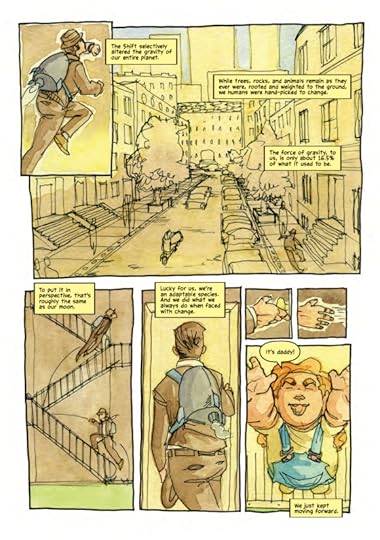
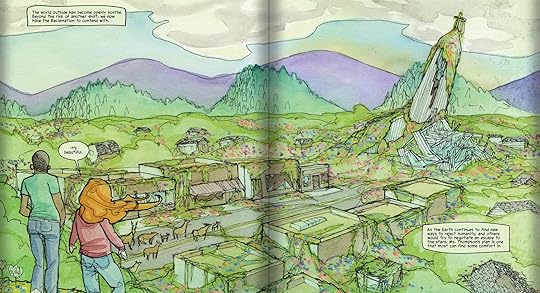
Against the wondrous backdrop of massive planetary transformation, this stunning watercolor graphic novel explores one family's struggle to stay grounded.
The world is changing. Gravity, a force everyone takes for granted, has begun to disappear. As a young journalist, Noah spends his days documenting the wondrous and terrifying shifts in the world around him.
But Noah's life is changing, too. Falling in love and raising a rebellious daughter adds new meaning to life in this mysterious floating world. As he covers the invention of new sports, interviews experts, and even journeys into space, each experience shapes how Noah views the world and, in turn, his relationship with his family.
And as his daughter grows older, Noah faces the challenge every parent dreads and dreams letting go.
A Radical Shift of Gravity is a science-fiction a graphic novel that explores the ties that bind a family together, the forces that threaten to pull them apart, and the quiet beauty of a world where everyone is floating away.
Nick Tapalansky writes some comics you should totally read, including A Radical Shift of Gravity, Awakening, and Cast No Shadow, a fall 2017 Junior Library Guild selection. His work has also been included in the award-winning Popgun and Mouse Guard: Legends of the Guard anthologies. He currently lives in New York with his wife and daughter. http://nicktapalansky.com
Interesting premise. Earth's gravity is shifting. Almost like an earthquake it will lessen with people eventually floating to their doom if unanchored.
Unfortunately, it suffers from poor execution. The story shifts back and forth through about 8 different times. The only indication of time shifts is how the main characters hair is cut. That's a problem with the often rudimentary art. It looks like the artist is learning on the job. The first half of this book looks like sketches and thumbnails. Eventually the coloring gets better to hide some of the shortcomings of the penned artwork. The book could have also used an editor. The first half of this book is soliloquy after soliloquy without furthering the story. The story stagnated enough that I considered setting the book aside several times.
Received a review copy from Top Shelf and NetGalley. All thoughts are my own and in no way influenced by the aforementioned.
This book has gorgeous art, a really interesting premise, a fun non-linear plot, but I just have no clue what the point of it was. It's opaque whether this is a story about how we come to terms with loss or how humanity strives to defeat every challenge or how the earth will reject and forget us.
**Thanks to the artist, publisher, and NetGalley for a free copy in exchange for an honest review.
This is a very quaint and impressive work of storytelling. It's slow paced, features lots of nonlinear jumps and arcs, but at it's heart there's lots of heart. A massive planetary transformation brings panic and strife, global-scale catastrophe, and opportunity for the opportunists. While everyone is losing their head, one man struggles to keep his family grounded despite all indications against this. It's very touching and thought-provoking. Generally, a wholesome experience.
Most of the fiction's post-apocalyptic scenarios are pretty hard to swallow, when you really think about them, won't stand up to reality if we know enough of it. What if the dead suddenly came back to life? What if there was a super-plague? A bigass meteorite that our satellites can't pick up in time, a supervolcano just out of nowhere, or climate change cranking up to Day After Tomorrow tiers? Aliens or killer robots? What if a couple world superpowers suddenly got some bloodthirsty maniacal warmongers in charge that decided to start a nuclear war for no reason? They all range from unlikely to inconceivable. Thankfully.
But you don't need something to be impossible to get a story out of it. All you need to do is to engage us with it - suspend our disbelief, get us to, for a moment, believe that it could happen.
And this may be just me talking, but taking a fundamental law of physics, and pretty much just turning it off, for seemingly no reason, is a pretty tall order for me. I just couldn't believe it. So the comic had an uphill battle for my engagement from the start.
It does its best to show a world that's more or less realistically adapted to the changes. It goes on about science and philosophy, about whom to believe and what is the best thing for the future of mankind. It goes through the motions, but - be it because of the premise or for other reasons - never quite manages to grab me.
'A Radical Shift of Gravity' by Nick Tapalansky with art by Kate Glasheen is about a planet changing even and how one man reacts.
Gravity starts to disappear and people try to adapt. Noah is in love and raising a daughter, but he's also reporting on the strange events. New sports crop up or adapt to less gravity as people react with a kind of delight. Gravity continues to change though and that has Noah and others concerned. Noah and his now older daughter find themselves at odds about the future.
I really liked this SF tale that oddly mirrors the times I find myself living in. I liked how the story jumped through time, and even though the story affected everyone, the scope stays personal. I found it moving and I'm glad I was able to read it.
I received a review copy of this graphic novel from IDW Publishing and NetGalley in exchange for an honest review. Thank you for allowing me to review this graphic novel.
The writer is a colleague, so in keeping with my usual policy re things written by people I know, I'll withhold a star rating and any significant review. I did enjoy the book. And I lack sufficient broad exposure to comics to know how it stacks up next to other things in the genre. There's a good chance I'll ask a comic buff buddy to give it a look and tell me what he thinks.
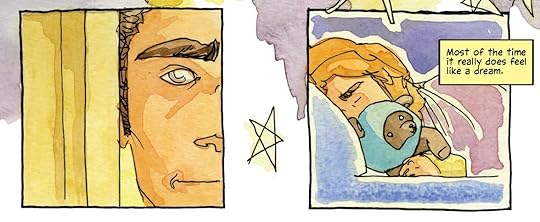
The illustrating is beautiful. The watercolor and pen drawing gives the story a more dream-like quality that works well as the main character floats between memory and the present. Very original story idea. The loss of gravity and what it means to humans living on the planet. The dialogue is good and reads naturally. It was something different.
This would be a good companion piece to Skyward - this tackles a similar idea (gravity is unreliable), albeit with a much more grounded and philosophical approach, sometimes bordering on the Fountain in terms of themes and topics (and trees). It's very timely to be reading now, as it focuses on how the world deals with a change that means nothing can be the same again, as some people try to find a new path and others try to force the old ways to work again, and our protagonist, Noah, navigates the different groups across multiple timelines as he writes articles that shape the perspectives of the world. Tapalansky does an interesting job building the rules of his world, especially in the ways that the rules aren't necessarily known in his world - everyone knows what happened, but no answer to the why. Noah's life intersects intelligently with the different factions, and his character is affected by the shifts that make his character arc very sympathetic, even if some of the pivotal moments are telegraphed early on. I wasn't thrilled by the artwork - the environments were usually impressive but the people felt a little slapdash. The color work is a bit heavy-handed, but it serves the purpose in guiding readers through the time of the story, and tells a story all its own too. Ultimately, this was a very effective story, highlighting how people change and try to adapt to a new normal, even when what is new is not normal. Noah and his relationship with his daughter serve as a strong anchor in this strange world, and there's a tree in New York I think I need to see now...
This wasn't for me. I felt that a lot of thought went into the story telling but some of this was lost in the way the story was told. I think the flipping back and forth between the past and the present could have been made clearer and easier to follow. I lost the story threads far too easily and then I had to guess why a main character had disappeared.
Of course the story could have been presented this way so that we would appreciate the loss of gravity which is central to the story. I think it was simply not for me but if you like sci-fi you may find this intriguing.
Copy provided via Netgalley in exchange for an unbiased review.
The book is fairly touching by the end. I was tearing up a bit. Illustrations were loose but served the book really well. I really loved the concept behind the book. I thought it was clever and had a surprising amount of emotional weight behind it. Only thing I wasn't a fan of was the captions. Call me a hater but I don't love captions in a comic. I find them hard to follow most of the time as my brain has to constantly switch between who's speaking, at what point, about what topic. It's tough for my pea brain!
The art in this one is gorgeous and full of emotion, and the story does grow in impact. By the end, I did care and was invested in the characters and the outcome. But the multiple timelines switching back and forth were confusing, and while I can see what the author was attempting to do with color to distinguish them, I didn't find them easy to separate.
I found this book exceptionally difficult to like. The art is fantastic but the way the story cuts back and forth (yes I get it, I know why, it’s still poorly executed) the story just... lost my interest early in and even as things come together they never really come together enough.
just what i needed, an eco melt down themed dystopian sci fi drama based around family dynamics. lots of feels. strange low key action. gorgeous and drool worthy artwork concepts. i havent read a disaster story quite like this one, both in plot, pace and presentation.
I loved this — the drawings were light and sketchy, but with a solid sense of place and character. I would compare this to the movie “Interstellar,” with its emotional weight and sense of gravitational time.
The first time I reviewed a comic where the Earth's gravity had been greatly reduced, allowing us to float around our neighbourhoods – or also endlessly out to the edge of the atmosphere – seems to have floated off into the ether. But luckily here's a second one, albeit more cerebral, literary and convoluted than the first. Hand-inked and then watercoloured for the, er, colours, this comes to us with a distinctive style, or should that be two, for the different threads we're continuously, annoyingly, jumping between.
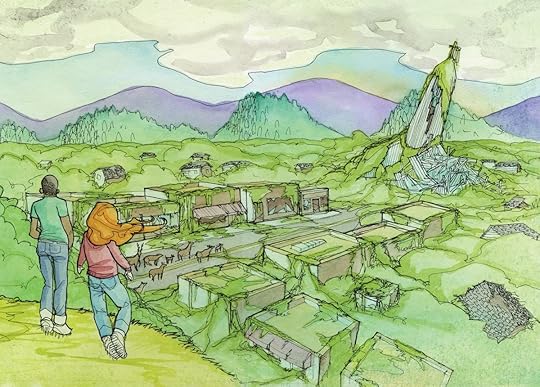
We're concentrating on two time zones for the same small family group, which we first see consisting of a young wannabe journalist, his wife and their young daughter. He's trying to establish himself as a writer about the whole gravity-lite existence we have these days; but when he's older, and somewhat crotchety, and his daughter is a crabby teenager, he's checking out a base where everyone is lumpenly sticking to terra firma, and making every effort to not float anywhere. The first has one colour scheme for the visuals and the voice-over, the other another, the first is city-based, the second much more post-Apocalyptic, and we can handle all that, but when it comes to them interrupting each other – midword on at least one occasion – that's when it gets a bit too annoying.
However the book, certainly as one to be read in 2020, is well worth continuing with. It actually rings really topical, as it asks how we as a species are adapted for change. When a big gravity shift/virus hits our way of life and thinking, and it's one that could be interpreting as Earth rejecting us and Gaea going for a bit of cleansing self-help, can we adapt and find a new normal, or will we splinter off madly? And what's the right way of response as a species, living with it, trying to change it back, or accepting the wackamamie agendas disguised as business plans of the Elon Musks of the world?
Ultimately I don't think this is a complete success, but it's certainly worth a look. It actually took me quite some time to twig the connection between the two narratives, so I couldn't say if I did it early or way too late, and if the delay in that is intended or not. And a lot of the final third is an issue-based monologue, with little attempt at trying to match the drama of the whole scenario. That issue is, as I say, prescient, for the script actually calls "the new normal" exactly that, and the book does show how one person – not just one species – can be forced to face change, just by meeting a partner for instance. That human side of things is probably going to be the draw, matching the high concept that isn't perfectly run with. Three and a half stars.
A change in gravity seems to make a lot of changes, especially in how people look at the world. I have always been a little skeptical of nonlinear storytelling especially if it's directly brought up like it's trying to cover up mistakes. But maybe that's what made this so good. Released in a time with Flat Earth Theories still a subject in discussion, this series goes into how sudden changes can change people's world view. Following a reporter (Noah) whose greatest memories are what he holds onto so closely, the reader sees the dynamic shifts between parts of his life. Nobody fully understands what the effects of gravity have on a person, especially when the rules about it seem to change when applied to people. But it's this lack of full understanding of things and the faults that come from it that drive wedges between people. When things seem untrustworthy, people want to reject every part of it. While no one side can be perfect, it's a lack of trust and confirmation bias that leads to people trying desperately to hold onto whatever semblance of a normal life they can. But how much of this is control and how much is just delusions? Furthermore, how long can people hold onto their delusions?
Which brings up an important question: What's the difference between biased truth and subjective facts? If you don't know what goes onto a subject, what happens when all you have left are your projections? Sometimes it's better to just take it easy and roll with the punches.
A Radical Shift of Gravity- I was taken back by how much this book speaks to our current Covid crisis. A worldwide scientific event occurs that completely restructures the way society operates and people attempt to cope in alarming and conflicting ways.
It was like reading A guidebook on how to operate with our new normal. At its heart it is this parental story of how one can raise a child in a world of chaos and give them a life still filled with joy. I found the way it presents these ideas profound and rightfully complicated. Answers are messy
The idea of Earth losing gravity may link back to a book like Skyward but this is much more cerebral in its approach. Still very emotionally resonant despite the heftier material. I did have some technical issues with it.
The art is non descriptive which made multiple timelines a bit hard to follow. You had to play close attention to realize the time and place. Some of the lettering made some poor choices like purple dialog boxes laid atop of purple foreground but overall a very solid read that hits very close to home.
Imagine the possibility of gravity continuing to change, until we are ejected from this planet.
"Like the rest of us, Ms. Spedmore faces an uncertain future. One in which what we take for granted today might be, for better or worse, unrecognizable tomorrow."
The world may end... but our love and memories will continue to live...
Blurb:
The world is changing. Gravity, a force everyone takes for granted, has begun to disappear. As a young journalist, Noah spends his days documenting the wondrous and terrifying shifts in the world around him.
A Radical Shift of Gravity is a science-fiction fable: a graphic novel that explores the ties that bind a family together, the forces that threaten to pull them apart, and the quiet beauty of a world where everyone is floating away.
This is a fantastic parable about how a global catastrophe is felt on the most personal of levels. Across the world, the force of gravity begins to work less on humans and humans alone, and what at first seems like a gift is a warning sign of a coming apocalypse. Or is it? As we follow the journey of a writer who struggles to raise his daughter alone after the first loss of gravity killed his wife, we see that the competing theories on how to save humanity - bore into the earth and "reset" gravity or simply pack up in starships and leave - may very well destroy his relationship with his daughter, and his very reason for surviving at all. The story is told with economy and focus, and the art throughout - which reminds one of 1970s loose pencils beneath watercolor - is a visual treat from the first to last page. A Radical Shift of Gravity might not be for everyone. But for those who can appreciate its qualities, it will be a compelling read, for sure.
Great concept -- how would the world, and the people in it, respond if Earth's gravity suddenly weakened, but only for humans? What if the Earth is slowly rejecting people, and our time is limited? It's told from the point of view of a journalist, focused on his wife and daughter and his combative relationship with the wealthy head of a corporation who may or may not be working to save humanity. It's a good story, and the ending is strong, but the book is weakened somewhat by its structure. The story spans decades, and switches back and forth between different moments in time in a way that can be hard to follow. It makes it difficult to go with the flow and dive into the story. While it's an interesting way to show the changes in the characters, unfortunately I found it distracting and sometimes disconcerting.
an enjoyable take on what happens when we lose something we perceived to be fact, something that kept us grounded.
it took a moment to pick up on the shift in timeline, however early on in the book it does imply the shift of gravity is adjacent to a loss of functioning time- stating how its as though Noah can travel through it in the end. Each time "arc" is depicted by a different color of speech bubble makung it relatively easy to follow. Yellow is the youngest, followed by the clean blue, then the pale pink, then green, then purple, then the ragged blue as the oldest.
almost poetic in nature, it takes on coping with the world as we thought we knew it, and how those who never experienced life before this event would interpret what is seen as a constant reminder of what- and who- once was.
This entire review has been hidden because of spoilers.
This is a quiet family tale told in a future in peril. I thought that the characters were really well established and the father/daughter dynamic was really well done and realistic as well. I felt like I immediately cared about this family and could understand both sides in the argument, which is difficult to do. The story was very grounded and small considering the scope of the setting, which set it apart from other similar premises I've seen. The art was lovely and so unique in it's watercolor nature.
Okay story of near future where gravity begins to fail and nobody knows why or what to do about it. At first it’s just an odd change but as it worsens tragedies ensue. It’s told through the lens of a reporter, his daughter & wife and some movers and shakers they interact with. One faction thinks an escape to space stations is the best that can happen; another thinks the earth’s core needs a jump start. Mostly, though, this is the story of the reporter and his struggle to make sense of any of it. As such, he’s not very compelling and thus my “just okay “ reaction.
Picture this: You've stopped to pick-up coffee on your way to work when suddenly you, and everyone around you, begin to float. In this world created by Nick Taplansky and beautifully illustrated by Kate Glasheen, we follow Noah, a journalist and father, who grapples with the ways gravity shifts have forever altered his life and humanity as a whole. Figuring out how to live a good life during times of vast uncertainty is something we all face, and this book portrays this in an effective and moving way.
It took some effort to figure out the structure of the story, but I soon realized the color shifts indicated a time shift, each focusing on one era of the main character’s life. The story raised interesting questions about trust and hope when people are faced with a catastrophe. The themes resonate especially with the state of the world today. When everything looks bleak, who do you trust, how do you maintain hope, and how hard do you fight to adjust to the new normal?
Thank you to Netgalley for the opportunity to read and review this book. I do not get to look at many graphic novels. I am just not comfortable with the genre. It seems to me that combining visual art with wordsmithing is very difficult tyo do properly. This novel is very much a good concept but, as with other graphic novels, too much is done in too little space. The result is that I found the story hard to follow. What the author and artist were trying to express did not make it to my eyes.
3.5 knocked down to 3 because it wasn't *that* good. Intriguing idea, where gravity is becoming variable on Earth, but... only for humans! Somehow, Earth wants to get rid of humans, and that's the best way, just let them float off into space. I found the jumping back and forth between like, 4 or 5 different timelines to be a bit confusing, especially at first, and it was unclear why the main character become *so* opposed to the CEO who wanted to build space stations.
Seriously, how good is this book? Not only is this mind- and time-bending story told with deftness and illustrated with virtuosity, it's filled with heart and warmth. And its timeliness and prescience--a tired Earth literally ejects much of its human populace by virtue of mega-event gravity swells/shifts--captures global catastrophes in powerful ways. Kudos to Nick Tapalansky and Kate Glasheen.
Yeah, I really didn't like this one and I generally love graphic novels. The plot was all over the place and the random time jumps felt disorienting and left me unable to connect to the characters or comprehend the story. Maybe I will reread this later and think differently, but for now, I really didn't like it.
Lovely dreamy art to go with a story that drifts around in confusing musings on memory, truth, family, and gravity. Characters changing their minds with not at all convincing arguments and plans with little to no sense. But I admire the overall idea and it is so very close to being coherent but ends up mostly frustrating.