

What do you think?
Fordham Series in Medieval Studies
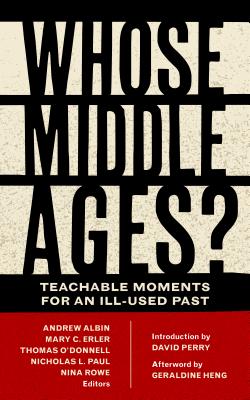
Whose Middle Ages?: Teachable Moments for an Ill-Used Past
Whose Middle Ages? is an interdisciplinary collection of short, accessible essays intended for the nonspecialist reader and ideal for teaching at an undergraduate level. Each of twenty-two essays takes up an area where digging for meaning in the medieval past has brought something distorted back into the in our popular entertainment; in our news, our politics, and our propaganda; and in subtler ways that inform how we think about our histories, our countries, and ourselves. Each author looks to a history that has refused to remain past and uses the tools of the academy to read and re-read familiar stories, objects, symbols, and myths.
Whose Middle Ages? gives nonspecialists access to the richness of our historical knowledge while debunking damaging misconceptions about the medieval past. Myths about the medieval period are especially beloved among the globally resurgent far right, from crusading emblems on the shields borne by alt-right demonstrators to the on-screen image of a purely white European populace defended from actors of color by Internet trolls. This collection attacks these myths directly by insisting that readers encounter the relics of the Middle Ages on their own terms.
Each essay uses its author’s academic research as a point of entry and takes care to explain how the author knows what she or he knows and what kinds of tools, bodies of evidence, and theoretical lenses allow scholars to write with certainty about elements of the past to a level of detail that might seem unattainable. By demystifying the methods of scholarly inquiry, Whose Middle Ages? serves as an antidote not only to the far right’s errors of fact and interpretation but also to its assault on scholarship and expertise as valid means for the acquisition of knowledge.
Whose Middle Ages? gives nonspecialists access to the richness of our historical knowledge while debunking damaging misconceptions about the medieval past. Myths about the medieval period are especially beloved among the globally resurgent far right, from crusading emblems on the shields borne by alt-right demonstrators to the on-screen image of a purely white European populace defended from actors of color by Internet trolls. This collection attacks these myths directly by insisting that readers encounter the relics of the Middle Ages on their own terms.
Each essay uses its author’s academic research as a point of entry and takes care to explain how the author knows what she or he knows and what kinds of tools, bodies of evidence, and theoretical lenses allow scholars to write with certainty about elements of the past to a level of detail that might seem unattainable. By demystifying the methods of scholarly inquiry, Whose Middle Ages? serves as an antidote not only to the far right’s errors of fact and interpretation but also to its assault on scholarship and expertise as valid means for the acquisition of knowledge.
240 pages, Hardcover
Published October 15, 2019
Ratings & Reviews
Friends & Following
Create a free account to discover what your friends think of this book!
Community Reviews
Displaying 1 - 21 of 21 reviews

July 28, 2020
This volume offers a wide range of essays on the appropriation of the concept of “the Middle Ages” in contemporary society (reenactment, popular culture, politics, memes, etc.). The authors describe how the medieval past is misrepresented in modern discourses and present some suggestions and approaches to how a more ethically responsible perspective on the past can be cultivated. Well-written, brief and thought-provoking contributions make for a pleasurable as well as stimulating read. I highly recommend it as a teaching resource too.

June 3, 2020
This is a solid collection of essays, clearly designed for an undergraduate audience, but which should appeal both to experts and the casual fan. In a time where the study of the Middle Ages is fraught with issues of appropriation and control of the narrative, this collection reframes issues and shines a spotlight on places which need more intensive research.
As I read, I realized how many of these essays would be helpful in classes I have taught and will teach in future.
5 stars.
As I read, I realized how many of these essays would be helpful in classes I have taught and will teach in future.
5 stars.

October 22, 2019
الفكرة من الكتاب مواجهة العنصرية العرقية الغربية، وتبيين أن صورة أوروبا التي لم يكن بها في العصور الوسطى إلا العرق الأبيض صورة متخيلة وليست حقيقية. والكتاب مكون من مقالات كتبها متخصصون في تاريخ العصور الوسطى الأوروبية.

December 9, 2019
Excellent collection of essays that tackle different elements of the medieval for modern audiences. Useful to debunk myths and broaden your horizons.

June 16, 2022
We don’t know history, and some people are misusing history.
The fact that people of color did not help create the text is addressed.
The fact that people of color did not help create the text is addressed.
June 12, 2023
For the most part, a lively collection of essays, all pitched at a level suitable for a first-year undergrad or interested layperson. The short-form, jargon-avoiding essays are easily digestible over a train commute or cup of coffee, and can be tackled in any order.
Do note that the essays generally don't cite various claims (though they provide bibliographies). They aren't going to convince a white-nationalist pseudo-medievalist of the error of their ways, even if said white nationalist is open to reasoned argument based on evidence. This book is not a tool of conversion, rather it's a jumping off point for people who are already open-minded about a complex, diverse medieval Europe, to learn more about it, and about the historiography of it.
I particularly enjoyed:
* Andrew Reeves's essay on medieval attitudes to extramarital sex and the creative ways medieval people sought annulments to unhappy marriages
* Sarah M. Guérin's essay on the trade networks between West Africa and Europe (through the Sahara). I'd never thought about where all the alum necessary for medieval Europe's textile industry must have come from.
* William J. Diebold's essay on Heinrich Himmler's particular brand of race ideology, and how the SS renovated a medieval church to better reflect that ideology, destroying Gothic architectural motifs for being too French.
Do note that the essays generally don't cite various claims (though they provide bibliographies). They aren't going to convince a white-nationalist pseudo-medievalist of the error of their ways, even if said white nationalist is open to reasoned argument based on evidence. This book is not a tool of conversion, rather it's a jumping off point for people who are already open-minded about a complex, diverse medieval Europe, to learn more about it, and about the historiography of it.
I particularly enjoyed:
* Andrew Reeves's essay on medieval attitudes to extramarital sex and the creative ways medieval people sought annulments to unhappy marriages
* Sarah M. Guérin's essay on the trade networks between West Africa and Europe (through the Sahara). I'd never thought about where all the alum necessary for medieval Europe's textile industry must have come from.
* William J. Diebold's essay on Heinrich Himmler's particular brand of race ideology, and how the SS renovated a medieval church to better reflect that ideology, destroying Gothic architectural motifs for being too French.
April 24, 2022
A very good anti-racist text but falls short of being any form of global history with most of it’s essays still being about Europe. These authors need to realise that writing about Muslims, Africans and Jews who were living in Europe is not the same as writing about Africa or the Muslim-World.
There was also virtually no mention of Oceania or the Americas, further showing that the term ‘middle ages’ can’t be applied for anywhere outside of the Mediterranean and Western Europe.
These critiques stem from me writing a very critical essay on this book for uni though.
It is still a big step in the right direction for writing proper histories and challenging racialised myths about the past that nearly all those living in the western world are raised believing.
There was also virtually no mention of Oceania or the Americas, further showing that the term ‘middle ages’ can’t be applied for anywhere outside of the Mediterranean and Western Europe.
These critiques stem from me writing a very critical essay on this book for uni though.
It is still a big step in the right direction for writing proper histories and challenging racialised myths about the past that nearly all those living in the western world are raised believing.

January 9, 2022
This is a collection of essays that disabuse some of the beliefs about events that occurred in the dark ages. It is important for us to understand the truth about past events from investigation of contemporary writings instead of blindly following the official history line that we are fed by those who have an agenda. For instance: there has not always been fighting in the Middle East, there were times of peace and cooperation. Many other examples, all backed by writings of the time period being discussed. This is a very serious work and deserves a read (or listen) because we are being lied to

November 25, 2021
History can often be appropriated for political ends both fair and foul. When it does so it often distorts and lies. This book is a collection of Medievalists setting the record straight in regards to the misappropriation of medieval history by the far-right and white supremacists who want to build mythology about a simpler (whites only) time that they imagine Europe during the middle ages. This period is way messier and often contradicts such mythology. As a bonus, it will clue you into creepy alt-right dog whistles.

Read
May 9, 2023Una serie de ensayos que reflexionan en torno a las ideas que sobre la Edad Media nos hemos hecho, lo cual es evidente desde el título, ¿De quién fueron las edades medias?, los autores plantean que la edad media no fue una sola y que la interpretación historiográfica —pero también popular— que hagamos de ese milenio en Europa son muy diferentes y mucho más amplios que las ideas preconcebidas —y en las que los movimientos de ultraderecha tanto europeos como estadounidenses quieren reivindicar sus orígenes—. Altamente recomendados todos los ensayos.
March 1, 2024
Appreciate that the chapters are short and concise, but it’d be nice to have the primary author draw more comparative analyses between the differing opinions within the book. I do appreciate that the book covers many different topics and implications of Medieval misconceptions onto modern day events/beliefs, although deeper elaboration into these studies could have brought even greater value to these topics.

September 20, 2025
This book makes the middle ages relevant to today. Unfortunately a lot of the ways it does that is by discussing imagery and words used by the far right and neonazis, but most of the articles talk about a way in which the middle ages are used amongst popular culture and why that isn't really an accurate way to describe the time period. i know a lot about the middle ages, but even I was taken by surprise by a few things, and found a lot of the book quite interesting. I'm quite impressed.

December 23, 2025
Great read that explores and debunks many modern beliefs about the past through several essays!
I read this partially during my undergrad (I did a project on the Vikings chapter, loved it), but wanted to return to it years later to read the rest, and I thought it was great for those studying Art History/History, or those who are fans of these topics.
I do think the essays require reader having some [just some!] knowledge beforehand, or some research during reading.
I read this partially during my undergrad (I did a project on the Vikings chapter, loved it), but wanted to return to it years later to read the rest, and I thought it was great for those studying Art History/History, or those who are fans of these topics.
I do think the essays require reader having some [just some!] knowledge beforehand, or some research during reading.

July 3, 2025
A very fascinating topic -- the book is comprised of essays that point out the various flaws in our contemporary thinking about the middle ages (a term vastly overused that probably shouldn't even exist). Unfortunately the writing is so dry that it's much more suited for a classroom than for casual reading.
May 7, 2024
Great range of topics covered by the essays in this book, but each one felt just a tad short and shallow to me. This works well as an jumping off point for each individual topic, and I love that each essay provided a bibliography for further reading.
April 21, 2020
A necessary read for any student of history.

March 4, 2021
Denne boka burde være pensum på lærerutdanninga, og for den saks skyld også på ungdomsskolen.

May 7, 2022
Clumsy and inconsistent at times but very effective.
October 6, 2022
better than golden rhinoceros, also had to read for class

September 10, 2023
Don't forgot to read the short chapter at the back, "This Book Is A Teachable Moment" on Whiteness and MOC

June 8, 2024
This is a compilation of essays. Covering many topics
Displaying 1 - 21 of 21 reviews