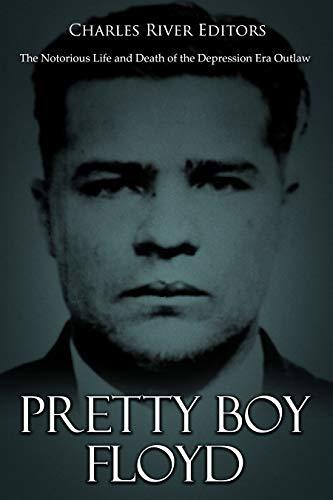
*Includes pictures *Includes contemporary accounts *Includes online resources and a bibliography for further reading *Includes a table of contents “If you'll gather 'round me, children, a story I will tell 'Bout Pretty Boy Floyd, an Outlaw, Oklahoma knew him well.” – Woody Guthrie, “The Ballad of Pretty Boy Floyd” (1939) November 1, 1932 was a fine autumn day in the sleepy, cotton-farming city of Sallisaw, Oklahoma, the heart of Sequoyah County. The blinding rays of the midday sun were shining their brightest, but the otherwise blistering heat was offset by a brisk breeze. These were ideal conditions for a Tuesday, a seemingly pedestrian day of the week, but what was unfolding in the Sallisaw State Bank was anything but ordinary. At first glance, it would seem as if a traveling carnival or a homegrown celebrity had come to town. The sidewalks of the city bank and its surrounding establishments were teeming with locals, generations of families, young lovebirds, and clusters of friends. Indeed, they had convened to witness a spectacle, albeit one of an entirely different sort. The doors of the Sallisaw State Bank swung open with a resounding bang, signaling the start of the show. Out staggered a pair of thieves, each toting bulging sacks of bills and coins and glinting Colt .45s. The hogtied tellers inside the bank desperately wriggled across the floor to voice their distress, craning their necks and directing their muffled screams towards the open door. One had even managed to squirm out of his gag and was calling out to the crowd across the street for help. Unfortunately, his cries were negated, not by the spectators' own cries of alarm, but by thunderous applause, supplemented by whoops, whistles, and a constellation of waving handkerchiefs. Some of those who cleared the path for the robbers' getaway car were supposedly patrons present in the establishment during the stick-up itself. The ringleader, a striking young gentleman with a square jaw, a smoldering squint, and dark hair slicked back with scented pomade, acknowledged his admirers with a quick nod before ducking into the running vehicle. According to local lore, quite a few of the spectators had been briefed on the robbery beforehand by none other than the ringleader himself. So bold was he in his endeavors that he strolled into the bank's neighboring establishments in the days prior and simply asked its proprietors to refrain from ringing the cops, to which they gladly agreed. He even left those complicit with enough time to extract their savings from the bank. The dashing ringleader, hailed by many as the “Robin Hood of Cookson Hills,” was none other than Pretty Boy Floyd, a perplexing character as abhorred as he was revered. To the feds, Pretty Boy Floyd was a venomous, manipulative scoundrel who was egregiously lionized as an anti-hero with a heart of gold. A career bank robber supposedly associated with up to 40 bank robberies, his face would soon be plastered on the 1934 poster of the FBI's Most Wanted alongside John Dillinger, Baby Face Nelson, and Alvin Karper. He was also implicated in multiple murders, yet Pretty Boy Floyd's admirers have been willing to overlook these crimes, with some even providing justifications for his behavior and contending that he was unfairly vilified for fighting an unjust system. To them, he was singled out as a scapegoat, and he used that angle himself, once noting, “I guess I’ve been accused of everything that has happened, except the kidnapping of the Lindbergh child, last spring.” As this all suggests, it is virtually impossible to assemble a thoroughly objective profile of the outlaw more than 80 years after his life of crime.
Charles River Editors is an independent publisher of thousands of ebooks on Kindle, Nook, Kobo, and Apple iBookstore & provider of original content for third parties.
Pretty Boy Floyd by Charles River Editors outlines the live and notorious deeds of Pretty Boy Floyd. From birth to death, we follow his life when America is extremely poor. He is robbing banks left and right!
I read this short biography for a writing project I'm involved in. On the plus side, it's quick, and it lays out many of the basic facts about this criminal's brief, violent life. On the minus side, the writing is florid and the sourcing doesn't always seem reliable. But I think for many of the Depression-era criminals, myth frequently mixed with reality, and the same is true for Floyd.
Born in Oklahoma, Floyd took his teenage talent for making moonshine for his dad in much bolder directions, and then ended up for a few years in a brutal Oklahoma state penitentiary. After that, his life as a criminal, chiefly a bank robber, seemed destined. But Floyd was more than just a stickup artist. He also was quite violent, and killed several federal agents up until the day he was trapped in a cornfield by federal agents in East Liverpool, Ohio, and riddled with bullets, thus ending his brief reign as the FBI's most wanted criminal. He was just 30 years old.
This book was well-written, held my attention, and was richly descriptive—I felt as if I were there. The author provided great detail about Charles Floyd's early years and how his choices influenced his life.
Side note for the book designer: The physical size of the book felt unusual, almost like reading a Time Life magazine. Font size is important—too small, and it's difficult to read; too large makes it feel like a Dr. Seuss story.
After all the stories, movies, accounts of gangster, Pretty Boy Floyd. I can say I that in this novella I now know more of the truth than ever before. For instance, I thought Floyd was part of the John Dillinger gang. He wasn't. His family, his burgeoning career in crime. His status as a bain with the law, his adoration with the public. It's all here. Well worth the read.