Jump to ratings and reviews
Rate this book

De parade

Rate this book
In een naamloos land wordt na een decennium oorlog een nieuwe weg aangelegd die de twee helften van het land met elkaar verbindt. Twee buitenlandse aannemers zijn verantwoordelijk voor de voltooiing ervan. Terwijl de een avontuurlijk is, het nachtleven en de mensen wil ervaren, wil de ander het liefst zo snel mogelijk terug naar huis. Gaandeweg worden de beide mannen geconfronteerd met de absurditeit van hun werkzaamheden en de verregaande gevolgen die hun aanwezigheid in het land heeft.

115 pages, Kindle Edition

First published March 19, 2019

270 people are currently reading
7676 people want to read

About the author

Dave Eggers

353 books9,463 followers
Dave Eggers is an American writer, editor, and publisher. He is best known for his 2000 memoir, A Heartbreaking Work of Staggering Genius, which became a bestseller and was a finalist for the Pulitzer Prize for General Nonfiction. Eggers is also the founder of several notable literary and philanthropic ventures, including the literary journal Timothy McSweeney's Quarterly Concern, the literacy project 826 Valencia, and the human rights nonprofit Voice of Witness. Additionally, he founded ScholarMatch, a program that connects donors with students needing funds for college tuition. His writing has appeared in numerous prestigious publications, including The New Yorker, Esquire, and The New York Times Magazine.

Ratings & Reviews

What do you think?
Rate this book

Friends & Following

Create a free account to discover what your friends think of this book!

Community Reviews

5 stars
1,427 (15%)
4 stars
3,841 (42%)
3 stars
3,074 (33%)
2 stars
639 (7%)
1 star
111 (1%)
Displaying 1 - 30 of 1,087 reviews
Profile Image for BlackOxford.
1,095 reviews70.3k followers
August 18, 2019
Paving the Road to Hell

What is the authentic measure of a human being: his commitments to an important goal; or his responses to unforeseen circumstances? Commitments are professional; responses are personal. Commitments are often contractual; responses are usually not obligatory, especially when they may require criminality as well as ingenuity.

The question becomes even more intriguing when the people involved do not know each other, not even by name. And when both commitments and ad hoc responses are contained, as it were, in some larger system of commitments and responses whose real purpose is unknown. Is it even possible to speak of moral responsibility of any sort in such circumstances?

The Parade is a variation on the stylistic devices of Kafka’s Castle, Buzzati’s The Tartare Steppe and Coetzee’s Waiting for the Barbarians. No one has a name, only a designation. The location is threatening but not overtly violent. The reader is permanently stuck in medias res, waiting for the resolution of a mystery which hasn’t been stated. Motivations are unclear except for the notions of duty and personal affection. The distinguishing feature of The Parade is that its protagonists, a two-man road-paving crew, penetrate into an alien landscape rather than preparing for the approach of what the landscape might have in store for them.

So Eggers latest has a possible ethical focus and a respectable pedigree. But all sorts of incidental conceits go unresolved in his narrative - the contents of bin bags strewn around the country, the out-of-character and sudden dependence of the junior on the senior, the flashes of kindness in the senior, the motivations of the natives who assist the crew at great personal expense. Most events seem merely dropped in as misdirections without meaning, literary detritus. These are not just loose ends. Rather it seems Eggers playing with, or rather against, the reader. A sort of sloppy Kafka; and certainly not Buzzati or Coetzee.
Profile Image for Lori.
308 reviews96 followers
May 27, 2019
Four, a man aspiring to be an automaton, and assigned co-worker, Nine pave a road across a war-devastated countryside. Nine is of a plant out of place. He shouldn't be there. Or as Four thinks:
Four had never met this man, and did not think himself capable of prophecy, but in a instant he knew Nine was an agent of chaos and would make the difficult work ahead far more so.

Lasting impressions will be the health aide worker who doesn't want to stop watching television when someone in need knocks on the clinic door, Four's soundtrack, and that perfect black road. Straight and gleaming with immaculate stripes through all that human tragedy.
Profile Image for Imme [trying to crawl out of hiatus] van Gorp.
792 reviews1,933 followers
June 13, 2023
|| 4.0 stars ||

Set in a country completely torn apart by a Civil War, our main character, Four, is hired by “The Company” to build a highway that will connect the impoverished South with the prosperous Capital.
This road is meant to symbolize the peace struck between the Rebels and the Government, and is predicted to exponentially further the South in their developments and wealth; in other words, this road will help the poor war-victims of the country have access to the medicine, products and information the lucky ones already had.

While Four is building this road, we see him come across many horrible situations in the Southern regions, and he is approached by multiple of the locals. However, he is under strict orders from the Company to not interfere with anything or acknowledge anyone for fear of it leading to difficult situations, ultimately delaying their schedule. He is just supposed to do his job, and nothing else. Four is content to do this and takes his task of building the road very seriously.
His colleague, on the other hand, seemed to have very different plans: Four is paired with a reckless man named Nine, who refuses to be efficient, and who instead chooses to wander away every day to hang out with the locals.
Both men have opposing views; Nine thinks he is helping the Southern people by gracing them with his presence and showing them respect, while Four is practical enough to understand that building this road on time will help the locals more than anything else they could ever do.

It was definitely interesting to see Four develop emotionally throughout this novel; he was very shut off from the harrowing experiences happening around him at first, but he seemed to become more affected as time went by. He also seemed to develop more and more respect for the locals and he even came to realise how some of his assumptions about them were shameful.

Most of all though, I have to say that Four’s narration in itself was absolutely hilarious. His constant annoyance with Nine was such a mood, honestly; who wouldn’t go crazy being stuck with such a useless and self-assured dickhead? I mean, I can see why some people might think Four was heartless and way too uptight, but I found him kind of realistic. They had a job to do, and Four wanted to do it well and efficiently. Also, I don’t think you could do a job like this without shutting yourself off emotionally at least a little.
So I can see why it would be hell to be stuck with someone like Nine in that situation, someone who just refuses to help and does nothing but incessantly talk and make things worse. God, he even drove me insane!

Lastly, I just want to mention that the ending absolutely broke my heart. Seriously. I was completely shocked. It was so depressing.
I mean, that ending literally just said: “Oh you thought there was hope for these people and the rich were actually trying to help the poor? Haha no.”
It was brutal…
Profile Image for Ron Charles.
1,165 reviews50.9k followers
March 12, 2019
What are we to make of his slight new novel, “The Parade,” a tale of Western assistance in the developing world?

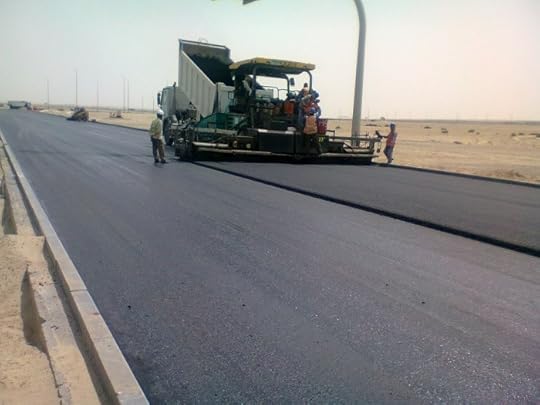
The story opens in an unnamed country that has recently emerged from civil war. To reunify this broken land, an international company has been hired to build a highway connecting the rural south to the urban north. In two weeks, when the work is done, the president will hold a parade to demonstrate his nation’s new era of peace and prosperity. All that remains is to pave and paint this 150-mile road. That job will be accomplished by a single gargantuan machine driven by one man, assisted by another man who drives ahead to keep the path clear. Completing the job from start to finish is the whole plot of “The Parade.”

For security reasons, the two men entrusted with this work don’t give their names, identifying themselves only by numbers. The driver of the giant paving machine is “Four,” an experienced construction worker who holds strictly to every company policy, particularly the rule prohibiting interaction with the local populace. Much to Four’s consternation, his partner, “Nine,” is a cavalier novice who constantly wanders away to frolic with the people they pass. Four deplores everything about his younger partner, from his ridiculously long hair to his disregard for the dangers of their job. But Nine has such a buoyant spirit and such an appreciation for this place and these native people that he makes Four seem. . . .

To read the rest of this review, go to The Washington Post:
https://www.washingtonpost.com/entert...
Profile Image for Sam Quixote.
4,802 reviews13.4k followers
March 13, 2019
Two (probably American) contractors have to pave a new road across the blighted, war-torn landscape of a Third World shithole (probably in Africa) so the new regime can have a parade on it. A novel about road paving. And it’s as exciting to read as it sounds!

I like Dave Eggers but his books set in Africa/the Middle East are, for whatever reason, turrible. I hoped Eggers would take the mundane setup and do something interesting with it - no way could the book be so determinedly dull - but, nope, it really is simply a portrayal of everyday engineering work in a desolate country. Crikey…

I still tried to see what Eggers was trying to say - if anything. The two contractors are Four and Nine (for security reasons they don’t know each other’s real names): Four is stoic and professional who puts his head down and gets on with the job; Nine is reckless and irresponsible, shirking his duties and nearly getting killed.

Was this a metaphor for life - the road being paved is life and you can choose to walk along it not taking risks like Four but ultimately have an uneventful time of it, or you can be like Nine and take risks and have adventures, living it up while you can? Probably not - that’d be too banal, even for a self-consciously literary novel.

But then I don’t know what the point of the novel was! And that nihilistic ending - is Eggers saying that the Third World can’t be helped until they help themselves? From what I know of the chap, it seems unlikely Eggers would be that uncharitable.

Parts of the story were mildly interesting like when Nine got sick and Four had to figure out a way to save him. The character of Medallion kept me guessing as to whether he’d turn on the two men at some point or not. Eggers’ writing too is decent - clearly composed if uninspired - and I felt a strong sense of place from the descriptions.

Otherwise, The Parade is one helluva boring and seemingly pointless story about how life in the Third World is as depressing as you think it is! Instead, I highly recommend Your Fathers, Where Are They? to see how dynamite Dave Eggers can be.
Profile Image for Elyse Walters.
4,010 reviews11.9k followers
March 19, 2019
In an unamed country...recovery from the civil war ...marred with corruption and burdened by a new lawless government....
two men - named Four and Nine (security company pseudonyms), are on a 12-day assignment to repair a road before a planned parade by the President, “ known for political theater.

Both of these men were anonymous and of little value... other than do their job.

Four dishes out the important tasks. He’s the boss! Serious - responsible - most experienced.... sixty three different assignments in all.
Four could be counted on to complete any job on time or early.
He didn’t earn the nickname, ‘clock’ for no reason.
He tells Nine:
“If you find a significant surface variation, you are
tasked with filling it in before the RS-80 arrives, and if the variation is too large to fix, you will have to radio me, or come back to me in person. Then we can
assess whether we power down to fix the anomaly,
or if we just pave it over. Okay?”
“Okay”.

Nine is the complete opposite from Four....
messy - late - women in his bed - ( whom he would gladly loan out to Four)...
and frankly, Four considered Nine a liability.

Nine is a character- but Four doesn’t consider anything about him funny - not his hair that impedes his vision...pushing it out of the way a hundred times a day - nor his feminine mouth.

I won’t say more about this new novel...as it would be too easy to give spoilers...
Other than....
This spare novel is fierce...
an evocative story....
Dave Eggers prose touched me right in my gut!


Profile Image for Linda.
1,653 reviews1,706 followers
April 5, 2019
"Don't you see? It's like a parade before the real parade. This is one of hope. A procession of longing."

Dave Eggers sets the wheels turning in this one. He sets his storyline within the margins of an unnamed country ravaged by war for over ten years. Peace is a construct served up by the government under questionable circumstances. A road is to be laid out connecting the north to the south for the first time in forever. A parade of celebration will be take place after completion.

Eggers never quite labels anything in this newest offering. We assume that the said country may, indeed, be in Africa with two men from Western countries set to pave the road. Their private names and that of their particular countries and company are sealed as well.

We will come to know the supervisor strictly as "Four". His assistant bears the name of "Nine". Four will be manning the RS-80 that lays down the surface of the road. Nine's job will be to drive a smaller vehicle ahead that checks for any obstructions. Supplies, food, tents, and weapons have been packed inside the RS-80 and each compartment will be locked with a separate key. Sounds pretty ship-shape. Not so fast......

Four is built with a mechanical mindset almost as rigid as the RS-80 itself. He's a "solely by the book" kind of guy who adheres to company policy like a steel vice. Four has a low threshold when it comes to tolerance. We know nothing of his background story or his life before taking on this position. From the onset we realize that he and Nine are going to be like a dull razor tearing at a raggedy beard.

Nine is filled with life and curiosity. We've got a sort of Grasshopper and the Ant scenario happening. Nine takes off for hours at a time in search of adventures in the passing villages. Four obsesses with vengeance against Nine as he continues his job of paving hour after hour. His daily rituals remain the same even under these circumstances. Nine seems to always show up eventually ........until he goes missing. And here is where our story escalates.

This was my first book by Dave Eggers. It's a stripped-down model in regard to limited dialogue and atmosphere. It manages to set up camp in as few as 179 pages. But you will definitely be intrigued by these two main characters with danger lurking around every corner. Keeping pace with these two guys is the easy part. Keeping it together with what's on the very last page is a story unto itself.
Profile Image for Meike.
Author 1 book4,962 followers
April 10, 2020
This novella offers an allegorical take on Western assistance in developing nations: Two contract workers, only referred to as Four and Nine, are sent to an unnamed country marred by civil war in order to complete a strategically important road, hoping their project would help connect people and enable locals and NGOs to transport important goods like food and medicine. Once they finish their 12-day-assignment, there are are plans to celebrate their accomplishment with the titular parade - so yes, do not ask whether it makes sense that two lonesome dudes pave an important road in the middle of nowhere within such a short period of time, Eggers is not here to write in the realm of realism. This is a fable: Will the connection be made? And where will the road lead? Does it, built by the West, even stand for progress?

Four and Nine represent different attitudes Westerners might show towards such potentially dangerous places they do not fully understand: Four is cautious, always adheres to the rules and regulations, trying to ignore the surroundings and fully concentrating on his task without really connecting his deeds with the world around him; Nine, on the other hand, acts like he is on an adventure, marvelling at the locals and their customs while being fully aware that he will be able to leave behind the poverty they are subjected to. Of course, both attitudes are questionable in their own way - is this particularly subtle storytelling? Hell no. But it's not like Eggers doesn't have a point (and aren't there many backpacking tourists stumbling through Asia and Africa with an outlook similar to that of Nine?).

Eggers' story hints at the Gordian knot that foreign aid can be, the mistakes of the West, but also the price those pay who enter with the best intentions and find themselves facing a reality of violence and corruption so overwhelming they themselves start to feel helpless. The ending of this book is unbelievably grim, but very fitting for what Eggers is trying to do here.

So this is not a very layered or filigrane book, but this small text tells a compelling story and packs a punch. From the outside, being a foreign aid worker - be it as a doctor, an engineer or a craftsman - often seems like a heroic and fulfilling job, but whoever really looked at what this can mean for the individual or in how many ways such missions can fail will realize that this is one of the toughest, most merciless professions around. Eggers writes about just that.

Now also available in German: Die Parade - if you want to learn more about the book, you can listen to the latest episode of our podcast (in German).
Profile Image for D.  St. Germain.
28 reviews97 followers
June 12, 2019
“Excellent,” the man said, walking briskly and squinting into the distance. “With a road like this, now it is possible to make plans.”

Dave Eggers is a writer of the modern moral parable. Yet often his moralizing can be somewhat simplistic or otherwise heavy–handed - like a Sunday school marm looking disapprovingly upon the children for no particular reason. As I read The Parade I began to think Eggers had finally found his stride and was becoming a bit more nuanced in his parables – until I hit this book's bizarre end.

Two men of radically different dispositions, going by the code names Four and Nine for reasons of security, have been tasked with paving a highway in an unnamed country that has just recently settled into an uneasy peace after an ugly civil war. The highway, set to connect the prosperous capital in the north with the more modest south, is seen by many as a harbinger for prosperity, linking people and markets to better health care and opportunities. The road must be completed on time so that the President can hold a parade celebrating the country’s newfound peace and reunification.

Four is a man of schedules and time frames. He puts his head down and gets to work. He’s done sixty or so of these projects, and all he wants to do is get the job done as quickly as possible and go home. This is Nine’s first project, on the other hand, and he is there for the experience: he takes every opportunity to engage with locals on the route: drinking, eating, playing dominoes, swimming in potentially typhoid-laden water, and partaking of the ladies - all of which are forbidden by the company. He also, unbeknownst to Four, gives away their supply of medicine and their satellite phone to the locals, as he believes they need them more. So when Nine becomes gravely ill from eating/drinking/swimming (we're not sure which), and the local NGO clinic nastily refuses to treat him because it is outside their mandate to treat local women, Four and Nine must trust a group of local men to save his life. (And while the locals' leader needed the road finished so he might bring his dying wife for treatment in the capital, none of the other potentially lethal motives Four suspects these helpmates of harboring turns out to be true.) The story is further complicated when the laborers are seized by another group of armed men who demand justice for a young woman Nine has defiled.

Through a series of acts of kindness by strangers, Four and Nine prevail, and Four is forced to reckon with his employer's paranoia about “the other.” And against the odds of a near-death, near-imprisonment and the loss of basic tools needed to complete the work, the two managed to complete the road on time for the presidential parade. As they approach the last kilometers of pavement, it is clear they have become the beacon of hope for the future for everyone along its path. Thousands of people stream onto the highway behind them, becoming a “parade before the real parade. This is one of hope. A procession of longing. The second we’re done, their world catapults into the twenty-first century. Trade, medical care, access to government services, information, education, relatives, electricity and the northern port.”

But just as the road is completed and you think the story was about learning to find a balance between steadfastness and openness, mercy and late-capitalist inhumanity, and you’re pondering the poison at the heart of modern man’s inability to relate to those in radically different circumstances and from different backgrounds, Eggers crushes all those thoughts with a brutal ending that confronts something else entirely and makes you question everything you thought you’d learned - and makes you wonder WHY, Dave, WHY?!? Hope is murdered, and for what?

The ending is obviously intended to shock, but what further response that shock is supposed to produce in the reader is unclear. Should no one work on projects outside their home country? Is hope for naught in the face of brutal men? I'm not sure. The point of writing a story with a moral is to produce a shift in thinking in the reader, helping them come to a conclusion about what is right and wrong for humans in a set of circumstances - which this ending does not produce at all. A puzzling read.

I also write longer-form reviews that you can find here.
Profile Image for Henk.
1,198 reviews310 followers
February 19, 2024
A modern fable of a road turns into a thoughtful read on colonialism and exploitation
Eggers is a bit of a hit or miss author for me; I loved the Circle but hated a Hologram for the King. This book falls a bit in between, but offers plenty of content to ponder about despite it’s short size. 3.5 stars rounded down.

Characters and Plot
Four and Nine, codenames for the two employees sent to an unnamed (in my head African but I don’t think its really made specific anywhere) third world country, must build a road between North and South. Nine has knowledge of the language and is a go-lucky guy, blending in with the locals while for Four this is his sixty-third mission. When the experienced Four meets him for the first time, he finds Nine sleeping with a girl, and during the whole story the recklesness of Nine is pitted against the meticulous, orderly nature of Four.

Four is the chauffeur of the automated asphalt dispensing RS-80, and wants to complete his job as soon as possible, and certainly before a military parade is due. Nine’s job is to clear the road of obstacles but his (mis)behaviour turns out to be the greatest obstacle to make the deadline. Four must engage with a local to get the job done and discovers along the way that the protocols of his company are of little worth in a crisis, or in real life in general for that matter.

Throughout the book I found Nine, portrayed as a careless, idealistic milennial type of guy who compares the road they are laying to the trunk of a tree, that would heal the country through micro enterprises alongside, quite annoying. Maybe that shows that I am as a person a bit closer to the rule abiding Four, despite the fact I found him rather boring and disliked how he kept conviently narrating to himself why he could not seek outside help of his company.

Themes
What Eggers does really well however is the portrayal of people in a third world country as just that: people. The locals Four and Nine meet are neither saints nor money hungry kidnappers. In general they want to help and they want to be compensated for that help. They genuinly want to heal their country, that is littered with mines in forests and plastic bags filled with, what I interpret to be, human remains, after the long civil war. They want prosperity and better healthcare for their loved ones and the road is a way to that. However Eggers alludes on the final page that it can just as well be that the road is a road to hell, dependent on the intentions of those in power.

What struck me most is how priviliged Four and Nine as westerners are, how for them one and a half week in the country is kind of an adventure. A kind of real life escape room with money, weapons and medicine available at will, a company who could provide an airlift, and a business class flight out afterwards. Eggers shows the same detachment at work at a NGO healthcare clinic they meet along the way. Here someone watches a game of soccer and this person will be repatriated in a few months, while people literally plead at the door of the compound for the medicine that could save lives.
Profile Image for Brian.
Author 1 book1,242 followers
June 6, 2019

......and yes, the road to hell IS paved with good intentions.
Profile Image for Ian.
982 reviews60 followers
August 5, 2019
There are some books that are slow to begin with but which deliver later, and others that promise much but fall away in the denouement. I would say that “The Parade” falls into the latter category. The story centres around two Westerners employed to construct a road in a developing country. I thought of the two main characters as Americans and the setting as being in Africa, but that might be partly down to the accents adopted by the narrator in the audio version. The author deliberately tries to create a particular atmosphere in the setting. The two lead characters are known only as “four” and “nine” and they are employed by “the Company”. Two local men they encounter are referred to as “medallion” and “cousin” and they converse in “the local language”. The road is being built to “the Capital City” and the country is unnamed. It’s not quite Kafkaesque but it borders on that.

The two main characters are polar opposites to an almost absurd degree. “Four” is like an automaton, uncommunicative and humourless. He follows the rules set by the Company to the absolute letter and wants minimal interaction with the local inhabitants. “Nine” wants to experience everything about the country they are in, the food, the alcohol, the culture, and the women.

I was intrigued by the setting and by how the developing story of “four” and “nine” would work out. I was dissatisfied with the last couple of chapters though. Obviously I can’t say much without giving away spoilers, but I thought the ending banal. Three stars for the way the book held my attention throughout, but ultimately a bit of a disappointment.
Profile Image for Art.
237 reviews11 followers
January 18, 2019
My actual rating is 4.5 for this masterful piece of storytelling by Dave Eggers. There is not a wasted word in this short account of two men who have been charged with building a road to unify an unknown country that has been ravaged by 10 years of civil war. Conflict on all levels - personal, interpersonal, and societal - is a central theme. The resolution of these conflicts makes for compelling reading and creates an underlying current of stress throughout the book. I have been unable to let go of the Twilight Zone like ending that simply blew me away.

P.S. The two main characters are named Four and Nine, not Four and Five as stated in the Goodreads book description.
Profile Image for Olaf Gütte.
222 reviews76 followers
May 16, 2020
Wenn man einfach nur seine Arbeit macht
und denkt man tut etwas Gutes...
Was dabei rauskommen kann, zeigt uns hier Dave Eggers.
Profile Image for Joy D.
3,136 reviews329 followers
July 14, 2023
Two men, code named Four and Nine, are sent by a construction company to pave a road connecting the North and South of an unnamed country that has just gone through a brutal civil war. Four is on his sixty-third assignment. He is methodical and focused on business. He follows the rules closely and tries not to get distracted. Nine is a free spirit, full of zest for life, wanting to experience everything the country has to offer. He is not a rule follower and does not seem all that concerned about completing the job, but it needs to be finished on time in order for a parade to take place.

Who knew a book about paving a road could be so engrossing? It is short but covers a lot of ground. The “odd couple” of road paving is an intriguing setup. The characters of Four and Nine are almost complete opposites, but they need to work together to get the job done. As I read this, it gave me a feeling of foreboding. Nine’s actions end up causing problems for himself and the project. I think this book shows that even people with the best intentions can (and often do) cause harm. It also portrays the perils of “helping” complete a project when the goals are unclear. I particularly liked the paving crew’s interactions with the locals. Four is inclined to distrust but ends up needing to rely on a man he calls Medallion, who turns out to be much different than he expected. It is a thought-provoking page-turner.
Profile Image for Ethan.
345 reviews337 followers
July 30, 2022
A year or so ago, I told myself I'd never read a Dave Eggers book again. I really liked The Circle, but thought A Hologram for the King and Your Fathers, Where Are They? And the Prophets, Do They Live Forever? were pretty "meh" three star reads. And then The Wild Things was just downright awful and I said "I'm done; I'm never reading an Eggers book again."

But rules are made to be broken, I guess, because here I am, and I've just finished another Dave Eggers book, his 2019 short novel The Parade. Unfortunately, this one falls firmly into the "meh" category with most other Eggers novels I've read. It tells the story of two unnamed men, who work for an unnamed company, who are sent to an unnamed country that has just gotten out of a long civil war. The head of this country's victorious government wants to build a paved road, the first of its kind in this clearly third world country of otherwise entirely dirt roads, to connect the modernized capital city in the northern part of the country with the rural southern regions of the country.

The new road is supposed to connect the country like never before, and usher in a new era of commerce, prosperity, and peace. The president wants the road done by a certain date so a massive parade can proceed south down the road from the capital city, to celebrate its completion and all it symbolizes. The two anonymous men sent to the country, who assume the pseudonyms of Four and Nine, are employed by the company contracted by the government to pave the road. It is Four and Nine's job to pave the road, using a new state-of-the-art paving machine.

Sound boring as hell? That's because it is. We quickly learn that Four is the strict, by the book company man who has already paved sixty-something roads in multiple different continents before, totalling thousands of miles. He's the veteran, he always follows procedure, and he likes to be done early. Nine, on the other hand, is reckless, is on his first assignment, and generally acts like a drunken man whore baboon the entire time, shirking his job responsibilities every chance he gets.

The two are completely incompatible, which sometimes works well, and in fact mirrors buddy cop movies, where you often have a strict, no-nonsense veteran detective paired with a loose cannon rookie. But in this book it just doesn't work, and it's completely unrealistic how everything unfolds. Someone as by the book as Four would have gotten Nine fired probably on the first day. And yet, time and again, over the entire course of the book, he thinks about getting him fired and requesting a replacement from the company, but for some unexplained reason ends up just constantly putting up with Nine's bullsh*t. For the vast majority of the book it seems like Nine isn't even around. He's off partying somewhere or being a man whore while Four basically paves the entire road himself. It would just never happen that way, where a guy like Four would put up with that, especially when Nine's negligence is putting Four's life at risk, a fact Four is aware of.

In addition to this, the book is incredibly repetitive, with the daily routine of Four paving the road, setting up his tent at the end of the working day, eating a depressing dinner, and going to sleep, all while Nine is away goofing off and not doing his job repeats itself endlessly, and with a few exceptions this repetitive routine makes up the vast majority of the entire book.

Borrrrrrrrriiiiiiiiiiinnnnnnnggggggg.

There were some things I liked about this book, however. It has a twist ending, which I could see being polarizing, but it made me think, so overall I liked it. I also did think that Four, Nine, and a secondary character named Medallion were well-developed, strong characters, and the story was interesting in the parts where it deviated from the boring road paving routine. But this book just wasn't very believable, and isn't anything special. Eggers is a very good writer, and his books flow well. It's generally pleasant to read one of his books, and they usually have a very interesting and unique story. It's just too bad the execution so rarely matches the promise of the idea with Eggers. But I'd be open to reading him again. Who knows what the future holds?
Profile Image for Anika.
967 reviews320 followers
May 25, 2020
ETA: [Dieses Buch haben wir auch im Papierstau Podcast besprochen (Folge 96: Alphabet Street)] /ETA

"Die Parade" ist eine novellenartige, gut und schnell lesbare Parabel zum Thema Entwicklungshilfe, frei nach dem Motto: Gut gemeint ist nicht immer gut gemacht (zumindest nicht immer für alle Beteiligten). Vier und Neun,zwei namenlose Facharbeiter, helfen beim Aufbau der Infrastruktur eines vom Bürgerkrieg zerrütteten Landes. Mit Hilfe einer komplexen und modernen Maschine asphaltieren sie innerhalb weniger Tage eine Straße, die den wohlhabenderen Teil des Landes mit dem ärmlicheren verbinden und so auch diesen Gebieten medizinische Versorgung und vieles mehr bringen soll. Die titelgebende Parade ist für den Abschluss der Bauarbeiten geplant.

Was nach einem ziemlich klaren Auftrag klingt, gestaltet sich von Beginn an kompliziert, vor allem für Vier, der den überkorrekten, verlässlichen Arbeiter symbolisiert. Er will nur seine Arbeit machen, sich dabei strikt an die Anweisungen halten und den Job wie viele andere zuvor möglichst schnell und ohne Kontakt zur Außenwelt - den Regeln entsprechend - hinter sich bringen. Ganz anders Neun, der die Nähe der Menschen vor Ort sucht. Er will nicht nur eine Straße bauen, sondern gerne auch auf andere Art helfen - was den Regeln der Firma, in dessen Auftrag die Straße gebaut wird, widerspricht und vor allem auch Viers Unmut nach sich zieht.

Dass Vier und Neun quasi auf engsten Raum unterschiedliche Ansätze der Entwicklungshilfe westlicher Industrienationen und den daraus resultierenden Folgen symbolisieren, könnte kaum offensichtlicher sein. Doch trotz dieser fast schon zu einfachen Symbolik lebt das kurze Werk von dem wachsenden Konflikt zwischen Vier und Neun und der daraus enstehenden Spannung. Denn schon nach kurzer Zeit zeichnet sich ab, dass Neuns Interaktionen mit den Einheimischen Konsequenzen haben, die die Fertigstellung der Straße gefährden könnten. Und so muss Vier Entscheidungen treffen, mit denen er sich im Laufe seiner bis dato glänzenden Karriere noch nicht befassen musste...

Nichts allzu viel Neues und dazu ziemlich offensichtlich - dennoch ist "Die Parade" empfehlenswert, denn Eggers erzählt gut und spannend. Man kann den heißen Asphalt fast riechen, die Hilflosigkeit der Einheimischen und ihre Hoffnung auf die Straße fast spüren. Die Kürze von knapp unter 200 Seiten bietet eine komprimierte Geschichte mit einem Ende, das fast schon unausweichlich schien.
Profile Image for Nancy.
1,907 reviews476 followers
March 17, 2019
Four just wanted to do his job. He operated a state-of-the-art paver and he had a schedule to meet. He was to pave a road that would connect two halves of a country, the rebels at one end and the modern city and army at the other end. He was to keep to himself, not get involved, just do his duty and go home.

Nine had other ideas. He was to ride ahead and remove anything that might hinder Four's advancement. But Nine was a free spirit. He chatted up the locals, ate at their fires and went to bed with their women. He made connections.

Four couldn't control Nine. If he reported Nine's misadventures it would make Four look bad. Nine's behavior brought a crisis when he came down deathly ill, forcing Four to accept the help of locals to save his life.

This short novel is an extended parable. What interests me is that the title is not 'The Road' or a reference to Four and Nine's divergent attitudes towards the people they met who have endured war but still offer hospitality. No, it is called The Parade.

Four's time schedule must be met because there is a parade scheduled by the general in the city at the other end of the road. The road's completion is to be celebrated. Four completely believes in the road's peaceable purpose of bringing progress to the rural bush folk. He has bought the story of the celebration.

The twisted, dark ending was almost expected.

In some ways, Four's faith in his supposed peaceful purpose recalled to mind another novel I recently read, The Cassandra by Sharma Shields, in which a young woman finds work at a government facility working on something that will end WWII. She completely buys into her work and purpose until she discovers what it is that will end the war--the Atom Bomb.

I have always wondered how people can participate in industries that manufacture products of destruction. How do they justify their work? Do they willingly believe some fantasy? Do they push the purpose out of their minds?

How hard it must be to discover too late what you have done. It is easier to believe in a fantasy parade.

I received a free ebook through First to Read in exchange for a fair and unbiased review.
Profile Image for Alex.
817 reviews123 followers
March 24, 2019
3.5

This was a pretty sharp and satirical short story about contract work in developing countries. I appreciate Eggers and enjoy his tone and manages to say unexpected and profound things.
Profile Image for Bee.
83 reviews80 followers
March 18, 2019
The premise is simple enough: a pair of western contractors have been sent to an unnamed country that has been ravaged by years of civil war. In this time of peace, they have been contracted to pave a road bridging the northern and southern regions of this country. The story is narrated by Four, the older and more experienced of the two men. Four intends to carry out this job has he has every assignment before, but Nine throws a wrench in that. As Four keeps his head down and his gaze fixed on the finish line, Nine soaks up the landscape and the hospitality of locals.

The Parade chugs along at a steady pace. I wouldn't characterize this as particularly suspenseful, but the book doesn't drag on. Eggers leads you on with the promise of further intrigue and maybe, just maybe figuring out what this book is actually about. It feels almost allegorical with the way he layers on the vagueness: an unnamed company sending two men who go only by pseudonyms to an unnamed country after a conflict between nameless factions. It felt at times as if I knew the machine they were using to pave the road better than the characters before me. I enjoyed how both Four and Nine's relationship evolved over time, but the ending ultimately fell flat. The final twist was tragically predictable and didn't land with much more than a thud. For better or for worse, I've never read anything quite like The Parade before.

I received my copy of The Parade from Knopf via First to Read in exchange for an honest review.
Profile Image for Jeroen Schwartz.
Author 2 books29 followers
March 21, 2019
Grunbergiaans, satirisch boek over hulpverlening en bureaucratie. Het sterke aan Eggers’ werk is zijn bevlogenheid, zijn onvermoeibare journalistieke insteek. Eggers is nergens zeurderig, wel schrijnend en boven alles is De Parade een bijna klassieke, Orwelliaanse vertelling met meer lagen dan je zou vermoeden. Zijn boeken gaan altijd over mensen die verzuipen maar ergens een reddingsboei proberen te vinden. Laat dat voor de mens de literatuur zijn.
Profile Image for John Hatley.
1,383 reviews233 followers
June 25, 2019
I must be on some sort of literary lucky streak. I have read several books so far this year that I've given 5 stars. This is one of them.
In a country recovering from civil war, the new government commissions a 230-km stretch of new highway to be built from the impoverished south to the capital in the prosperous north in an effort to re-unite the recently divided country. With the aid of an amazing road-building machine that requires only one operator and one assistant, the project is implemented. It is absolutely essential that the road be finished on schedule and the new government has planned a parade to celebrate its completion. With their RS-80, which can pave 25 km a day, the secretive company that wins the contract is confident that the deadline can be met. This is where the story begins. The contrast couldn't be greater between the experienced, highly disciplined operator and the happy-go-lucky, flippant assistant who is assigned to him and who doesn't mind breaking all the rules. To write any more would mean spoiling the plot, but this is another book I can recommend.
Profile Image for TraceyL.
990 reviews161 followers
June 7, 2019
Such a simple but interesting story. Two men are building a road. "Four" is a straight-laced professional focused on doing the best job he can, as quickly as he can. "Nine" is a rookie who keeps screwing around and impeding progress. It's set in an unknown war-torn country where a long civil war has just ended. The citizens are suffering, but the road gives them hope for the future. I thoroughly enjoyed it.
Profile Image for Ernst.
645 reviews29 followers
March 8, 2024
Ein ideales Buch für einen Wochenendtrip, auf den man vorsichtshalber ein zweites Buch mitnehmen sollte, denn mit den 180 Seiten ist man sehr schnell durch. Hier zeigt sich das Dave Eggers ein richtiger Könner ist. Sprachlich sehr stark, stark verdichtet. Großartiger Spannungsbogen. Intelligente Unterhaltung. Für meinen Geschmack war es der beste Eggers, den ich bislang gelesen habe (inklusive Circle und Every).
Profile Image for Paul Dembina.
694 reviews164 followers
July 12, 2020
I rather like this type of allegorical tale where the main characters are archetypes with no proper names, in this case called Four and Nine
This one reminded me strongly of a lot of Magnus Mills
There's a revelation (of sorts) right at the very end. It came too swiftly for my liking (last 2 pages) and wasn't totally unexpected
Profile Image for Michael J..
1,042 reviews34 followers
August 27, 2019
On the surface, this is an interesting short novel and quick read about a highway construction project in a third-world country completed by just two workers using high-tech machinery. Curiously, they are only identified by numbers - - Four and Nine - - and their names are never revealed. Four is a straight-shooter, intent on completing his work on time and minimizing any obstacles that would slow down reaching that goal. Nine is a free spirit, less inclined to follow rigid rules or structure and yearning to explore and mingle with the locals.
This is the first work I've read by Dave Eggers, known for "literary fiction" with a lot to say about the present human condition, etc. The whole novel could be seen as an allegory for the path of life and the way a person conducts themselves upon it and the choices they make, with the road serving as metaphor for that journey. The Parade could easily be interpreted to be about commitment, goals, responsibility, morals, ethics and the road one choses to build and travel upon. Do I think that is what Eggers intended to do? Like another literary work I recently read (Lincoln In The Bardo) it's impossible to figure out what the real message or moral of The Parade is.
There are some scenes in this novel that are very touching, heart-warming and uplifting. However, Eggers ends the story on a downer, which is why I'm having trouble determining what he wants to say here.
My recommendation is to read this for quick entertainment; and any message, moral or parable you can get out of The Parade is just ice cream.
Profile Image for Emma.
200 reviews36 followers
May 23, 2019
Oof, I did not see that final twist coming!

I really enjoyed this short novel! It’s about two men who build a highway from the south of an unnamed country to its capital. During their work, they meet various locals, and even though they are instructed by their company not the interact with them.

This short novel has a slightly dystopian feel to it in my opinion. It’s about the kindness of strangers, and it showcases what years of (civil) war can do to a country. The twist all the way at the end of the novel was the cherry op top, and I absolutely loved it! I just wish it would’ve been longer!
Profile Image for Kasa Cotugno.
2,755 reviews587 followers
April 2, 2019
When Dave Eggers wants to make a point, he writes a book. And whereas some are definitely more successful, his intent more clear, there is no one who can come close. My favorites are those in which he presents a larger picture by focussing on a smaller, more personal story (such as Zeitoun, What is the What, and the Monk of Mocha). I slip this one into the same slat as The Circle and Hologram for the King. His point here is his own, and if it not as accessible as some of his other works, I'll keep reading anything he writes.
Displaying 1 - 30 of 1,087 reviews

Join the discussion

Can't find what you're looking for?

Get help and learn more about the design.