

What do you think?

River of Blood: American Slavery from the People Who Lived It: Interviews & Photographs of Formerly Enslaved African Americans
In the late 1930s, the federal government embarked on an unusual project. As a part of the Works Progress Administration's efforts to give jobs to unemployed Americans, government workers tracked down 3,000 men and women who had been enslaved before and during the Civil War. The workers asked them probing questions about slave life. What did they think about their slaveholders? What songs did they sing? What games did they play? Did they always think about escaping? The result was a remarkable compilation of interviews known as the Slave Narratives. This book highlights those narratives―condensing tens of thousands of pages into short excerpts from about 100 former slaves and pairs their accounts with their photographs, taken by the workers sent to record their stories. The book documents what slaves saw and remembered, and explains how they lived. It is an eye-opening account that details what it was like to be a slave―from everyday life to the overwhelming fear they harbored for their lives and for the lives of their family and loved ones. Their stories are clear and stirring. For some reason, the 700 photographs taken for the Slave Narrative Collection have been largely overlooked. The negatives are missing and the paperclip impressions used to attach the small prints to the typewritten interviews indicates that the photos were never valued or treated as art. By pairing 100 narratives and photographs, the material takes on a new life. Every word from every former slave comes alive when the reader can see exactly who told these accounts. The photographs―with the stories―are essential in helping us understand the humanity behind these stories. The words take on new meeting paired with the photographs. When you hear Bill Homer explain that he was given as a wedding present at the age of ten in 1860 and look at his photograph as a proud old man, the true meaning of slavery starts to sinks in. This book is designed so that all Americans will better understand this issue that plays such an important role in present day society. The words and the photographs are profound.
240 pages, Hardcover
Published January 20, 2020
Ratings & Reviews
Friends & Following
Create a free account to discover what your friends think of this book!
Community Reviews
Displaying 1 - 30 of 37 reviews

February 2, 2021
This book is incredibly powerful. It is photos and oral accounts of the last of people born into slavery.FDR had a program in the grim thirties that besides giving people work also documented this elderly population who were born into slavery.5ooo were hired to visit these people and gather this information.Only 100 of the 5000 hired were negroes themselves and some of the accounts showed the bias of the documenter.Since it was illegal to teach negroes to read or write in many states many would be unable to document their own story and until the civil war many slaves did not have a last name and were identified by their first name only. It is irony too that when freed many took their master or his plantations name as a last name.

April 30, 2021
What an extraordinary book! A selection of excerpts and photographs from more than 3500 interviews with formerly enslaved persons recorded back in the late 1930's, some 70 years after the official end of slavery in the U.S. Text and photos are both mesmerizing. I find it powerfully moving that the U.S. Library of Congress has saved the entire array of interviews -- and that government money was used to document our nation's shameful history in the first place. The fact that Black Americans are STILL fighting for equality all these years later is an even greater shame. This is an eye-opening book: you can read it in a couple of hours and I urge you to do it.

August 12, 2021
Amazing Grace: Words and wisdom of American slaves
The book is about the formerly enslaved people who lived to tell the story of their bondage and freedom. This is a human account of what it meant to assert a place in this country, as Black people and as Americans. The words and the photographs are profound, and they offer vivid reality of how tough it was for African Americans to have basic dignity in everyday life. There are intimate details provided by the last survivors of slavery, and the violence perpetrated by the KKK . This is a well-researched book on the legacy of slavery and its imprint on centuries of American history.
In 1936, the Federal Writers' Project (FWP), a branch of the Works Progress Administration, a government agency was set up to provide work to the one-quarter of Americans during Great Depression. Notable projects of the FWP included the Slave Narrative Collection, a set of interviews that culminated in over 2,300 first-person accounts of slavery and five hundred black-and-white photographs of former slaves. These narratives are available online from the above-named collection at the Library of Congress website. More than seventy years after the Civil War, the people interviewed for this project were in their seventies, eighties, and nineties.
Notable pictures are of Sarah Gudger born into slavery in 1816 in North Carolina and believed to be one of the oldest people when she died at the age of 122. Betty Boomer, born into slavery in Texas, and she was one of the African Americans terrorized by the Ku Klux Klan. Donaville Broussard born into slavery in 1850 in Lafayette, Louisiana. but like so many others he lived in the ominous shadow of the Ku Klux Klan and white hostility. Many formerly enslaved recall torture, dislocation, extreme overwork, severe abuse, inadequate nutrition, constant stress, and a multitude of other trauma produced serious psychological and physical scars. The book also highlights the cabin of former slave in Putnam County, Georgia, slave quarters in Cecil County, Maryland; Caruthersville, Missouri; and St. Charles Parish, Louisiana; and an African American cemetery in Person County, North Carolina.
The book is a tremendous illustration of formerly enslaved people and I recommend this to anyone interested African-American history.
The book is about the formerly enslaved people who lived to tell the story of their bondage and freedom. This is a human account of what it meant to assert a place in this country, as Black people and as Americans. The words and the photographs are profound, and they offer vivid reality of how tough it was for African Americans to have basic dignity in everyday life. There are intimate details provided by the last survivors of slavery, and the violence perpetrated by the KKK . This is a well-researched book on the legacy of slavery and its imprint on centuries of American history.
In 1936, the Federal Writers' Project (FWP), a branch of the Works Progress Administration, a government agency was set up to provide work to the one-quarter of Americans during Great Depression. Notable projects of the FWP included the Slave Narrative Collection, a set of interviews that culminated in over 2,300 first-person accounts of slavery and five hundred black-and-white photographs of former slaves. These narratives are available online from the above-named collection at the Library of Congress website. More than seventy years after the Civil War, the people interviewed for this project were in their seventies, eighties, and nineties.
Notable pictures are of Sarah Gudger born into slavery in 1816 in North Carolina and believed to be one of the oldest people when she died at the age of 122. Betty Boomer, born into slavery in Texas, and she was one of the African Americans terrorized by the Ku Klux Klan. Donaville Broussard born into slavery in 1850 in Lafayette, Louisiana. but like so many others he lived in the ominous shadow of the Ku Klux Klan and white hostility. Many formerly enslaved recall torture, dislocation, extreme overwork, severe abuse, inadequate nutrition, constant stress, and a multitude of other trauma produced serious psychological and physical scars. The book also highlights the cabin of former slave in Putnam County, Georgia, slave quarters in Cecil County, Maryland; Caruthersville, Missouri; and St. Charles Parish, Louisiana; and an African American cemetery in Person County, North Carolina.
The book is a tremendous illustration of formerly enslaved people and I recommend this to anyone interested African-American history.

January 24, 2021
This book is a powerful, searing preservative portrait of the deliberate evil, and systemic avenue for one group of people to practice cruelty with liberated sadism on another, that was American slavery. This is an oral history and compilation of firsthand narratives from survivors of slavery, collected before they passed away. For readers, like me, who are aware of slavery as a general concept, these accounts are jarring and affecting. There are short but powerful passages about people who are systematically dehumanized and turned into mechanized labor to engineer the economic output of American farms and plantations. Even the routines of their everyday life was demonically managed for the purpose of deadening dignity-- people were regularly whipped for cupping their hands up for more food, people were compelled to eat at food troughs, they were overworked from morning until night without compensation, all for the singular distinction of being from a different ethnicity. What could drive a person to whip another human being even as blood flowed and flowed? Yet all the 'masters' seemed to know to do and turn to this practice by some common instinct, the birthright of their ethnicity and social position.
I highly recommend this to everyone who wants to remember or learn about this dark period in history. I think this is a good educational book to give for people who are vocal about being overfatigued about attempts at systemic equity and diversity of underrepresented African-Americans.
I highly recommend this to everyone who wants to remember or learn about this dark period in history. I think this is a good educational book to give for people who are vocal about being overfatigued about attempts at systemic equity and diversity of underrepresented African-Americans.
August 12, 2021
I thought this book was beautifully executed. The formerly enslaved people, in their photos, are the essence of dignity in the face of unfathomable hardship, loss and grief. The brief quotes and stories from each of these people are eye-opening and heartbreaking. It's hard to believe that we have not yet made reparations to the descendants of these men and women who lost so much as they provided the free and tortured labor that built the foundation of our nation.
The book was gripping and a very quick read.
The book was gripping and a very quick read.

September 20, 2022
This first person account is heart breaking but it is necessary. The soil of America is dripping with Rivers of the Blood of heroic African Americans. People should read about the evils of chattel slavery from the mouths of those who endured it. Survived it and thrived despite.

September 15, 2020
All white Americans need to read this book.
June 23, 2021
This powerful book is an important reminder of the inequities and horror faced by slaves. All in their own voices.

November 27, 2020
So valuable. So hard to read. So glad the WPA compiled these stories.

Read
July 24, 2020Powerful and moving. However, because of the subject matter, and out of respect for those within, I will not rate this book.

July 21, 2020
River of Blood is wonderful. I am so glad these memories are not lost. I'm also thankful to see the faces of beautiful, strong and enduring people. I will not soon forget the impact of words and faces.

November 7, 2020
Valuable anecdotes of slavery from the voices of those who experienced its evils. The racism that remained in the way these stories were collected by whites in the 1930s is acknowledged. (Invented pidgin spellings that demean the speakers—“get” replaced by “git,” “poor replaced with “pore,” etc.) Really, this collection gives us but a glimpse of the systemic racism that has existed in altered forms for generations.

December 22, 2020
Seeing the photos of the people is worth picking up this book for, but the excerpts from their oral histories are frustratingly short. Also, the captions have an annoying tendency to assure the reader that the subjects are giving correct information, which undermines them a bit. This resource is short and accessible, but probably more useful alongside fuller ones.
December 21, 2022
Hearing the stories directly from the people that lived thru this time was interesting, yet it leaves me feeling deeply saddened. I like to learn more about what took place during that time, but it still leaves me with a sorrow that shakes me to my core. This is a great read overall.
February 6, 2020
Moving, powerful, important compilation of former slaves memories of their experience.

August 21, 2021
Seventy-five years after the civil war, the last vestiges of slavery in the United States were documented. The remains of plantations, slave quarters, cabins and barns--some long abandoned--were photographed. Thousands of formerly enslaved African American men and women provided first-hand accounts of life under slavery. Now, these words and pictures are paired to offer insight into a shameful time in American history that resonates today.
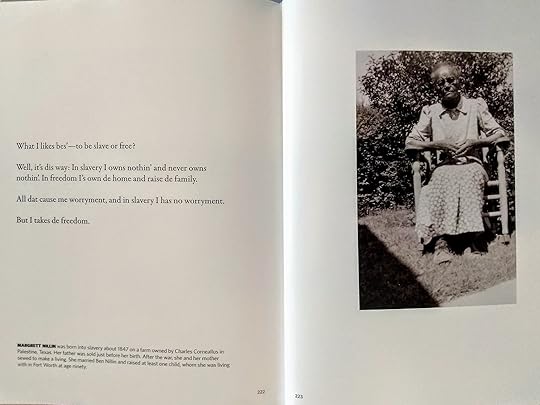
This beautifully designed book is a wonderful record of a dark part of U.S. history. The editors have carefully selected key statements and anecdotes from a variety of people who lived through slavery to weave a quilt that tells the story of the enslaved experience from many perspectives. It's top-notch, embodied history. I highly recommend it.
As you can see in the picture above, each spread provides a picture of the speaker, some of their words from the interview with them, and a short factual biography about their life. These spreads are thematically arranged to document U.S. slavery in a roughly chronological fashion.
I want to highlight the book here especially to recognize the source material it emerged from, the Federal Writers' Project of the 1930s. From the introduction:
The Federal Writers' Project [was] a branch of the Works Progress Administration. The WPA was a government agency set up to provide work to the one-quarter of Americans who were unemployed during the Great Depression. More than 8 million men and women were hired by the WPA to build roads, bridges, dams and parks--and to paint, sculpt and write. "Hell," said relief administrator Harry L. Hopkins, "artists have got to eat just like other people."Ten years ago, I read another book pulled from the work produced by the Federal Writers' Project: The Food of a Younger Land : A Portrait of American Food From the Lost WPA Files, edited by Mark Kurlansky. It does an equally wonderful job of capturing an aspect of U.S. history. I'd love to see even more.
The WPA's Federal Writers' Project hired more than 6,500 unemployed writers, historians and teachers to gather the nation's history. They produced 48 books called The American Guide series for each state, as well as dozens of books and pamphlets of cities and regions. They also interviewed 10,000 ordinary Americans.
Federal Writers' Project managers were described as "romantic nationalists" because they were interested in the words and thoughts of almost everyone--from story clerks to prostitutes to meat packers. Everybody had something to say. The work of the government writers was a celebration of diversity and democracy.

January 18, 2021
Reading these types of texts reminds me of why it is important to understand history in it's entirety and not erase the names and memories of the people who built this country with their free labor and their lives. The words of Lou Turner resonates with me especially "I couldn't go to school. I beg and beg, but she kep'saying', "Someday, someday," and I ain't never sit in a school in my life." After gaining her freedom, Ms. Turner was probably stopped from attending school because of the efforts of the KKK and Jim Crow Laws that denied the basic right of an education.
March 15, 2022
What an incredible book, so full of both the humanity of the enslaved, and the inhumanity of the overseers, if not the owners themselves.
Showcasing the work of the WPA project interviewing former slaves during the 1930's, the book tells the experiences of the people in their own words, sometimes in dialect (there's a dictionary in the back if you get stuck), with photos, many taken by the legendary Dorothea Lange.
This is a book not to be missed. It won't take you long to read through, but it will change your heart forever.
Showcasing the work of the WPA project interviewing former slaves during the 1930's, the book tells the experiences of the people in their own words, sometimes in dialect (there's a dictionary in the back if you get stuck), with photos, many taken by the legendary Dorothea Lange.
This is a book not to be missed. It won't take you long to read through, but it will change your heart forever.

June 10, 2021
This was a painful book to read. I learned about personal experiences of slaves: auctions separating families, eating from troughs, working from light to dark, whippings until blood flowed on the ground, attached bells to warn of escape, not hearing about or trusting their freedom until years later, not being allowed to read and write, and more. Each of the 100 first-hand accounts documented in the 1930s was accompanied by a photograph, and for most of them, just before they died.

September 10, 2021
Engrossing, tragic, enraging, exhilarating book - firsthand accounts from the Federal Writers Project of the 1930s. Photographs & excerpts of interviews with former slaves. Nothing needs to be said, the words stand alone.
The positive aspect of this is the realization of the successes these people had, having survived such a destructive and inhuman institution, and the aftermath.
The positive aspect of this is the realization of the successes these people had, having survived such a destructive and inhuman institution, and the aftermath.

July 9, 2025
It's hard to read or watch anything dealing with slavery as a Black American. But I'm glad I was able to read this. Some of them got a chance to have a voice and speak on the horrible truths that happened not too long ago that many ignorant people downplay and twist to feel comfortable. God Bless them all.

December 16, 2025
During the Great Depression, the U.S government employed hundreds of people to interview former slaves in southern states to gather their stories. This book takes about 100 of those photos and stories and categorizes them into this book. This was really hard to read because some of the stories were so brutal, but what an important read.

October 2, 2024
This book is a must read. These first-hand accounts from enslaved people, accompanied by photographs, are sometimes hard to read but also definitely worth it. As much as one can enjoy a book on the topic of slavery, I really did enjoy reading this book and looking through the photographs.
November 8, 2025
Today our nation's history is being whitewashed and eradicated in a concerted effort to make people believe that the enslaved were better off enslaved than free, enjoyed being enslaved, and were treated well. Now there is an urgency that people read this book - a book that tells the truth.
March 14, 2021
This book is powerful and poignant.
However, I really don't like that the footnotes sometimes include remarks along the lines of, "This statement is factual." I feel that it undermines the testimonies of the folks who were interviewed.
However, I really don't like that the footnotes sometimes include remarks along the lines of, "This statement is factual." I feel that it undermines the testimonies of the folks who were interviewed.

March 22, 2021
These interviews are heartbreaking.
September 8, 2021
Photos and quotes from actual slaves sharing their experiences with slavery. This was very eye-opening about how horrific slavery was and how frightening 'freedom' was. 'River of Blood' indeed.

April 19, 2022
The text is cursory, but you can read the whole interviews online. Required reading.

November 5, 2023
Incredible book. Very powerful. Definitely one to add to your home library.
February 20, 2024
Beautiful book of photos of the formerly enslaved and quotes from their accounts as written down by the Slave Narrative Project. A good reminder of what happened, so that it may never happen again.
Displaying 1 - 30 of 37 reviews