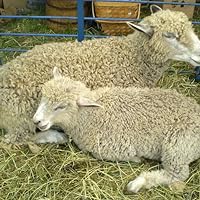
When we think of the key figures of early American history, we think of explorers, or pilgrims, or Native Americans--not cattle, or goats, or swine. But as Virginia DeJohn Anderson reveals in this brilliantly original account of colonists in New England and the Chesapeake region, livestock played a vitally important role in the settling of the New World. Livestock, Anderson writes, were a central factor in the cultural clash between colonists and Indians as well as a driving force in the expansion west. By bringing livestock across the Atlantic, colonists believed that they provided the means to realize America's potential. It was thought that if the Native Americans learned to keep livestock as well, they would be that much closer to assimilating the colonists' culture, especially their Christian faith. But colonists failed to anticipate the problems that would arise as Indians began encountering free-ranging livestock at almost every turn, often trespassing in their cornfields. Moreover, when growing populations and an expansive style of husbandry required far more space than they had expected, colonists could see no alternative but to appropriate Indian land. This created tensions that reached the boiling point with King Philip's War and Bacon's Rebellion. And it established a pattern that would repeat time and again over the next two centuries. A stunning account that presents our history in a truly new light, Creatures of Empire restores a vital element of our past, illuminating one of the great forces of colonization and the expansion westward.
Virginia DeJohn Anderson is Professor of History at the University of Colorado, Boulder. She is the author of New England's Generation: The Great Migration and the Formation of Society and Culture in the Seventeenth Century, Creatures of Empire: How Domestic Animals Transformed Early America, and American Journey: A History of the United States.
To purloin a phrase, well-behaved livestock rarely make history. Indeed, livestock rarely make history at all, and yet as the author herself points out, neglecting to include the role of livestock in the early history of America ignores a very important point of contact and conflict between the arriving English colonists and the Native American inhabitants of the land. The early records of the time are full of references to animals - lost cows, stolen pigs, livestock attacked and mutilated by dogs and wolves, disputes over brands and earmarks, fines over damage by livestock, broken fences, destroyed crops.
For farming settlers, livestock played an immensely important and central role in their lives, and dismissing that role does them and history a major disservice. One of the main distinguishing characteristics, in the English mind, between themselves and the natives was their concept of agriculture, of 'improving' the land - to the English un-farmed, unimproved land was therefore 'empty' and belonged to no-one and could be claimed. Livestock again played a substantial role in this, pushing the boundaries of the English-claimed land further and further beyond the settlements in search of pasturage and grazeable land. Lacking the labour necessary for the intensive husbandry they were used to in England, the settlers let their livestock range freely, and therein lay the seeds of another source of the conflict.
There was a fundamental disconnect between the way animals were viewed - Native Americans not only had no concept of domesticated animals, but no concept of the idea of animals as property. It was near impossible for the natives to distinguish between the wild animals of the forest and the almost-as-wild strange new animals of the settlers roaming freely in their traditional hunting grounds. What difference was there between killing a deer in the forest and killing a cow? To the settlers there was all the difference in the world. Much of the early disruption and violence of the colonial era could frequently be traced to disputes over a cow, a horse, a pig.
I found this a really interesting read, a truly original approach to history and one I confess I'd never thought about myself. One rarely thinks of cows of agents of historical momentum, and yet it is hard to argue against it in reading this book!
I'm going to get the negatives out of the way at the outset. First, the work is over-billed as "stunning" (although there is a certain ironic twist to that term in relation to livestock). To those working in agricultural history, the arguments in the book are welcome, but not surprising. For those not on the inside of the field, the sometimes labored exposition diminishes the impact of the work.
Second, the author is inconsistent in the degree of agency assigned to animals. A scan of reviews in this forum indicates that reviewers diverge on this, too. Were cattle and hogs and horses mere tools of settlers, or were the animals themselves historical actors? In the end the author says that "livestock could hardly be blamed for everything that happened in early America" (242), which at least implies they might be blamed for some of what happened, and therefore have some degree of agency. This has implications. It seems to say, animal agriculture was, perhaps is, the problem. Perhaps, without livestock, people could get along.
Third, I don't get quite what I need from the book in order to assess the role and impact of livestock on the imperial frontier. There are obvious things left out that must have had an effect on events. What breeds and types of livestock are we talking about? What are their behavioral traits? In a lengthy discussion of how settlers and Indians thought about animals, the author somehow never gets around to eating them. What food or other use did settlers and Indians make of the animals? How much meat did they eat? Did Indians find European cattle tasty, or was venison, to their taste, better? There are large implications to this.
Now, all these things out of the way, I offer thanks and praise to the author for dealing seriously and substantially with the role of livestock on the English colonial frontier. Indeed, there is a certain template to take from the work and consider in relation to imperial encounters elsewhere in the world, as well as to extend across the North American continent. Personally, I think we need to surrender a little bit of agency to animals, although not in a short-term way, but rather in the long term of co-evolution.
I expected Creatures of Empire to be essentially a follow-up or expansion on Ecological Imperialism--the title is clearly a play on it, after all. It turns out that it's actually a lot more like facing east from Indian country. It focuses narrowly on the New England and Chesapeake Bay colonies, and in both cases contrasts the cultural understanding of animals in general and particularly European livestock mammals between settlers and indigenous peoples. It's full of fun anecdotes and insightful observations on ecological "middle grounds," creating a postmodern ecology that draws in cosmology, gender roles, land management concepts, and of course, power.
I was refreshingly surprised by two conclusions that are necessarily standard in historiography on this subject. The first is that it derives its picture of settler culture not just through settler sources but with a fairly extensive treatment of the role of livestock in society and brand management in England. That perspective feels crucial, shedding a lot of light on how settlers saw themselves and why, and giving them an explicit sense of historical continuity. The other thing is just that Anderson often notes relative population sizes and trends, incites them as key drivers of livestock management habits and both internal and external politics. It's not like she's spelling out a secular cycle or talking about multiethnic frontiers but it acknowledges the demography underlying colonization.
My only real problem with the book is that it gets a bit repetitive by the end, a common problem for histories that are loosely thesis driven and discuss the same problem from a variety of angles It's still relatively short and readable, but for my purposes there was probably just a little bit too much evidence relative to the conclusions drawn.
Virginia Dejohn Anderson’s Creatures of Empire is interesting reading. While Anderson describes her work as an environmental history, I think environmental-social history would be more accurate. Anderson’s approach is novel but I believe this is one of the few times where I wished a book were longer.
An intriguing and convincing story about how animals (especially cows and pigs) created the landscape of 17th century America and how they probably did more to inspire both the expansion of colonial governments and increased conflict with the Indians than any other factor.
Anderson shows how Virginia and Massachusetts were forced to pass innumerable laws about livestock "government" in this period, from requiring the fencing of corn and tobacco fields from foraging livestock, to hiring a "town bull" to mate with the cows, to making treaties with Indians respecting the return of marked or unmarked (by ear clippings) pigs. Anderson also shows that the mobility of "free range" animals (unlike in England no one was willing to take the time and effort to grow food and feed them in a pen, they just roamed the countryside) and their insatiable demand for pasture (usually 3 to 4 times as many acres were devoted to pasturage as crops) became the major reason for colonial expansion and therefore for wars with the ever-retreating Indians.
This is a great book that shows the important role animals played in the English conquest of the Eastern seaboard. Animals wandered far from white settlements destroying Indian fields and displacing game, thus undermining Indian subsistence. Whites also brought new ideas about property that led to conflicts between whites and Indians, as they tried to enforce their ownership of animals that had wandered far from their settlements.
The introduction of cattle and hogs was one of the consequences of European settlement that has gotten little attention in standard histories. These animals had very different meanings to Indians and Europeans. What the animals did, and what people did with them, really mattered, and that is made clear in this book.
Like slaves brought across the sea as property chained to ships but prior to that horrendous violation of human rights, the English transported cows, hogs, dogs and horses to suit their needs in a Land far from home. To them, it was empty space, lower-case "l" land waiting to be occupied, tilled and worked, and with that labor came the right to own--because through hard-work and destiny one earned his stakes and individual right to ownership. These domesticated animals were an extension of their culture and conscripted accomplices on their mission. This mission was as Christian in its ideals as it was English in character. The people already native to the New World had not yet figured out how to be "civilized" like they had. No, they had not ingrained the principle of the dominion of man in themselves. Instead, they lived dynamically with the seasons and with the wild land they inhabited, whether this meant valuing movement over stationary land cultivation, or a reciprocal respect for the native creatures they co-inhabited that land with. The natives peoples of the New World lived according to concepts according to their own space and their own relationship with the environment. Virginia DeJohn Anderson tells this narrative of the encounter of the English and the native peoples of the New World while maintaining a role for the livestock the English brought with them. It is a heavily sourced historical monograph. With the English perspective of livestock and property rights in mind, she carefully reveals how these "civilized" peoples adapted to the New World with their animals in ways inconceivable to the Native peoples. The clash of view over "Nature's agents," the animals, escalated tensions to the point of irreconcilable difference. The text is thoroughly cited with an extensive bibliography pointing towards many primary and secondary sources. Anderson invested a lot of time in discovering and interpreting the evidence. Her sources are telling, but some of the arguments seem less convincing--mostly the book shines when she lets the sources speak for themselves. This is a skill in its own right, and reason enough to spend time with this study. Ultimately, I enjoyed this way of thinking about history. It's value rests not just in taking a second look at the other facets of nature and environment beyond the strictly human-to-human encounter (which makes for a richer, more thorough, more deeply contextual history), but also in the perspective it puts on the entire conquest of the New World. With the ownership of animals being so crucial to the English in the seventeenth century, I find myself looking at the proceeding four hundred years with a cleaner lens that distinguishes the English character that would evolve into the "American," someone more obsessed with their frontier, their private property and ownership rights, and their public spaces, albeit somewhat paradoxically! On a personal level, I often enjoy comparing the Western "American" character with the "Eastern" character--less personal, more group-deferring. Yet Anderson's text illuminates the historical period this similar dichotomy of views by hinging it on the often overlooked third party inhabiting the same space as everyone else: the animals, or, creatures, which only became "of empire" because the English wanted them to be so.
Virginia DeJohn Anderson’s Creatures of Empire: How Domestic Animals Transformed Early America is an environmental history of colonial North America, focusing on the relationship between domestic animals and colonization. She argues that domesticated animals were central in the European development and settler colonialism of colonial North America. She asserts that domesticated animals that Europeans introduced to the Americas, including horses, cattle, pigs, and sheep displaced native flora and fauna. Through the analysis of colonial government documents and correspondence, Anderson found that domesticated animals that escaped onto Native American lands strained diplomatic relationships and became recognized as a symbol for the domination of the continent.
Creatures of Empire contributes to the historiography of colonial America by presenting the environmental and diplomatic implications of early European settler colonialism, specifically arising from the production of colonial livestock. The book effectively explains the significance of domesticated animals as a major point of contention to Native Americans in the wake of settler colonialism. Anderson exclusively focuses on the role of domestic animals within the English colonies of North America, primarily pulling from correspondence and government documents from European and Euro-American authors. Although Creatures of Empire pulls exclusively from European colonial sources, she effectively reads into the perspective of Native American communities in the transformation of North American ecosystems as domesticated animals joined Europeans in their invasion of the continent.
An interesting work that describes how colonists used their animals to take land from indigenous peoples. It points out the differences in ideas of nature and how one should respond to it. Native Americans had not seen the likes of animals Europeans brought to this continent. Therefore they, at first, treated them like the animals they were use to. They considered them to have spirits just like the creatures they were use to. After less then a century of interaction with colonists they learned colonists would have their animals as the vanguard of taking their land. They found that trying to get compensation for damage to their crops from biased colonial courts was useless. And so on, the rest is history that should be taught rather than the myths and half truths taught in school.
In today’s climate , a book on the beginning of America without a mention of slavery or the connection of “chattel cows” to “chattel slavery” is negligent history. Yet, this is a topic I’ve never previously thought of or encountered, so, I gave it four stars, really more a 3.
An easy read, but much more academic than I'd expected. I read it for pleasure and it was interesting and kept me occupied, but I wouldn't call it entertaining like a mystery, thriller or historical fiction for me.
Virginia Anderson argues that livestock played a surprisingly significant--if not central--role in exacerbating tensions between Indians and colonists in colonial America. "Although livestock could hardly be blamed for everything that happened in early America, they certainly helped to shape the course of events. As indispensable to colonial survival as they were inimical to Indian sovereignty, livestock enabled the English to extend their dominion over the New World with remarkable speed and thoroughness" (242). Many of the tensions and even wars began with colonists' pigs trampling Indians' cornfields, Indians killing the pigs and colonists seeking retribution. The colonists did not have sufficient time to fence in and care for their livestock as they did in England, so grazing of pigs and cattle became commonplace. This did not go over well with the Indians who had unique concepts of animals--never property and usually revered to a degree above that of the colonists. The only domesticated animal in the New World was the dog, which was not used for food. As pigs were more like dogs than cows, the Indians were more receptive to them of the two (i.e. in trading for them and raising them). The colonists viewed their livestock as agents of civilization and settlement--i.e. tools first to nominally civilize Indians but truly displace them as they claimed more and more land.
"No wonder that expressions of Indian resistance, in the nineteenth century as before, took the form of attacks on livestock as hated symbols of American encroachment" (245).
Indians often did cooperate with European and American property laws in hopes of compromising to maintain their way of life, but this was not what was not on the agenda for European and American expansion. "Therein lies the tragedy of the story. Indians found room in their world for livestock, but the colonists and their descendants could find no room in theirs for Indians" (246).
Also not just the story of livestock in New England, but the south too.
"A cow is an imperial beast." --Brendan McConville
Anderson's focus is the introduction of livestock, chiefly cattle and hogs, to England's first colonies in the 17th Century. In so doing, these animals proved challenging to the settlers who were accustomed to Old World rules of husbandry, to the Native Americans who had no previous experience with either livestock nor English farmer, and to the animals themselves which were often left to fend for themselves. The treatise is interesting and challenging, but has significant shortcomings. For one, Anderson focuses rather too tightly on the English, missing opportunities to compare developments with rival cultures. And more importantly, she is insensitive to a true economic understanding, perceiving livestock as covert weapons in a cultural war.
This is a book for the history nerds. If you are not intrigued by the idea that domesticated animals might have had a significant impact on the colonization of North America by Europeans, don't bother reading this one. I found the material fascinating, but there were some really repetitive parts of the book that needed to be cut. Great book overall though!
(I don't know if the print version of this book has the colonial maps I was craving, but the Kindle version was sorely lacking!)
Reads like a Ph. D. thesis. If you have an interest in early North American history and want to read about how livestock affected the lives of both Native Americans and British settlers, then this book is for you.
Seemed a bit too wordy to me. But overall, I really enjoyed the second half for its economic content, especially the discussion about Indians competing with English selling pork and the anger that caused, the overall theme of land and labor scarcity, and the discussion of property rights and fencing.
I am actually impressed the author made a seemingly dry subject so interesting. She did, however, begin to repeat herself quite often near the end of the book. If she chopped the book in half, while all the facts were still new, it would have ended on a better note.