«Elle avait de grands yeux vides de chien un peu con, mais ce qui les sauvait c’est qu’ils étaient bleu azur, les jours d’été. Des lèvres légèrement entrouvertes sous l’effort, humides et d’un rose délicat, comme une nacre. À cause de sa petite taille ou de son excessive blancheur, elle avait l’air fragile. Il y avait en elle quelque chose d’exagérément féminin, de trop doux, de trop pâle, qui me donnait une furieuse envie de l’empoigner, de la secouer, de lui coller des baffes, et finalement, de la posséder. La posséder. De la baiser, quoi. Mais de taper dessus avant.»
La tranquillité d’un village de Galice est perturbée par l’arrivée d’une jeune femme à la sensualité renversante, d’autant plus attirante qu’elle est l’innocence même. Comme tous les hommes qui la croisent, Tomás est immédiatement fou d’elle. Ce qui n’est au départ qu’un simple désir charnel va se transformer peu à peu en véritable amour.
Suiza si chiama in realtà Sylviane ed è francese: ma in questa affascinante parte della Spagna chiamata Galizia diventa Suiza perché tutti la credono svizzera. È facile scambiarla per qualcos’altro: Suiza non parla spagnolo, è naive, indifesa, in qualche strano modo bambina e donna, bella e attraente - oh sì molto molto attraente. Ai primi incontri la gente la scambia per povera di mente, un po’ ritardata, non proprio intelligente. Poi, conoscendola meglio, non solo la si apprezza per altri doni e virtù oltre alla sensualità del suo corpo, ma si sente palpitare un’anima bella, si avverte sensibilità e umanità.
Qui e a seguire, angoli di Galizia.
Al primo incontro Tomàs si sente dannatamente e “mortalmente” attratto da lei: Suiza è al bar del paese, cameriera schiava del padrone, è appena arrivata nel villaggio, lui la vede e non riesce a toglierle più gli occhi di dosso. L’afferra per il polso, la trascina via, alle proteste del proprietario del bar lo colpisce e stende per terra, si porta dietro la donna con le buone o con le cattive (inizialmente soprattutto con le cattive). E appena trova un angolo di strada adatto, la possiede con forza e brutalità. Uno stupro?
Il romanzo d’esordio della francese Bénédicte Belpois rimane sul filo di questa ambiguità e si configura come un country dark, o rural noir, genere che sta diventando diffuso (ne ho appena letto un altro, sempre francese) Racconta una storia d’amore anomala, estrema, disturbante, forse esagerata, che nasce da un gesto di violenza e mai diventa davvero romantica perché i personaggi coinvolti e il tono della narrazione tengono distante il colore rosa, l’umore romantico. E per le prime decine di pagine la tentazione di mollare la lettura è stata forte, proprio per il disagio che mi suscitava la storia e il modo di narrarla.
Il quarantenne Tomàs ha una piccola azienda agricola che coltiva direttamente insieme a Ramòn, un anziano contadino, proprietà che fa di lui il più ricco del paesello galiziano. Ha studiato, s’è laureato, e poi ha ereditato. Vive solo, nel caos e nella sporcizia, in semplicità e ruvidezza, vedovo già da sedici anni. È stato tirato su da Ramòn, il suo contadino e da un’anziana governante, Agustina, figure che col tempo ha imparato a sentire come padre e madre, sentimento che però tace e nasconde come tutti gli altri. È abituato a non mostrare emozioni, a pronunciare poche parole concrete che non rivelano neppure i suoi veri pensieri. Durezza e asprezza che si riflette sul lavoro di contadino e allevatore e sulla terra di Galizia, che nulla regala. Durezza e sofferenza che sono conseguenza della malattia che viene diagnosticata a Tomàs.
Suiza è indifesa, ingenua, innocente, coi suoi capelli biondo rossi e la pelle candida. È facile capire che ha sofferto, si comporta come un cane che conosce il bastone. È cresciuta senza futuro, in un istituto. Poi, un giorno, ha deciso di volere andare a vedere il mare e in autostop è arrivata in Galizia. Suiza, la donna del titolo, rimane alquanto sconosciuta, indefinita, misteriosa, nonostante le siano offerti alcuni brevi inserti in corsivo che esprimono con la sua diretta voce il suo punto di vista sugli accadimenti. E anche il finale, che Belpois scegli di raccontare al futuro, è momento misterioso perché la scelta del tempo verbale lascia aperta la porta alla speranza. O no?
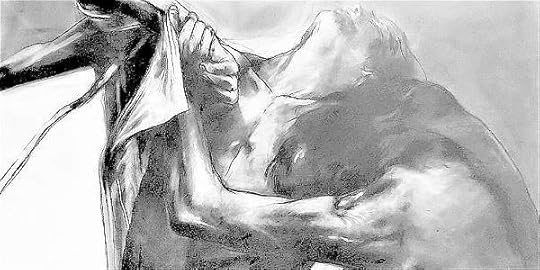
Luis Caballero, pittore colombiano così citato nel romanzo: “All’epoca avevo trovato scioccanti quei corpi di uomini nudi, tesi, in posizioni inequivocabili, ma ero invecchiato e ormai mi rendevo conto che a colpirmi era stato soprattutto il senso di eccitazione provocato dalla vista di membri maschili. Avevo avuto paura che mi piacessero.”
Non è facile suscitare empatia, ma neppure simpatia, per un narratore così brutale come Tomàs. Eppure Bénédicte Belpois ci riesce, forse per la “voce” che riesce a dargli, forse per la profonda compassione che nutre per i suoi personaggi. Capisco chi di fronte alla brutalità e alle dettagliate descrizioni di atti sessuali ha abbandonato la lettura, o l’ha portata a termine odiando il romanzo: ma perseverando nella lettura ho scoperto un libro insolito e affascinante, a suo modo misterioso e perfino incantevole. Un libro che sa togliere il fiato.
Suiza is translated from the French by Alison Anderson from Bénédicte Belpois’s 2019 novel of the same name
It opens, ominously:
People around here are bound to say anything they want about me, given what happened. Anything. That it was in my genes, the violence and boredom, that I really did take after my father and it was sure to happen anyway.
Our narrator, Tomás, is almost 40, a well-off farmer in an otherwise impoverished small Galician village, but taciturn and lonely, his parents both dead and his wife having died 16 years previously, his only two real companions his farmhand Ramón and his former wetnurse, Agustina. As the story he tells opens he has just received a diagnosis of advanced lung cancer.
Generations under the yoke of poverty, and a financial crisis that had broadsided us added another layer of difficulty. The hardship had dug in, we were like stones surprised by a winter frost. The most striking thing was that since we were used to doing without, and couldn’t deprive ourselves any more than we already had, we’d become sparing even in our feelings and our relations with others. We didn’t say much, just what was essential, indispensable. We kept to a bare minimum. We didn’t know how to deal with gentleness. Our values had not changed—friendship, honor, love, respect—but we only expressed them in deeds, and they too were reduced to an extreme. Words had disappeared. Happiness was fleeting, almost a miracle, and often culinary. A good glass of wine, a good plate of meat, a dark bread that stuck to your guts were more satisfying than any compliment. Poverty hadn’t made us mean, but it left us close-fisted when it came to feelings. I should have been more talkative, since I was richer, but alas, I was even more rough around the edges than the others, because I had constructed myself with this lack of love, and no one had been able, or had had the time, to teach me otherwise. ... Sixteen years since Rosetta died. Sixteen years of solitude. That must be why I was on a short fuse, even with my late-stage cancer. I would turn forty at Christmas, I was still in the prime of life, in spite of my illness. I should have bought myself another wife, another Rosetta . . . Even if old Ramón still called me kid, or son, or boy, time had had its way with me like with everyone. I felt old, worn out, sick, and bitter. And I had been talking to myself for ages.
On his daily visit to the local bar, where he drinks expensive wine only he can afford, he discovers there is a new member of staff, a woman referred to as “Suiza” who was discovered sleeping rough in the chicken sheds.
“Where’s she from?” “Switzerland, apparently. That explains the name. In fact, we don’t even know her name. Some Swiss name, probably, something not from around here. But everyone calls her Suiza.”
In fact Suiza, whose real name is Sylviane, is from France, a fact the reader discovers in some slightly incongruous sections told from her perspective. Institutionalised as a girl, she hitchhikes to Spain simply, and naively, in search of the sea and piece of evocative guitar music.
Suiza is unable to communicate verbally with the villagers, in part due to language and in part her own lack of education.
“A French-Spanish dictionary.” “Why French? She’s Swiss isn’t she? Why not Swiss-Spanish?” “The Swiss speak French, Agustina, there’s no such thing as Swiss. They can speak German, too, or even Italian.” “They don’t have their own language, they have to go stealing from others? The buggers! Then they come and lecture us with their money and their banks, and they don’t even have what it takes to talk to each other . . . What a bunch of savages, that’s for sure!” “They do have their own language, Romansh, but not many Swiss people speak it, to be honest.” “Then it’s not really a language, is it. Savages, I tell you.”
But her body drives the men of the village wild, the bar owner making it clear that servicing him is part of her duties:
I don’t know what it is about her that drives us all half crazy. I can see she’s not like other women, that she gives off this impression of being a little bit stupid and it’s not just because of the language barrier. But I don’t think she is stupid, not really, it’s something else. It’s as if she’d been arrested, prevented from growing up.
On his return visit to the bar, and filled with animal lust, Tomás literally drags Suiza out of the bar, forces himself upon her in the street, then takes her home as his trophy.
What follows is a rather odd “love” story, as Tomás, with his life nearing an end, comes to appreciate better his relationship with Ramón and Agustina, and, very gradually, moves from lust to a form of love for Suiza and to treating her like a person rather than a sex doll he owns. And throughout the sense of dread from the ominous opening of the story hangs over the reader.
Mixed feelings on this one. It’s well written with a very earthy feel, but it’s hard not to feel this is a story of abuse rather than a love affair but it wasn't clear if that was the intention, and the inclusion of Suiza's perspective didn't really work for me as it was too infrequent and brief to really enable the reader to understand her and it may have been better to leave her as an enigma.
Thanks to the publisher via Netgalley for the ARC. 2.5 stars
THIS REVIEW IS ONE BIG FAT SPOILER, READ AT YOUR OWN PERIL!
A man with lung cancer sees a busty woman in a bar who looks a bit daft. He gets a raging erection. He drags her into the nearest field and rapes her. She doesn't protest. Then her literally drags her home to his house and keeps her there. She does the cleaning and cooking. The woman has some sort of learning disability and stays because she feels protected (from other rapey men, who knows?!!) Eventually she gets pregnant, there is talk of marriage. She has made him into a "better man". Meanwhile he's thinking of blowing his brains out with a gun. Nyawwww, there's lovely (I'm being facetious!! What in the actual fuck?!!) And this book was written by a female midwife! O-kayyyyy!
It’s hard to elicit sympathy for a rapist, yet somehow Bénédicte Belpois achieves this in her debut novel. The voice helps – I loved it from the beginning – and the author’s deep compassion for her characters, however deeply flawed. Although I’m sure I’d have little sympathy for Tomas if I met him, this unusual and poignant novel is a contender for my favourite reads of the year. https://annegoodwin.weebly.com/annecd...
During the time of my youth, there were times when I felt like I want to escape my hometown just to find out what the other side of the horizon looks like. Unlike me, Suiza chooses to follow her desire to see the sea even at the cost of losing important things. She hitchhiked and got stranded in Galicia, far from her comfortable home in France. It’s in Galicia that she was mistaken as a Swiss, taken as a waitress at Álvaro’s bar, and being labelled as stupid by the villagers due to the fact that she couldn’t speak Spanish. It was at this time that Tomás came to her rescue, kidnapping her in front of everyone at the bar.
Tomás’s life is full of loneliness. He never felt any real love throughout his life. His father committed suicide as soon as he reached adulthood, telling him in his suicide note that he wishes to follow Tomás’s mother footsteps in heaven and left him with a farm to tend. He felt he couldn’t love his first wife, Rosetta, who ended up dying young after less than 5 years of marriage due to breast cancer. On top of that, he is suddenly diagnosed with lung cancer at the height of his loneliness. It was at this time that he encountered Suiza during one of his frequent visits to Álvaro’s bar when he could not hide the desire aroused in him seeing her up close.
What follows is a tragic yet sweet love story in unlikely circumstances to happen in real life. Bénédicte Belpois tells the story from two points of view, both Tomás and Suiza get their shares of voice to recount their stories. Tomás’s thoughts are described using bestial elements with how he desires to take Suiza into his bed and screw her, whereas Suiza’s mind is depicted as selfless with no material wants. The scenes that happen in between of their relationship are intense with frequent depictions of their lovemakings, about which I am sure not everyone would be able to digest it properly.
However, Suiza ends up curing the hatred and contempt that Tomás had towards life. It’s the story of healing, how one person could heal another’s wounds. The meeting between Tomás and Suiza could simply be discerned as serendipity, an unlikely thing to happen, yet it still happens. By living together, they soon learned how to be tender towards each other. Other people around Tomás, the old farmer helper Ramón and the former wetnurse Agustina told him how his behaviours and demeanours changed after the arrival of Suiza in his life.
I don’t know if I like or hate this book. The story is really simple, yet the prose is beautiful, and I’ll have to admit that the translation of Alison Anderson is rich in words. It kinda reminds me of the simplicity of daily life in old age, with a depiction of Tomás and Suiza as Adam and Eve in a communal village in Galicia where everyone knows everyone else. Bénédicte Belpois as a Frenchwoman really does a great job in depicting the minds of men and the daily life in Galicia, as she wrote this story during a long stay in Galicia. Perhaps this is the kind of story that could only be produced through the encounter with Others.
What jumps out here is the humanity - broken, sometimes brutal, but always hoping for something approaching the presence of love. Benedicte Belpois' male lead is rough hewn, at once old fashioned and painfully self aware. A highly literate, wounded animal. The female lead - our titular herone Suiza - remains enigmatic throughout. She is a survivor, perhaps even a savant. Together, she and Tomas start to build a life; yet they live always in the looming shadow of death. Even in translation, 'Suiza' is intense, a novel of sorrow and sex, of revelation and ruin. At points it bleeds. Yet, it is always beautifully observed. Although it sometimes veers into discomfort - in both content and style - it draws you into its world of peasant ritual and modern malaise, recreating the rural Galician landscape with post-Impressionist dash. This is a gem of a book. Maybe not a fully polished jewel but a rare and lustrous uncut stone, its sparkle still spattered with dirt.
Improbable histoire d’amour entre Suiza jeune femme paumée et déracinée , d’une beauté troublante et Tomas, agriculteur espagnol veuf âpre et puissant . Ou comment l’Amour peut ouvrir les yeux , les cœurs et rendre meilleur .. Toutefois la fin est violente et égoïste
Merveilleux récit, qui sait dire comme rarement la nature du désir masculin, ce lien étroit entre possession et virilité, puissance aveugle et honte, bestialité et remord. Je retrouve très exactement mon désir dans la formulation de celui de Tomás. Belpois crée des personnages crédibles, campés, motivés, pérennes. Elle a un sens de la psychologie comme des dialogues. Elle réussit des scènes érotiques comme j’en ai rarement lu, et qui fonctionnent précisément parce que ses personnages vivent et que leur attirance est rendue irrésistible par leur évocation littéraire.
Encore quelques caresses sont-elles trop suggestives (« (…) je l’embrasserais là où je la rendais folle de jouissance et où elle m’éclaboussait de plaisir »), et l’on regrette que l’auteure ne dise pas cuni pour cuni, ni sodo pour la chose. L’érotisme n’est-elle pas la visée littéraire la plus difficile à atteindre, et qui doit constamment jouer les funambules, entre l’écueil du mièvre et celui de la description clinique, le rose bonbon et le blanc hospitalier, le cucul et le cul ?
The single star I’ve given this book is for the objectively well written syntax, figurative language, writing conventions, etc. The plot, events, and message of this story are honestly just vile and societally regressive.
My confusion with the novel started with the fact that the title of the book is after the woman who I figured the story would center around, especially considering she endures such sexual and patriarchal abuse. However, the book has exactly three and a half moments of her perspective. None of them are full chapters. She doesn’t even speak the language of the man whose story this novel really belongs to, so even in all of his chapters, the audience doesn’t get much of what she’s saying or any of what she’s thinking. This is extremely dangerous in a novel written by a woman about a woman experiencing the harsh reality of being a woman in the world.
At best, this book is a poorly written satire. The misogyny seeping through these pages almost seems sarcastic, it’s so overused as a way to progress the story.
We meet Tomás, the novel’s “protagonist” as he’s discovered he has cancer. Up to this point and after, he’s a general asshole. Unloving to those he loves, obnoxious in his speech, and vulgar. So much so that upon seeing Suiza for the first time, he feels violently sexually attracted to her. His inner monologue made my insides twist with discomfort in the way he thought about her. He makes blatant remarks that he’d like “to kill her too-powerful femininity” and “reduce her to nothing.” After his thoughts become just too overwhelming for him to handle (the excuse this book seems to make for him), he drags this woman into a field and forces himself on her. He then drags her home and keeps her, claiming she “belongs” to him.
One of her only points of view expressed in this story is at this point when she hopes that he will keep her as she is excited to now have a home. What an utterly deranged plot point for a woman who’s just been defiled. She begins to bring her delicate womanly touch (🙄) to his home in order to prove herself useful, so that he will want her.
The rest of the novel uses gender roles to restore the problems of these characters, claiming that as she is more subservient to her abuser and captor, he in turn grows softer and feels better about his life, and she feels worthy and useful. It’s appalling that this dynamic is portrayed as love throughout this entire book.
The whole book is riddled with pro-marriage themes to give women “masters” and therefore status (?), misogynistic sentiments like women being at fault for men objectifying/sexualizing them (?), and patriarchal claims of gender roles and gendered interests solving problems within society (?). It is almost sarcastic the way pink and cooking is used to define women while ownership and math is used to define men: “you don’t know how to count and I can’t teach you. I don’t know how to make apple pie, and you couldn’t teach me.” Because neither of these things are fundamental human skills, they are gendered traits that only women and men can do separately apparently (🙄).
Unfortunately I’m cursed with the inability to stop reading books midway through, though I wish I could have just put it down and burned it so I didn’t have to read the end when Tomás decides to kill his pregnant wife and himself as a “romantic act” due to his self-predicted inevitable death by cancer. He fully believed he owned her life, enough to take it out of the jealousy that she would live to raise his child without him.
If this had been a social commentary on patriarchy and the danger of men who degrade women to uplift themselves, there would be something to learn here. But every plot point in this novel is taken for serious romanticism. It’s honestly quite dangerous for a book like this to be written in 2019, and in circulation to the public.
There is no high five or pat on the back for someone who dehumanizes someone else to start being a “better person” in their other relationships. The very thought is strange.
I am sincerely hoping I missed the mark entirely with this one. I keep trying to read between the lines, wondering if a groundbreaking perspective has been lost in translation (literally, as the original language is in French), but I can’t find it. Everywhere I look online, reviews are calling this book “a complicated love story” about “real adult life” with “complicated points.” It’s quite simple, in reality. It’s just 200+ pages of excuses for misogyny and violence against women.
This entire review has been hidden because of spoilers.
I bought it primarily because of the many emotional and extremely polarized reviews. I simply had to form my own opinion.
In reality, most of the "erotic" scenes in this book are scenes of violence. Although the farmer Tomas abuses the mentally disabled Suiza and essentially kidnaps her, she chooses to stay with him because, compared to the other men in the village, he is the lesser of two evils. She doesn't question what happened to her; instead, she completely blossoms in her role as the housewife caring for him. I can absolutely understand why many readers find this outrageous.
In my eyes, however, that is no reason for a poor rating! The story is simply not a heartwarming, easy-to-read romance novel with a self-determined, quick-witted protagonist. Anyone who likes that genre is simply in the wrong place here.
Nevertheless, love is a powerful motif in this novel: to me, Tomas is a terrifyingly realistic portrait of a man so emotionally crippled and shaped by patriarchy that he knows no other way to love than in a destructive, possessive manner.
Does this distinguish him in any way from the protagonists of modern Dark Romance literature, which female readers devour with such enthusiasm? The only difference is that Tomas isn't a filthy rich mafia boss; he’s an aging farmer dying of cancer. Readers who feel erotically attracted to a romanticized grape scene involving "Mr. Mafia Boss" find Tomas repulsive.
Personally, I find Tomas much, much more realistic than a character of Mr. Grey's caliber. The book dares to truly hold a mirror up to toxic masculinity instead of trivializing it.
The angry reactions toward the character of Suiza—who is exploited by men and doesn't even realize it—are, in my view, primarily an attempt by readers to distance themselves from such an image of femininity. Someone like Suiza is no longer "politically correct," only pitiable.
Again: for me, this is no reason for a bad review. By that logic, we would have to punish all the masterpieces of world literature with scathing reviews because the protagonists don't behave like cultivated, emancipated, and enlightened intellectuals.
Bénédicte Belpois intensified Suiza's impact on the reader by depicting the young woman as severely mentally disabled: on purpose, not by accident! Craft-wise, I find the book remarkable and the writing style hypnotic, especially for a debut novel.
I docked one star because of some narrative lulls and because I would have liked to read more from Suiza's perspective. I felt she didn't get enough of a voice, which makes it a bit harder to empathize with her and understand her motivations.
My Verdict: I don't believe it was ever Bénédicte Belpois' intention to write a sugary-sweet feel-good story. Good stories are controversial and must have the courage to be repulsive and offensive in places. To me, Suiza is good literature, even though I found many scenes terrifying and the ending sad and alarming. If we start demanding that books always confirm our opinions, follow a strict good-versus-evil scheme, and provide a happy ending, we are lost.
This entire review has been hidden because of spoilers.
"You don’t know how to count, and I don’t know how to teach you, you don’t understand. I don’t know how to make apple pie, and you couldn’t teach me. I wouldn’t understand a thing. We’ll leave it like that. We’ll share: I’ll do the counting and you’ll make the apple pie, all right?”
Trigger warning: mental, sexual and physical abuse is present in this book.
Dark book about healing power of love.
The story shows how difficult life can be, when even your own family is not accepting you. At times, especially at the beginning, it’s fairly disturbing, a lot of mentally hard things are happening to the main character. But at the same time, this book is an eye opener to the world we are living in, full of judgements, grunges, grumpiness. Suiza is like a first ray of sunshine after the long, dark winter.
Tomas is a farmer in Spain, he loves his land, but he is broken mentally. He finds out that he’s got cancer, that makes him into even more of a bitter person. Until one day, whilst drinking in the bar, he sees her, Suiza.
Suiza is a foreigner, she left her own country, because she wanted to see the sea. She traded her body in order to get free truck rides, to Galicia. She ends up being a waitress in Alvaros bar, without speaking a word in Spanish.
Tomas is driven by lust and he can’t control his emotions. What impact they will have on each other? Could they heal each other's wounds?
Truly beautiful story, this book is full with broad spectrum of emotions. It’s about finding yourself (for example everyone treated Suiza badly back home, and kept saying that she is stupid, but simple acts of kindness have transformed her into someone else). I like that author has used small commune, where everyone knows everyone, their prejudice towards the stranger and how their views have changed after some time. How person living with their childhood traumas, can still bloom in the right surrounding.
I highly recommend this book to everyone, who likes reading books about realistic, life-like stories. This book won’t leave you indifferent
Separate thank you to Alison Anderson, for the beautiful translation of this book.
Un vrai choc ! Un roman qui commence comme un truc de cul bien torride et… bien en peine avec les nouvelles masculinités…
Et, petit à petit, Bénédicte Belpois m’a emmené là où elle voulait, et je l’ai suivie… Bon gré, mal gré… Un premier roman d’une magnifique construction, d’une grande ampleur et tout en délicatesse.
L’histoire d’un paysan de Galice, tout malade qui tombe raide dingue amoureux de Suiza, une fille un peu paumée.
Mais merde ! Quelle fin ! Pourquoi ?
Et, s’il vous plaît, les mecs violents et les femmes qui ne sauraient que faire sans eux (à part le ménage et la cuisine) … on en a un peu soupé, non ? Pourquoi construire un personnage sympathique avec ce qui ressemble quand même bien à un gros connard… Avec ça, je suis très moyen fan
I quickly grabbed this book in a bookstore as I was buying some other books. I definitely did not expect a story like that! As I started the book I was quite startled by the first few pages as they are a bit vulgar and immersive. But the more I read the more I got to know the protagonist and saw a change in character. As for Suiza, I think the fact that we get so little insight of her own thoughts makes it hard to get to know her without only seeing her from Tomás’s perspective. To be fair I did like the book and thought it was a nice read. And even though the end shocked me it kinda made sense that it ended like that? Idk.
I’m very conflicted about this book, having considered scores between 2 and 5. On the one hand, it is beautifully written prose that was a pleasure to read. In the other, it depicts a deeply misogynistic society, where women are seen as being there for the pleasure of men and no-one bats an eyelid in the event of the rape of a vulnerable young woman. I disliked the male protagonist from the beginning when he describes his sexually incontinent reaction to Suiza, and found it difficult to reconcile my acceptance of their relationship as it developed. And the last page was a real jaw-dropper!
Would be more stars but the ending is horrible. WTF with that? The rest is actually pretty good. The ending though, personally, I don’t see it as even being in character. A million ways this could have wrapped up, any would have been better. And I’m not pining for a happy ending, just not this one.
This entire review has been hidden because of spoilers.
Told from both POVs, Suiza is about a dying man who kidnaps a non-verbal girl to be his wife. Painfully realistic, this is a terrifying and bitter 'love story' that is completely dissatisfying in the best way possible. I have no idea how to explain it. Impossible to put down but I will never pick it back up again.
3.5 ⭐ Un romanzo che non lascia indifferenti, mi ha respinto ed attratto al contempo; sullo sfondo di una Galizia rurale la storia di una e di tante relazioni umane con spunti di riflessione (e di fastidio...voluto?) su temi delicati e profondi. La gestione della parte finale ha penalizzato il flusso della narrazione, pur ammettendo che è stata una chiusura d'impatto.
Livre très bien écrit. Mais dont la lecture n’est pas indispensable. Un agriculteur solitaire rencontre une jeune femme, superbe, mais paumée. C’est un coup de foudre, l’Amour...alors qu’il vient d’apprendre qu’il a un cancer très grave.
Sad, offensive and dark yet somehow romantic. Emotional damage is much more intense than this world gives it credit for and this book sheds serious light on that.