Jump to ratings and reviews
Rate this book
Rate this book
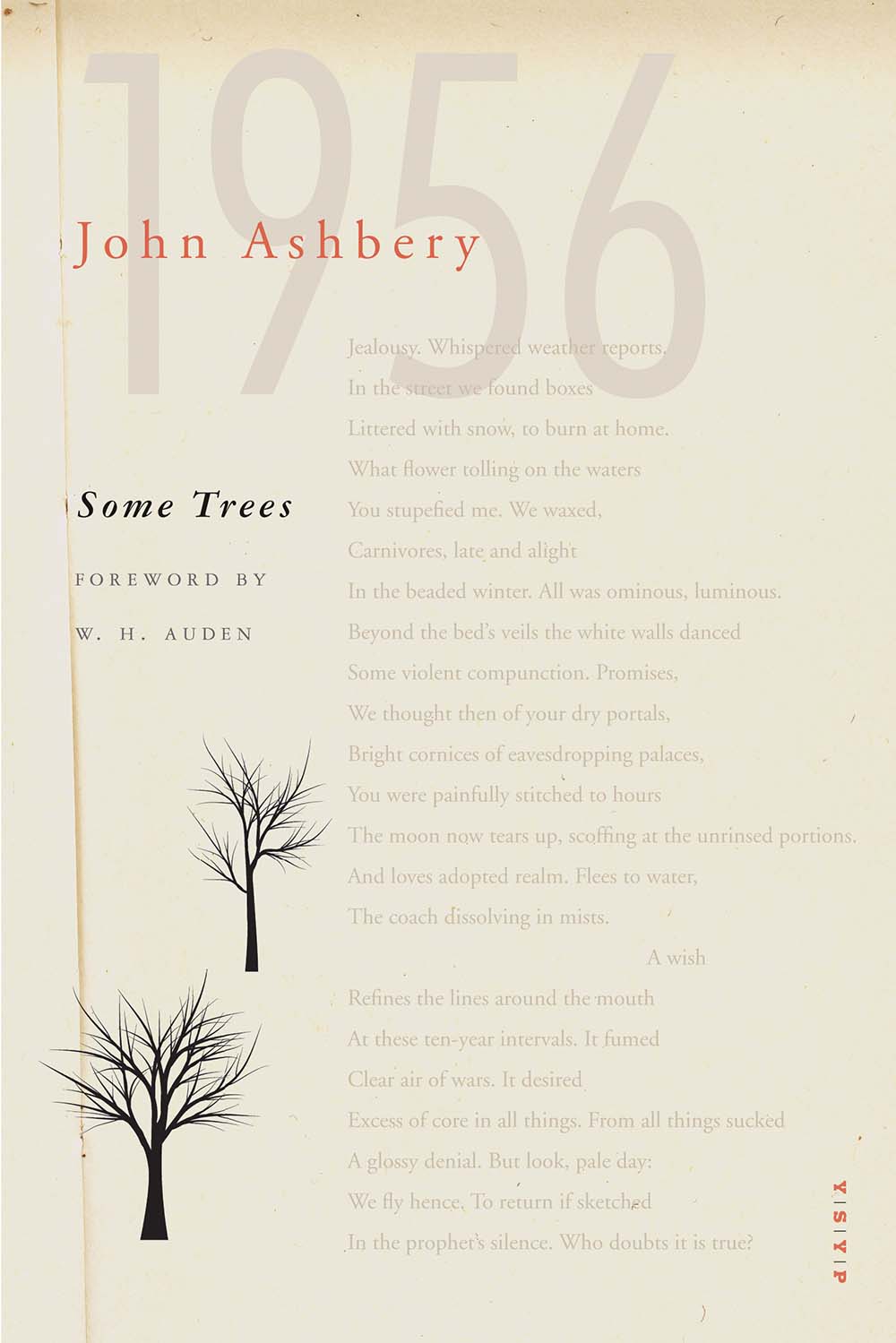
A capsule of the imaginative life of the individual, Some Trees is the 52nd volume of the Yale Series of Younger Poets
 
Comparing him to T. S. Eliot, Stephanie Burt writes that Ashbery is “the last figure whom half of the English-language poets alive thought a great model, and the other half thought incomprehensible.” After the publication of Some Trees, selecting judge W. H. Auden famously confessed that he didn’t understand a word of it. Most reviews were negative. But in this first book of poems from one of the century’s most important poets, one finds the seeds of Ashbery’s oeuvre, including the influence of French surrealists—many of whom he translated—and abstract expressionism.

96 pages, Paperback

First published January 1, 1956

25 people are currently reading
609 people want to read

About the author

John Ashbery

290 books478 followers
Formal experimentation and connection to visual art of noted American poet John Ashbery of the original writers of New York School won a Pulitzer Prize for Self-portrait in a Convex Mirror (1975).

From Harvard and Columbia, John Ashbery earned degrees, and he traveled of James William Fulbright to France in 1955. He published more than twenty best known collections, most recently A Worldly Country (2007). Wystan Hugh Auden selected early Some Trees for the younger series of Elihu Yale, and he later obtained the major national book award and the critics circle. He served as executive editor of Art News and as the critic for magazine and Newsweek. A member of the academies of letters and sciences, he served as chancellor from 1988 to 1999. He received many awards internationally and fellowships of John Simon Guggenheim and John Donald MacArthur from 1985 to 1990. People translated his work into more than twenty languages. He lived and from 1990 served as the Charles P. Stevenson Jr. professor of languages and literature at Bard college.

Ratings & Reviews

What do you think?
Rate this book

Friends & Following

Create a free account to discover what your friends think of this book!

Community Reviews

5 stars
220 (38%)
4 stars
203 (35%)
3 stars
98 (17%)
2 stars
37 (6%)
1 star
9 (1%)
Displaying 1 - 30 of 58 reviews
Profile Image for Matthias.
397 reviews8 followers
June 1, 2019
I used to read more poetry in the past, this is the first complete volume that I've read in a while. This one I read because it is quoted in Siri Hustvedt's Memories of the Future. I usually find that out of 50 poems, there are 2 or 3 that I can relate to, that speak to me. This doesn't mean the others are weak: With poems, it is like with people, you have to meet them at the right time. Here, there are five out of 35. This is one of them.

Chaos

Don’t ask me to go there again
The white is too painful
Better to forget it
the sleeping river spoke to the awake land

When they first drew the wires
across the field
slowly air settled
on the pools
The blue mirror came to light
Then someone feared the pools
To be armor enough might not someone
draw down the sky
Light emerged
The swimming motion

At last twilight that will not protect the leaves
Death that will not try to scream
Black beaches
That is why I sent you the black postcard that will
never deafen

That is why land urges the well
The white is running in its grooves
The river slides under our dreams
but land flows more silently
Profile Image for Steven Godin.
2,782 reviews3,358 followers
October 27, 2020

The green bars on you grew soberer
As I petted the lock, a crank
In my specially built shoes.
We hedged about leisure, feeling, walking
That day, that night. The day
Came up. The heads borne in peach vessels
Out of asking that afternoon droned.
You saw the look of some other people,
Huge husks of chattering boys
And girls unfathomable in lovely dresses
And remorseful and on the edge of darkness.
No firmness in that safe smile ebbing.
Tinkling sadness. The sun pissed on a rock.

That is how I came nearer
To what was on my shoulder. One day you were lunching,
With a friend's mother; I thought how plebeian all this
testimony,
That you might care to crave that, somehow
Before I would decide. Just think,
But I know now how romantic, how they whispered
Behind the lace of their aspiring
Opinions. And heaven will not care,
To raise our love
in scathing hymns. So beware and
Bye now. The jewels are for luck.


Profile Image for Jeremy Allan.
204 reviews41 followers
April 22, 2012
Pantoums, sonnets, sestinas. I will return to this book, both out of a desire to understand it better, as well as out of general desire. Because there were moments when I was reading and felt as disarmed as I always feel while reading Ashbery, but there were also moments where I felt a sheer, simple joy. At least three times I had to stop and immediately share lines of what I'd just read. It's amazing, even in this first volume, how Ashbery can simultaneously seem to speak with a common language, and yet stand so evasive to the stubborn left brain's attempts at sense-making. That frustration of the rational brain feels equal parts pleasurable and enflaming. And he makes it appear so natural, like how commentators describe the uncanny grace of a matchless athlete. That might be the most apt analogy one can make for the work of John Ashbery, after all, that he is himself a fine specimen of an athlete. Any who doubt it should just consider his dexterity compared to other "great" poets when it comes to his work in the sestina form...
Profile Image for Jonfaith.
2,141 reviews1,741 followers
October 5, 2021
Our days put on such reticence
These accents seem their own defense.


I'm gonna side with Auden here and admit much of this passed me by, blithe or otherwise.
Frankly, O'Hara was robbed.
At times a firm vision is expressed but too often this is swept aside by caprice and folly.
I failed this work, undoubtedly.
Profile Image for Dolors.
604 reviews2,803 followers
March 19, 2013
SOME TREES OUT OF A HUGE FOREST

Used Poem: "Some Trees" by John Ashbery
The "Mesostomatic" Poem I got using the program:

Each neighBor
by spEech were
Arranging
yoU and I
in whaT performance
not merelY chance

means sOmething
Filled with

Canvas
puzzling ligHt
And being there
and moviNg our days
suCh reticence
these sEem defense.

I chose option A in this assignment because the idea of being able to create as many "automatic poems" as you would like to with the aid of a computer program piqued my curiosity. I have to admit that I had to try several times to obtain a poem without errors from the selected text, but my pleasure with the final result made up for all the effort. I had great fun too!
I finally selected the poem "Some Trees" by Ashbery, firstly because I was deeply impressed by its close reading and then because I thought that it was an appropriate poem to give further meaning to the concept of chance. Because in this aleatory process creating the Mesostic poem, chance has a great deal of importance, but at the same time, adding the wing words and writing the spine, you can somehow unconsciously interfere with the result.
As the branches of the trees in Ashbery's poem, which arrange by chance to meet and dance together, or the lovely accidental side of any relationship, in this new reduced poem, I find a freshly and even liberating sense in the words. They become the highest reality.
Trying to do a close reading of the poem, I'd say that for me it talks about meetings. Meetings in the general sense, two lovers, an artist and a new idea, a reader and a poem, a subtle and elegant courtship, any kind of meeting, of getting to know something or someone who didn't exist before. Meetings which may seem to be casual or even meaningless, but at the same time, they have a reason to be, they are performed, they exist so we (the readers, the lovers, or both!) can move forward, overcoming any formal and conventional obstacle which might be found on their way and becoming something completely different in the process.
And out of all the huge forest of words, the program and I chose only some of them, so chance creates a new quality, a new interpretation for these words, there is an accidental intention which somehow gives homage to Ashbery's poem, and why not, it creates new and unadulterated beauty out of it.
Profile Image for landon.
86 reviews37 followers
September 12, 2015
His attention usually shifts with every turn of phrase, often even between modifier and modified. This trick is successful when you sense substance behind each glimpse, when the sequences, a training, don't actually seem distracted or random, although at a surface level they may seem so. Some of the first poems in here don't succeed as well. You see him address poetic molds: the sestina, the sonnet, the canzone. These can give a chaos of images continuity, although not in their classical way, which is their ingenuity here. In one poem for instance, the word "chill" varies context so insistently that it loses not only its denotative but it's more creative meanings as well; it takes on an inaccessible surface, which is nonetheless still useful in many ways, as we see by its versatility. Like this he reveals the opacity of words before your eyes. In "The Painter," you try to tease out a theoretical problem until, by the end, the key words have rung so many times in different places that, in a way, you can only listen to them. And that's the most freeing thing about his voice for me. Ultimately, if while reading you can catch some enjoyable pieces of speech, you're "getting" it. He frees you to enjoy
Profile Image for Caspar "moved to storygraph" Bryant.
874 reviews55 followers
Read
July 29, 2022
This is John's debut Auden loved it and aaaaa it's fantastic I'm with Auden.

Sometimes it reads like Rimbaud writing Frank O'Hara ? In a good way? Makes sense in some way as John & Frank were pals.

It's exquisitely beautiful honestly sharply but as its John obliquely too. In a way I'm glad I read the highly tesselated verse of the later collections ahead of this one because this is remarkably present by contrast.

Cheeky experiments with form explode here this is supposed to especially characterise this period he does things unspeakable to the ghazal and I love it. John john john I need more in my life

For as change is horror,
Virtue is really stubbornness

And only in the light of lost words
Can we imagine our rewards.
Profile Image for M.W.P.M..
1,679 reviews27 followers
January 17, 2022
In 1955 both Frank O'Hara and John Ashbery entered the annual competition for the Yale Younger Poets Award. The outcome of this contest is one of the nice ironies of literary history. The judge that year was W.H. Auden, and he originally declared that none of the manuscripts submitted deserved to win the prize. But then, by Ashbery's account, the following happened:
. . . someone, a mutual friend, possibly Chester Kallman, told Auden - by that time he'd gone to Ischia for the summer - that Frank and I both submitted. And he asked us through his friend to send our manuscripts, which we did, and then he chose mine, although I never had felt that he particularly liked my poetry, and his introduction to the book is rather curious, since it doesn't really talk about the poetry. He mentions me as being a kind of successor to Rimbaud, which is very flattering, but at the same time I've always had the feeling that Auden probably never read Rimbaud. He was very outspokenly anti-French.

Auden's Foreword to
Some Trees, published by Yale in 1956, is a curious document. The comparison between Ashbery and Rimbaud leads Auden to the following rather back-handed compliment:
Where Wordsworth had asked the question, "What is the language really used by men?" Rimbaud substituted the question, "What is the language really used by the imagining mind?"
In "Les Illuminations" he attempted to discover this new rhetoric, and every poet who, like Mr. Ashbery, has similar interests has the same problem. . . . the danger for a poet working with the subjective life is. . . . realizing that, if he is to be true to nature in this world, he must accept strange juxtapositions of imagery, singular associations of ideas, he is tempted to manufacture calculated oddities as if the subjectively sacred were necessarily and on all accounts odd.

This emphasis on Ashbery's "calculated oddities," his "strange juxtapositions of imagery" is put even more bluntly in Auden's letter of rejection to O'Hara:
I'm sorry to have to tell you that, after much heart searching I chose John's poems. It's really very awkward when the only two possible candidates are both friends.
This doesn't mean that I don't like your work; lots of the poems I like very much, particularly Jane Awake.
I think you (and John too, for that matter) must watch what is always the great danger with any "surrealistic" style, namely the confusing authentic non-logical relations which arouse wonder with accidental ones which arouse mere surprise and in the end fatigue.

It is hardly surprising that Auden would have misgivings about a poetic style so seemingly unlike his own, and so startling a departure from the carefully controlled neo-Symbolic poetry that dominated the early fifties.

- Marjorie Perloff, The Poetics of Indeterminacy, pg. 248-250

*

excerpts from Some Trees...

Of who we and all they are
You all now know. But you know
After they began to find us out we grew
Before they died thinking us the cause

Of their acts. Now we'll not know
The truth of some still at the piano, though
They often date from us, causing
These changes we think we are. We don't care

Though, so tall up there
In young air. But things get darker as we move
To ask them: Whom must we get to know
To die, so you lives and we know?
- The Grapevine, pg. 19

*

Whose face is this
So stiff against the blue trees,

Lifted to the future
Because there is no end?

But there has faded
Like flowers, like the first days

Of good conduct. Visit
The strong man. Pinch him -

There is no end to his
Dislike, the accurate one.
- The Hero, pg. 23

*

Each servant stamps the reader with a look.
After many years he has been brought nothing.
The servant's frown is the reader's patience.
The servant goes to bed.
The patience rambles on
Musing on the library's loft holes.

His pain is the servant's alive.
It pushes to the top stain of the wall
Its tree-top's head of excitement:
Baskets, birds, beetles, spools.
The light walls collapse next day.
Traffic is the reader's pictured face.
Dear, be the tree your sleep awaits;
Worms be your words, you not safe from ours.
- Sonnet, pg. 37

*

He is sherrier
And sherriest.
A tall thermometer
Reflects him best.

Children in the street
Watch him go by.
"Is that the thinnest shaddow?"
They to one another cry.

A face looks from the mirror
As if to say,
"Be supple, young man,
Since you can't be gay."

All his friends have gone
From the street corner cold.
His heart is full of lies
And his eyes are full of mold.
- The Thinnest Shadow, pg. 43

*

These are amazing: each
Joining a neighbor, as though speech
Were a still performance.
Arranging by chance

To meet as far this morning
From the world as agreeing
With it, you and I
Are suddenly what the trees try

To tell us we are:
That their merely being there
Means something; that soon
We may touch, love, explain.

And glad not to have invented
Such comeliness, we are surrounded:
A silence already filled with noises,
A canvas on which emerges

A chorus of smiles, a winter morning.
Placed in a puzzling light, and moving,
Our days put on such reticence
These accents seem their own defense,
- Some Trees, pg. 51
Profile Image for oliver.
111 reviews6 followers
August 14, 2025
Simply phenomenal. Ashbery’s voice already fully fledged, already dancing at the edges of meaning: “In the evening / Everything has a schedule, if you can find out what it is.”
181 reviews
April 4, 2014
یک چند درخت


شگفت انگیزند، دست در دست همسایه
گفت وگویشان نمایشی خاموش. قراری حادثه

به دیداری ،دور از جهان، تو بودی و من
و ناگاه درختان هم آمدند به سخن:

که ما هم اینجاییم و همین بودن معنایی
که عنقریب: لمس ، عشق ، شرح و بیانی.

و خوشا این نظم محشر کار ما نیست، محصوریم درآن
به سکوتی پر از همهمه ، بومی برش نقش بسته
دسته ای لبخند، صبح زمستان، در نوری خیره ، جنبان

روزهای ما چه خموش می رود
وین آوای نغمه ها خود دلیل خود.
Profile Image for Mark Babcock.
23 reviews4 followers
July 31, 2018
The title itself is a poem. Say it in all the ways you can think. Essential Ashbery.
Profile Image for Lauren.
89 reviews5 followers
September 22, 2021
3.5

Finally completed this. Enjoyed it- though I have to admit Auden's introduction was perhaps my favourite part. I did particularly like 'And You Know'.
Profile Image for Will.
287 reviews91 followers
March 15, 2024
Ashbery is always pleasant sunny day reading.

"Her tongue from previous ecstasy/ Releases thoughts like little hats."
Profile Image for Ibrahim Rafea.
5 reviews1 follower
December 29, 2024
The point is that you have to forget all that you know about poetry, all your collected theoretical knowledge from your past reading, in order to read Ashbery. That is what makes him, in my opinion, one of the most vital voices in modern American poetry.
Profile Image for Jeff.
5 reviews
September 1, 2011
Strange experience reading this book. Necessary reading with poems like "The Instruction Manual," "He," the sparsened sonnets throughout:

The barber at his chair
Clips me. He does as he goes.
He clips the hairs outside the nose.
Too many preparations, nose!
I see the raincoat this Saturday.
A building is against the sky--
The result is more sky.
Something gathers in painfully.


and the title poem. Could only have been assembled blossoming, like a hollyhock doll. You can see Ashbery closer up to Auden and Stevens, working through them as the book progresses, or writing to their tune without his later, languid aperture at infinity. 2 stars at first, then 5 by the end. Rounding up to 4.
Profile Image for Chris.
583 reviews47 followers
February 4, 2021
I read a poem in an anthology by this poet, and wanted to read more. The poem was in this collection so I chose this one. I also depend on what my library has. I sometimes write poetry, and this year I'm wanting to read more poetry. There was one poem in this collection I adored! I enjoyed the structure of "Pantoum" very much. There were images throughout other poems I loved, but I have to admit, I felt I didn't understand most of the poems in this collection. I love poetry because there an either be very specific rules, or no rules. Once a poem is released to the world, people also can make of it what they want. I guess I am still looking for the poetry that I love to read and connect with.
Profile Image for Kent.
Author 6 books44 followers
March 1, 2010
It is a difficult balance Ashbery has to keep. In this book, whose poems explicitly value the worth of poetry, believing that it can give access to something in this world that would value even the mundane, it would be easy to see Ashbery condescending to his reader. He is the poet, writing a poetry that understands the world better. But Ashbery is as happy and surprised by poetry as he assumes his reader is. In that, he charms me. And all those mundane occasions that manage to give rise to the spectacular of his imagination are motive for me to take in and embrace the potential all the world has to offer.
Profile Image for Ginger Gonzales-Price.
373 reviews20 followers
December 13, 2016
I tire of people praising Ashbury for his brilliant execution of x, y, or z; he has famously admitted that he himself had no idea what he "meant" or was doing while writing this collection. I suppose I can appreciate the postmodern project to a certain extent, but I don't think it's useful for people to talk about the accessibility of this work. This work is only approachable if you have a background in poetry and understand some of the nuances of what he's doing. Again, I tire of people asserting Ashbery's genius. Writing something that is notoriously difficult to understand doesn't make someone a brilliant writer.
Profile Image for John.
377 reviews14 followers
May 25, 2019
Ashbery's first book, selected by W.H. Auden for the Yale Series of Younger Poets. I wanted to see what the hubbub about Ashbery has always been and I figured his first book would be a good way in to the work.

I honestly don't see what the hubbub was about and found most of the poems impenetrable. I like to think, after 40 years of reading poetry, that I can get it when it comes the obtuse poets like Ashbery. But obtuse or not, poetry is supposed to give pleasure. If you come to the end of a book and find yourself feeling indifferently about the whole effort, then it's not you, but the poet.

Given this was Ashbery's first book, I am going to quit while I am ahead.
Profile Image for Descending Angel.
812 reviews32 followers
February 3, 2020
Ashbery's first poetry collection from 1956. Made up of 35 poems. Interesting first impression, I like the language and style. I feel like this collection is uneven, it's his first but their are some flashes of greatness. I have the first 5 books by ashbery , so it will be interesting to see where his work goes from here. Highlights ~ "the mythological poet" "chaos" "the orioles" "errors" "illustration" " some trees" "hotel dauphin" "the painter" "the pied piper" and "le livre est sur la table".
Profile Image for Mitch.
159 reviews29 followers
July 31, 2007
Another great Ashbery book, his first full-length book, which I believe, includes The Instruction Manual, a masterpiece that should be permananently moored in the Norton. Technically, this book is the definition of how it is done. Some sestinas and canzones abound, and we see the young Ashbery, a student, perhaps the best student in the class.
Profile Image for Cooper Renner.
Author 24 books57 followers
September 20, 2022
I’ve mostly avoided Ashbery in the past. The books simply didn’t appeal. But this, his first, isn’t bad at all though Auden’s alleged remark that he didn’t understand a word of it is often not far off the mark. But understanding isn’t all that poetry is.
Profile Image for Ben.
237 reviews1 follower
July 22, 2013
I have no idea how to review poetry, but some of these poems are doubtlessly beautiful. This is the first collection of Ashbery that I've read, and I look forward to more.
Profile Image for Rob Hendricks.
Author 1 book8 followers
January 5, 2023
"The news spread like wildfire through the buildings: / He had gone back to the sea for his subject."
50 reviews3 followers
August 31, 2020
This book is for people who like poetry. A casual poetry reader probably won't like it.

I haven't read any reviews, but I'm certain Auden is mentioned.

From Poetry Foundation:

"Ashbery’s first book, Some Trees (1956), won the Yale Younger Poets Prize. The competition was judged by W.H. Auden, who famously confessed later that he hadn’t understood a word of the winning manuscript."

I've never read a critical analysis of Some Trees, but I'm sure at least one exists. I imagine an analysis might mention the importance of the book's final poem:

It seems to me that "Le livre est sur la table" is the key to understanding every poem that came before it, similar to how Shakespeare's Sonnet 1 is a key/index to the other 153 sonnets that follow.

I believe "Le livre est sur la table" explains why Ashbery used certain words, phrases and images.

The book is not filled with gibberish (like, I assume, many of its detractors would have you believe). No. It's filled with images, unique usage of language, and intensity.
Profile Image for Matthew Blais.
50 reviews116 followers
January 11, 2022
Feel the same about this as I do the Sorrentino collection I read recently - good overall, but inconsistent in that I never really had more than a few poems cohere for me; but while reading along somewhat detached, a single line would strike me, and strike me hard. And out of context I mean too; just a phrase, an image, would burn into me, while the rest of the poem remained still. As again with the Sorrentino, some welcomed gentle surrealist touches throughout, but where Sorrentino often roughly invoked the quotidian (comparisons to Bukowski not unearned), Ashbery comes off more deliberately opaque, opting for abstraction.
Profile Image for Wesley.
121 reviews
October 18, 2022
So far, to me, this is Ashbery's second weakest work (one ahead of his weakest work, "The Tennis Court Oath"), as it's clear he hadn't totally found his more airy means of expression that seemed to explode in fruition starting with "River and Mountains." In interviews, he admits to not having ever been able to go back and write neat, and tight poems like these again. Perhaps this was his journeyman phase, trying on the hats of different poets, like Auden, Stevens, and Moore. I really like the prose-poem "The Young Son," and I feel it's an indication of where'd later go with his aesthetic. All this being said, this collection is still better than most poetry written then or since.
Profile Image for Sajid.
457 reviews110 followers
August 3, 2023
“Yet I cannot escape the picture
Of my small self in that bank of flowers:
My head among the blazing phlox
Seemed a pale and gigantic fungus.
I had a hard stare, accepting
Everything, taking nothing,
As though the rolled-up future might stink
As loud as stood the sick moment
The shutter clicked. Though I was wrong,
Still, as the loveliest feelings
Must soon find words, and these, yes,
Displace them, so I am not wrong
In calling this comic version of myself
The true one. For as change is horror,
Virtue is really stubbornness
And only in the light of lost words
Can we imagine our rewards.”
Profile Image for Brooks Harris.
106 reviews2 followers
January 24, 2024
Ashbery's first published collection. A young man; a young poet. Showing promise, certainly, and already up to no good in the way of confounding his reader and making you squint at the words, trying to find meaning where there is none--at least not the meaning you're hoping to find. The titular poem is truly excellent, a line like "you and I / Are suddenly what the trees try / To tell us we are" is really one for the ages, and almost better out of context. Some other good poems in the collection as well, but not my favorite of his.
Displaying 1 - 30 of 58 reviews

Can't find what you're looking for?

Get help and learn more about the design.