Indudablemente, Franz Kafka es uno de esos escritores tan universales cuya obra –tanto por su excelencia como por los enigmas que encierra– sigue permitiendo nuevas visiones e interpretaciones, se diría que en un sentido casi ilimitado. Por su parte, Peter Kuper es un artista gráfico de un espectro sumamente variado, que lo mismo ha creado diarios de viajes, novelas gráficas, o reinterpretado con gran éxito clásicos como Alicia en el País de las Maravillas. En Kafkiana, Kuper realiza una adaptación de catorce de los más emblemáticos relatos de Kafka, entre ellos «En la colonia penitenciaria» o «Un artista del hambre». Como él mismo explica en el prólogo, en esta ocasión se inspira en una estética similar a la de artistas de grabados como Lynd Ward o Frans Masereel, produciendo un efecto opaco y asfixiante, en perfecta consonancia con la escritura del propio Kafka. Como es habitual en su obra, Kuper introduce elementos que dialogan de manera directa con la realidad contemporánea, como cuando en «Ante la ley» es a un hombre de raza negra a quien se le deniega el acceso a la protección legal, o en su interpretación de «Los árboles», en la que reflexiona sobre la situación de los indigentes. En suma, Kafkiana es una adaptación de enorme calidad estilística y literaria, de gran originalidad y completa actualidad.
Peter Kuper is an American alternative comics artist and illustrator, renowned for his politically charged, socially conscious, and often autobiographical work. He co-founded the influential anthology World War 3 Illustrated, and is best known for his long-running reinvention of Spy vs. Spy for Mad magazine from 1997 to 2022. Kuper has produced numerous graphic novels, including award-winning adaptations of Franz Kafka’s Give It Up! and The Metamorphosis, as well as autobiographical works like Stop Forgetting To Remember and Diario de Oaxaca, documenting life, travel, and social struggles. His illustration work has appeared on covers and in publications such as Time, Newsweek, The New Yorker, Rolling Stone, and The New York Times. Kuper’s style often merges comics and illustration techniques, with both wordless narratives and text-driven storytelling, reflecting his belief that the two disciplines are inseparable. He has traveled extensively across Latin America, Europe, Africa, and Southeast Asia, often documenting these experiences in sketchbook journals. Kuper has taught courses on comics and illustration at the Parsons School of Design, the School of Visual Arts, and Harvard University’s first class on graphic novels. He has received numerous awards, including recognition from the Society of Newspaper Designers, the Society of Illustrators, and Eisner and NCS awards for his work. His comics combine sharp political commentary, personal observation, and inventive visual storytelling, establishing him as a prominent figure in contemporary alternative comics and illustration.
Wonderful comics/illustrated versions of 14 stories by cartoonist/illustrator Kuper. Some of these are stripped-down versions of short short stories told in even shorter fashion through mostly images, sometimes in as few as four pages, such as "Trip to the Mountains," or "A Little Fable". Maybe those are not quite as memorable as others, but there's no mistaking Kuper's deep connection to Kafka. Kuper gets Kafka!
There's an intro by Kuper, which explains, among other things, why he is attracted to the (admittedly bleak, or black) humor of Kafka. There's some expected stories, much longer, such as Kafka classic stories "The Hunger Artist" and "In the Penal Colony" that are bleak and yes, have a kind of surreal (call it gallows?) humor, some of them focused on authoritarian power crushing little people, sometimes based in the legal profession, something Kafka knew from his own work and training.
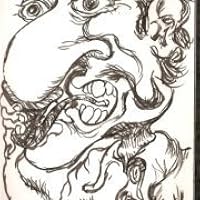
The black and white scratchboard art is meant to approximate some of the black and white woodcuts with which Kafka may have been familiar at the time he wrote, early twentieth century comics wordless comics by Frans Masereel and Lynd Ward. The production is awesome.
Here's a 38 minute film presentation, thanks to YouTube, of Kuper on his career, Kafka (Kuper also did a comics version of Kafka's "The Metamorphosis,") and about this book in particular:
The title tells the story - Kafka stories interpreted by Peter Kuper. This is a bold interpretation of some of Kafka's most hallucinatory works; the feeling of confinement and thinning of air can be felt as one reads this book. A Hunger Artist, In The Penal Colony and The Burrow are some of the stories Kuper interprets in this collection. A great introduction to Kafka.
Peter Kuper is the most obvious choice in comics to do an adapation of Kafka. He's so good at dark, politically-charged, anxiety-inducing comics. Here he takes all his skills and applies it to adapting some of Kafka's best known short works.
It's good primer on Kafka and demonstrates Kafka's lasting appeal.
Het is zoveel makkelijker te lezen in strip-vorm wie had dat gedacht. Minder lezen en meer plaatjes! Mocht dit van Evan lenen, omdat ik mijzelf graag martel met Kafka. Nu nog Kafka on the Shore, als die ooit weer wordt gevonden in de bieb!
I absouletly loved this. Amazing illustrations, so very creative. Story wise, I loved The Burrow most, Give It Up, and Before the Law (almost all of them were good). Honestly, most of these stories had deeper meanings behind them, some even political. 10/10.
I love graphic adaptations of Kafka. In part his stories lend themselves to it. And he attracts excellent artists as well. This is a collection of fourteen stories, including "The Hunger Artist", "In the Penal Colony", "The Burrow," and several lesser known fables. They are black-and-white and look like they were done on woodcuts in German expressionist style. The text is all drawn directly from the stories but highly abbreviated.
What I particularly appreciated in going back-and-forth between the full text of some of the stories and Kuper's adaptation is how he took turns of phrase that I had never taken literally and rendered them as such (e.g., the scribbles on the page of instructions for The Harrow in "In the Penal Colony" or a coal bucket rider flying through the air.
Of course not a substitute for the stories themselves, but definitely a complement.
Kuper wonderfully illustrates Franz Kafka's short and inscrutable tales of torment, torture and death in his trademark jagged style.
Apparently, Kafka was an early adopter of flash fiction, as the original stories adapted here are often less than a thousand words, and at least one was basically just a single paragraph. Despite the length, they are packed with symbolism and unspoken depth that just left my poor head spinning.
Worth a look, but too dark and bleak to ever enjoy.
Very short stories, made even shorter for this graphic treatment. The art, which resembles woodcuts by Lynd Ward, is well suited to the stories. Though I prefer Kafka's longer works, these adaptations are pretty nice.
Una visión diferente de algunos relatos de Kafka, re-interpretados a través de la narrativa gráfica de Peter Kuper. Sobre todo rescato que no son los relatos ilustrados, sino realmente una re-narración a través de la visión gráfica de Kuper, que los hace diferentes, algunos los contextualiza de nueva cuenta, otros permanecen en su forma más clásica, otros más son llevados al límite fantástico.
Rescato especialmente "La madriguera" y "En la colonia penal". Aunque el libro está muy bueno, la edición tal vez desmerece un poco en la traducción, no por el idioma sino porque implicó modificar cuestiones tipográficas y se pierden algunos detalles. Kuper menciona que parte de su trabajo fue utilizar diferentes letras a mano para identificar personajes, cosa que me parece, en la edición en español se pierde. Por eso baja un poco las estrellas, ya que considero que en un libro eminentemente visual, es algo muy importante.
I've read a couple of collections of kupers Kafka and think he is a perfect graphic art interpretor of Kafka works the woodcut etch angst German expressionist black and white layouts are excellent! Also check out Sinclairs the jungle by Peter kuper.
Absolutely loved this. The menacing bold illustrations perfectly match the Kafka stories; the oppressors, the political system, social injustice, poverty, bureaucracy, surrealism.
Already looking forward to revisiting this and checking out more of Kuper’s work
Kuper seems to have a firm grasp on Kafka's messages, and his stylistic choice reflects them. The stories in this book are mostly from Kafka's very short fables, often only 3-4 pages long. (Two longest are "The Hunger Artist" and "In the Penal Colony").
Great adaptations make the readers see the points that he might have missed in the original work, and this book provided such an opportunity for me.
Kafka is type of a writer whose messages become more and more agreeable as one ages. I read his novels when I was much younger, and I'd love to revisit them. Reading this graphic novel adaptation made me more so.
A creative and accessible version of a handful of Kafka's most famous stories, Kuper was a good illustrator for such, bringing the twinge of humor and the skepticism and cynical drawl of Kafka to the reader visually.