

What do you think?
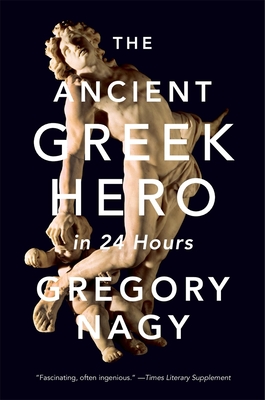
The Ancient Greek Hero in 24 Hours
What does it mean to be a hero? The ancient Greeks who gave us Achilles and Odysseus had a very different understanding of the term than we do today. Based on the legendary Harvard course that Gregory Nagy has taught for well over thirty years, The Ancient Greek Hero in 24 Hours explores the roots of Western civilization and offers a masterclass in classical Greek literature. We meet the epic heroes of Homer’s Iliad and Odyssey, but Nagy also considers the tragedies of Aeschylus, Sophocles, and Euripides, the songs of Sappho and Pindar, and the dialogues of Plato. Herodotus once said that to read Homer was to be a civilized person. To discover Nagy’s Homer is to be twice civilized.
“Fascinating, often ingenious… A valuable synthesis of research finessed over thirty years.”
―Times Literary Supplement
“Nagy exuberantly reminds his readers that heroes―mortal strivers against fate, against monsters, and…against death itself―form the heart of Greek literature… [He brings] in every variation on the Greek hero, from the wily Theseus to the brawny Hercules to the ‘monolithic’ Achilles to the valiantly conflicted Oedipus.”
―Steve Donoghue, Open Letters Monthly
“Fascinating, often ingenious… A valuable synthesis of research finessed over thirty years.”
―Times Literary Supplement
“Nagy exuberantly reminds his readers that heroes―mortal strivers against fate, against monsters, and…against death itself―form the heart of Greek literature… [He brings] in every variation on the Greek hero, from the wily Theseus to the brawny Hercules to the ‘monolithic’ Achilles to the valiantly conflicted Oedipus.”
―Steve Donoghue, Open Letters Monthly
656 pages, Paperback
First published February 25, 2013
About the author
Gregory Nagy
54 books45 followersGregory Nagy is an American professor of Classics at Harvard University, specializing in Homer and archaic Greek poetry. Nagy is known for extending Milman Parry and Albert Bates Lord's theories about the oral composition-in-performance of the Iliad and Odyssey.
Ratings & Reviews
Friends & Following
Create a free account to discover what your friends think of this book!
Community Reviews
Displaying 1 - 25 of 25 reviews

January 2, 2014
I almost made the mistake of getting too caught up In the forward and intro material and getting bored before I got into the heart of the book.
By the end of it, I felt as if my humble library card had treated me to a classics course at a world class university. It's a little nerdy and might lose the interest of some but I found it fascinating and approachable. Like a feast prepared for a hungry man, my enjoyment may have been colored by circumstance. This was the only book I had through power outage and loss of TV and internet during Atlanta's Snowmageddon 2014. I read the bulk of it then.
The concept of hero is often overused today and has lost its original meaning. It makes it harder for modern folk to "get" the heroes of the classics. Nagy helps you understand the contrast between the flashy immortal gods and the mortal heroes who go up against them and monsters and fate and how the ancient Greeks would have seen them.
He gives a nice survey of Greek Literature from Homer to Euripides and looks at different flavors of heroes during the different hours then draws threads of them together. I enjoyed the pacing of the book giving me natural times to put it away and busy myself with something else while I digested the earlier points.
By the end of it, I felt as if my humble library card had treated me to a classics course at a world class university. It's a little nerdy and might lose the interest of some but I found it fascinating and approachable. Like a feast prepared for a hungry man, my enjoyment may have been colored by circumstance. This was the only book I had through power outage and loss of TV and internet during Atlanta's Snowmageddon 2014. I read the bulk of it then.
The concept of hero is often overused today and has lost its original meaning. It makes it harder for modern folk to "get" the heroes of the classics. Nagy helps you understand the contrast between the flashy immortal gods and the mortal heroes who go up against them and monsters and fate and how the ancient Greeks would have seen them.
He gives a nice survey of Greek Literature from Homer to Euripides and looks at different flavors of heroes during the different hours then draws threads of them together. I enjoyed the pacing of the book giving me natural times to put it away and busy myself with something else while I digested the earlier points.

May 14, 2023
Brilliant. I read this while auditing the course through edx.org and I haven't been this happy to be in a class for a very long time. I'm so sad that I've completed it, but I will be retaking it when available again to revisit the works with, hopefully, a broader understanding of the content.
Nagy is an absolute treasure, both as a person and as a professor. His knowledge is boundless, but his enthusiasm to share that knowledge exceeds even that. He makes the textbook freely available for all who take the class (I bought mine regardless) and simply wants you to engage in the community that is along for the journey with you so you can learn more.
If I were more knowledgeable on this material I would love to pick his brain on several things addressed in this course. I didn't agree with him on a few occasions, but for the most part I found this book and the course entrancing. I have such a newfound respect for ancient Greek history and culture now, and am so excited to take this knowledge and apply it moving forward with all of my future readings.
Seriously. If you have even a passing interest in Greek heroes and/or mythology you will find this book and, more importantly, the course an immeasurably enriching experience. 10/10. Cannot recommend enough.
Nagy is an absolute treasure, both as a person and as a professor. His knowledge is boundless, but his enthusiasm to share that knowledge exceeds even that. He makes the textbook freely available for all who take the class (I bought mine regardless) and simply wants you to engage in the community that is along for the journey with you so you can learn more.
If I were more knowledgeable on this material I would love to pick his brain on several things addressed in this course. I didn't agree with him on a few occasions, but for the most part I found this book and the course entrancing. I have such a newfound respect for ancient Greek history and culture now, and am so excited to take this knowledge and apply it moving forward with all of my future readings.
Seriously. If you have even a passing interest in Greek heroes and/or mythology you will find this book and, more importantly, the course an immeasurably enriching experience. 10/10. Cannot recommend enough.

to-read-other
August 23, 2016I'm taking this course The Ancient Greek Hero in 24 Hours on EdX now, taught by Gregory Nagy. It's free and online, and looks really good! Why don't y'all join me? Then we can discuss the texts together. It just started (August 15) so if you join soon you won't be missing a thing.
This book is the text to that class, and is also included (free) as an eBook download. I probably won't read (or review) all of it, but pick and choose.
This book is the text to that class, and is also included (free) as an eBook download. I probably won't read (or review) all of it, but pick and choose.
You'll read Iliad and The Odyssey.
... seven tragedies.
... two Platonic dialogues.
... huge chunks of Herodotus, the so-called father of history.
... & get a very good sample of ... Late Antique literature, which takes a kind of no-holds-barred approach to the religious aspects of the hero.

June 20, 2025
This is in essence a series of close readings of portions of numerous texts from the Iliad to the Odyssey to an assortment of Greek tragedies to some works by Plato. Parts of the book were interesting, but my overwhelming feeling was it could have used extensive editing. At 700+ pages, it could easily have been cut to about 350-400. There is excessive repetition. The author will often write something such as, “As I wrote previously” and will then go on to repeat exactly what he wrote previously. And sometimes this repeating occurs just a paragraph or two down from where it originally appeared, not just chapters later. I ended up skimming quite a bit. I know some people love this text, but for me it didn’t work as a straight read. However, I suspect I will use it as a reference in the future when I want to look up the author’s thoughts about specific plays.

August 29, 2020
Other than the bit where Plato's Socrates is having dialogue with Achilles in his own special way, this companion to the course, Ancient Greek Hero in 24 Hours, offers some moments of insight, additional resource information and includes some core vocabulary of key Greek words.
Professor Nagy breaking down the etymology of the Homeric Greek in the focus passages and texts, elucidating and expanding on why and how certain words are translated as such, is absolutely fascinating to me.
Yes I nerded out. I stan word detectives.
All in all decent, though I'd scratched my head a few times, especially trying to figure out why Thetis' golden amphora is somehow implicitly related to Achilles' immortalization.
That being said, I adore Professor Nagy who is a joyous, indefatigable wellspring of Classical knowledge that we are lucky to have in our lifetime!
Professor Nagy breaking down the etymology of the Homeric Greek in the focus passages and texts, elucidating and expanding on why and how certain words are translated as such, is absolutely fascinating to me.
Yes I nerded out. I stan word detectives.
All in all decent, though I'd scratched my head a few times, especially trying to figure out why Thetis' golden amphora is somehow implicitly related to Achilles' immortalization.
That being said, I adore Professor Nagy who is a joyous, indefatigable wellspring of Classical knowledge that we are lucky to have in our lifetime!
October 27, 2014
A very in-depth treatment, yet pitched at an introductory level, of the idea of the hero in ancient Greek literature (Homer, Herodotus, tragedy, Plato etc.). Works on the basis of close reading of selected short texts, and works extremely well. Has been tremendously insightful and revelatory for me, and as a theme a great way into reading more closely some of the key texts of the Greeks.

September 16, 2020
I loved this book, which I read as part of Professor Nagy’s online class. It was incredibly informative and in-depth yet understandable (a huge plus for a novice like me!) I feel fortunate to have come across this class, and by extension, this book. A truly epic experience!
May 18, 2022
Prof. Nagy's interpretative insights inspired my fictional version of Euripides' Madness of Herakles https://jasonkassel.substack.com/.

August 23, 2013
I like this book. I like it a lot.
It's all here.
It's all here.

May 22, 2022
Rating: All the stars
I started this book before Christmas and managed to finish it in the first part of last January. It took me a long time to write a review though. Mostly because it’s a book that cannot really be reviewed —or commented upon. The greatness and soundness of Nagy’s scholarship are very well-known in the academic field and talking about this work almost feels like judging the Iliad. You cannot. You should not. So, let’s keep it short.
It’s a book that takes the reader on a long journey, 24 chapters to be precise, through several ancient classics and handles a great many complicated themes, whilst always keeping in mind that knowledge should be shared with simplicity and respect.
It’s a book that manages not only to teach you how to look at the past and how to question the ancient authors, but also teaches you some Greek on the side. I have highlighted so many passages, so many beautiful commentaries. The one about Achilles seeing himself in Penthesilea through some complicate layers of not only interpretation, but philology… Ah. Such an astonishing scholarship indeed. This is a book that will stay with me for ever.
All the stars.
I started this book before Christmas and managed to finish it in the first part of last January. It took me a long time to write a review though. Mostly because it’s a book that cannot really be reviewed —or commented upon. The greatness and soundness of Nagy’s scholarship are very well-known in the academic field and talking about this work almost feels like judging the Iliad. You cannot. You should not. So, let’s keep it short.
It’s a book that takes the reader on a long journey, 24 chapters to be precise, through several ancient classics and handles a great many complicated themes, whilst always keeping in mind that knowledge should be shared with simplicity and respect.
It’s a book that manages not only to teach you how to look at the past and how to question the ancient authors, but also teaches you some Greek on the side. I have highlighted so many passages, so many beautiful commentaries. The one about Achilles seeing himself in Penthesilea through some complicate layers of not only interpretation, but philology… Ah. Such an astonishing scholarship indeed. This is a book that will stay with me for ever.
All the stars.

December 29, 2025
Nagy brings a lot of expertise to bear in this tome, and you will definitely learn a fair bit about the mysticism of hero cults.
That said, I read the paperback edition, which is supposedly the trimmed down version of this book, and it still felt maybe twice as long as it needed to be, in part because Nagy’s writing is very repetitive—both in the points he makes, and in his insistence on providing both the Greek phrases and their retranslations every time he includes key phrases. This is especially true for the first part of the book, which focuses on Homeric hero portrayals.
The hours are each structured around a key word, often with etymological breakdowns. I love an etymological rabbithole as much as the next guy, but there were certainly moments where it seemed we might be in etymological fallacy territory, especially in the many cases where words could apparently take on particular mystic significance.
That said, I read the paperback edition, which is supposedly the trimmed down version of this book, and it still felt maybe twice as long as it needed to be, in part because Nagy’s writing is very repetitive—both in the points he makes, and in his insistence on providing both the Greek phrases and their retranslations every time he includes key phrases. This is especially true for the first part of the book, which focuses on Homeric hero portrayals.
The hours are each structured around a key word, often with etymological breakdowns. I love an etymological rabbithole as much as the next guy, but there were certainly moments where it seemed we might be in etymological fallacy territory, especially in the many cases where words could apparently take on particular mystic significance.

November 15, 2022
Read for Ancient Greek Heroes Gen-Ed. Personally this topic doesn’t interest me too much so the depth of analysis that Nagy goes into under each heading and subheading gets a bit boring. However, I think it is cool that such deep analysis and so many connections can be drawn from a field of literature. This book more or less is an grouping of academic and scholarly claims, arguments and a smattering of primary texts. Not my particular cup of tea: I think that there are other pieces of literature and history more worth studying than the Ancient Greek hero, but a good introduction for me into how deep and how much analysis there is to be had out there.
March 15, 2023
I love Gregory Nagy. Professors like him make me want to go to Harvard so bad *poor screeches*. I loved learning about not only linguistics but also the culture and the context behind every single detail presented in ancient texts. I’ll be rereading this over and over, no doubt. What a good book to get lost in.

Read
May 5, 2020Great companion to the Iliady and Odyssey.

May 29, 2022
Clear and entertaining, this is a great read for the introductory level without dumbing things down. I read this book from the library and will probably purchase a copy for myself to revisit.

December 9, 2023
Greg Nagy is a national treasure
July 1, 2024
A freaking MASTERPIECE 👌🏻👌🏻👌🏻. I wish I had Prof. Nagy’s brain; he is a genius and his writing style makes him, in my opinion, basically the Wilde of academia.

February 24, 2025
I suspect that someone who loves diving into language/translation/etymology would like this book better than I did.

December 18, 2018
This book is mostly focused on literary analysis with the goal of understanding Greek attitudes re: heroes/hero cults.
1. It's incredibly overlong. Filled with padding, irrelevant fluff, and repetitions. You could genuinely cut 450 pages from this book with _zero_ loss of substance. Quite disorganized as well, often the title of a chapter has the slightest of relations to its content.
2. It's badly written. Here's a typical paragraph:
What happened here? Did the editor fall asleep? This goes on and on for seven hundred pages!
3. A lot of the readings are not really supported by the texts, and even if they could be supported they wouldn't be that interesting. A lot of long, convoluted, unconvincing arguments about shit that doesn't matter. 60+ pages on the connection between a particular type of chariot racing and the depiction of chariots in the Iliad.
Here you have a poem about life and death, mortality and immortality, war and peace, family and comradeship. Grand themes, grand gestures. And the best thing he can come up with is jumping off chariots? As a result of the focus on bizarre minutiae, you're not actually going to have a solid grasp on the ancient Greek hero after reading this.
4. Nagy loves etymology too much. A lot of genetic arguments.
5. At some points treats the "epic tradition" as if it's set in stone, at other points bases his arguments on different versions of the same stories. Switches depending on what is useful for the particular point he's arguing for.
6. Filled with non sequitors. My notes are riddled with "????"
7. Reads Homer and Hesiod/Sappho/other lyric poets/vase painters/summaries of the epic cycle poems/Herodotus/2nd century Romans/etc as if they were a single contiguous poem. I'm super skeptical of this approach. No attempt to argue for intertextuality or any other justification. "The Ancient Greek Hero" is actually meant like that, as if there was a single notion of the ancient Greek hero, across hundreds and hundreds of years. In reality, many different types of hero cults: this is NEVER EVEN MENTIONED. Nagy even makes up imaginary versions of the Iliad to support his ideas. The notion that perhaps there may have been different attitudes about the issue does not appear in this book.
He switches effortlessly between Homer and Herodotus, as if these guys separated by 300 years are speaking about the exact same thing.
7.1. Never mentions that hero cults arose without a tholos, e.g. Achilles cults all over Greece and its colonies.
8. His reading undermines everything that's good about the Iliad! In a poem whose central theme and question is mortality, Nagy only sees a poem about continued life after death.
9. At some point he posits mid-6th century additions to the Iliad, with the flimsiest of arguments.
10. "Homeric poetry does not address the problem of justice": has this guy even read the Odyssey?
11. He plunders from others, e.g. on Socrates' view of philosophy as agon (analyzed by e.g. Nietzsche) without a hint of attribution.
12. There are some good points, I liked his take on the Odyssey rebirth/return to light/life stuff, but you can find this in other places expressed in a much better way. In terms of actual info on hero cults, e.g. hour 15, it's OK.
1. It's incredibly overlong. Filled with padding, irrelevant fluff, and repetitions. You could genuinely cut 450 pages from this book with _zero_ loss of substance. Quite disorganized as well, often the title of a chapter has the slightest of relations to its content.
2. It's badly written. Here's a typical paragraph:
I now highlight the critical moment in the narration of the speaker when he in turn highlights the critical moment in the apobatic competition that he is narrating. Instead of losing his nerve, our athlete somehow managed to surpass the momentum of the oncoming chariot team that almost ran over him. That is what we are about to read at the critical moment of the speaker’s narration about the apobatic chariot race held at the festival of the Panathenaia in Athens. I now quote the original Greek text of that climactic moment.
What happened here? Did the editor fall asleep? This goes on and on for seven hundred pages!
3. A lot of the readings are not really supported by the texts, and even if they could be supported they wouldn't be that interesting. A lot of long, convoluted, unconvincing arguments about shit that doesn't matter. 60+ pages on the connection between a particular type of chariot racing and the depiction of chariots in the Iliad.
Here you have a poem about life and death, mortality and immortality, war and peace, family and comradeship. Grand themes, grand gestures. And the best thing he can come up with is jumping off chariots? As a result of the focus on bizarre minutiae, you're not actually going to have a solid grasp on the ancient Greek hero after reading this.
4. Nagy loves etymology too much. A lot of genetic arguments.
5. At some points treats the "epic tradition" as if it's set in stone, at other points bases his arguments on different versions of the same stories. Switches depending on what is useful for the particular point he's arguing for.
6. Filled with non sequitors. My notes are riddled with "????"
7. Reads Homer and Hesiod/Sappho/other lyric poets/vase painters/summaries of the epic cycle poems/Herodotus/2nd century Romans/etc as if they were a single contiguous poem. I'm super skeptical of this approach. No attempt to argue for intertextuality or any other justification. "The Ancient Greek Hero" is actually meant like that, as if there was a single notion of the ancient Greek hero, across hundreds and hundreds of years. In reality, many different types of hero cults: this is NEVER EVEN MENTIONED. Nagy even makes up imaginary versions of the Iliad to support his ideas. The notion that perhaps there may have been different attitudes about the issue does not appear in this book.
He switches effortlessly between Homer and Herodotus, as if these guys separated by 300 years are speaking about the exact same thing.
7.1. Never mentions that hero cults arose without a tholos, e.g. Achilles cults all over Greece and its colonies.
8. His reading undermines everything that's good about the Iliad! In a poem whose central theme and question is mortality, Nagy only sees a poem about continued life after death.
9. At some point he posits mid-6th century additions to the Iliad, with the flimsiest of arguments.
10. "Homeric poetry does not address the problem of justice": has this guy even read the Odyssey?
11. He plunders from others, e.g. on Socrates' view of philosophy as agon (analyzed by e.g. Nietzsche) without a hint of attribution.
12. There are some good points, I liked his take on the Odyssey rebirth/return to light/life stuff, but you can find this in other places expressed in a much better way. In terms of actual info on hero cults, e.g. hour 15, it's OK.
October 25, 2021
Good analysis by a classic classics author. Some of it still reads as gobbledygook - especially the hyper-detailed analysis of specific words used in works that were written hundreds of years apart from one another, but there is more than enough good to offset the questionable.
My favorite quote, which also serves as an epitome:
"Heroes keep trying to prove to themselves that they belong somehow in the to a world of immortals, but, after all is said and done, heroes only end up proving that they deserve to die trying."
Or, to paraphrase: A hero is someone who wants to be like the gods and dies trying.
My favorite quote, which also serves as an epitome:
"Heroes keep trying to prove to themselves that they belong somehow in the to a world of immortals, but, after all is said and done, heroes only end up proving that they deserve to die trying."
Or, to paraphrase: A hero is someone who wants to be like the gods and dies trying.

June 21, 2013
The book is really good to understand a lot of myths and ideas of the ancient Greek. There is a free online version of it

September 3, 2014
Too academic for me. I'm going to stick with the sources.
September 10, 2014
It takes its time to finish this but I must say it is worth it. A very interesting insight in ancient Greek culture.
April 25, 2017
Went very well with the course ... I read the book along with/interspersed with watching the corresponding videos.

March 27, 2013
Read this for an edX class during the spring and summer of 2013.
Displaying 1 - 25 of 25 reviews