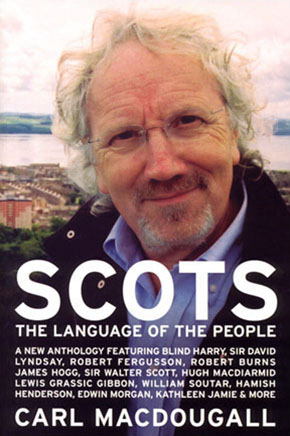
Carl MacDougall was a Scottish writer. He wrote for theatre, radio and television in addition to being a short story writer. His first novel, Stone over Water was preceded by a collection of short stories, Elvis is Dead, published to great acclaim in 1986.
Pretty much become / becoming the grand man and commentator on the Scottish literary scene (though that's a BIG area which is constantly changing so that it is hard to keep up with it). MacDougall came on the scene when Scottish new fiction was burgeoning and there was a great deal of interest from the punters as well. A heap of raw new talent was out there and there was the will to get into print on the authors part as well as on the side of the publishing houses that this was a real and marketable (and therefore profitable) line to pursue. It was as if a whole set of circumstances came together at the right moment. 'Elvis is Dead' was published as MacDougall's second book and came out in 1986 published by the independent Mariscat Press. It took eight years to write and collate these 19 short stories. Lanark by Alasdair Gray, published in 1981 had changed the field and perceptions. James Kelman changed it even more writing in broad Scots with no attempt at easing the reader into it. Macdougall was, you might say, one of the lesser writers but stylish and clear and clean cut without the fancy-dannish arty-fartiness of Gray or the uncompromising attitude of Kelman.
This book is a great introduction to the quality of contemporary Scottish writing from the explosive period in the mid-80's - mid 90's and shows every merit in the stories here. I first read it straight off the press in '87 and rereading it now takes me back to a world where literature in Glasgow felt like the new rock 'n' roll. Creative Writing groups thrived. West Coast Mag was banging out excerts and articles by up and coming authors and poets. It would all explode into an amazing frenzy when Glasgow became European City of Culture in 1990.
Should I describe each of the 19 stories? Not really. That would fail to do justice to each of them. Some are very short - one pagers. Others are longer. But they all contain themes of Scotland from that time which are expansive and go beyond the Scottish experience. They all make interesting reading and doorways to other writers. Reading this will want to make you investigate them all, apart from Gray and Kelman. Find Janice Galloway, Jeff Torrington, James Robertson, Douglas Dunn. Once you start, you'll find more.