James Blake est un jeune homme solitaire, rêveur et marginal. Son obsession, c'est de pouvoir voler, d'accomplir le premier " vol à propulsion humaine ". À l'aéroport de Londres, il s'empare d'un petit avion pour accomplir sa tentative, mais il s'échoue dans la Tamise, à Shepperton, une banlieue tranquille.
Miraculeusement rescapé de son accident (on lui apprend qu'il a passé onze minutes sous l'eau) il est adopté par les habitants de la petite communauté. Pourtant le doute subsiste : est-il mort, est-il vivant, a-t-il transcendé sa condition de simple mortel ? Dans les jours qui suivent, Blake est en proie à des visions prophétiques. Il métamorphose son environnement et bouleverse la vie de sa nouvelle famille...
" Agent secret de l'inconscient ", J.G. Ballard (1930-2009) ressuscite dans un cadre banlieusard - celui-là même où il vivait - quelques-uns des plus vieux mythes de l'humanité. À sa manière inimitable, il nous propose une fable sarcastique, un Petit Prince perverti qui est aussi une parabole sur la situation de l'écrivain, seul véritable " rêveur illimité ".
James Graham "J. G." Ballard (15 November 1930 – 19 April 2009) was an English novelist, short story writer, and essayist. Ballard came to be associated with the New Wave of science fiction early in his career with apocalyptic (or post-apocalyptic) novels such as The Drowned World (1962), The Burning World (1964), and The Crystal World (1966). In the late 1960s and early 1970s Ballard focused on an eclectic variety of short stories (or "condensed novels") such as The Atrocity Exhibition (1970), which drew closer comparison with the work of postmodernist writers such as William S. Burroughs. In 1973 the highly controversial novel Crash was published, a story about symphorophilia and car crash fetishism; the protagonist becomes sexually aroused by staging and participating in real car crashes. The story was later adapted into a film of the same name by Canadian director David Cronenberg.
While many of Ballard's stories are thematically and narratively unusual, he is perhaps best known for his relatively conventional war novel, Empire of the Sun (1984), a semi-autobiographical account of a young boy's experiences in Shanghai during the Second Sino-Japanese War as it came to be occupied by the Japanese Imperial Army. Described as "The best British novel about the Second World War" by The Guardian, the story was adapted into a 1987 film by Steven Spielberg.
The literary distinctiveness of Ballard's work has given rise to the adjective "Ballardian", defined by the Collins English Dictionary as "resembling or suggestive of the conditions described in J. G. Ballard's novels and stories, especially dystopian modernity, bleak man-made landscapes and the psychological effects of technological, social or environmental developments." The Oxford Dictionary of National Biography entry describes Ballard's work as being occupied with "eros, thanatos, mass media and emergent technologies".
How much semen is too much for one book to contain? The answer is none. There is none too much semen.
For proof of this, proceed directly to The Unlimited Dream Company. I couldn’t name a book more semen-spangled if you held a loaded dick to my head. Even the word ‘semen’ has to hold some kind of per-page record here. If you can make your way past all the goo, this is actually quite a lovingly endearing story—perhaps in spite of the fact that the predominance of it concerns a guy ejaculating flowers and shooting snakes out of his penis. Sci-Fi, so much to answer for. That said, the passages on flora and animalia alone merit inclusion on your reading list.
I know Ballard gets tagged with the lazy ‘transgressive’ ribbon all the time (or at least used to; I’m sure his descendants have outpaced him) and that he’s notoriously hit-or-miss. Here, he’s mostly ‘hit.’ Barring a bit of repetition that could have been tightened-up (did I mention semen?), the majority of Dream Co. is stunningly well-written. The core of the plot is a tricky beast; one is never sure which direction Ballard is going to end the whole shebang in but, for my money, he absolutely nails the landing. It’s a beauty and, yeah, true loves eats itself.
OR
If you’ve ever longed to read a book where a guy transforms into a deer and fucks everything in sight while flinging cum over an entire town, then immediately pass GO.
Although highly unlikely, but let's just say for the sake of delving into the realms of fantasy this was a movie; it would be like some weird collaboration between Terry Gilliam, Studio Ghibli, and Davids Attenborough and Cronenberg. It would also likely have to be a warped skin-flick, because the narrator (like on a cocktail of viagra and hallucinogens) roams around in his birthday suit with a constant erection masturbating over anything and everything.
This was just completely nuts, and I actually quite enjoyed it!.
Come fly with me, we'll fly, we'll fly away!.....nope, not to that bar in far Bombay, but rather hovering in the skies over Shepperton, England as a winged creature. Mr Ballard, draws on science-fiction methods to create a magical but disturbing modern fantasy, that could also be seen as a sort of satire. Fused with surrealism, suburbia, erotica, and...er...exotic plantlife, J.G. showcases he was a writer of enormous intentive prowess.
The Unlimited Dream Company is simply like nothing I have read before, a flight into a world of dreams and desire. And it is truly a book dominated by wild and vivid imagery. A failed medical student (Blake) becomes obsessed with the idea of flying, and sets out to steal a plane from a London airport, but it's not long before he crash-lands in the Thames at Shepperton. Trapped under water, he somehow miraculously and mysteriously survives, and on the banks of the river is met by a doctor, her madcap mother, and a priest, all whom try and take possession of him. So begins his dream-like journey where the other residents of Shepperton seem to have been waiting for his arrival. They believe him to be a messiah, someone with strange mythical powers. He sets out to perform wonders throughout the area, sprouting jungle vegetation, huge birds, animals and fishes. He also heals the sick, teaches people how to fly, and with a perverse heightened sexual energy, tries to have sex with the whole town, before an apocalyptic mirage of heaven and hell descends on this corner of the earth. All the while, the submerged aircraft shimmers in the water, containing a body.
This is no doubt heady stuff, a dreamy netherworld where Ballard you feel just lets himself off the leash. Even though I liked it, and not for a page was I ever bored, it does have it's problems though. At times it felt like the writer was someone trying to imitate Ballard, incorporating just too much in what was only a short novel. From the midway point everything felt clustered and suffocating with little time to take it all in. It also contained an uncomfortable moment involving handicapped children, which left me with a bad taste in my mouth.
I never thought I would get to read a novel with Vultures circling over the skies of London, but then, it's not that unbelievable really, seeing as there is a great big vulture cage right in the heart of the Capital. I know it as the Houses of Parliament.
I find it difficult to know how to talk about this book. I loved the vibrant writing and surreal story, but could not recommend this to 95% of the readers I know.
Why? Well, you see... Blake is a bit of a loser. He steals a plane and crashes it into the Thames at Shepperton, and that's when everything goes a bit strange. He develops strong desires for everyone and everything in the town (see 95% comment earlier). Just like in dreams, relationships have no consequences, people can fly and commune with the sea and forest creatures. Blake becomes like a pagan dream god - even spreading his semen around grows a tropical rainforest.
And yes, I said the word semen. Trust me, if you can't take it the two times in this review, this is not the book for you.
But maybe you are a reader who can push aside all of your senses of moral violation to enjoy the writing, the description, the dreamy world of this book. If you can, you should. I couldn't put it down. The aerial wedding scene is particularly memorable.
"When they had gone, I walked alone through the late afternoon, my damp suit covered with a coat of rainbows, a confetti of petals, celebrating my marriage with the meadow."
I've marked this as sci-fi/fantasy, and it isn't really... more absurdist/surrealism. In a brief interview in the back, Ballard says he started writing sci-fi. I am hooked and want to read more. There is a beautiful recent volume of complete short stories that might be the next thing I hunt down.
"For all we know, vices in this world may well be metaphors for virtues in hte next." - J.G. Ballard, The Unlimited Dream Company
A man named Blake crashes his plane in a small British town. He is transformed into a demigod in the town. Or perhaps, he is dead and this is some weird limbo he is stuck in. Or perhaps he is just mad. Anyway, Blake isn't a very reliable narrator. The story keeps getting weirder and weirder, breaking out of any form of simple narrative and becoming fractured, recursive, fractaled, contradictory. As this book begins to "take flight" and enters into fertile vision territory, it begins to seed and grow into some funky William Blake inspired story. In a lot of ways, this novel is a "retelling/reincarnation" of Blake's poem Milton (just as in Milton, Blake was reinterpreting/retelling/reincarnating Milton's masterpiece 'Paradise Lost'). Confused? That is OK. This book shouldn't even be thought of as dystopian or science fiction. In reality is a surreal fantasy, a vision-based parable, a verdent exploration of death, sex, and life. Read it like you would look at a painting Salvador Dalí might have done if he was exploring the art of William Blake.
Kind of like Lord of the Flies if the dead pilot had been reanimated into the Pied Piper and instead of playing his flute, strolled around ejaculating on everything. Then it gets all Peter Pan flying around on bath salts. Oddly sentimental ending. Way too many birds and plants (and I really like birds and plants). And waaaay too much semen. The title should've been The Unlimited Semen Company. It's certainly an original book but not really the type of thing I look to Ballard for--clearly an anomaly in his oeuvre.
The fact that I have finished this book makes me feel like drinking champagne, dancing in the rain, throwing a party, bouncing on a trampoline.... Why? Because I LOATHED this book and continuing to read it was worse than the time I got three detentions at school on my birthday, worse than waiting for the results of a medical test that might prove you have a horrible disease, worse than being trapped in a train compartment with an interminable bore. I just needed it to be OVER.
So why did I continue to the end, and not throw the book in the dustbin, or flush it down the loo or donate it to the nearest organised Bonfire Night event? Because I was hoping that at some point I would discover some coherence or meaning to make the awfulness of wasting my life on this book worthwhile. This was a forlorn hope.
When I was young, I devoured science fiction novels so fast that I had read almost all they had in my local library by the time I was about 15. And yet, I never read anything by J G Ballard, supposedly one of the giants of this genre. I know that there have been many attempts by many people, most of them cleverer than me, to define SF. I don't know what SF is, but I can say with certainty, this wasn't it. There was no science here, no logic. It was like the demented, rambling outpourings of a sex maniac on LSD.
I have never thought that I was a prude, but I prefer my reading not to have semen on every page (if Ballard was paid for every time he used the word, he must have been very well paid). Other people's sex is boring and his vision of sex, paedophilia, incest, semen, shit, blood and pus was stomach churningly disgusting.
I suspect this was intended to be some sort of Eden parable since the whole unclothed population of Shepperton "did not know they were naked". I was bored the second time this was mentioned, never mind the 3rd, 4th, 5th and nth.
You might have gathered that I didn't much like this book! The best thing I can say about it is that it was not badly written, in fact, J G Ballard is probably quite a good writer. It's a pity, therefore, that he wasted his talent on this load of meaningless drivel.
This book gets off to a good start, with one of those great, swift openings of Ballard's that throws you right in the deep end (early chapter title: "I Steal the Aircraft"). But his vision dims after awhile and the book gets taken over by an overactive cloaca.
Bizarre Suburban Messiah Death Fantasy, with Loads of Symbolism Depending on how open you are to very ambiguous, uncomfortable, subtly ironic, and flat-out bizarre stories, you will probably rate this very highly or give up after a few chapters. As a long-time Ballard fan, I know enough to expect all of the above, and take pleasure in the strangeness of it all. The story outline is easily described (check some book blurb), but the reading must be experienced to understand it. There is just no way to predict how any given reader will react - its a love/hate thing. Oh, and there is a load of sperm flying about, literally, metaphorically, metaphysically, so if you are faint of heart or easily offended, you've been warned! You will struggle to interpret what it all means, even after finishing it, but I guarantee you won't forget it. I might revisit again someday, it's short enough, and has plenty of psychological depths to plumb.
Top-tier Ballard, in the same realm as The Atrocity Exhibition, Crash, and High-Rise, despite each of those books being so different from one another. Blake's frenetic and hallucinatory rebirth after death wavers from euphoria to outright horror, sometimes in the same moment, and while dreamlike, the events are consistently relayed through Ballard's sharp and smart prose. The overall effect is frequently mystifying and joyous, occasionally boring, but always fiercely original.
Critically acclaimed intense novel focussing on a super powered messiah crashing in Shepperton… yes you read that right! To me somewhat dated with all the pseudo-sexual drama and seemingly intentional aim to shock. 3 out of 12
Ballard geç kapitalizmle derdi olan sürekli romanlarında işleyen bir yazar. Okuduklarım içerisinde edebi olarak beni en çok etkileyen bu roman oldu. Gerçekle düş tamamen birbirine karışıyor. Diğer romanlarına kıyasla şiddet, vahşet daha az olsa da tedirginlik seviyesi kurgu ilerledikçe artıyor.
Bilim kurgu olsa da türün bildik özelliklerinden sıyrılmış olan roman bir uçak kazasıyla başlıyor. Karakterin gözünden tanık oluyoruz her şeye. Çaldığı uçak ile bir nehre düşüyor. Kazadan sağ kurtulmuştur ama Blake emin değildir bundan. Uçmaya bir tür takıntısı olan Blake kaza ile çeşitli güçler kazanmıştır. Ballard karakteri gibi okuru da şüpheye itiyor. Diğer romanlarında birkaç sefer işlediği gibi karakter bulunduğu yeri terk edemiyor. Daha önce Beton Ada’yı okurken de bu his yüzünden rahatsız olmuştum. Sıkışmışlık atmosferini ciddi anlamda iyi yaratan bir yazar. Ama bu romanda sıkışmışlığa garip güçlerin de eklenmesi çok farklı bir durum yaratmış. Blake artık uçarken herhangi bir vasıtaya ihtiyaç duymadığı için bir tür hayaller diyarındadır aslında. Her konuda sınırsız bir şehir yaratmış. Uçmak isteyen uçuyor, tüm tutkular doyuma ulaşıyor. Okuru ahlaki olarak pek çok ikileme sürüklüyor. Çok sevdiğim bir roman oldu. Ütopyayı tedirginliklerle donatarak sarsıcı bir roman ortaya çıkarmış. Hayranlığım gittikçe artıyor.
if you wanted to know what the inside of a crazy rapist cult leader's mind looked like it would be this. this literary pieces of garbage is what happen when you give lsd to a crazy person and they think that what they see and feel is true and serves only them. if i had to describe the tone of this book it would be pee mixed with the pulp of old news paper. to sum it up if you like rape, pedophilia, and pseudo cannibalism presented as the world's salvation then read this book!
The main thing i think this book does well is how the world around the main character changes in relation to his mood. it does help to hammer the main character's god complex home. so to sum up the concept was cool but it wasn't my cup of tea. to each's own.
I recommend this book to anyone who loves the word "semen" and constant references to it. I wanted to like this book, I really did, but it was just too over the top and obvious with its metaphors trying to be spiritual, philosophical, deep, but instead just seemed hackneyed, repetitive and silly. I will read more of Ballard's books to see if this is just a one off but it really didn't do anything for me as I dislike the word semen.
Ballard’ın herşey ile “birlikte olma” alter egosunun manifestosu niteliğinde. Bir tür “uçma hali”, kafanın “berrak” ve saflık içeren bütünlüğünün bozulmuşluğu. Çok sevemedim. Belki de okuma zamanım şu an değildi.
2023 reads, #83. So, the last time we were discussing my completist read of the entire oeuvre of JG Ballard, after just finishing the most famous book of the author's career, 1975's High-Rise (my review), I mentioned how I would likely be skipping Ballard's next book after this, 1979's The Unlimited Dream Company, because of it being just so obscure as to almost not even exist anymore; the paper version is long out of print, with no Kindle version ever having been made, no BitTorrented version inside the fairly complete Pirate Bay file on Ballard's works, and most importantly with not even a single copy available through the Chicago Public Library, such an unusual occurrence that it always causes attention to itself the rare times it happens. (For those who don't know, Chicago has the third largest public library system not just in America but the entire world, and so for the most part typically has at least one copy of pretty much every pre-Amazon novel you can even name.)
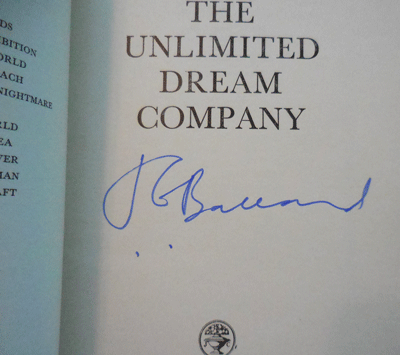
But instead, this lack of accessibility made me even more curious about the book than before -- for what's the point in even doing a completist challenge if you're not going to read the most obscure titles of that author's career, the kind of stuff that pretty much no one else will go to the trouble of tracking down themselves? So, that's exactly what I did, going on eBay and actually purchasing a rare first edition of the book (for more money than I care to admit) so that I could add it to my own rare-book collection afterwards and partly justify the expense, with my copy eventually arriving a little earlier this year. Unfortunately, though, I quickly discovered this week why this book is so obscure, when I finally sat down to read it; for while High-Rise right before it is arguably Ballard firing on all cylinders, perhaps not the absolute best book of his career although with no one denying it's in the top three, the one after it is unambiguously the worst book of his career up to that point, a sloppy and self-indulgent mess that Ballard only seems to have gotten away with because of this coming straight after his unexpected bestseller and instant cultural touchstone, and with him therefore having the power to be as masturbatory as he wanted to be. And sister, believe me when I say that he wanted to be very, very masturbatory.
And indeed, I suspect an important thing to remember here is that, far from being a slow-burning cult sleeper, High-Rise was hugely popular from almost its release among a certain hip crowd "in the know," with there having been serious plans to make a Hollywood adaptation starting literally weeks after the book was first published, which would've been directed by famed trippy countercultural filmmaker Nicolas Roeg (Walkabout, Don't Look Now, The Man Who Fell to Earth -- ah, what might've been!). That I expect has a large part to do with why Ballard set this follow-up book in Shepperton, center of England's film industry because of Pinewood Studios (where most of the original "Star Wars" trilogy was filmed, in exactly the same years Ballard first wrote this), because you can sort of squint at this book sideways and kind of see that it's partly about the pressures of an indie artist trying to fit into mainstream respectability (after our book's antisocial, perpetually horny, often physically violent "hero" Blake impulsively steals a small aircraft in London one day for no particular reason, ends up crash-landing it in Shepperton, then seemingly can't escape that town once he's there no matter what he tries, in that the highways all improbably end up leading back to the city when he tries driving down them, etc.).
But it's this facile description of the book's plot that's also an example of everything wrong with it, because Ballard seems to have codified his book's themes in such an impenetrably dense and personal way that it often feels like he's describing a dream he once had (among other developments, the entire city's population all turn into birds at one point, Blake spends most of the novel not knowing whether he's alive or dead, and an unsettlingly high amount of the citizenry seem to be convinced that he's the Messiah). And as most people can tell you, being forced to listen to someone describe one of their recent dreams is literally one of the most tedious experiences all of us have on a regular basis, because there's nothing inherently compelling about dream logic -- anything can happen, no actions have any stakes or repercussions, the laws of physics themselves can be conveniently ignored whenever the author wants, and in general it's much like trying to get emotionally invested in a Bugs Bunny cartoon, by which I mean it's not only impossible but a genre designed specifically to make it impossible.
That leads to a highly unsatisfying reading experience, one in which just weirdo random things arbitrarily happen on a page-by-page basis, with you never knowing whether Ballard's ever going to come back and reference that turn of events again, whether it's important to our story or not, or even whether it's supposed to have "really" happened within the collective fictional reality of the world this story inhabits. In other words, in a book where dreams are apparently real, this book continues to feature dreams on top of that which aren't supposed to be a "real" part of the "dream world" where this book takes place, which gets so metafictional so quickly that it just left me with a giant headache before I had even gotten 50 pages into it.
That's a shame, because after eight books of his now, I've come to realize that Ballard needed a lot of boundaries artificially placed on him for his writing to truly shine, such as when his career first started out and the only people who would publish him were traditional science-fiction presses who wanted traditional Mid-Century Modernist sci-fi tales from him. When the countercultural revolution of the 1970s erased this need for Ballard to deal with artificial limits placed on his unlimited imagination, the results started becoming extremely hit and miss, and for every brilliant book like High-Rise or Concrete Island (my review), he also put out a sloppy, stream-of-consciousness mess like today's book or the similarly frustrating Crash (my review).
That's of course the entire point of doing a completist read of a specific author, to get a really deep sense of what made them tick as both a person and an artist, divorced from just the handful of "greatest hits" that will be the only books of theirs read by 99 percent of future audience members after that author's death; but while that's a worthwhile endeavor, it's sometimes not a fun one, as I was reminded of with this book I eventually just had to hold my nose and slog down as quickly as I could, like bitter medicine being force-fed to me by some bitter Ballardian nurse with a cruel streak and a loaded gun pointed straight at me. That's kind of what this book feels like, Ballard essentially punishing you for daring to be a fan of his writing, and it's easy to see why the book quickly died on the vine when it first came out and then was promptly and completely forgotten by society at large. Let's see if things get any better with the next book in the list, 1981's Hello America, whose synopsis at least promises more of the same.
JG Ballard books being reviewed for this series: The Drowned World (1962) | The Burning World (1964) | The Crystal World (1966) | The Atrocity Exhibition (1970) | Crash (1973) | Concrete Island (1974) | High-Rise (1975) | The Unlimited Dream Company (1979) | Hello America (1981) | Empire of the Sun (1984) | The Day of Creation (1987) | Running Wild (1988) | The Kindness of Women (1991) | Rushing to Paradise (1994) | Cocaine Nights (1996) | Super-Cannes (2000) | Millennium People (2003) | Kingdom Come (2006)
3.5 stars. An unusual, imaginative, fantastical, surreal novel. Blake steals a light aircraft and crashes in the Thames at Shepparton. Blake struggles to the surface, alive, though witnesses thought he had died as Blake had been underwater for at least ten minutes. Within hours the sleepy suburb of Shepparton has been transformed. Luxuriant tropical flora and fauna appears all over Shepparton. Blake seems to be some sort of a god, taking over peoples bodies, walking naked through the streets, spreading his semen.
The novel has a dreamlike narrative with Ballard’s usual sharp, smart, vibrant writing style. It is a zany reading experience with no obvious narrative logic.
Ballard fans should find this book an interesting, worthwhile reading experience. Readers new to Ballard should firstly try ‘Crash’ and ‘Empire of the Sun’.
This is quite a disturbing novel and suitably wired for the lovers of Ballard. I particularly liked the three pages of the first chapter, which are actually the end of the novel but placed at the beginning. You are presented with a bizarre situation. A man has stolen a plane, crashed it into the river Thames and is now walking around the deserted town of Shepperton. The reader has no idea what is going on, but the town is overrun with strange birds that are out of place in the English countryside – flamingoes, frigate-birds, falcons and albatross. A harpy eagle sits on top of a post box and condors circle above. All the people have gone. Toys have been dropped mid-game by children just an hour before. Strange tropical plants are growing everywhere and there are helicopters circling overhead looking for something. This solitary man in his ragged flying suit is the only person there, but is talking about leaving. He foresees that the same depopulation will start to happen all around the world. He talks about escaping both his death and his life. All that in three pages, it is bewildering and bizarre. Then we step backwards and complete the full story. We learn about this man called Blake, who is not a pilot at all but just a thief. He dies in the plane crash and then is resurrected as some sort of pagan fertility deity, bringing abundance to the town of Shepperton. He literally spreads his semen everywhere, in people, plants and animals. He absorbs people into his body and thrives on their life force. Under his direction, Shepperton become an Amazonian paradise, and people are cured of their diseases and learn to fly. I wonder how much the use of Blake as his name was related to the visions of William Blake the English poet. I do like the fact that Ballard has picked on Shepperton, which was his home for nearly fifty years, and is known chiefly for the fact there are film studios there. Ballard describes it thus; “…I strode past the war memorial and the open-air swimming pool. The town centre consisted of little more than a supermarket and a shopping mall, a multi-storey car-park and filling station. Shepperton, known to me only for its film studios, seemed to be the everywhere of suburbia, the paradigm of nowhere.”
I picked this up on the basis of an unusual and interesting premise but until near the end I didn't know what to make of it. Full of Ballard's verbose and symbolic imagery, this story explores some very adult themes and is not for the easily offended. As the protagonist increasingly believes that the "sins of this world are metaphors for virtues in the next", he proceeds to break down taboos in the town of Shepperton as the reader is left to ponder the meaning of this idea.
As we follow Blake's transformation into some kind of messianic figure, biblical metaphors abound and the town of Shepperton becomes a kind of garden of Eden until realisation of his and humanity's ultimate destiny finally dawns on him.
My high rating of this book reflects more my intellectual appreciation of what the author was trying to do more than my emotional response and personal enjoyment which otherwise would have led me to rate this book lower. Take from that what you will.
Terrible. Just, terrible. There's really no character interaction. The dialogue is minimal and mostly meaningless. There's no character development, and the story arc is one big fat flat line. At best, this is a 30 page short story, but instead it's 235 pages of endless description of bullshit, over-the-top, uninteresting "miracle" after "miracle" told in the first person by a charmless "messiah". On and on and on. I started speed reading 150 pages in and it was still fucking torture to get thru the last 85 pages. After having just read CRASH and CONCRETE ISLAND I was hoping the book would redeem itself somehow, but it just got worse instead of better. I should have quit about 70 pages in, probably. So it goes!
There is nothing quite like this in Ballard oeuvre; consisting of equal parts fantasy, satire, hallucination and surrealist odyssey. I can only compare it maybe to Anna Kavan's "Ice" set in Samuel Delaney's "Dhalgren" but maniacal, ecstatic and devoid of the need for narrative drive. What I love the most about it, is how unlike anything Ballard has published, it is certainly depraved and weird, but in neon, and about plenum versus the strict confines of say "Crash" or "High Rise" - it really feels as if it could continue as a sort of perverted nature in reverie. Just great work, so glad I finally got around to it and so glad Ballard never repeated it like he did with many of his other works. This is a singular work.
Pure surrealism. Ballard's vision of paradise. Very Blakean. A friend of mine made the point that once you've read one Ballard novel you've read them all, and that's true to some extent. They are all variations on a theme, like Woody Allen's films. I like Ballard, and he is very unique, but he is very samey.
Sõnakasutus on meisterlik ning karakerid välja peetud ning detailised, aga kogu raamat on justkui teismelise märg unenägu, ükskõik millega, kellega, peaasi, et seemnevedelik voolaks. Meenutas Philip K. Dicki "parimaid" palu, mis droogide mõju all kirja on pandud. Teisalt tundub sürrealism justkui kergema vastupanu teed minemisena: autor saab loa lisada loole detaile ning muuta maailma toimimist oma suva järgi.
Really unusual novel about a pilot who crashes a stolen prop plane in a river outside a small village. After emerging from the wreckage, the pilot becomes a sort of deity based on his healing powers and ability to walk away from a plane crash. Or did he?
I’ve read many Ballard novels, and I’ve come to appreciate him like other artists who have long careers where you can follow their creative metamorphosis over decades, where they have masterworks, intermediate transitional pieces (which sometimes can be more revealing than the masterworks), rough sketches, misguided experiments – it all becomes one large autobiography. Thinking Cronenberg or Fassbinder in film, Miles Davis in music. With Ballard, Dream Company is definitely in the transitional category, with a dash of experimentation. There’s nothing else quite like it of the works I’ve read – though it has elements of all of them. It’s almost like Fellini’s 8 ½, Aronofsky’s Mother, even Ari Aster’s Beau Is Afraid – tunneling inward through a phantasmagoric stew – a glorious mess of Freudian pseudo-psychology, surreal collective unconscious dream imagery, and cracked mirror biography.
Many of Ballard’s obsessions come to the fore here – it starts with a low-flying airplane crash, which immediately references the film adaptation of Empire of the Sun, young Jim seeing the Cadillac of the sky zip above the internment camp as well as the crashed airplane he plays in as a much younger boy – and he seems not to be analyzing them, but to letting them have full reign over his writing apparatus. There’s very little of the harsh social commentary of the modern life is rubbish run of Crash, Concrete Island, or High Rise, and none of the abstract experiments of The Atrocity Exhibition BUT he does tap into the eros/Thanatos elemental dark humanity of those works here, while linking to the abstract landscapes of the elemental apocalypse novels. I’ve read many of his short stories as well, though I feel reading them as digressions to the novels might be incorrect – another journey would be to completely dive into the short stories and see the novels as digressions to them – the stories mimic his transitions as a writer.
The Unlimited Dream Company is a fantasy – we are on firm ground for maybe the first two chapters then things get weird and never return. Essentially the main character might have died in the airplane crash – he does come face to face with his own corpse towards the end – and the novel seems to take on the journey of the self removed from the body, though Ballard is very much a materialist writer. His scientific, clinical descriptions of the bizarre might be the only direct ties to science fiction here. Blake – the name could be referencing the prophetic/crazed writer artist whose religious obsession drove his own work – wanders through a landscape he seems to be in control of – though “control” might not be the correct word. He inspires it – usually through his ejaculations which create the massive flora that over take his English suburb Shepperton. I know that Ballard lived in Shepperton most of his adult life, where he raised his three children after the sudden death of his wife in the 60s, and Blake here has three young children who follow him around throughout the novel. Blake is constantly absorbing people and things into his body, changing them and literally showing them how to fly, as he can fly. The whole thing seems to be a metaphor for his own creativity and influence – as at this point Ballard had already become one of the leading lights of the “New Wave” of British science fiction which had started to influence other writers and artists – The Normal’s Warm Leatherette was explicitly “Ballardian,” and others like Throbbing Gristle and Joy Division seemed to call upon Ballard as much as Burroughs (a much different band Suede seems indebted to Ballard less in the music but more in the presentation – see the album covers to Sci Fi Lullabyes and The Blue Hour – the broken romanticism of Suede miles away from the noise of Throbbing Gristle, but there’s some connection there…) – the writer Ballard allowed to wash over him for The Atrocity Exhibition – Ballard’s tendency towards surrealism (he was always influenced by the surrealists in the early works) sent into a broken spiral by personal trauma, the changing world around him, and probably booze and drugs. Blake acts as a filter in the novel, and that could be how Ballard sees himself – a filter to the world where he wants to remind everyone that they are naked under their clothes, and that “vice in this world was a metaphor for virtue in the next” – which seems to be a key phrase not only to Dream Company, but also the works leading up to it.
If you read this novel without reading any other Ballard, I feel you’d have a much different reaction to it than if (like I have) you’ve seen where he’s come from. Crash is an extremely unpleasant statement, where the main character seems to have all personality removed so that his actions are these primal urges, something underneath the layers of psychology, down to the male need for reproduction, the anima. They are animal instincts in the modern world, manipulated by the media and technology to make us less than animals, to make us like reproductions of machines. Crash scoffs at the nature of souls or good/evil – there are only needs and urges. Crash is more extreme than Concrete Island and High Rise (please skip the misguided Ben Wheatley adaptation), but both show the decline of humanity under the façade of civilization. Ballard seems to be saying if you remove society from the equation, what you’re looking at is primitive, ugly, and psychopathic.
Dream Company seems to be as if he worked through some of his shock of the new via psychoanalysis and tried to present a positive version of his vivid imagination. He cannot remove the sense of a Naked Lunch (showing us what we are really eating – he had been quoted as wanting to rub humanity’s nose in its own vomit with Crash (!)) from Dream Company, but the character is showing the staid suburb how to fly. It does come from his semen, which (from the other Goodreads reviews I briefly looked at this morning) seems to offend most, but you know, after Crash where people are kinda having sex with automobiles, it makes sense. That is the truth, the primal urge in men – sure we can suppress it (one might argue that the entire system of Christianity might be a control technique to combat the urges Ballard pathologically describes) but in the realm of the imagination, he can (arguably) indulge these urges, and their fruit comes out as surrealism.
While reading this, I kept thinking that “fecund” would be the most apt description of the mood it’s presenting. I think the dictionary definition of fecund is along the lines of “rich” as in taste, but I always associate it with “fecal” – so yeah, its very rich and detailed but there’s a hint of shit to it. I think Jennifer Lawrence’s character in American Hustle says something similar about the smell of nail polish. So Ballard is going to show us liberation through creativity, but you can’t escape the semen left behind. The bodily functions. The creative act – regardless of the beauty, the fantasy, the wonder it inspires – for Ballard must have ties to the truth of reality, of humanity, so he can’t escape it. The dreams are these uncontrollable worlds, I had unbelievably vivid dreams last night of watching rough cuts of movies with Tracy Letts while driving sideways on a beach, I’ve never met Tracy Letts so I don’t know exactly how he wound up there, but of course while thinking about Ballard I can’t help but think of his incendiary story from the 60s “Why I want to Fuck Ronald Reagan” – he’s talking about how the mediated images of celebrities (politicians, movie stars) appeal to these lower urges and insert themselves into the sub/unconscious. So I’m watching movies with Tracy Letts, which might come from recently watching his Criterion Closet picks on Youtube where he recommends Fassbinder’s Berlin Alexanderplatz which one might easily think is his 15-hour masterpiece though while I feel it does present Fassbinder’s obsessions quite neatly and clearly, I would NOT consider it his masterpiece and would easily recommend Ali: Fear Eats the Soul or The Bitter Tears of Petra Von Kant or maybe 10 other Fassbinders BEFORE Berlin Alexanderplatz, which could explain why he popped up in my dream last night.
I will also say along with ejaculating, low-flying aircraft, attractions to aging women, birds, surreal inner and outer landscapes, the fixation with inspiring flight and flying himself dominates the Dream Company. I have had one lucid dream in my life that I’m aware of which came after my only (thus far) major surgery (scars and surgery another Ballard fixation that dominate Crash and Atrocity Exhibition and are kinda here – Blake was revived and whomever saved/killed him left bruises and maybe scars on his chest): I was standing in a field and I thought in the dream “I am asleep, this is a dream. I should fly.” And immediately I started floating in the dream. I had flown in other dreams before but never of my own volition. Ballard desperately wants his readers to fly – and in a way to liberate western civilization from its own hubris. In that respect he shares similarities with Pynchon – the metaphor of death in Gravity’s Rainbow is the first rocket to ever leave the earth – but Ballard comes from genre science fiction. Pynchon gets the reputation of difficulty as an heir to Joyce but he’s also mixing the high and low, SF being considered “low” due to the pulpy proliferation in the 30s. So the vice and degradation of Crash is his own admission that without confronting what we are – warts, boners and all – we will never figure out a way to liberate ourselves. Would the surreal, overgrown gardens of the imagined Shepperton be liberation, or would finding a way to fly? We are only in the realms of the imagination, only in the realms of metaphor. The supposedly safe place to confront these ideas, so if we begin to suppress what we are, there is no hope of virtue.
From Dream Company, Ballard wrote the two pseudo-biographical novels Empire of the Sun and the Kindness of Women, then several more post-apocalyptic or post catastrophe novels, including Cocaine Nights and The Day of Creation – Cocaine Nights takes place in a resort (echoes of the earlier Vermillion Sands) and explores the nastiness going on under the surface of luxury. With Shepperton being the home to film studios and film appearing in many Ballard stories, I would think that the experience of Spielberg making Empire of the Sun would have been extremely dreamlike, to have his memories, already explored in a fictional setting, then filtered through the imagination of Spielberg – one could call that a dream come true, pun intended. I saw Empire of the Sun when I was 10 – my parents took me and I think that year of Oscar ready cinema including Hope and Glory and The Last Emperor might have been the most influential on my own life. Empire of the Sun was my favorite – when it didn’t win any Oscars I think I cried? I still come back to it – the scenes of Jim alone in his now abandoned Shanghai mansion haunted me, and I think they haunted me as a 10-year-old, which is a strange experience to have, like the adult world foisted upon me in ways I couldn’t comprehend and am still not comprehending. I remember trying to read Empire of the Sun when I was 10 and it was too much for me. I still haven’t read it.
“…I knew that these perverse impulses had been no more than confused attempts to anticipate what was taking place in Shepperton, my capture of these people and the merging of their bodies with mine. Already I was convinced there was no evil, and that even the most plainly evil impulses were mainly crude attempts to accept the demands of a higher realm that existed within each of us. By accepting these perversions and obsessions, I was opening the gates into the real world, where we would all fly together, transform ourselves at will into the fish and birds, the flowers and the dust, unite ourselves once more within the great commonwealth of nature.”
There is an acceptance to Ballard, an acceptance of nature’s cycles, and man’s inhumanity to himself and to others, that comes from his childhood experience of living in a prison camp. When the pandemic hit and the grocery stores were empty, I couldn’t help but think Ballard was right: Society is fragile, and we have deluded ourselves with the comforts and convenience provided by technology and wealth. The only steps towards a better world are through understanding what’s underneath it all, and hopefully finding a way to inspire that striving for the realm of virtue. It is a difficult lesson, but one needed to be taught and explored.
(I have to thank the Speculative Reader booktuber for his episode on this novel. I turned it off as soon as he started describing the book and picked up my own copy. Will now finally finish the episode!)