

What do you think?

Chronicle of Modern American Conservatism #1
Before the Storm: Barry Goldwater and the Unmaking of the American Consensus
Acclaimed historian Rick Perlstein chronicles the rise of the conservative movement in the liberal 1960s. At the heart of the story is Barry Goldwater, the renegade Republican from Arizona who loathed federal government, despised liberals, and mocked “peaceful coexistence” with the USSR. Perlstein’s narrative shines a light on a whole world of conservatives and their antagonists, including William F. Buckley, Nelson Rockefeller, and Bill Moyers. Vividly written, Before the Storm is an essential book about the 1960s.
672 pages, Paperback
First published January 1, 2001
About the author
Rick Perlstein
10 books718 followersEric S. "Rick" Perlstein (born 1969) is an American historian and journalist. He graduated from the University of Chicago with a B.A. in History in 1992. He is a former writer for The Village Voice and The New Republic and the author of numerous articles in other publications. Until March, 2009 he was a Senior Fellow at the Campaign for America's Future where he wrote for their blog about the failures of conservative governance.
Perlstein is also the author of the books Before the Storm: Barry Goldwater and the Unmaking of the American Consensus (2001) and Nixonland: The Rise of a President and the Fracturing of America (2008). Before the Storm covers the rise of the conservative movement culminating in the nomination and campaign of Barry Goldwater and how the movement came to dominate the Republican Party despite Goldwater's loss. Nixonland covers American politics and society from 1964 to 1972, centering on Richard Nixon's attempt to rehabilitate himself politically and his eventual successful use of the resentment of settled society against the social unrest of the day to rebuild the Republican Party.
His article for the Boston Review on how Democrats can win was published in book form under the title The Stock Ticker and the Superjumbo, together with responses.
Perlstein is also the author of the books Before the Storm: Barry Goldwater and the Unmaking of the American Consensus (2001) and Nixonland: The Rise of a President and the Fracturing of America (2008). Before the Storm covers the rise of the conservative movement culminating in the nomination and campaign of Barry Goldwater and how the movement came to dominate the Republican Party despite Goldwater's loss. Nixonland covers American politics and society from 1964 to 1972, centering on Richard Nixon's attempt to rehabilitate himself politically and his eventual successful use of the resentment of settled society against the social unrest of the day to rebuild the Republican Party.
His article for the Boston Review on how Democrats can win was published in book form under the title The Stock Ticker and the Superjumbo, together with responses.
Ratings & Reviews
Friends & Following
Create a free account to discover what your friends think of this book!
Community Reviews
Displaying 1 - 30 of 488 reviews

March 8, 2017
“Imagine you live in a town of twenty, or fifty, or one hundred thousand souls…with a colonnaded red-brick city hall at its center, a Main Street running its breadth, avenues ringed with modest bungalows and named for trees and exotic heroes and local luminaries, interrupted at intervals by high-steepled churches. On the outskirts of town are factories. It is June 1959 and, three shifts a day, they throw up great clouds of smoke, churning out vast pools of cement, cords of lumber, spools of rolled steel, machine parts of every size and description. Although no one who didn't have to would ever venture inside one of these factories, locals point to them with pride, because they are what make their little town prosper, and because all over the world foundries use machine parts inscribed with your town’s name.
Imagine you are the proprietor of one of these concerns…”
- Rick Perlstein, Before the Storm: Barry Goldwater and the Unmaking of American Consensus
Good day to you, sir/ma’m. Thank you for answering your door. I’ve only been knocking for ten minutes. What do I want? Why, I’m here to make a literary suggestion. Could I interest you in a book on the 1964 U.S. presidential elect – Hold on! It’s impolite to throw things at people when they’re talking. Now you’re walking away. And still throwing things!
I get it. It hasn’t been that long since we finished the most bruising election cycle in recent memory, if not the most bruising in all the history of the United States. Rather than cooling passions, the election has made them boil over. Families are sundered. Friendships altered. The internet is no longer a fun place to visit.
It’s understandable that you might want to take a break from the whole politics thing.
But hear me out. (At which point, I will remove my foot and you can close your door).
This is about a completely different time period! It’s the story of a an anti-establishment Republican presidential candidate that some people think is literally mad. He snatches the nomination away from other, far more established candidates due to a strong grass roots movement that taps into decades of political frustration. The Republican establishment furiously tries to stop him. His Democratic opponent is a lifelong politician who is marred by scandal and accused of voracious ambition. There are vicious television ads. People are marching in the streets. Family gatherings become even less enjoyable than before.
Oh wait. That’s exactly like today. Okay, so maybe this isn’t so much an escape from the present as it is a counterfactual. Still, you should read Rick Perlstein’s Before the Storm. Not because you’ll learn a lot – though you will – but because this is how history should be written. It is sweeping, informed, and entertaining as heck.
Before the Storm gripped me from the start. Its introduction – excerpted above – is pure Caro, and I mean that as the highest compliment I can bestow on an author/historian.
Perlstein uses this clever bit of scene-setting to describe the kernel from which the modern American conservative movement sprung. This hypothetical factory owner “hated Franklin Roosevelt,” has tangled with organized labor, and feels beset by governmental regulations. He voted for Eisenhower and then felt betrayed when he expanded the Federal Government. He wondered whether his party, the Republican Party, would ever advance a true conservative.
And then came Goldwater.
At 516 pages of text, Before the Storm is rather hefty, and it tells a big tale. In four sections, Perlstein covers the ideological underpinnings of the new conservative movement; the rise of Arizona Senator Barry Goldwater, as the torchbearer of that conservatism; Goldwater’s surprise nomination; and the election of 1964, which resulted in Goldwater’s historic trouncing at the hands of President Lyndon Johnson.
Perlstein tells this story in narrative fashion, with a flair for capturing personalities and a real skill at delivering riveting set-pieces. Before the Storm is generous in its broad sweep, and precise with its telling details. Once I got going, I had a hard time putting it down.
Obviously, this is a book about politics. Politics is a touchy subject. (Give me a call if you want me to list other super-obvious things about life). Before you pick it up, you probably want to know where its author is coming from on the ideological spectrum. Okay, I’ll indulge your whims. Before the Storm is a book about the American Right, written by an author from the American Left. Does that mean it’s biased? Of course! The bias, though, is implicit. Take, for instance, the passage I excerpted above. Perlstein takes pains to “imagine” the worldview and logic behind a Goldwater supporter, but the very act of this imagination shows where Perlstein’s political convictions reside.
Certainly, Perlstein is fair in his presentation. He may not agree with Clarence Manion (one of the godfathers of the movement) or F. Clifton White (who engineered Goldwater’s nomination) but he is certainly respectful of them and their talents. He presents William F. Buckley almost with reverence, like a prophet who has seen the latter day. LBJ, on the other hand, probably gets the roughest treatment of anyone, with the exception of arch-segregationist George Wallace.
What I’m trying to say is that this is more history than politics. Perlstein is attempting to trace the arc of the conservative movement, rather than attack or critique it. If he has an axe to grind, it’s pretty subtle. Frankly, if it were otherwise, I wouldn’t have bothered. I have no interest in extremes or dogmatists. Life doesn’t happen at the poles, and neither does history.
LBJ won big in 1964. So did his party. The Democrats took both Houses of Congress, leading many contemporary pundits to declare (and not for the last time) the death of the Republican Party. This didn't happen. And in the ashes of defeat, there were signs of life. For instance, the number of Goldwater volunteers and micro-donors hugely outnumbered those people working for Johnson. Goldwater’s movement lived on. Within a few years, the Titanic of the Democrats would slam into the iceberg of Vietnam. The Age of Roosevelt soon gave way to the Age of Reagan.
Perlstein argues in his introduction that the Goldwater campaign beget the Republican resurgence; and that his ideology, once labeled fringe, has become mainstream doctrine. Before the Storm’s narrative is so good I barely realized that Perlstein never satisfactorily concluded the argument he teases in the first few pages. Of course, Before the Storm (published in 2001) is the first book of a trilogy (Nixonland and The Invisible Bridge are the follow-ups), so perhaps that is covered in later volumes.
The subtitle of Before the Storm is Barry Goldwater and the Unmaking of American Consensus. That is an interesting phrase. American Consensus. Perlstein knows as well as anyone that America has never had much consensus about anything. The result of the 1860 election, after all, was the bloodiest war in U.S. history. What Perlstein means, I think, is that there was a myth of consensus. People might disagree with each other, but we could paper that over with some shared truths and common ground.
That veneer has quite disappeared. Not only do we lack consensus, but consensus is no longer a virtue. Compromise is seen as surrender. Empathizing with your opponents is now a moral hazard. Talking about politics in real life, as opposed to the echo chambers we find online, can get ugly real fast. I hesitated to post this review, because the last thing I need – literally, the last; I’d prefer a kick in the nuts – is a web-based political argument.
It is a long road that brought us to this place. Before the Storm is not always a pleasant story. It is definitely not a diversion. However, it is – strange as it sounds – incredibly enjoyable to read.
Imagine you are the proprietor of one of these concerns…”
- Rick Perlstein, Before the Storm: Barry Goldwater and the Unmaking of American Consensus
Good day to you, sir/ma’m. Thank you for answering your door. I’ve only been knocking for ten minutes. What do I want? Why, I’m here to make a literary suggestion. Could I interest you in a book on the 1964 U.S. presidential elect – Hold on! It’s impolite to throw things at people when they’re talking. Now you’re walking away. And still throwing things!
I get it. It hasn’t been that long since we finished the most bruising election cycle in recent memory, if not the most bruising in all the history of the United States. Rather than cooling passions, the election has made them boil over. Families are sundered. Friendships altered. The internet is no longer a fun place to visit.
It’s understandable that you might want to take a break from the whole politics thing.
But hear me out. (At which point, I will remove my foot and you can close your door).
This is about a completely different time period! It’s the story of a an anti-establishment Republican presidential candidate that some people think is literally mad. He snatches the nomination away from other, far more established candidates due to a strong grass roots movement that taps into decades of political frustration. The Republican establishment furiously tries to stop him. His Democratic opponent is a lifelong politician who is marred by scandal and accused of voracious ambition. There are vicious television ads. People are marching in the streets. Family gatherings become even less enjoyable than before.
Oh wait. That’s exactly like today. Okay, so maybe this isn’t so much an escape from the present as it is a counterfactual. Still, you should read Rick Perlstein’s Before the Storm. Not because you’ll learn a lot – though you will – but because this is how history should be written. It is sweeping, informed, and entertaining as heck.
Before the Storm gripped me from the start. Its introduction – excerpted above – is pure Caro, and I mean that as the highest compliment I can bestow on an author/historian.
Perlstein uses this clever bit of scene-setting to describe the kernel from which the modern American conservative movement sprung. This hypothetical factory owner “hated Franklin Roosevelt,” has tangled with organized labor, and feels beset by governmental regulations. He voted for Eisenhower and then felt betrayed when he expanded the Federal Government. He wondered whether his party, the Republican Party, would ever advance a true conservative.
And then came Goldwater.
At 516 pages of text, Before the Storm is rather hefty, and it tells a big tale. In four sections, Perlstein covers the ideological underpinnings of the new conservative movement; the rise of Arizona Senator Barry Goldwater, as the torchbearer of that conservatism; Goldwater’s surprise nomination; and the election of 1964, which resulted in Goldwater’s historic trouncing at the hands of President Lyndon Johnson.
Perlstein tells this story in narrative fashion, with a flair for capturing personalities and a real skill at delivering riveting set-pieces. Before the Storm is generous in its broad sweep, and precise with its telling details. Once I got going, I had a hard time putting it down.
Obviously, this is a book about politics. Politics is a touchy subject. (Give me a call if you want me to list other super-obvious things about life). Before you pick it up, you probably want to know where its author is coming from on the ideological spectrum. Okay, I’ll indulge your whims. Before the Storm is a book about the American Right, written by an author from the American Left. Does that mean it’s biased? Of course! The bias, though, is implicit. Take, for instance, the passage I excerpted above. Perlstein takes pains to “imagine” the worldview and logic behind a Goldwater supporter, but the very act of this imagination shows where Perlstein’s political convictions reside.
Certainly, Perlstein is fair in his presentation. He may not agree with Clarence Manion (one of the godfathers of the movement) or F. Clifton White (who engineered Goldwater’s nomination) but he is certainly respectful of them and their talents. He presents William F. Buckley almost with reverence, like a prophet who has seen the latter day. LBJ, on the other hand, probably gets the roughest treatment of anyone, with the exception of arch-segregationist George Wallace.
What I’m trying to say is that this is more history than politics. Perlstein is attempting to trace the arc of the conservative movement, rather than attack or critique it. If he has an axe to grind, it’s pretty subtle. Frankly, if it were otherwise, I wouldn’t have bothered. I have no interest in extremes or dogmatists. Life doesn’t happen at the poles, and neither does history.
LBJ won big in 1964. So did his party. The Democrats took both Houses of Congress, leading many contemporary pundits to declare (and not for the last time) the death of the Republican Party. This didn't happen. And in the ashes of defeat, there were signs of life. For instance, the number of Goldwater volunteers and micro-donors hugely outnumbered those people working for Johnson. Goldwater’s movement lived on. Within a few years, the Titanic of the Democrats would slam into the iceberg of Vietnam. The Age of Roosevelt soon gave way to the Age of Reagan.
Perlstein argues in his introduction that the Goldwater campaign beget the Republican resurgence; and that his ideology, once labeled fringe, has become mainstream doctrine. Before the Storm’s narrative is so good I barely realized that Perlstein never satisfactorily concluded the argument he teases in the first few pages. Of course, Before the Storm (published in 2001) is the first book of a trilogy (Nixonland and The Invisible Bridge are the follow-ups), so perhaps that is covered in later volumes.
The subtitle of Before the Storm is Barry Goldwater and the Unmaking of American Consensus. That is an interesting phrase. American Consensus. Perlstein knows as well as anyone that America has never had much consensus about anything. The result of the 1860 election, after all, was the bloodiest war in U.S. history. What Perlstein means, I think, is that there was a myth of consensus. People might disagree with each other, but we could paper that over with some shared truths and common ground.
That veneer has quite disappeared. Not only do we lack consensus, but consensus is no longer a virtue. Compromise is seen as surrender. Empathizing with your opponents is now a moral hazard. Talking about politics in real life, as opposed to the echo chambers we find online, can get ugly real fast. I hesitated to post this review, because the last thing I need – literally, the last; I’d prefer a kick in the nuts – is a web-based political argument.
It is a long road that brought us to this place. Before the Storm is not always a pleasant story. It is definitely not a diversion. However, it is – strange as it sounds – incredibly enjoyable to read.

December 15, 2015
UPDATE: Rick Perlstein has written an outstanding article, appearing top of the front page of the New York Times: I Thought I Understood the American Right. Trump Proved me Wrong. The article reads as Rick Perlstein's mea culpa for underestimating extremism in the development of today's conservative movement, for example ignoring the popularity of groups such as the German American Bund or the Black Legion. For anyone interested in the history behind Trump's presidency this article is a must-read.
***********************************************
After finishing six hundred and twenty five pages of “Before the Storm” I now know more than any non-American will ever need to know about the US Presidential Campaign of 1964.
Why invest so much time reading a book about an obscure US election campaign more than half a century in the past? Because the parallels between the 1964 and 2016 Republican compaigns are just too interesting not to want to know more.
And it turns out I am not the only one who finds Goldwater’s 1964 campaign interesting. Ted Cruz has been studying the back room work that won Goldwater a majority at the 1964 Republican Convention. If Trump had read this book he would not be surprised to see Lyin’ Ted stealing his delegates.
Encouragingly for Cruz the book shows that Goldwater stood a much better chance of winning the Presidency than LBJ’s landslide victory implies. Goldwater wanted to fight a noble 'campaign of conservative ideas' without resorting to campaign trickery and surrounded himself with cronies from Arizona that were, broadly speaking, incompetent. If Goldwater had been more flexible around policy and more pragmatic about how his campaign was run he stood a good chance of winning. November might tell us whether or not Cruz has done his homework and learnt from Goldwater's errors.
“Before the Storm” is full of places where the 1964 and 2016 presidential campaigns converge or diverge. Here are a few examples.
The mainstream GOP choice was Nelson Rockefeller, a candidate who shared a lot in common with Jeb Bush: son of a famous family, rich, leisured, entitled, mediocre, dull. Understandably, the public was left cold. In 1964 Rockefeller was seen by many as an ‘East Coast Liberal’ out of touch with the concerns with the rest of the country.

Nelson Rockefeller and Jeb Bush: Republican mediocrities.
Rather quaintly in 1964 people used to believe that New Yorkers like Rockefeller exercised malign influence over Wall Street and by extension the rest of the country. Nowadays, of course, we know that Wall Street exercises a malign influence over the rest of the country regardless of what New Yorkers do. But this outlook was another black mark against Rockefeller. Members of more extreme right wing groups such as the ‘John Birch Society’ (the Tea Party of its day) suspected Rockefeller - and even incredibly Eisenhower - of being communists. The tradition of stupefying ignorance on the fringes of the GOP extends back to well before 2016.
So just like Goldwater back in 1964, in 2016 Trump and Cruz occupied the vacancy on the GOP bench left open by the unpopularity of the mainstream candidate. And just like Trump and Cruz in 2016, Goldwater attracted some rather unconventional support:

Strange bed sheets for strange GOP bed-fellows
In 1964 Goldwater’s team had to distance themselves from extremists on the conservative right wing in order to maintain their credibility . In contrast these days Trump and Cruz discretely call out to extremists, blowing on their dog-whistles with as much puff as they can muster. Trump delays condemning his endorsement from David Duke; Cruz shares a platform with religious bigots who call for death to LGBT individuals.
Some things never change in GOP politics. Just like today back in 1964 the GOP were happy to exploit the fears of the electorate in order to win votes. A real difference between 1964 and now was that in 1964 America was facing an imminent threat to its existence: nuclear war with the USSR. Unsurprisingly the Cold War was a major concern of the electorate and focus of the 1964 campaign:
In 2016 America also faces clear and present existential threats, but ones very different from those of 1964. These threats are largely ignored by the candidates of 2016: climate change, pollution, environmental destruction. The difference, of course, is that these are not imminent threats but rather threats that accumulate imperceptibly by degrees. They can be safely ignored by a GOP that needs to exaggerate fears to raise votes and can be paid lip-service to by a Democratic party that needs to raise donor money from the fossil fuel industry or polluters.
So whereas the 1964 Campaign focused on the pressing issue of nuclear holocaust and the end of the world the 2016 campaign focuses on marginal threats such as the danger from ISIS terrorists infiltrating across the Mexican border or from shariah law in Arizona. Sadly neither the Democrats of today nor LBJ in 1964 did much to put these issues in a proper perspective.
It is interesting from a purely historical perspective to take a closer look at how the GOP and the Democrats dealt with the real threat of global nuclear war in the 1964 campaign.
Goldwater’s weakest spot was being seen as a warmonger who might trigger a nuclear exchange. One has to wonder whether this would be a weak spot in a candidate today. His background included flying planes from the US to deploy on the front line for WW2 and he loved to talk about military equipment, which didn't do much to dispel the warmonger image. His support for allowing military commanders the authority to launch nuclear strikes didn’t help much either. Neither did his advocacy of weapons systems such as the ‘Davy Crockett’ – the atomic warhead mounted on a portable recoilless rifle which had the drastic design flaw of sometimes including within its blast zone the infantry men firing the weapon.
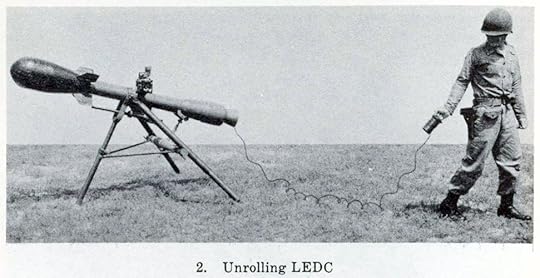
The Davey Crockett: pulling the string launches the atomic warhead.
In 1964 LBJs campaign produced ads that were pioneering in their day in exploiting the fears of the electorate. These ads didn’t mention candidates by name and favored raw fear and emotion over rationality - a tradition adopted by political ads to this day. The ads are good enough to warrant a look at even now:
The “Daisy” ad, only thirty seconds long. Do you want your children counting down to a nuclear holocaust? This ad was so effective at fear-mongering it was only broadcast once.

“Test Ban” an effective reminder from the Johnson campaign that Kennedy’s test ban might have saved humanity from nuclear destruction
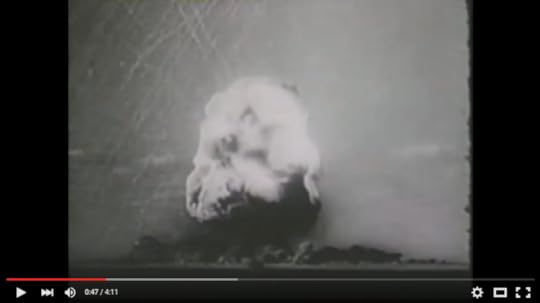
So in 1964 the Democrats were able to effectively counteract GOP fear-mongering by pointing out that the GOP itself was something justifiably to fear. This is something that most of the Democrats have conspicuously failed to do in 2016. Instead of explaining to the electorate that ISIS are many thousands of miles away and present much less of a threat to the average American household than keeping a gun in the home, they have let the fear-mongering go unchecked.
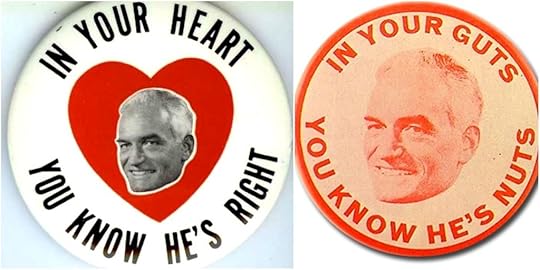
In 1964 the Democrat’s attack ads were amusing and effective
The legacy of the Goldwater campaign that is felt most strongly today in the moral sphere. It was in 1964 that the GOP began holding the Democratic Party accountable for most of the social ills of the day. Just like Trump in 2016, back in 1964 the GOP was waging war on political correctness - although it wasn’t called political correctness at the time. Just like today, victory over political correctness meant having the right to speak your prejudice out loud:
The Republican party’s first attempt to capture the moral high ground was a film called “Choice” in which LBJ is the driver of an out of control Cadillac as a metaphor for out of control moral decline. It’s worth watching just for some entertaining examples of what passed as immoral behavior in the sixties.

At the time the advert was a failure. Mentions of ‘men for sale’ and shots lingering over pictures of young women in bikinis left the electorate with the impression that the Goldwater campaign had, for their own strange reasons, decided to produce a porno movie. But ever since 1964 the GOP has taken up the fight for moral righteousness and, for the time being, has won the issues vote. Cruz has valiantly picked up this fight for American moral purity with his legal attack on dildos, vibrators and other marital aids (which are illegal in Texas). This will no doubt win him as many votes in 2016 as Goldwater’s film did in 1964.
So what did I learn from reading this immensely detailed book? I learnt that things are going to get ugly.
If you've been thinking that - with its talk of carpet bombing, delegate theft, small hands and menstruating TV reporters - the campaign is already ugly, well - you ain’t seen nothing yet. Just wait until the 2016 Republican Convention. If it is anything like the Republican Convention of 1964 it will be a doozy.
Fortunately help is at hand. An enterprising political pundit has produced a guide to candidate selection that could help keep both Republican and Democratic Conventions civilized.
If this flowchart is converted into a flyer and handed out in Cleveland and Philadelphia, delegates will be able to focus on the key election issues in a way that they haven’t done to date. Using this America can elect the President it deserves in 2016.

***********************************************
After finishing six hundred and twenty five pages of “Before the Storm” I now know more than any non-American will ever need to know about the US Presidential Campaign of 1964.
Why invest so much time reading a book about an obscure US election campaign more than half a century in the past? Because the parallels between the 1964 and 2016 Republican compaigns are just too interesting not to want to know more.
And it turns out I am not the only one who finds Goldwater’s 1964 campaign interesting. Ted Cruz has been studying the back room work that won Goldwater a majority at the 1964 Republican Convention. If Trump had read this book he would not be surprised to see Lyin’ Ted stealing his delegates.
Encouragingly for Cruz the book shows that Goldwater stood a much better chance of winning the Presidency than LBJ’s landslide victory implies. Goldwater wanted to fight a noble 'campaign of conservative ideas' without resorting to campaign trickery and surrounded himself with cronies from Arizona that were, broadly speaking, incompetent. If Goldwater had been more flexible around policy and more pragmatic about how his campaign was run he stood a good chance of winning. November might tell us whether or not Cruz has done his homework and learnt from Goldwater's errors.
“Before the Storm” is full of places where the 1964 and 2016 presidential campaigns converge or diverge. Here are a few examples.
The mainstream GOP choice was Nelson Rockefeller, a candidate who shared a lot in common with Jeb Bush: son of a famous family, rich, leisured, entitled, mediocre, dull. Understandably, the public was left cold. In 1964 Rockefeller was seen by many as an ‘East Coast Liberal’ out of touch with the concerns with the rest of the country.
Nelson Rockefeller and Jeb Bush: Republican mediocrities.
Rather quaintly in 1964 people used to believe that New Yorkers like Rockefeller exercised malign influence over Wall Street and by extension the rest of the country. Nowadays, of course, we know that Wall Street exercises a malign influence over the rest of the country regardless of what New Yorkers do. But this outlook was another black mark against Rockefeller. Members of more extreme right wing groups such as the ‘John Birch Society’ (the Tea Party of its day) suspected Rockefeller - and even incredibly Eisenhower - of being communists. The tradition of stupefying ignorance on the fringes of the GOP extends back to well before 2016.
So just like Goldwater back in 1964, in 2016 Trump and Cruz occupied the vacancy on the GOP bench left open by the unpopularity of the mainstream candidate. And just like Trump and Cruz in 2016, Goldwater attracted some rather unconventional support:
Strange bed sheets for strange GOP bed-fellows
In 1964 Goldwater’s team had to distance themselves from extremists on the conservative right wing in order to maintain their credibility . In contrast these days Trump and Cruz discretely call out to extremists, blowing on their dog-whistles with as much puff as they can muster. Trump delays condemning his endorsement from David Duke; Cruz shares a platform with religious bigots who call for death to LGBT individuals.
Some things never change in GOP politics. Just like today back in 1964 the GOP were happy to exploit the fears of the electorate in order to win votes. A real difference between 1964 and now was that in 1964 America was facing an imminent threat to its existence: nuclear war with the USSR. Unsurprisingly the Cold War was a major concern of the electorate and focus of the 1964 campaign:
"...Lyndon Johnson understood how souls were moved by dark thoughts that crept up on sleepless nights. 'Men worry about heart attacks', he would say, clasping his chest. 'Women worry about cancer of the tit' (here he jabbed the breastplate of his nearest companion). 'But everybody worries about war and peace. Everything else is chickenshit'..."
In 2016 America also faces clear and present existential threats, but ones very different from those of 1964. These threats are largely ignored by the candidates of 2016: climate change, pollution, environmental destruction. The difference, of course, is that these are not imminent threats but rather threats that accumulate imperceptibly by degrees. They can be safely ignored by a GOP that needs to exaggerate fears to raise votes and can be paid lip-service to by a Democratic party that needs to raise donor money from the fossil fuel industry or polluters.
So whereas the 1964 Campaign focused on the pressing issue of nuclear holocaust and the end of the world the 2016 campaign focuses on marginal threats such as the danger from ISIS terrorists infiltrating across the Mexican border or from shariah law in Arizona. Sadly neither the Democrats of today nor LBJ in 1964 did much to put these issues in a proper perspective.
It is interesting from a purely historical perspective to take a closer look at how the GOP and the Democrats dealt with the real threat of global nuclear war in the 1964 campaign.
Goldwater’s weakest spot was being seen as a warmonger who might trigger a nuclear exchange. One has to wonder whether this would be a weak spot in a candidate today. His background included flying planes from the US to deploy on the front line for WW2 and he loved to talk about military equipment, which didn't do much to dispel the warmonger image. His support for allowing military commanders the authority to launch nuclear strikes didn’t help much either. Neither did his advocacy of weapons systems such as the ‘Davy Crockett’ – the atomic warhead mounted on a portable recoilless rifle which had the drastic design flaw of sometimes including within its blast zone the infantry men firing the weapon.
The Davey Crockett: pulling the string launches the atomic warhead.
In 1964 LBJs campaign produced ads that were pioneering in their day in exploiting the fears of the electorate. These ads didn’t mention candidates by name and favored raw fear and emotion over rationality - a tradition adopted by political ads to this day. The ads are good enough to warrant a look at even now:
The “Daisy” ad, only thirty seconds long. Do you want your children counting down to a nuclear holocaust? This ad was so effective at fear-mongering it was only broadcast once.
“Test Ban” an effective reminder from the Johnson campaign that Kennedy’s test ban might have saved humanity from nuclear destruction
So in 1964 the Democrats were able to effectively counteract GOP fear-mongering by pointing out that the GOP itself was something justifiably to fear. This is something that most of the Democrats have conspicuously failed to do in 2016. Instead of explaining to the electorate that ISIS are many thousands of miles away and present much less of a threat to the average American household than keeping a gun in the home, they have let the fear-mongering go unchecked.
In 1964 the Democrat’s attack ads were amusing and effective
The legacy of the Goldwater campaign that is felt most strongly today in the moral sphere. It was in 1964 that the GOP began holding the Democratic Party accountable for most of the social ills of the day. Just like Trump in 2016, back in 1964 the GOP was waging war on political correctness - although it wasn’t called political correctness at the time. Just like today, victory over political correctness meant having the right to speak your prejudice out loud:
"...Goldwater had said back in January that the reason most people were on relief was because they were stupid or lazy...when he asked those who criticized him if they thought what he said was right, they invariably responded, 'Oh, yes, you're right, but you shouldn't have said it'..."
The Republican party’s first attempt to capture the moral high ground was a film called “Choice” in which LBJ is the driver of an out of control Cadillac as a metaphor for out of control moral decline. It’s worth watching just for some entertaining examples of what passed as immoral behavior in the sixties.
At the time the advert was a failure. Mentions of ‘men for sale’ and shots lingering over pictures of young women in bikinis left the electorate with the impression that the Goldwater campaign had, for their own strange reasons, decided to produce a porno movie. But ever since 1964 the GOP has taken up the fight for moral righteousness and, for the time being, has won the issues vote. Cruz has valiantly picked up this fight for American moral purity with his legal attack on dildos, vibrators and other marital aids (which are illegal in Texas). This will no doubt win him as many votes in 2016 as Goldwater’s film did in 1964.
So what did I learn from reading this immensely detailed book? I learnt that things are going to get ugly.
If you've been thinking that - with its talk of carpet bombing, delegate theft, small hands and menstruating TV reporters - the campaign is already ugly, well - you ain’t seen nothing yet. Just wait until the 2016 Republican Convention. If it is anything like the Republican Convention of 1964 it will be a doozy.
Fortunately help is at hand. An enterprising political pundit has produced a guide to candidate selection that could help keep both Republican and Democratic Conventions civilized.
If this flowchart is converted into a flyer and handed out in Cleveland and Philadelphia, delegates will be able to focus on the key election issues in a way that they haven’t done to date. Using this America can elect the President it deserves in 2016.

September 13, 2024
A lengthy, detailed, and readable account of the 1964 US presidential election campaign.
I bought Perlstein's
 Reaganland: America's Right Turn 1976-1980 having read some positive reviews wanting to learn more about Reagan's rise to become president. Having bought it, I realised there were books prior to this by the author; the first being Before the Storm.
As a Brit, I was completely unaware of Barry Goldwater, and yet judging from reviews of Rick Perlstein's series of books I needed to read Before the Storm to give me the full picture of the Republican story from 1964 through to Reagan becoming the 40th President of the USA.
In short, Perlstein's book is very substantial but rich in reward. It is clear that he has a quite astonishing grasp on his subject/subject matter. What also became clear very quickly is that whilst this is a book about Goldwater and the GOP/Republican party, it is much more, as the book details, how Kennedy, and then Johnson operated and campaigned during the period of 1960 to 64. Moreover, the book details many of the challenges and worries of those years, including civil rights, social services/care, education including student protests, job creation, nuclear war and Russia, China and wider Communism and of course the sore that would become a suppurating mess: Vietnam.
Perlstein delves deeply into the Republican party and how its potential nominees operated and campaigned. There is extraordinary detail about the campaigns and who did what, why and when as well as the impacts on various [numerous] committees, voters and the key players - all the while the reader being kept in touch with the plans and doings of Kennedy and later Johnson.
There is much here for political fans but also social history afficionados, including for example how parties' worked with the press, radio, cinema, and increasingly television shaping their campaigns, their messaging and the opposition strategy and responses. There was also usage of celebrities, including a certain Ronald Reagan, as well as leaflets, buttons, pamphlets and books to deliver messages. I was simply amazed at the numbers of volunteers who supported the Goldwater campaign across the nation - one wonders if this enthusiasm and commitment, especially from the young, remains in the modern era of Trump and Harris?
For readers who enjoy the insight into presidential campaign planning, meetings, rallies and the policy setting (including arguments) you will be spoilt.
To understand how Goldwater came to be a candidate and then how he operated, communicated and came to be the Republican nominee this books tells this well. To understand the Goldwater campaign, and indeed US politics and the election of Johnson in 1964 there is probably no better book from the Republican side, especially as Perlstein is fair, measured and very factual to both sides.
I bought Perlstein's
Reaganland: America's Right Turn 1976-1980 having read some positive reviews wanting to learn more about Reagan's rise to become president. Having bought it, I realised there were books prior to this by the author; the first being Before the Storm.As a Brit, I was completely unaware of Barry Goldwater, and yet judging from reviews of Rick Perlstein's series of books I needed to read Before the Storm to give me the full picture of the Republican story from 1964 through to Reagan becoming the 40th President of the USA.
In short, Perlstein's book is very substantial but rich in reward. It is clear that he has a quite astonishing grasp on his subject/subject matter. What also became clear very quickly is that whilst this is a book about Goldwater and the GOP/Republican party, it is much more, as the book details, how Kennedy, and then Johnson operated and campaigned during the period of 1960 to 64. Moreover, the book details many of the challenges and worries of those years, including civil rights, social services/care, education including student protests, job creation, nuclear war and Russia, China and wider Communism and of course the sore that would become a suppurating mess: Vietnam.
Perlstein delves deeply into the Republican party and how its potential nominees operated and campaigned. There is extraordinary detail about the campaigns and who did what, why and when as well as the impacts on various [numerous] committees, voters and the key players - all the while the reader being kept in touch with the plans and doings of Kennedy and later Johnson.
There is much here for political fans but also social history afficionados, including for example how parties' worked with the press, radio, cinema, and increasingly television shaping their campaigns, their messaging and the opposition strategy and responses. There was also usage of celebrities, including a certain Ronald Reagan, as well as leaflets, buttons, pamphlets and books to deliver messages. I was simply amazed at the numbers of volunteers who supported the Goldwater campaign across the nation - one wonders if this enthusiasm and commitment, especially from the young, remains in the modern era of Trump and Harris?
For readers who enjoy the insight into presidential campaign planning, meetings, rallies and the policy setting (including arguments) you will be spoilt.
To understand how Goldwater came to be a candidate and then how he operated, communicated and came to be the Republican nominee this books tells this well. To understand the Goldwater campaign, and indeed US politics and the election of Johnson in 1964 there is probably no better book from the Republican side, especially as Perlstein is fair, measured and very factual to both sides.

November 8, 2014
Before the Storm is the first (and best) of historian Rick Perlstein’s fantastic, four volume history of the rise of the modern conservative movement in American politics. Its focus is the 1964 presidential campaign, where conservatives first seized control of the Republican Party from the centrist establishment. From the early planning stages, (beginning in 1961), through the contentious battles for the nomination, and the bruising, catastrophic electoral loss, Perlstein weaves all the elements together into a fascinating, highly readable story.
Perlstein examines how the diverse strands of conservatism, from Robert Welch and his conspiratorial wing-nut John Birch Society, to the elite God and Man at Yale set of William F. Buckley and his National Review intelligentsia, came together behind the pugnacious, straight-shooting Senator from Arizona, Barry Goldwater as the champion of their cause. Despite the frantic resistance of the Republican establishment and its champions (Nelson Rockefeller, William Scranton, George Romney, Henry Cabot Lodge) they managed to ride the crest of a critical historic moment to accomplish what had been seen as impossible.
The book also details the response of LBJ and his administration. They had to shape their response to this unique challenge while pushing through the monumental Civil Rights Bill and dealing what would soon become full scale war in Vietnam.
Perlstein’s storytelling includes painting a dramatic picture of the extraordinary times. They included such monumental, history bending events as the Cuban Missile Crisis, the Civil Rights Movement, the Kennedy assassination, and the Gulf of Tonkin incident. He also captures the cultural ferment that shaped the moment, including such cultural milestones as the Beatles American tour, the proto-hippie Merry Pranksters and their cross country bus journey, boxer Cassius Clay’s conversion to the Nation of Islam and becoming Muhammad Ali, and the Berkeley University Free Speech Movement.
Though Goldwater went down to epic defeat in the 1964 election, it was a productive defeat. Conservatives seized control of the Republican Party, a control they would never fully relinquish. Richard Nixon collected chits and laid the groundwork for the Southern Strategy and his 1968 campaign. Ronald Reagan made his auspicious political debut in the ‘64 campaign, and Phyllis Shaftly emerged as a right wing star. Perlstein ends his book on an ironic note, with all mainstream sources reporting the destruction and disappearance of conservatism as a factor in politics thanks to the shattering electoral defeat. We, of course, know better.
Perlstein examines how the diverse strands of conservatism, from Robert Welch and his conspiratorial wing-nut John Birch Society, to the elite God and Man at Yale set of William F. Buckley and his National Review intelligentsia, came together behind the pugnacious, straight-shooting Senator from Arizona, Barry Goldwater as the champion of their cause. Despite the frantic resistance of the Republican establishment and its champions (Nelson Rockefeller, William Scranton, George Romney, Henry Cabot Lodge) they managed to ride the crest of a critical historic moment to accomplish what had been seen as impossible.
The book also details the response of LBJ and his administration. They had to shape their response to this unique challenge while pushing through the monumental Civil Rights Bill and dealing what would soon become full scale war in Vietnam.
Perlstein’s storytelling includes painting a dramatic picture of the extraordinary times. They included such monumental, history bending events as the Cuban Missile Crisis, the Civil Rights Movement, the Kennedy assassination, and the Gulf of Tonkin incident. He also captures the cultural ferment that shaped the moment, including such cultural milestones as the Beatles American tour, the proto-hippie Merry Pranksters and their cross country bus journey, boxer Cassius Clay’s conversion to the Nation of Islam and becoming Muhammad Ali, and the Berkeley University Free Speech Movement.
Though Goldwater went down to epic defeat in the 1964 election, it was a productive defeat. Conservatives seized control of the Republican Party, a control they would never fully relinquish. Richard Nixon collected chits and laid the groundwork for the Southern Strategy and his 1968 campaign. Ronald Reagan made his auspicious political debut in the ‘64 campaign, and Phyllis Shaftly emerged as a right wing star. Perlstein ends his book on an ironic note, with all mainstream sources reporting the destruction and disappearance of conservatism as a factor in politics thanks to the shattering electoral defeat. We, of course, know better.

July 5, 2025
Given the massive, landslide victory by Lyndon Johnson, the 1964 presidential election could be considered inconsequential.
Before the Storm
by Rick Perlstein proves that this would be the wrong conclusion. It is the perfect title for a book that shows the founding of the conservative right-wing faction of the modern Republican party.
During the 1950s there had been widespread agreement where conservatives would support the social and domestic agenda of liberals while liberals supported the efforts by conservatives to resist and contain the spread of communism abroad. The death of that consensus is the subject of this book.
Conservatives seized control of the Republican Party following their disappointment with Eisenhower. There are some hints that Eisenhower and the Northeastern wing of the party had stolen the nomination from Robert Taft in 1952. During the 1950s the conservative faction of American politics had become identified with the John Birch Society, the Ku Klux Klan, Joseph McCarthy, or George Lincoln Rockwell’s American Nazi Party. Conservatives recognized that this lunatic fringe would limit their effectiveness in politics.
In 1955 William F. Buckley started a magazine, the National Review, which would articulate a conservative position that a conservative candidate could offer without embarrassment. He was able to combine the various schools of conservative thinking into an ideology that inspired a generation of conservatives to develop alternatives that eventually appealed to the American middle class.
At his victory speech Johnson declared “I doubt that there has ever been so many people seeing so many things alike on decision day”. (Page 512) Indeed pundits declared that Goldwater’s loss had brought the end of the Republican Party. But in Theodore H. White’s “The Making of the President 1964” he stated: “History would have to record that the Republican Party had not submitted docilely to this leadership, but had resisted it to the end—so that from this resistance and defeat, others, later, might take heart and resume the battle.” (Page 516) This is the classic case of the seeds of success being sown by failure.
The loss in 1964 by Goldwater was in large part a result of a reluctant candidate and a disastrously run campaign. He was also facing a seasoned, master politician in Lyndon Johnson. The end of the book describes how Richard Nixon took advantage of the aftermath of this campaign to collect favors from political groups around the country.
This is the first of four books by Rick Perlstein covering the GOP from the campaign of Barry Goldwater in 1964 through the presidency of Ronald Reagan. The subsequent books in this series will show the triumph of the conservative takeover of the Grand Old Party that still exists today.
During the 1950s there had been widespread agreement where conservatives would support the social and domestic agenda of liberals while liberals supported the efforts by conservatives to resist and contain the spread of communism abroad. The death of that consensus is the subject of this book.
Conservatives seized control of the Republican Party following their disappointment with Eisenhower. There are some hints that Eisenhower and the Northeastern wing of the party had stolen the nomination from Robert Taft in 1952. During the 1950s the conservative faction of American politics had become identified with the John Birch Society, the Ku Klux Klan, Joseph McCarthy, or George Lincoln Rockwell’s American Nazi Party. Conservatives recognized that this lunatic fringe would limit their effectiveness in politics.
In 1955 William F. Buckley started a magazine, the National Review, which would articulate a conservative position that a conservative candidate could offer without embarrassment. He was able to combine the various schools of conservative thinking into an ideology that inspired a generation of conservatives to develop alternatives that eventually appealed to the American middle class.
At his victory speech Johnson declared “I doubt that there has ever been so many people seeing so many things alike on decision day”. (Page 512) Indeed pundits declared that Goldwater’s loss had brought the end of the Republican Party. But in Theodore H. White’s “The Making of the President 1964” he stated: “History would have to record that the Republican Party had not submitted docilely to this leadership, but had resisted it to the end—so that from this resistance and defeat, others, later, might take heart and resume the battle.” (Page 516) This is the classic case of the seeds of success being sown by failure.
The loss in 1964 by Goldwater was in large part a result of a reluctant candidate and a disastrously run campaign. He was also facing a seasoned, master politician in Lyndon Johnson. The end of the book describes how Richard Nixon took advantage of the aftermath of this campaign to collect favors from political groups around the country.
This is the first of four books by Rick Perlstein covering the GOP from the campaign of Barry Goldwater in 1964 through the presidency of Ronald Reagan. The subsequent books in this series will show the triumph of the conservative takeover of the Grand Old Party that still exists today.

January 25, 2010
In honor of Michelle Bachman accidentally comparing herself to John Wayne Gacy I thought I'd post a quick review. I read this last January and since then I can't count how many times I've seen the news or heard snippets of conversation and thought to myself, "Jesus Christ, this reminds me of the Perlstein book." The 1964 election seems somewhat non-consequential in retrospect. History buffs might be able to think of the Daisy ad and Goldwater's "extremism in defense of liberty is no vice... moderation in the pursuit of justice is no virtue " line at the GOP convention. But in the end, Johnson crushed Goldwater. Johnson won over 61% of the vote, the highest since 1820 and one that has yet to be matched.
However, Perlstein persuasively makes the case that the '64 election meant a lot more than voting results would suggest. 1964 is arguably the birth of the modern GOP. This election is where the Southern and Western conservatives finally were able to choose a candidate of their own as opposed to one imposed on them by Northeastern businessmen. This is where the GOP transitioned from the Eisenhower/Taft/Dewey Era to something resembling the modern party. For the first time since Reconstruction the Republican party won the Cotton Belt. This election set pieces in moving that would dominate the party for the next generation. As well as featuring the political resurrection of Richard M. Nixon the election of '64 witnessed the emergence of Ronald Reagan as a national figure on the right.
The election is intriguing for more reasons than as an augur of the future. Barry Goldwater was a new kind of candidate. He was not the establishment's man. Indeed, the Republican establishment desperately sought a possible anti-Goldwater. What enable Goldwater to prevail* was a strong, structured, and well-funded organization. This backing extended beyond traditional power brokers into something akin to grass root support. At the heart of this grass root support was the John Birch Society. This is were similarities with contemporary events really jumps out at you. If you're not familiar with the Birchers, they were a group of rabid anti-Communists who were convinced that the mainstream media and establishment were card carrying Pinkos. They weren't satisfied calling Kennedy, Marshall, and Truman commies, they were convinced Eisenhower was red. Perlstein's writing on the Birchers is perhaps the most entertaining and insightful writing in this book.
*In addition to other potential candidate's hesitation to run and Nelson Rockefeller's public divorce.
Before the Storm is a well titled book. In more ways than one, 1964 is a transition point in American history. The major mid-century cultural and historical trajectories all had some sort of turning point in '64. The year witnessed the passage of the CIvil Rights Act, the Gulf of Tonkin Incident, the Beatles first appearance on the Ed Sullivan Show, and much more. Perlstein is a talented historian, and he is just as natural describing political gamesmanship as he is describing the cultural impact of Kubrick's Dr. Strangelove.
Perlstein subtitles this book "this unmaking of the American Consensus." Of course partisanship has been a part of the American political tradition since before there was a United States. But the storm that, according to Perlstein, was on the horizon after November 1964 was a growing sense that the other half of the political spectrum were out to destroy everything that was truly remarkable about America. The other side became transformed from an adversary to an enemy.**
** This trend wasn't unprecedented, just that the last time it was so prevalent we ended up in a civil war.
Nixonland, Perlstein's most recent book, is another fantastic book. In it, Perlstein gives an account of the cultural wars of the latter half of the sixties and early seventies, and makes the argument that much of the acrimony surrounding these battles was the personal creation of Richard M. Nixon. Perlstein argues, and presents a convincing case, that we are still living in Richard Nixon's America. However, I think Before the Storm might be the more relevant work. Nixonland explains the past fifty years, but through some twist of history, Before the Storm seems to often explain the present.
However, Perlstein persuasively makes the case that the '64 election meant a lot more than voting results would suggest. 1964 is arguably the birth of the modern GOP. This election is where the Southern and Western conservatives finally were able to choose a candidate of their own as opposed to one imposed on them by Northeastern businessmen. This is where the GOP transitioned from the Eisenhower/Taft/Dewey Era to something resembling the modern party. For the first time since Reconstruction the Republican party won the Cotton Belt. This election set pieces in moving that would dominate the party for the next generation. As well as featuring the political resurrection of Richard M. Nixon the election of '64 witnessed the emergence of Ronald Reagan as a national figure on the right.
The election is intriguing for more reasons than as an augur of the future. Barry Goldwater was a new kind of candidate. He was not the establishment's man. Indeed, the Republican establishment desperately sought a possible anti-Goldwater. What enable Goldwater to prevail* was a strong, structured, and well-funded organization. This backing extended beyond traditional power brokers into something akin to grass root support. At the heart of this grass root support was the John Birch Society. This is were similarities with contemporary events really jumps out at you. If you're not familiar with the Birchers, they were a group of rabid anti-Communists who were convinced that the mainstream media and establishment were card carrying Pinkos. They weren't satisfied calling Kennedy, Marshall, and Truman commies, they were convinced Eisenhower was red. Perlstein's writing on the Birchers is perhaps the most entertaining and insightful writing in this book.
*In addition to other potential candidate's hesitation to run and Nelson Rockefeller's public divorce.
Before the Storm is a well titled book. In more ways than one, 1964 is a transition point in American history. The major mid-century cultural and historical trajectories all had some sort of turning point in '64. The year witnessed the passage of the CIvil Rights Act, the Gulf of Tonkin Incident, the Beatles first appearance on the Ed Sullivan Show, and much more. Perlstein is a talented historian, and he is just as natural describing political gamesmanship as he is describing the cultural impact of Kubrick's Dr. Strangelove.
Perlstein subtitles this book "this unmaking of the American Consensus." Of course partisanship has been a part of the American political tradition since before there was a United States. But the storm that, according to Perlstein, was on the horizon after November 1964 was a growing sense that the other half of the political spectrum were out to destroy everything that was truly remarkable about America. The other side became transformed from an adversary to an enemy.**
** This trend wasn't unprecedented, just that the last time it was so prevalent we ended up in a civil war.
Nixonland, Perlstein's most recent book, is another fantastic book. In it, Perlstein gives an account of the cultural wars of the latter half of the sixties and early seventies, and makes the argument that much of the acrimony surrounding these battles was the personal creation of Richard M. Nixon. Perlstein argues, and presents a convincing case, that we are still living in Richard Nixon's America. However, I think Before the Storm might be the more relevant work. Nixonland explains the past fifty years, but through some twist of history, Before the Storm seems to often explain the present.

October 11, 2012
Rick Perlstein’s first book, and still his best, Before the Storm revisits the launch of the modern conservative movement. Perlstein centers his narrative on Barry Goldwater, the Arizona Senator whose small government principles made him an outlier in postwar consensus politics. Never particularly ambitious for himself, Goldwater seems content functioning as a gadfly against the Washington Establishment, until an unlikely coalition of right wing groups goads him into action. Business magnates like Clarence Manion and Robert E. Wood; the student conservatives of Young Americans for Freedom and the paranoid John Birch Society; conservative intellectuals like William F. Buckley along with southern demagogues disgusted with the Civil Rights Movement. With their assistance, Goldwater overwhelms the “Kingmakers” who control the Republican Party and wins their nomination in 1964. Unfortunately, he’s a terrible campaigner who’s easily savaged by Lyndon Johnson and caricatured as an extremist by the media. Goldwater loses in a landslide, causing pundits to dismiss him as an aberration. Surely, they reason, such a reactionary platform can never succeed in American politics.
Indeed, pundits dismissing phenomena like Goldwater as aberrations points up the book’s recurring theme. Perlstein’s subtitle about the “American Consensus” is largely ironic; for all the talk about America’s postwar conformity, tensions big and large simmer beneath the surface. Joe McCarthy’s Red Scare flamed out by mid-decade, but the institutionalized anticommunism remained, nurtured by liberals and conservatives alike: this bred paranoia, resentment and suspicion of alternate ideologies as un-American. African Americans began to organize in earnest, the Civil Rights Movement generating white resistance and backlash in proportion to its success. The South is ravaged by Klan bombings and murders; frustrated northern Blacks engage in race riots; John F. Kennedy’s assassination rings in a decade of political murder. There’s even a burgeoning movement of Leftists protesting nuclear weapons, American adventurism and racial and economic inequality - though, for now, they’re overshadowed by their counterparts on the Right. All the while, American reporters and politicians insist repeatedly, trying to convince themselves, that their country remains “United and At Peace With Itself,” even as it stands on the precipice.
Before the Storm illustrates how conservative thought bloomed in such a climate. The postwar economic boom renders middle class Americans susceptible to appeals to property rights and low taxes, forgetting how much of their prosperity came from government contracts and New Deal politics in the first place. (A curious irony, this: the success of American liberalism often proves its downfall.) The demands of Black Americans leads to resentment and fear of displacement, even among whites who aren’t overtly racist. Union leaders like Walter Reuther are caricatured as thugs out to break American freedom with strikes and unreasonable demands. All while ever present dread of communism hangs overhead, scaring the public with nightmares of enslavement or annihilation. When even the most liberal politicians bought into the Cold War consensus - when Kennedy engages in brinkmanship in Cuba and Berlin, or Johnson commits America to Vietnam - anything short of total war with the USSR seems inadequate. And, if you’re particularly scared, it seems part of a deliberate conspiracy to undermine America. Even wild groups like the Birchers, however mad their claims that Eisenhower is a communist or water fluoridation a Soviet plot, are in many ways consensus thinking taken to an illogical conclusion.
Perlstein provides bracing accounts of YAF and other young conservatives, who convinced themselves they were subversives against a Liberal Establishment. Their rhetoric, with its denunciation of a dehumanizing system and unfeeling government, curiously mirrors that of the New Left which displaced them later in the decade. Goldwater’s nomination is stage-managed by brilliant operatives, not the least F. Clifton White, who orchestrates his takeover of the GOP in backroom deals with party delegates. Compared to liberal Republicans who are compromised (Nelson Rockefeller, his campaign destroyed by his untimely remarriage), ineffectual (William Scranton, the Pennsylvania Governor whose vacillations earned him the epithet of “the Harrisburg Hamlet”) or devious (Richard Nixon, lurking in the wings for a draft that never comes), Goldwater’s straightforward conservatism appears much more appealing. At least until LBJ and the media savage him as an extremist, that most dreaded of figures to the postwar consensus.
Perlstein’s books are as much a study of liberalism’s failures as of conservative successes. The “kingmakers” in the press repeatedly mock Goldwater’s chances of winning, putting forth increasingly bizarre Republican alternatives (Henry Cabot Lodge, who won New Hampshire’s primary while serving as Ambassador to South Vietnam, or perennial loser Harold Stassen) with little appeal, in or outside the party. Democrats treat racist Alabama Governor George Wallace as a grandstanding thug, until he performs competitively in several northern primaries to Johnson’s mortification; the Republicans, abandoning their Party of Lincoln mantle, “go hunting where the ducks are” (in Goldwater’s words) and destroy the Solid South by fanning racial resentment and recruiting apostate Democrats like Strom Thurmond as allies. (The cross pollination of “movement” conservatism with Birchers, the KKK and other fringe groups, of course, laid seeds for the Party’s descent into fanatical nationalism.) In Washington, Lyndon Johnson’s legislative successes in the Great Society lead him to hubris; he makes a devil’s pact to escalate the war in Vietnam, while ignoring the groundswell that, four years later, would sweep Richard Nixon into the White House.
Between the portraits of politicos and grassroots organizers, the lively depictions of conventions and protests, the dissection of media touchstones from The Twilight Zone to Dr. Strangelove, Before the Storm offers a masterwork of political history. Some of Perlstein’s later books fall victim to caricature; he struggles to see Goldwater’s successors, Nixon and Ronald Reagan (introduced, in cameo, making a stirring television address on Goldwater’s behalf), as anything more than monstrous. Perhaps because Barry Goldwater didn’t win, perhaps because he lacks Nixon’s amorality or Reagan’s smoothness, Perlstein finds him a sympathetic figure. And this story of a political movement who succeeds even in a catastrophic failure yields a lesson for anyone who follows, participates in or cares about politics.
Indeed, pundits dismissing phenomena like Goldwater as aberrations points up the book’s recurring theme. Perlstein’s subtitle about the “American Consensus” is largely ironic; for all the talk about America’s postwar conformity, tensions big and large simmer beneath the surface. Joe McCarthy’s Red Scare flamed out by mid-decade, but the institutionalized anticommunism remained, nurtured by liberals and conservatives alike: this bred paranoia, resentment and suspicion of alternate ideologies as un-American. African Americans began to organize in earnest, the Civil Rights Movement generating white resistance and backlash in proportion to its success. The South is ravaged by Klan bombings and murders; frustrated northern Blacks engage in race riots; John F. Kennedy’s assassination rings in a decade of political murder. There’s even a burgeoning movement of Leftists protesting nuclear weapons, American adventurism and racial and economic inequality - though, for now, they’re overshadowed by their counterparts on the Right. All the while, American reporters and politicians insist repeatedly, trying to convince themselves, that their country remains “United and At Peace With Itself,” even as it stands on the precipice.
Before the Storm illustrates how conservative thought bloomed in such a climate. The postwar economic boom renders middle class Americans susceptible to appeals to property rights and low taxes, forgetting how much of their prosperity came from government contracts and New Deal politics in the first place. (A curious irony, this: the success of American liberalism often proves its downfall.) The demands of Black Americans leads to resentment and fear of displacement, even among whites who aren’t overtly racist. Union leaders like Walter Reuther are caricatured as thugs out to break American freedom with strikes and unreasonable demands. All while ever present dread of communism hangs overhead, scaring the public with nightmares of enslavement or annihilation. When even the most liberal politicians bought into the Cold War consensus - when Kennedy engages in brinkmanship in Cuba and Berlin, or Johnson commits America to Vietnam - anything short of total war with the USSR seems inadequate. And, if you’re particularly scared, it seems part of a deliberate conspiracy to undermine America. Even wild groups like the Birchers, however mad their claims that Eisenhower is a communist or water fluoridation a Soviet plot, are in many ways consensus thinking taken to an illogical conclusion.
Perlstein provides bracing accounts of YAF and other young conservatives, who convinced themselves they were subversives against a Liberal Establishment. Their rhetoric, with its denunciation of a dehumanizing system and unfeeling government, curiously mirrors that of the New Left which displaced them later in the decade. Goldwater’s nomination is stage-managed by brilliant operatives, not the least F. Clifton White, who orchestrates his takeover of the GOP in backroom deals with party delegates. Compared to liberal Republicans who are compromised (Nelson Rockefeller, his campaign destroyed by his untimely remarriage), ineffectual (William Scranton, the Pennsylvania Governor whose vacillations earned him the epithet of “the Harrisburg Hamlet”) or devious (Richard Nixon, lurking in the wings for a draft that never comes), Goldwater’s straightforward conservatism appears much more appealing. At least until LBJ and the media savage him as an extremist, that most dreaded of figures to the postwar consensus.
Perlstein’s books are as much a study of liberalism’s failures as of conservative successes. The “kingmakers” in the press repeatedly mock Goldwater’s chances of winning, putting forth increasingly bizarre Republican alternatives (Henry Cabot Lodge, who won New Hampshire’s primary while serving as Ambassador to South Vietnam, or perennial loser Harold Stassen) with little appeal, in or outside the party. Democrats treat racist Alabama Governor George Wallace as a grandstanding thug, until he performs competitively in several northern primaries to Johnson’s mortification; the Republicans, abandoning their Party of Lincoln mantle, “go hunting where the ducks are” (in Goldwater’s words) and destroy the Solid South by fanning racial resentment and recruiting apostate Democrats like Strom Thurmond as allies. (The cross pollination of “movement” conservatism with Birchers, the KKK and other fringe groups, of course, laid seeds for the Party’s descent into fanatical nationalism.) In Washington, Lyndon Johnson’s legislative successes in the Great Society lead him to hubris; he makes a devil’s pact to escalate the war in Vietnam, while ignoring the groundswell that, four years later, would sweep Richard Nixon into the White House.
Between the portraits of politicos and grassroots organizers, the lively depictions of conventions and protests, the dissection of media touchstones from The Twilight Zone to Dr. Strangelove, Before the Storm offers a masterwork of political history. Some of Perlstein’s later books fall victim to caricature; he struggles to see Goldwater’s successors, Nixon and Ronald Reagan (introduced, in cameo, making a stirring television address on Goldwater’s behalf), as anything more than monstrous. Perhaps because Barry Goldwater didn’t win, perhaps because he lacks Nixon’s amorality or Reagan’s smoothness, Perlstein finds him a sympathetic figure. And this story of a political movement who succeeds even in a catastrophic failure yields a lesson for anyone who follows, participates in or cares about politics.

February 18, 2017
Preface
--Before the Storm: Barry Goldwater and the Unmaking of the American Consensus
Notes
Selected Bibliography
Acknowledgments
Index
--Before the Storm: Barry Goldwater and the Unmaking of the American Consensus
Notes
Selected Bibliography
Acknowledgments
Index

put-aside
September 5, 2017It's hard to believe Perlstein wrote this had this published only in 2001. It is so detailed and filled with period detail (1960s) that he writes as though these people or events were familiar to us in some way. He writes in English, but he may as well be talking about another country, the information is so distant from my sphere. Add to that the extraordinary density of the information (I suppose like Caro's LBJ series) and you come up with a 'fascinating I'm sure' work that is completely undigestible in 2017.
I am interested in Goldwater and how conservatives sort of went off the deep end after the 1950s with all the 'Commies' in the workforce (labor unions), government, theatre, schools, media, yada yada, but am not interested enough to relive that narrow-minded idiocy. We have enough of that right here right now. Just give me the highlights--that's his job, isn't it? I mean, that's what I'm paying for...I didn't write this thing, after all.
Perlstein was completely brilliant and completely obsessed; he followed every conversation with diligence. He knew so much he no longer knew what was important to tell us.
Is Hill & Wang the official CIA publishing company? Just wondering...have seen it come up before...and who else could afford to keep this brilliant obsessed guy Perlstein working for so many years following so many threads except our bros in intelligence?
I am interested in Goldwater and how conservatives sort of went off the deep end after the 1950s with all the 'Commies' in the workforce (labor unions), government, theatre, schools, media, yada yada, but am not interested enough to relive that narrow-minded idiocy. We have enough of that right here right now. Just give me the highlights--that's his job, isn't it? I mean, that's what I'm paying for...I didn't write this thing, after all.
Perlstein was completely brilliant and completely obsessed; he followed every conversation with diligence. He knew so much he no longer knew what was important to tell us.
Is Hill & Wang the official CIA publishing company? Just wondering...have seen it come up before...and who else could afford to keep this brilliant obsessed guy Perlstein working for so many years following so many threads except our bros in intelligence?

December 29, 2014
Perlstein’s account of the birth of modern conservatism also provides fascinating perspective for the hyperbole so prevalent today. Fully appreciating how people felt in the past means putting aside knowledge of ensuing events. Take the recent Ebola scare in America. Fear ran rampant, kids stayed home from school, people without symptoms were quarantined, an Ebola Czar was appointed, and rumor had it that radical Islamists were infecting themselves in order to decimate America. Looking back we may see some overreaction, but perhaps not so much at the time. Consider this. In 1963 California Senator Kuchel announced he was receiving over 6,000 letters a month asserting that Chinese Communist troops in Mexico were preparing to invade the US and that a Soviet Colonel was training African troops, including many cannibals, in the swamps of southern Georgia readying for a UN takeover of the US. Think people are more paranoid today than fifty years ago? Think again. Such fears were catalysts to the inception of modern conservatism as they are to its staying power.
With the failure of the Dixiecrat movement to affect the 1948 presidential election, the failure of staunch Ohio conservative Senator Robert A. Taft to win the nomination at the 1952 Republican convention, and the censure of Joe McCarthy in 1954, conservatives of every variety were left searching for new leaders. Southern Democrats found themselves out of step with the national party. Eisenhower, viewed as an internationalist and by many as a liberal, enjoyed widespread popularity. By 1958 the number of conservatives in Congress had dwindled. In this vacuum the modern conservative movement was unfolding. The idea of uniting pro-business, anti-labor, anti-tax, balanced budget, isolationist Republican conservatives with states’ rights, segregationist Southern conservatives along with anti-communist conservatives into a single conservative force that could win national elections was championed by Clarence “Pat” Manion. Manion was a retired dean of Notre Dame’s law school, lifelong conservative and disheartened Taft activist who vented on his own radio and TV program. The leader he found to carry the torch and corral the faithful was Barry Goldwater.
First elected to the Senate in 1952, Goldwater changed the conservative rhetoric. Instead of identifying communist infiltration as the cause of America’s problem and looking for communists under every bed, Goldwater held the much more cogent view that American’s themselves were the problem. The New Deal had spawned a dependent society that had lost its vigor and industriousness, had grown soft, and could no longer stand up to the communist threat. Only by putting responsibility back on the individual could people develop the work ethic and moral fiber for America to prosper and be respected internationally. Goldwater put conservative philosophy in human moral terms everyone, North and South, could follow and it caught on with a very committed and vocal minority.
Meanwhile William F. Buckley and his 1955 startup National Review provided support for conservative causes and reached out to a new generation of young conservatives on college campuses and former communists disillusioned by the revelations of Soviet slave camps. These reformed conservatives were among the most fervent. Manion hired his cohort and Buckley’s Yale debating partner and brother-in-law Brent Bozell to ghostwrite Goldwater’s book, Conscience of a Conservative, which leaped to Time’s and The New York Times bestseller lists in 1960. Manion had hoped to exploit a Nixon-Rockefeller stalemate at the Republican convention. This didn’t happen but Goldwater did gain permanent committed supporters many of whom went on to establish Young Americans for Freedom which mobilized college students across the country.
In 1958 Robert Welch founded the ultra-conservative John Birch Society which carried McCarthyism to new extremes holding that even Eisenhower was a communist conspirator and Chief Justice Earl Warren should be impeached. Fred Koch, father of the current conservative activists, billionaires Charles and David Koch, co-founded the John Birch Society. By 1961 membership swelled to tens of thousands with endorsements from Cardinal Cushing, Senator Eastland and Goldwater. Red hysteria was reborn. The Society was particularly popular in Orange County, CA where Ronald Reagan often spoke to anti-communist groups and supported Nixon’s ultra-conservative opponent in the 1962 Republican primary for California governor. Nixon regarded as far too liberal for the OC’s and Birchers to support lost to Democrat Pat Brown in the main election.
1963 was a watershed year in terms of national divide. The fifties’ calm and illusion of consensus had given way to the Civil Rights movement of Martin Luther King and violent reprisals in the South, Boston schools’ crisis in the North, growth of conservative movements such as Young Americans for Freedom and radical liberal ones such as Tom Hayden’s SDS and Malcom X’s black supremacy. Fear stoked the conservatives and moralism the liberals as Rachael Carson’s Silent Spring, Betty Friedan’s The Feminine Mystique and Michael Harrington’s The Other America appeared. George Wallace stood in the schoolhouse door and President Kennedy finally took a stand proclaiming equal rights for blacks a moral issue. Americans were splintering from Birmingham to Boston to Berkeley.
The polarization of America was critical to LBJ’s decision to escalate the war in Viet Nam in early 1964. Remembering well how the charge that Truman lost China cost the Democrats in 1952 and gave credence to McCarthyism, LBJ wanted no repeat. Faced by the Joint Chief’s judgment that current tit for tat policy was hopeless and only bombing in Laos and the North could stave defeat, LBJ, nervous about a conservative challenge in the upcoming election, felt he had little choice. However, public announcements would wait until after the election.
As 1963 rolled into 1964, longtime conservative activist Clif White was getting the job done for Goldwater. White led a fervently dedicated organization in a grassroots campaign to select delegates loyal to Goldwater in state caucuses and primaries. The May California primary went to Goldwater with help from an ineffective campaign by Rockefeller as Lodge and Scranton held back until too late. After California, Goldwater’s nomination was never really in doubt. The party had been taken over by extreme conservatives not representative of the general public, 80% of whom supported LBJ over Goldwater.
In July, the 1964 Republican convention in San Francisco was overwhelmed by conservative Goldwater delegates and supporters offering an amazing counterpoint to a city with a different crowd making Haight-Ashbury its home. In June, the first hippies, the Merry Pranksters, had left the area on their school bus “Furthur” to spread cheer and perhaps pick up fresh supplies from Timothy Leary who’s The Psychedelic Experience had just appeared. Back at the Cow Palace, delegates enjoyed the latest dances such as the “Eisenhower sway”, “sway back and forth. But end up in dead center. Do not speak while performing this exercise.”
Goldwater, simplistic in his policies and in his politics, kept close his old Arizona friends with similar myopic views and kept distant the professionals like Clif White whose diligent work got him the nomination. Goldwater’s ill-considered, self-righteous pronouncements were authentic, but political disaster. He voted against the popular (except in the South) Civil Rights bill in a time of terrible violence against blacks saying passage would create a police state in America, ignoring the fact that the Deep South already was. He called for nukes to defoliate Viet Nam saying that as president he would just tell the Joint Chiefs to win and to figure out how on their own. He called for reducing the number of American soldiers in Europe and putting in tactical nukes in their place as a front line defense. He called for an end to federal assistance to the poor saying that the reason they were poor was because they were lazy or stupid.
Goldwater’s political naiveté was showcased in his acceptance speech, with his handcrafted phrases only shown to his cronies in advance. The famous lines,” …extremism in the defense of liberty is no vice…moderation in the pursuit of justice is no virtue.” were cheered loudly by his raucous rabble on the convention floor, but the image on national TV cast him as an extremist in most viewer’s minds. Afterwards, when one state leader was asked how he would campaign with Goldwater at the head of the ticket, he responded, “I’ll jump off that bridge when I come to it.”
Both campaigns evolved to campaigns of fear. LBJ played on the recklessness of Goldwater characterizing him as a warmonger who would start a nuclear war. The famous “daisy” ad showing a little girl counting daisy petals switching to a countdown for a nuclear explosion captured this fear perfectly. Goldwater played on crime and cultural fears. Those threatened by accelerating social change (sex, drugs, decline of religious values) were prime targets as were those afraid of race riots, loss of order, miscegenation and of course those afraid of “big brother”, the federal government. Goldwater’s campaign themes presaged many conservative campaigns to come as it recognized a growing split in the electorate reflecting the changing times and the loss of the comfort of 1950’s “Father Knows Best” Americana.
And who best represented that homespun image in the 1950’s other than GE spokesman Ronald Reagan. With his GE Theater TV show canceled in 1962, he put all his time into politics, switching parties (he had once been a liberal Democrat supporting Truman in 1948). He became co-chair of the California Citizens for Goldwater-Miller, gave numerous speeches and taped TV commercials for Goldwater. Reagan quickly became preferred to Goldwater as an event speaker. He firmly established himself as an extraordinary orator in his nationwide TV address for Goldwater election eve. Interestingly many of his techniques were copied from FDR’s fireside chats which Reagan listened to as a child. So while Goldwater was headed for sure demise, someone to carry the torch of conservatism through thick and thin was ready, willing and able. A star was rising.
Another, whose demise was prematurely predicted by the media, was also more than ready. Richard Nixon traveled the country for Goldwater and gave speeches, not nearly as eloquent as Reagan’s. However Nixon’s focus was on meeting and getting to know the local political leaders, the precinct chairman and the county chairman, relationships that would prove very useful in four more years.
Goldwater’s ineptitude and stridency not only lost the election but undermined the conservative cause and enabled the very future he so feared, LBJ’s Great Society. Goldwater’s failure to connect with any but the most conservative voters led to LBJ’s crushing victory. And not just LBJ won, Democrats came away with a huge congressional majority of 295 – 140 and Senate majority of 68 – 32, more than enough for LBJ to get his ambitious liberal programs passed.
Perlstein’s book filled in many blanks for me showing the transition of Taft era conservatism to a very different one that took form in the early 1960’s and more or less persists to this day. And while Goldwater’s humiliating defeat left the movement in disarray, the rubble of his campaign paved the way for two future presidents to carry his cause forward. Nixon learned to appreciate the power of the conservative movement and put that knowledge to good use in 1968. Ronald Reagan became widely recognized as the conservative champion who could connect with the general public.
Perlstein shows how conservative values developed in response to the rapid culture change and predominant liberalism of the fifties and sixties. Furthermore he shows how the legacy of conservative foundations built then would carry far into the future. While not the flowing dramatic prose of a Caro or a McCullough, Pearlstein’s style is engaging. For those who want to understand how modern conservatism began and gain insight into conservatism today, “Before the Storm” is highly recommended.
With the failure of the Dixiecrat movement to affect the 1948 presidential election, the failure of staunch Ohio conservative Senator Robert A. Taft to win the nomination at the 1952 Republican convention, and the censure of Joe McCarthy in 1954, conservatives of every variety were left searching for new leaders. Southern Democrats found themselves out of step with the national party. Eisenhower, viewed as an internationalist and by many as a liberal, enjoyed widespread popularity. By 1958 the number of conservatives in Congress had dwindled. In this vacuum the modern conservative movement was unfolding. The idea of uniting pro-business, anti-labor, anti-tax, balanced budget, isolationist Republican conservatives with states’ rights, segregationist Southern conservatives along with anti-communist conservatives into a single conservative force that could win national elections was championed by Clarence “Pat” Manion. Manion was a retired dean of Notre Dame’s law school, lifelong conservative and disheartened Taft activist who vented on his own radio and TV program. The leader he found to carry the torch and corral the faithful was Barry Goldwater.
First elected to the Senate in 1952, Goldwater changed the conservative rhetoric. Instead of identifying communist infiltration as the cause of America’s problem and looking for communists under every bed, Goldwater held the much more cogent view that American’s themselves were the problem. The New Deal had spawned a dependent society that had lost its vigor and industriousness, had grown soft, and could no longer stand up to the communist threat. Only by putting responsibility back on the individual could people develop the work ethic and moral fiber for America to prosper and be respected internationally. Goldwater put conservative philosophy in human moral terms everyone, North and South, could follow and it caught on with a very committed and vocal minority.
Meanwhile William F. Buckley and his 1955 startup National Review provided support for conservative causes and reached out to a new generation of young conservatives on college campuses and former communists disillusioned by the revelations of Soviet slave camps. These reformed conservatives were among the most fervent. Manion hired his cohort and Buckley’s Yale debating partner and brother-in-law Brent Bozell to ghostwrite Goldwater’s book, Conscience of a Conservative, which leaped to Time’s and The New York Times bestseller lists in 1960. Manion had hoped to exploit a Nixon-Rockefeller stalemate at the Republican convention. This didn’t happen but Goldwater did gain permanent committed supporters many of whom went on to establish Young Americans for Freedom which mobilized college students across the country.
In 1958 Robert Welch founded the ultra-conservative John Birch Society which carried McCarthyism to new extremes holding that even Eisenhower was a communist conspirator and Chief Justice Earl Warren should be impeached. Fred Koch, father of the current conservative activists, billionaires Charles and David Koch, co-founded the John Birch Society. By 1961 membership swelled to tens of thousands with endorsements from Cardinal Cushing, Senator Eastland and Goldwater. Red hysteria was reborn. The Society was particularly popular in Orange County, CA where Ronald Reagan often spoke to anti-communist groups and supported Nixon’s ultra-conservative opponent in the 1962 Republican primary for California governor. Nixon regarded as far too liberal for the OC’s and Birchers to support lost to Democrat Pat Brown in the main election.
1963 was a watershed year in terms of national divide. The fifties’ calm and illusion of consensus had given way to the Civil Rights movement of Martin Luther King and violent reprisals in the South, Boston schools’ crisis in the North, growth of conservative movements such as Young Americans for Freedom and radical liberal ones such as Tom Hayden’s SDS and Malcom X’s black supremacy. Fear stoked the conservatives and moralism the liberals as Rachael Carson’s Silent Spring, Betty Friedan’s The Feminine Mystique and Michael Harrington’s The Other America appeared. George Wallace stood in the schoolhouse door and President Kennedy finally took a stand proclaiming equal rights for blacks a moral issue. Americans were splintering from Birmingham to Boston to Berkeley.
The polarization of America was critical to LBJ’s decision to escalate the war in Viet Nam in early 1964. Remembering well how the charge that Truman lost China cost the Democrats in 1952 and gave credence to McCarthyism, LBJ wanted no repeat. Faced by the Joint Chief’s judgment that current tit for tat policy was hopeless and only bombing in Laos and the North could stave defeat, LBJ, nervous about a conservative challenge in the upcoming election, felt he had little choice. However, public announcements would wait until after the election.
As 1963 rolled into 1964, longtime conservative activist Clif White was getting the job done for Goldwater. White led a fervently dedicated organization in a grassroots campaign to select delegates loyal to Goldwater in state caucuses and primaries. The May California primary went to Goldwater with help from an ineffective campaign by Rockefeller as Lodge and Scranton held back until too late. After California, Goldwater’s nomination was never really in doubt. The party had been taken over by extreme conservatives not representative of the general public, 80% of whom supported LBJ over Goldwater.
In July, the 1964 Republican convention in San Francisco was overwhelmed by conservative Goldwater delegates and supporters offering an amazing counterpoint to a city with a different crowd making Haight-Ashbury its home. In June, the first hippies, the Merry Pranksters, had left the area on their school bus “Furthur” to spread cheer and perhaps pick up fresh supplies from Timothy Leary who’s The Psychedelic Experience had just appeared. Back at the Cow Palace, delegates enjoyed the latest dances such as the “Eisenhower sway”, “sway back and forth. But end up in dead center. Do not speak while performing this exercise.”
Goldwater, simplistic in his policies and in his politics, kept close his old Arizona friends with similar myopic views and kept distant the professionals like Clif White whose diligent work got him the nomination. Goldwater’s ill-considered, self-righteous pronouncements were authentic, but political disaster. He voted against the popular (except in the South) Civil Rights bill in a time of terrible violence against blacks saying passage would create a police state in America, ignoring the fact that the Deep South already was. He called for nukes to defoliate Viet Nam saying that as president he would just tell the Joint Chiefs to win and to figure out how on their own. He called for reducing the number of American soldiers in Europe and putting in tactical nukes in their place as a front line defense. He called for an end to federal assistance to the poor saying that the reason they were poor was because they were lazy or stupid.
Goldwater’s political naiveté was showcased in his acceptance speech, with his handcrafted phrases only shown to his cronies in advance. The famous lines,” …extremism in the defense of liberty is no vice…moderation in the pursuit of justice is no virtue.” were cheered loudly by his raucous rabble on the convention floor, but the image on national TV cast him as an extremist in most viewer’s minds. Afterwards, when one state leader was asked how he would campaign with Goldwater at the head of the ticket, he responded, “I’ll jump off that bridge when I come to it.”
Both campaigns evolved to campaigns of fear. LBJ played on the recklessness of Goldwater characterizing him as a warmonger who would start a nuclear war. The famous “daisy” ad showing a little girl counting daisy petals switching to a countdown for a nuclear explosion captured this fear perfectly. Goldwater played on crime and cultural fears. Those threatened by accelerating social change (sex, drugs, decline of religious values) were prime targets as were those afraid of race riots, loss of order, miscegenation and of course those afraid of “big brother”, the federal government. Goldwater’s campaign themes presaged many conservative campaigns to come as it recognized a growing split in the electorate reflecting the changing times and the loss of the comfort of 1950’s “Father Knows Best” Americana.
And who best represented that homespun image in the 1950’s other than GE spokesman Ronald Reagan. With his GE Theater TV show canceled in 1962, he put all his time into politics, switching parties (he had once been a liberal Democrat supporting Truman in 1948). He became co-chair of the California Citizens for Goldwater-Miller, gave numerous speeches and taped TV commercials for Goldwater. Reagan quickly became preferred to Goldwater as an event speaker. He firmly established himself as an extraordinary orator in his nationwide TV address for Goldwater election eve. Interestingly many of his techniques were copied from FDR’s fireside chats which Reagan listened to as a child. So while Goldwater was headed for sure demise, someone to carry the torch of conservatism through thick and thin was ready, willing and able. A star was rising.
Another, whose demise was prematurely predicted by the media, was also more than ready. Richard Nixon traveled the country for Goldwater and gave speeches, not nearly as eloquent as Reagan’s. However Nixon’s focus was on meeting and getting to know the local political leaders, the precinct chairman and the county chairman, relationships that would prove very useful in four more years.
Goldwater’s ineptitude and stridency not only lost the election but undermined the conservative cause and enabled the very future he so feared, LBJ’s Great Society. Goldwater’s failure to connect with any but the most conservative voters led to LBJ’s crushing victory. And not just LBJ won, Democrats came away with a huge congressional majority of 295 – 140 and Senate majority of 68 – 32, more than enough for LBJ to get his ambitious liberal programs passed.
Perlstein’s book filled in many blanks for me showing the transition of Taft era conservatism to a very different one that took form in the early 1960’s and more or less persists to this day. And while Goldwater’s humiliating defeat left the movement in disarray, the rubble of his campaign paved the way for two future presidents to carry his cause forward. Nixon learned to appreciate the power of the conservative movement and put that knowledge to good use in 1968. Ronald Reagan became widely recognized as the conservative champion who could connect with the general public.
Perlstein shows how conservative values developed in response to the rapid culture change and predominant liberalism of the fifties and sixties. Furthermore he shows how the legacy of conservative foundations built then would carry far into the future. While not the flowing dramatic prose of a Caro or a McCullough, Pearlstein’s style is engaging. For those who want to understand how modern conservatism began and gain insight into conservatism today, “Before the Storm” is highly recommended.

October 11, 2018
I’m a huge perlstein fan and read his Nixon and Reagan books—this was the missing link. It fell short of expectations because the others were so good. What’s missing here is what made the others so interesting—cultural context and analysis. This book is a play by play of the pivotal 1964 election and the run-up before it. The earlier chapters are the best—laying down the intellectual current that led to Goldwater, but for a real history of how Goldwater shaped politics today, Perlstein’s invisible bridges and Nixonland are more instructive. Still, it’s such an important shift in American politics and the aftermath is still so present that I can’t get enough of histories of the era.

August 24, 2015
Occasionally can drift into condescension, writing off the conservative movement as a fit of anger. But at least as often, this writer can show real perceptiveness as to the motivations of individuals and the most subtle turns in the culture. He also has a gift for breaking down the stuff of sociology with a particularly apt everyday analogy.

November 1, 2012
Perlstein does a solid job of describing the rise of the conservative movement that began in the late 50s, gained steam in the early 60s, and resulted in Barry Goldwater's Republican nomination - and subsequent landslide defeat at the hands of Lyndon Johnson - in 1964. Perlstein delves into the various elements that came together to almost force Goldwater to run. He details how sometimes Goldwater and his "Arizona mafia" [all close friends of his from Arizona who he insisted on trusting with running his campaign] caused his followers more consternation than Democrats did.
Goldwater emerges here as a reluctant, stubborn, and disinterested individual who would have much preferred to have stayed in the Senate (which he went back to by winning a seat in the 1968 election). At times, it almost seemed like Goldwater wanted to lose so he could just be left alone.
One of the most interesting segments of the book has to do with the other contenders for the 1964 Republican nomination, and the general state of the party following Richard Nixon's 1960 loss to JFK. Perlstein discusses how Nelson Rockefeller tried to force himself on the Party, how Nixon kept quietly maneuvering for the 1968 nomination, how William Scranton could have made a serious challenge in the primaries but hesitated until the convention was almost ready to begin, and how Dwight Eisenhower was lukewarm towards Goldwater but refused to endorse any of the Republican candidates.
Also mentioned is the rise of Ronald Reagan from GE spokesman (and registered Democrat) to conservative icon.
The only thing that I would have liked to have seen would have been an epilogue briefly describing what became of some of the lesser known characters who were prominent players in the book.
Goldwater emerges here as a reluctant, stubborn, and disinterested individual who would have much preferred to have stayed in the Senate (which he went back to by winning a seat in the 1968 election). At times, it almost seemed like Goldwater wanted to lose so he could just be left alone.
One of the most interesting segments of the book has to do with the other contenders for the 1964 Republican nomination, and the general state of the party following Richard Nixon's 1960 loss to JFK. Perlstein discusses how Nelson Rockefeller tried to force himself on the Party, how Nixon kept quietly maneuvering for the 1968 nomination, how William Scranton could have made a serious challenge in the primaries but hesitated until the convention was almost ready to begin, and how Dwight Eisenhower was lukewarm towards Goldwater but refused to endorse any of the Republican candidates.
Also mentioned is the rise of Ronald Reagan from GE spokesman (and registered Democrat) to conservative icon.
The only thing that I would have liked to have seen would have been an epilogue briefly describing what became of some of the lesser known characters who were prominent players in the book.

March 10, 2016
If you read Before The Storm after Nixonland - as I did - be warned: the fluency and fury of that book is absent. Before The Storm is a denser, more focused read, casting Perlstein as a historian's historian, fusing the great narrative tradition of Anglo-Saxon history writing with the ultra-detailed "thick description" of the continental schools. It's still a blast, but the thick description is at times very thick, the detail of convention politicking as much re-enactment as analysis. Perlstein doesn't need to spell his conclusions out too much - if you don't come away from Before The Storm believing the received wisdom about youth and the 1960s leaves half the story out, then what book were you reading?
Perlstein is on the left himself, but as a historian that doesn't matter: he's drawn to energy and political wiles, even when they're malicious - if his Nixon isn't quite the Shakespearean monster of his second book, he's still the most compelling of the B-cast here. And Perlstein despises folly and complacency, particularly in the pundit class. There is plenty of it to go around. Before The Storm - and Perlstein's work in general - is among the most righteous fruit of Gen X's simmering love-hate arrangement with the Baby Boomer left. He can't settle on which horrifies him most: their unreasonable conviction that they would win, or their later hallucination that they did. He's a liberal writing Whig history as horror, where the placid teleology of progressivism is recast as the docile idiocy of teenagers in a slasher flick, with Perlstein in the audience shaking his head as liberal America insists on skinny dipping at midnight or just going to see what that noise in the cellar was.
Perlstein is on the left himself, but as a historian that doesn't matter: he's drawn to energy and political wiles, even when they're malicious - if his Nixon isn't quite the Shakespearean monster of his second book, he's still the most compelling of the B-cast here. And Perlstein despises folly and complacency, particularly in the pundit class. There is plenty of it to go around. Before The Storm - and Perlstein's work in general - is among the most righteous fruit of Gen X's simmering love-hate arrangement with the Baby Boomer left. He can't settle on which horrifies him most: their unreasonable conviction that they would win, or their later hallucination that they did. He's a liberal writing Whig history as horror, where the placid teleology of progressivism is recast as the docile idiocy of teenagers in a slasher flick, with Perlstein in the audience shaking his head as liberal America insists on skinny dipping at midnight or just going to see what that noise in the cellar was.

October 20, 2008
"You go back and tell your crowd that I'm going to lose this election. I'm probably going to lose it real big. But I'm going to lose it my way."
In this magnificent book, Rick Perlstein details seemingly every skirmish, conspiracy, and speech in the conservative movement's campaign to put Barry Goldwater in the White House in 1960-4. Indeed, Before the Storm is less about Goldwater -- perhaps the least enthusiastic candidate imaginable -- than about the birth of that conservative movement as a political force. While Goldwater did his best to alienate or exasperate every last supporter, not to mention terrify every undecided voter, a new generation of right-wing intellectuals, strategists, pamphleteers, youth organizers, and truebelieving volunteers worked to redefine the Republican Party. Although Goldwater lost in a landslide, their revolution succeeded.
1964 was the election that launched the political career of Ronald Reagan and resurrected that of Richard Nixon. It inaugurated modern campaign advertising, in the form of gripping short TV spots created by the firm of Doyle Dane Bernbach for Lyndon Johnson. (Most memorably, DDB produced the "Daisy Girl" ad, which depicted Barry Goldwater as a mortal threat to the nation without ever mentioning him.) It saw the ascendancy of ideological grassroots managers armed with punchcard databases, teletype machines, and mass-market paperback presses, who marshaled legions of ordinary voters against established political dynasties. It turned the South over to the Republican Party for the first time, and shook the Democratic Party's hold on northern union voters, both developments stemming (to Goldwater's consternation) largely from racial hostility.
Perlstein describes each development in detail, recreating a huge cast of colorful characters and shadowy organizations and setting them loose to rampage through our image of the early Sixties. He appends a discreet 109-page scholarly apparatus at the end of the book, laying to rest my early doubts that such vivid writing could be the result of careful research. I highly recommend the book to anyone interested in contemporary American politics or twentieth-century history in general.
In this magnificent book, Rick Perlstein details seemingly every skirmish, conspiracy, and speech in the conservative movement's campaign to put Barry Goldwater in the White House in 1960-4. Indeed, Before the Storm is less about Goldwater -- perhaps the least enthusiastic candidate imaginable -- than about the birth of that conservative movement as a political force. While Goldwater did his best to alienate or exasperate every last supporter, not to mention terrify every undecided voter, a new generation of right-wing intellectuals, strategists, pamphleteers, youth organizers, and truebelieving volunteers worked to redefine the Republican Party. Although Goldwater lost in a landslide, their revolution succeeded.
1964 was the election that launched the political career of Ronald Reagan and resurrected that of Richard Nixon. It inaugurated modern campaign advertising, in the form of gripping short TV spots created by the firm of Doyle Dane Bernbach for Lyndon Johnson. (Most memorably, DDB produced the "Daisy Girl" ad, which depicted Barry Goldwater as a mortal threat to the nation without ever mentioning him.) It saw the ascendancy of ideological grassroots managers armed with punchcard databases, teletype machines, and mass-market paperback presses, who marshaled legions of ordinary voters against established political dynasties. It turned the South over to the Republican Party for the first time, and shook the Democratic Party's hold on northern union voters, both developments stemming (to Goldwater's consternation) largely from racial hostility.
Perlstein describes each development in detail, recreating a huge cast of colorful characters and shadowy organizations and setting them loose to rampage through our image of the early Sixties. He appends a discreet 109-page scholarly apparatus at the end of the book, laying to rest my early doubts that such vivid writing could be the result of careful research. I highly recommend the book to anyone interested in contemporary American politics or twentieth-century history in general.

July 27, 2022
Great storytelling about the Republican party national campaigns in the fifties and sixties with a focus on the 1964 debacle. The author published this history book in 2001 at a time when political observers were of the opinion that many of the policies, programs, ideas that were promoted by the right which were not selling back in the sixties were already becoming acceptable at the turn of the new century.
This book filled a gap in my knowledge of the sixties which were mainly about liberalism, the Great Society, individual rights. But those changes were not necessarily permanent as the recent SCOTUS decisions about gun restrictions and reproductive rights have shown. If Barry Goldwater was unacceptable and impossible to sell in the day he now looks like a boy scout when compared to Nixon of Watergate fame and especially with Trump the ultimate unprincipled, dishonest, insurrectionist. Goldwater was not lacking in integrity compared with these two: in fact he was saying out loud what he really believed in a way which was most of the time a mortal blow to his handlers. Very often his style was a disaster from a communication standpoint: as Marshall McLuhan said the medium is the message, well the medium was not slick and was often confused and counterproductive to his messsage.
Many of the organizations on the right which have worked at changing the GOP from being a conservative party into evolving into a personality cult under Trump were already at work in the sixties. The movement which wants to dismantle public services and administrations and eliminate individual rights, started to be influential during that period. The John Birch Society was a driving force trying to negate the changes made during the FDR years and confirmed during the Eisenhower presidency. The GOP has since become a tactical machine trying to make it difficult for the electorate to vote and even has adopted laws where the incumbents can be designated by state assemblies which could negate the results of the vote. The goal is not to hold fair and free elections but to control the results and legally deprive voters of their choices, which is a building block towards a fascist society. When republicans say we are a republic, not a democracy they mean it. If Goldwater was unacceptable to a vast majority of the electorate in 1964 he would be now be seen as middle of the road. That in itself is scary.
Two works come to mind when I review this book: the The Paranoid Style in American Politics and Other Essays by Richard Hofstadter andThe Changing World Order: Why Nations Succeed and Fail by Ray Dalio. Hofstadter described how fear and hate are part of the electoral climate and cycles in US politics. No politician has used the fear and hate card more successfully than Donald Trump. And in the models developed by Ray Dalio the US is clearly on the decline with social and political factors hampering governance and the respect of standards. For instance, the legislations enacted by states to abolish any type of commonly accepted reproductive health measures have not been evaluated for their impact on the overall economy in the long term because it is not an economic or social measure it is an ideologically driven action. The goal is to rewind the clock back to 1950 and take control over women's bodies. Laws target women and the intent is to punish them and criminalize personal decisions. Science has nothing to do with it, it is the white evangelical minority imposing its views on society.
A country where 10 year old females can be married but where abortion is illegal in all cases even in the case of rape, incest or for an ectopic pregnancy is clearly on the decline. In the US gun owners have more rights than women and female children The american talibans are now in charge. I wonder how Goldwater would react to that, as he repeatedly gave strong warnings about the false prophets using religion to manipulate political parties and voters.
This book filled a gap in my knowledge of the sixties which were mainly about liberalism, the Great Society, individual rights. But those changes were not necessarily permanent as the recent SCOTUS decisions about gun restrictions and reproductive rights have shown. If Barry Goldwater was unacceptable and impossible to sell in the day he now looks like a boy scout when compared to Nixon of Watergate fame and especially with Trump the ultimate unprincipled, dishonest, insurrectionist. Goldwater was not lacking in integrity compared with these two: in fact he was saying out loud what he really believed in a way which was most of the time a mortal blow to his handlers. Very often his style was a disaster from a communication standpoint: as Marshall McLuhan said the medium is the message, well the medium was not slick and was often confused and counterproductive to his messsage.
Many of the organizations on the right which have worked at changing the GOP from being a conservative party into evolving into a personality cult under Trump were already at work in the sixties. The movement which wants to dismantle public services and administrations and eliminate individual rights, started to be influential during that period. The John Birch Society was a driving force trying to negate the changes made during the FDR years and confirmed during the Eisenhower presidency. The GOP has since become a tactical machine trying to make it difficult for the electorate to vote and even has adopted laws where the incumbents can be designated by state assemblies which could negate the results of the vote. The goal is not to hold fair and free elections but to control the results and legally deprive voters of their choices, which is a building block towards a fascist society. When republicans say we are a republic, not a democracy they mean it. If Goldwater was unacceptable to a vast majority of the electorate in 1964 he would be now be seen as middle of the road. That in itself is scary.
Two works come to mind when I review this book: the The Paranoid Style in American Politics and Other Essays by Richard Hofstadter andThe Changing World Order: Why Nations Succeed and Fail by Ray Dalio. Hofstadter described how fear and hate are part of the electoral climate and cycles in US politics. No politician has used the fear and hate card more successfully than Donald Trump. And in the models developed by Ray Dalio the US is clearly on the decline with social and political factors hampering governance and the respect of standards. For instance, the legislations enacted by states to abolish any type of commonly accepted reproductive health measures have not been evaluated for their impact on the overall economy in the long term because it is not an economic or social measure it is an ideologically driven action. The goal is to rewind the clock back to 1950 and take control over women's bodies. Laws target women and the intent is to punish them and criminalize personal decisions. Science has nothing to do with it, it is the white evangelical minority imposing its views on society.
A country where 10 year old females can be married but where abortion is illegal in all cases even in the case of rape, incest or for an ectopic pregnancy is clearly on the decline. In the US gun owners have more rights than women and female children The american talibans are now in charge. I wonder how Goldwater would react to that, as he repeatedly gave strong warnings about the false prophets using religion to manipulate political parties and voters.

November 9, 2015
A few years ago I read and thoroughly enjoyed Rick Perlstein's impressive Nixonland: America's Second Civil War and the Divisive Legacy of Richard Nixon 1965-1972 (2008). And am looking forward to reading the last book in the trilogy of the rise of conservatism in America, The Invisible Bridge: The Fall of Nixon and the Rise of Regan (2014). But before undertaking the last volume in the series, I thought that I should go back and read the first volume in the series, Before the Storm: Barry Goldwater and the Unmaking of the American Consensus (2002), for a better overall understanding of how America has arrived at this point in time in which politics have shifted significantly to the right. One of the things I liked best about Nixonland, was that Perlstein brought in historical and cultural examples of the changing of society and culture over time. He does this in Before The Storm as well, but he doesn't really get to this aspect until about 200 pages in the book after he has established how the conservative movement became organized nationally with a base in Orange County in California. He also shows how the John Birch Society was formed as well as Buckely's conservative National Review. The story of politics cannot be told without broaching the civil rights movement that was dividing the nation at the time. It is somewhat difficult to get my head around the fact that in the past the Republican party (the party of Lincoln) used to be the proponents of the civil rights movement and that most southerns were staunch Democrats. This book chronicles how this reversal started to take place with a conservative Republican like Goldwater. I think the book really starts getting interesting during the lead up to the Republican primaries when Perlstein starts reporting about domestic and world events that had an effect on public perception of politics and candidates. Obviously Kennedy's assassination and the escalating war in Vietnam. It is at this time that Republican front runner for the 1964 Presidential election, Nelson Rockefeller, becomes a liability after divorcing his long-time wife and marrying a formerly married woman 20 years younger. As usual Nixon is there even though he was decimated in the previous election by Kennedy, but Henry Cabot Lodge emerges as a dark horse despite the fact he is serving as an adviser in Vietnam. Some of Goldwater's gaffes talking to the media are reminiscent of Donald Trump's in the present run up to the Republican nomination for President. Essentially he scared off most people with his extremist views and the seeds of the modern Tea Party were sown so long ago with the fringe right and the rise of Nixon and Regan after him. There were fears that Medicare would take over the medicine industry and that many of these people thought that 50 percent of welfare recipients were frauds among many other long standing myths from the extreme right. It was also during this election that Bill Moyers, LBJ's campaign manger and trusted aide, was key in innovating "the full-time espionage, sabotage, and mudslinging unit" that is so prevalent today. It is another impressively researched book like the one I read previously, Nixonland, however, as I mentioned earlier it took me a while to get into this narrative since painstaking details leading up to Goldwater's nomination dominated the book and was not so compelling in some aspects of the corralling Republican delegates. That being said it was very enlightening overall.
January 28, 2021
I finally reach the end of Before the Storm: Barry Goldwater and the Unmaking of the American Consensus, by Rick Perlstein, with a feeling of exhaustion, a sense of having been dragged through a bruising political campaign from which neither side emerges with much glory. The reader learns a good deal about negative advertising in 1964 – the famous ‘Daisy’ film suggesting that Goldwater will plunge Americas into nuclear war, or statements that the Democrats plan to abolish freedoms in the Soviet manner (actually referring to Civil Rights legislation). There are the inevitable conference tangles (sometimes difficult to follow) and the power struggles within camps, the weaknesses of both candidates as public speakers, the little humiliations Goldwater has to endure when he makes a film with ex-President Eisenhower, who doesn’t like him, the horror when one of LBJ’s closest associates is caught in a homosexual act, the rather comic mistake made by the Republicans in trying to produce ‘morale collapse’ propaganda in its wake. There’s the discomfort of watching LBJ scouring FBI files for dirt on his opponents or Goldwater trying to sound non-racist while supporting the right of states and communities to impose racist laws.
And the mixed results: union members declare for anti-union Goldwater when polled at the factory gates, but help give LBJ his landslide, which is overwhelming but undermined by, for example, referendum votes in California roundly rejecting open (non-discriminatory) housing legislation. As the joyful results pour in, Johnson keeps muttering, ‘We’re in trouble in Vietnam, serious trouble’. Everyone assumes the GOP is finished – but there’s this new star, Ronald Reagan – and, overlooked and written off in the misty background (but never saying die), Richard Nixon.
And the mixed results: union members declare for anti-union Goldwater when polled at the factory gates, but help give LBJ his landslide, which is overwhelming but undermined by, for example, referendum votes in California roundly rejecting open (non-discriminatory) housing legislation. As the joyful results pour in, Johnson keeps muttering, ‘We’re in trouble in Vietnam, serious trouble’. Everyone assumes the GOP is finished – but there’s this new star, Ronald Reagan – and, overlooked and written off in the misty background (but never saying die), Richard Nixon.

Read
March 16, 2021I've heard great things about the quartet of books written by Rick Perlstein about the rise of the new conservatism in the United States and figured I'd start at the beginning — with Barry Goldwater's run for the presidency in 1964.
Goldwater lost, thankfully, but his style of politics essentially remade the Republican Party.
Though it was published back in 2001, "Before the Storm" is one of those books you go to in order to try and better understand the presidency of Donald Trump and the craziness that has consumed the country. On this, Perlstein's book feels especially topical. Many of the campaign tactics and rhetoric Goldwater uses while campaigning in the 1960s feels totally normal today, though at the time it was new and greeted with disbelief.
I started this book exactly a month ago. I picked it up, read about 60 pages, and set it down again. It hasn't left the table since. At some point over the past month, I just lost all interest in continuing. Maybe because, so soon after our national nightmare had ended, I didn't have the desire to dive deep into its origins.
This is a nearly 700-page book and as such it is insanely detailed. Perlstein has done a wonderful job of researching this, but I can't say it is particularly readable. Not unless you are very, very interested in the subject. There are so many names thrown about, so many conversations taking place, that the book would probably benefit with a list of all the various players.
For me, this was just too much. I'm interested in the era and in the turn the Republican Party and the country at large have taken over recent decades but, as I soon found out, I'm not 700 pages interested.
I dreaded the thought of opening this one up again, until at some point I forgot I was even reading it. Better to just cross this one off the list then.
It's not Perlstein, it's me. Maybe one day, when I have a lot more time on my hands and far fewer books to read, I'll pick "Before the Storm" up again, but it won't be in this lifetime.
Goldwater lost, thankfully, but his style of politics essentially remade the Republican Party.
Though it was published back in 2001, "Before the Storm" is one of those books you go to in order to try and better understand the presidency of Donald Trump and the craziness that has consumed the country. On this, Perlstein's book feels especially topical. Many of the campaign tactics and rhetoric Goldwater uses while campaigning in the 1960s feels totally normal today, though at the time it was new and greeted with disbelief.
I started this book exactly a month ago. I picked it up, read about 60 pages, and set it down again. It hasn't left the table since. At some point over the past month, I just lost all interest in continuing. Maybe because, so soon after our national nightmare had ended, I didn't have the desire to dive deep into its origins.
This is a nearly 700-page book and as such it is insanely detailed. Perlstein has done a wonderful job of researching this, but I can't say it is particularly readable. Not unless you are very, very interested in the subject. There are so many names thrown about, so many conversations taking place, that the book would probably benefit with a list of all the various players.
For me, this was just too much. I'm interested in the era and in the turn the Republican Party and the country at large have taken over recent decades but, as I soon found out, I'm not 700 pages interested.
I dreaded the thought of opening this one up again, until at some point I forgot I was even reading it. Better to just cross this one off the list then.
It's not Perlstein, it's me. Maybe one day, when I have a lot more time on my hands and far fewer books to read, I'll pick "Before the Storm" up again, but it won't be in this lifetime.

May 22, 2012
I bought Before the Storm after reading Perlstein's Nixonland expecting it to be not a prequel, but the first of what will most likely be multi-volume history of the rise of the conservative movement in the United States. Before the Storm not only fulfilled, but exceeded those expectations as one learns the roots of conservative ideas and how slowly they were put into words to that could be consumed by the average American one day. Before the Storm is also about how the conservative movement found their standard-bearer in Barry Goldwater, who was reluctant to take up the call and when he did surrounded himself with those unequal to the task of a national political campaign. But as Perlstein shows while Goldwater's official campaign failed, the political operatives that has set-up his nomination before being discarded had established themselves in "unofficial" citizen groups planting the beginnings of an army to be reaped later by Ronald Reagan.
If one could find faults it would be that Perlstein didn't give an in-depth description of the 1952 GOP Convention that conservatives always pointed out as being stolen from them, it was referenced many times but never delved into.
To those wanting to understand our present political landscape, I recommend this book to know how it developed in the past.
If one could find faults it would be that Perlstein didn't give an in-depth description of the 1952 GOP Convention that conservatives always pointed out as being stolen from them, it was referenced many times but never delved into.
To those wanting to understand our present political landscape, I recommend this book to know how it developed in the past.
August 3, 2008
One would be hard pressed to hit more of my sweet spots as a reader, the writing is fluid and the book hovers at that convergence of history, political science, and philosophy. It is also concerned with my own chief (impersonal) obsession of how civil society fails. While there was no formal revolution in the 1960’s, there was an end to the political culture that came before it. Often told is how the New Left and its associated hippie counterculture attempted to rewrite the terms of American politics, but what is missing from this story is the fact that the New Left failed. Instead, it was the New Right, and its own radical counterculture, that overturned the rules of American politics. In terms of popular history, this may be the best book about the passing of American politics to the rules of today. It may also be a coda to an era, having arrived just as the current governing coalition has started to fail, creating a void for a new, New Politics.

December 8, 2020
After reading Perlstein's "Nixonland" and "The Invisible Bridge" (both got 5 stars), I backtracked to "Before the Storm" to help make further sense of our times. This one gets 4.5 stars -- 5 for amazing content, and 4 for the dense-packed details that were (sometimes) hard to wade thru. But, still, a highly recommended read.
Next: looking forward to Perlstein's "Reaganland."
Next: looking forward to Perlstein's "Reaganland."

March 27, 2023
The prolog to Perlstein's Nixonland, Before the Storm makes for a spooky read (for anyone who doesn't subscribe to the conservative faith anyway) given the way the story has unfolded in its long aftermath. Perlstein, as always, presents a dense texture of facts in a compelling narrative style. He's a master at sketching in a broad background economically, rarely simplifying. When the Republicans nominated Goldwater in 1964, it was widely taken as a kind of political death wish, and Lyndon Johnson's landslide victory confirmed the predictions; many at the time saw it as the death knell of conservative extremism. As events were to demonstrate, that wasn't quite how it worked out. Perlstein doesn't hammer the point, but it's abundantly clear that in the hands of more experienced and talented political operatives, the forces were in place that might have made the election close. And even though Goldwater's Arizona Mafia bungled every opportunity, they laid the ground work that Nixon would exploit in 1968, and that would lift Reagan to office in 1980. It's difficult not to see 1964 as the first step onto the slippery slope of polarization that opened the door for the chaos of 2016 and beyond.
Reading Perlstein's series on the conservative movement alongside Taylor Branch's trilogy on America in the King Years is a great way to get a sense of what the political 60s were. Throw in Robert Caro on Johnson and you've pretty much got it covered. (I think Perlstein's too cynical about LBJ, but it's not like there isn't some supporting evidence.)
Reading Perlstein's series on the conservative movement alongside Taylor Branch's trilogy on America in the King Years is a great way to get a sense of what the political 60s were. Throw in Robert Caro on Johnson and you've pretty much got it covered. (I think Perlstein's too cynical about LBJ, but it's not like there isn't some supporting evidence.)

April 17, 2022
much like moayad, goldwater didnt want to be president, much like moayad, he had the nomination forced upon him, unlike moayad, goldwater lost…
in all seriousness its a fascinating look at how the republican party shifted rightwards. would wholeheartedly recommend!
in all seriousness its a fascinating look at how the republican party shifted rightwards. would wholeheartedly recommend!

Read
May 31, 2020It is, unfortunately, a good time to read about the origins of the southern strategy, conservative backlash to the new deal, white backlash to civil rights, and the resulting political realignment. I knew about this stuff, vaguely, but reading about Barry Goldwater and his movement in context really crystalized how consequential it all was. From the end of Reconstruction through the 1950s, the two political parties had considerable ideological overlap. This is no longer the case, and Barry and his friends deserve a lot of the credit. With missionary fervor and military discipline, conservatives executed a hostile takeover of national Republican party machinery, wresting it away from liberal softies like Nelson Rockefeller and William Scranton. Though they lost the '64 election spectacularly due to awful campaigning, cold war fears (the Daisy ad goes so hard), Kennedy nostalgia, and LBJ's political genius, history would reward the conservatives and their frothing-at-the-mouth, racist, paranoiac anti-communist supporters immediately and decisively. But I didn't have to tell you that.
I'm too lazy to write all that much more so I'm going to move to bullet points:
What I liked most:
Perlstein demonstrates that the conservative movement was a 60s movement through and through just like civil rights and free speech. It was cool, filled with young people, and scared political insiders. The likes of SDS and CORE had their equals in YAF, the National Review (lol), and Goldwater organizations.
The media got everything wrong. Reading their constant predictions of Goldwater's demise and the fatal damage his loss would inflict on the Republican party is a great reminder that pundits are always full of shit, and love nothing more than rubber-stamping powerful interests while being incorrect all of the time. It's even funnier now because as reporters at prestigious legacy outlets have less power to shape narratives, their pomposity increases.
It's tempting to draw parallels between the conservative takeover of the GOP and Bernie's outsider shot at the Democratic nom in 2016 and 2020. There are enough similarities to make the comparison worthwhile: ideologically committed and disciplined outsiders representing people who feel shunned by both parties coalescing around the presidential campaign of a Senator far afield of the political mainstream. These were movement candidates, powered in unprecedented fashion by small donors, animated by righteous anger at the system and targeted at political parties seen as sluggish and out of touch. It's interesting too that both Sanders and Goldwater were reluctant candidates, because of the perceived impossibility of their goal and its likelihood to ruin their comfortable Senate careers. There are two things, in my view, that ultimately made Goldwater successful and Sanders fall short. First, '64 was one of the last of the "smoke-filled room" primaries. Far fewer delegates were bound to reflect a popular vote than nowadays. The conservative political takeover of the GOP happened procedurally, through a thorough knowledge and steady application of party rules at county, state, and eventually national conventions. Sure, Goldwater encountered the same structural barrier that Sanders did: complete opposition from mainstream media in coordination with powerful capitalists and party donors. But he was able to take over the party machinery *before* popular sentiment was in his corner in a way that Bernie, or any other left challenger to the Democrats, could never do.
The second factor in Goldwater's success and Bernie's failure is that conservatism had backers among the capitalist class, whereas even mild social democracy faces unified opposition from wealth. Some capitalists may have held old-school views about civic virtue among businessmen, and others may have sneezed at such rabid racism and bellicosity, but Goldwater had enough buy-in among the wealthy to significantly bolster his movement. To be super reductive: this is also why Trump's outsider candidacy succeeded and Bernie's didn't.
What I liked least about this book:
I learned that Barry Goldwater is Jewish, a fact that fills me with unutterable shame.
I'm too lazy to write all that much more so I'm going to move to bullet points:
What I liked most:
Perlstein demonstrates that the conservative movement was a 60s movement through and through just like civil rights and free speech. It was cool, filled with young people, and scared political insiders. The likes of SDS and CORE had their equals in YAF, the National Review (lol), and Goldwater organizations.
The media got everything wrong. Reading their constant predictions of Goldwater's demise and the fatal damage his loss would inflict on the Republican party is a great reminder that pundits are always full of shit, and love nothing more than rubber-stamping powerful interests while being incorrect all of the time. It's even funnier now because as reporters at prestigious legacy outlets have less power to shape narratives, their pomposity increases.
It's tempting to draw parallels between the conservative takeover of the GOP and Bernie's outsider shot at the Democratic nom in 2016 and 2020. There are enough similarities to make the comparison worthwhile: ideologically committed and disciplined outsiders representing people who feel shunned by both parties coalescing around the presidential campaign of a Senator far afield of the political mainstream. These were movement candidates, powered in unprecedented fashion by small donors, animated by righteous anger at the system and targeted at political parties seen as sluggish and out of touch. It's interesting too that both Sanders and Goldwater were reluctant candidates, because of the perceived impossibility of their goal and its likelihood to ruin their comfortable Senate careers. There are two things, in my view, that ultimately made Goldwater successful and Sanders fall short. First, '64 was one of the last of the "smoke-filled room" primaries. Far fewer delegates were bound to reflect a popular vote than nowadays. The conservative political takeover of the GOP happened procedurally, through a thorough knowledge and steady application of party rules at county, state, and eventually national conventions. Sure, Goldwater encountered the same structural barrier that Sanders did: complete opposition from mainstream media in coordination with powerful capitalists and party donors. But he was able to take over the party machinery *before* popular sentiment was in his corner in a way that Bernie, or any other left challenger to the Democrats, could never do.
The second factor in Goldwater's success and Bernie's failure is that conservatism had backers among the capitalist class, whereas even mild social democracy faces unified opposition from wealth. Some capitalists may have held old-school views about civic virtue among businessmen, and others may have sneezed at such rabid racism and bellicosity, but Goldwater had enough buy-in among the wealthy to significantly bolster his movement. To be super reductive: this is also why Trump's outsider candidacy succeeded and Bernie's didn't.
What I liked least about this book:
I learned that Barry Goldwater is Jewish, a fact that fills me with unutterable shame.
December 19, 2024
There's a lot of detail in here and I suppose depending on your interest this is a curse or a blessing…to me it was more the former. A major problem with this, is that its clogged with far too much inconsequential political minutiae of the day, which is likely only to appeal to hardcore US political historians. I really struggled to maintain interest in such trivial and forgettable mini-dramas, especially when Goldwater is far from the most appealing or interesting figure in this story, which tells you something considering its supposed to be about him.
Goldwater came from serious money hailing from Arizona - the land of cotton, cattle and copper but was only after power. He appears to be a seriously crass and charmless man but then since when did that become an obstacle to personal wealth and success?...If anything its usually an asset. With this being mostly set in the 60s we get a lot of dramatic backstory (most of it far more interesting than the subject matter). As well as the ongoing Civil Rights movement with MLK etc and the Cold War, Vietnam and the Bay of Pigs, this touches on movements and figures like the John Birch Society, Young Americans for Freedom, JFK, LBJ, Richard Nixon and old Ronnie Reagan and many more right-wing nuts and paranoid maniacs who spent so much time, money and effort into terrifying Americans into giving them power and control over their lives and money.
Again this shows us the ruthless and relentless manner in which the most wealthy and powerful seem to pursue and attack the neediest and poorest in society. That’s the American reality for the vast majority. A culture which at the deepest and most powerful and meaningful levels clearly despises the poor, hates women and is inherently racist. It seems that no words are too cruel, no bureaucracy too confusing and no cuts too demeaning to inflict upon the “poor”. They are forever fair game and good only for political capital.
As well as that time and time again history has shown how depressingly simple and effective it is to confuse and scare the majority of the American public – take a word, almost any old word, (Nazi, Welfare, Communist – or the current one – Terror) add an ism on the end of it and inject it with all sorts of ridiculous drama and unlikely eventualities and viola you have a great, big baddie to fear and prepare against.
So not only should this have been shorter, but it probably could have been half the size and packed more punch at the same time. But instead we get long, drawn out segues about really uninteresting or unrelated matter. I nearly had the maturity to put this down and not finish it, but childish stubbornness triumphed again and I endured it to the end, but it was a bit of a slog and I wasn’t a fan of Perlstein’s style which felt a tad monotonous. So this is maybe catnip for those with a niche or vested interest but for the vast majority outside of that clique this would be one to avoid in favour of a more concise and sharper version.

July 29, 2021
i was looking for a comprehensive Goldwater biography, however thru the extensive search i came to find out that the pickets are slimmed for the old Arizona republican. Unfortunately this book hefty in length is very slim on facts about Goldwater. For fans of news clipping biographies this book might be a good read, but i will definitely stay away from Perlstein's other two monsters Nixonland and Reaganland.

March 2, 2025
Feels a bit like an upside down version of our present political reality; a two party system, one Liberal and one Diet Liberal; an insurgent wing, carried by youth enthusiasm, accused of radicalism and extremism, held to account for all types of political violence, taking over one of them to unleash a new vision for the world, the good word of conservatism. When the votes are cast, it’s a landslide in the opposite direction, and conservatism is vanquished, surely to slink into the shadows for an eternity, only to be seen in fringe circles and nutjob pamphlets forever.
That is where this story leaves off, the failed Goldwater campaign which despite its failure ultimately transforms America forever from liberal undisputed hegemony to its current state of conservative dominance over both parties. The contradictions of post World War II society are starting to simmer; a middle class, lifted by the post war boom and government policy, begins to resent those looking to climb up onto even terms, especially as they start to look different from them. A civil rights movement emerges that seems unmoved by legislation, demanding real, expensive change that cannot be granted, at least not by one stroke of the pen. An electorate moves rightward in everything but the names it puts down for the presidential ballot box. Barry was just a touch too early, a touch too (I hate to say it) principled to cater to where he needed to, a touch too independent and shoot from the hip to land where he needed to be to be more than a prophet who never got to see the promised land.
It may be grim to see the roots of the shitty political situation we’re in, to see that the root of the conservative movement (at least at the grassroots, voter level; Barry himself is portrayed more sympathetically) is not in some principled ideological conservatism, but in left hating and segregation, in that middle class resentment and backlash to movements for equal rights and desegregation. But also there is in it a glimmer of hope for the future; that political parties can be overturned, that contradictions in the electorate between what they vote for in a politician and what they vote for in policies (see minimum wage increases/Medicare bumps in most states) can be channeled into a movement that actually seizes power and changs the world.
Aside from the overarching details of the political situation, also found this fascinating for all sorts of details of the past. A presidential campaign totally ruined by a candidate getting remarried after a divorce; LBJ running as the peace candidate, claiming no wars are incoming, all the while planning the war in Vietnam the whole time; a write-in candidate winning a primary, then basically cast into irrelevancy immediately after; a man with known Communist affiliations killing the President but it somehow gets blamed on conservative extremism; conservatives taking over Republican organizations by stealing parliamentary procedures from Communists; the emergence of morality as a political concept separating the parties rather than a bipartisan issue. All sorts of interesting characters with connections you wouldn’t imagine too; the founder of Knott’s Berry Farm, major conservative backer with a freedom center on the grounds, the Welch’s grape snacks guy the founder of the John Birch Society. The details of the past are far more interesting and contradictory than the simplistic, propagandized versions sold in high schools and popular conceptions and to go this deep on the not so distant past reveals a lot of that.
There’s been precious little Goldwater in what I’ve written so far, and in a sense, there’s not actually all that much of him in the book (or at least not as much as you would expect). He was reluctant to run from the start, pushed by groups and figures who made his ascendency inevitable behind his back. Those groups made him into a figure far beyond his actual appeal or charisma; crowds would chant his name, treat him like Jesus, and then be bored by his speeches. This was in part because he distrusted anyone outside of his Arizona circle, particularly in the groups that made him into the figure he was, and in part because he thought it was disingenuous to pander (down to the point of giving speeches decrying government programs that gave everyone in his audience benefits). He was, in some ways, one side of the ideal that Republicans pretend to be, a guy who liked flying his plane and cussed on TV and didn’t care for backlash or really anything else.
Perlstein weaves all this history, of major and minor figures, of party reps and fringe groups, in a pretty remarkably compelling fashion. He can get at times bogged down with youth activists and fringe small groups that don’t end up tying all the way back into the main narrative, but very rarely was I bored and most of the time I was fascinated. Highly, highly recommend reading, and excited to have a Dick summer (reading his Nixon book) soon.
That is where this story leaves off, the failed Goldwater campaign which despite its failure ultimately transforms America forever from liberal undisputed hegemony to its current state of conservative dominance over both parties. The contradictions of post World War II society are starting to simmer; a middle class, lifted by the post war boom and government policy, begins to resent those looking to climb up onto even terms, especially as they start to look different from them. A civil rights movement emerges that seems unmoved by legislation, demanding real, expensive change that cannot be granted, at least not by one stroke of the pen. An electorate moves rightward in everything but the names it puts down for the presidential ballot box. Barry was just a touch too early, a touch too (I hate to say it) principled to cater to where he needed to, a touch too independent and shoot from the hip to land where he needed to be to be more than a prophet who never got to see the promised land.
It may be grim to see the roots of the shitty political situation we’re in, to see that the root of the conservative movement (at least at the grassroots, voter level; Barry himself is portrayed more sympathetically) is not in some principled ideological conservatism, but in left hating and segregation, in that middle class resentment and backlash to movements for equal rights and desegregation. But also there is in it a glimmer of hope for the future; that political parties can be overturned, that contradictions in the electorate between what they vote for in a politician and what they vote for in policies (see minimum wage increases/Medicare bumps in most states) can be channeled into a movement that actually seizes power and changs the world.
Aside from the overarching details of the political situation, also found this fascinating for all sorts of details of the past. A presidential campaign totally ruined by a candidate getting remarried after a divorce; LBJ running as the peace candidate, claiming no wars are incoming, all the while planning the war in Vietnam the whole time; a write-in candidate winning a primary, then basically cast into irrelevancy immediately after; a man with known Communist affiliations killing the President but it somehow gets blamed on conservative extremism; conservatives taking over Republican organizations by stealing parliamentary procedures from Communists; the emergence of morality as a political concept separating the parties rather than a bipartisan issue. All sorts of interesting characters with connections you wouldn’t imagine too; the founder of Knott’s Berry Farm, major conservative backer with a freedom center on the grounds, the Welch’s grape snacks guy the founder of the John Birch Society. The details of the past are far more interesting and contradictory than the simplistic, propagandized versions sold in high schools and popular conceptions and to go this deep on the not so distant past reveals a lot of that.
There’s been precious little Goldwater in what I’ve written so far, and in a sense, there’s not actually all that much of him in the book (or at least not as much as you would expect). He was reluctant to run from the start, pushed by groups and figures who made his ascendency inevitable behind his back. Those groups made him into a figure far beyond his actual appeal or charisma; crowds would chant his name, treat him like Jesus, and then be bored by his speeches. This was in part because he distrusted anyone outside of his Arizona circle, particularly in the groups that made him into the figure he was, and in part because he thought it was disingenuous to pander (down to the point of giving speeches decrying government programs that gave everyone in his audience benefits). He was, in some ways, one side of the ideal that Republicans pretend to be, a guy who liked flying his plane and cussed on TV and didn’t care for backlash or really anything else.
Perlstein weaves all this history, of major and minor figures, of party reps and fringe groups, in a pretty remarkably compelling fashion. He can get at times bogged down with youth activists and fringe small groups that don’t end up tying all the way back into the main narrative, but very rarely was I bored and most of the time I was fascinated. Highly, highly recommend reading, and excited to have a Dick summer (reading his Nixon book) soon.

March 20, 2024
(3.75 / 5 stars)
If you pick up this book looking for a biography of Barry Goldwater, this is surprisingly not the book for you.
If you picked up this book just HOPING for a day by day play by play of the 1964 election, right down to every stop the candidates made, who they shook hands with, how many babies they kissed etc, then you’re in luck my friend.
On the whole, this book is good. It is not great, however. My main issues are:
- the prose. At times hard hitting and well composed, and at others, tangly messy paragraphs where I wonder if ole Rick fired his editor or at least really pissed them off. By the 300th page… it gets old.
- not enough insight into the psyche of the phenomenon of Barry Goldwater. Joan Didion of all people said she never regretted her vote for Barry. i feel the book leaves out crucial angles for what the appeal was— but will go into excruciating detail about every rule of primaries in all 50 states.
- not enough (really hardly anything) about Barry himself. the book at times elevated him to a principled character then in the next breath would describe his moral failings. not enough info to make an opinion of the man about whom 500 plus pages was written.
anyways. glad it’s over so i can get back to my day job.
If you pick up this book looking for a biography of Barry Goldwater, this is surprisingly not the book for you.
If you picked up this book just HOPING for a day by day play by play of the 1964 election, right down to every stop the candidates made, who they shook hands with, how many babies they kissed etc, then you’re in luck my friend.
On the whole, this book is good. It is not great, however. My main issues are:
- the prose. At times hard hitting and well composed, and at others, tangly messy paragraphs where I wonder if ole Rick fired his editor or at least really pissed them off. By the 300th page… it gets old.
- not enough insight into the psyche of the phenomenon of Barry Goldwater. Joan Didion of all people said she never regretted her vote for Barry. i feel the book leaves out crucial angles for what the appeal was— but will go into excruciating detail about every rule of primaries in all 50 states.
- not enough (really hardly anything) about Barry himself. the book at times elevated him to a principled character then in the next breath would describe his moral failings. not enough info to make an opinion of the man about whom 500 plus pages was written.
anyways. glad it’s over so i can get back to my day job.

June 30, 2026
Like his other books, I listened to Perlstein's hours of painstakingly reconstructed 20th-century American political history on audiobook. I listened through the series starting with Nixonland, so I finished with the first entry a quarter-century late.
Without any denigration of Perlstein, this one didn’t hold my interest to quite the same extent as Nixonland, The Invisible Bridge, and Reaganland. I just can’t bring myself to care all that much about Barry Goldwater. That isn't by any means to say that Perlstein is wrong to locate '64 as the moment that catalyzed "movement conservatism" and saddled us with so much of what came after — just that there isn't much in Goldwater that I find all that personally compelling.
None of which was helped by the fact that this was one of the worst listening experiences of my life. If the narrator's gumbo of mispronunciations wasn't bad enough, he also launches into two-bit vocal impressions for every "character" throughout: Jack Kennedy. LBJ. Richard Nixon. George fucking Wallace. And I shit you not, Martin Luther King. If it weren't a library loan I would have tried to get my money back.
Without any denigration of Perlstein, this one didn’t hold my interest to quite the same extent as Nixonland, The Invisible Bridge, and Reaganland. I just can’t bring myself to care all that much about Barry Goldwater. That isn't by any means to say that Perlstein is wrong to locate '64 as the moment that catalyzed "movement conservatism" and saddled us with so much of what came after — just that there isn't much in Goldwater that I find all that personally compelling.
None of which was helped by the fact that this was one of the worst listening experiences of my life. If the narrator's gumbo of mispronunciations wasn't bad enough, he also launches into two-bit vocal impressions for every "character" throughout: Jack Kennedy. LBJ. Richard Nixon. George fucking Wallace. And I shit you not, Martin Luther King. If it weren't a library loan I would have tried to get my money back.
Displaying 1 - 30 of 488 reviews