

What do you think?

The Ballad of Halo Jones #1
The Ballad of Halo Jones, Volume 1
Comic legend Alan Moore’s highly-influential classic of British comics, presented to a new generation coloured and remastered for the very first time.
“Where did she go? Out. What did she do? Everything…”
Bored and frustrated with her life in 50th-century leisure-ghetto housing estate ‘The Hoop’, 18-year-old everywoman Halo Jones yearns for the infinite sights and sounds of the universe. Pledging to escape on a fantastic voyage, she sets in motion events unimaginable; a spell on a luxury space-liner, a brush with an interstellar war – Halo Jones faces hardship and adventure in the name of freedom in the limitless cosmos.
A galaxy-spanning story, comics’ first bona fide feminist space opera, and the first true epic to grace the bibliography of arguably the greatest comic book writer the world has ever known.
“Where did she go? Out. What did she do? Everything…”
Bored and frustrated with her life in 50th-century leisure-ghetto housing estate ‘The Hoop’, 18-year-old everywoman Halo Jones yearns for the infinite sights and sounds of the universe. Pledging to escape on a fantastic voyage, she sets in motion events unimaginable; a spell on a luxury space-liner, a brush with an interstellar war – Halo Jones faces hardship and adventure in the name of freedom in the limitless cosmos.
A galaxy-spanning story, comics’ first bona fide feminist space opera, and the first true epic to grace the bibliography of arguably the greatest comic book writer the world has ever known.
64 pages, Paperback
First published January 1, 1987
About the author
Alan Moore
1,630 books22.3k followersAlan Moore is an English writer most famous for his influential work in comics, including the acclaimed graphic novels Watchmen, V for Vendetta and From Hell. He has also written a novel, Voice of the Fire, and performs "workings" (one-off performance art/spoken word pieces) with The Moon and Serpent Grand Egyptian Theatre of Marvels, some of which have been released on CD.
As a comics writer, Moore is notable for being one of the first writers to apply literary and formalist sensibilities to the mainstream of the medium. As well as including challenging subject matter and adult themes, he brings a wide range of influences to his work, from the literary–authors such as William S. Burroughs, Thomas Pynchon, Robert Anton Wilson and Iain Sinclair; New Wave science fiction writers such as Michael Moorcock; horror writers such as Clive Barker; to the cinematic–filmmakers such as Nicolas Roeg. Influences within comics include Will Eisner, Harvey Kurtzman, Jack Kirby and Bryan Talbot.
As a comics writer, Moore is notable for being one of the first writers to apply literary and formalist sensibilities to the mainstream of the medium. As well as including challenging subject matter and adult themes, he brings a wide range of influences to his work, from the literary–authors such as William S. Burroughs, Thomas Pynchon, Robert Anton Wilson and Iain Sinclair; New Wave science fiction writers such as Michael Moorcock; horror writers such as Clive Barker; to the cinematic–filmmakers such as Nicolas Roeg. Influences within comics include Will Eisner, Harvey Kurtzman, Jack Kirby and Bryan Talbot.
Ratings & Reviews
Friends & Following
Create a free account to discover what your friends think of this book!
Community Reviews
Displaying 1 - 30 of 63 reviews

July 22, 2020
As the teasers and the cover that 2000AD ran for this series used to go: “Where did she go? Out. What did she do? Everything.” The Ballad of Halo Jones began as Alan Moore intentionally breaking the mold of a typical 2000AD series. Instead of a tough, gruff, male protagonist, Halo is female and vulnerable (but determined.) Instead of adventures focusing on violence, action, and conflict, Ballad focuses on character interactions, exploration, and problem solving.
Halo lives with her roommates Brinna, Rodice, and Ludy, as well as Brinna’s robot guard dog, Toby. Their home is in the Hoop, a floating complex off the coast of Manhattan intended as free housing for the unemployed. Book One is mostly about introducing us to Halo and the future society in which she lives. It's about a restless soul finding direction and taking her life to the next level.
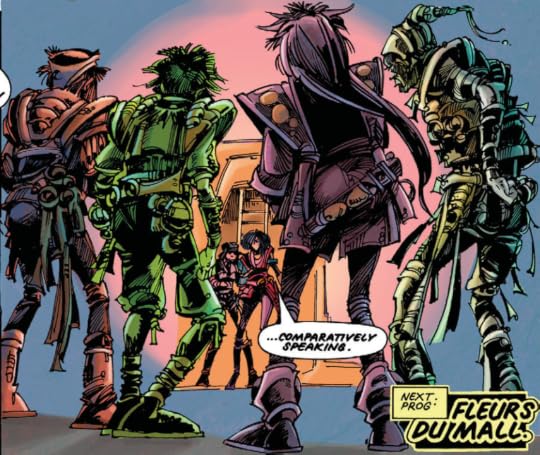
This is a deeply imagined world, and there are plenty of background aspects in art and dialogue that will be explored more fully in future volumes. Ian Gibson’s art, in my experience, takes a bit of getting used to. But it's got a quirky charm, as well as a rich visual imagination.
A bit of a slow start, but I know from past experience that it gets better. Recommended!
Halo lives with her roommates Brinna, Rodice, and Ludy, as well as Brinna’s robot guard dog, Toby. Their home is in the Hoop, a floating complex off the coast of Manhattan intended as free housing for the unemployed. Book One is mostly about introducing us to Halo and the future society in which she lives. It's about a restless soul finding direction and taking her life to the next level.
This is a deeply imagined world, and there are plenty of background aspects in art and dialogue that will be explored more fully in future volumes. Ian Gibson’s art, in my experience, takes a bit of getting used to. But it's got a quirky charm, as well as a rich visual imagination.
A bit of a slow start, but I know from past experience that it gets better. Recommended!

July 11, 2019
Oh man this is considered, by some, to be one of the high points of British comics. Neil Gaiman had tears in his eyes when he finished. Halo might be the first feminist hero of sci-fi comics. Etc., etc.
And yet reading it felt like an exercise in subduing my own irritation? Subduing it with boredom, though?? Like the only thing I liked less than how boring I thought this was was how frikn annoying I thought it was?
Idk I’m trying to read about it now and I’m hoping McCleary has some insight coz wtf, this book was a real flabby fart, to me.
And yet reading it felt like an exercise in subduing my own irritation? Subduing it with boredom, though?? Like the only thing I liked less than how boring I thought this was was how frikn annoying I thought it was?
Idk I’m trying to read about it now and I’m hoping McCleary has some insight coz wtf, this book was a real flabby fart, to me.

August 10, 2020
The first book that collects the initial stories in the Ballad of Halo Jones. It starts off by throwing readers straight into the world inhabited by Halo Jones with little introduction which may confuse readers at first until they get their heads around the slang and mannerisms and way of dressing of the people of The Hoop, the place where the story takes place.
Into this world steps Halo Jones, a down and out inhabitant of The Hoop who lives with her friends and a robot dog that belongs on a friend. Halo lives out her life, yearning to get away from the Hoop and hoping that one of her friends, who is a member of a band, may also have a chance to live a life away from The Hoop.
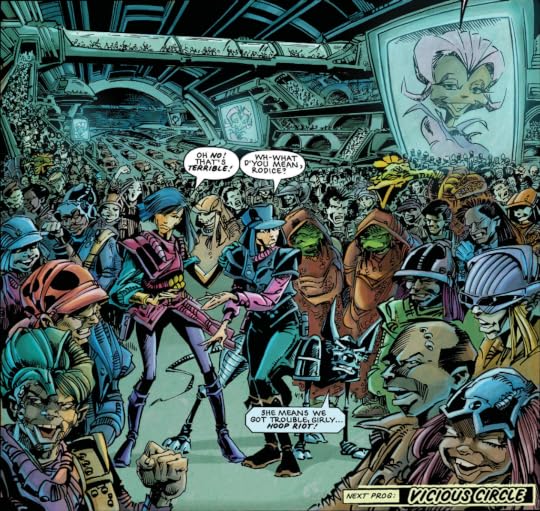
Then, disaster strikes when they run out of food and have to make a 'terrible' shopping trip to get new supplies. Their best plans go awry and they have to brave a journey outside The Hoop (one of Halo's friends has severe agoraphobia or fear of open places). But they survive the shopping expedition.
But they return to discover that tragedy struck while they were away. Now, with their lives turned upside down, Halo decide that enough is enough and leaves The Hoop by joining a space liner that is leaving.
Unlike many other comics and graphic novels, Halo Jones is 'just' an ordinary person without special abilities or super powers, trying to live the life she wants while surviving in a world that does not really care for people like her. An interesting start to the Halo Jones stories.
Into this world steps Halo Jones, a down and out inhabitant of The Hoop who lives with her friends and a robot dog that belongs on a friend. Halo lives out her life, yearning to get away from the Hoop and hoping that one of her friends, who is a member of a band, may also have a chance to live a life away from The Hoop.
Then, disaster strikes when they run out of food and have to make a 'terrible' shopping trip to get new supplies. Their best plans go awry and they have to brave a journey outside The Hoop (one of Halo's friends has severe agoraphobia or fear of open places). But they survive the shopping expedition.
But they return to discover that tragedy struck while they were away. Now, with their lives turned upside down, Halo decide that enough is enough and leaves The Hoop by joining a space liner that is leaving.
Unlike many other comics and graphic novels, Halo Jones is 'just' an ordinary person without special abilities or super powers, trying to live the life she wants while surviving in a world that does not really care for people like her. An interesting start to the Halo Jones stories.

September 15, 2020
I didn't know what to make of this volume when I first read it, but coming back to it after I finished all of the volumes really helped. The first volume of the trio drops the reader off right in the middle of action. The world in which Halo lives is one that is segregated, full with alien races and robots, and young people who get bio-implants and basically turn into zombies.
Volume one starts with Halo's wish to leave this world, follows her around as she goes shopping for food (which is not as easy as one would think) and sees her world disintegrate. It sets up the rest of the story perfectly, and it also helps that the second volume starts by immediately explaining most of the more confusing parts in this one.
Volume one starts with Halo's wish to leave this world, follows her around as she goes shopping for food (which is not as easy as one would think) and sees her world disintegrate. It sets up the rest of the story perfectly, and it also helps that the second volume starts by immediately explaining most of the more confusing parts in this one.
April 11, 2019
I fell in love with Halo Jones reading my Dad’s copies of 2000AD, probably 30 years ago, and the story hasn’t lost any of its pleasure. Still a story of an ordinary young woman who wants to get out and on. Brilliant in its sense of normality in a space age dystopia. In some ways, the jobless realm of the Hoop seems closer now than ever. I’ll be ordering books 2 & 3 asap, and lending this to my Dad!
June 30, 2018
Ahead of its time.

September 18, 2026
(4.75)
VERY 2000AD but with the added benefit of female characters who are rich and interesting.
A fantastically well-realised world with incredible concepts shown through the artwork, and brilliantly told through the dialect Moore has created for the 50th century. I immediately want to read the next volume, ten issues was not enough.
VERY 2000AD but with the added benefit of female characters who are rich and interesting.
A fantastically well-realised world with incredible concepts shown through the artwork, and brilliantly told through the dialect Moore has created for the 50th century. I immediately want to read the next volume, ten issues was not enough.

July 20, 2019
Oookay. So I read this book because Garden said she wanted to talk about it and I found the 3-volume set at Comic-Con for half price, and there you are.
The simplest thing to say is that none of the things you'll read about it -- 'epic,' 'groundbreaking,' 'feminist,' even dare I say 'good' -- are actually things that it is until the third volume, but the first two volumes are short and like, honestly, it doesn't matter what I write here, you'll read them and wonder why anyone bothered recommending it to you. Here, look, I'm just going to spoil the plots of the first two books because nothing happens and they're kind of terrible until you get to the third book anyway.
Volume 1 (this one): Halo Jones goes shopping.
Volume 2: Halo Jones gets a job on a cruise ship.
I mean, like, that is basically it. Volume 1 takes place in about 6 hours of story time and nothing happens until the last two pages. It's supposed to just be about "women being women" or something, according to Moore in the afterword, but it's bogus. It's dreck. Find it for five bucks or less if you can.
Volume 2 is mildly better because, like, a few things happen, but they're sort of inconsequential and basically unconnected from one another. The most interesting part of the book is its prologue, which starts to paint a picture of the world of poverty which Halo escaped in the previous book. And like, a few other interesting things happen, but most of them aren't clearly interesting until either the last few pages of Volume 2, or once you get rolling on Volume 3.
And oohhhh, Volume 3.
If Volumes 1 and 2 are what it's like to watch the original X-Men movies 20 years later, Volume 3 is what it's like to get your face blasted off by Logan. But better, really -- it's all the anti-war and anti-corporate sentiment of Starship Troopers and Apocalypse Now. It's just dark -- incredibly dark, painfully dark, the kind of truth-in-darkness that has come up through time to the inky black hell that is life in 2019 to sort of explode.
Halo Jones is fucking genius, but, like its titular character, it takes a looooong time to come to fruition. It is a painful book to read while living in the world we have been doomed to, but that is perhaps what makes it most sublime.
The simplest thing to say is that none of the things you'll read about it -- 'epic,' 'groundbreaking,' 'feminist,' even dare I say 'good' -- are actually things that it is until the third volume, but the first two volumes are short and like, honestly, it doesn't matter what I write here, you'll read them and wonder why anyone bothered recommending it to you. Here, look, I'm just going to spoil the plots of the first two books because nothing happens and they're kind of terrible until you get to the third book anyway.
Volume 1 (this one): Halo Jones goes shopping.
Volume 2: Halo Jones gets a job on a cruise ship.
I mean, like, that is basically it. Volume 1 takes place in about 6 hours of story time and nothing happens until the last two pages. It's supposed to just be about "women being women" or something, according to Moore in the afterword, but it's bogus. It's dreck. Find it for five bucks or less if you can.
Volume 2 is mildly better because, like, a few things happen, but they're sort of inconsequential and basically unconnected from one another. The most interesting part of the book is its prologue, which starts to paint a picture of the world of poverty which Halo escaped in the previous book. And like, a few other interesting things happen, but most of them aren't clearly interesting until either the last few pages of Volume 2, or once you get rolling on Volume 3.
And oohhhh, Volume 3.
If Volumes 1 and 2 are what it's like to watch the original X-Men movies 20 years later, Volume 3 is what it's like to get your face blasted off by Logan. But better, really -- it's all the anti-war and anti-corporate sentiment of Starship Troopers and Apocalypse Now. It's just dark -- incredibly dark, painfully dark, the kind of truth-in-darkness that has come up through time to the inky black hell that is life in 2019 to sort of explode.
Halo Jones is fucking genius, but, like its titular character, it takes a looooong time to come to fruition. It is a painful book to read while living in the world we have been doomed to, but that is perhaps what makes it most sublime.

December 27, 2015
So this was something definitely, may be not just for me. This tells the story of a girl in a future time. Different slangs and busy style of the book makes i a little hard to get. I liked it hopefully next volumes would be better.
I have always loved comics, and I hope that I will always love them. Even though I grew up reading local Indian comics like Raj Comics or Diamond Comics or even Manoj Comics, now's the time to catch up on the international and classic comics and Graphic novels. I am on my quest to read as many comics as I can. I Love comics to bit, may comics never leave my side. I loved reading this and love reading more, you should also read what you love and then just Keep on Reading.
I have always loved comics, and I hope that I will always love them. Even though I grew up reading local Indian comics like Raj Comics or Diamond Comics or even Manoj Comics, now's the time to catch up on the international and classic comics and Graphic novels. I am on my quest to read as many comics as I can. I Love comics to bit, may comics never leave my side. I loved reading this and love reading more, you should also read what you love and then just Keep on Reading.

January 1, 2024
Had a friend offer this up for loan as a less known Alan Moore series. Certainly it was not something I'd heard of. And it felt old-ish. The text was a bit hard to read, but as long I didn't try to read it fast, it was fine. Apparently we are New York City? but not Manhattan or Connecticut or Jersey? Basically we get dropped into this kind of violent world with characters we don't really know and they go shopping. And maybe listen to the news? Really there's not a lot here but it is cool-ish.

January 10, 2013
¡Qué quilombo que me hicieron con los Halo Jones combinando al pedo y borrando ediciones! Este, por ejemplo, lo leí dentro de "La Balada de Halo Jones #1" de Dolmen, que incluía también el book 2. Cuando pueda me pongo a redatear todos los tomos que tenga a mano. Y a rerreseñarlos, obviamente.

January 29, 2023
Wow, definitely going to read books 2 and three. This was very satisfying. The robot dog is amazing!!

August 10, 2026
The Ballad of Halo Jones, Book One is a terrific introduction to a character and a world that feel astonishingly fresh even decades after their creation.
Alan Moore takes the familiar ingredients of dystopian science fiction—overpopulation, unemployment, social control, alien threats, technological absurdities—and mixes them with an irreverent British sense of humour and a remarkably sharp eye for the contradictions of modern society. The world of the Hoop is simultaneously hilarious, grotesque, inventive and deeply unsettling. Behind all the jokes and bizarre situations there is a very clear critique of a society that has found ingenious ways of keeping people occupied, controlled and essentially powerless.
But the real strength of the book is Halo Jones herself. She isn't introduced as a conventional superhero or chosen one. She's an ordinary young woman who simply wants to get out and see something of the universe. That modest desire becomes the engine of an increasingly extraordinary adventure. Halo is intelligent, independent, curious and refreshingly human, and Moore wisely allows her to develop rather than immediately turning her into an action heroine.
Ian Gibson's artwork is the perfect complement to Moore's writing. His designs give the Hoop an incredible sense of personality, filling it with strange machines, bizarre creatures, eccentric characters and countless visual details. There is an exuberant, almost anarchic quality to the artwork that perfectly matches the story's imagination.
What impressed me most is how much Moore and Gibson manage to accomplish in this first volume. The Ballad of Halo Jones is funny, satirical, adventurous and occasionally quite dark, often within the same few pages. It feels like a comic that refuses to stay inside a single genre.
And perhaps most importantly, it leaves you wanting to know what happens next.
A superb piece of British comics science fiction and a very strong opening chapter to Halo Jones's journey. I'm definitely continuing with Books Two and Three.
Alan Moore takes the familiar ingredients of dystopian science fiction—overpopulation, unemployment, social control, alien threats, technological absurdities—and mixes them with an irreverent British sense of humour and a remarkably sharp eye for the contradictions of modern society. The world of the Hoop is simultaneously hilarious, grotesque, inventive and deeply unsettling. Behind all the jokes and bizarre situations there is a very clear critique of a society that has found ingenious ways of keeping people occupied, controlled and essentially powerless.
But the real strength of the book is Halo Jones herself. She isn't introduced as a conventional superhero or chosen one. She's an ordinary young woman who simply wants to get out and see something of the universe. That modest desire becomes the engine of an increasingly extraordinary adventure. Halo is intelligent, independent, curious and refreshingly human, and Moore wisely allows her to develop rather than immediately turning her into an action heroine.
Ian Gibson's artwork is the perfect complement to Moore's writing. His designs give the Hoop an incredible sense of personality, filling it with strange machines, bizarre creatures, eccentric characters and countless visual details. There is an exuberant, almost anarchic quality to the artwork that perfectly matches the story's imagination.
What impressed me most is how much Moore and Gibson manage to accomplish in this first volume. The Ballad of Halo Jones is funny, satirical, adventurous and occasionally quite dark, often within the same few pages. It feels like a comic that refuses to stay inside a single genre.
And perhaps most importantly, it leaves you wanting to know what happens next.
A superb piece of British comics science fiction and a very strong opening chapter to Halo Jones's journey. I'm definitely continuing with Books Two and Three.

November 21, 2019
The Ballad of Halo Jones was a groundbreaking tale which appeared originally within the pages of 2000AD back in 1984. This was a sci-fi comic famous for Judge Dredd, a violent future cop, and other similarly traditional boy stories. Based on the usual fare found in 2000AD, Halo Jones should not have existed. That it does is more to do with its creators, writer Alan Moore and artist Ian Gibson who collaborated on the story, concept and design.
Set in a depressed future world, Halo Jones and her friends exist in a dangerous and numbing world, a future slum filled with outcasts, strange cults and hopelessness. In this first book of the Halo Jones saga we are introduced to the character who initially appears to be little more than a supporting character to Rodine. Through the course of the story she starts to be rounded out as she tries to keep her spirits high and stay alive.
Alan Moore and Ian Gibson stated from the beginning that they were writing a story for girls. Halo wasn’t a damson in distress, neither was she a gun toting femme fatale. She was a normal woman in a futuristic world. The story was originally due to run for nine books but, for various reasons Moore and Gibson didn’t get to finish Halo’s story as intended. What we do have though are the first three books of a groundbreaking and brilliant series which in themselves are an incredible and complete read. We’ll likely never get to finish her story but we will get to start it and it’s well worth the journey.
Set in a depressed future world, Halo Jones and her friends exist in a dangerous and numbing world, a future slum filled with outcasts, strange cults and hopelessness. In this first book of the Halo Jones saga we are introduced to the character who initially appears to be little more than a supporting character to Rodine. Through the course of the story she starts to be rounded out as she tries to keep her spirits high and stay alive.
Alan Moore and Ian Gibson stated from the beginning that they were writing a story for girls. Halo wasn’t a damson in distress, neither was she a gun toting femme fatale. She was a normal woman in a futuristic world. The story was originally due to run for nine books but, for various reasons Moore and Gibson didn’t get to finish Halo’s story as intended. What we do have though are the first three books of a groundbreaking and brilliant series which in themselves are an incredible and complete read. We’ll likely never get to finish her story but we will get to start it and it’s well worth the journey.

October 2, 2020
Originally appearing in 2000AD, Halo Jones is a young woman eking out a living on the Hoop, a delapidated floating city moored off of Manhattan, and dreaming of escape. She and her housemate Rodice take an epic journey around the Hoop on a dangerous trip to the shops, returning to find that their world has been turned upside down.
As a long-time fan of both Alan Moore and of the distinctly British 2000AD comics, I've wanted to read the celebrated Balad of Halo Jones for quite some time.
I have to say that it doesn't entirely live up to the hype. The world of the Hoop is one we're thrown into with little or no explanation of the setup and the language the characters use is a futuristic slang that takes a lot of getting used to (a la Anthony Burgess' 'A Clockwork Orange').
What is interesting about Halo as a character is that she's so very different from most female comic book protagonists, particularly of the 1980s. She's not powerful, seductive or a badass; instead simply being an ordinary woman with dreams of escaping from a depressingly limited life and just enough courage to try to make it happen.
Whilst we only see the beginnings of her breaking free from the drudgery of Hoop life, it definitely feels that the story and the character are winding up to bigger and better things in subsequent books.
* More reviews here: https://fsfh-book-review2.webnode.com/ *
As a long-time fan of both Alan Moore and of the distinctly British 2000AD comics, I've wanted to read the celebrated Balad of Halo Jones for quite some time.
I have to say that it doesn't entirely live up to the hype. The world of the Hoop is one we're thrown into with little or no explanation of the setup and the language the characters use is a futuristic slang that takes a lot of getting used to (a la Anthony Burgess' 'A Clockwork Orange').
What is interesting about Halo as a character is that she's so very different from most female comic book protagonists, particularly of the 1980s. She's not powerful, seductive or a badass; instead simply being an ordinary woman with dreams of escaping from a depressingly limited life and just enough courage to try to make it happen.
Whilst we only see the beginnings of her breaking free from the drudgery of Hoop life, it definitely feels that the story and the character are winding up to bigger and better things in subsequent books.
* More reviews here: https://fsfh-book-review2.webnode.com/ *

August 7, 2020
"Some found our decision to dump the reader straight in at the deep end with a totally alien society and let them figure things out for themselves to be merely confusing and irritating. Then, of course, there were those readers who complained that very little happened in the strip."
Ya think, Al? That maybe irritating your readers is not such a good thing? Anyway, Alan Moore is this guy that sometimes takes it too far. From Hell immediately comes to mind as a book that is pretty much unreadable. "I was researching the letters from the early 20th century so I just started writing them at some point." Forgetting in the process that his readers are from the late 20th century and probably won't digest that. The society described in this book is quite alien, which is exacerbated by the invented slang that just has to be in every phrase, making you re-read it for a couple of times before you get what was said. What's the point of that? Obviously, invented slang is there to make the text more colorful, and usually, they make a dozen or so words/phrases like "Kowabunga" or "Your move, creep" and repeat them ad nauseam until the reader starts to understand and repeat them, enhancing the experience. The problem is that when there's so much of that new invented slang, the reader is just constantly baffled, and the learning/bonding process occurs only if they bother to read the book repeatedly multiple times. And most won't bother.
The second obvious problem is that due to the culture alienness you can't easily grasp what the hell is happening and why the characters behave the way they do sometimes. That's easily solved by adding helpful world explanation text here and there. But no, the unbridled genius does not write for the unwashed masses. There's actually a very helpful page that describes some concepts like the Hoop and robodogs... in the end of the book. And that brings us to the third problem - the blurb focuses on the supposedly exciting parts that come next... As in, in the next book. Halo is just a poor woman with a couple of friends from some highly inventive dump and we're watching her not that interesting life. You could pack the first thirty pages into maybe four and nothing of value will be lost. So hopefully, it will get better. Judging by some of the reviews, people bothered to read it just because it was the first book with a female lead or something. Well, that's not enough for me. Oh yeah, loved the art and coloring, though.
Ya think, Al? That maybe irritating your readers is not such a good thing? Anyway, Alan Moore is this guy that sometimes takes it too far. From Hell immediately comes to mind as a book that is pretty much unreadable. "I was researching the letters from the early 20th century so I just started writing them at some point." Forgetting in the process that his readers are from the late 20th century and probably won't digest that. The society described in this book is quite alien, which is exacerbated by the invented slang that just has to be in every phrase, making you re-read it for a couple of times before you get what was said. What's the point of that? Obviously, invented slang is there to make the text more colorful, and usually, they make a dozen or so words/phrases like "Kowabunga" or "Your move, creep" and repeat them ad nauseam until the reader starts to understand and repeat them, enhancing the experience. The problem is that when there's so much of that new invented slang, the reader is just constantly baffled, and the learning/bonding process occurs only if they bother to read the book repeatedly multiple times. And most won't bother.
The second obvious problem is that due to the culture alienness you can't easily grasp what the hell is happening and why the characters behave the way they do sometimes. That's easily solved by adding helpful world explanation text here and there. But no, the unbridled genius does not write for the unwashed masses. There's actually a very helpful page that describes some concepts like the Hoop and robodogs... in the end of the book. And that brings us to the third problem - the blurb focuses on the supposedly exciting parts that come next... As in, in the next book. Halo is just a poor woman with a couple of friends from some highly inventive dump and we're watching her not that interesting life. You could pack the first thirty pages into maybe four and nothing of value will be lost. So hopefully, it will get better. Judging by some of the reviews, people bothered to read it just because it was the first book with a female lead or something. Well, that's not enough for me. Oh yeah, loved the art and coloring, though.

August 6, 2021
I was 16 the first time I read The Ballad of Halo Jones. It was the first time I sat up and took notice of Alan Moore. It was a real break from the usual 2000AD stories of the time, and I wasn't too sure what to make of it, but came to see it as one of the greats. Coming back to it after well over 35 years (!), I can appreciate it even more. The future English owes something to A Clockwork Orange, The story of an everyday person in a dystopian future reminds me of 1984. Diving straight into the story without introduction, and dropping bits of backstory in as things unfold is something Moore would use in a much more famous work, Watchmen. The artwork of Ian Gibson suits the story perfectly. If you haven't read this, then go and find it.

October 11, 2022
Halo Jones is 18 and lives in a floating ring-shaped housing estate called "The Hoop" moored in the Atlantic Ocean off the East coast of America. Over the course of a day Halo goes on a violent but occasionally comic shopping trip then returns to find her flatmate and best friend Brinna murdered. When another friend, a talented musician, becomes a "Different Drummer" (a youth cult numbed by the implant-generated beat of a drum in their ears), Halo decides to leave Earth, never to return.
Halo Jones first appeared in 2000AD in 1984 and I’d stopped reading the comic by then so although I’d heard of the character this was my first time reading her story. Moore and Gibson set up her universe brilliantly and it’s a horrific but fully realised vision and Jones is the perfect character to see it through - she’s young and a bit naïve and a bit tough and very independent. So much happens it keeps you zipping through the beautifully laid out panels but I couldn’t tell you, bit by bit, what she does because it’s all part of the whole. Well worth a read and I’m looking forward to finding book two now.
Halo Jones first appeared in 2000AD in 1984 and I’d stopped reading the comic by then so although I’d heard of the character this was my first time reading her story. Moore and Gibson set up her universe brilliantly and it’s a horrific but fully realised vision and Jones is the perfect character to see it through - she’s young and a bit naïve and a bit tough and very independent. So much happens it keeps you zipping through the beautifully laid out panels but I couldn’t tell you, bit by bit, what she does because it’s all part of the whole. Well worth a read and I’m looking forward to finding book two now.

July 20, 2021
First Edition = August 1986 = Second Printing = £4.50
Read the last page first- it's an introductory printed in the wrong place.
Rounded up to **** because of the last page which explains the "world" that they live in. It should've preceded the story so that the environment had some context because you don't really know why things are the way they are as they traverse their "Hooplife" in future NYC. I like how he does commentary on racial divides in this country with it.
Nothing really happens until the end of this book. Sure they go places but without that context I spoke of you remain lost through it. He uses the first three quarters to navigate a "world" that gets ditched anyway but I guess he wants us to know where she comes from and why she is tuned that way. It's all pretty weird but in a good way other than the way they talk which is annoying.
As Alan says three times in the introduction- Gibson draws great women. The book is nearly all women -The main characters and 70% of population- so that really pays off.
Read the last page first- it's an introductory printed in the wrong place.
Rounded up to **** because of the last page which explains the "world" that they live in. It should've preceded the story so that the environment had some context because you don't really know why things are the way they are as they traverse their "Hooplife" in future NYC. I like how he does commentary on racial divides in this country with it.
Nothing really happens until the end of this book. Sure they go places but without that context I spoke of you remain lost through it. He uses the first three quarters to navigate a "world" that gets ditched anyway but I guess he wants us to know where she comes from and why she is tuned that way. It's all pretty weird but in a good way other than the way they talk which is annoying.
As Alan says three times in the introduction- Gibson draws great women. The book is nearly all women -The main characters and 70% of population- so that really pays off.
November 27, 2020
The Ballad of Halo Jones - 4/5
Yin ah Alan Moore's first major original comic creations with art by Ian Gibson, Halo Jones wis written is individual episodes in British comic 2000AD in the 1980s. Follwin the storie ah normal girl Halo Jones as she gaes on a shopping trip. Noo tis daesnae soond the maist interestin storie bit Moore and Gibson manage tae insert sae much character and world intae tis tale is absurd.
Halo Jones, her freend Rodice in a robot dug call Toby gae oot fir ah shoppin trip and the depressin alienation and cripplin poverty of the Hoop wae ah kick in the teeth it the end. Halo gaes tae escape at the end.
The art be Gibson is well done in brings detail tae the wurld.
O'erall, the storie is well wurth ah read, especially if yer a fan ah Alan Moore.
Yin ah Alan Moore's first major original comic creations with art by Ian Gibson, Halo Jones wis written is individual episodes in British comic 2000AD in the 1980s. Follwin the storie ah normal girl Halo Jones as she gaes on a shopping trip. Noo tis daesnae soond the maist interestin storie bit Moore and Gibson manage tae insert sae much character and world intae tis tale is absurd.
Halo Jones, her freend Rodice in a robot dug call Toby gae oot fir ah shoppin trip and the depressin alienation and cripplin poverty of the Hoop wae ah kick in the teeth it the end. Halo gaes tae escape at the end.
The art be Gibson is well done in brings detail tae the wurld.
O'erall, the storie is well wurth ah read, especially if yer a fan ah Alan Moore.

Read
July 24, 2022Once again, I jumped into an Alan Moore story which initially confused me. However, by the end, I really liked the first book of Halo Jones. There is a lot to like. Firstly, Ian Gibson's art is ace and the world designed, and the challenges faced can be understood, Mass unemployment, underclass societies, and the sheer stress of public transport.
Beyond that, the broader characters are cool and the dialogue is sweet. Nonetheless, I have one issue which is a classic case of misrepresentation. In Future Shock, a documentary about 2000ad, Neil Gaiman praises Halo Jones and points out that when Alan Moore told him how it was going to end, he was in tears.
Alan Moore never completed this story. He left 2000ad when book three was finished, I believe. There were another series of books planned as mentioned in Future Shocks. So, the book takes that quote from twenty years after the end of the comic run and applies it to the series out of context. Not cool. Not cool at all.
Beyond that, the broader characters are cool and the dialogue is sweet. Nonetheless, I have one issue which is a classic case of misrepresentation. In Future Shock, a documentary about 2000ad, Neil Gaiman praises Halo Jones and points out that when Alan Moore told him how it was going to end, he was in tears.
Alan Moore never completed this story. He left 2000ad when book three was finished, I believe. There were another series of books planned as mentioned in Future Shocks. So, the book takes that quote from twenty years after the end of the comic run and applies it to the series out of context. Not cool. Not cool at all.

August 3, 2020
I remember reading Halo Jones in high school in the late 80’s when the short lived Quality Comics was reprinting 2000AD material for us here in the USA. It had really bad coloring back then, but it was groundbreaking at the time and a very good read. 2000AD had their recent color reprints in there store tonight at $2.50 a volume, so I picked them up. I am surprised at how much I remember and have forgotten. One of the bad things about reading books that were ahead of their time, is that time catches up to them. There are a lot of things that were felt Wow in 87 that in 2020 lack that “wow” factor. Or maybe it’s that then I was 16 and now I’m 49 and they lack the “wow” factor. Either way, the story is still solid, and while it takes a bit of the first book to get there, Halo and her world begin to come alive at then end.

November 26, 2018
1986. While Alan Moore was already working on Watchmen and The Killing Joke, Titan Books published the first book of The Ballad of Halo Jones, directly from the pages of 2000 AD. Those were the days.
Well ahead of its time, this female-character driven SF series was a rara avis within the 2000 AD magazine ecosystem, dominated by “guns, guys and gore”, as Moore points out in the introduction.
Even if it can be irritating, confusing and frustrating, as you land in a future, alien world with little idea of what’s going on - and nothing much seems to happen at the beginning -, the characters grow on you and the story slowly builds up to an emotional ending that leaves you craving for more.
One of the good ones from master Moore.
Well ahead of its time, this female-character driven SF series was a rara avis within the 2000 AD magazine ecosystem, dominated by “guns, guys and gore”, as Moore points out in the introduction.
Even if it can be irritating, confusing and frustrating, as you land in a future, alien world with little idea of what’s going on - and nothing much seems to happen at the beginning -, the characters grow on you and the story slowly builds up to an emotional ending that leaves you craving for more.
One of the good ones from master Moore.

January 12, 2019
Before I get into how great the story is, I have to complain about how awful the coloring is on this. I'd read a couple of single issues of the black and white and it was gorgeous but the pastels mixed with bright colors they picked for this is horrid. It messes with the art and distracted me with appalling color combinations.
Rant finished.
The story is one of those where nothing major happens, but you get so much out of it. You're dropped in the middle of a future world that's a mess and is full of terms and words that make no sense to you until you're immersed in the story and then it flows and makes perfect sense.
A future-set adventure with a female lead that starts out slow but sets up quite an adventure, all peppered with cautionary tales and societal commentary. It's great.
Rant finished.
The story is one of those where nothing major happens, but you get so much out of it. You're dropped in the middle of a future world that's a mess and is full of terms and words that make no sense to you until you're immersed in the story and then it flows and makes perfect sense.
A future-set adventure with a female lead that starts out slow but sets up quite an adventure, all peppered with cautionary tales and societal commentary. It's great.

October 25, 2021
The legendary Halo Jones? Well, yes, I should have listened in the 80s, 90s, 00s... Vol. 1 decent though underwhelming. The best descriptor is dense. Moore's dialogue is stuffed with new words, lettering's small, Gibson's innovative designs pack the pages too much and Barbara Nosenzo's colours, though fitting, make this tough to read when the sun goes down. The reproduction could benefit from increased size, albeit on lovely paper and well bound. Successive style changes in the following books make reading much easier. I quite enjoyed how most of the narrative is about banal everyday life stuff with mad SF armour grown on top of it and the big concepts resonate. Certainly a good read.
September 22, 2018
I first read Halo about 15 years ago, in b/w. The color really helps it pop, and helps the images to be more immediately "readable." Gibson's art is a little too... uh, rubbery(?) for my tastes, but it's fine enough here. The main draw is of course the story and the character of Halo. It's still great, and at my current age and in the current political maelstrom, the class politics elements of the story are in greater relief and more noticeable. I hope it reaches more audiences now that it's in color.
December 27, 2018
Why?
This is some earlier work of Alan Moore while he worked on 2000AD. I suppose I'm becoming some sort of weird "completest."
What did I think? (minor spoiler alert)
I did not like it. Each chapter was only about 5 pages, so it was written and presented in short spurts. Although some of the ideas were really original and creative, I simply did not feel captivated by the characters, nor the world that they inhabited. In fact, the book climaxes with the main character and her "dog" leaving this creation.
This is some earlier work of Alan Moore while he worked on 2000AD. I suppose I'm becoming some sort of weird "completest."
What did I think? (minor spoiler alert)
I did not like it. Each chapter was only about 5 pages, so it was written and presented in short spurts. Although some of the ideas were really original and creative, I simply did not feel captivated by the characters, nor the world that they inhabited. In fact, the book climaxes with the main character and her "dog" leaving this creation.

November 18, 2019
Early Alan Moore science fiction work. Has a ton of potential, but I'm reserving a higher star rating to see how this all plays out. Written in an interesting and occasionally unforgiving dialectical style that requires more concentration than comics generally do.s
Interesting art, btw. I'd say it was vaguely reminiscent of Tank Girl, but I'm reasonably certain I've got it backwards. I think Tank Girl is reminiscent of this. (Just art. This story is far more sophisticated and less silly.)
Interesting art, btw. I'd say it was vaguely reminiscent of Tank Girl, but I'm reasonably certain I've got it backwards. I think Tank Girl is reminiscent of this. (Just art. This story is far more sophisticated and less silly.)
August 27, 2026
An introduction to Alan Moore's character Halo Jones, we follow her through a day where her entire world is thrown into disarray.
A solid world-building story, we follow Halo around The Hoop, a huge slum where virtually everyone is unemployed. The reality of Halo Jones is that everything happens to and around her and nothing that happens around her is good. She seems to be the focus of everything that happens, but everything is focused in a way to work out only so that she survives and not much else. It's a hell of a story, though.
A solid world-building story, we follow Halo around The Hoop, a huge slum where virtually everyone is unemployed. The reality of Halo Jones is that everything happens to and around her and nothing that happens around her is good. She seems to be the focus of everything that happens, but everything is focused in a way to work out only so that she survives and not much else. It's a hell of a story, though.

May 20, 2022
I'm currently (slowly) rereading issues of 2000AD that I read as a kid. This is a real standout, beautifully written and drawn. Alan Moore and Ian Gibson created an utterly believable and well-realised future and an everywoman who is timeless. There are plenty of things I like from 2000AD but this feminist masterpiece shines as possibly its best moment, and makes some of the more dated stories it shares comic space with look awful by comparison.
Displaying 1 - 30 of 63 reviews