Jump to ratings and reviews
Rate this book

Ar

Rate this book
Winner of the Icelandic Literary Prize, Hotel Silence is a delightful and heartwarming new novel from Auour Ava Olafsdottir, a writer who "upends expectations" (New York Times). Told with grace, insight, and humor, this is the story of one man's surprising mid-life adventure of self-discovery that leads him to find a new reason for being.

Jonas Ebeneser is a handy DIY kind of man with a compulsion to fix things, but he can't seem to fix his own life. On the cusp of turning fifty, divorced, adrift, he's recently discovered he is not the biological father of his daughter, Gudrun Waterlily, and he has sunk into an existential crisis, losing all will to live. As he visits his senile mother in a nursing home, he secretly muses on how, when, and where to put himself out of his misery.

To prevent his only daughter from discovering his body, Jonas decides it's best to die abroad. Armed with little more than his toolbox and a change of clothes, he flies to an unnamed country where the fumes of war still hover in the air. He books a room at the sparsely occupied Hotel Silence, and there he comes to understands the depths of other people's scars while beginning to see his wounds in a new light.

A celebration of life's infinite possibilities, of transformations and second chances, Hotel Silence is a rousing story of a man, a community, and a path toward regeneration from the depths of despair.

253 pages, Paperback

First published January 1, 2016

375 people are currently reading
14226 people want to read

About the author

Auður Ava Ólafsdóttir

15 books1,052 followers
Auður Ava Ólafsdóttir was born in Iceland in 1958, studied art history in Paris and has lectured in History of Art at the University of Iceland. Her earlier novel, The Greenhouse (2007), won the DV Culture Award for literature and was nominated for the Nordic Council Literature Award. She currently lives and works in Reykjavik.

Ratings & Reviews

What do you think?
Rate this book

Friends & Following

Create a free account to discover what your friends think of this book!

Community Reviews

5 stars
2,612 (20%)
4 stars
5,868 (46%)
3 stars
3,307 (26%)
2 stars
687 (5%)
1 star
105 (<1%)
Displaying 1 - 30 of 1,864 reviews
Profile Image for Jim Fonseca.
1,163 reviews8,490 followers
February 28, 2022
Edited 2/27/22

Although this is a relatively unknown author and a not-well-known book, note that Hotel Silence won the Nordic Council Literature Prize in 2018 and it was chosen Best Icelandic Novel in 2016 by booksellers in Iceland.

We know from the blurbs that this is a novel about a man contemplating suicide. He’s almost fifty, divorced, lonely, and has no purpose in life. He hasn’t been with a woman for the eight years since his marriage ended. He has a daughter that he sees on and off but when they got divorced his wife kindly told him he wasn’t her biological father. His father is dead and his mother rambles on with Alzheimer's in an institutional setting.

description

He’s a Mr. Fixit – a handyman type. So, not wanting to have his body discovered by his daughter, he plans a trip to a war-ravaged country and packs up some of his tools so he can hang a hook for his final ending, and flies off.

The author does an excellent job of depicting the war-ravaged country he arrives in. We aren’t told where, but maybe it’s Beirut or in Syria, or in the Balkans --so many places it could be. Buildings are bombed out or deserted with all the windows blown out. Streets are empty. You are warned not to go to vacant areas or take shortcuts on paths because of landmines. There may be a restaurant where you can let them know ahead of time to cook something for you. You can buy a shirt if you know somebody who knows somebody. Dogs have three legs, cats one eye, and birds are missing a foot. Humans are equally damaged.

description

With his toolbox the main character is suddenly in demand. Despite everyone’s suspicions (no one believes he's “on vacation” like he tells people) he is needed by everyone. We watch as he has an opportunity to fall in love, to act as a father to a boy with PTSD, and in general, help a whole town get back on its feet. His wounds and scars don’t seem as deep as those of the people around him. In the end he is the one who is transformed.

There is good writing:

“Since I’m not dying today, I need to eat.”

“Sorrow is like a piece of glass in the throat.”

“God is sending me a message. Not that I believe in him.”

All in all, a very good read. I didn't add it to my favorites but I gave it a '5.'

description

Auður Ava Ólafsdóttir (b. 1958) is an Icelandic professor of art history, a novelist, playwright and poet.

Top photo Zabadani, Syria from china.cn
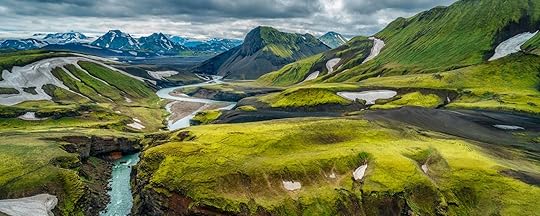
Icelandic landscape from geoex.com
The author from Goodreads
Profile Image for Adina.
1,292 reviews5,506 followers
June 15, 2020
At first, I had a feeling of dread to start Hotel Silence. It was coming in line right after I finished My Struggle vol. 1 by Karl Ove Knausgaard and The Only Story by Julian Barnes. While I loved both books, I wasn’t in the mood for another story about a whining Nordic man. As I keep my ARC deadlines, I had to push through. Well, my reluctance was ill founded because I was impressed by the Icelandic writer and her little novel about loss and revival.

Jónas is left by his wife and is told a secret that shatters his will to live. Broken and empty inside, he decides he doesn’t want to carry on and struggles to find the best way to go. His main concern is to upset his daughter as little as possible. You see, Jónas was always a person who though more about other’s feelings than his own. Except for now. He decides to book a trip to a hotel in the middle of a country ravaged by war but who recently found peace.

Hotel Silence has seen better days. It is run by two young siblings, brother and sister, the only remaining members of the family who owned the establishment. The others either left the country or died. Faced with the reality of real tragedy, of ever-present death and destruction, Jonas slowly begins to see his hardship with different eyes and to form a friendship with the siblings and with other locals. A handyman at home, he starts to help people to rebuild their homes and also assists with the renovation of the hotel.

I have no idea what it is about the Scandinavian* literature that goes straight to my soul. Except for one Danish crime novel, I enjoyed everything I read from this area. Is it the simple but powerful description of daily life? Is it the melancholy that comes out from the pages, possibly propagated by the lack of sun? Is it the silence and poetic beauty of the writing, just like the unlimited wilderness of the frozen north? Is it the precise, basic and no fuss language but which still succeeds to touch me? Probably all of them and more.

There is a bit more of a plot than in the other Nordic novels that I’ve read but the focus is still on feelings, characters and their daily lives, past and present struggles.

The authors includes small quotes from poems and songs a the beginning of each chapter which enhances the beauty of the novel.

Thanks to Netgalley and Grove Atlantic for providing me with a free copy of this book in exchange for an honest review.

*Yes, I know Iceland is not in Scandinavia but for ease of classification I put all this Nordic countries together.
Profile Image for Tras.
264 reviews51 followers
April 23, 2018
It is a truth universally acknowledged, that a single, probably divorced, man (or woman*), in possession of 50 years or so of existence on this planet, must be in want of an existential crisis.

*is this also true for women? I honestly don't know. Feel free to 'enlighten' me :)

Anyway, I'm not Icelandic, nor have I ever stepped foot on Iceland's shores. But I think I would like it there if this book is anything to go by. I'm a fairly solitary individual in the main, and I adore wide expanses of very little. I'm okay with peace and quiet and trees and hills and calm. I loved the sparse simplicity of the Ólafsdóttir's writing (does her name literally translate as Olaf's daughter, I wonder?). The way the author seemed to use just the right number of words to tell her story, and no more. At no point will you think: Jesus, can you please stop spinning off down tangential side-streets and try to stick to the story!

Jónas Ebeneser, a handyman of sorts, is 49, divorced, and drowning in the futility (or so he sees it) of his own sad and lonely existence. His war obsessed mother has succumbed to dementia, and he's recently discovered he isn't the father of his daughter.

“I don’t know who I am. I’m nothing and I own nothing.”

Jónas doesn't want to end up like his mom, so decides to end it all. However, rather than inflict the unpleasant task of finding a dead body - HIS dead body - on his daughter, it makes more sense, he believes, to do the deed overseas. Why not in a country that has just endured a war? Where the possibility of being shot in the street, or blown up by a landmine, still exists, despite an ongoing ceasefire?

"Will the world miss me? No. Will the world be any poorer without me? No. Will the world survive without me? Yes. Is the world a better place now than when I came into it? No. What have I done to improve it? Nothing."

We are never told which country Jónas chooses, but it isn't important. War leaves behind similar wounds regardless of where it happens. Death, destruction, maimed bodies, mental and physical scars that can never fully heal. What matters are the survivors he meets; as they enrich his life with meaning, and he responds in kind.

It's a story told with delicacy and care. There's a genuine affection for those whose lives have been undone by war; people who are trying to come to terms with what happened, and are struggling to rebuild what was broken.

From a personal standpoint, I'm around the same age as Jónas and so the book resonated strongly. I have also pondered many of the same questions that Jónas asks of himself. But there the similarities end. I can empathise with his plight on many levels, though by no means all of them, and, for the most part, I get where he is coming from.

Your mileage may vary :)

"As for me, I am a watercolor. I wash off."
Profile Image for Sue.
1,438 reviews650 followers
March 6, 2018
This quiet, somewhat understated novel really was much more than I expected from its description. From Jonas' abject resignation to unhappiness with all aspects of his life, except for his daughter, to his search through his diaries for answers in the past, to the plan to die but how and where. This man lives in his head...And we live there with him. The book is sprinkled with thoughtful poetic quotes from a number of authors (who are listed at the end). Another thing sprinkled through the story are moments of subdued humor.

This is a quiet yet powerful portrait of a man who feels his life has no meaning. Desperate seems too active a word to describe Jonas, our 49 year old protagonist who finds life empty except for his daughter, Waterlily. And thoughts of her open another heartbreak. Where does a man wanting no future go? Jonas opts for the Balkans, then emerging from the horrors of war into a hopeful cease fire. Here is the world of life and death, certainly a suitable place for his last days. So off he goes with his tool box (why I'm not sure he knows) and a plan to die, somehow, some way. Our journey is to go with him through it all.

I do recommend this journey. I think you will be rewarded.

A copy of this book was provided by the publisher through NetGalley in return for an honest review.
Profile Image for Diane Barnes.
1,614 reviews446 followers
May 30, 2021
Poor Jonas. His life is slipping away from him. His mother is sinking deeper into dementia every day, his wife has divorced him, and let him know before she left that his daughter is not really his daughter. He decides to end it all, but doesn't want his daughter to find his body, so decides to "vacation" in a war torn foreign country. That way, if he's killed before he does it himself, so much the better, but at least he doesn't have to worry about who finds him. None of this is a spoiler, as it all happens in the first 20 or so pages. The real story begins when he arrives in this unnamed country.

Except.......Jonas is a handyman and never goes anywhere without his tools. He is one of only 3 guests at the hotel, which is in severe disrepair. He fixes a few things in his room, word gets around, all of a sudden he is in great demand. He also comes to know his hosts and others in the town.

How can he contemplate suicide because his life isn't going according to plan when he hears the horrifying details of what these new friends of his have endured? And of their efforts to stay alive in the face of all that?

This is a quick and engaging read that asks some big questions about the nature of what seems unendurable to some, and how that can change in an instant.
Profile Image for Banu Yıldıran Genç.
Author 2 books1,423 followers
February 13, 2021
ne kadar etkileyici yazılmış bir roman. ne kadar basit. ne kadar insana dair.
resmen tuzu kuru ve varoluş dertleriyle kendini bitiren bir adamın savaş görmüş bir ülkeye gitmesi ve “gerçek” acılarla karşılaşınca “erkek” olmasını yaşıyoruz romanda.
dertsiz ya da bireysel dertlerle dolu depresif bir izlandalı erkeğin muhtemelen yugoslavya savaşı sonrası mahvolan bir ülkedeki sessizlik oteli’nde büyümesini deneyimliyoruz. 50 yaşında bile olsa insan büyümek ne demek, erginleşmek nasıl olur görüyoruz.
ve kadınların gücü, savaşın kirliliği her satırda hissediliyor.
ana karakter erkek olsa da müthiş bir kadın romanı.
olafsdottir’in ilk okuduğum romanı “kasım yağmuru”nda da aynı şeyi hissetmiştim.
çok etkileyici.
ve tamirat yapabilen erkek candır :) bunu yine anladım. varoluş sancısıyla depresif depresif takılan erkekler bunları günlüğüne yazarak ağlasın hakkaten.
kadınlar onların yerine de dünyayı değiştirir.

ya bir de kitapta bir yerde daha yeni okuduğum dorothy parker’ın bahsi geçti. bayılıyorum böyle tesadüflere :)
Profile Image for Richard (on hiatus).
160 reviews213 followers
April 30, 2018
I wanted to read Hotel Silence before this year’s Hay Literature Festival where the Icelandic novelist Auður Ava Ólafsdóttir will be discussing her book.
Hotel Silence is a sad, funny and quietly powerful novel concerning Jónas a very unhappy and lonely middle aged man, who decides it’s time to end it all.
So as not to upset his family he decides to travel to a war torn town in a far away, unnamed country to commit suicide.
This all sounds pretty depressing but Ólafsdóttir writes humorously, with a lightness of touch. Her style is simple, ironical and a little remote which is perfect for this short novel, which at times feels allegorical, or fable like.
The meaning of life, death and the horror of war are examined and themes such as scars, healing, reconstruction and ‘fixing things’ run throughout.
Jónas is a lovely character, mild, practical and refreshingly average and it’s great to see the absurdities and cruelties of the world through his unflinching eyes. A wonderful and moving book!
Profile Image for Sandy.
872 reviews242 followers
January 1, 2018
3.5 stars

This is very different from my usual reads. It tells the story of Jónas Ebeneser, a 49 yr. old man who has (in his eyes) lost everything. The last straw was learning from his ex-wife that he’s not the father of his adult daughter. Now living in a tiny flat, he calmly decides there is no reason for him to go on living.

He’s always been a quiet, insular man. After selling his business, his only job these days is visiting his elderly mother. “I don’t know who I am. I’m nothing & I own nothing”. As Jónas considers his options he concludes it would be better for him to end things in a foreign country.

This is the first part of the book & there’s a dreamy, almost surreal feel to it. The prose is poetic & non-linear as Jónas reminisces about his life & the people who have crossed his path. Despite how it may sound, there’s not a drop of self-pity or drama in Jónas’ character. He’s simply reached a point where he has no purpose.

The second part of the story moves to a small village in an unnamed country that is slowly rebuilding after a long war. Jónas takes a room at the Hotel Silence which is decidedly worse for wear. It’s run by a young sister & brother who are determined to bring it back to its former glory. After he makes some small repairs to his own room, he becomes the hotel’s resident handyman. Word spreads quickly & it’s not long before other villagers come knocking.

This section is much more earthbound. As Jónas strolls the safe areas & meets the people, we see firsthand the physical & emotional tolls of war. A man who lived a comfortable if basic life & wants to die is suddenly surrounded by those who have nothing & fight to live. Their stories are poignant & their courage, humbling. And through no effort of his own he forms relationships. With each job, you get the sense he’s also repairing himself as he begins to feel needed & useful again.

This is a book that will appeal to fans of literary fiction, especially if you enjoy that indefinable Scandi vibe. It’s a quiet, introspective read with several running themes. Loss, isolation, self worth, survival, love….all of these are explored through analogy & symbolism. Quotes from well know poets & philosophers take the place of chapter headers. It’s a strange, quirky & ultimately hopeful story about mending what is broken, whether it’s a chair or a human being.

I found it an oddly peaceful, almost mesmerizing read. And in a world where people walk around with faces glued to phones & spend more time in the virtual world, its themes are hauntingly relevant.
Profile Image for Marcello S.
647 reviews291 followers
May 20, 2018
Motivi per cui l’ho letto: finalista allo Strega europeo / Supercorallo / breve / autrice islandese più nota

Non avevo idea di cosa parlasse, le quarte di copertina non le guardo quasi più che spesso portano fuori strada.
Finora la mia unica esperienza con autori islandesi era stata con Jón Kalman Stefánsson, molto poetico ma fin troppo barocco per i miei gusti. Ólafsdóttir si piazza all’estremo opposto, riduce tutto al minimo e va di sottrazione con l’accetta. E in effetti ho apprezzato quella sua delicatezza da Circolo polare, le emozioni sempre con la sordina inserita, mai una parola di troppo.

Però mi discosto un po’ dall’entusiasmo generale. L’idea di partenza è buona ma poi si perde per strada. Mi è sembrata una storia poco credibile, troppo costruita. Avrei preferito ci si soffermasse di più sulla prima parte (quella ambientata al nord), che uscisse fuori la desolazione di Jónas e del suo mondo. Invece pare tutto un po’ telecomandato.

Il fatto poi che ci sia una morale di fondo abbastanza evidente, tipo che se ti rendi utile agli altri dai anche un senso alla tua vita, ecco, in un libro del 2018 mi spiazza un po’.

È davvero “il suo romanzo più bello”?
Tre stelle tirate. [63/100]
Profile Image for Elizabeth (Alaska).
1,570 reviews553 followers
March 7, 2019
The first line of the GR description is spot on. How do you put your life together when you see it crumbling around you? Do you even want to? Despite what doesn't sound faintly amusing - "buy a one-way ticket to a chaotic, war-ravaged country and put an end to it all" - there are some laugh out loud sections in the early portions of this. Jonas and his neighbor are discussing their individual marital problems and that they don't understand what it is their wives actually want. Completely bewildered is the way I would describe them. I was reminded of a recent episode of Family Feud where the question was "what creature are men most terrified of?" The #1 answer was Women!

Jonas goes to an unnamed country that has been at war. Who goes on vacation with their toolbox but not a change of clothes? What he hasn't anticipated is what a war-ravaged country actually looks like, nor what the survivors might have experienced. This becomes a story of healing in a way I didn't anticipate. I suppose I've read enough war novels that I might have been able to project some of what happens, but I didn't. What happens next is rarely part of my reading habit.

I am assuming this is not just a good translation, but wonderful prose as well. It is short enough that only Jonas gets the more-fully fleshed characterization, though war's aftermath is also extremely well drawn. I am not about to quibble with that. The novel brought tears as well as laughter.

This morning I added her earlier Butterflies in November to my over-burdened wish list. I don't know when I'll get to it, but I know I'll be happy when I do. Hotel Silence is a full, unequivocal 5-stars.
Profile Image for Paltia.
633 reviews109 followers
February 18, 2019
Repair, restoration, rejuvenation, and redemption. Jonas is a man in pain. Feeling useless he decides to end his life. In order to spare his daughter the pain of finding his body he selects a war torn place to carry out his plan. What he finds and those he meets at the Hotel Silence just might rearrange his life. Told in spare but beautiful words this short novel is achingly profound. Ms. Olafsdottir reminds us that all suffering is unique and therefore can’t be compared. She provides a voice for each of her characters “none of them without meaning.”
Profile Image for Meike.
Author 1 book4,945 followers
February 23, 2018
"The formulation of a scar is a natural part of the biological process, which occurs when a lesion to the skin or other body tissue grows after an accident, illness or surgery. Since the body is unable to create an exact replica of the damaged tissue, the fresh tissue grows with a new texture and properties that differ from the undamaged skin around it."

"Hotel Silence" is a novel about the many faces of pain, the Icelandic title of the book, "ör", translating as "scar". Auður Ava Ólafsdóttir's protagonist Jónas is 49 and has just gotten divorced. Upon leaving him, his ex-wife informed Jónas that their 26-year-old daughter Waterlily is not his biological child. Furthermore, he is forced to helplessly witness how his own mother's health is slowly deteriorating. Heartbroken and unhappy about the state of his professional and personal life, Jónas decides to kill himself, but as he does not want his beloved daughter to find his body, he decides to do it abroad and boards a plan to the cheapest last-minute holiday resort he can find.

This is how Jónas ends up in Hotel Silence. While Ólafsdóttir never mentions the country or city where this hotel is located, the descriptions remind me of Ex-Yugoslavia, maybe Croatia, right after the war: Located at the Mediterranian Sea, formerly known for its beautiful landscapes that were often used as film locations (like the plitvicer lakes?), and torn apart by a conflict in which former neighbours turned against each other, the landscapes becoming death traps due to the many landmines.

When Jónas arrives, there is a truce, but still there are no other tourists in the area. As Jónas befriends the siblings running Hotel Silence, he starts helping them with the skills he has as a handyman - and becomes a local celebrity known as "Mister Fix". With all the problems the people he meets are already encountering, how can he burden them with his suicide? And, as it turns out, "in the land of death, there isn't the same urgency to die."

While this is a very straightforward story without any gimmicks, Ólafsdóttir does a great job when it comes to character descriptions and juxtaposing Jónas' pain and loneliness with warm, but never condescending humor. It would be far too easy to simply see this as a tale stating that there are always others who have a worse destiny - rather, the author acknowledges the individual character of the sadness that all of her characters are experiencing.

"Do you remember, Dad, when we lay on our tummies over the frozen lake and looked down at the vegetation below the ice?", Waterlily asks Jónas after she aked him over the phone to come back to Iceland. Auður Ava Olafsdóttir wrote a book about how to melt this ice, or, to put it differently, how to grow and live on with scar tissue. For that, she won the Icelandic Literary Award for Fiction 2017.
Profile Image for Kristina Dauksiene.
280 reviews57 followers
July 6, 2024
LT/ENG
3* su stipria uodega!
Priežastis- žinojimas... Tai kas tavo- tampa ne tavo...neįtikina, nesvaru tapti priežastimi.

Kelionė- tai kas sujaudina! Kelionė į save, verčiant naujo gyvenimo knygos lapus ir ten pildant istoriją nuo gimimo...gimimas-išbraukus priežastį, radus "Tylą" pradžiai ir tylą žmonėse, kurie nutildyti karo mašinos, radus tuos kurie neša gilesnius ir labiau kraujuojančius randus.Tyloje gimsta ilgiausi išsakyti sakiniai, ieškomi žodžiai, laimė skaičiuojama nenužudytais kūnais.
**************************************
3* with a strong tail!
The reason is cognition... What is yours becomes not yours... for me it hardly can be a reason, it does not have the weight to become a reason.

Journey is what excites! A journey to oneself, turning the pages of the book of a new life and filling in the story from birth there... birth - after erasing the reason, finding "Silence" for the beginning and silence in people who are silenced by war machines, finding those who carry deeper and more bleeding scars. In silence the longest spoken sentences are born, words are searched for, happiness counted in unkilled bodies.
Profile Image for Connie  G.
2,143 reviews709 followers
March 27, 2019
Auður Ava Ólafsdóttir won the Icelandic Literary Prize for Fiction for this short novel. It's a strange book--but in a good way--about Jonas who loses his will to live after some family problems surface. He contemplates suicide, but he does not want his daughter to discover his body. He decides to take a vacation to an unnamed country (probably in the Balkans) damaged by recent wars and littered with landmines.

Handy with tools, Jonas finds a sense of purpose helping people who have been through so much suffering. He is forming connections that open him up to life again. Written in spare prose, Hotel Silence shows the quiet satisfaction one gets from being needed and living with meaning.
Profile Image for spillingthematcha.
739 reviews1,140 followers
August 30, 2021
To jedna z tych książek, które poruszają swoją prostotą i są przepełnione smutkiem. Ta historia ma w sobie wiele wyjątkowych fragmentów i na pewno na długo je zapamiętam.
Profile Image for Eylül Görmüş.
756 reviews4,677 followers
November 18, 2021
Allahım, ne kadar güçlü bir kitap. İsmi gibi ne kadar sessiz ve nasıl da güçlü. Çok etkilendim. İnsanı çok kişisel yerlere götürme becerisine sahip, çok acayip iyi yazılmış bir kitap çıktı bu. İskandinav edebiyatını gitgide daha fazla sever oldum – az kelimeyle çok şeyi tariflemeyi muazzam beceriyorlar. Ölmeye karar verip yanına sadece alet çantasını alıp bir savaş bölgesine giden bir adamın, yıkılan dünyayı tamir etmeye çalışırken kendini de tamir edişinin öyküsünü anlatıyor Olafsdottir. Kadınların dünyaya nasıl tırnaklarını geçirdiklerini, nasıl köklendiklerini bir de… Varoluşsal sıkıntılarla boğuşan bunalımlı erkekler ellerine birkaç alet edevat alıp bir şeyleri -gerçekten- onarmaya başlasa ne çok şey değişecek aslında – bunu hep düşünürdüm, bu kadar somut ortaya konuluşunu okumak nefis oldu. Hakikaten çok özel bir kitap, çok ama çok tavsiye ediyorum. “Dünyayı sessizlik kurtaracak.”
Profile Image for Olga Kowalska (WielkiBuk).
1,694 reviews2,908 followers
May 9, 2020
Przed czytelnikiem piękna, łamiąca północne schematy opowieść o tęsknocie za byciem potrzebnym, o poszukiwaniu sensu życia i o samotności w cierpieniu. Kolejny tom niezastąpionej Serii Dzieł Pisarzy Skandynawskich – "Blizna" Auđur Avy Ólafsdóttir.

"Wymień jeden powód, dla którego mam dalej istnieć."

Auđur Ava Ólafsdóttir miała odwagę, by skonfrontować dwa oblicza cierpienia, tak różne, bo oparte na tak odmiennych założeniach. Z jednej strony, "Blizna" to opowieść o zmęczeniu życiem w tym najbardziej europejskim, a nawet zachodnim wymiarze. O osamotnieniu jednostki, która krąży bez celu pośród innych samotnych wysp, obija się jak atom i nie może się już odnaleźć. Ten brak celu i sensu jest pożywką dla nihilizmu, dla cynizmu, dla wewnętrznego zagubienia. I nagle zmiana i inny świat, świat jednego z krajów wschodu, który został zmieciony przez wojnę, a w nim prawdziwe ofiary i drugie oblicze rozpaczy. Mężczyźni i kobiety i dzieci, którzy utracili swoich bliskich pośród wybuchów, pyłu, lejącej się krwi. Ta konfrontacja blizn wyśnionych i blizn realnych, namacalnych okazuje się być dla bohatera otrzeźwieniem, którego tak bardzo potrzebował. Bo jak można skończyć ze sobą, gdy ktoś naprawdę cię potrzebuje, gdy wokół jest tyle nieszczęścia i rozpaczy większych i mniejszych?

"Blizna" jest zdecydowanie jedną z najważniejszych powieści tego roku, perełką rodem z Islandii, która otwiera oczy na to, co naprawdę ważne. Tym bardziej teraz, w chwili największej próby i największego kryzysu ostatnich lat. Porusza najważniejsze tematy, ale robi to iście po skandynawsku: czysto, minimalistycznie, bez zbędnej egzaltacji i niepotrzebnych wzruszeń, tak jak lubię najbardziej.
Profile Image for Tony.
1,030 reviews1,911 followers
Read
March 31, 2022
I read this because of the set-up: a man decides he needs to commit suicide, and eschewing the usual methods, googles the most war-torn country and travels there, imagining that he will be done in by a land mine or a drive-by, or whatever they do to kill unwitting people in war-torn countries.

Also, at my last annual physical, my doctor, finding nothing wrong with me after doing all those doctor kind of things, sat back on his doctor's stool, and looking sadly at me (as I said, having found nothing wrong with me), asked me if I was reading enough Icelandic literature.

(Side-note: insurance did not cover this medical advice).

The rational reader in me had a few issues, most particularly why the protagonist felt the need for suicide. His wife left him; but a casual observer would think he was the better for the departure. When she left, she said, Oh, and our daughter isn't yours. But, still. There was a hint, that he had scars, real scars, and was getting tattoos to mask them; but they weren't masking a terminal illness.

But he's a handyman. Homo habilis. And so, universally useful.

And he's a good man. So we hope for better than his intended ending.

Next year, when my doctor sits back on his stool, and looks a question, I will tell him:

. . . a generation will grow up without any memory of it. Then there'll be the danger of a new war. . . . That won't be for another ten years yet, though, . . . because that's how long it takes to create a new generation of men.

This book is taking me on a path, as books often do with me.
Profile Image for Clif Hostetler.
1,280 reviews1,033 followers
August 9, 2021
This tells the story of a man who decides to travel to the most dangerous country in the world in the hopes of getting killed. He has nothing to live for anymore and wants to commit suicide. He knows if he commits suicide in his home country of Iceland that his daughter will be forced to endure the trauma of finding his body. He figures that if he goes to a country that has experienced many years of bloody civil war that his death will simply be one more body requiring disposal.

The name of the "dangerous country" isn't identified, but it seems in my mind to come close to describing Syria if there ever is a ceasefire truce there. In this story the shooting has recently stopped with a "shaky" truce allowing the survivors to contemplate rebuilding. Many of the survivors have scars and/or missing limbs—there's even a one-eyed cat in the story. At one point a taxi driver says, “Once there were ancient Roman ruins here, now it’s just ordinary ruins.”

The serious issues of war and suicide are dealt with in this book with mostly ironic humor. The story does include a few poignant observations about people recovering from civil war. However, the book is not intended to be a realistic account of war, and the treatment of suicide is a bit flippant.
_________
The following are some excerpts from the book each preceded with my introductory comments. I think these quotes demonstrate the book's mixture of seriousness and humor.

Since the story's narrator is planning to die soon after arriving in the "dangerous" country he is able to pack light—i.e. no change of clothes. Inexplicably this gives him the freedom on impulse to take his tool box. This is the first hint in the book's narrative that it's not trying to be realistic, but rather it's setting up the protagonist for an extended adventure.
As the taxi waits outside, I turn back at the doorstep and fetch a few tools. There is no telling what circumstances I might land in, I might need to put up a hook. I also take an extension cord and transformer, which is when I realise I may as well take the small toolbox, the one with the rechargeable drill.
The story's narrator has just arrived in the "dangerous country" that is mostly in ruins from the war. He is riding in a taxi to the hotel with one other passenger and they ask why he came to this country
He wants to know what I’m doing in this place.

“Vacation,” I say.

They both stare at me, the man and the woman. I notice them exchanging a glance in the mirror. The man says something I don’t understand to the woman, then they look at me again and nod.
Coming to the "dangerous" country for vacation is so obviously absurd as to be unbelievable, thus later in the story he admits the truth.
Before I know it, I’ve said it.

“I actually came to die.”

She looks straight at me.

“Are you ill or …?”

“No.”

I sense she wants more information.

“To die how?”

“To kill myself. I haven’t decided how yet.”

“I understand.”

I don’t know what she understands.
The following excerpt is from a place in the story when the narrator is getting a lesson in proper etiquette in a country where people are recovering from war.
“You don’t ask a man if he’s killed someone or a woman if she has been raped or by how many.”

“No, you don’t have to worry about me asking any questions,” I say.

“And when one sees a child, one doesn’t wonder whether it’s the child of a woman who was raped by an enemy soldier.”

“No, one doesn’t.”

She adjusts a lock of hair, tucks it under the clip. “All women are subjected to violence in war,” she continues without looking at me.
He's a man with a tool box in a country with lots of things needing repair so he inevitably succumbs to a compulsion to help fix things. Ironically he failed to pack a tool or pharmaceutical with which to commit suicide, and since he is overwhelmed with a backlog of handyman projects to complete he doesn't have time to figure out how to kill himself.

In the following excerpt he is talking by telephone to his daughter back home.
Before I realise it, I hear myself saying:

“I’m going to extend my stay. I’ve got a job.”

“Job?”

“Yes, sort of. It’ll delay me. For several weeks.”

“Several weeks?”

“Yes, I’m helping some women here to fix up a house.”
It is no surprise that the story has a generally happy ending. However, there is a report of unexpected news at the end of the book.
Profile Image for JimZ.
1,297 reviews759 followers
May 2, 2020
This novel was dark. A man approaching 50 contemplates suicide and to spare his daughter (well, sort of his daughter…) the unpleasantness of finding him dead, he buys a one-way plane ticket to “somewhere, anywhere, with no intention of returning. He chooses a country far away from Iceland, an unnamed country that has been ravaged by way but is right now in a precarious cease-fire. He picks a hotel online “in some derelict small town I recognize from the news.” And the rest of the story is told there.

It turns out he’s a handyman and the caretakers of the hotel ask him to do odds jobs here and there because the hotel is falling apart. A brother and sister are caretakers, and the sister has her little son who is suffering from PTSD because of the war. So take the example of PTSD and imagine that on pretty much every page there is a past event that is revealed from the war that is, well, sad and/or horrific and/or makes for uncomfortable reading. But that is what war is. This war reminded me of the war fought in Serbia/Croatia/Kosovo in the 1990s…neighbor no longer a neighbor but now a sworn enemy. In one part of the novel mention was made of the town’s choir and that “Former choir members turned into enemies, the baritone on one side, the bass and tenor on the other”.

All in all it was a good read. The book was winner of the Icelandic literature Prize. Olafsdottir has two other books translated into English, “Butterflies in November” and “The Greenhouse.”

I liked the book cover. It showed a hotel and the “T” in HOTEL” was tilted, befitting the hotel since it was a ramshackle affair. It showed a caricature of a man at the front of the hotel with a paint can in one hand and a saw in the other, and either the windows of the hotel were broken or had shades that were broken.

I had to look up a word, intercalary — a date inserted into the calendar to make the calendar year correspond to the solar year. I believe the main protagonist, Jonas, was born on such a day.

Reviews:
http://www.washingtonindependentrevie...
https://www.thenational.ae/arts-cultu...
https://www.popmatters.com/hotel-sile...
https://bookmarks.reviews/reviews/all... (~10 reviews in one link!)
Profile Image for Edita.
1,586 reviews590 followers
August 21, 2023
Is there anything, I ask myself, that can still surprise me in life? The evil of man? No, my knowledge of human cruelty is complete. Human kindness? No, I have met enough good men to believe in man. The immeasurable beauty of mountaintops, multiple layers of landscape, mountains behind mountains, multiple blues on blue? Endless black sand beaches and glistening glaciers in the east, the outline of a thousand-year dream that moves slowly, as if it were under a sheet of plexiglass? I know all that. Is there something I still long to experience? Nothing I can think of. I have held a newborn slimy red baby, chopped down a Christmas tree in the woods in December, taught a child to ride a bike, changed a tire up on a mountain road alone at night in a snowstorm, braided my daughter’s hair, driven through a polluted valley full of factories abroad, rattled in the rear carriage of a small train, boiled potatoes on a Primus in a coal-black sand desert, wrestled with aughs, that he suffers and loves, that he possesses a thumb and writes poems, and I know that a man knows that he is mortal.
What’s left? To hear the chirp of a nightingale? To eat a white dove?
*
Yearning is stronger than pain.
*
I can’t tell this young woman, who owns nothing but life itself, that I’m lost. Or that life turned out to be different than what I expected. If I were to say: I’m like other people, I love, cry, and suffer, she would probably understand me and say: I know what you mean. “I was unhappy,” I say.
*
The only way to continue is to pretend we lead a normal life. To pretend everything is okay. To shut one’s eyes to the destruction.
Profile Image for Ken Fredette.
1,187 reviews57 followers
February 18, 2018
Jonas seems, in the story, to be the type of person who really wants to help people, even though he went to Hotel Silence to commit suicide. His thought was to save his daughter the sting of finding him. It's out of the country in a war zone, currently under a cease fire. Hotel Silence needs to be updated, the result of war. Audur Ava Olafsdottir uses poetry to bring to life all the sayings that Jonas has heard, and for once I could make sense of all the poetry and could see how it goes with each saying. In reality Jonas fits with how a typical Icelander thinks. Audur seems to have hit all the right thoughts at the right time and made it into a wonderful story. I highly recommend this book to read.
Profile Image for Odai Al-Saeed.
943 reviews2,920 followers
July 5, 2021
سوف يمضي بك الوقت وأنت تقرأ مذكرات بلغة هذيان محبطة، رتابة في الحبكة ولا شيئ آخر يذكر .
النجمتان لبعض العبارات الجميلة التي يمكن أن تستشفدمن الكاتب .اذا مرت في طريقك تجاوزها فلن يفوتك شيئ
Profile Image for Uroš Đurković.
902 reviews229 followers
January 11, 2023
Trudim se da pratim sve što dolazi sa Islanda, a posebno me raduje svaki novi prevod Tatjane Latinović i mislim da ih imam sve u svojoj ličnoj biblioteci. Prevod sa originalnog jezika, naročito ako je u pitanju jezik sa malim brojem govornika, predstavlja uvek divan događaj. S tim u vezi, zanimljivo je da sam u međuvremenu naišao na još dva savremena prevodioca sa islandskog: Anu Stanićević i Gaspara Šarea, što je divna okolnost. Iako na Islandu živi nešto više od 370 000 ljudi, fascinantan je maltene pa globalni uticaj islandske kulture, od muzike, preko filmova i televizijskih serija, sve do toga da se po gotovo svim supermarketima može kupiti famozni skyr – islandski tip jogurta, a u apotekama sredstvo protiv bolova u grlu od islandskog lišaja. (A malo ko zna, da dodam i to, da je predivo koje se koristi za proizvodnju čuvenih sirogojnskih džempera, uvezeno baš sa Islanda, gde postoji bogata vunovlačarska tradacija.) Vesna Goldsvorti je u jednoj emisiji rekla da se sa islandskog na engleski prevodi više nego sa svih balkanskih jezika zajedno, što zvuči pomalo neuverljivo, ali nije nemoguće, samo što ne znam kako bi to moglo da se proveri. Ipak, podatak koji se često ističe je da je procena da će tokom života jedan od deset Islanđana napisati knjigu. Zbog istorijskih, pa i geografskih specifičnosti, Islanđani su bili oduvek upućeniji na književnost od ostatka sveta i to ne iz nekakvih zanesenjačkih razloga, već preživljavanja. Kad čovek čita, nikad nije sam.

Ipak, sve što sam naveo ima samo posredno veze sa knjigom o kojoj pišem, čiji bi sinopsis mogao da izgleda ovako: Jonas Ebeneser je u egzistencijalnoj krizi, razvodi se, saznaje da nije biološki otac svoje ćerke i vodi računa o dementnoj majci, koja, između ostalog, govori svom sinu da ga je Hajdeger zvao telefonom. Da bi skončao sa životom, pretražuje na internetu koja je najgora zemlja na svetu i kupuje kartu u jednom pravcu. Sa sobom nosi svoj alat, koji će mu biti višestruko koristan. Odseda u hotelu „Tišina” gde doživljava niz bizarnih, ali i prosvetljujućih momenata. Ne znamo o kojoj zemlji se radi i dobro je da je tako – svaka konkretizacija bila bi bespotrebno sužavanje jer je ovo roman pre svega o ožiljcima (kako i glasi naslov u originalu), pronalaženju sopstvenog uporišta i o (ne)uporedivosti problema prvog i drugog sveta. Ipak, ukoliko se roman doživi kao pričica o zalečenju u kojoj čovek iz jedne od najnaprednijih zemalja sveta dolazi u krš i lom, jad i bedu, kao spasilac i neko ko će svojim alatkicama sve popraviti, ovo bi bio višestruko kritičan koncept. Nasuprot tome, želim da smatram da prema toj ideji postoji ironija – Jonas ne napušta svoju domovinu da bi pomogao drugima, već da bi spasio samog sebe, tek postepeno shvatajući kako svojim delovanjem vrši pozitivan uticaj na svet. (Takođe, indikativno je kako se uporno iznenađuje kako su ljudi u zemlji gotovo potpuno uništenoj od rata, znali latinske izraze, imali prekrasne antičke mozaike ili ploče Marije Kalas.) Ipak, svet je u celini nepopravljiv, moguće su samo sitnije intervencije, ali, nekim čudom, i dalje postoji i traje i to je daleko optimističnija poruka nego što se čini.

Imajući u vidu ono što sam napisao o Islandu, ne čudi i to koliko se različitih književnih dela pojavljuje u ovom romanu, a likovi ponekad i govore kroz citate – jasne ili zamaskirane. Uz to vrlo je zanimljiva perspektiva muškog pripovedača u odnosu na sopstveno telo, međuljudske odnose, ali i celu životnu situaciju. Ejdur Ava Olafsdotir piše pristupačno, krajnje jednostavnim i jasnim rečenicama u kojima se ponekad pronađe i neka poetska iskra, a uvek specifična crnohumorna, izmeštena atmosfera. Ovo je roman koji može mirne duše da se preporuči i onima koji sasvim malo čitaju jer ima dobru ravnotežu između forme i inspirativnih tema koje pokreće, a čita se brzo, lako i sa uživanjem.
Profile Image for Krista.
1,469 reviews854 followers
January 23, 2019
We are still separated by three floorboards, massive pinewood from the surrounding forest, which is carpeted with mines, each floorboard is thirty centimetres wide, with intermittent gaps, and I stretch out my arms, groping towards her like a blind man trying to catch his bearings. First I reach the surface of the body, the skin, a streak of moonlight caressing her back through a slit between the curtains. She takes one step towards me, I step on a creaking floorboard. And she also holds out her hand, measuring palm against palm, lifeline against lifeline, and I feel a turbulence gushing through my carotid artery and also a pulsation in my knees and arms, how the blood flows from organ to organ. Leaf-patterned wallpaper adorns the walls around the bed in room eleven of Hotel Silence and I think to myself, tomorrow I'll start to sandpaper and polish the floor.

The above passage is from the first page of Hotel Silence, so although it contains a spoiler of sorts, I guess that's the point: Author Auður Ava Ólafsdóttir has decided to begin with the resolution of her plot's conflict, and then the story rewinds to a few weeks earlier, when our main character is experiencing an existential crisis. And it all works fabulously. The plot is interesting but sparse; the characters are soft spoken but fully revealed; the themes are deep but subtly handled. I have never read an Icelandic author before, but the quiet tone and scant ornamentation of the writing here seems wholly in keeping with what I know of the Icelandic landscape. This read leaves me hungry for more of the same.

Is there something I still long to experience? Nothing I can think of. I have held a newborn slimy red baby, chopped down a Christmas tree in the woods in December, taught a child to ride a bike, changed a tire up on a mountain road alone at night in a snowstorm, braided my daughter's hair, driven through a polluted valley full of factories abroad, rattled in the rear carriage of a small train, boiled potatoes on a Primus in a coal-black sand desert, wrestled with the truth under long and short shadows, and I know that a man both cries and laughs, that he suffers and loves, that he possesses a thumb and writes poems, and I know that a man knows that he is mortal. What's left? To hear the chirp of a nightingale? To eat a white dove?

Approaching his fiftieth birthday and newly divorced, Jónas Ebeneser can no longer see much reason for living. Ever since his father died when he was in his first year of university (which precipitated Jónas dropping out to run the family business), Jónas had found meaning in taking care of/acting as the handyman for the women in his life; but now with his wife gone, his twenty-six-year-old daughter fully independent, and his mother suffering dementia in a nursing home, Jónas recognises that he has not made a big impact on the world and it would continue to spin without him. He doesn't come across as particularly depressed or delusional, Jónas is simply done with living. Not wanting his daughter to be the one to find his body if he went by self-inflicted-shotgun or dangling rope, Jónas decides to travel to a recently war-torn country (never named, but seems Balkan); maybe if he steps on a landmine or encounters a sniper's bullet, his daughter will never even know his intent. But when Jónas checks into the formerly opulent Hotel Silence and meets the twenty-something brother and sister trying to keep it going, he is forced to recognise what real pain looks like:

If we were to sit down, me and this young woman in pink sneakers, and compare our scars, our maimed bodies, and count how many stitches had been sewn from the neck down, and then draw a line between them and add them all up, she would be the winner. My scratches are insignificant, laughable. Even if I had lance wounds in my side, the girl would win the prize.

Starting with some small repairs around the hotel, Jónas is eventually enlisted as a handyman for the whole village; and in the process of mending a town, he mends himself. And I know that sounds trite and hokey, but it's really not: Ólafsdóttir tells you right on page one that Jónas is still alive and making a human connection after the date he had chosen for his expiration, so this novel is meant to be more about the why than the what. And the fact that Ólafsdóttir packs so much relatable meaning into the why, in what is ultimately just a few hours' read, makes for a moving and technically exquisite read.
Profile Image for A. Raca.
768 reviews172 followers
January 28, 2021
Karakterimiz Jonas yaşama sebebi kalmamış, karısı terketmiş, boşlukta bir adam. İntihar etmek için savaştan yeni çıkmış bir ülkeye gider ve Sessizlik Oteli'nde bambaşka insanların dertleriyle karşılaşınca kendi iç muhakemesi başlar.

Şuraya bir alıntı bırakıyorum;

"Nereden geldiğimi ve son yıllarda orada savaş olup olmadığını soruyor.
"1238'den beri olmadı," diyorum.
"Yani hiç hava saldırısına uğramadınız?"
"Hayır, bizde ordu yok zaten.""
Profile Image for Betsy Robinson.
Author 11 books1,229 followers
June 7, 2021
Oh my. This book sent me into such personal thoughts and memories that they paralyze me from reviewing it. I suspect this might be something this book does: finds you in your most personal place, evoking even more intimate thoughts and insights. Not necessarily stuff you want to share in public places and all the more reason to read this lovely, lovely human novel.
Displaying 1 - 30 of 1,864 reviews

Can't find what you're looking for?

Get help and learn more about the design.