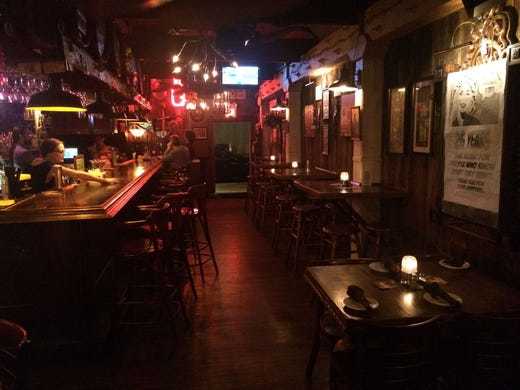
Lucy's Tavern is the best kind of small-town bar. It has a good jukebox, a bartender with a generous pour, and it's always open, even in terrible weather. In the raw and beautiful country that makes up Rebecca Barry's fictional landscape, Lucy's is where everyone ends up, whether they mean to or not.
There's the tipsy advice columnist who has a hard time following her own advice, the ex-con who falls for the same woman over and over again, and the soup-maker who tries to drink and cook his way out of romantic despair. Theirs are the kinds of stories about love and life that unfold late in the evening, when people finally share their secret hopes and frailties, because they know you will forgive them, or maybe make out with them for a little while. In this rich and engaging debut, each central character suffers a sobering moment of clarity in which the beauty and sadness of life is revealed. But the character does not cry or mend his ways. Instead he tips back his hat, lights another unfiltered cigarette, and heads across the floor to ask someone to dance.
A poignant exploration of the sometimes tender, sometimes deeply funny ways people try to connect, Later, at the Bar is as warm and inviting as a good shot of whiskey on a cold winter night.
Rebecca Barry lives in Trumansburg, New York, with her husband and two sons. She received her B.A. from Cornell and her M.F.A. from The Ohio State University. Her nonfiction has appeared in numerous publications, including The New York Times Magazine, The Washington Post Magazine, Seventeen, Real Simple, Details, Hallmark, and The Best American Travel Writing 2003. Her fiction has appeared in Ploughshares, One Story, Tin House, Ecotone, The Mid-American Review, and Best New American Voices 2005.
The literature of alcohol is a tricky field for new writers to enter. There's the constant risk of slipping into lazy cliches as well-worn as the overlapping water rings on a bar (you see what I mean?). Then, too, so many masters of fiction have already gone before and blazed a brilliant trail—-William Kennedy's Ironweed, Raymond Carver's short story "What We Talk About When We Talk About Love," and nearly everything written by John Cheever. In the hands of the right writer, booze-soaked fiction can be--yes, I'll say it--intoxicating.
Now along comes Rebecca Barry with Later, at the Bar, a collection of linked stories which revolve around the barflies of Lucy's Tavern in upstate New York. More than a credible example of "Lost Weekend" Fiction, Barry's debut succeeds largely on the merits of her pared-down style and her obvious love for the characters she's created. Most of these people are on slippery slopes of self-pity and regret, but Barry tenderly gives them occasional glimmers of redemption and hope.
The small-town universe of Later, at the Bar is rife with the kind of drama found in soap opera and country-western songs: failed marriages, one-night stands, terminal illness, scrapes with the law, loneliness, bitterness and pent-up anger. The characters converge at Lucy's Tavern, but Barry does not confine the action to just that dim, smoky interior. The opening story (unfortunately the weakest of the bunch) tells us that Lucy's is a place where "bad behavior within reason was perfectly acceptable," a place where "most people in town came to lick their wounds or someone else's, or to give in to the night and see what would happen."
In the course of the book, we meet several recurring characters. There's advice columnist Linda Hartley, "who wouldn't set foot in the bar without high heels and a soft sweater"; there's Grace Meyers who "was nice to look at in an unreachable way"; and there's Grace's ex-husband Harlin who promised himself when he got out of jail "he would live a quieter, more peaceful life...by drinking at home, counting to ten before hitting anyone, and staying away from women, his ex-wife Grace especially, but all other women as well."
Even as Harlin says this, we know he'll break that vow the first lonely Saturday night he ends up back at Lucy's Tavern slumped on his stool and desperately throwing pick-up lines in Grace's direction. Harlin is the most interesting character in the book's large cast.
Barry knows when to let the story spin itself out at its own pace, and when to jab the reader with a punchy sentence like "The trouble with his new wife, (Harlin) said, was that she had terrible taste in men." She even gets good mileage out of hackneyed cliches Like the country-western songs that sob from the jukebox, all the familiar love-em-and-leave-em stories are on parade here. Yet, in Barry's hands, the time-worn feels fresh.
Later, at the Bar is full of gem-like moments where characters, with nothing better to do than drink and think, have a knack for saying what they really feel, no matter the consequences (and the stakes are usually very high for these characters). One barfly neatly expresses the sum total of the stories here when she remarks, "Say what you will about drunks, but no one will love you like they can."
We listened to this on a roundtrip. We did get a few giggles out of it, but moistly bc sometimes it was just ridiculous. It was very one tone and never really went anywhere. Just a hillbilly bar and the same old customers.
Without the diminutive size of this book, and font so large it wouldn't require a separate edition for the visually impaired, this book never would have been written.
The format of telling a novel through short stories worked. It was the charachters themselves that got on my nerves. Despite the passing of time, not a single one demonstrated any interest or motivation to change. With that in mind, even the brevity couldn't keep me from feeling weary after I finished a chapter. Having attended college in upstate New York, I thought that I'd feel a sense of camraderie with the characters. I was mistaken.
Only for those who like to finish a book in a single sitting.
Skip it! The subject matter could have been interesting – the book is a series of short stories involving the same characters that interact w/ one another at the same bar in a small town. But the characters were shallow and unlikable; the author just scratching the surface and never really telling a story about anything more interesting than a man pining over his ex wife, or another man who doesn’t have the nerve to talk to the cute girl at the end of the bar. Incredibly boring.
“But it was daytime. The sun was out and the rules were different. He dropped his eyes and they passed each other without speaking, the way people who drink at the same place often do once they step out of the bar and into the world.”
“Across the street she could see the mourners staggering out of the lodge, two or three at a time, some singing, one woman weeping. 'Say what you will about drunks,' she said out loud to the dark room around her, 'but no one will love you like they can.'”
I like linked stories and I like drinking, so this collection, centered around Lucy's Tavern, in a small town, in upstate New York, turned out to be a perfect fit for me. The same broken and lovelorn characters, weave in an out of these stories, buying rounds, mooching drinks, and finding someone to go home with, after “last call”. My friends know, I love my craft beer and an occasional cocktail, but drinking on this level, with this kind of reckless abandon, has no appeal for me, but I sure like reading about it. Another round, bartender!
As the title states,"Later , at the Bar: a Novel in Stories" is a tale of interwoven stories about the regulars at Lucy's Bar in upstate New York. It should have been a depressing book . The characters unfortunately evolved very little, although they talked about changing. As you would guess , alcohol is pervasive in the tales so if this offends you , take note and avoid. Somehow , even considering all of this, it ends up being hopeful. Possibly because the author likes her characters, the reader also comes to care for most of them in spite of their faults. A poignant story that could lead to many provocative discussions.
Oddly enjoyable. Or enjoyably odd. I'm not sure which it is. I've read worse. I've read way better. It's a series of short stories about a bunch of "losers" (IMHO) who frequent this bar called Lucy's. Now, I know there are people like that out there, but in this book, there's an entire little town absolutely overflowing with them. The people in this book are a really sorry sack of people. I didn't find them endearing at all yet I plodded on (the book is small and a quick read). There were times when I wondered why the author would bring this somewhat ugly truth to light in such an exaggerated manner. I dunno. As always, it's probably just me.
It's hard to be critical of a book recommended by one of my favorite authors, Pam Houston, but honestly these linked short stories fell flat after I'd met the characters. Briefly, the barflies to congregate at Lucy's Tavern in the unnamed blue collar town in upstate New York drink far too much as they regale each other with the scrapes and bad emotional encounters that make up their lives. One or two pieces were well crafted but after the fourth or fifth chapter I was ready to be done.
Sorry Pam; maybe I'm just not a critical enough reader to appreciate this book.
This is a bunch of short stories where they all are intertwined. The central character is actually the bar. The stories were good and well written. You felt like you knew them and each storyline seemed to wrap up.
I bought this on a complete whim. I hadn't heard of it. I almost never buy books I haven't already heard of. But the title jumped out at me. And it was adorably small (5.5 x 7.5). And I opened it to a random page and liked what I saw.
Turns out it has gotten some very good reviews.
Basically, it's 10 chapters about barflies in a small blue collar town in upstate New York. Each one stands on its own. And basically all character studies. Nothing happens. There are no lessons learned. They just muddle through their lives. But it's a really nice read. Real. And not in a depressing way.
I think part of whether this appeals to people is based on their own expectations and experiences of bar culture. This was very true to what I know. It's not a big city book.
Some excerpts:
"It was evening and the bar was beginning to take on the cozy, womblike feel it always got after happy hour, when people had just enough to drink to like themselves and forgive each other."
(Grace is crying)
"Lanford took a cocktail napkin out of his pocket and checked it for phone numbers. Seeing none, he handed it to Grace, who took it."
"She looked at the people around her: Earl in his one fine suit checking out Ada Wilder's ass; Ada standing there with her hand on her hip, letting him. Cyrus trying to look over his neck brace and down Janet Wilder's dress, Anne-Marie saying something to Martin, and Martin looking past her as if he'd already heard it a thousand times."
This depressed me. It made me want to stop being an alcoholic redneck from upstate New York. Seriously, the alcoholism was rampant and terrifying. I felt hopeless reading about the failed (repetitive, always doomed) relationships, bored by the endless dart-games, nervous every time someone got behind the wheel. I'm really glad the kids were not a more obvious part of the story (except at the end). There was so much self-inflicted sadness, it was like reading the local paper. Lucy's bar reminded me of Goody's in Beloit, and I wonder now if there were regulars who left when we showed up. I don't hate that I read "Later, at the Bar", and there are many parts of the book that will stick, but it probably wasn't the best book to pick up after "My Year of Meats", a hilarious indictment of the beef industry.
I liked the book well enough, but given all the praise, I expected something pretty great. It wasn't. For me, only two of the characters were compelling and they even seemed pretty standard. The linkages between the stories is handled well, and it's refreshing to leave the bar and get a broader sense of the (often sad) lives of these characters. But Later At the Bar is much like being in a bar yourself. There are some good times to be had, the drunks are kind of interesting, but in the end their antics are a little tiring and you want nothing more than to send them off for some strong coffee and go back to your sober life.
This novel in short stories captivated me with its perfectly balanced exploration of the community of drinkers who base their lives in and around Lucy's, an Upstate NY bar. Rebecca Barry has managed to capture the elusive quality of that makes these dysfunctional, alcoholic wrecks lovable. I think these stories spoke to me because I know these people, grew up in the towns that Barry mentions. We hear so much about the charm of Upstate NY, of the beauty of the lakes and the quality of the wines produced, but Barry focuses on the grittier aspects of life here, without disparaging, and still manages to produce a periodically funny, easy read. I look forward to more from this author.
I'm not quite sure what I was expecting out of this, but whatever it was, I didn't get it.
These short stories center around small town inhabitants and their local bar. Ironically, the only story that I actually enjoyed was the only one that didn't have anything to do with drinking, or the bar.
I'd say skip this one if you happen to pick it up. It's a short read, which is probably the only reason I decided to finish it.
seriously, kim: thank you!! a quick read... but the funniest and most heart-breakingly real group of stories i've read in a long time. i haven't laughed out loud like that since david sedaris. it's like... the small town you were from, plus a james mcmurtry song, plus beautiful girls (the movie), plus i dunno... wood paneling. and somewhere in there is paul schneider. it's fantastic.
A wonderful, funny, moving collection. Only one problem: the next-to-last story doesn't fit in with the rest of the book, but that's a tiny quibble. I would read this book again, absolutely.
this is a quick and satisfying read about southern life at the local. the entertwined stories keep you interested. the characters are memorable. overall, i really recommend it.
There is an interview in the back of the book in which the author states that she has intended to write a book with Linda Hartley, an advice columnist living in upstate New York, as the protagonist. While Hartley is featured in several vignettes, I found myself wanting to know more about Linda Hartley, as I found the other characters a bit flat - it seemed like they just would drink and get into trouble (fighting, arrests, starting a big cooking project and then passing out and leaving out all the ingredients). This book could've been better in so many ways - offering more backstories, what were these characters' childhoods, struggles. I couldn't make a picture of the setting or the characters in my mind.
This started off well for me, and she has written some truly beautiful descriptions throughout, but by the end of the book, I’d started to tire of the characters and the plots, namely because the later stories didn’t feel too much different from the first few. Maybe this was a few drafts away from being truly great? It also annoyed me that I never knew how much time passed between stories. It was an easy read, though, and deeply moving at times.
This book was written about or by someone who came form the area I grew up in. There was something eerie reading stories that seemed like they described the lives of people you have meant in town, or even observed on a local Saturday nights.
Her characters lived in a recklessness I was used to, but never seen adequately described. Barry's book was definitely a good read.
From the first chapter with a heartbreaking description of death, to the end with its heartbreaking experience of surviving another death, I was hooked. Although near the beginning I was tempted to put it down, this book pulled me into the lives of a "family" of alcoholics that was entirely real. My life is changed a bit from meeting them all.
This entire review has been hidden because of spoilers.
What a collection of vaguely likeable, mostly harmless, and incredibly depressing characters. There are lots of fictional places I want to visit, but this town and this bar sure don't make the list. Some good stories...some meh stories...all of them a real bummer.
1.5 ⭐️. I wanted to enjoy this but honestly it just made me sad for every single person whose perspective was portrayed. I kinda guess that’s the point but jeez. It was depressing and just kinda put a damper on my mood through out the book.