

What do you think?

The MIT Press Essential Knowledge
Fake Photos
A concise and accessible guide to techniques for detecting doctored and fake images in photographs and digital media. Stalin, Mao, Hitler, Mussolini, and other dictators routinely doctored photographs so that the images aligned with their messages. They erased people who were there, added people who were not, and manipulated backgrounds. They knew if they changed the visual record, they could change history. Once, altering images required hours in the darkroom; today, it can be done with a keyboard and mouse. Because photographs are so easily faked, fake photos are everywhere—supermarket tabloids, fashion magazines, political ads, and social media. How can we tell if an image is real or false? In this volume in the MIT Press Essential Knowledge series, Hany Farid offers a concise and accessible guide to techniques for detecting doctored and fake images in photographs and digital media. Farid, an expert in photo forensics, has spent two decades developing techniques for authenticating digital images. These techniques model the entire image-creation process in order to find the digital disruption introduced by manipulation of the image. Each section of the book describes a different technique for analyzing an image, beginning with those requiring minimal technical expertise and advancing to those at intermediate and higher levels. There are techniques for, among other things, reverse image searches, metadata analysis, finding image imperfections introduced by JPEG compression, image cloning, tracing pixel patterns, and detecting images that are computer generated. In each section, Farid describes the techniques, explains when they should be applied, and offers examples of image analysis.
232 pages, Paperback
Published September 10, 2019
About the author
Hany Farid
2 books6 followersHany Farid is Professor in the School of Information and the School of Computer Science and Electrical Engineering at the University of California, Berkeley. He is the author of Photo Forensics (MIT Press).
Ratings & Reviews
Friends & Following
Create a free account to discover what your friends think of this book!
Community Reviews
Displaying 1 - 7 of 7 reviews

September 30, 2019
Farid spends a lot of time in technical details (sometimes even navigating you through which drop-down menus to select in Photoshop, and going through lines of metadata to the 64th place - unnecessary...). I was hoping for a more comprehensive history of how fake photos have you been used and disclaimed in history, and how science and math were used to disprove. The book is entirely about digital works - which is good, and there's a lot to glean. He speaks of several court cases and scientific discoveries that he has authenticated and disproved, and how he arrived at these details. Those are among the best parts of the book.

October 23, 2019
Hany Farid's book is:
- not about misrepresentation, although true content with false/misleading context ('cheapfakes') is more common than manipulated/false content, e.g., on political social-media (1, 2, 3🇩🇪); too, for a real threat actor, having provably false content is worse than having unverifiable content (1)
- not about researching locations, weather data, true date/time of events (solar altitude, ...), creators, alternative sources, etc. (1, 2/2🇩🇪, 3, 4, 5, 6, 7, 8🇩🇪)
- not about fake photos response communication (1, 2, 3),
how not refuting a lie (1),
how refuting the message independent of the truth of the photo (critique of a naïve critique + counter narrative; ad hominem)
- not about fake photo history
- not about psychology, e.g., what makes a good fake photo, apart from the technical (confirmation bias, …), selective exposure; fake photos distort viewer's memory (Eric Cheyfitz disinfo="process of erasing history", creating a structure where contradictions are not recognized); increasing perception of online fake news increases the probability to share political fake news; "availability heuristics" & overestimating frequency of negative events; distrust in established media and authorities or everyone, cynicism/paralysis (1), ...
- not about sociology and economic activities, e.g., the right has lower standards (2/3), universality/omnipresence of lying, digital forensics market (customers, e.g., insurance companies, …), ad-supported fake news business
- not about the spread (1, 2, 3) and containment of fake photos, e.g., refutations are more laborious and shared less frequently than false claims = a time and range disadvantage
In this Essential Knowledge book series, Lee McIntyre's book Post-Truth may already cover a few of these topics, but Prof Farid probably could tell one or two things about it, too (1, 2).
Instead, Farid's gap-filling book Fake Photos (which seems a layman version of his Photo Forensics) is throughout technical and throughout focused on detecting actually doctored photos by examining:
- inconsistencies between the Exif metadata and the scene (f-number, shutter speed, ISO, APEX conversion vs. evident brightness, blur, image noise etc)
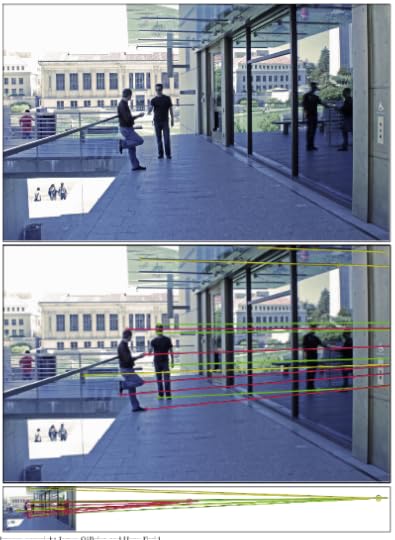
- inconsistencies in the scene itself such as an implausible number of light sources or vanishing points (intersection of van. lines)
- inconsistent reflections
- implausible geometries and shadows (scene reconstruction in 3D programs)
- telltale double-compression and interpolation artifacts—perceivable and in the data (quantization tables)
- ...
Farid also demonstrates techniques to prove the use of a particular camera or graphics tool, e.g., the comparison of stable noise patterns (Photo Response Non-Uniformity) or JPEG file-format variabilities (internal thumbnail, segment markers, ...).
Some techniques are presented with basic math and small background stories from Farid's own work, but the book is technical through and through. Overall: I found his book very interesting and instructive. The book confirms that these procedures are actually practicable and accepted in reality.
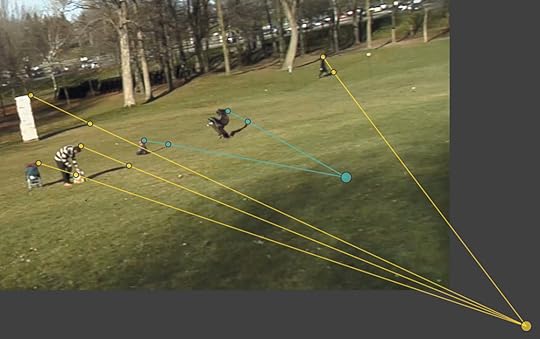
Occasionally, you read captions like "all vanishing points (blue and black) do not converge to the vanishing line (red)" written under black-and-white images. These images are printed again in color and on high-quality paper in the middle of the book ("plates"). This is probably due to the mass printing process (probably cheaper so), but is distracting and feels somewhat backward.
"JPEG encoding" in the background section isn't well explained; it's a refresher at best if you already know how it works; otherwise you have to search other docs or watch youtube videos.
All books from the MIT Press' Essential Knowledge series are pocket books with a pleasant stiff and glossy softcover. The key statements are repeated every few pages in big white letters on a separate black book page to make content stick.
- not about misrepresentation, although true content with false/misleading context ('cheapfakes') is more common than manipulated/false content, e.g., on political social-media (1, 2, 3🇩🇪); too, for a real threat actor, having provably false content is worse than having unverifiable content (1)
- not about researching locations, weather data, true date/time of events (solar altitude, ...), creators, alternative sources, etc. (1, 2/2🇩🇪, 3, 4, 5, 6, 7, 8🇩🇪)
- not about fake photos response communication (1, 2, 3),
how not refuting a lie (1),
how refuting the message independent of the truth of the photo (critique of a naïve critique + counter narrative; ad hominem)
- not about fake photo history
- not about psychology, e.g., what makes a good fake photo, apart from the technical (confirmation bias, …), selective exposure; fake photos distort viewer's memory (Eric Cheyfitz disinfo="process of erasing history", creating a structure where contradictions are not recognized); increasing perception of online fake news increases the probability to share political fake news; "availability heuristics" & overestimating frequency of negative events; distrust in established media and authorities or everyone, cynicism/paralysis (1), ...
- not about sociology and economic activities, e.g., the right has lower standards (2/3), universality/omnipresence of lying, digital forensics market (customers, e.g., insurance companies, …), ad-supported fake news business
- not about the spread (1, 2, 3) and containment of fake photos, e.g., refutations are more laborious and shared less frequently than false claims = a time and range disadvantage
In this Essential Knowledge book series, Lee McIntyre's book Post-Truth may already cover a few of these topics, but Prof Farid probably could tell one or two things about it, too (1, 2).
Instead, Farid's gap-filling book Fake Photos (which seems a layman version of his Photo Forensics) is throughout technical and throughout focused on detecting actually doctored photos by examining:
- inconsistencies between the Exif metadata and the scene (f-number, shutter speed, ISO, APEX conversion vs. evident brightness, blur, image noise etc)
- inconsistencies in the scene itself such as an implausible number of light sources or vanishing points (intersection of van. lines)
- inconsistent reflections
- implausible geometries and shadows (scene reconstruction in 3D programs)
- telltale double-compression and interpolation artifacts—perceivable and in the data (quantization tables)
- ...
Farid also demonstrates techniques to prove the use of a particular camera or graphics tool, e.g., the comparison of stable noise patterns (Photo Response Non-Uniformity) or JPEG file-format variabilities (internal thumbnail, segment markers, ...).
Some techniques are presented with basic math and small background stories from Farid's own work, but the book is technical through and through. Overall: I found his book very interesting and instructive. The book confirms that these procedures are actually practicable and accepted in reality.
Occasionally, you read captions like "all vanishing points (blue and black) do not converge to the vanishing line (red)" written under black-and-white images. These images are printed again in color and on high-quality paper in the middle of the book ("plates"). This is probably due to the mass printing process (probably cheaper so), but is distracting and feels somewhat backward.
"JPEG encoding" in the background section isn't well explained; it's a refresher at best if you already know how it works; otherwise you have to search other docs or watch youtube videos.
All books from the MIT Press' Essential Knowledge series are pocket books with a pleasant stiff and glossy softcover. The key statements are repeated every few pages in big white letters on a separate black book page to make content stick.
December 9, 2019
Very interesting and informative book on the forensics ("Snopes") of photography. I found it useful simply as a book on the technical aspects of digital photography. But what is more interesting peripherally is how our brains can actually be deceived, and relates to the speed of cognition. We "see slowly" but imagery and information exponentially exceed it. Information now overdrives cognition into distortion, similar to over-driving an amplifier. But what seems like a new phenomenon of fakery, has been around as long as humans have been manufacturing imagery. It's great that we can now analyze it to micro detail, but we’ll have to continually do this, like stopping a tsunami with sandbags.

February 2, 2020
Not at all what I expected and hoped for. More of a technical manual than an exposition of media tactics or an investigation of propaganda — WHICH IS REAL, NOT A CONSPIRACY. This was just disappointing.

August 12, 2023
I got this book as part of a bundle of MIT Press books from Humble Bundle. I didn't have any expectations about the book before reading and was quite pleasantly surprised as the author revealed how to identify fake photos. The author provides many examples of things to look at to see if a photo has been altered or created outside of a camera.

September 19, 2019
Great book full of useful and interesting information.

June 5, 2024
Interesting, but a good portion of it is fairly technical.
Displaying 1 - 7 of 7 reviews