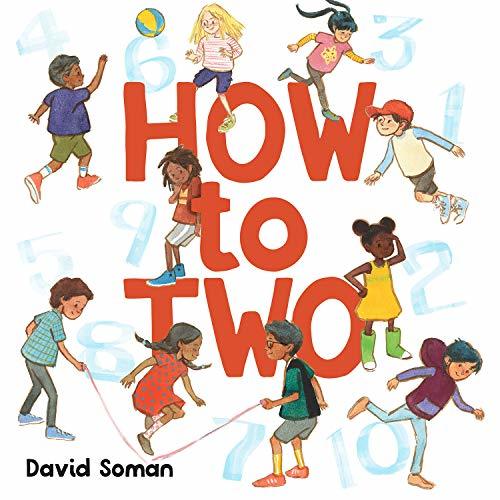
From the co-creator of the New York Times bestselling Ladybug Girl series comes a joyful counting book about inclusivity, play, and the thrill of making new friends--from one to ten and back again.
A quiet day at the playground turns into a boisterous park-wide adventure as one boy on the slide becomes two kids on the see-saw, then three jumping rope. Before long, ten new friends are playing like they've known one another forever.
With its deceptively simple text and a rich visual narrative, How to Two is a playful counting and reverse-counting concept book as well as an exuberant celebration of inclusive play, friendship, and community.
"No two ways about it--this one is a delight." --Kirkus "A joyous celebration of play...Seamless...Diverse." --The Horn Book (starred review) "Inviting and welcoming." --BCCB (starred review) "Dynamic." --Booklist "Exciting." --Publishers Weekly
David Soman hails from a family of artists, and has been drawing since he could walk (over to the kitchen walls to draw on them). He is the New York Times bestselling co-creator of the Ladybug Girl series with his wife Jacky Davis, as well as author and illustrator of Three Bears in a Boat and The Monster Next Door. David, Jacky, their children, and a big furry dog live in New York’s Hudson Valley. When not working on picture books, shoveling snow, or chopping firewood, David is an instructor at the School of Visual Arts in New York City.
Something about this one rubbed me the wrong way. The illustrations are cute, and the counting aspect is fun, but I have a problem with the overall wording. Plus, this is a book that doesn't know when to quit.
This is a counting book with a bit of a... well, it's not so much a story as a premise. It starts out with one kid playing by himself. This is "how to one". This phrasing is used throughout, and though I can tell it means "how to play in a group of X number of kids", the wording is really weird. I've never heard playing in a numbered group said as "how to X". Unfortunately, that's pretty much the whole text of the book, so if it bothers you, there's no escape.
When we get to the end (or so we think), we're treated to another run-down of the numbers from 10 through 1 as the kids are collected by their respective families. Then the book seems to start all over again (thankfully, though, it only goes to two). And then we find out that there are animals hidden throughout the pages, so of course kids will want to go back and find them all. But wait, there's more! As a final, somewhat random touch, the numbers are reinforced yet again with illustrations of kids' hands and their fingers indicating the numbers from 1 to 10. I would definitely not recommend this book at bedtime; you'd never be done!
I've encountered Soman's work before in the Ladybug Girl books, as well as in Three Bears in a Boat. I don't really have much of a complaint with the illustrations, other than the fact that the diversity didn't really go far enough; there are kids from various backgrounds and family types, but everybody is able-bodied. It might've been nice to see a child with a physical disability represented, especially as the theme seemed to be one of friendship and inclusion.
The clunky phrasing (and never-ending nature of the latter part of the book) makes this a title I can't wholeheartedly recommend. I realize that my annoyance at the wording is a subjective thing, though, so others might enjoy this one more than I did. It certainly reinforces the numbers, so if that's what you're looking for, this might be a good counting book for you.
While this might initially be viewed as a simple counting book, there's much more going on here story-wise. "How to one" is just one boy sliding down a playground slide by himself. Then "how to two" is two children on a seesaw together. On and on the story goes until it reaches 10 and starts back over at "how to one" when the young boy who started the book heads home to read with his mother. Similar to a wordless picture book, readers can discuss all sorts of things happening within each page spread. The story may take different directions as every reader interprets the thoughts and feelings of each character. Such fun! The artwork in this book was done with watercolors, ink, and colored pencils on paper.
For more children's literature, middle grade literature, and YA literature reviews, feel free to visit my personal blog at The Miller Memo!
I didn't care for the repetitive and awkward text -- "How to one. How to two. How to three." etc. -- but the illustrations are lovely. The pages flow nicely, especially when we count backwards from 10 to 1. There are hidden animals on each page!
Though the main text was awkward ("How to one, How to two"), the pictures and concept are strong. The children pictured finding different ways to play together to accommodate their expanding group have different skin tones, body shapes/sizes, and gender presentations, though they all appear able-bodied. If I used this book in a storytime, I would honestly substitute different words ("How to play with two, How to play with three, How do you play with four?" etc) and use it as a lesson for caregivers about how you can change the words of picture books to better suit your listeners.
Story of inclusiveness, inviting kids to join in playground activities. One criticism is that while the kids and their families are diverse (LGBTQ, single parents, interracial, grandparents, religion, culture, ethnicity), none feature differently abled kids. Would have loved to see a child using an assistive mobility device or aid. But I loved the concept!
This mostly visual story follows child after child who join each other to play in a park. The phrase "How to..." repeats with numbers 1-10, with the numerals shown near the end of the story, allowing opportunities to count children on each page. Soman's watercolor illustrations are beautifully layered with a diverse cast of new friends.
I absolutely loved some of the illustrations in this book, and the energy of it, and the mix of kids and families. But the words just didn't do it for me, the whole "how to one, how to two" thing didn't really gel and there wasn't much else there. But still worth a read for the memorable images and if you're looking for one of those books with lots of kids
A lovely, inclusive counting book taking place at a park, where a boy starts off playing by himself, but finds more kids to play with until there's a group! How to Two shows how kids can have fun with just a friend or two, or a whole crew! There is also a fun search and find with the critters in the park.
I'm actually going to give it a 2.5. I love the illustrations and that it helps the readers with counting. However, I felt that the book was going to be more about how to play with others/sharing and I felt that it could have been better addressed. It fell flat for me, but doesn't mean that it isn't a good book. I hope my patrons like it.
4 stars for the illustrations and for the concept 3 stars for the seek and find 2 stars for the text which was difficult and didn't flow for me 1 star for letting me down
Richie’s Picks: HOW TO TWO by David Soman, Dial, March 2019, 40p., ISBN: 978-0-525-42784-1
“Say, say, oh playmate Come out and play with me And bring your dollies three Climb up my apple tree Shout down my rain barrel Slide down my cellar door And we’ll be jolly friends Forever more” -- 100+ year old song/hand clapping game
“A playground roundabout (or merry-go-round) is a flat disk, frequently about 2 to 3 metres (6 foot 7 in to 9 foot 10 in) in diameter, with bars on it that act as both hand-holds and something to lean against while riding. The disk can be made to spin by pushing or pulling on its handles, either by running around the outside, or by pulling and re-grabbing as it spins, from a stationary stance. Often found in school playgrounds and public parks, they offer riders (typically children) a dizzying ride either when others spin the wheel, or by spinning it themselves by running around it, and then jumping on.” --from Wikipedia, “Roundabout (play)”
For author/illustrator David Soman, it was “the little playground that was on West 77th Street in Central Park.” For me, it was the playground located behind my grandparents backyard in Garden City.
As a little kid, I spent many days on that playground. I didn’t live there, I only visited, so I didn’t know any of the children. But it didn’t matter. I’d become just one more of the many kids playing there. Joining the other children on the dizzying roundabout was one of my absolute favorites.
HOW TO TWO is a beautiful, satisfying picture book about joining in at the playground. It is organized as a counting book, but it serves equally well as a compendium of suggestions for playing together without gadgets and screens.
The story begins with one boy on a slide, who is then joined by a girl to become a pair on a see-saw. The pair then turns a jump rope for a third child, when along comes a fourth child with a ball. So the quartet play foursquare. Onward goes the activities as, one-by-one, the number of children playing together grows to ten. There’s sand play, duck-duck-goose, puddle splashing, hide-and-seeking, and tag-your-it. The simple text counts up: “How to one.” “How to two,” etc. The growing cast of children is multiracial and of varying sizes.
After reaching “How to ten,” dusk arrives. Along come parents, and the numbers then count back down in a circle as the children scatter, homeward bound, to the edges of a two-page spread. Finally, we see the original boy at home, where he selects a book, looks at it (“How to one.”) and brings it to Mom for a lap-sit read-aloud (“How to two.”)
HOW TO TWO will be valuable in promoting inclusiveness and cooperative play, and is a great reminder of how much fun there is to be had by playing outside with a bunch of friendly kids.
“How to Two” is a counting picture book that follows a child who is playing by himself on the playground. The story is simple to follow; the lone child is introduced as “how to one.” As he meets and plays with others on the playground, the sentence varies just enough with the appropriate number. Some may see this as awkward as the sentence structure is a fragment, but it is a simple enough fragment that the child may understand what's going on and the importance of counting.
I also would like to draw attention to the fact that, as one reviewer said, the book acts more like a wordless book; there is more benefit in reading the pictures for more context rather than reading only the words.
The illustrations are vivid and dynamic; you get the sense that the child is enjoying the company and having fun on the playground as his group gets larger. It is a story about playtime, friendship, and having fun with others. It is an endearing story that ultimately has a lovely ending about coming home. I would recommend this book to any family who is trying to teach their children how to count and the importance of friendship. This book is great for preschoolers, ages 3-5, because the sentence structure is simple enough to be predictable, yet it also teaches them how to effectively count.
A boy finds one new playmate after another at the playground until there are ten. As the children join each other to play, they take part in a variety of playground activities. Beautiful illustrations show a diverse group of children having fun playing and being with each other. The text is sparse, but it tells a wonderful story of friendship. It could also serve as a counting book. The end pages encourage readers to look back through the book and count various animal critters that are pictured throughout the pages. Thanks to the publisher for a review copy.
This awesome picture book uses counting up to ten and back down again to illustrate such a lovely message for young readers. The book starts with one little boy playing on a playground, but as he is joined by friends, everyone is welcomed and the activity is adjusted to include each child. The beautifully painted illustrations along with the simple text really show how simple it is for everyone to play together. This is definitely a terrific book to share with young children during the warm weather months when everyone is headed outdoors and will need to be able to share space and activities.
This is a really lovely counting book about play and community!
The number of kids who are the focus on each page is the number on the page. The play is often related to that number, and there are animals (that many of a particular animal) hidden on each page.
I really liked the hints about what's coming on some of the pages, as well as the way we see the landscape of play expand.
Through most of the book, only the number words are used. Near the end, a two-page spread has the numerals in a circle (1 to 10), but not counting anything. The back cover shows the numerals beside images of the animals that are hidden through the book.
There is no particular reason why I like this book so much, but it definitely left me smiling. The book starts by showing a child playing by himself (“How to one.”). Then, he finds a friend and does a different activity (“How to two.”). The children consecutively find more children, and play appropriate games with that number of children until the group reaches 10. I guess it just made me happy to see the potential of a diverse group of kids playing together outside and getting along.
In the same spirit as last year's Pie Is For Sharing, one of my favorite books of the year. A group of kids at a big city playground finds new ways to play together as more kids join in. The minimal text is lovely, but a little high-concept for Iris. The watercolor illustrations are great, though: the kids (and their families, when they appear) are diverse, and Soman does some beautiful things with the day's changing light and weather.
I loved this book. At first I was like "meh" because when I read the title I thought it was going to be about a 2 year old not a counting book, but then it was super cute. I pointed out to a coworker how cute it was that the animals matched the numbers as well which she hadn't noticed and then turned in to a "find all of the animals" game which would be tons of fun to help a child learning their numbers but also think more critically and observe more closely.
When I picked up this book, I didn't quite know what to expect based on the title. I kind of thought it was going to be an instruction manual on how to be 2 years old.
But I like the real version better. Essentially, it's about encouraging kids to always let others join in their circle, or as Glennon Doyle says, permanently standing in a horseshoe so others can join.
I liked the inclusive message of this counting book and I particularly enjoyed matching up each kid with their families toward the end. Though the language is, of course, simpler, it reminded me a little of All the World, where there were so many different individuals all doing their thing and you could trace each one if you wanted.
The illustrations are beautiful and watercolory (totally a word... cause I want it to be). This book is a cute and to the point book that shows how to play together as groups and be inclusive with those around you. It’s super heartfelt, as you can tell though the illustrations. However, the text isn’t very robust, so it is best for younger kids.
Beautiful illustrations and plenty of diversity in these characters. A young boy starts out as one and friends join in until they've counted to ten. The counting process is reversed as families come to take their children home. Then the process starts over and ends at two with boy and mom reading a book together.
A fun and simple story about friendship. As a bonus it counts to ten and there are even hidden things to find in the pictures. The illustrations are gorgeous as well, which makes this a fun book.
Not sure you can make it interactive enough for a storytime, but this is a sweet parent/child read aloud.
This is a great book for children who are learning how to count numbers! This would allow for a perfect opportunity for children to count by using people. I would recommend using this book as it would be a fun and simple way to introduce numbers.