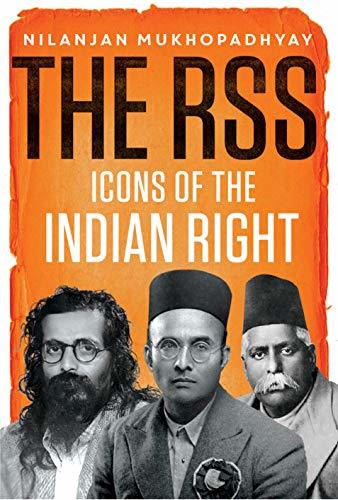
A fog of mystery surrounds the Rashtriya Swayamsevak Sangh—or RSS—the largest cadre-based organisation in the world. Veteran journalist and author of the bestseller Narendra The Man, The Times, Nilanjan Mukhopadhyay lays bare its fascinating, unique and perhaps startling world. He also chronicles the personal and political journeys of the most important men (and a woman) of the Hindu Right-wing, digging up little-known but revealing facts about them.
KESHAV BALIRAM The founder of the RSS, and its first sarsanghchalak, was called ‘Cocaine’ as a young revolutionary, and transported subversive literature and arms for a group back home in Nagpur.
VINAYAK DAMODAR This leading light of the Hindu Right had once invited the vegetarian Mahatma Gandhi to dinner and told him that unless one consumed animal protein, one would not be able to challenge the might of the British.
MADHAV SADASHIV GOLWALKAR aka ‘GURUJI’: The iconic ‘hermit-ideologue’, whose appointment as sarsanghchalak was challenged by many in the RSS, had once warned a protesting colleague, ‘I will throw him out of (the) RSS like a stone in rice...’
SYAMA PRASAD A brilliant academic-statesman who became part of Nehru’s Cabinet, Mookerjee had several differences with the prime minister. He once asked ‘Are Kashmiris Indians first and Kashmiris next, or are they Kashmiris first and Indian next, or are they Kashmiris first, second and third, and not Indians at all?’
BALASAHEB This towering pracharak had a strong dislike for religious rituals, and referred to himself as a ‘Communist’ within the RSS—‘it is highly debatable if he believed in God, or if in any way needed Him.’
DEENDAYAL The man who propounded the ‘philosophy’ of Integral Humanism was opposed to the partition of India and recommended that, ‘If we want unity, we must adopt the yardstick of Indian nationalism, which is Hindu nationalism, and Indian culture, which is Hindu culture.’
These and other leaders, including Vijaya Raje Scindia, Atal Bihari Vajpayee, Lal Krishna Advani, Ashok Singhal and Bal Thackeray, are all reckoned with in The Icons of the Indian Right. Through individual stories of the organisation’s tallest leaders, a bigger picture in spite of a three-time ban on the RSS in a multicultural and secular India—and despite the RSS’s insistence that it has no truck with electoral politics—the group is, and will be, the hand that rocks the BJP’s cradle.
When I started reading this book, we were living in a different world. In a span of one month, everything has changed. Just the way, it didn't matter who sat on the iron throne among the 7 royal families in Game of Thrones when the WhiteWalkers showed up, same way, in the post Covid-19 world, the fight between Left and Right has become probably insignificant. However, since I started the reading of this book, with the intention of knowing more about icons of the Indian right, as the right wing politics have dominated over the liberals world over now, I needed to finish it. And, hence this book.
Even if the right dominates the political narrative now, the left has been ruling, and still commands the intellectual sphere. And hence, as there is very less literature available that puts the ideas of the right in a publicly accessible way, it is rather hard to understand and appreciate the ideas of the right. In order to have an objective understanding the contentions between right and left, I have started reading the lives and ideas of right wing influencers. In that effort, I had read Savarkar's Hindutva, and DeenDayal Upadhaya's Integral Humanism. I am afraid, despite having my primary education in an RSS affiliated school, and having attended multiple RSS camps in my early years before the age 12, my knowledge about the stalwarts of RSS is very limited. And, hence this book.
From the writings it is evident that, Nilanjan Mukhopadhay, is not a fan boy of RSS and hence there are no eulogies for the figures that the Indian right idolize. So, the possibilities of selective writings and cherry pickings, cannot be ruled out. However, the author being a seasoned journalist, I would presume, most of the research and representations are factual, even if biased. There are not many books that I have come across that cover all the influencers of RSS and Indian Hindutva ideologues. And, hence this book.
India's ancient history could be predominantly Hindu, but in the last 1000 years or so, because of foreign invasions India has now become multi religious, multi ethnic and multi-cultural. However, this is not acceptable to the egos of many people who fantasize India of in its glorious past. Hindu nationalism is the result of that fantasy and that begets a hatred for anything that doesn't fit that fantasy. During the British rule of India, apart from the political agitation for getting rid of the foreign rule, there has been many ideologues who managed to proliferate this fantasy, and got widespread justification because of the similar divisive thoughts coming from Islamic fundamentalism. In that atmosphere, Savarkar became one of pioneers of the idea of Hindu nationalism, coning the word Hindutva. K B Hedgewar establised RSS to give shape to that idea in an organized way.
From his youth, he had searched for a reason to explain India's inability to ward off foreign dominion, but he had obviously found no answers. After what seemed like a lifetime of a struggle involving quasi-philosophical and religio-cultural debates, stretches of apprentships under various leaders, and home-grown revolutionary movements, K,B. Hedgewar finally seemed to have identified the reason: a psychological and inherent weakness amongst Hindus which could only be overcome by creating a common emotional cause within the community, and to build a disciplined and cadre-based organization to achieve the ultimate goal.
The spiritual leader Golwalkar gave a more religious and cultural colour to the organization, away from core politics. However, the subsequent leaders became more and more politically motivated, but still because of the visions of the founding fathers of RSS, the political wings were separate from core RSS functions, conceptualized by Shyama Prasad Mookerjee and Deen Dayal Upadhaya in the form of Jan Sangh that later became BJP. The effort of instilling the RSS ideologies in Indian political sphere further continued and perfected by Atal Bihari Vajpayee and Lal Krishna Advani. And we see the BJP of today of Modi, Shah and Adityanath, because of the visions of efforts of these early leaders, even if they differ in their approach from each other -
Savarkar was clearly in favour of militarization, Hedgewar wished to channelize the idea through the organization structure, while Golwalkar was prone to a spiritual interpretation of the idea. Balasaheb Deoras on the other hand, wanted the RSS to plunge headlong into politics.
This book gave me a lot of understandings of the minds and ideas of the indian right, through lives and actions of these icons, especially of the ones that I had very little knowledge before. A must read.
The hardwork in writing the book is evident. The author has conveniently cherry picked articles , quotes and allegations which could defame the leaders and put them in bad light."propganda literature " used in chapter of savarkar is one instance where he tries to shrug off the academic rigoristy of the leaders. There was so much to be written about shyama mukherjee and his active role in noakali rights , atal bihari whole stint as a prime minister is missing. The only one shown in good light is Balasaheb deoras as he was the left in right.
The book though gives some good historical anecdotes and synchronized history.
It is interesting to think about how human beings impact the world, not just in the present, but as a continuous process through the ages. Our species’ ability to cognitively think and ensure the continuity of new thought processes has resulted in a situation that is unprecedented and unparalleled in the animal kingdom. No other animal is capable of fully building upon, let alone concretely transmit acquired knowledge, and that has set us apart. Remembering this makes a world of difference when it comes to thinking of political events. As much as we like to dismiss political gimmicks and actions as ideology less power-grabbing acts, the truth is that each human being, either consciously or subconsciously driven by a chosen ideology which may or may not be unique. Perhaps that’s why, it becomes of paramount importance to study the socio-cultural influence of the prevalent ideologies and the personalities that inspired them. Ironically, our ability to listen to the other side and the meticulous efforts required in processing information is what drives us apart constantly, because absolutely no one feels it worth their while to neutrally understand a different opinion, as most choose to revert to the defensive human stance of abject criticism. Reading this book did not change my opinion or stance towards Hindutva or Right wing politics in general. But it definitely did give me crucial insights into a thought process that I demonise and vociferously oppose. Why does it matter? Largely, and broadly, it doesn’t. But on a micro-level, it does matter vastly. The only way to fix something is to understand the underlying issue and/or the cause of emergence of a grievance if any. I wouldn’t want to take further sides, but simply say that perhaps an ideology might be harmful and incorrect, it’s raison-d’être rarely is, and must be understood to work towards reconciliation of reactionary society politics.
The only saving grace for this book is that it can be used as a single source for researching all the great people that have shaped the Hindu mind over the decades and helped Hindus to see themselves as a unified group. The author, instead of treating his subjects with academic neutrality, time and again uses sources and language that are clearly biased and shows his left-liberal leanings. This bias is a great let-down for the reader who might want to see the subject from other perspectives, especially since the subject in question has been a topical since 2014 in India and much reviled worldwide.
This book provides use insight on RSS, idea, people behind it. Journey of its leaders and contribution. Not going in detail helped the reader to keep going.
After reading about Karl Marx, it was important to complete the circle by understanding right-wing philosophy and its leaders. Before proceeding ahead, let's understand the concept of LEFT and RIGHT in layman terms (without attaching politics and religion to it).
RIGHT: An individual or a group who benefits through the existing system, conventions, laws, traditions LEFT: An individual or a group is at the receiving end and is oppressed, deprived because of the existing system, and struggles for justice and rights in a biased system.
With this background in mind, let's understand the birth of a right-wing movement. It is to be understood that right-wing thinking has always been there. Right is the ideology that supports tradition, hierarchy, duty, and pride in what you are and what you are doing. The idea to challenge them is the genesis of the left which took place three centuries ago. When Britishers started expanding in India, they started abolishing practices of this right-wing ideology and started lifting up the marginal and oppressed. Their intention was to ensure that the infighting between these two continues and they continue to rule unabashedly. That is how the RSS took birth.
The staunch right-wing leaders when they saw that their positions and beliefs were effectively challenged and ceding ground to these marginal communities, started grouping themselves up and channelized their thoughts into a social organization. This book mentions the journey of each of the RSS leaders like Vinayak Sawarkar, Shyama Prasad Mukherjee, Balasaheb Deoras, Madhav Golwalkar, etc, and how they expanded the ideology and the organization.
The Burning Question is: Are you a left, right or centrist?
It disturbs the mental peace of a person when they are being labeled as rightist or leftist just because they don't agree with anyone's views on government and administration. In the coming days, it will only get intensified and the division will only become wider. So allow me to put it in a lucid manner:
IF You are a beneficiary of the existent system, it is coming at someone's expense and you continue to keep the Status QUO as it is, YOU ARE ON RIGHT
IF you are oppressed, unheard in the existent system, and fighting for the basic rights and freedom for yourself and your group, YOU ARE ON LEFT
But the most important role here is of a CENTRIST! Who is a centrist? - One who is the beneficiary of the current system but challenges the status quo by including the people who are excluded from it.
Let's understand with few examples:
1) If You are a rich SC/ST/OBC person who has been the benefactor of reservation policy (Education/jobs) for few decades and now are willing up to give it to a Poor high caste Person, You are a Centrist (Likewise for a high caste person to give its due rights to other castes in caste/religion sensitive region)
2) If you are ahead of the organization heavily dominated by males and now are willing to share the responsibility with including more females and other genders, You are a centrist.
We need more leftists to challenge the status quo and centrist to open the doors. These ideologies are important for everyone from the position they are in and intelligent application can make a better world.
Fascism is a form of radical, characterized by dictatorial power, forcible suppression of opposition, and strong regimentation of society and of the economy,which came to prominence in early 20th-century Europe. We as a nation are facing the similar things. The conditions may not be that serious today but if they went unchecked, than it would be a disaster for India. Coming to the book, it covers all the important people who held the flag of right wing politics (bhagwa) in India from K.B.Hedgewar,M.S.Golwalkar,V.D.Savarkar to A.B.Vajpayee,L.K.Advani and Bal Thackeray, most of the institutions formed by them like Hindu Mahasabha,RSS,VHP,Jan Sangh later BJP,etc, their crusades like cow protection,Ram Mandir,etc. This book gives you a knowledge about how this right wing politics emerged,sustained and flourished in India. In a country where no one declared these icons anti national when they refused to take part in freedom struggle,wrote apology letters to get out of jail. After few decades when one of them becomes premier of this great nation,he starts calling everyone coming his way anti national. Right from the inception their politics was based on polarization, divide and rule including a fascist mentality which they project as Nationalism. What this right has done is create a divide in our society on religious lines(depending on the situation),on eating habits,love choices,etc. Blaming their predecessors for not doing anything for this country as if they are the only saviours. Never telling what they had done for this nation. I recommend this book to everyone just to have an idea what these icons stood for,what was their ideology and how they operate even today. So be a vigilant citizen,think wisely and don't buy everything your leader says.
Rashtriya Swayamsevak Sangh is the focal point of all the things pushing our population today, where, who and how it began is the reason I wanted to read this book. I intend to know about the organisation and the people associated with it from a perspective less grandiose and more fact-driven if possible. It begins with the founder of Sangh, Keshav Baliram Hedgewar, a man who intended to establish an organization for strengthening Hindus in a quest for a Hindu Rashtra. Unimpressed by Gandhian way of things which he considered would weaken the stand of Hindus in the future, K. B. Hedgewar established RSS in September 1925 at Nagpur, based on the ideals of Hindutva by V D Savarkar. Vinayak Damodar Savarkar is embodied as Swantantra Veer, he escaped the clutches of British, was captured again and spent 2 decades in Andaman and Nicobar's infamous Cellular where he time and again placed clemency petitions before the British Raj. In later years he becomes President of Hindu Mahasabha and how that put him in place of change which he chose not to use, how he was against everything Gandhi stood for, how he never did anything to bring fruit to his ideologies makes one question the reverence placed on him by the current administrators. Madhav Sadashiv Golwalkar reined in as RSS chief for 33 years, staying guard from the times of Quit India movement(which they didn't participate), his help in getting Maharaj Hari Singh to join Jammu & Kashmir with India, their humanitarian help during partition which was shaded by their revenge rioting of the Muslims as retribution for the treatment meted out to Hindus in Pakistan, to being arrested for the suspected part in Gandhi's assassination(RSS was banned by Sardar Patel for it), his method for bringing laws in place for a ban on cow slaughter and essentially for his role in the creation of Bharatiya Jana Sangh (precursor to today's Bharatiya Janata Party) and Vishwa Hindu Parishad which was begun for uniting the Hindus spread across the world as one. If K. B. Hedgewar and V D Savarkar seeded the ideas of Hindu Nationalism or One Hindu Rashtra then M S Golwalkar knitted RSS together while expanding its horizons towards active politics, all this despite him wanting an ascetic life in the beginning. What made for the change is explained and I think M S Golwalkar played his part for the survival of RSS in critical times. Deendayal Upadhyaya's Integral Humanism is explained which played a crucial role in the shaping of core values of future BJP, his sudden tragic death raises questions that are still left unanswered till today. After all these comes Balasaheb Deoras who moved RSS from being a hitherto Socia-Cultural group to empower Hindus to the mainstream political world, along with Jayaprakash Narayan he pushed the protests against Indira Gandhi's governance and was jailed during Emergency, he affirmed the position of RSS's political arm Bharatiya Jana Sangh when it became part of Janata Party after people mandated the end of Indira Gandhi's rule and he was there when Ram Mandir agitation lead to demolishing of Babri Masjid pushing India to one of the worst communal riots across the country. What struck me was of how an agnostic brahmin who broke the rules of the time by serving food to the people of lower caste (which is a big deal!) could orchestrate such a heinous action by his followers. Recently a Maharaja quit the Congress to move to BJP which eventually led to the fall of Kamal Nath's government in Madhya Pradesh, Jyotiraditya Scindia is the grandson of Vijaya Raje Scindia who was a co-founder of Bharatiya Janata Party and we see how an erstwhile Rajmata was forced into politics at the beginning but came into her own owing to many humiliations and her idealogy similarities with the RSS. Apart from these, we get a quick brief on the leaders who we have heard about like Atal Bihari Vajpayee who first began BJP with a concept of Gandhian Socialism which almost pushed him to retirement due to the lack of support from Sangh, how L. K. Advani catapulted BJP to pan-India focus through his Rath Yatra from Somnath to Ayodhya but was later sidelined (events of 6th December 1992) to pave way for A B Vajpayee to become India's 10th Prime Minister. Lastly, we get a look into VHP's head Ashok Singhal who played a crucial role in making the Ram Mandir agitation a political issue and Bal Thackeray who shaped the Hindutva ideology in the '90s. Nilanjan Mukhopadhyay gives an idea of what RSS stands to be and how these people and events of past decades have shaped it, he doesn't make it a devotional song but questions their actions with facts which makes this a must-read for anybody who wants to know about the Sangh and how it has shaped the political opinions of Indians for past 3 decades.
I am someone who is deeply interested in politics . We all have been witnessing rise of right wing politics throughout the world .This is very interesting in international politics because we have never witnessed this trend before but what is remarkable of right wing politics is it is very different from each other in each nation . Hence this book clearly explains the the ideology of indian right which is on a high in indian politics .
BJP whose parent organisation is RSS had not played any big role in india indepence [ for which they are mocked by congress ] but now this right wing and hindutwa ideology is in the centre stage . The book talks about various icons of rss who were ideologues of rss like keshav baliram hegdewar[founder of rss], v d savarkar, m s golwalker etc . It tells what compelled and inspired them to make an organisation whose main objective was to make hindu rastra in hindustan . It also talks about how they made them relevant , how they evolved , how they dealt with crises [ ban of rss in 1948] etc .
The book is also very interesting to bring out many anecdotes in which paths of congress leaders and rss leaders crossed and how they faced that . Today congress and bjp or rss cannot look into each other but it was striking to read that k b hegdewar was once a member of rss and in 1948 , congress passed a resolution which made the entry of rss members acceptable but it was struck down by prime minister nehru . The author has tried to bring both sides of coins into light . Another interesting fact about rss was and is their discipline and how they make their cadres disciplined which has proved to be pivotal in electoral gains of bjp , making bjp a electoral machine . The credit to make bjp definitely goes to l k adwani. Mr modi and amit shah and all these men comes from rss background . Hence they have huge experience in organisation work which makes bjp a party with a difference .
Chapters on right wing leaders like vijayraje scindia , atal bihari vajpayee, bal thackeray and particularly l k adwani were short and not very infromative about their contribution to right wing politics in india which i suppose were huge but still this book explains core ideology of rss and its founders whose ideas are reflective in the way bjp governs and make policies in india . The core rss ideology and their definition of nationalism is that whose pitrabhoomiand and punyabhoomi were within the territorial boundaries , they were hindus and muslims can live in this hindustan but will have to concede to the fact that their birth and civilisation is hindustan .
I do not agree with this ideology because i believe that india was formed on two ideas that is unity in diversity and democracy and reading this book i can say that rss ideology is divisive in nature [ because of its anti muslim stance ] and it is a known fact that they did not believe in democracy , that is why we call india a country of nehru-gandhi and not of hegdewar-savarkar because india was never formed or could have survived on thier ideas of hindu rastra .Though BJP derives its roots from RSS and has put out that it believes in constitution and secularism but future will tell us that how desparate bjp is to impose rss ideology in india . I have to admit that i did not like the latter part of the book as itwas not as descriptive as it was for the fouders of rss but it gives a jist and crux . Also modern icons of the right should have been discussed too so that i can understand how rss changed with time .
overall , it is a must read book because if you want to know about today's politics , rss has a huge role to play in it and one should be aware of them and their doings
The RSS, Icons of the Indian Right by Nilanjan Mukhopadhyay is a meticulously researched book on the life and times of those people who are not only the fountainheads of the ideology of Hindutava but also inspired multitudes. The book tells us about Keshav Baliram Hedgewar, Vinay Damodar Savarkar, Madhav Sadashiv Golwalkar, Syama Prasad Mookerjee, Deendayal Upadhyaya, Balasaheb Deoras, Vijaya Raje Scindia, Atal Bihari Vajpayee, Lal Krishna Advani, Ashok Singhal, and Bal Thackeray. I highly recommend this book to those readers who are eager to learn about the Sangh, about those people who became heroes of the right-wing politicians, and the ways of the Sangh Parivar in which they operate, especially in the context of Indian politics.
Good read for both right wing supporters and haters
The book is written based on facts ( a lot of them taken from right wing publication) and the author tried to keep his own commentry at minimum. Gives a good context behind the ideologies of right wing icons. The last few chapters are too short.. sometime seems cut short on purpose to limit the length of book. Recommended to both right wing supporters (so they can have valid facts behind their comments instead of WhatsApp forwards) and right wing haters (so they can understand that every ideology has shades and cannot be divided in absolute black and white).
Its important to understand different versions of history and come to your own conclusions. Unfortunately our history books do not talk much about the RSS or if they do they paint it with a universally black brush. This book gives a fairly unbiased view of what RSS stands for by highlighting the journey of RSS stalwarts. Would have loved if it has included a chapter on Modi also ! Overall a good antidote to the leftist leaning history we have been fed constantly .
RSS the guardian of Hinduism with focus of one India. This book reveals how RSS built, who all are in it's strong foundation. Many open secrets mentioned and how RSS deals with it. Detail history mentioned of the founder and other two successor , how they made RSS constitution, beliefs and principals. Must read to understand indian politics and history after independence.
A book on the stalwarts of a Right-wing party, written by a left-leaning author. You get the drift, right? There are instances where the bias is clearly visible and also where the conclusions drawn look really forced. The amount of research that has gone into making this book is commendable, nonetheless.
Must read for everyone who uses the word 'Sanghi' on social media!
Written by Nilanjan Mukhopadhyay, who has covered the right wing and its many associated forces for a long time, this book is a crisp primer for anyone who uses the word Sanghi at random. Gives you a good perspective. This book has been written with equanimity.
One time read. Insightful. It is very lengthy. The quality of the book is very good. The cover is vibrant and relevant to the topic. The language used is simple and easy to understand. The ones who are interested in the political history of India will definitely love this book.
To know more, you need to know some. And as a result, your interest waxes and wanes depending upon the prior knowledge about the subject being covered. Nevertheless, an informative read
When i start reading this book i had a little knowledge about rss now i had some clear knowledge about rss. I don't know why they added thakery in this book