Jump to ratings and reviews
Rate this book

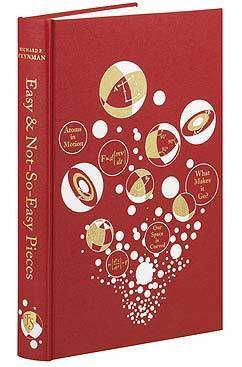
Easy And Not-So-Easy Pieces

Rate this book
P. Feynman (1918-1988) is widely recognized as the most creative physicist
of the post-World War II period. His career was extraordinarily expansive.
From his contributions to the development of the atomic bomb at Los Alamos
during World War II to his work in quantum electrodynamics, for which he was
awarded the Nobel Prize in 1965, Feynman was celebrated for his brilliant
and irreverent approach to physics.


It was Feynman's outrageous and scintillating method of teaching that earned
him legendary status among students and professors of physics. From 1961 to
1963, Feynman delivered a series of lectures at the California Institute of
Technology that revolutionized the teaching of physics around the world. Six
Easy Pieces and Six Not-So-Easy Pieces
, taken from these famous Lectures on
Physics, represent the most accessible material from the series.


In Six Easy Pieces, Feynman introduces the general reader to the following
topics: atoms, basic physics, the relationship of physics to other topics,
energy, gravitation, and quantum force. With his dazzling and inimitable
wit, Feynman presents each discussion without equations or technical jargon.


In the slightly more challenging Six Not-So-Easy Pieces, Feynman delves into
the most revolutionary discovery in twentieth-century physics: Einstein's
theory of relativity. The idea that the flow of time is not constant, that
the mass of an object depends on its velocity, and that the speed of light
is a constant no matter what the motion of the observer, at first seemed
shocking to scientists and laymen alike. But as Feynman shows so clearly in
these lectures, these crazy notions are not merely dry principles of
physics, but things of beauty of elegance.


Readers will remember how, using ice and water, Feynman demonstrated with
stunning simplicity to a nationally televised audience the physics of the
1986 Challenger disaster. It is precisely this ability-the clear and direct
illustration of complex theories-that made Richard Feynman one of the most
distinguished educators in the world. Filled with wonderful examples and
clever illustrations, Six Easy Pieces and Six Not-So-Easy Pieces is the
ideal introduction to the fundamentals of physics by one of the most admired
and accessible physicists of our time.


Six Easy Pieces was named one of the Twentieth Century's Best Nonfiction
Books

280 pages, Hardcover

First published September 19, 2001

77 people are currently reading
1577 people want to read

About the author

Richard P. Feynman

261 books6,716 followers
Richard Phillips Feynman was an American physicist known for the path integral formulation of quantum mechanics, the theory of quantum electrodynamics and the physics of the superfluidity of supercooled liquid helium, as well as work in particle physics (he proposed the parton model). For his contributions to the development of quantum electrodynamics, Feynman was a joint recipient of the Nobel Prize in Physics in 1965, together with Julian Schwinger and Sin-Itiro Tomonaga. Feynman developed a widely used pictorial representation scheme for the mathematical expressions governing the behavior of subatomic particles, which later became known as Feynman diagrams. During his lifetime and after his death, Feynman became one of the most publicly known scientists in the world.

He assisted in the development of the atomic bomb and was a member of the panel that investigated the Space Shuttle Challenger disaster. In addition to his work in theoretical physics, Feynman has been credited with pioneering the field of quantum computing, and introducing the concept of nanotechnology (creation of devices at the molecular scale). He held the Richard Chace Tolman professorship in theoretical physics at Caltech.

-wikipedia

See Ричард Фейнман

Ratings & Reviews

What do you think?
Rate this book

Friends & Following

Create a free account to discover what your friends think of this book!

Community Reviews

5 stars
214 (43%)
4 stars
207 (42%)
3 stars
57 (11%)
2 stars
10 (2%)
1 star
1 (<1%)
Displaying 1 - 30 of 37 reviews
Profile Image for Mike Dixon.
Author 16 books22 followers
August 28, 2013
Six Not-So-Easy Pieces.

This book contains transcripts of lectures delivered to first-year science students by the famed physicist, Richard P. Feynman. Its aim is to provide the reader with a basic understanding of the concepts underpinning Einstein's two famous principles of relativity.
I wish such a book had been available when I was a student. It is superb. Reading it again recently, I was delighted to have my mind refreshed by things I had forgotten of never understood properly.
As the title suggests, the subject matter is not easy. For the reader with a basic grasp of mathematics, it is not so hard either ... when it comes from Feynman's lips.
Profile Image for Earl.
749 reviews18 followers
November 28, 2018
I may not have understood a lot of concepts (and MATHEMATICAL EQUATIONS) in this book; however, it brought me back to the basics of physics which I learned in my fourth year of high school and first year of college. I appreciated in the way it helped me learn "systems thinking," as well as their philosophical implications. Credits to Feynman for making it a bit simple for us non-science people.
58 reviews
January 2, 2024
My copy is used, and missing the dust jacket, so I'm not positive if this is exactly the same as mine; but mine is also the combination with Six Not-So-Easy Pieces. It's quite coincidental that I'm now reviewing a work from another scientist so integral in the Manhattan Project, since I had actually started reading this book before I had even considered reading American Prometheus (see previous review).

This book is essentially just a collection of transcribed, introductory physics lectures by Richard Feynman. I'm trying not to be biased (I do have a degree in physics), but these lectures are very cursory. The descriptions are good, and you do get a taste of the uniquely Feynman, common-sense-no-nonsense style. But you won't learn how to solve physics problems; and beyond having some conversational knowledge about how basic physical reasoning works, you'll still need a traditional textbook to gain any functional knowledge. These lectures would be most useful for a young student currently enrolled in rigorous courses (who would gain a different and amusing perspective probably not given in his course-required materials), or someone does not plan to take any actual physics courses but wants to have at least been exposed to some basic concepts. (The latter group should include everyone.) Perhaps the most valuable thing I found was Feynman's explanation of how to reason like a physicist, how certain conclusions may be reached, and some reasons a valid conclusion can not be reached.

Thanks to my grad school lab-mate for recommending these lectures.


Second part of Richard Feynman's lecture series beginning with the Six Easy Pieces (see my review in 2022 below), covering more advanced topics. While my review of the first "six pieces" was a little take-them-or-leave-them, the "not-so-easy pieces" were much more advanced and much more practically useful. In fact, I believe that these "pieces"-- unlike the first six-- would be excellent reading for any physics student. (If I teach physics one day, I'll probably make at least a few of these chapters required reading.) Here are the chapters in bold with a thought about each:

Vectors. Excellent explanation of the tool and notation, as well as motivation for their use, and some of the great convenience afforded by them. Since this is one of the first topics taught in highschool/college physics classes, this chapter from Feynman makes an excellent addition to any cirriculum.

Symmetry in Phyiscal Laws. Very pleasing explanation of what the heck physicists mean with they talk about "symmetries," or "broken symmetry," etc. These phrases are often encountered even in popular science and science journalism, with no real explanation of what is meant (probably because the science journalist doesn't even know). The concept of "symmetry" is so powerful, so pervasive in the physical sciences, and so simple to understand, that I see no good reason it isn't described this way in other introductory texts/courses. Definitely read this chapter!

The Theory of Special Relativity. This and the remaining three chapters give an excellent, Feynman-style, common-sense, no-nonsense introduction to these topics. From my own study of special and general relativity, I can attest that Feynman does a great job of describing the basic problem addressed by relativity and some of the new concepts (e.g. four-vectors) required for the new physics.

Relativistic Energy and Momentum. Apart from describing the ways that relativity updated our understanding of mass and energy, Feynman gives an accurate diatribe about the problem of philosophers making assertions about physics without truly understanding its mechanics. As something of a physics/philosophy mutt, I have had enough experience around philosophers to be annoyed with this phenomenon myself. This discourse is in the first section of this chapter.

Space-Time. Good description of the fact that, according to relativity, we must not think of time as a fourth, independent dimension; but rather as inextricably conjoined to the familiar spatial dimensions.

Curved Space. Explanations suitable for freshmen that I waited until my senior-level undergrad course to encounter.

I think it would be very good for young physics-minded students to be exposed to these concepts very early in their education. This may serve as motivation to stay the course (physics departments suffer from both a low sign-up rate and a high attrition rate). It may also help develop a more rounded understanding of the connections between different topics.
Profile Image for Sophie.
1 review2 followers
February 8, 2024
Ich finde das Buch sehr interessant und ich liebe auch Feynman.. doch für eine Person die sich noch nicht so gut auskennt in Physik, sind es ziemlich viele Formeln, wo ich manche Zeichen nicht verstehe, da tu ich mir einwenig schwer. Dennoch finde ich es toll auch Formeln zu den verschiedenen Sachen zu sehen, damit man weiß wie man etwas ausrechnet und das ist dann auch ein plus Punkt für mich. Es ist auch sehr verständlich geschrieben meiner Meinung nach.
91 reviews2 followers
December 31, 2021
Так как это не полноценная книга, а вырезки из полного курса лекций Ричарда, в тексте полно ссылок и упоминаний на параграфы, которых нет в книге. Поэтому сложно рассматривать эту книгу как что-то, что можно прочитать отдельно от начала и до конца. Уровень физики тут школьный. Это совсем не университетский курс. По всему видно, что даже полный курс лекций - это вырезка и лучше уже взять что-то более полное, как, например, курс Сивухина или Матвеева. То есть Матвеев или Сивухин более полны, чем полный курс Фейнмана, а тут вырезка из вырезки. Да, есть интересные моменты и аналогии. Но курсы Ландсберга, Жданова или Джанколи смотрятся на том же уровне более крутыми и цельными. При всей шумихе и восхощении вокруг Ричарда Фейнмана совсем не ожидаешь встретить вот такую вырезку. Очень жаль. Интересно, что некоторые моменты по СТО пришлось пересмотреть в Теории поля Ландау, в которой это все было описано гораздо яснее. В общем, эта книга - разочарование года(
13 reviews1 follower
October 5, 2018
Reading Feynman is a great trip for the layman to experienced scientist. He explains things we learn about physics and take for granted at an intuitive level. These chapters are the most accessible and puts physics in perspective related to other sciences and topics within itself. I recommend this to anyone who would say "I hated physics in school", and loved the concepts but got turned off by all the formalism and math. As a great contemporary physics professor Walter Lewin said, "You have to love physics, if you don’t love it, don’t touch it. And if you hate it, it is only because you had a bad teacher." So pick this to relearn how to love physics from one it's legendary teachers dubbed 'The Great Explainer'.
6 reviews
August 11, 2018
I'm an incoming sophomore engineering physics major, so I wanted to see a little taste of modern physics before I took the class (not to mention I've been getting antsy not learning any new physics over the summer). Feynman expertly explains concepts to be accessible to at least an audience who has taken phys 1 and 2. I think this could be a fun read for the layperson, but I would recommend it more to people who have taken some physics and or calculus before and really loves learning this type of material!
8 reviews
December 11, 2019
I wonder if there could be the video of those lectures, listening and seeing Feynman explaining physics would have felt like completely out of the world learning experience, this is an easy read recommended to rather junior students.
159 reviews2 followers
March 30, 2020
I just finished the first of these; it is a good review of classical physics with the charm of this author, a Nobel laureate in physics. If you want a nice review, this is it. I have the Not-So-Easy book, which will be my next project.
19 reviews1 follower
October 5, 2020
费曼演讲口述系列,语言比较直白,没有太多艺术性,但是道理实在,例子浅显,费曼对于科学、宗教、艺术的理解其实很包容。不信仰科学,不迷恋权威,也不否定宗教,这是对科学与世界最大的一种尊重吧。很平民的科学家。不过基于最近对种族歧视和性别歧视方面的阅读,费曼的有些想法果然是在一个没有政治正确的环境里才能这么讲出来。。。而作为一个美国科学的标杆,他的一些颇具敏感的例子以及对于女性的某些不尊重行为,也没有被抨击。总之,认知有时代局限,评判对错的标准也是有时代局限的。
Profile Image for Brenton.
152 reviews
March 8, 2017
Really enjoyed this book! Feynman does a very good job of explaining complicated concepts, and it helped me to understand a lot of new ideas about our physics!
Profile Image for Fábio Dantas.
1 review
December 29, 2018
Um livro de divulgação científica que aprofunda um pouco mais, apresentando fórmulas e deduções, porém continuando simples e acessível para leigos.
Profile Image for Mack .
1,497 reviews57 followers
December 11, 2019
Terrific. A must read for deletantes in physics!
105 reviews
February 19, 2021
About special relativity and space-time. Despite promising to be not-so-easy was terrific and understandable. changed way I thought about physyics
11 reviews
June 13, 2021
Great lectures from Feynman. It’s very annoying that this edition has many typos in the equations. Minus signs replaced by equal signs and prime symbols missing.
Profile Image for Neil Aplin.
136 reviews
September 25, 2023
Listened to Lecture 6 as audiobook, complete with scratchings on blackboard, and became lost within seconds! But absolute joy to listen to the master at work.
Profile Image for Lisa.
359 reviews2 followers
July 28, 2011
I'm done for now. Not nearly finished. I got through six easy pieces quite easily. But as soon as I got into the "not so easy" I became quickly bogged down and have pretty much bogged to a stop. I'll probably pick it up and finally finish in a couple months. For someone who hasn't taken physics since high school it is quite facinating and overal enjoyable. I have learned alot and do regret to be bogged down for now.
Profile Image for Lori.
499 reviews8 followers
May 23, 2012
This is difficult for me to rate. I'm not by any means fluent with physics. It is a subject I find extremely fascinating and highly intelligent, but I struggle with the concepts, theories, and ideas.
Feynman, however, has a way of describing really difficult concepts in physics in an easy to understand manner and I found myself mostly following along. I have the audio version of this book which was hard to listen to because it was recorded before modern technology improved digital means.
Profile Image for Adam.
282 reviews
January 10, 2014
I enjoyed this, but I imagine it would be a hard slog if you didn't have at least some background in physics. I took physics in high school and in two undergraduate courses, and that seemed to be enough. Relativity is weird, but you can fool yourself into believing that you understand it. Quantum mechanics, on the other hand, is just insane.
Profile Image for Bill Desjardins.
11 reviews1 follower
Read
June 15, 2015
Feynman going through more classic problems in physics, these ones a little more advanced than in the previous book of similar design. While reading it on the NY subway on New Year's Day, I looked up and spotted Liv Tyler sitting across from me, being admired and questioned by a couple of riders. Although interesting, I immediately bent my head back down to continue reading Feynman.
Profile Image for Pero Krivić.
15 reviews
August 8, 2015
All 12 pieces are excerpts from Lectures and can be found as chapters in there. While the 1st 6 pieces tend to cover very basic physics area, the second 6 pieces do the great job in diving in general relativity and space-time concept. Feynman's description of curved space time is the best one for a freshman or physics enthusiast like myself.
51 reviews1 follower
November 9, 2010
Feynman is one of the few educators that can make difficult subjects understandable to average students. These lectures bring me oh-so close to understanding many of the things I could not grasp in my college physics classes.
Profile Image for Jc.
33 reviews
July 1, 2012
Not for the faint of heart, but definitely worth the struggle if you are interested in have physics explained by one of the greats and in a manner that is much more understandable than most high school physics teachers.
Profile Image for Marianna Monaco.
266 reviews3 followers
July 14, 2013
came from the library as a set of both little book and 6 DVDs. The sound quality on the first two are quite bad, but still, great to hear the voice of this icon, explaining physics in simple (relatively) terms.
10 reviews2 followers
July 18, 2013
Amazingly accessible, given the material. A little patience and dedication bring out the illustrative and humorous way that Feynman shows us the world. Don't get intimidated by the math, he uses it as it should be second nature to all of us.
Profile Image for Kevin.
2 reviews
July 6, 2011
Some really hard concepts in physics, clearly explained... at least to the extent possible given the topics.
Displaying 1 - 30 of 37 reviews

Can't find what you're looking for?

Get help and learn more about the design.