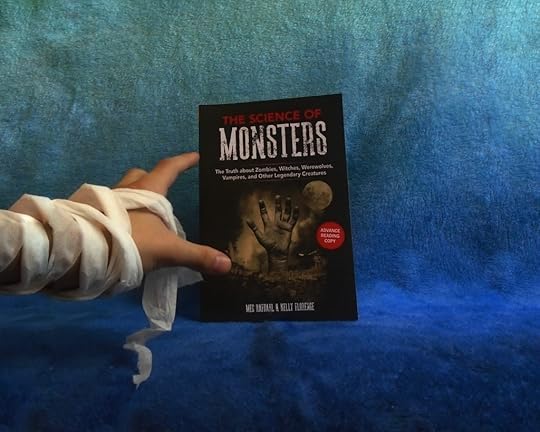
A must-have for any fan of dark and spooky cinema.
Gothic media moguls Meg Hafdahl and Kelly Florence, the women behind the Horror Rewind podcast called “the best horror film podcast out there” by Film Daddy, are revisiting horror films from their childhood to discover the science behind the mask. Join Kelly and Meg as they unravel the medical mysteries and scientific marvels that inspired the creation of famous monsters like Nosferatu, Norman Bates, and many more.
In The Science of Monsters, Meg and Kelly discover the real science behind our greatest fears. In interviews with experts at the top of their field, they seek answers to questions like:
How would a zombie really decompose in Night of the Living Dead?
Are there instances of shape shifting in nature like in The Wolfman?
What is the science behind the night terrors that inspired the creation of Freddy Krueger?
Is there scientific data supporting ghost detection like the tools used in Poltergeist?
What is the psychological drive that compels cannibals like Hannibal Lecter?
And so much more!
An approachable and frightfully fun examination of what goes bump in the night, The Science of Monsters will thrill every horror fan.
Many thanks to Skyhorse for sending me a copy in exchange for an honest review
I absolutely love horror movies and the monsters that are in them. At the same time, I have a very logical, science-craving brain so whenever I watch a horror movie, there's always a little part of me thinking wait, how does that work? or well, that couldn't be possible.
If you're like me (or even if you aren't), this is definitely the book for you. The authors take some of history's most famous monsters and break them down, revealing how every little thing could and should work.
And it was truly fascinating. I sped through this book because it just snagged my attention and kept it tied down for hours.
Overall, I highly recommend this book for horror movie or horror novel lovers!!
---------------
Creative, funny and super interesting! Review to come!
This books take most well known horror movies and gives an interesting but brief text about the movies and "monsters" in them. It was a little to brief for me as I would have liked to spend some more time reading about the movies that I liked but I could probebly do that on a Google search. But think the book did what it set out to do and did it well.
A book that reads like Cliffnotes wrote a textbook about a textbook.
Found myself frustrated that the authors covered certain ideas in ways that had me wanting more -- or disappointed in their approach. The interview sections was a neat idea, but it often included bits that were irrelevant to topics being discussed. I also found the lack of behind-the-scenes on movies disappointing, though this was not advertised "on the tin" so I can't hold it against the book.
Was it poorly written? No. Did it cover what it said it would? Yes. Was it enough or as in-depth as I would have liked? No.
I didn't like how quippy the book tended to be, ending every topic with a pun or joke about the subject matter got old rather quickly.
It was a very good book and very informative. Unfortunately some of the science was much more elementary than I anticipated. But still a very good read.
Monsters, especially movie monsters, and science don’t seem like peas in a pod – one being fictitious and favoring the outlandish and the other insisting on firm roots in reality. Still, the supernatural creatures that enter folklore or mythology (and many movie monsters derive from these sources – whether loosely or closely) often arise because of some real world phenomena, e.g. genetic conditions that cause one to grow hair everywhere or – conversely – that make one pasty complected and sun-avoiding. It’s these kernels of truth as well as the limits of what is possible that form the core of this book. It considers a wide range of “monsters” from psychopathic humans to mythical monsters to ghosts to aliens to mysterious creatures of unknown origins.
The two focal points of a book like this (e.g. monsters and science) are seldom equal. A popular class of nonfiction books has arisen that exists to convey scientific ideas by exploiting pop culture for examples. This isn’t that kind of book. I don’t say that as a criticism. There is room for both types of books. But in this one, the science is secondary to giving readers interested in movie monsters some context and background. This stress can be seen in the book’s organization (i.e. each of its chapters features a different horror [or horror-adjacent] film and its monster) as well the authors’ expertise (while they consulted scientists, the authors are more knowledgeable about horror movies.) Also, the focus is tighter on the type of monster under examination, and the discussion of science roams through different scientific disciplines (including social sciences and even humanities – and, in one instance, pseudoscience) as it discusses what Hafdahl and Florence are interested in, which is any real word bases for the plausibility of these monsters.
Again, the last paragraph isn’t so much a criticism as a statement of what kind of book this is -- and isn’t. (Needless to say by this point, it’s also not a book about the science and technology of making credible monsters for movies [e.g. CGI or the anatomy of a credible kaiju,] which is another worthy topic of discussion for another book.) The fact that the book is inclusive of discussions beyond biology and physics and which range into the social sciences and other disciplines offers the reader interesting insights. The exploration of what makes an entity terrifying was fascinating to me, and there is a significant art, science, and psychology to that subject, itself.
I will say that there was at least one time when I couldn’t really grasp how the science under discussion was relevant to the topic (i.e. monster) under discussion. It seemed as though the authors had succumbed to a common ailment of writing – that is, the inability to pitch material that is good, hard worked for, but ultimately irrelevant.
All in all, I enjoyed this book. I learned about how the monsters of the silver screen relate to happenings in the real world. There were several references to how quirky little news stories influenced screenwriters and directors to come up with some of the iconic horror and dark sci-fi movies. If you are interested in the origins of monsters, I’d recommend you check this book out.
I really wanted to like this book. Unfortunately, most of the information in each chapter came off as either a movie review or an opinions blog. There wasn't really much science that went into the book, and I'm honestly just disappointed. Only about 3 chapters had a satisfactory amount of real scientific review put into them regarding the various monsters/creatures of interest. Neither of the authors have a scientific background aside from one of them being married to a doctor. I do not say this to demean them, but they should either put forth way more effort into researching scientific papers before titling a book "The Science of..." or just stick to writing about horror.
An extremely dry read. It felt like I was reading an essay from middle school writers who think it's "edgy" to like the horror genre so they wrote a book about it. The title gives a very incorrect notion on what this book actually about and barely touches the surface of the science of villains. It's literally brief descriptions of the movies with "fun facts". I couldn't keep reading when they repeatedly kept referring to The Texas Chain Saw Massacre as The Texas Chainsaw Massacre. True horror fans know the correct spelling.
Definitely an interesting read but I feel like some of the science covered was too loosely tied to the movies they were talking about and very similar movies were used to explain different topics which tended to pad the length of the book. Also, why did it seem like all the interviews with experts were conducted without the authors present? There were very few instances of the experts engaging with the authors and their exclamations and banter. Just very strange and stilted.
An interesting and well written book, really informative and entertaining. I look forward to reading other works by this author. Recommended! Many thanks to the publisher for this ARC, all opinions are mine.
I saw this book in a bookstore, and leafing through a few pages, I thought it looked like a pretty good concept. What makes us afraid, why these fears, why do certain things persist as scary across generations as centuries and even millennia? What does investigation of these phenomena show us about ourselves and our world?
The concept is pretty strong but the execution is not. This book reads like a series of term papers written by college sophomores who began each paper without a clearly defined topic. The wander away from what the movie under discussion places before us, usually within a paragraph.
The author’s review of the Stanley Kubrick masterpiece The Shining, for instance, is in a section of the book about ghosts. But the chapter doesn’t have much at all to say about the ghosts or why the haunting imagery is so frightening, or the specific ghost styles or tropes of the film. There’s nothing here about why we are afraid of ghosts generally, or what made their portrayal in the movie so very unsettling and effective. Instead, the focus on cabin fever and the question of whether that has ever actually produced an act of violence. That’s a legitimate topic to discuss with respect to the film, but is it really a Monster, as one would expect given the title of the book? And in a section on ghosts, shouldn’t they discuss the ghosts?
I found myself experiencing this very confusion again and again. Had I been grading term papers, I’d probably give the authors a C+, because technically they are proficient and communicate with moderate success. I was very grateful that they managed to avoid injections of politics or other irrelevant material into their book. All the same, they simply don’t seem to be able to stay focused on the topic that they promise to cover. Given that one of the two authors is a college instructor of communication, I found myself bewildered by their lack of success.
It’s a pretty good idea, but they really didn’t pull it off very well.
The Science of Monsters: the truth behind zombies, witches, werewolves, vampires and other legendary creatures by Meg Hafdahl and Kelly Florence5
Being a horror fan since 6-years-old, I must say that this book is the book that I would have devoured at that age. The Science of Monsters satisfies the curiosity innate of the horror genre. It answers the ‘whys?’, the ‘how comes?’ and ‘reallys?’. This book takes three movies emblematic of each sub-genre and delves into these questions in a relatable, personal and yet academic way.
There is no doubt that Hafdahl and Florence, the authors, are fans of the genre. Their approach and their tone were reverential. There is also no doubt that these authors are thinkers and academics. Each section and each movie chosen is explored from a position of curiosity and awe. Their narrative is conversational and relatable. Although the book’s thesis is to demystify and analyze the genre’s probabilities through scientific explanations, it is presented with a genuine respect for the genre and its filmmakers as opposed to a desire to discredit or invalidate the creative process of these filmmakers.
The first movie of the genre to scare me genuinely was called Hell Night, I was 9 years old, and it was my first experience with the slasher sub-genre. To this day, that sub-genre is my favourite and I was excited that it was up first. Using Halloween, Child’s Play, and Nightmare on Elm Street as the three films, Hafdahl and Florence explored the inspiration of each director by looking at the probabilities of specific plot devices used. The ‘child killer’ and the ‘survival possibilities’ were explored with Halloween. The use of dolls in the genre and the inherent duality they occupy in our minds, as benign and evil, as well as mechanics of investigating a crime committed by a doll was examined through Child’s Play.
I especially enjoyed the interview with a former detective as to how he would go about identifying a doll as the culprit. Night terrors and sleep paralysis were scrutinized using Nightmare on Elm Street. I must commend the inclusion of cultural references in this conversation, as they undoubtedly influence the creators of the genre while also speaking to the audience’s consumption and interpretation of the subject matter.
The second section, Serial Killers, was explored through the movies Psycho, Texas Chainsaw Massacre and The Silence of the Lambs. I must admit that I always associated serial killers with slashers and thought them interchangeable. Regardless, this section introduced me to a couple of people that escaped my years of true crime consumption… Ed Gein and Dr. Alfredo Balli Trevino. I knew that Texas Chainsaw was loosely based on reality as was the infamous Dr. Hannibal Lecter, but these names eluded me. I was fascinated by the similarities and how each film pulled inspiration from these people. I still think both sub-genres are interchangeable, but I can now appreciate their differences.
Hafdahl and Florence also explored vampires, ghosts, witches, reanimated corpses, the possessed, deadly animals and creatures, as the subtitle of the book indicated. By touching on each sub-genre, Hafdahl and Florence ensured that this book would appeal to every long-term fan and novitiate of the genre. Like the consumers of the genre, each reader will gravitate towards a favourite section. That said, each section is rife with ideations linked to various plot devices within each film explored.
These authors did not shy away from anything! Topics ranged from the obvious: taxidermy, phobias, the black-market body part industry, parasites, hypnosis, and subliminal messaging to the not too obvious: cultural references to burial practices, anthropomorphism, female motivations, folklore, mythology, and animal behaviour. The authors also provided very practical advice for navigating the forest or woods should one get lost… who woulda thought??
I appreciated the inclusion of interviews with a variety of experts as well as the visual aids. I must commend the authors for the amount of research that was so very eloquently and succinctly presented and analyzed in the crafting of this book. The links made within and outside the genre through various decades, sources and across areas of study were mind blowing! What an accomplishment!
The Science of Monsters is equally academic and colloquial, which is no easy feat. From the introduction, I felt a kinship with Hafdahl and Florence. Their love of the genre is palpable. Their thirst to satisfy their curiosity about the connection between the genre’s inner-workings and science, or by extension, reality, is valid and understandable. With each film, a question is raised and answered, thereby leading to another question. The book’s pacing made it easy to digest and enjoyable to savour. Each layer was as delectable as the one that came before.
The cultural links of young South Asian men to sleep death, the ties to true crime, the mechanics behind the spiders of Arachnophobia, each reveal or hypothesis demanded and garnered an applause. I will admit that there were a couple inclusions of interviews that I questioned. I thought them to be distantly, extremely distantly, related to the subject matter but I could understand the deviation that led to the line of questioning, and I did learn something… kinda. That said, this book was quite simply fascinating!
I wondered if by attempting to pull back the curtain on these wizards of horror, the authors would de-fang the genre leaving it toothless and void of any mystique. On the contrary, the questions raised and answered in this book, if anything, enhanced the genre’s fear factor.
Hafdahl and Florence are horror nerds and I completely identified with them. This book was a conversation full of respect and admiration between family, the horror family. Whether you were born, adopted, fostered, or married into it, once you sit through a meal / movie with us, you become a member of the family. The Science of Monsters is the perfect welcome mat and should grace every horror fan’s house! Do come in and pull up a chair…
Pros: Personable and interesting narrative Well researched and presented, easy read Inclusion of interviews and visual aids provided the academic elevation to the subject matter Inclusion of endnotes and index to facilitate further reading and research References to other films in the sub-genre
I really wanted to love this book, but by the 10th page, I had found 3 typos or bits of misinformation and just didn't feel like I could rely on it to be correct. They say "intended upon" instead of either "intended to" or "intent upon," quote a law enforcement professional as saying "shed some potential height of the subject" instead of "potential light on the height of the subject," and they say that Charles Manson was a serial killer and a cult leader when he was never a serial killer at all.
I'm still going to read the rest of it; I just can't help myself. But I feel like I will have to fact-check anything I don't already know myself.... and I guess that kind of defeats the purpose. Cool idea, but the editor just really fell flat on their face in checking this one over.
Both really educational and entertaining! I enjoyed reading this one! I know horror fans will surely love reading this book.
I love how the authors really took the time to analyze every movie and every creature or character featured in it. Sometimes I feel like they did not explain the movie enough, and just went straight ahead explaining the science behind them. But other than that, everything was good. I definitely learned a lot of things in this book—about science, about movies, about horror.
The tone of this book is fine, you just kind of have to change your expectations once you dive into it because it reads more like what an episode of a their podcast must sound like. I appreciated the information about the movies listed at the top of each chapter. I do feel, however, that the subtitle "the truth about -insert thing here-" is incredibly misleading. Half the time, no actual science is talked about, or it doesn't actually have to do with the -insert thing here- the chapter is supposed to be about.
I wanted to like this book because it has a fantastic concept and some of the experts the authors speak to are genuinely interesting. But the lazy approach and incredibly poor writing drag it down. This book honestly reads like a high school essay that was left until the night before it was due.
The basic set-up is that each chapter is themed around a different movie, with the authors exploring related science and historical context, sometimes with expert interviews. I think it's a genuinely great idea, but so many of the chapters are lazy and so many of the scientific and historical connections they draw are tenuous at best.
For the Jaws chapter, for example, you'd think perhaps they'd speak to a marine biologist. Nope, I guess they couldn't find one in the two days they spent writing this book. Instead, it starts with a quote from a comedian about how the movie is great, moves on to a page about how the low budget made the film scary (true, but probably the most well-known piece of trivia about Jaws) and then a page listing random "scary" sea creatures (mostly because they have weird names; none of them are dangerous) and then concludes that it's no wonder people are afraid are sharks.
In the Carrie chapter, they decide that Carrie is a witch (I guess?) and that in a completely unrelated movie, witches have laser eyes so they should speak to a physicist who works on lasers.
Some of the experts are genuinely interesting people, but not only are some of them barely connected at best, some of them are downright pathetic. One "expert" is asked two questions and answers both with "I don't know." Not only that, she goes on to say that "well, this is how this is done in the movies so that's probably how it's done in real life" (movies! Famously a perfectly accurate reflection of real life!). The interviewers have to jump in to provide actual information. And yet they included this drivel in the final manuscript.
This book is so bad it's embarrassing and all I've learned is that I am never listening to their podcast. AVOID.
This book is one you read for fun, not for science. The authors have a podcast about horror (Horror Rewind) and are horror fans. The science involved is really just a series of questions about various aspects of the thirty horror films they feature. They don’t try to prove that there really are vampires or werewolves.
As the reader of many academic books, you get used to a lot of footnotes and backing up statements. Of course, popular (trade) publishing allows you to cut corners in that regard. This is not a heavily footnoted book and some of the information is suspect, but the discussion of horror films in enjoyable.
That’s not to say I didn’t learn a thing or two from reading this. I found out that it was only after 1916 that it was discovered that shark attacks could be fatal (the chapter on Jaws). And I learned about some movies that I probably should see. As I noted in my blog post (Sects and Violence in the Ancient World), I wouldn’t turn to this book for science, but it is a great source to get you thinking, “what if?” I do wish it had a filmography apart from the index.
Audio specific: The narrator of this book was pretty good. I would have preferred they used a second narrator to do the interview portions instead of the narrator just reading off who is talking. Other than that the audio was fine.
This was an interesting take on what’s beneath monsters, fears and other elements of horror film.
Each chapter identifies a significant film (historical, innovative, socially relevant, etc.) and then connects it to a real world science question. It looks at whether certain aspects of movies are possible, what is the closest naturally known occurrence or inspirations for the aspects of horror movies that scare or intrigue us. To discuss the question they interview an “expert” to discuss it.
It’s a quick read and it’s interesting and informative. My only complaint is that there are some questions that seemed tangentially connected at best. It seemed like they wanted to discuss the film and tried to find a grounded question to ask. Also the expert level widely varied. We had everything from elementary school teachers to secure lab facility researchers.
An absolute must own for any horror fan with a hunger for the "why" of things, Science of Monsters takes a peek behind the biggest movies we love and asks "would this really work? Does this really happen?" I learned so much! Even some things about some movies I thought I knew everything about! I'll definitely be returning to this one again and again and regaling my friends with all sorts of brand new fairly useless information (except maybe during a zombie apocalypse). If you love the classics or have ever wondered what it takes to make the horrors we see in them come to life out in the real world, I highly recommend picking this one up. The love for the genre shines through.
I can only really recommend it for fans of horror movies that want a light and easy read. The book provides a summary of every classic horror movie while linking elements of the movies to real life. Where the book disappoints is in the detail offered. It only covers each topic at a basic level and doesn't offer much more than you would find in a standard blog article. I would love to rate it higher because I'm a fan of the content and you can tell the authors are passionate about the subject matter, but it just doesn't provide enough depth to be elevate it above the kind of articles you would find on pop culture websites.
I enjoyed this examination of the science behind some favorite horror movies. That being said, a lot of this had absolutely nothing to do with the movies they mention, but more about the behind the scenes of the stories. An example would be what serial killers inspired Psycho and The Texas Chain Saw Massacre. The authors seem to assume that the reader knows nothing about witches or vampires either, but I’m pretty sure that if you’re a horror fan, you already have a clue. Still, it’s worth a look.
This book wasn’t quite what I expected and it made things disappointing for me. Talking about the science behind the various monsters and villains of horror movies is a great concept! But in each chapter, the authors would very briefly talk about the movie they were focusing on and then start moving completely away from it. What I mean is, it was like they got distracted by a topic they thought was interesting and they tried to loosely connect it to the chapter subject. It made it hard to stay interested and I ended up skimming quite a few chapters.
These series are so educational and entertaining! I enjoyed reading this one! I know horror fans will surely love reading this book.
I love how the authors really took the time to analyze every movie and every creature or character featured in it. They really deconstruct it that I wished this book was bigger, haha. Would recommended not only to horror fans but any cinephile that is always curious about the “why”.
I picked up this book on a whim while on vacation, and I'm very happy I did. I learned new things about certain movies I love, and how it is possible for most of them to have aspects in the real world and histories to show where some ideas came from. I would recommend this book to people who like horror, science, or are just plain curious about the macabre.
Spoiler alert: very little science here. It is a nice collection of "creatures" from horror movies, more like a quick overview of 31 horror movies. It is nothing like Kakalios' "The Pyhsics of Superheroes" or Adler's "Wizards, Aliens, and Starships". I gave it 2 stars because it is kind of entertaining and I am a fan of horror movies.