Jump to ratings and reviews
Rate this book

Waveland

Rate this book
In the aftermath of Hurricane Katrina on Mississippi's Gulf Coast, mostly retired architect Vaughn Williams, who is beset by the routine but no less troubling difficulties of late midlife, is doing what he can to remain, as he says, “viable.” He scans the channels, reads newspapers and blogs online, Googles practically everything, teaches an occasional class at the local junior college, and worries perhaps overmuch about his late father.

When his ex-wife, Gail, is assaulted by her hot-tempered new boyfriend, she asks him and his landlady/girlfriend, Greta, to move in with her. Perhaps a little too cavalierly, they agree, and complications distinctly Barthelme-esque follow, including manly confrontations with the perp, lamentations of his father’s life and death, casual moonlight drives, gambling for money, adults playing with trains, and the eventual untimely arrival of Vaughn’s annoyingly successful younger brother, followed closely by Vaughn’s ex-wife’s invitation to remarry.

The tattered landscape of the post-hurricane Gulf Coast is the perfect analogue for these catastrophically out-of-order lives, and in this setting the players work into and out of almost all their troubles. In the process, and en route to a satisfying set of resolutions, Barthelme’s acute eye and subtle wit uncover and autopsy an inner landscape of mortality, love, regret, and redemption. The result is his most emotionally resonant work of fiction yet—and a new reason to celebrate him as an American master.

229 pages, Hardcover

First published January 1, 2009

26 people are currently reading
262 people want to read

About the author

Frederick Barthelme

56 books82 followers
Barthelme's works are known for their focus on the landscape of the New South. Along with his reputation as a minimalist, together with writers Raymond Carver, Ann Beattie, Amy Hempel, and Mary Robison, Barthelme's work has also been described by terms such as "dirty realism" and "K-mart realism."He published his first short story in The New Yorker,and has claimed that a rotisserie chicken helped him understand that he needed to write about ordinary people.He has moved away from the postmodern stylings of his older brother, Donald Barthelme, though his brother's influence can be seen in his earliest works, Rangoon and War and War.
Barthelme was thirty-three year editor and visionary of Mississippi Review, known for recognizing and publishing once new talents such as Larry Brown, Curtis Sittenfeld, and Amy Hempel early in their careers.

Ratings & Reviews

What do you think?
Rate this book

Friends & Following

Create a free account to discover what your friends think of this book!

Community Reviews

5 stars
56 (17%)
4 stars
88 (26%)
3 stars
106 (32%)
2 stars
58 (17%)
1 star
21 (6%)
Displaying 1 - 30 of 64 reviews
Profile Image for Perry.
634 reviews621 followers
November 8, 2017
An Epic Disaster

I so wanted to like this novel. I traveled from Mobile, AL to Waveland, MS with the guys from the rock group 3 Doors Down, and a few others associated with their charitable organization, The Better Life Foundation, one week after Hurricane Katrina's landfall, to deliver a new police car and fire truck to a town that had no police cars or fire trucks left. I did not expect the impact that trip would have on me, how life-altering it would be to see how a forty-feet high tidal surge/wave can completely destroy an entire town and every nerve center within (power, water, phone lines, etc.); to stand with goosebumps on what felt like sacred ground in the silent desolation of nothing at all standing straight except a flagless flagpole in front of a post office's muddied concrete foundation; and, then kneeling down and closing my eyes and swearing I could hear in the gulf breeze the echoing cries of the many who drowned in their homes around dawn on that last Monday morning of August 2005. I stood up with teardrops welling and walked back to the pickup truck transporting us around.


Unfortunately, I did not like this novel even though it has the requisite structure, development of characters, subtext and details, and contains passages of beautiful prose and near-perfect paintings of life along the northern Gulf of Mexico in the days after Katrina. Moreover, the protagonist's internal ponderings reminded me of some of William Faulkner's best work.

Yet, I trudged well over halfway through and I hadn't seen a redeeming quality in any of the 5 characters, and did not have the slightest spark of a connection with the protagonist. In fact, I found him pathetic . He's a loser part-time instructor of architecture at a local community college whose wish, I'm not kidding here, is to work as a gas station attendant so he won't have to worry about anything except pumping gas.

His girlfriend, who he likes because she looks "rode hard and put up wet," Larry's dream has her reveling in a beautiful memory she shares with him of sex she had with a guy she had just met in a stall at a gas station. This same girlfriend's husband died 5 years ago from a .22 bullet point blank in the head while he slept. She was accused but police found "insufficient evidence" that she killed him.

If you've ever read Faulkner's "Wild Palms," the Waveland dialogue is similar to Faulkner's in being seemingly incessant, annoying and incredible as that had by Faulkner's Harry (another loser) and Charlotte. It appeared though with Faulkner that he aimed at sharing with the reader with state of mind of Harry or Charlotte (as strange as that may have been). Here, you get from the girlfriend gems like "that's a double duh" and "let's get down to brass tacks."

I am all for descriptions to paint the picture, establish the mood, feel for the character through the details. But I ask, is it really needed, to show the extent of Loser's neglect of his father in his dying days, to harp on about the toilet traditions of an invalid elderly man:
"On this occasion, he managed to shit and on inspection saw that the shit was well-formed, well-covered and cleanly off him. Buoyed by his success, he wiped his bottom several times with the toilet paper flushing the toilet after each pass and then without getting off the toilet wet a washcloth and passed the wet cloth between his legs. It burned his skin but after a couple of attempts the cloth emerged unsoiled and he returned it to the sink under the running water."
After this, it was all I could do to continue... 10 more pages.
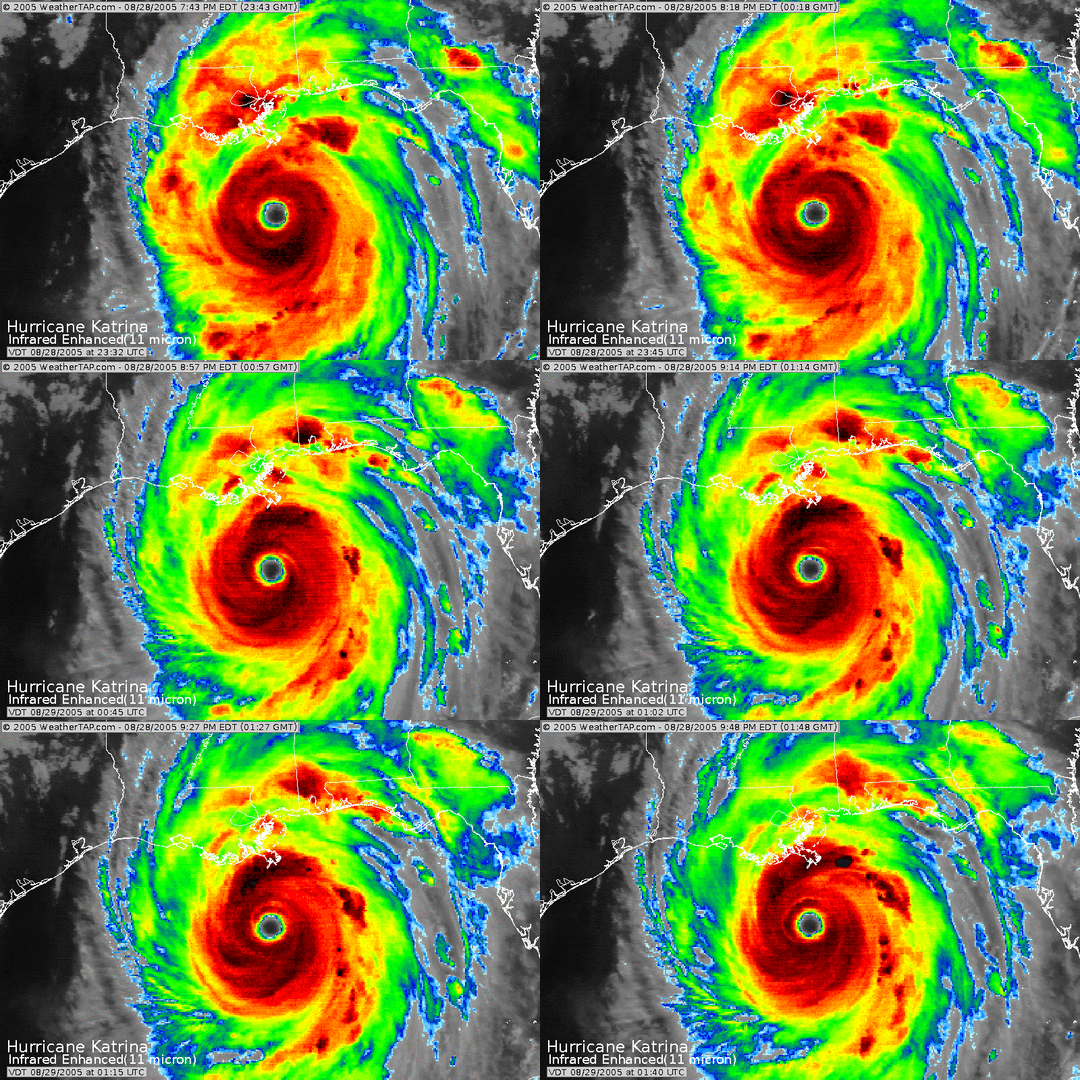

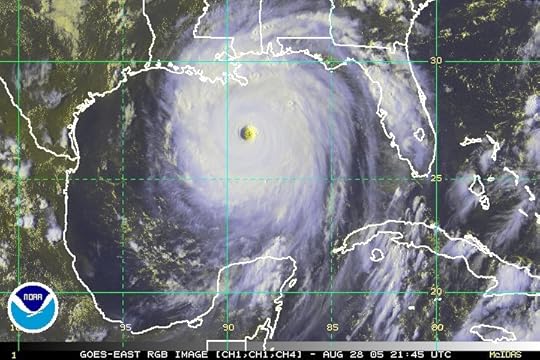
Nearing Twelve Years Since Hurricane Katrina's Landfall between New Orleans, LA and Waveland, MS, as dawn broke on August 29, 2005: The Costliest Natural Disaster in United States History


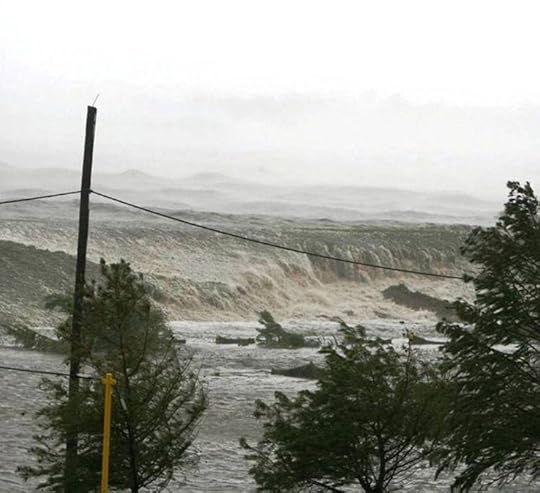
Waveland, MS, on eastern side of Katrina's eyewall at landfall, was flattened by giant tidal surges. Below is initial tidal wave, approximately 40 feet high, as it approached to destroy 99% of every structure for a stretch of nine miles along the MS Gulf Coast and well over one mile inland


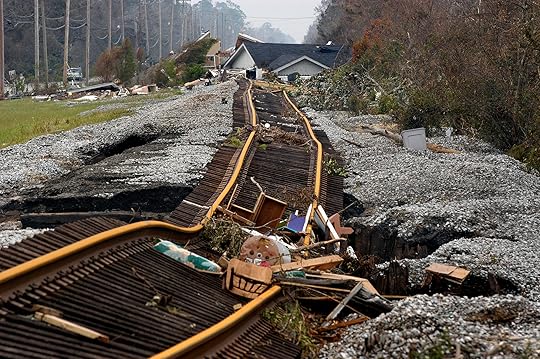
Railroad Line in Waveland, more than a Mile of an incline north of coastal waterline


Profile Image for Clif Hostetler.
1,285 reviews1,041 followers
March 17, 2017
The story's protagonist has a messed up life that matches the surrounding scenery of his neighborhood, the post-Katrina Mississippi Gulf coastal area. Many things in his life and community are damaged, both metaphorical and physical. First his wife asks for a divorce. Then a year later his ex-wife calls to report that she's been beaten-up by a boy friend, she's afraid, and asks Vaughn and his new live-in girl friend to move into her house until she feels better. What could go wrong?

The main message in the novel is not the resulting action and relationships. Rather, it's conveyed through flash backs and internal ruminations that explore the despair of past regrets, despair of growing old, and pondering of the apparent pointlessness of life. All the characters in the book are profoundly common but uniquely weird in their own individual ways.

The following soliloquy caught my attention. It could pass for free verse poetry.
When you live with a woman for a long time, after a while you make a lot of excuses for what you don't feel. But unless you're a fool you don't believe the woman is at fault. It's that the world changes beneath your feet. Things go slow at first and the changes are so small that it's almost imperceptible and you pay it no mind. And then later, years later, the change seems huge, and it seems to have occurred overnight. Suddenly you aren't the person you were. And then where once you thought not wanting what you used to want was punishment, suddenly you think it may be a blessing, and things stand still.

You watch the moon reflected on the swarming Gulf water, and you think that's enough, that's all I want. I just want to sit on this broken down deck on this night in this cool weather with this breeze blowing over me and watch this moon lift into the sky, remarkably oval, remarkably pearly, remarkably aloft. And you want to think this in just these words, and you know the words aren't right. They aren't even close, and that doesn't matter. The deal is that it's just the moon in the sky reflected on the Gulf, the water hissing and receding. And you're in the middle of it, and you're just a small part, an unimportant part, but a part nonetheless. Your job is to be something so the moon can hit something when it shines at the earth. You are something to hit. And that's the way it is for the rest of the world too. What people say and what they think, who they are, what they think about you, what they ask of you. What you want, what you give them does not matter. It's that way for everything. ... .... ..... You're something to hit, you're a receiver, you're an antenna.

These ponderings can serve as a summary reflection on the overall mood of the book. They provide a feeling of acceptance and resolution for the confusion contained in the preceding story.

The overall feeling of the book for me was depressing. There are plenty of things in the book to not like. But that may make it a good book selection for a book group discussion. I've observed that group discussions generally go better when there are plenty of things in the book about which to complain.
Profile Image for W.T..
Author 12 books8 followers
April 13, 2009
As I finished Waveland this afternoon I just felt this resolute understanding of what a great piece of art it is, and what sort of amazing life the artist had in order to get to those words and that story.

I have always loved Barthelme's work, always felt amazed at the miraculous things he did with language. But Waveland just blows all of those modest ideas away and replaced them with something that I'd say was respect if respect wasn't such a small word.

There isn't another soul on the planet who could have written it. I could point out one of dozens of set scenes that are mind blowingly gorgeous, or pick out the dozen one-liners that are so deft and searing that they almost seem to have come from outer space. "Slang was used. Doughnuts flew." That's my favorite.

But noting the good items in the book doesn't come close to what I want to say, which is the book is nearly perfect, and like all good art, it just makes me want to do better things, live better, act better, write better. It has shaken me and stirred me all at the same time.

Reading it humbled me.
Profile Image for Bill.
626 reviews16 followers
April 18, 2012
This book could be used as an example of what's wrong with modern fiction. First and foremost, the pacing was horrendous. It starts off slow, slows down even more, and then wraps up with a final 20 pages of breakneck resolution that doesn't even make much sense. You know that part at the end of "Animal House" where they tell you how the characters ended up? That's what the final pages of this book remind me of, and the endings make about as much sense, to be honest.

Second, the dialogue made me want to scream. Said, said, said, said, said said said saidsaidsaidsaid... AAARRGH!!!! All of the characters start to sound alike after a while as well. The author tries to handwave this away by saying that the main characters are picking up each other's mannerisms, but it's a lame excuse. If I wanted to read dialogue where all the characters sounded the same, I'd pick up a Douglas Coupland novel.

Third, the narration is so irregular it would make your head spin. Mostly third person omniscient, occasionally it seems to slip into the characters' internal dialogues, but sometimes it spirals off into nonsensical second person garbage that makes "Bright Lights, Big City" sound like Shakespeare.

Fourth, anticlimax is a cop out when so little actually happens in a book.

And finally -- dear God, the brand name dropping. HGTV, iPod, even specific cookie types and brands. And the television. The characters watch so much television, then talk about it, then talk to each other while watching television... yes, it happens in real life. No, it does not make for good reading.

Books like this make me hate reading. I think I need to do Sudoku puzzles on the way to work instead. They have more of a plot than this infuriating piece of tripe.
Profile Image for Mary.
Author 14 books420 followers
June 29, 2013
So much brilliance here.

Here is just one of my many, many favorite passages:
Sometimes, when you are putting your arms around this new woman it seems as if you are remembering your role, your lines, as if your *ability* to put your arms around someone is somehow reduced. Sometimes, when you touch the skin of her face, it only reminds you of having touched the cheek of a person you were once crazy about. You smell her hair. You shut your eyes, smelling her hair. You hold her close, her back to you, smelling her hair. Your eyes closed, your hands on her forearms, on the backs of her hands. You feel her weight against you, and you remember when you felt the weight of someone you were desperate about. In short, you mimic yourself, and you wonder, Does she know?
Profile Image for Riley.
161 reviews36 followers
July 9, 2021
There's some great writing in here, and if you like Barthelme, you'll get enough out of it to finish it. However, the off-kilter menace that gives tension to much of his other work is absent, here. Every threat turns out to be toothless, every confrontation too easy.
Profile Image for John Pappas.
411 reviews34 followers
July 27, 2011
Set in post-Katrina Mississippi, Fred Barthelme's new novel is one of reconstruction, but surprisingly, Katrina is just a backdrop to the story of a mediocre retired architect who has given up on actively pursuing joy in life, and, after a fallow, static period, realizes that the family you piece together from the friends who love you is more important than the family you are born into. In a gorgeous Zen-like (and totally not cliche) way, he learns to appreciate the beautiful mundane. Barthelme's dialogue is sparkling and realistic and his pacing is wonderful, spare but totally engaging, almost Japanese in style (think Banana Yamamoto and others...). A fantastic new novel.
Profile Image for Corey.
Author 85 books282 followers
May 29, 2009
Barthelme is brilliant. He's witty and he gets all the little things right. Waveland is funny and warm and smart and crackles with brilliant dialogue. It may be remembered decades from now as THE post-Katrina book.
Profile Image for Wes.
72 reviews35 followers
February 11, 2013
One of the most unexpected reading pleasures I've known. Simple structure and sentiment that, for me, truly belies its enormous impact.
Profile Image for Ginger.
63 reviews9 followers
October 22, 2010
A Mississippian wrote Waveland, and being from Mississippi I could tell you that without reading the dust jacket. It's set on the gulf coast after Hurricane Katrina blew through and flattened everything, and the characters have similarly all had their lives flattened at one point or another. Just like the coast, they are actively trying to recover with the things you fill up your days with after something is gone...cable television, alcohol, home improvement, trying to be a better person than you really believe you are. These are the lives that people actually live in the rural south; staying at home watching cable because it's too hot, getting your dinner from the chinese restaurant that opened in the gas station, driving down the highway by the casinos at night because it's the only place that looks open in town. The main character Vaughn is a 40ish, mostly noble but pretty boring guy with the usual story...split with his wife a few years back, career treading water, shacking up with a new girlfriend and just getting by. There's a lot of time spent in the book describing the tv shows he's watching, or the restaurants he doesn't like eating at. He spends afternoons thinking about why he can't get on with his family, or how he so suddenly got from being young to old. Says Vaughn, "... years later, the change seems so huge and it seems to have occurred overnight. Suddenly you aren't the person you were. And then, where once you thought not wanting what you used to want was punishment, suddenly you think it may be a blessing."
Ok, there's a certain feeling in the rural south that Barthelme nails. It's overtly friendly and hospitable, but there's a underlying sadness and thoughtfulness, accepting what you've got and what there is and trying to make your peace and happiness out of that. If you wanted to have the most fun or be the smartest person you would've left long ago, so the people who stayed are the ones who said, "This is good. I'm going to stop wanting something else and get on with living this life I have."
This is a book about those people, and it's not the most exciting book, but it is pretty damned accurate. The dialog is only a few stunted sentences now and then, but it's the real stuff, nicely understated. There is a plot of sorts but it's just a backdrop. Really the only movement in the book is the coming on of a feeling, the acceptance of life and teaching yourself how to enjoy it despite everything.
"He imagined what his life with Greta might be in the future- isolated, inconsequential, apart from the world and yet in the world in a new, more immediate way, full of sensory things, a sampler of ordinary pleasures. He imagined their daily life and endless succession of such pleasures, a river of tiny recognitions- the pleasures of toast, the pleasures of hot sunlight, of the dark scent of wet dogs, of summer nights, of the crush of sudden thunder, the warmth of winter socks, the surprise of skin indented by furniture. These weren't pleasures he had dreamed of, and it wasn't a life he had dreamed of, nor sought, nor even imagined for himself; but facing it, finally, he thought it was a life for which he was now well prepared."
Profile Image for Nick Grammos.
278 reviews161 followers
July 8, 2022
Upgraded to 4 stars after some contemplation.

All the elements of a Barthelme novel are there, the trashy cultural motifs, the struggle to survive, the pop culture, more pop culture and always relationships lost or new ones found. Here we’re in a post hurricane Katrina universe: the destroyed landscape, the constant references to casinos that laid bare and impoverished well before it hit. Only Waveland felt a little tired, that the author peaked some time ago.

I still love Barthelme, even though this one got weaker than the last. No one sees the world quite like him, describes actions quite so deftly and precisely. I do love his exploration of muddle-headed thought processes: 


The were family and that meant something-or it might mean something, or in some cases under the right circumstances, if push came to shove, and with a little luck- well, theoretically, that mattered.


Let's face it, how many of us are truly clearer about anything than that. Doubt and confusion, are permanent states of being for Barthelme characters. Clarity is frightening, as is the domination of uptight values. People just want to do their best, struggle is perennial.

Every encounter with the landscape is a reminder that eighteen months later, nothing has improved, nothing was fixed. But somehow that means nothing much has changed much either - 'only browner' Vaughn says as his brother Newton arrives in town.

There's always that matter-of-factness in a Barthelme work. Characters only really get by, even in crisis whether personal or financial. So everything is about quotidian survival. But there’s some literary jackpots among all the coins slipped into the slot machine. The old lady in the burger place talks endlessly as Vaughn waits for his burger about her hamster named Teeny Weeny, while her husband is incapacitated at home all day, everything is positive for her, everything like that hamster, except when he gets trapped, the hamster doesn't like being trapped.

There are some poignant observations about poverty and wealth. Gail, Vaughn's recently divorced wife has family wealth, she is whimsical. So she got sick of Vaughn, and got rid of him. Then she wants him back, then she calls his brother, Newton, a successful dotcommer with nothing to do these days so they move to the north west together. Such episodes of privilege slip easily into the prose while everyone else struggles.

The prose is at times beautiful. There are some great moments; and sometimes tired prose. When written in the present, the prose is excellent, when introducing backstory, it sometimes struggled. 

Waveland marks a crisis point in American life – like Hurricane Katrina – when writers go for newsworthy contemporary events, you know they’re showing a little wear and tear themselves.
Profile Image for Nick.
Author 15 books14 followers
April 20, 2010
A rereading a few years back of some books by Theodore Dreiser and Edith Wharton sent me on an continual search for realism in novels. Reading all the novels of Richard Yates fueled this interest even further. Going through the outside stacks recently at the Strand I came across a book by Frederick Barthelme. Confusing him with his brother Donald, I bought the book, knowing I never much cared for the work, but I should give it another try. Although Frederick's Painted Desert was a slow starter, I found it hypnotically satisfying in some strange way, and went back looking for more. The earlier novel Tracer was hard going, but then I found Waveland in the library. Published in 2009, the book is every bit as fascinating, so far after about 85 pages as Yates' Revolutionary Road.
1,186 reviews26 followers
April 6, 2022
3.5 stars. Dysfunction and ennui are prevalent in this noir ish work.
The characters are has beens, never wases, coulda beens and a stuffed shirt to round things out.
They seem to be stuck in prolonged young adulthood which includes drinking too much and staying up til sunrise. Yet there is a certain sweetness to the characters and the fact that they care about and help each other that makes them bearable to spend time with. They are all searching for connections in one way or another.
This is an easy quick read. It would be great for a beach or plane ride.

Profile Image for Robin.
Author 9 books75 followers
July 1, 2009
This book is like a slow burn. I am still thinking about scenes a month after finishing it. Barthelme's prose is jaded and blissful. The story is basically a contemporary Southern love triangle, but it's as if the angles of the triangle are in motion, shifting the shape. This is a narrow, elegant story that has, at its core, a real acceptance of the failures of modern love.


Profile Image for Jeanie.
3,091 reviews1 follower
July 24, 2012
I have about 50 pages left and I am pretty sure my rating will not change. There is not a thing I like about this book. I will finish just to be sure that I can still say that and if not, stay tuned
Profile Image for Bill.
308 reviews300 followers
June 21, 2009
This is the first book I've read by Frederick Barthelme, but it definitely won't be the last.
Profile Image for Alexus Ray.
51 reviews1 follower
October 9, 2020
I really liked the contemporary style of the writing. Barthelme is very different from other Southern Lit writers that I have read like Elizabeth Spencer, William Faulkner, Eudora Welty, and so forth. He is much more concerned with how the town is doing post-Katrina. He isn't overly hifalutin in his language nor is he very descriptive. He is direct and gets on with the story. One could identify his writing as a minimalist writing because there is a lack of political posture of the time, not much history, the lack of big philosophical ideas, drabness of style, and commonplace descriptions of towns and people in general. Barthelme is a very sneaky writer. He isn't going to come out and say what he means when he writes something. He leaves it for his audience to figure out. I didn't even think Vaughn would experience any growth throughout the story, but he did. Towards the latter half of the novel, around page 197, Vaughn experiences some forward momentum where it shows his characterization. He is able to accept things in his life and move on.

Overall a great story and fun read.
Profile Image for Tim Jadick.
42 reviews1 follower
February 18, 2022
Vaughn. What a guy. This is the story of Vaughn, who is half-divorced, dating another woman who may or not be guilty of murder, all while sulking and loathing over his late-to-mid-life crisis. As irritating and pathetic as he was, I saw myself in him at times. Thus, I would not recommend this book to many people because I am an eccentric and self-proclaimed weirdo.
25 reviews
January 20, 2020
a little malaise-y for me in some parts but I'm always happy to read something that takes place near the hometown and I'm glad I read this
quick read
Profile Image for James.
595 reviews9 followers
May 25, 2021
Either you'll get this or you won't. It's a perfect imitation of a life lived, filled with asides and small moments that ring true. Begin with this or Bob the Gambler.
Profile Image for Stephanie.
234 reviews
July 16, 2012
This book was interesting, but not exciting, which I suppose is the point. Vaughn, the main character, is living in the post-Katrina south, where the passions of weather have come and gone and the surrounding area wanting to rebuild, but is finding it takes too much money and effort to do so. The scene perfectly reflects Vaughn's post-divorce existence. He wants to be passionate about something, but just can't muster it up in his boring, confusing life. Apart from the last page, where half a glimmer of hope for Vaughn being interested in life appears, there is just not much going on.

This quote pretty much sums up Vaughn's whole perspective of life: "Your job is to be there so the moon can hit something when it shines at the earth. You are something to hit. And that's the way it is for the rest of the world, too. What people sand and what they think, who they are, and what they think about you, what they ask of you, what they want, what you give them does not matter: It's that way for everything---the sounds of the night, the breeze on the back of your hand, on your knee, the shoe hanging off your foot, the pressure of the plastic chair against your elbow...you're something to hit. You're a receiver. You're an antenna."

This novel is a good meditation on Ecclesiastes-style hevel. Life, work, love, money: all is meaningless. I enjoyed the novel for that reason.
Profile Image for Jacqueline Masumian.
Author 2 books33 followers
June 17, 2015
This is the story of a middle-class, middle-aged man who is adrift following his divorce. Oh, my.

Taking place on the Mississippi coast a year after Katrina, Waveland centers around the character of Vaughn, a man who is like a piece of detritus caught in a shoreline wave. Lacking ambition and energy, full of regret about his relationship with his brother and his neglect of his elderly father, he flounders around till he meets and moves in with Greta, a feisty woman who is herself directionless. The two of them bob around like flotsam and jetsam on the ocean of mid-life, eating Fritos and M&M's and drinking beer. When Vaughn's ex-wife gets into trouble, Vaughn and Greta move in with her to keep her company. Really.

That's as much as I'll say about the plot (there's little else to say). I believe this book is meant for a male audience. Women may have a hard time relating to these aimless characters.

Though Barthelme's prose is excellent, and there is a good deal of humor in the book, his characters engender little reader sympathy until near the end. And the theme seems hackneyed. Yes, many of us are feeling unsettled as we approach old age . . . zzzz. Vaughn is a pathetic guy, or maybe he's supposed to be humorous. In any event, the book was not my cup of tea.
Profile Image for Amy.
518 reviews1 follower
December 12, 2012
Not terrible, but not really interesting either. This is the story of Vaughn, his lady friend, and his ex-wife. And their seemingly strange relationship. And hurricane Katrina??? Honestly, I don't understand the significance of post-Katrina to the story. I was listening to a Literary Disco podcast yesterday and they were discussing a book that was butted up against WW1 as the setting, though the story had nothing to do with WW1. The hosts felt the author was sort of cheating by using WW1 to set the emotional tone, rather than using narrative and writing skills to develop.

Don't worry, everything gets sorted out in the end.
Profile Image for Louie Verile JR..
120 reviews
May 11, 2009
I enjoyed this alot. I like reading about people going through the motions and it not always being some great big happy ending. this reminds me a little bit of some of the stories in Everything Ravaged without the dark cloud. Not everyones life is perfect and sometimes we just exist. Not to mention that the author, rather than let this plot turn into a free for all comedy, allowed us to read about the unomfortableness of the main characters and their situation.
Profile Image for Jay French.
2,163 reviews89 followers
August 29, 2009
This short book hit the spot. This is a story of a man dealing with his girlfriend and ex wife while rethinking the next steps in life. He takes action so as to chill. Interesting writing - I often ended up reading a couple of sentences, then rereading a chunk, then rereading a chunk a bit further down. Seems like every chunk of a couple of sentences brought satisfaction. I picked this based on the Esquire review. Thanks, Esquire.
Profile Image for Lauren Albert.
1,834 reviews192 followers
May 10, 2010
This book is about Teeny-Weeny the hamster. Well, not really. But Teeny-Weeny, a chatty restaurant cashier's hamster, symbolizes how life's best, most consistent pleasures are the small ones. "These weren't pleasures he had dreamed of, and it wasn't a life he had dreamed of, nor sought, nor even imagined for himself: but facing it, finally, he thought it was a life for which he was well prepared."
Profile Image for Rayroy.
213 reviews84 followers
December 31, 2011
Nothing match happens in this book that centers around a middle aged man, who still talks to his Ex-wife, even though he has a girlfriend. He watchs cable T.V. with an American solider suffering from PDS.The thing is he can't decide what to do, with his life. He's stuck but finds himself ultimatley content. Waveland is a study of man coming to many realizations about himself and the small sort of family that surrounds him. A lite read that in the end is anything but.
151 reviews2 followers
January 9, 2010
Yes, a writer who has mastered his craft in terms of setting and character development. His subtle wit was perhaps what I must enjoyed. The problem for me was that I didn't care about the characters, hence only three stars. However, I share Vaughn's astonishment in trying to reconcile the circumstances of his past life with that of his present circumstances.
Profile Image for Paddy.
364 reviews
January 24, 2010
The two women don't work for me, they seem more like men than women, and their dialogue is off. Thought of The Moviegoer a couple of times, Binx wheeling along the Gulf Coast. I love the region, appreciated Barthelme's depiction of the area around Waveland. Also appreciated some of the main protagonist Vaughn's musings about his search for meaning. But not like I loved Binx Bolling's searching.
Displaying 1 - 30 of 64 reviews

Can't find what you're looking for?

Get help and learn more about the design.