

What do you think?

Widen the Window: Training Your Brain and Body to Thrive During Stress and Recover from Trauma
"I don't think I've ever read a book that paints such a complex and accurate landscape of what it is like to live with the legacy of trauma as this book does, while offering a comprehensive approach to healing."--from the foreword by Bessel van der KolkA pioneering researcher gives us a new understanding of stress and trauma, as well as the tools to heal and thriveStress is our internal response to an experience that our brain perceives as threatening or challenging. Trauma is our response to an experience in which we feel powerless or lacking agency. Until now, researchers have treated these conditions as different, but they actually lie along a continuum. Dr. Elizabeth Stanley explains the significance of this continuum, how it affects our resilience in the face of challenge, and why an event that's stressful for one person can be traumatizing for another.This groundbreaking book examines the cultural norms that impede resilience in America, especially our collective tendency to disconnect stress from its potentially extreme consequences and override our need to recover. It explains the science of how to direct our attention to perform under stress and recover from trauma. With training, we can access agency, even in extreme-stress environments. In fact, any maladaptive behavior or response conditioned through stress or trauma can, with intentionality and understanding, be reconditioned and healed. The key is to use strategies that access not just the thinking brain but also the survival brain. By directing our attention in particular ways, we can widen the window within which our thinking brain and survival brain work together cooperatively. When we use awareness to regulate our biology this way, we can access our best, uniquely human our compassion, courage, curiosity, creativity, and connection with others. By building our resilience, we can train ourselves to make wise decisions and access choice--even during times of incredible stress, uncertainty, and change.With stories from men and women Dr. Stanley has trained in settings as varied as military bases, healthcare facilities, and Capitol Hill, as well as her own striking experiences with stress and trauma, she gives readers hands-on strategies they can use themselves, whether they want to perform under pressure or heal from traumatic experience, while at the same time pointing our understanding in a new direction.
496 pages, Kindle Edition
First published September 24, 2019
Ratings & Reviews
Friends & Following
Create a free account to discover what your friends think of this book!
Community Reviews
Displaying 1 - 30 of 116 reviews

October 20, 2021
For context, unlike Elizabeth Stanley I have a masters degree in counseling, and specialize in trauma recovery.
This book frustrates me because so much of it was truly gold standard, top tier explanations about the body’s stress response system with some really phenomenal skills to regulate our systems and decrease long term negative health consequences. The bulk of this book was helpful, informative, approachable, well researched, and empirically supported.
That acknowledged, Stanley also layers a lot of her own biases throughout that research in a way that has potentially deadly consequences for vulnerable readers. She frequently makes claims about “obesity”, an outdated term that came from the BMI which is largely considered an ineffective measurement of health, and despite going into detail about epigenetics still claims we have complete control over things like our weight. This is untrue and not factually supported. She makes a lot of dangerous claims regarding body size and weight loss, like her claims that using her approach can lead to weight loss, that is dangerous for people who struggle with eating disorders or harmful eating/exercising behaviors. Eating disorders are the single deadliest mental illness, and there is huge overlap between eating disorders and trauma. This is an oversight and frankly a gross form of bigotry that was hard to overlook.
She also frequently stresses the need for personal accountability (which I absolutely agree is part of unlearning learned helplessness) but the examples she uses “switch to a four day work week” “take days off work” “have one full day every week where you do nothing” neglect to consider the fact that for most Americans this advice is so out of touch and is completely inaccessible to them. Framing societal problems as failures of individual time management is very elitist, out of touch work that was disappointing to see layered throughout the book. She definitely goes into these structural problems, but doesn’t present real solutions for them and instead places the burden back on the individual.
Again, the tools in this book were great. But also, she basically is just reinventing DBT and calling it something new, while layering her own prejudices and biases into the material. Further, she consistently refers to her PhD but neglects to mention that it is not in anything related to counseling, trauma, or psychology. She is under qualified to write this book and it shows. She is more than capable of parroting other people in the field who have already done this work for decades, but other than adding her own problematic spin on it she does little else.
This book frustrates me because so much of it was truly gold standard, top tier explanations about the body’s stress response system with some really phenomenal skills to regulate our systems and decrease long term negative health consequences. The bulk of this book was helpful, informative, approachable, well researched, and empirically supported.
That acknowledged, Stanley also layers a lot of her own biases throughout that research in a way that has potentially deadly consequences for vulnerable readers. She frequently makes claims about “obesity”, an outdated term that came from the BMI which is largely considered an ineffective measurement of health, and despite going into detail about epigenetics still claims we have complete control over things like our weight. This is untrue and not factually supported. She makes a lot of dangerous claims regarding body size and weight loss, like her claims that using her approach can lead to weight loss, that is dangerous for people who struggle with eating disorders or harmful eating/exercising behaviors. Eating disorders are the single deadliest mental illness, and there is huge overlap between eating disorders and trauma. This is an oversight and frankly a gross form of bigotry that was hard to overlook.
She also frequently stresses the need for personal accountability (which I absolutely agree is part of unlearning learned helplessness) but the examples she uses “switch to a four day work week” “take days off work” “have one full day every week where you do nothing” neglect to consider the fact that for most Americans this advice is so out of touch and is completely inaccessible to them. Framing societal problems as failures of individual time management is very elitist, out of touch work that was disappointing to see layered throughout the book. She definitely goes into these structural problems, but doesn’t present real solutions for them and instead places the burden back on the individual.
Again, the tools in this book were great. But also, she basically is just reinventing DBT and calling it something new, while layering her own prejudices and biases into the material. Further, she consistently refers to her PhD but neglects to mention that it is not in anything related to counseling, trauma, or psychology. She is under qualified to write this book and it shows. She is more than capable of parroting other people in the field who have already done this work for decades, but other than adding her own problematic spin on it she does little else.

December 15, 2019
EXCELLENT book on stress and trauma.
Written by a military psychologist and trauma/stress resilience training researcher, Dr Elizabeth A. Stanley.
The book is field tested, sensible and designed to be useful and inoffensive to high achieving, hard driving, high functioning people.
It’s not about boo-hooing. It’s about managing your life and training your body and mind so that you can keep doing what needs to get done.
But here’s the deal.
You can’t just keep taking on stress.
It’s bad for you.
It’s bad for your body.
And it’s bad for the people around you.
It’s particularly bad if you have been exposed to stressful and/or traumatic shit in the past.
Trauma and stress make you more susceptible to trauma and stress. It’s a bad downward spiral to burnout our worse.
The NUMBER ONE best thing about the book is the way it removes the false distinction between unhealthy stress and trauma.
According to the author, all unhealthy stress and trauma deal in the same currency i.e. in the activation and accumulation of energy (stress hormones and nervous system readiness to take action in the form of fight, flight or freeze).
If you have a history of trauma, your brain and body’s emergency response may have a hair trigger. This leaves you more susceptible to stress activation and accumulation.
This stress/trauma activation and accumulation is referred to throughout the book as ‘alostatic load’. And carrying a heavy alostatic load is awful for your brain, body and life. Particularly over the protracted long term.
The book warns against ‘stuff it down and soldier on’ ways of dealing with stress.
The rule of thumb is, you can stuff your feelings down into the basement, but then they get together lift weights and eventually come upstairs and kick your ass.
So if you think about cops and soldiers and first responders, dealing with high stress work, probably many of them coming from messed up childhood situations, or previous trauma, you can see how they may be at elevated risk for some pretty nasty, and potentially EXPLOSIVE problems.
The book recommends a regimen of mental fitness training that helps us (a) identify when we’re carrying a heavy alostatic load, and (b) choose and use the appropriate ‘ground and regulate’ strategies for ‘discharging’ that energy in healthy and adaptive ways.
NOTE: although the book recommends mindfulness, the book does not tout it as a panacea.
In fact, this maybe the best book I have read addressing the contraindications of traditional mindfulness for stress and trauma.
In a nut shell: the author recommends sleep, exercise, healthy diet and supportive relationships to ground and regulate stress/trauma accumulation.
The author recommends using mindfulness in addition to all that basic stuff (as opposed to instead of).
Otherwise, mindfulness can become just another mechanism of blowing off your feelings and stuffing them down in the basement.
Same goes with cognitive therapy and positive psychology ‘thinking brain’ type interventions.
They can also become part of the emotional stuffing machine.
According to the author (and I completely agree) the first line of stress/trauma defense should always be, sleep, exercise, healthy diet, supportive relationships and time out of the meat grinder.
The cognitive and mindfulness based practices should only be utilized in the service of all that.
Anyway.
I fucking LOVE this book.
One of my favorites of 2019 for sure.
🦅👍😬🔥☠️🧠
Written by a military psychologist and trauma/stress resilience training researcher, Dr Elizabeth A. Stanley.
The book is field tested, sensible and designed to be useful and inoffensive to high achieving, hard driving, high functioning people.
It’s not about boo-hooing. It’s about managing your life and training your body and mind so that you can keep doing what needs to get done.
But here’s the deal.
You can’t just keep taking on stress.
It’s bad for you.
It’s bad for your body.
And it’s bad for the people around you.
It’s particularly bad if you have been exposed to stressful and/or traumatic shit in the past.
Trauma and stress make you more susceptible to trauma and stress. It’s a bad downward spiral to burnout our worse.
The NUMBER ONE best thing about the book is the way it removes the false distinction between unhealthy stress and trauma.
According to the author, all unhealthy stress and trauma deal in the same currency i.e. in the activation and accumulation of energy (stress hormones and nervous system readiness to take action in the form of fight, flight or freeze).
If you have a history of trauma, your brain and body’s emergency response may have a hair trigger. This leaves you more susceptible to stress activation and accumulation.
This stress/trauma activation and accumulation is referred to throughout the book as ‘alostatic load’. And carrying a heavy alostatic load is awful for your brain, body and life. Particularly over the protracted long term.
The book warns against ‘stuff it down and soldier on’ ways of dealing with stress.
The rule of thumb is, you can stuff your feelings down into the basement, but then they get together lift weights and eventually come upstairs and kick your ass.
So if you think about cops and soldiers and first responders, dealing with high stress work, probably many of them coming from messed up childhood situations, or previous trauma, you can see how they may be at elevated risk for some pretty nasty, and potentially EXPLOSIVE problems.
The book recommends a regimen of mental fitness training that helps us (a) identify when we’re carrying a heavy alostatic load, and (b) choose and use the appropriate ‘ground and regulate’ strategies for ‘discharging’ that energy in healthy and adaptive ways.
NOTE: although the book recommends mindfulness, the book does not tout it as a panacea.
In fact, this maybe the best book I have read addressing the contraindications of traditional mindfulness for stress and trauma.
In a nut shell: the author recommends sleep, exercise, healthy diet and supportive relationships to ground and regulate stress/trauma accumulation.
The author recommends using mindfulness in addition to all that basic stuff (as opposed to instead of).
Otherwise, mindfulness can become just another mechanism of blowing off your feelings and stuffing them down in the basement.
Same goes with cognitive therapy and positive psychology ‘thinking brain’ type interventions.
They can also become part of the emotional stuffing machine.
According to the author (and I completely agree) the first line of stress/trauma defense should always be, sleep, exercise, healthy diet, supportive relationships and time out of the meat grinder.
The cognitive and mindfulness based practices should only be utilized in the service of all that.
Anyway.
I fucking LOVE this book.
One of my favorites of 2019 for sure.
🦅👍😬🔥☠️🧠

January 17, 2020
Managing stress and recovering from past traumas are some of the many challenges facing humanity in the modern era. Widen the Window addresses both those problems.
Elizabeth Stanley explains how individuals handle stress and trauma varies widely from person to person. It is first affected by your biology, then your unique childhood experiences making everyone's responses different. What is incredibly stressful to one person may to a cakewalk to the next, and vise versa.
She describes the ability to manage responses to stress as a window. Through a variety of mindfulness techniques, healthy eating, maintaining a large social network, and getting plenty of rest, Stanley guides the reader through ways to "widen the window" or increase your ability to manage stress.
I am always on the lookout for ideas on how to appropriately manage stress. If I manage my stress responses when they're small, it prevents something more serious from building up and coming out in other, perhaps more dysfunctional, ways.
I could see this book being useful to every reader who picks it up. Everybody has something they're dealing with - from current work to family to friends issues or traumatic past experiences that push themselves into the present. We're all in this together, even if your mind is telling you otherwise.
Elizabeth Stanley explains how individuals handle stress and trauma varies widely from person to person. It is first affected by your biology, then your unique childhood experiences making everyone's responses different. What is incredibly stressful to one person may to a cakewalk to the next, and vise versa.
She describes the ability to manage responses to stress as a window. Through a variety of mindfulness techniques, healthy eating, maintaining a large social network, and getting plenty of rest, Stanley guides the reader through ways to "widen the window" or increase your ability to manage stress.
I am always on the lookout for ideas on how to appropriately manage stress. If I manage my stress responses when they're small, it prevents something more serious from building up and coming out in other, perhaps more dysfunctional, ways.
I could see this book being useful to every reader who picks it up. Everybody has something they're dealing with - from current work to family to friends issues or traumatic past experiences that push themselves into the present. We're all in this together, even if your mind is telling you otherwise.
January 2, 2020
Lessons Included Demand Amounts of Leisure Time Most Working People Don't Have
I was REALLY looking forward to this book, unfortunately it offered very little of the MMFT. What it did offer required that you set aside amounts of time that most working class people simply do not have.
If I was wealthy, on a retreat or without many responsibilities in life, this book would be wonderful. I could devote hours of every day to "widening my window" and fully recovering from a very stressful and traumatic life. But then, if I had the amounts of time and physical ability the author assumes everyone has, I probably wouldn't need her book to begin with.
Her suggestions for free time you should absolutely have include: "One day each week without any work, errands or household tasks (absolutely impossible if you have a family!), schedule time for long-term goals and window widening each day, build a few hours into each week's plan for attending to squeeky wheels in your environment, build plenty of white space into your schedule for unexpected challenges and opportunities, 15 to 30 minutes of pratice every morning, aim for one awareness and one reflective practice every morning and evening, aim to finish working etc a few hours before bedtime..." I am lucky if I can get 6 hours of sleep. I wake up, immediately tend to my family, get them fed and taken care of before I rush off to a very stressful job, then rush home and again begin caring for family. I don't have the luxury of a "few hours" before bed with NO work. Working class people don't live like that. Then there's the fact that she assumes everyone is able-bodied. I am partially disabled and the condition I have prevents me from much of the exercise she prescribes for stress reduction. So, if you are able-bodied and have hours of free time each day and can spend and entire day of every week on "me-time", this book is definitely for you....but then, if that's your situation, I'm guessing you don't need this book.
I was REALLY looking forward to this book, unfortunately it offered very little of the MMFT. What it did offer required that you set aside amounts of time that most working class people simply do not have.
If I was wealthy, on a retreat or without many responsibilities in life, this book would be wonderful. I could devote hours of every day to "widening my window" and fully recovering from a very stressful and traumatic life. But then, if I had the amounts of time and physical ability the author assumes everyone has, I probably wouldn't need her book to begin with.
Her suggestions for free time you should absolutely have include: "One day each week without any work, errands or household tasks (absolutely impossible if you have a family!), schedule time for long-term goals and window widening each day, build a few hours into each week's plan for attending to squeeky wheels in your environment, build plenty of white space into your schedule for unexpected challenges and opportunities, 15 to 30 minutes of pratice every morning, aim for one awareness and one reflective practice every morning and evening, aim to finish working etc a few hours before bedtime..." I am lucky if I can get 6 hours of sleep. I wake up, immediately tend to my family, get them fed and taken care of before I rush off to a very stressful job, then rush home and again begin caring for family. I don't have the luxury of a "few hours" before bed with NO work. Working class people don't live like that. Then there's the fact that she assumes everyone is able-bodied. I am partially disabled and the condition I have prevents me from much of the exercise she prescribes for stress reduction. So, if you are able-bodied and have hours of free time each day and can spend and entire day of every week on "me-time", this book is definitely for you....but then, if that's your situation, I'm guessing you don't need this book.

July 11, 2023
In “Widen the Window,” Elizabeth Stanley offers advice and training on how to thrive during stressful times and overcome both daily and long-term trauma.
I’ll start with the good: Stanley has put in an impressive amount of work researching this book. You can tell she's combed through study after study to create a foundation for her arguments. Seriously, the bibliography is a tome in and of itself. I do respect the level of commitment that takes.
Stanley also has a rich life story that can't be ignored. As a former soldier, she's certainly seen more action and faced more challenges than the average person. There's a toughness to her that shines through. She uses these perspectives to add depth to the scientific information she presents. This isn’t your run-of-the-mill self-help book, but rather a personal journey that lead to a recovery program she developed called “Mindfulness-based Mind Fitness Training” (MMFT).
But now, on to the not so good. My biggest gripe is Stanley's handling of trauma recovery. She tends to present her method as a panacea for all forms of trauma, which I found problematic. Trauma is a highly individualized experience and requires a nuanced approach.
While the tools she provides can be beneficial, suggesting that they'll work for everyone is, at best, overly optimistic and, at worst, damaging. She has this conviction that everyone can overcome their problems with the same bulldog tenacity she has. While it's a commendable effort, the idea that one program can heal all psychological issues seems overly ambitious and misguided.
Next up, the Mindfulness-based Mind Fitness Training (MMFT) program. While it is the centerpiece of the book, the presentation left me wanting. Stanley lays out a lot of exercises, but they start to feel repetitive. More variety or some fresh, innovative techniques would have kept me more engaged and invested in the process.
Stanley’s interpretation of the research feels somewhat skewed as well. The book often cherry-picks aspects of studies that align with her views and support her program. While this is not necessarily unusual, it does raise questions about objectivity.
“Widen the Window” often felt more like a sales pitch for MMFT than a helpful guide for readers. Stanley frequently mentions how her program has been used in military and first responder settings. While these anecdotes can lend credibility, it began to feel like an advertisement more than an objective discussion of the merits of her approach. Stanley heavily pushes her classes and products, which sometimes feels like a hard sales pitch in the guise of a self-help guide.
Finally, Stanley's writing style. To be blunt, it's like she's on a crusade against brevity. She has a knack for packing her sentences with more adjectives and verbs than I thought possible to cram into a single sentence. It's as though she believes every word needs a trio of synonyms to drive the point home. It's not just “good,” it's “joyfully, marvelously, splendidly first rate.” It makes reading feel like a bit of a slog and tends to dilute her points.
In the end “Widen the Window” has some commendable aspects, notably Stanley's personal strength. However, it is hampered by an overly broad approach to psychological healing, a somewhat biased interpretation of studies, a pervasive sales pitch for mFit, and a writing style that takes the scenic route a little too often. As it stands, the book feels more like an overzealous sales pitch than a nuanced guide to managing stress and trauma. And that, unfortunately, is a bit of a letdown.
I’ll start with the good: Stanley has put in an impressive amount of work researching this book. You can tell she's combed through study after study to create a foundation for her arguments. Seriously, the bibliography is a tome in and of itself. I do respect the level of commitment that takes.
Stanley also has a rich life story that can't be ignored. As a former soldier, she's certainly seen more action and faced more challenges than the average person. There's a toughness to her that shines through. She uses these perspectives to add depth to the scientific information she presents. This isn’t your run-of-the-mill self-help book, but rather a personal journey that lead to a recovery program she developed called “Mindfulness-based Mind Fitness Training” (MMFT).
But now, on to the not so good. My biggest gripe is Stanley's handling of trauma recovery. She tends to present her method as a panacea for all forms of trauma, which I found problematic. Trauma is a highly individualized experience and requires a nuanced approach.
While the tools she provides can be beneficial, suggesting that they'll work for everyone is, at best, overly optimistic and, at worst, damaging. She has this conviction that everyone can overcome their problems with the same bulldog tenacity she has. While it's a commendable effort, the idea that one program can heal all psychological issues seems overly ambitious and misguided.
Next up, the Mindfulness-based Mind Fitness Training (MMFT) program. While it is the centerpiece of the book, the presentation left me wanting. Stanley lays out a lot of exercises, but they start to feel repetitive. More variety or some fresh, innovative techniques would have kept me more engaged and invested in the process.
Stanley’s interpretation of the research feels somewhat skewed as well. The book often cherry-picks aspects of studies that align with her views and support her program. While this is not necessarily unusual, it does raise questions about objectivity.
“Widen the Window” often felt more like a sales pitch for MMFT than a helpful guide for readers. Stanley frequently mentions how her program has been used in military and first responder settings. While these anecdotes can lend credibility, it began to feel like an advertisement more than an objective discussion of the merits of her approach. Stanley heavily pushes her classes and products, which sometimes feels like a hard sales pitch in the guise of a self-help guide.
Finally, Stanley's writing style. To be blunt, it's like she's on a crusade against brevity. She has a knack for packing her sentences with more adjectives and verbs than I thought possible to cram into a single sentence. It's as though she believes every word needs a trio of synonyms to drive the point home. It's not just “good,” it's “joyfully, marvelously, splendidly first rate.” It makes reading feel like a bit of a slog and tends to dilute her points.
In the end “Widen the Window” has some commendable aspects, notably Stanley's personal strength. However, it is hampered by an overly broad approach to psychological healing, a somewhat biased interpretation of studies, a pervasive sales pitch for mFit, and a writing style that takes the scenic route a little too often. As it stands, the book feels more like an overzealous sales pitch than a nuanced guide to managing stress and trauma. And that, unfortunately, is a bit of a letdown.
January 7, 2020
I was unable to slog through all the medical jargon to get to the practical parts of coping with stress. This book actually caused me stress by repeating the same information over and over for the 100 pages I made myself read to try to get to the point of the book. Disappointing after hearing her speak on a podcast so concisely about her program.

January 7, 2020
My summary:
We all have our own capacity to handle stress (the author uses an analogy of "stress window" to explain this.
Survival brain(unconscious - below the surface) regulates response to stress. It constantly scans for internal and external threats in a process called neuroception.
Sympathetic Nervous System(SNS, a branch of survival brain) has three lines of defense for responding to stress that exceeds our window:
1. social engagement system(seeking help from others)
2. fight-or-flight response.
3. freezing. (expressed as trauma in common language)
Traumas are personal; Even a tooth removal can cause trauma to a person.
Recovery from Stress also managed by Survival Brain(allostasis), hence we are not able to control the process; until your survival brain perceives safety recovery process doesn't start.
Chronic stress impedes the recovery because they don’t allow your survival brain to feel safe.
This builds allostatic load in the system in the longterm this causes dysregulation.
Dysregulation negatively affects cognitive performance, decision-making process, and causes stress-related diseases such as depression, anxiety, PTSD, insomnia, sleep apnea, diabetes, asthma, alcoholism, migraines, and eating disorders, etc.
There are 4 big things for reducing stress:
Having an active social life,
getting enough sleep(lack of sleep causes stress),
eating a balanced diet,
and exercising regularly.
Other than these, author recommends journaling and MMFT( Mindfulness-based Mind Fitness Training, a program created by the author) instead of harmful coping mechanisms(smoking, drinking, binge eating, compulsive actions).
MMFT is like improved Samatha meditation. You can look for it on the Internet.
We all have our own capacity to handle stress (the author uses an analogy of "stress window" to explain this.
Survival brain(unconscious - below the surface) regulates response to stress. It constantly scans for internal and external threats in a process called neuroception.
Sympathetic Nervous System(SNS, a branch of survival brain) has three lines of defense for responding to stress that exceeds our window:
1. social engagement system(seeking help from others)
2. fight-or-flight response.
3. freezing. (expressed as trauma in common language)
Traumas are personal; Even a tooth removal can cause trauma to a person.
Recovery from Stress also managed by Survival Brain(allostasis), hence we are not able to control the process; until your survival brain perceives safety recovery process doesn't start.
Chronic stress impedes the recovery because they don’t allow your survival brain to feel safe.
This builds allostatic load in the system in the longterm this causes dysregulation.
Dysregulation negatively affects cognitive performance, decision-making process, and causes stress-related diseases such as depression, anxiety, PTSD, insomnia, sleep apnea, diabetes, asthma, alcoholism, migraines, and eating disorders, etc.
There are 4 big things for reducing stress:
Having an active social life,
getting enough sleep(lack of sleep causes stress),
eating a balanced diet,
and exercising regularly.
Other than these, author recommends journaling and MMFT( Mindfulness-based Mind Fitness Training, a program created by the author) instead of harmful coping mechanisms(smoking, drinking, binge eating, compulsive actions).
MMFT is like improved Samatha meditation. You can look for it on the Internet.
December 4, 2021
Way too long and repetitive. Felt like she wanted to prove the scientific background to the point where it got very annoying, makes me think she knew that the rest of the book was inadequate. Don’t expect anything new, mind blowing or refreshing.
April 14, 2020
This book is one of my all-time self-help favorites. It discusses the physiological similarities between stress and trauma and also makes the distinction that the difference is whether or not the person experiencing the stressful situation perceives a sense of agency (stress) or not (trauma). She also talks about the importance of the ‘thinking brain’ (conscious, analysis, verbal) and ‘survival brain’ (unconscious, perceiving, feeling) working together and the dangers of when they start working against each other (which she refers to as disregulation) when we are not as equipped to healthily handle stressful situations. She talked specifically about when the survival brain perceives a threat and the thinking brain (as a coping mechanism) minimizes/doesn’t acknowledge that threat, then the survival brain feels the need to assert its sense of threat even more strongly since the thinking brain is ignoring it. Which is something that I do a lot.
The book spends the first 2/3rds on the scientific/research evidence for the above and the final 1/3rd covers practical things we can all do to ‘widen the window’ of experiences/contexts in which the survival and thinking brains are working together. I appreciated the practical nature of it all, although I don’t feel fully empowered to implement all these things. On the author’s website, it says they are starting an online course of Mindfulness-based Mind Fitness Training (MMFT) is going to be available on Sounds True beginning in Oct 2020 which I plan to sign up for to experience the theory in practice.
All that being said, it took me 4 months to get through this book and I ended up re-reading much of it since it is very dense.
The book spends the first 2/3rds on the scientific/research evidence for the above and the final 1/3rd covers practical things we can all do to ‘widen the window’ of experiences/contexts in which the survival and thinking brains are working together. I appreciated the practical nature of it all, although I don’t feel fully empowered to implement all these things. On the author’s website, it says they are starting an online course of Mindfulness-based Mind Fitness Training (MMFT) is going to be available on Sounds True beginning in Oct 2020 which I plan to sign up for to experience the theory in practice.
All that being said, it took me 4 months to get through this book and I ended up re-reading much of it since it is very dense.

December 30, 2019
The key message in these blinks:
Stress arousal is a natural response of your survival brain, designed to help you deal with a short-term threat and then recover afterwards. Chronic stress and trauma impede recovery because they prevent your survival brain from perceiving safety. The dysregulation that results from this affects your health, performance, and decision-making. By practicing mindfulness and developing healthy habits to replace unskillful coping tools, you can bring down your overall stress level and aid survival brain recovery, thereby widening the window of stress in which you can optimally function.
What to read next: It Didn’t Start With You, by Mark Wollyn
In Widen the Window, you already got an overview of how genes and childhood trauma shape our relationship to stress. In It Didn’t Start With You, psychologist Mark Wollyn dives even deeper into how our family history affects your mental and emotional health, and what you can do to reclaim agency.
If you want to learn more about how trauma is handed down from generation to generation, and what you can do to break the cycle, check out our blinks for It Didn’t Start With You.
Stress arousal is a natural response of your survival brain, designed to help you deal with a short-term threat and then recover afterwards. Chronic stress and trauma impede recovery because they prevent your survival brain from perceiving safety. The dysregulation that results from this affects your health, performance, and decision-making. By practicing mindfulness and developing healthy habits to replace unskillful coping tools, you can bring down your overall stress level and aid survival brain recovery, thereby widening the window of stress in which you can optimally function.
What to read next: It Didn’t Start With You, by Mark Wollyn
In Widen the Window, you already got an overview of how genes and childhood trauma shape our relationship to stress. In It Didn’t Start With You, psychologist Mark Wollyn dives even deeper into how our family history affects your mental and emotional health, and what you can do to reclaim agency.
If you want to learn more about how trauma is handed down from generation to generation, and what you can do to break the cycle, check out our blinks for It Didn’t Start With You.
February 16, 2020
Good book that can apply to anyone's lives. Although the author repeats herself often throughout the book, there are many things I took away from it.
Survival brain has a large effect on our physiological well-being. Stressors add up during our lifetime which, if not dealt with properly, create allostatic load, and cause health effects like anxiety, eating disorders, cardiovascular disease and so on. Proper recovery time is needed to allow the body to not be in high-stress mode all the time.
Proper recovery includes most things that you've heard before - meditation, journaling, exercise. Her ground and release exercise was the new thing that I learned:
Think of something that creates stress for you. While still comfortable enough that you are not in flight or flight or freeze mode, become aware of the physiological changes that are occurring. This is your survival (unconscious) brain thinking there will be an attack and focusing on what it thinks is necessary for it to survive. Then, while you have activated your stress but haven't gone too far, bring your attention to the points of contact that are supporting you. The idea to is train your brain that just thinking of or seeing these things doesn't mean you're in danger.
I learned a couple handy and interesting things from this book and would recommend it for anyone. Especially in this day in age, we never give time to ourselves to recover from our stress.
Survival brain has a large effect on our physiological well-being. Stressors add up during our lifetime which, if not dealt with properly, create allostatic load, and cause health effects like anxiety, eating disorders, cardiovascular disease and so on. Proper recovery time is needed to allow the body to not be in high-stress mode all the time.
Proper recovery includes most things that you've heard before - meditation, journaling, exercise. Her ground and release exercise was the new thing that I learned:
Think of something that creates stress for you. While still comfortable enough that you are not in flight or flight or freeze mode, become aware of the physiological changes that are occurring. This is your survival (unconscious) brain thinking there will be an attack and focusing on what it thinks is necessary for it to survive. Then, while you have activated your stress but haven't gone too far, bring your attention to the points of contact that are supporting you. The idea to is train your brain that just thinking of or seeing these things doesn't mean you're in danger.
I learned a couple handy and interesting things from this book and would recommend it for anyone. Especially in this day in age, we never give time to ourselves to recover from our stress.
July 31, 2020
One of the best books I’ve ever read on stress and trauma. A fantastic array of information to understand ourselves and others. The tools provided are simple, unbelievably helpful, and easy to implement into daily life.

March 9, 2021
I did it! I have been trying to get through this book for over a year, and finally committed to 10 pages a day and finished. This book is a must read for anyone who lives through stress and is dealing with trauma.

December 28, 2024
I read Widen the Window after encountering some really cool studies looking at how Mindfulness-based Mind Fitness Training (MMFT) changes the brain and how those changes correlate with behavior. MMFT looked interesting to me, especially since I was working through a stoic philosophy phase and really trying to level up my resilience and mental toughness. From what I've read, MMFT looks like it has some decent evidence behind it, and I was hoping to find out more about it in the book.
Unfortunately, I felt like the book read more like an overly long sales pitch for doing an MMFT program. The exercises in the book often feel a little superficial or repetitive, and the author explicitly states that you won't get the same experience reading the book as you would by joining an MMFT program. I understand that the program is her livelihood, but it still irks me when important details or exercises are left out for no other reason than to sell the information in a different format - and that's what this felt like to me.
Elizabeth Stanley is really tough, but her anecdotes of extreme perseverance and toughness felt out of place in the book. She would emphasize the importance of rest and wellness, and explicitly advocated not doing the kinds of behaviors that she used to engage in. But I couldn't help but feel that Elizabeth Stanley was trying to paint a picture of her toughness by relying on stories of herself behaving in the ways that she was also saying are unhealthy. Maybe I've just internalized an idea that the ability to work as hard as Elizabeth Stanley worked is admirable - but I found myself often being drawn to her stories of extreme grit, rather than rejecting those behaviors like I was supposed to, and focusing on her methods for recovering from trauma. This felt especially problematic to me because Stanley focuses so heavily on individual responsibility for managing stress and trauma, relying on the same gritty tenacity that she leaned into earlier in her life, which seems like an overly simplistic approach, or at least an incomplete and non-universal one.
Overall, I did get something out of the overarching theme of incorporating mindfulness into my conception of training resilience to stress and anti-fragility, but the book generally didn't live up to my expectations after reading some really excellent peer-reviewed papers around her work.
Unfortunately, I felt like the book read more like an overly long sales pitch for doing an MMFT program. The exercises in the book often feel a little superficial or repetitive, and the author explicitly states that you won't get the same experience reading the book as you would by joining an MMFT program. I understand that the program is her livelihood, but it still irks me when important details or exercises are left out for no other reason than to sell the information in a different format - and that's what this felt like to me.
Elizabeth Stanley is really tough, but her anecdotes of extreme perseverance and toughness felt out of place in the book. She would emphasize the importance of rest and wellness, and explicitly advocated not doing the kinds of behaviors that she used to engage in. But I couldn't help but feel that Elizabeth Stanley was trying to paint a picture of her toughness by relying on stories of herself behaving in the ways that she was also saying are unhealthy. Maybe I've just internalized an idea that the ability to work as hard as Elizabeth Stanley worked is admirable - but I found myself often being drawn to her stories of extreme grit, rather than rejecting those behaviors like I was supposed to, and focusing on her methods for recovering from trauma. This felt especially problematic to me because Stanley focuses so heavily on individual responsibility for managing stress and trauma, relying on the same gritty tenacity that she leaned into earlier in her life, which seems like an overly simplistic approach, or at least an incomplete and non-universal one.
Overall, I did get something out of the overarching theme of incorporating mindfulness into my conception of training resilience to stress and anti-fragility, but the book generally didn't live up to my expectations after reading some really excellent peer-reviewed papers around her work.

November 19, 2020
Very important read with practical tips on how to widen our window and function at our best self. Really liked some of the techniques and impressed with the rigor of this book. It was the most in-depth book I ever read on how to activate there parasympathetic nervous system. Very timely as well with what’s happening in our nation, with the benefit if more were operating within our windows, it would be a more peaceful world. Points of connection, ground and release, the three different kinds of plans, and the exercise tips are all key take-always. Also like the second half of the book focused on what’s in our control, even if we are starting from a narrower window. The only thing this needs are end of chapter take-always to help retain as we go. There is a lot of good material here and it would help synthesize.

February 5, 2022
This book started strong, with a good discussion of how our minds and bodies are affected by trauma and chronic stress and great suggestions for grounding exercises. Stanley’s framework is a “window,” a range of stress arousal in which our “survival brain” and “thinking brain” (her terms for System 1 and System 2 thinking, respectively) are able to work in concert. Her conclusion, where she finally addresses widening our windows, was disappointing in its generic, unoriginal, and uninspired advice: eat healthy, exercise regularly, sleep at least 8 hours, and keep a journal. Boo.
April 22, 2026
A really great comprehensive review of the nervous system, the things that influence it throughout our lifespan, and really clear steps to managing it intentionally. Of all the books I’ve read on the topic, I feel like this was one of the best at providing an educational and compassion based approach to understanding what/how/why issues arise during stress and trauma while also giving clear research based recommendations on what to do before, during, and after such experiences. It’s long and dense at times so can’t say I would go recommending it to any/all clients but definitely would recommend to all therapists.

Read
April 22, 2024dnf @ 16% - did this author not think for a second that maybe including a graphic sexual assault scenario to illustrate the fight or flight instinct without warning was a tacky move? no editor caught that? no? cool. “oh imagine you’re being raped-“ babe i don’t *have* to, that’s why i’m *here*!
between this and the hamfisted retellings of psych 101 concepts any undergrad is already familiar with, i’m happy to not waste another — i’m sorry, FIFTEEN hours??? — of my life on this.
between this and the hamfisted retellings of psych 101 concepts any undergrad is already familiar with, i’m happy to not waste another — i’m sorry, FIFTEEN hours??? — of my life on this.

June 4, 2022
On the one hand, wow, cool! On the other, SOEGIOEASIHGOSEHGOSEHGOSEHGOIEHSGOHRSOGL. 4.22 stars.
PT: self-development/motivation, trauma books, books on psychology and endocrinology,
WIL
1) discussions of trauma for the traumatized in denial. There really is a need for this book. For the people who don't want to go to therapy. For the people who insist they're fine when they have nightmare disorder and PTSD. For the people who have a Reputation to maintain and ANY cracks in their exterior cannot be allowed. This is very directed and regimented speech for those who don't really want to acknowledge their vulnerabilities but want to get back to the stronger, more whole and put-together version of themselves that they lost along the way.
2) Stanley does NOT mess around. She is VERY clear and to the point, and MAN is that impactful! (It might be a bit intense for some readers, but there's something to be said for just saying it like it is, no subtlety or softness about it.)
3) Interesting information! Lots on the nervous system! Love that!! Good resource for those just learning about trauma and its anatomical impacts.
WIDL
1) (extracted from reading progress notes.) Microbiota. The overgeneralization of microbiota discussions in books makes me want to throw myself into the ocean. IT'S REALLY NOT THAT SIMPLE. And for something that regulates "70 percent" of immune response IT SHOULD BE MORE ACCURATELY ANALYZED AND DISCUSSED. also that ventral parasympathetic recalibration corresponds so CLEANLY with what I call Se establishment days makes my brain positively buzz with dopamine.
2) (extracted from reading progress notes.) G & R and chapter 13-14. "after exercise... [You] can try G and R again" uh ABSOLUTELY NOT THANKS. I mean sure it's effective but GOODNESS HEAVENS AT WHAT COST. Also, to anyone considering reading this: read chapter fourteen before you try your hand at G and R. Chapter thirteen will have you believe that you've got all possibilities covered but OHOOO there's more to it
3) (extracted from reading progress notes.) Stanley: I know you’re stressed and traumatized, and I’m here to help you through that!!
Also Stanley: [proceeds to stress and traumatize readers with horrifying statistics and overwhelm]"
NEUTRAL GROUND:
1) (extracted from reading progress notes.) This book and I are going to have a complicated relationship, and I know this because I'm 4% in and have already developed strange stomach spasms in response to the subject material. Points to the book for being quite clearly and immediately effective!! Perhaps efficacy in triggering an immediate physiological response is not the best quality in a book designed to help people heal trauma, but imma read it anyway."
UPDATE AFTER FINISHING BOOK: yea, this book and I have a complicated relationship for sure.
4.25 stars on Storygraph
PT: self-development/motivation, trauma books, books on psychology and endocrinology,
WIL
1) discussions of trauma for the traumatized in denial. There really is a need for this book. For the people who don't want to go to therapy. For the people who insist they're fine when they have nightmare disorder and PTSD. For the people who have a Reputation to maintain and ANY cracks in their exterior cannot be allowed. This is very directed and regimented speech for those who don't really want to acknowledge their vulnerabilities but want to get back to the stronger, more whole and put-together version of themselves that they lost along the way.
2) Stanley does NOT mess around. She is VERY clear and to the point, and MAN is that impactful! (It might be a bit intense for some readers, but there's something to be said for just saying it like it is, no subtlety or softness about it.)
3) Interesting information! Lots on the nervous system! Love that!! Good resource for those just learning about trauma and its anatomical impacts.
WIDL
1) (extracted from reading progress notes.) Microbiota. The overgeneralization of microbiota discussions in books makes me want to throw myself into the ocean. IT'S REALLY NOT THAT SIMPLE. And for something that regulates "70 percent" of immune response IT SHOULD BE MORE ACCURATELY ANALYZED AND DISCUSSED. also that ventral parasympathetic recalibration corresponds so CLEANLY with what I call Se establishment days makes my brain positively buzz with dopamine.
2) (extracted from reading progress notes.) G & R and chapter 13-14. "after exercise... [You] can try G and R again" uh ABSOLUTELY NOT THANKS. I mean sure it's effective but GOODNESS HEAVENS AT WHAT COST. Also, to anyone considering reading this: read chapter fourteen before you try your hand at G and R. Chapter thirteen will have you believe that you've got all possibilities covered but OHOOO there's more to it
3) (extracted from reading progress notes.) Stanley: I know you’re stressed and traumatized, and I’m here to help you through that!!
Also Stanley: [proceeds to stress and traumatize readers with horrifying statistics and overwhelm]"
NEUTRAL GROUND:
1) (extracted from reading progress notes.) This book and I are going to have a complicated relationship, and I know this because I'm 4% in and have already developed strange stomach spasms in response to the subject material. Points to the book for being quite clearly and immediately effective!! Perhaps efficacy in triggering an immediate physiological response is not the best quality in a book designed to help people heal trauma, but imma read it anyway."
UPDATE AFTER FINISHING BOOK: yea, this book and I have a complicated relationship for sure.
4.25 stars on Storygraph

December 22, 2022
A good read for anyone with chronic pain or fatigue from something not so obvious as physical pain or abuse, but from our own mind.
This is a book about stress on the mind, on the body, ad how our subconscious tries to protect us while hurting us. Makes us all wonder why our symptoms only get worse as we keep up that buisness first grind of America.
This is a book about stress on the mind, on the body, ad how our subconscious tries to protect us while hurting us. Makes us all wonder why our symptoms only get worse as we keep up that buisness first grind of America.

January 17, 2025
There is so much great material in here. Sadly, it is clouded by the author’s constant marketing of her MMFT program, a choice that made more sense once I learned she holds an MBA and that her Ph.D. is in philosophy, NOT counseling psychology. That is misleading.

April 16, 2020
Excellent. A more practical overview of the mind/body relationship than The Body Keeps the Score. And a book that I wish I read years ago.

September 8, 2022
Excellent explanation of biological changes in the body caused by stress and trauma and ways to overcome them.

September 23, 2020
3.5 Stars, pretty good, not my normal read but I think this is a good book for anyone that is interested in this topic.

July 1, 2021
Took a while to finish, but this was a very informative read. I hope to go back through it as it contains a lot of practical advice for grounding and mindfulness and other mental health hygiene tools. The author kept coming back the the warrior virtues of wisdom
and courage, which I think are so important to cultivate.
and courage, which I think are so important to cultivate.


December 13, 2021
So many AHA! moments, this book literally took my breath away. Beautifully written and explained, based on cutting edge science. I am forever grateful for this gem of a book.

April 24, 2020
Oh dear, lots of notes for this one. It will take me awhile to upload all of them.
Here goes:
All research is me-search.
Mindfulness based training helps us learn how to direct and sustain our attention - and thereby stabilize awareness - so that we can become aware of, learn from, and modulate these different mind-body experiences.
Without adequate recovery after chronic stress and/or trauma, the mind-body system remains activated and doesn't return to its regulated equilibrium. Systems become dysregulated.
Extreme behavior is usually linked to extreme dysregulation - the hallmark of someone masking, suppressing, denying, self-medicating, or coping with extreme dysregulation the best way they know how.
The effects from being a stressed-out office worker are more closely related to those experienced by a combat veteran with PTSD than the usual societal narrative would have us believe.
The US is one of the most violent, stressed, and traumatized countries in the world.
About 1/4 of American adults currently have a mental illness, and nearly half will develop at least one mental illness during their lifetime - such that mental illnesses account for more disability than any other group of illnesses, including cancer and CVD.
While Americans constitute only 4% of the world's population, we consume 75% of the world's prescriptions.
Drug overdoses are the leading cause of death for Americans under 50, with opiods causing 2/3 of them.
1 in 5 Americans report overeating/eating unhealthy foods frequently because of stress.
Suffering comes in many flavors, but it's still suffering.
Discrimination, prejudice, and harassment - from any -ism - don't have to actually be experienced to create toxic effects in our mind-body systems. We can experience toxic effects through learning, remembering, and/or anticipating.
Capitalism also feeds our society-wide mixed messaging: It tends to value and incentivize productivity and profits, while disregarding, denying, and ignoring many costs and consequences of these profits.
When any of us experience stress, trauma, negative emotions, cravings, 'irrational' impulses, or the urge to make violent or harmful choices, it's really nothing more than our past conditioning playing out. It doesn't actually say anything about who we really are.
Rather than self-improvement, the most direct path to feeling better, thriving during stress and trauma, and making effective choices is actually self-understanding.
Neuroplasticity - the brain constantly rewiring itself in response to our repeated experiences, with every sensory input, body movement, reward signal, thought, emotion, stress arousal, and association between stimulus and response.
The brain can be changed and rewired without any input from the outside world. In fact, the brain changes simply from repetitive thought patterns and/or chronic stress arousal. Over time, worrying can become a habit, and the amygdalae can actually thicken, becoming hypersensitive to worry, prompting even more anxiety. Vicious cycle.
The repetition of any experience makes it easier to do - and harder not to do - again in the future. This is the basis of neuroplasticity. This is why habits are hard to start/stop.
Greater physical activity and higher cardio-respiratory fitness levels are linked with better brain oxygenation, healthier brain activity patterns, and greater gray matter volume in the prefrontal cortex and hippocampus, brain regions involved in executive functioning and explicit memory.
Since many of use spend a lot of time on autopilot, we're actually choosing to allow our unconscious habits and patterns to drive most of our repeated experiences.
For activities that require thinking brain attention, there's really no such thing as multitasking - instead, we're actually task-switching and dividing our attention.
College students using instant messenger while reading a textbook took 25% longer to read the passage - not including IM time - compared with students who simply read.
Drivers talking on their cell phones were more than twice as likely to fail to stop appropriately at intersections. Researchers concluded that 'a person who drives while talking on a cell phone...is a worse driver than an individual at the legal limit of alcohol intoxication.
While we may have genetic tendency toward a particular trait, whether that tendency actually manifests through gene expression is strongly influenced by our environment and our habits.
One of the most common epigenetic changes from chronic stress or trauma, without adequate recovery, shows up in immune system functioning.
Chronic stress arousal, especially during childhood, programs the macrophages in a dysregulated way. This alters inflammatory response.
After an hour, sustained stress arousal suppresses immunity, down to 40 to 70% below our normal baseline.
Because the ventral PSNS is deeply involved with both social engagement and recovery functions, one important implication is that if we experience difficulty regulating our stress arousal, we're also likely to have trouble creating and maintaining workable, supportive, and satisfying relationships, in both personal and professional settings.
Well-being mode is available only when the survival brain neurocepts safety and the body is releasing oxytocin, the social-bonding hormone.
Executive functioning is like a credit bank: We can deplete it through heavy use in 2 ways. 1) We might deplete it through what are called 'cold' cognitive tasks - mental tasks that require detailed attention and focus - such as reading dense text, writing a report, or completing detailed calculations. 2) We might deplete it through 'hot' regulatory tasks - conscious, top-down efforts to curb cravings, re-frame or compartmentalize negative emotions, and manage or suppress stress arousal.
Because nerve fibers in the hippocampus don't develop the fatty sheath that allows them to conduct electricity until we're about 2 years old (myelination), it's rare to have explicit memories from ou earliest years.
Executive functioning and explicit memory functions may be impaired or damaged with prolonged or high stress levels.
Tedious or familiar tasks may require greater stress arousal to create focus and motivation. This is actually one of the reasons why people procrastinate with unpleasant tasks: As the deadline looms, their stress arousal increases, eventually creating enough stress to motivate them to handle it.
Until the survival brain, nervous system, and body have an opportunity to finish the incomplete defensive strategy and discharge its associated stress activation, the survival brain continues to perceive the event as ongoing.
The thinking brain often unwittingly serves as one of the primary obstacles to a complete recovery ever happening. Instead, to manage increasing symptoms of dysregulation, most traumatized humans cope with a range of behaviors that are socially acceptable - while tragically only narrowing the window further.
Colic, which affects roughly 1 in 5 babies - may be a sign that the infant's ventral PSNS circuit is having difficulty learning how to regulate parasympathetic processes, including sucking swallowing, and bonding with mother.
Attachment style is more related to parental (especially maternal) sensitivity and attunement.
Infants may be predisposed to attend to their mothers' heightened-arousal states, such as reactions to negative, threatening, or angering events.
Hyperactive macrophages also continue to release inflammatory cytokines to turn inflammation on, long after physical trauma that triggered them is gone.
Cortisol overproduction has been linked with depression, type 2 diabetes, active alcoholism, anorexia, hyperthyroidism, panic disorder, and OCD. Conversely, cortisol underproduction has been linked with PTSD, fibromyalgia, chronic fatigue, hypothyroid, allergies, asthma, RA, and other autoimmune diseases.
Too conveniently, we judge their choices from a place of ignorance - not fully recognizing that each of us has the potential to exhibit the same behavior, given appropriate conditions. The more we collectively deny the understandable reasons for their behavior - and the more we condemn them for that behavior - the more we trap them into their current patterns and stifle their efforts to change.
In Robert Scaer's practice, the most powerful predictors of prolonged and/or severe post-accident whiplash symptoms include having experienced physical and sexual abuse, a difficult birth, intense medical treatment, or and alcoholic parent during childhood, or having experienced discrimination, harassment, or other relational trauma during adulthood.
Possible the single most important choice we make in daily life affecting the width of our window is how much high-quality sleep we get on a regular basis.
It is EXTREMELY DIFFICULT to maintain normal weight or lose weight when we're not getting adequate sleep.
People who are chronically lacking in social contacts are more likely to experience elevated levels of stress hormones and chronic inflammation. Not enough quality friendships is linked with CVD, HTN, autoimmune disorders, cancer, and slowed would healing.
Social media, junk food, alcohol, drugs, etc. usually make us feel better in the short term, which is why we're drawn to them when we're stressed. In fact, when we feel their pull, it's a clue that our mind-body system is activated and needs some recovery.
By the time salmon lay and fertilize their eggs, their chronically high levels of stress hormones have exhausted their energy stores and devastated their immune systems. As a result, after breeding, the salmon die. In other words, while their stress hormones help them mobilize enormous amounts of energy for their trek, chronic exposure to toxic tress levels eventually kills them.
We generally have little influence over our stressors. However, if we can eliminate, change, or influence a stressor without jeopardizing our goals or values, we probably should.
You might redirect your attention away from any stressed thinking brain habits that amp up stress arousal - such as rationalizing the distress away, judging ourselves for being stressed, ruminating about the stressor, catasrophizing about what-if worst-case scenarios, or comparing our experience to someone else's. For instance. you might redirect your attention instead to pleasant sounds or attractive colors in your surroundings. Or notice how your body is in contact with and supported by your surroundings, such as a chair, a bed, or the grass outside.
The first form of mental training that does provide domain-general learning is visualization of a physical skill, such as visualizing yourself running a race, performing surgery, or playing piano. Mental practice of the skill doesn't just improve muscle memory, as physical practice does. It also strengthens a more generalized understanding of the physical skill. Focused attention and open monitoring are two forms of mindfulness meditation that have been shown to confer domain general learning.
You may neither think of yourself as a warrior nor feel particularly connected to this archetype, but anytime you speak out against an injustice, protect someone else from harm, risk your life or your livelihood to stand up for a principle, you are calling on the Warrior. Warrior traditions throughout the ages, from the Tibetan warriors and Japanese samurai in the East to the Spartans and Native American tribes in the West, have offered different practices to train the mind body system to embody the qualities of wisdom and courage with a wide window. Although the list of specific warrior qualities varies somewhat by tradition, wisdom and courage show up consistently as the most important.
All warrior traditions shared a common understanding of the goal of practice - to follow the path consistently and thereby cultivate self-mastery. The path isn't about making progress or striving to get somewhere. Such striving can actually work against cultivating warrior qualities. In fact the more compulsively a warrior struggles for a particular achievement, such as winning martial arts belts or attaining particular mind states, the more attached her ego becomes to that outcome - and the less likely she can access wisdom and courage.
The strength from weight training is fungible, which means it can be employed in every facet of our lives.
We can't simply muscle the thinking brain into setting aside its expectations, comparisons, opinions, and judgments. We can only train the mind by directing the attention so that, over time, it builds the capacity to set these things aside naturally.
Wisdom requires trusting that when we fully arrive in the present moment and see it clearly, from this awareness will emerge the most perfectly appropriate response for this exact situation. When we operate from this place, it can even feel like we're not doing anything at all.
Since the survival brain is not verbal, the way that it communicates with us is through emotions and physical sensations. Whether we receive the survival brain's transmission correctly, however, depends on our capacity to notice, tolerate, and accurately interpret the message being conveyed by emotions and physical sensations. This capacity is called interoceptive awareness.
For people with narrowed windows, mindfulness practice by itself has the potential to make their dysregulation worse. In particular, a mindfulness-only training regimen increases the risk that someone with a narrowed window will become more aware of their dysregulation - but not understand how to work with it effectively. Thus, it's ethically imperative, in order not to cause harm, that the introduction of mindfulness practices in a any high-stress environment - and among people with narrowed windows - needs to be paired with skills for nervous system self-regulation.
Mindfulness alone, w/o skills to regulate the nervous system, may actually flood our mind-body system with heightened attention on the stress response, which often worsens our ability to self-regulate and exacerbates symptoms. That is, if you're extremely aware of your mind-body system and you're feeling stressed, all you may be able to do is focus on the stress, which could actually amplify the stress arousal and its cognitive, emotional, and physiological effects.
Dr. Willoughby Britton argues that Western scientific research about mindfulness has been biased toward over-representing positive results and examining potential benefits, w/o adequate attention to potential harms or risks.
Here goes:
All research is me-search.
Mindfulness based training helps us learn how to direct and sustain our attention - and thereby stabilize awareness - so that we can become aware of, learn from, and modulate these different mind-body experiences.
Without adequate recovery after chronic stress and/or trauma, the mind-body system remains activated and doesn't return to its regulated equilibrium. Systems become dysregulated.
Extreme behavior is usually linked to extreme dysregulation - the hallmark of someone masking, suppressing, denying, self-medicating, or coping with extreme dysregulation the best way they know how.
The effects from being a stressed-out office worker are more closely related to those experienced by a combat veteran with PTSD than the usual societal narrative would have us believe.
The US is one of the most violent, stressed, and traumatized countries in the world.
About 1/4 of American adults currently have a mental illness, and nearly half will develop at least one mental illness during their lifetime - such that mental illnesses account for more disability than any other group of illnesses, including cancer and CVD.
While Americans constitute only 4% of the world's population, we consume 75% of the world's prescriptions.
Drug overdoses are the leading cause of death for Americans under 50, with opiods causing 2/3 of them.
1 in 5 Americans report overeating/eating unhealthy foods frequently because of stress.
Suffering comes in many flavors, but it's still suffering.
Discrimination, prejudice, and harassment - from any -ism - don't have to actually be experienced to create toxic effects in our mind-body systems. We can experience toxic effects through learning, remembering, and/or anticipating.
Capitalism also feeds our society-wide mixed messaging: It tends to value and incentivize productivity and profits, while disregarding, denying, and ignoring many costs and consequences of these profits.
When any of us experience stress, trauma, negative emotions, cravings, 'irrational' impulses, or the urge to make violent or harmful choices, it's really nothing more than our past conditioning playing out. It doesn't actually say anything about who we really are.
Rather than self-improvement, the most direct path to feeling better, thriving during stress and trauma, and making effective choices is actually self-understanding.
Neuroplasticity - the brain constantly rewiring itself in response to our repeated experiences, with every sensory input, body movement, reward signal, thought, emotion, stress arousal, and association between stimulus and response.
The brain can be changed and rewired without any input from the outside world. In fact, the brain changes simply from repetitive thought patterns and/or chronic stress arousal. Over time, worrying can become a habit, and the amygdalae can actually thicken, becoming hypersensitive to worry, prompting even more anxiety. Vicious cycle.
The repetition of any experience makes it easier to do - and harder not to do - again in the future. This is the basis of neuroplasticity. This is why habits are hard to start/stop.
Greater physical activity and higher cardio-respiratory fitness levels are linked with better brain oxygenation, healthier brain activity patterns, and greater gray matter volume in the prefrontal cortex and hippocampus, brain regions involved in executive functioning and explicit memory.
Since many of use spend a lot of time on autopilot, we're actually choosing to allow our unconscious habits and patterns to drive most of our repeated experiences.
For activities that require thinking brain attention, there's really no such thing as multitasking - instead, we're actually task-switching and dividing our attention.
College students using instant messenger while reading a textbook took 25% longer to read the passage - not including IM time - compared with students who simply read.
Drivers talking on their cell phones were more than twice as likely to fail to stop appropriately at intersections. Researchers concluded that 'a person who drives while talking on a cell phone...is a worse driver than an individual at the legal limit of alcohol intoxication.
While we may have genetic tendency toward a particular trait, whether that tendency actually manifests through gene expression is strongly influenced by our environment and our habits.
One of the most common epigenetic changes from chronic stress or trauma, without adequate recovery, shows up in immune system functioning.
Chronic stress arousal, especially during childhood, programs the macrophages in a dysregulated way. This alters inflammatory response.
After an hour, sustained stress arousal suppresses immunity, down to 40 to 70% below our normal baseline.
Because the ventral PSNS is deeply involved with both social engagement and recovery functions, one important implication is that if we experience difficulty regulating our stress arousal, we're also likely to have trouble creating and maintaining workable, supportive, and satisfying relationships, in both personal and professional settings.
Well-being mode is available only when the survival brain neurocepts safety and the body is releasing oxytocin, the social-bonding hormone.
Executive functioning is like a credit bank: We can deplete it through heavy use in 2 ways. 1) We might deplete it through what are called 'cold' cognitive tasks - mental tasks that require detailed attention and focus - such as reading dense text, writing a report, or completing detailed calculations. 2) We might deplete it through 'hot' regulatory tasks - conscious, top-down efforts to curb cravings, re-frame or compartmentalize negative emotions, and manage or suppress stress arousal.
Because nerve fibers in the hippocampus don't develop the fatty sheath that allows them to conduct electricity until we're about 2 years old (myelination), it's rare to have explicit memories from ou earliest years.
Executive functioning and explicit memory functions may be impaired or damaged with prolonged or high stress levels.
Tedious or familiar tasks may require greater stress arousal to create focus and motivation. This is actually one of the reasons why people procrastinate with unpleasant tasks: As the deadline looms, their stress arousal increases, eventually creating enough stress to motivate them to handle it.
Until the survival brain, nervous system, and body have an opportunity to finish the incomplete defensive strategy and discharge its associated stress activation, the survival brain continues to perceive the event as ongoing.
The thinking brain often unwittingly serves as one of the primary obstacles to a complete recovery ever happening. Instead, to manage increasing symptoms of dysregulation, most traumatized humans cope with a range of behaviors that are socially acceptable - while tragically only narrowing the window further.
Colic, which affects roughly 1 in 5 babies - may be a sign that the infant's ventral PSNS circuit is having difficulty learning how to regulate parasympathetic processes, including sucking swallowing, and bonding with mother.
Attachment style is more related to parental (especially maternal) sensitivity and attunement.
Infants may be predisposed to attend to their mothers' heightened-arousal states, such as reactions to negative, threatening, or angering events.
Hyperactive macrophages also continue to release inflammatory cytokines to turn inflammation on, long after physical trauma that triggered them is gone.
Cortisol overproduction has been linked with depression, type 2 diabetes, active alcoholism, anorexia, hyperthyroidism, panic disorder, and OCD. Conversely, cortisol underproduction has been linked with PTSD, fibromyalgia, chronic fatigue, hypothyroid, allergies, asthma, RA, and other autoimmune diseases.
Too conveniently, we judge their choices from a place of ignorance - not fully recognizing that each of us has the potential to exhibit the same behavior, given appropriate conditions. The more we collectively deny the understandable reasons for their behavior - and the more we condemn them for that behavior - the more we trap them into their current patterns and stifle their efforts to change.
In Robert Scaer's practice, the most powerful predictors of prolonged and/or severe post-accident whiplash symptoms include having experienced physical and sexual abuse, a difficult birth, intense medical treatment, or and alcoholic parent during childhood, or having experienced discrimination, harassment, or other relational trauma during adulthood.
Possible the single most important choice we make in daily life affecting the width of our window is how much high-quality sleep we get on a regular basis.
It is EXTREMELY DIFFICULT to maintain normal weight or lose weight when we're not getting adequate sleep.
People who are chronically lacking in social contacts are more likely to experience elevated levels of stress hormones and chronic inflammation. Not enough quality friendships is linked with CVD, HTN, autoimmune disorders, cancer, and slowed would healing.
Social media, junk food, alcohol, drugs, etc. usually make us feel better in the short term, which is why we're drawn to them when we're stressed. In fact, when we feel their pull, it's a clue that our mind-body system is activated and needs some recovery.
By the time salmon lay and fertilize their eggs, their chronically high levels of stress hormones have exhausted their energy stores and devastated their immune systems. As a result, after breeding, the salmon die. In other words, while their stress hormones help them mobilize enormous amounts of energy for their trek, chronic exposure to toxic tress levels eventually kills them.
We generally have little influence over our stressors. However, if we can eliminate, change, or influence a stressor without jeopardizing our goals or values, we probably should.
You might redirect your attention away from any stressed thinking brain habits that amp up stress arousal - such as rationalizing the distress away, judging ourselves for being stressed, ruminating about the stressor, catasrophizing about what-if worst-case scenarios, or comparing our experience to someone else's. For instance. you might redirect your attention instead to pleasant sounds or attractive colors in your surroundings. Or notice how your body is in contact with and supported by your surroundings, such as a chair, a bed, or the grass outside.
The first form of mental training that does provide domain-general learning is visualization of a physical skill, such as visualizing yourself running a race, performing surgery, or playing piano. Mental practice of the skill doesn't just improve muscle memory, as physical practice does. It also strengthens a more generalized understanding of the physical skill. Focused attention and open monitoring are two forms of mindfulness meditation that have been shown to confer domain general learning.
You may neither think of yourself as a warrior nor feel particularly connected to this archetype, but anytime you speak out against an injustice, protect someone else from harm, risk your life or your livelihood to stand up for a principle, you are calling on the Warrior. Warrior traditions throughout the ages, from the Tibetan warriors and Japanese samurai in the East to the Spartans and Native American tribes in the West, have offered different practices to train the mind body system to embody the qualities of wisdom and courage with a wide window. Although the list of specific warrior qualities varies somewhat by tradition, wisdom and courage show up consistently as the most important.
All warrior traditions shared a common understanding of the goal of practice - to follow the path consistently and thereby cultivate self-mastery. The path isn't about making progress or striving to get somewhere. Such striving can actually work against cultivating warrior qualities. In fact the more compulsively a warrior struggles for a particular achievement, such as winning martial arts belts or attaining particular mind states, the more attached her ego becomes to that outcome - and the less likely she can access wisdom and courage.
The strength from weight training is fungible, which means it can be employed in every facet of our lives.
We can't simply muscle the thinking brain into setting aside its expectations, comparisons, opinions, and judgments. We can only train the mind by directing the attention so that, over time, it builds the capacity to set these things aside naturally.
Wisdom requires trusting that when we fully arrive in the present moment and see it clearly, from this awareness will emerge the most perfectly appropriate response for this exact situation. When we operate from this place, it can even feel like we're not doing anything at all.
Since the survival brain is not verbal, the way that it communicates with us is through emotions and physical sensations. Whether we receive the survival brain's transmission correctly, however, depends on our capacity to notice, tolerate, and accurately interpret the message being conveyed by emotions and physical sensations. This capacity is called interoceptive awareness.
For people with narrowed windows, mindfulness practice by itself has the potential to make their dysregulation worse. In particular, a mindfulness-only training regimen increases the risk that someone with a narrowed window will become more aware of their dysregulation - but not understand how to work with it effectively. Thus, it's ethically imperative, in order not to cause harm, that the introduction of mindfulness practices in a any high-stress environment - and among people with narrowed windows - needs to be paired with skills for nervous system self-regulation.
Mindfulness alone, w/o skills to regulate the nervous system, may actually flood our mind-body system with heightened attention on the stress response, which often worsens our ability to self-regulate and exacerbates symptoms. That is, if you're extremely aware of your mind-body system and you're feeling stressed, all you may be able to do is focus on the stress, which could actually amplify the stress arousal and its cognitive, emotional, and physiological effects.
Dr. Willoughby Britton argues that Western scientific research about mindfulness has been biased toward over-representing positive results and examining potential benefits, w/o adequate attention to potential harms or risks.
This entire review has been hidden because of spoilers.

April 20, 2021
I picked up this book after hearing about, "Window of Tolerance."
I wanted to know, how can people deal with life issues in a better way, eg: Grief, Sorrow, Loss, Trauma, death of a loved one and many issues.
Some day, my friends would face something, and I'd like to offer resources or know, what's best way for me to be of help to them.
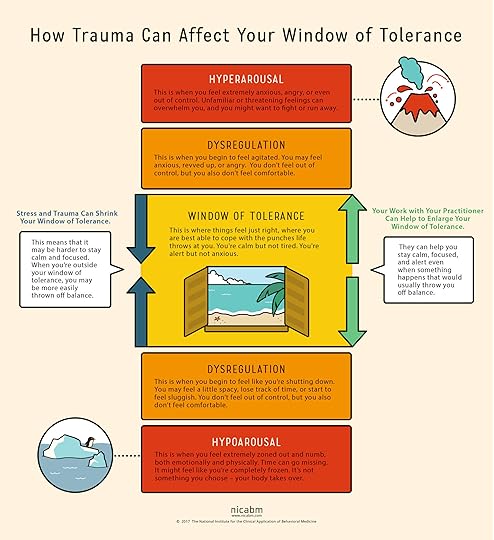
The Author misses out Islamic Tradition, Hindu Tradition, Christianity, which is about 80% of World's Population.
In this topic, "Can't they offer something to human life?"
Major Religious traditions of the World have offered something to human life.
I don't know, "Why would the author discard them completely?"
One could argue, they're mumbo-jumbo, by People who differ might say, for bringing any of the above religious tradition. But I doubt and would not say, entire human race is foolish since the beginning of history.
Most would resort to, "Aha, now we have science" to which, I can respond, basic human condition, nature of human being is same, regardless of time-line.
Someone who does research have to bring wider perspectives, compare and contrast, invent new ways.
I am sure 2000 years of history, earlier men in army, must have situations, where they'd need to cope with loss, grief, confusion, followed something to deal with pain and suffering that comes with War.
Most of the content is similar to other works in this area, which are popular.
I am not sure if the author can defend her work against researchers in the field.
The Topic is urgent, extremely valuable, sensitive, and meaningful to human life.
Okay, leave my rebuttal to the author, let's get to the meat of the book.
I'd want to get to truth in any conversation or field of inquiry.
How does one increase the Window of Tolerance?
This is what we want in this book.
Turn to Page 308, “safe home base” , which is what noted Child Development, Psychologist, Psychiatrist John Bowlby and others in this field of research recommend.
Elizabeth, the author says, if we don't fully recover, we would narrow down our window of tolerance.
I'd recommend this to anyone who needs a simple introduction, and being aware of this area of life.
Deus Vult,
Gottfried
I wanted to know, how can people deal with life issues in a better way, eg: Grief, Sorrow, Loss, Trauma, death of a loved one and many issues.
Some day, my friends would face something, and I'd like to offer resources or know, what's best way for me to be of help to them.
The Author misses out Islamic Tradition, Hindu Tradition, Christianity, which is about 80% of World's Population.
In this topic, "Can't they offer something to human life?"
Major Religious traditions of the World have offered something to human life.
I don't know, "Why would the author discard them completely?"
One could argue, they're mumbo-jumbo, by People who differ might say, for bringing any of the above religious tradition. But I doubt and would not say, entire human race is foolish since the beginning of history.
Most would resort to, "Aha, now we have science" to which, I can respond, basic human condition, nature of human being is same, regardless of time-line.
Someone who does research have to bring wider perspectives, compare and contrast, invent new ways.
I am sure 2000 years of history, earlier men in army, must have situations, where they'd need to cope with loss, grief, confusion, followed something to deal with pain and suffering that comes with War.
Most of the content is similar to other works in this area, which are popular.
I am not sure if the author can defend her work against researchers in the field.
The Topic is urgent, extremely valuable, sensitive, and meaningful to human life.
Okay, leave my rebuttal to the author, let's get to the meat of the book.
I'd want to get to truth in any conversation or field of inquiry.
How does one increase the Window of Tolerance?
This is what we want in this book.
Turn to Page 308, “safe home base” , which is what noted Child Development, Psychologist, Psychiatrist John Bowlby and others in this field of research recommend.
Elizabeth, the author says, if we don't fully recover, we would narrow down our window of tolerance.
I'd recommend this to anyone who needs a simple introduction, and being aware of this area of life.
Deus Vult,
Gottfried

January 21, 2020
I found Widen the Window a fascinating study on how the brain responds to trauma and stress (both of which have a much wider definition that I previously realized). I find myself able to think more critically as I analyze true-crime stories (and trashy TV hah!) and observe the lives of my friends/family members/coworkers. This book helped me grow a greater understanding for myself and others as well as contemplate my stress-recovery in a way that will remain with me for a long time. I was especially humbled by her military service and the work she does with our armed forces. I hope her work continues to impact more and more of our active forces as well as our veterans who so deserve and need mental health care. That being said, she gets on her high horse at the beginning and end of the book. I'm glad I pushed through the beginning to get to her content and that I knew better by the end to skip around.
Displaying 1 - 30 of 116 reviews