

What do you think?

I romanzi della rosa #1
Η Ηδονή
Για τον αριστοκράτη δανδή Αντρέα Σπερέλι, στη Ρώμη του τέλους του 19ου αιώνα, η πιο όμορφη γυναίκα είναι πάντοτε η επόμενη. Όπως όμως γίνεται με όλους τους ηδονοθήρες, κάποτε βρίσκει και ο Αντρέα τον δάσκαλό του. Μονάχα που στην περίπτωσή του δεν είναι μία γυναίκα αλλά δύο: η Έλενα Μούτι και η Μαρία Φέρες, αμφότερες σύζυγοι άλλων ανδρών. Διχασμένος ανάμεσα στα δύο αυτά πρόσωπα που κεντρίζουν την καρδιά και το σώμα του, και παρά τη σωρεία άλλων επτά γυναικών που παράλληλα παρελαύνουν στη ζωή του, ο Αντρέα φτάνει ως το κατώφλι του θανάτου για να συνειδητοποιήσει ότι τις επιθυμεί και τις δύο πάρα πολύ. Μήπως όμως έτσι τις χάσει και τις δύο και άρα χάσει τα πάντα;
Το εμβληματικό αυτό μυθιστόρημα του Γκαμπριέλε Ντ’ Ανούντσιο ανατέμνει τον κόσμο της αλόγιστης, τυφλής επιθυμίας, της ακόρεστης δίψας για ερωτικές κατακτήσεις, όπου όμως το πρόσωπο του πόθου σχεδόν δεν έχει καν πρόσωπο: το αντικείμενο του πόθου είναι ο ίδιος ο πόθος και το ξόδεμα του εαυτού έχει ως τίμημα μια γεμάτη αγκάθια μοναξιά. Με το απαράμιλλο, πληθωρικό ύφος του ο Ιταλός συγγραφέας σκιαγραφεί στην Ηδονή τον εστέτ χαρακτήρα που αναζητά το ωραίο χάριν του ωραίου, γιορτάζοντας μια παρακμή που είναι την ίδια στιγμή μια γιορτή της ζωής και του θανάτου.
Στην παρούσα έκδοση, σε νέα μετάφραση, εκτός από το προλογικό σημείωμα της μεταφράστριας Δήμητρας Δότση, περιλαμβάνονται ένα εισαγωγικό κείμενο του διευθυντή σειράς Ηλία Μαγκλίνη, καθώς και επίμετρο με αποσπάσματα ενός δοκιμίου πάνω στο έργο του Ντ’ Ανούντσιο από τον κορυφαίο κλασικό συγγραφέα Χένρι Τζέιμς.
Το εμβληματικό αυτό μυθιστόρημα του Γκαμπριέλε Ντ’ Ανούντσιο ανατέμνει τον κόσμο της αλόγιστης, τυφλής επιθυμίας, της ακόρεστης δίψας για ερωτικές κατακτήσεις, όπου όμως το πρόσωπο του πόθου σχεδόν δεν έχει καν πρόσωπο: το αντικείμενο του πόθου είναι ο ίδιος ο πόθος και το ξόδεμα του εαυτού έχει ως τίμημα μια γεμάτη αγκάθια μοναξιά. Με το απαράμιλλο, πληθωρικό ύφος του ο Ιταλός συγγραφέας σκιαγραφεί στην Ηδονή τον εστέτ χαρακτήρα που αναζητά το ωραίο χάριν του ωραίου, γιορτάζοντας μια παρακμή που είναι την ίδια στιγμή μια γιορτή της ζωής και του θανάτου.
Στην παρούσα έκδοση, σε νέα μετάφραση, εκτός από το προλογικό σημείωμα της μεταφράστριας Δήμητρας Δότση, περιλαμβάνονται ένα εισαγωγικό κείμενο του διευθυντή σειράς Ηλία Μαγκλίνη, καθώς και επίμετρο με αποσπάσματα ενός δοκιμίου πάνω στο έργο του Ντ’ Ανούντσιο από τον κορυφαίο κλασικό συγγραφέα Χένρι Τζέιμς.
488 pages, Unknown Binding
First published January 1, 1889
About the author
Gabriele d'Annunzio
1,064 books306 followersGabriele D'Annunzio, Prince of Montenevoso (12 March 1863 – 1 March 1938), was an Italian poet, playwright, orator, journalist, aristocrat, and army officer during World War I. He occupied a prominent place in Italian literature from 1889 to 1910 and later political life from 1914 to 1924. He was often referred to under the epithets Il Vate ("the Poet") or Il Profeta ("the Prophet").
D'Annunzio combined in his work naturalism, symbolism, and erotic images, becoming the best interpreter of European Decadence in post-Risorgimento Italy.
His love affairs, relationship with the world-famous actress Eleanora Duse, heroic adventures during World War I, and his occupation of Fiume in 1919 made him a legend in his own time.
D'Annunzio combined in his work naturalism, symbolism, and erotic images, becoming the best interpreter of European Decadence in post-Risorgimento Italy.
His love affairs, relationship with the world-famous actress Eleanora Duse, heroic adventures during World War I, and his occupation of Fiume in 1919 made him a legend in his own time.
Ratings & Reviews
Friends & Following
Create a free account to discover what your friends think of this book!
Community Reviews
Displaying 1 - 30 of 432 reviews

June 18, 2026
⋰˚☆ 3.5
ೃ⁀➷
Nothing is worse than when a guy is cognizant of his looks. I immensely prefer a vain woman than a man.
ೃ⁀➷
Nothing is worse than when a guy is cognizant of his looks. I immensely prefer a vain woman than a man.

January 12, 2018
Come la fiamma non trova vita che nella combustione
Al bar ordino un cornetto vuoto e un caffè. Vi sono occasioni in cui però i cornetti son rimasti solo con la crema. In quelle occasioni li apro in mezzo e con una salvietta, li svuoto del loro contenuto. La poca crema che resta, talvolta, li rende migliori di quelli vuoti. Questo romanzo è un cornetto dove la crema sono le citazioni di Shelley, Byron, i passi in latino, i madrigali.. e dove puoi aver la fortuna di trovarti in bocca
Le stelle uom non le desidera, - ma gioisce del loro fulgore
A quel punto è possibile rinunciare allo zucchero nel caffè
Il libro era in prestito, ho riempito un foglio A4 fronte/retro con le sue citazioni, ho fatto la scansione di almeno otto delle sue pagine. Ho voluto che me ne restasse le foto.
Da esse si evince che la trama è quasi nulla. È il racconto delle sensazioni del Conte Andrea Sperelli, uno al quale il padre aveva dato, tra le altre, questa massima fondamentale: bisogna fare la propria vita come un’opera d’arte. Bisogna che la vita d'un uomo d’intelletto sia opera di lui. La superiorità vera è tutta qui
E’ il racconto del degrado morale di Andrea che per trarre profitto esclusivo dai propri commerci amorosi, mentirà e abbandonerà qualsiasi inibizione.
Egli non aveva ripugnanza ad alcuna finzione, ad alcuna falsità, ad alcuna menzogna. Gran parte della sua forza era nell’ipocrisia
Proverà struggimento per la duchessa Elena Scerni perché anch’essa avida di piacere, ha per fondamento morale il suo egoismo. Il romanzo si apre proprio con un rinnovato incontro fra i due protagonisti, ormai ex amanti e si snoda in flash-back.
Il mio concetto d’amore non è quello di Andrea Sperelli, l’amore secondo me esiste solo nella verità. Ma vi chiedo, quanta verità e quanta bellezza ci sono in un passaggio come questo?
Dalla stanchezza medesima il desiderio risorgeva più sottile, più temerario, più impudente; come più si inebriavano la chimera del loro cuore ingigantiva, s’agitava, generava nuovi sogni; parevano non trovar riposo che nello sforzo, come la fiamma non trova vita che nella combustione
In ultimo Roma… Leggete che cosa è questa città nelle descrizioni di D’Annunzio e troverete la sua forma di amore puro
Al bar ordino un cornetto vuoto e un caffè. Vi sono occasioni in cui però i cornetti son rimasti solo con la crema. In quelle occasioni li apro in mezzo e con una salvietta, li svuoto del loro contenuto. La poca crema che resta, talvolta, li rende migliori di quelli vuoti. Questo romanzo è un cornetto dove la crema sono le citazioni di Shelley, Byron, i passi in latino, i madrigali.. e dove puoi aver la fortuna di trovarti in bocca
Le stelle uom non le desidera, - ma gioisce del loro fulgore
A quel punto è possibile rinunciare allo zucchero nel caffè
Il libro era in prestito, ho riempito un foglio A4 fronte/retro con le sue citazioni, ho fatto la scansione di almeno otto delle sue pagine. Ho voluto che me ne restasse le foto.
Da esse si evince che la trama è quasi nulla. È il racconto delle sensazioni del Conte Andrea Sperelli, uno al quale il padre aveva dato, tra le altre, questa massima fondamentale: bisogna fare la propria vita come un’opera d’arte. Bisogna che la vita d'un uomo d’intelletto sia opera di lui. La superiorità vera è tutta qui
E’ il racconto del degrado morale di Andrea che per trarre profitto esclusivo dai propri commerci amorosi, mentirà e abbandonerà qualsiasi inibizione.
Egli non aveva ripugnanza ad alcuna finzione, ad alcuna falsità, ad alcuna menzogna. Gran parte della sua forza era nell’ipocrisia
Proverà struggimento per la duchessa Elena Scerni perché anch’essa avida di piacere, ha per fondamento morale il suo egoismo. Il romanzo si apre proprio con un rinnovato incontro fra i due protagonisti, ormai ex amanti e si snoda in flash-back.
Il mio concetto d’amore non è quello di Andrea Sperelli, l’amore secondo me esiste solo nella verità. Ma vi chiedo, quanta verità e quanta bellezza ci sono in un passaggio come questo?
Dalla stanchezza medesima il desiderio risorgeva più sottile, più temerario, più impudente; come più si inebriavano la chimera del loro cuore ingigantiva, s’agitava, generava nuovi sogni; parevano non trovar riposo che nello sforzo, come la fiamma non trova vita che nella combustione
In ultimo Roma… Leggete che cosa è questa città nelle descrizioni di D’Annunzio e troverete la sua forma di amore puro
November 15, 2010
E' uno di quei libri che fa venire voglia al lettore, per una volta, di
abbandonare il legio per scendere a conoscere personalmente il protagonista, Andrea Sperelli in questo caso, guardarlo negli occhi e, quindi, iniziare a prenderlo a calci nel fondoschiena, fino a condurlo, in tal maniera, fino al limitare di una bella miniera ove abbandonare il nostro eroe a trascorrervi il resto della vita a spalar carbone in profondita'.
In questa sentita avversione per il protagonista, effimero, vacuo, narciso, egoista, non aiuta certamente la prosa di D'Annunzo, altrettanto effimera ed estetizzante, oltreche' a tratti rindondante.
Unica nota di interesse e' la societa' che descrive D'Annunzio, l'alta societa' romana di fine XIX secolo. La stessa nella quale D'Annunzio cercava di vivere, caricandosi di debiti, in prima persona.
Una societa' fatta di donne adultere e gentiluomini nullafacenti che si passano le amanti. Cosi, almeno, ci racconta l'autore, anche se sarebbe piu' corretto dire che, in fondo, sono le adultere a scambiarsi gli amanti, lasciando agli uomini l'illusione di essere loro i conquistaori e non un mero oggetto di piacere.
abbandonare il legio per scendere a conoscere personalmente il protagonista, Andrea Sperelli in questo caso, guardarlo negli occhi e, quindi, iniziare a prenderlo a calci nel fondoschiena, fino a condurlo, in tal maniera, fino al limitare di una bella miniera ove abbandonare il nostro eroe a trascorrervi il resto della vita a spalar carbone in profondita'.
In questa sentita avversione per il protagonista, effimero, vacuo, narciso, egoista, non aiuta certamente la prosa di D'Annunzo, altrettanto effimera ed estetizzante, oltreche' a tratti rindondante.
Unica nota di interesse e' la societa' che descrive D'Annunzio, l'alta societa' romana di fine XIX secolo. La stessa nella quale D'Annunzio cercava di vivere, caricandosi di debiti, in prima persona.
Una societa' fatta di donne adultere e gentiluomini nullafacenti che si passano le amanti. Cosi, almeno, ci racconta l'autore, anche se sarebbe piu' corretto dire che, in fondo, sono le adultere a scambiarsi gli amanti, lasciando agli uomini l'illusione di essere loro i conquistaori e non un mero oggetto di piacere.

June 29, 2021
Mai giudicare un libro da quello che si crede di sapere sull'autore.
Gabriele D'Annunzio: tanto amato in vita e tanto odiato in morte. Forse odiato è una parola un po' forte però anche i poeti che, almeno in parte, si sono ispirati a lui hanno invece sempre sottolineato le distanze da lui.
D'altronde è stato un personaggio difficile, scomodo, con idee molto discutibili; e il modo in cui si insegna a scuola riflette ciò. Si dice: sì, ha scritto Alcyone in cui c'è qualche bella poesia però...però, tutto il resto*...
Tutto questo per spiegare perché fino a quest'estate non avevo mai letto, né avuto voglia di leggere, un suo romanzo. Ho iniziato con il Piacere, che ha la fama di essere il suo migliore e allo stesso tempo di essere noioso e privo di trama.
Questo è uno di quei casi in cui posso capire chi non ha apprezzato il libro, al tempo stesso a me è piaciuto molto. D'Annunzio ha una maestria sorprendente nell'uso del linguaggio. È un libro lento, ma non l'ho trovato né senza trama né noioso. Poi, certo, bisogna mettersi d'impegno nel leggerlo ma secondo me ne vale assolutamente la pena.
*Sicuramente ci sono delle cose che ha scritto quasi illeggibili, però ci sono anche poesie belle che non fanno parte di Alcyone, per esempio "Qui giacciono i miei cani"
Gabriele D'Annunzio: tanto amato in vita e tanto odiato in morte. Forse odiato è una parola un po' forte però anche i poeti che, almeno in parte, si sono ispirati a lui hanno invece sempre sottolineato le distanze da lui.
D'altronde è stato un personaggio difficile, scomodo, con idee molto discutibili; e il modo in cui si insegna a scuola riflette ciò. Si dice: sì, ha scritto Alcyone in cui c'è qualche bella poesia però...però, tutto il resto*...
Tutto questo per spiegare perché fino a quest'estate non avevo mai letto, né avuto voglia di leggere, un suo romanzo. Ho iniziato con il Piacere, che ha la fama di essere il suo migliore e allo stesso tempo di essere noioso e privo di trama.
Questo è uno di quei casi in cui posso capire chi non ha apprezzato il libro, al tempo stesso a me è piaciuto molto. D'Annunzio ha una maestria sorprendente nell'uso del linguaggio. È un libro lento, ma non l'ho trovato né senza trama né noioso. Poi, certo, bisogna mettersi d'impegno nel leggerlo ma secondo me ne vale assolutamente la pena.
*Sicuramente ci sono delle cose che ha scritto quasi illeggibili, però ci sono anche poesie belle che non fanno parte di Alcyone, per esempio "Qui giacciono i miei cani"

May 9, 2021
Il Piacere is a novel written by a poet. That's perhaps the best way to describe this beautifully bittersweet novel. Its protagonist is a young poet, an Italian nobleman Andrea Sperelli. The novel feels autobiographical. How much of Gabriele D'Annuzio is there in Andrea Sperelli? It's hard to tell but I suspect a lot. Poetry is a big part of this novel. Not only is Annuzio's prose very poetic and powerful, but the fact the protagonist is poet is significant in itself. Moreover, throughout the novel there are many literary references, from Goethe, to Keats, Byron and Shelley.
Il piacere is the first novel by by Gabriele d'Annunzio (also the first work of his I read), written in 1889. What other novel was written around that time? The Picture of Dorian Gray by Oscar Wilde. There must have been something in the air that year, for the protagonist of Pleasure (also translated as Child of Pleasure in English) reminds me of Dorian Gray in so many ways. Supposedly both novels were inspired by the same French source. Like Dorian, Andrea is a beautiful young dandy who seduces women left and right. There is no Lord Henry in this one, though. There is, however, a femme fatale- Elena Muti. One could argue that Elena is the diabolic influence but Andrea himself is no angel. Andrea lives for pleasure and art. Like Dorian, Andrea is an egocentric. While he experiences moments of regret and guilt, Andrea seems to embrace his immorality.
At the start of the novel, Andrea suffers because Elena has left him to marry an English lord. He then goes on to indulge in a series of affairs. At times, Andrea suffers from remorse, wondering at what paint he causes to the husbands of these women (his love interests are mostly married), recalling his own intense pain at separation with Elena. Nevertheless, Andrea keeps on seducing women until husband one of them challenges him to a duel. Andrea is a more experienced duelist who has already won duels, so he stands a better change, but this time he ends up on the wrong side of the sword. Karma, perhaps. At any rate, Andrea is injured so gravely he needs to recover for a long time and stays with his cousin for a prolonged period of time.
While staying with his cousin (Francesca, was it?), Andrea meets her friend donna Maria, an angelic and spiritual noblewoman who attracts him with her sophisticated nature and immaculate taste in art. He professes his love for Maria and this time Andrea seems sincere. However, it's hard to know for sure with him, isn't it? Andrea, like Dorian, remains something of a mystery. Maria, however, is a well developed character. The writer introduces us to Maria through her diary and so as readers we become privy to her most intimate thoughts. This was a clever move on the writer's part because Maria is not the kind of woman to reveal her feelings. Andrea is fascinated by Maria and wants to posses her soul. But what of his fascination with Elena? This is where the book gets really interesting because as fate would have it, Andrea's path will cross with that of fatal Elena Muti.
On overall, I can say that I enjoyed this novel. I can see how it might not be for everyone, though. Andrea is not exactly a moral protagonist. He is a decadent young man who thinks mostly of himself. When he experiences true love, Andrea doesn't exactly shine. Andrea is not the kind of man to take on life, either. Neither a friend nor a lover you can rely on. However, Andrea is also a poet and an artist. His pains seem sincere enough and even if it can be said that he has brought up his sorrows onto himself, there is a Byronic attraction to him. You almost feel like Andrea cannot help being who he is or doing what he does- up to a point, at least.
I did read this book in original, but I needed the help of dictionary to read in Italian. Either the book is filled with archaic expression or my Italian isn't well developed. Possibly both. The language is beautiful, though. It is the kind of book that you want to copy multiple quotes and passages from. The descriptions of Rome in different seasons are absolutely magical. The passions between lovers are described quite poetically as well.
“And in the kisses, what deep sweetness! There are women's mouths that seem to ignite with love the breath that opens them. Whether they are reddened by blood richer than purple, or frozen by the pallor of agony, whether they are illuminated by the goodness of consent or darkened by the shadow of disdain, they always carry within them an enigma that disturbs men of intellect, and attracts them and captivates them. ”
Il piacere is the first novel by by Gabriele d'Annunzio (also the first work of his I read), written in 1889. What other novel was written around that time? The Picture of Dorian Gray by Oscar Wilde. There must have been something in the air that year, for the protagonist of Pleasure (also translated as Child of Pleasure in English) reminds me of Dorian Gray in so many ways. Supposedly both novels were inspired by the same French source. Like Dorian, Andrea is a beautiful young dandy who seduces women left and right. There is no Lord Henry in this one, though. There is, however, a femme fatale- Elena Muti. One could argue that Elena is the diabolic influence but Andrea himself is no angel. Andrea lives for pleasure and art. Like Dorian, Andrea is an egocentric. While he experiences moments of regret and guilt, Andrea seems to embrace his immorality.
At the start of the novel, Andrea suffers because Elena has left him to marry an English lord. He then goes on to indulge in a series of affairs. At times, Andrea suffers from remorse, wondering at what paint he causes to the husbands of these women (his love interests are mostly married), recalling his own intense pain at separation with Elena. Nevertheless, Andrea keeps on seducing women until husband one of them challenges him to a duel. Andrea is a more experienced duelist who has already won duels, so he stands a better change, but this time he ends up on the wrong side of the sword. Karma, perhaps. At any rate, Andrea is injured so gravely he needs to recover for a long time and stays with his cousin for a prolonged period of time.
While staying with his cousin (Francesca, was it?), Andrea meets her friend donna Maria, an angelic and spiritual noblewoman who attracts him with her sophisticated nature and immaculate taste in art. He professes his love for Maria and this time Andrea seems sincere. However, it's hard to know for sure with him, isn't it? Andrea, like Dorian, remains something of a mystery. Maria, however, is a well developed character. The writer introduces us to Maria through her diary and so as readers we become privy to her most intimate thoughts. This was a clever move on the writer's part because Maria is not the kind of woman to reveal her feelings. Andrea is fascinated by Maria and wants to posses her soul. But what of his fascination with Elena? This is where the book gets really interesting because as fate would have it, Andrea's path will cross with that of fatal Elena Muti.
On overall, I can say that I enjoyed this novel. I can see how it might not be for everyone, though. Andrea is not exactly a moral protagonist. He is a decadent young man who thinks mostly of himself. When he experiences true love, Andrea doesn't exactly shine. Andrea is not the kind of man to take on life, either. Neither a friend nor a lover you can rely on. However, Andrea is also a poet and an artist. His pains seem sincere enough and even if it can be said that he has brought up his sorrows onto himself, there is a Byronic attraction to him. You almost feel like Andrea cannot help being who he is or doing what he does- up to a point, at least.
I did read this book in original, but I needed the help of dictionary to read in Italian. Either the book is filled with archaic expression or my Italian isn't well developed. Possibly both. The language is beautiful, though. It is the kind of book that you want to copy multiple quotes and passages from. The descriptions of Rome in different seasons are absolutely magical. The passions between lovers are described quite poetically as well.
“And in the kisses, what deep sweetness! There are women's mouths that seem to ignite with love the breath that opens them. Whether they are reddened by blood richer than purple, or frozen by the pallor of agony, whether they are illuminated by the goodness of consent or darkened by the shadow of disdain, they always carry within them an enigma that disturbs men of intellect, and attracts them and captivates them. ”

December 14, 2022
Sensualissimo erotismo de fin de siècle
Sei mesi nella vita di Andrea Sperelli.
Ondeggia Andrea Sperelli.
Giovane aristocratico dai bei modi, colto, artista, dipinge e compone elegie poetiche, raffinatissimo esteta che vuole fare della sua vita un'opera d'arte.
La sua casa a Palazzo Zuccari, sulla sommità della scalinata di Trinità dei Monti, è un'alcova di lusso dove tutto predispone all'esaltazione del piacere.
Come un perfettissimo teatro ogni cosa è funzionale al piacere, il caminetto con le braci sempre ardenti, gli arazzi alle pareti e i quadri, tutti di estremo pregio e a tema prevalentemente sacro, con le loro Madonne che sono spettatrici mute dei suoi incontri amorosi con una cangiante flora e fauna femminile dal ricambio veloce e che fa parte del demi-monde romano di fin de siècle, coppe di cristallo sui tavolini in cui si piegano steli di fiori sotto il peso di corolle dalle forme voluttuose, e vasi di Murano poggiati ovunque con rose floribunde che sfogliandosi spandono i loro petali sui soffici tappeti che Elena attraverserà camminando a piedi nudi
Sono oggetti in mezzo ai quali Andrea Sperelli ha così tante volte amato e goduto e sofferto, che da lui hanno come acquistato la stessa sensibilità erotica, oggetti che non sono solo testimoni dei suoi amori e dei suoi piaceri e delle sue tristezze, ma quasi loro partecipi, come avessero assorbito le voluttuose atmosfere di quelle stanze.
Andrea Sperelli vuole fare della propria vita un'opera d'arte, scrive D'Annunzio, ed è una frase sulla quale ho riflettuto.
Credo lì sia racchiusa la chiave di questo capolavoro che è ad un tempo capolavoro letterario, psicologico, erotico, linguistico.
Un'opera d'arte quando è rappresentativa esibisce la bellezza della natura o la bellezza sensuale di un corpo, ma l'opera d'arte può anche trascendere dalle forme e veicolare un messaggi, un'idea, o meglio rappresentare un orizzonte ideale.
E citando l'opera d'arte non si può sottacere di Roma: opera d'arte a cielo aperto.
Perché Il piacere è anche il romanzo che omaggia massimamente la bellezza di Roma
Dopo un tratto di salita, apparve la città immensa, augusta, radiosa, irta di campanili di colonne e d'obelischi, Incoronata di cupole e di rotonde, nettamente intagliata come un Acropoli nel pieno azzurro
Roma che con le sue chiese e le sue ville gentilizie, villa Medici, Pamphili, con le sue gallerie di quadri e statue diventa lo scenario privilegiato dove il piacere di Andrea Sperelli percorrerà le sue strade, tutte le solitarie sedi della bellezza di Roma conosceranno i suoi amori.
Il protagonista ha un momento quasi mistico quando si ferisce gravemente dopo un duello e si allontana dal suo mondo e crede di poter rinascere come un uomo nuovo, l'ideale sembrerebbe prendere il sopravvento sul piacere.
Ma la brama di possedere due donne, molto diverse tra loro, Elena fortemente erotica e Donna Maria Ferres, dal cuore purissimo e materno, due nature che si sovrappongono nel suo immaginario, riveleranno la sua figura camaleontica che tesse ogni volta trame di finzioni e inganni.
La ricerca di conciliare gli opposti di riunificare un ideale di amore e piacere che magistralmente D'Annunzio esprime con queste parole:
Per la natura del suo gusto, egli ricercava negli amori un gaudio molteplice: il complicato diletto di tutti i sensi, l'alta commozione intellettuale, gli abbandoni del sentimento, gli impeti della brutalità.
si concluderà con la sconfitta morale del suo protagonista.
Romanzo che entra prepotentemente nei miei preziosi rari eletti 5 o 6, max 7 che prima di morire mi vedranno felice loro rilettrice, non da ultimo, anzi massimamente, per una scrittura musicale e visivamente pittorica, di una bellezza travolgente.
Pensate che questo romanzo venne pubblicato nel 1889, lo stesso anno del Mastro don Gesualdo di Verga.
La magia della letteratura che sa ascendere a vette di identica altezza ma pur così profondamente dissimili.
Sei mesi nella vita di Andrea Sperelli.
Ondeggia Andrea Sperelli.
Giovane aristocratico dai bei modi, colto, artista, dipinge e compone elegie poetiche, raffinatissimo esteta che vuole fare della sua vita un'opera d'arte.
La sua casa a Palazzo Zuccari, sulla sommità della scalinata di Trinità dei Monti, è un'alcova di lusso dove tutto predispone all'esaltazione del piacere.
Come un perfettissimo teatro ogni cosa è funzionale al piacere, il caminetto con le braci sempre ardenti, gli arazzi alle pareti e i quadri, tutti di estremo pregio e a tema prevalentemente sacro, con le loro Madonne che sono spettatrici mute dei suoi incontri amorosi con una cangiante flora e fauna femminile dal ricambio veloce e che fa parte del demi-monde romano di fin de siècle, coppe di cristallo sui tavolini in cui si piegano steli di fiori sotto il peso di corolle dalle forme voluttuose, e vasi di Murano poggiati ovunque con rose floribunde che sfogliandosi spandono i loro petali sui soffici tappeti che Elena attraverserà camminando a piedi nudi
Sono oggetti in mezzo ai quali Andrea Sperelli ha così tante volte amato e goduto e sofferto, che da lui hanno come acquistato la stessa sensibilità erotica, oggetti che non sono solo testimoni dei suoi amori e dei suoi piaceri e delle sue tristezze, ma quasi loro partecipi, come avessero assorbito le voluttuose atmosfere di quelle stanze.
Andrea Sperelli vuole fare della propria vita un'opera d'arte, scrive D'Annunzio, ed è una frase sulla quale ho riflettuto.
Credo lì sia racchiusa la chiave di questo capolavoro che è ad un tempo capolavoro letterario, psicologico, erotico, linguistico.
Un'opera d'arte quando è rappresentativa esibisce la bellezza della natura o la bellezza sensuale di un corpo, ma l'opera d'arte può anche trascendere dalle forme e veicolare un messaggi, un'idea, o meglio rappresentare un orizzonte ideale.
E citando l'opera d'arte non si può sottacere di Roma: opera d'arte a cielo aperto.
Perché Il piacere è anche il romanzo che omaggia massimamente la bellezza di Roma
Dopo un tratto di salita, apparve la città immensa, augusta, radiosa, irta di campanili di colonne e d'obelischi, Incoronata di cupole e di rotonde, nettamente intagliata come un Acropoli nel pieno azzurro
Roma che con le sue chiese e le sue ville gentilizie, villa Medici, Pamphili, con le sue gallerie di quadri e statue diventa lo scenario privilegiato dove il piacere di Andrea Sperelli percorrerà le sue strade, tutte le solitarie sedi della bellezza di Roma conosceranno i suoi amori.
Il protagonista ha un momento quasi mistico quando si ferisce gravemente dopo un duello e si allontana dal suo mondo e crede di poter rinascere come un uomo nuovo, l'ideale sembrerebbe prendere il sopravvento sul piacere.
Ma la brama di possedere due donne, molto diverse tra loro, Elena fortemente erotica e Donna Maria Ferres, dal cuore purissimo e materno, due nature che si sovrappongono nel suo immaginario, riveleranno la sua figura camaleontica che tesse ogni volta trame di finzioni e inganni.
La ricerca di conciliare gli opposti di riunificare un ideale di amore e piacere che magistralmente D'Annunzio esprime con queste parole:
Per la natura del suo gusto, egli ricercava negli amori un gaudio molteplice: il complicato diletto di tutti i sensi, l'alta commozione intellettuale, gli abbandoni del sentimento, gli impeti della brutalità.
si concluderà con la sconfitta morale del suo protagonista.
Romanzo che entra prepotentemente nei miei preziosi rari eletti 5 o 6, max 7 che prima di morire mi vedranno felice loro rilettrice, non da ultimo, anzi massimamente, per una scrittura musicale e visivamente pittorica, di una bellezza travolgente.
Pensate che questo romanzo venne pubblicato nel 1889, lo stesso anno del Mastro don Gesualdo di Verga.
La magia della letteratura che sa ascendere a vette di identica altezza ma pur così profondamente dissimili.

October 14, 2017
Alle superiori detestavo D'Annunzio, forse per colpa della prof di lettere che lo amava alla follia.
Ho appena scoperto che lo detesto ancora e che non era colpa della mia prof.
Ho appena scoperto che lo detesto ancora e che non era colpa della mia prof.

July 6, 2023
Avevo provato a leggere Il piacere molti anni fa, finendo per abbandonarlo annoiata. Da ragazzina mi era sembrato molto noioso. Questo mese, però, dopo la visita al Vittoriale, alla casa di D'Annunzio, mi sono riavvicinata. Guardare i suoi libri, le migliaia di oggetti che collezionava, mi ha fatto avvicinare ad una figura che mi sembrava lontana e poco interessante.
Questa volta ho trovato il libro diverso; ho potuto apprezzare la prosa densa e poetica dell'autore. Lui era soprattutto un poeta, e si vede benissimo. Sono rimasta affascinata dallo scoprire che, come scrisse Benedetto Croce recensendolo, il libro propone una figura decadente come non ce n'erano all'epoca nella letteratura italiana. Andrea Sperelli è un antieroe che fa la sua discesa nella amoralità, depravazione, rovinando la vita altrui e la propria. L'autore racconta tutto con raffinatezza crudele, senza risparmiare nessuna sottigliezza al suo personaggio e al lettore. Mi è piaciuto molto il linguaggio e il dettaglio con cui è descritta la distruzione interiore, la meschinità, l'uso vuoto e ipocrita delle arti da parte del protagonista. Belle le due protagoniste femminili più rappresentative, Elena e Maria, opposte tra di loro. L'una furba, serpentina donna di mondo anche un po' oscura; l'altra angelica e sincera, destinata alla sofferenza più intensa.
Questa volta ho trovato il libro diverso; ho potuto apprezzare la prosa densa e poetica dell'autore. Lui era soprattutto un poeta, e si vede benissimo. Sono rimasta affascinata dallo scoprire che, come scrisse Benedetto Croce recensendolo, il libro propone una figura decadente come non ce n'erano all'epoca nella letteratura italiana. Andrea Sperelli è un antieroe che fa la sua discesa nella amoralità, depravazione, rovinando la vita altrui e la propria. L'autore racconta tutto con raffinatezza crudele, senza risparmiare nessuna sottigliezza al suo personaggio e al lettore. Mi è piaciuto molto il linguaggio e il dettaglio con cui è descritta la distruzione interiore, la meschinità, l'uso vuoto e ipocrita delle arti da parte del protagonista. Belle le due protagoniste femminili più rappresentative, Elena e Maria, opposte tra di loro. L'una furba, serpentina donna di mondo anche un po' oscura; l'altra angelica e sincera, destinata alla sofferenza più intensa.

July 31, 2020
«Η Ηδονή» είναι ένα ανάγνωσμα παλαιάς κοπής που γράφτηκε στο όχι και τόσο κοντινό 1889. Ο Αντρέα Σπερέλι, ο πρωταγωνιστής της ιστορίας μας, είναι ένας δανδής της εποχής, που διαθέτει και χρήμα και μόρφωση, και ο μόνος της ζωής του σκοπός είναι η άντληση της ηδονής. Λατρεύει ο τύπος το «ωραίο», όχι μόνο ως προς τις γυναίκες, στις οποίες έχει μία ιδιαίτερη αδυναμία – ιδίως δε στις δεσμευμένες (η γιαγιά μου έλεγε ‘η γριά η κότα έχει το ζουμί’) αλλά σε κάθε τι το «ωραίο» όπως είναι έργα τέχνης, βιβλία, τοποθεσίες κλπ. κλπ. Παρακολουθούμε λοιπόν την έκλυτη (εδώ βάζω ερωτηματικό γιατί έχουμε δει άλλους αληθινά έκλυτους βίους) ζωή του Σπερέλι, την εσωτερική αναστάτωσή του και το μεγάλο δίλημμα στο οποίο βρίσκεται: ποια από τις δύο δεσποσύνες να διαλέξει, την Έλενα Μούντες ή τη Μαρία Φέρες… Από την Κική και την Κοκό, ποια να διαλέξω;
Το θέμα είναι πως ένα παλαιάς κοπής ανάγνωσμα μπορεί να εξελιχθεί σε ένα ακριβό παλαιωμένο κρασί ή σ’ένα ωραιότατο ξύδι. Μπορεί να εξελιχθεί σε all time classic ανάγνωσμα ή σε κάτι που είναι ξεπερασμένο και δεν έχει πλέον τίποτα να πει στον σύγχρονο αναγνώστη.
Η γραφή του Ντ’Ανούντσιο και η μετάφραση της Δήμητρας Δότση και του Χρήστου Καψάλη, να μεν ήταν λυρικότατες, αλλά τη σήμερον ημέρα φάνταζαν απίστευτα πομπώδεις. Θυμήθηκα όλα τα κοσμητικά επίθετα και τα καλολογικά στοιχεία που ήμουν υποχρεωμένο να χρησιμοποιώ στο μάθημα της έκθεσης μήπως και δελεάσω την έρμη εκείνη καθηγήτρια μου και μου βάλει κάνα βαθμό παραπάνω… Αργό, πολύ αργό στην πλοκή, (όχι πως αυτό αποτελεί πρόβλημα για μένα), αλλά πέρα από το να ζωντανεύουν στα μάτια μου τα tableaux vivants του Σπερέλι, άλλο ουδέν…
Στα συν, οι πολυάριθμες γνώσεις του συγγραφέα πάνω στην τέχνη, name dropping βιβλίων, πινάκων, μουσικών συνθέσεων που χαίρεσαι που υπάρχει το google και τα ψάχνεις αλλά μέχρι εκεί…
Εν ολίγοις, «Η ηδονή» μυρίζει πολύ την εποχή της… φοράει το μακρύ πανωφόρι και τους δαντελένιους γιακάδες των δανδήδων του 19ου αιώνα. Πολύ ενδιαφέρον ανάγνωσμα εάν το κάνεις σε μάθημα «Ιστορίας της Λογοτεχνίας» ή στα πλαίσια μιας έρευνας ή «για να δούμε τι έγραφαν και πως ζούσαν τότε οι γκόμενοι της εποχής» αλλά μέχρι εκεί. Το βρήκα κουραστικό, παλαιακό πολύ (ακόμα και για μένα) και δυστυχώς δεν εισέπραξα την αναγνωστική ηδονή που επιθυμούσα.
Με τη λογική πως δεν βαθμολογώ βάσει «λογοτεχνικότητας» αλλά βάσει «στο τι μιλάει στην παγερή καρδιά μου» από μένα είναι ένα δυαράκι κι αυτό για την αγάπη στην τέχνη που διαπνέει ολόκληρο το βιβλίο…
Το θέμα είναι πως ένα παλαιάς κοπής ανάγνωσμα μπορεί να εξελιχθεί σε ένα ακριβό παλαιωμένο κρασί ή σ’ένα ωραιότατο ξύδι. Μπορεί να εξελιχθεί σε all time classic ανάγνωσμα ή σε κάτι που είναι ξεπερασμένο και δεν έχει πλέον τίποτα να πει στον σύγχρονο αναγνώστη.
Η γραφή του Ντ’Ανούντσιο και η μετάφραση της Δήμητρας Δότση και του Χρήστου Καψάλη, να μεν ήταν λυρικότατες, αλλά τη σήμερον ημέρα φάνταζαν απίστευτα πομπώδεις. Θυμήθηκα όλα τα κοσμητικά επίθετα και τα καλολογικά στοιχεία που ήμουν υποχρεωμένο να χρησιμοποιώ στο μάθημα της έκθεσης μήπως και δελεάσω την έρμη εκείνη καθηγήτρια μου και μου βάλει κάνα βαθμό παραπάνω… Αργό, πολύ αργό στην πλοκή, (όχι πως αυτό αποτελεί πρόβλημα για μένα), αλλά πέρα από το να ζωντανεύουν στα μάτια μου τα tableaux vivants του Σπερέλι, άλλο ουδέν…
Στα συν, οι πολυάριθμες γνώσεις του συγγραφέα πάνω στην τέχνη, name dropping βιβλίων, πινάκων, μουσικών συνθέσεων που χαίρεσαι που υπάρχει το google και τα ψάχνεις αλλά μέχρι εκεί…
Εν ολίγοις, «Η ηδονή» μυρίζει πολύ την εποχή της… φοράει το μακρύ πανωφόρι και τους δαντελένιους γιακάδες των δανδήδων του 19ου αιώνα. Πολύ ενδιαφέρον ανάγνωσμα εάν το κάνεις σε μάθημα «Ιστορίας της Λογοτεχνίας» ή στα πλαίσια μιας έρευνας ή «για να δούμε τι έγραφαν και πως ζούσαν τότε οι γκόμενοι της εποχής» αλλά μέχρι εκεί. Το βρήκα κουραστικό, παλαιακό πολύ (ακόμα και για μένα) και δυστυχώς δεν εισέπραξα την αναγνωστική ηδονή που επιθυμούσα.
Με τη λογική πως δεν βαθμολογώ βάσει «λογοτεχνικότητας» αλλά βάσει «στο τι μιλάει στην παγερή καρδιά μου» από μένα είναι ένα δυαράκι κι αυτό για την αγάπη στην τέχνη που διαπνέει ολόκληρο το βιβλίο…

December 20, 2023
Penguin generally do a really good job when it comes to their covers for old classics, but this one is just plain stupid. You might be thinking erotica, right? Well, forget any thoughts about that. For 1889 I'd say the novel could be seen as provocative, yes. Reading it in the world of today, hardly. Whilst D'Annunzio never truly gets to the heart of the young Italian aristocrat Andrea Sperelli who, through art and nature pursues two love interests - one, somewhat of a party girl, who flirts in a life of luxury - the other, married, who rejects pleasures to pursue virtue - there is no doubt, even with what I'd say would have been a difficult translation to capture its true rhythm, that D'Annunzio writes beautifully. This is some of the best writing I've come across when it comes to decadence and sensuality; to aesthetics and the senses. The ending might have felt a little flat, but I can forgive this because of the writing overall. D'Annunzio has been compared with Joris-Karl Huysmans - whom I've loved reading previously, and the comparisons are spot on. As for D'Annunzio being a thrill-seeking Marquis de Sade-esque libertine and the one who pretty much invented fascism as an art project, which ended up inspiring Mussolini, I'm not going to be one of those idiots that pretend not to like a novel because of the writer's political standpoint. 4/5

May 23, 2017
Direi che "Schifanoja" riassume perfettamente il mio pensiero su questo libro.

June 10, 2017
La spiritualizzazione del gaudio carnale
Profondamente curato, stilisticamente perfetto, sintatticamente encomiabile, esteticamente superlativo, culturalmente straripante, musicalmente ineccepibile, poeticamente solenne, letterariamente un caposcuola.
La celebrazione della parola, dell'arte, delle sensazioni, dei profumi, dell'estetica.
La visita al Vittoriale degli italiani e in particolare alla Prioria, impressionante ultima residenza di Gabriele D'Annunzio, mi ha spinto a riguardarmi la storia del vate (decisamente interessante, a prescindere da ogni altra considerazione) e a leggere questo libro, considerato uno dei suoi migliori.
E' un mondo che non esiste più quello descritto da D'Annunzio. Un mondo di aristocratici nullafacenti, superflui, vuoti, privi di concretezza di valori e destinati inevitabilmente all'estinzione.
Ho provato, leggendo il piacere, sentimenti contrastanti. In generale ho trovato la prosa decisamente artificiosa, ampollosa, ricercata, involuta, ricamata. Un turbinio di parole che colpisce per varietà, bellezza ma soprattutto inconcludenza. D'Annunzio svuota con cura nel testo tutta la sua smisurata cultura, anestetizzando di fatto il lettore. Il linguaggio scritto sembra cessare la semplice funzione di mezzo comunicativo e diventa elemento integrante di questa ricerca estetica.
Provando a palesare il mio sentire con naturalezza con quel linguaggio manierato, estenuando nell'artifizio delle parole la forza dei sentimenti, la visione che produce nello spirito la lettura di questo libro si dissipa in mezzo a tutti quegli oggetti, forme, colori che inebriano ma non provocano una estasi di passione. La ricerca del gusto, del gaudio e del diletto di tutti i sensi tipico dell'abilissimo apparecchiatore che nell'artificio mette tutto di sé, induce l'oscuramento dell'alta commozione intellettuale. Il godimento prodotto dall'esistenza esteriore ha potere d'oblio sulla concretezza dei valori. L'ismisurata veemenza delle passioni descritte, il soverchiante desiderio di bevere, suggere, possedere l'anima dell'amata, non si traduce in uno smarrimento interiore. E dunque la lettura di queste mirabili pagine induce un leggero torpore che fa a poco a poco abbandonare la conscienza del luogo e del tempo.
Traducendo: un libro di valore, fondamentale per il decadentismo e per la letteratura italiana, esteticamente impressionante ma ahimè per me tedioso.
Un plauso in ogni caso ai riferimenti artistici e musicali, resi possibili grazie alla impressionante cultura di D'Annunzio. Da rimanere a bocca aperta.
August 15, 2017
"Everywhere, roses roses roses drifted down, slowly, densely, delicately, like snowfall at dawn"
In my opinion, Penguin should have chosen a different photo for the cover of this book.
You would be forgiven if, seeing the actual cover, you mistake the book (Englished as Pleasure) as an addition to the Italian corpus of erotic works (which include Boccaccio's The Decameron, and Aretino's Ragionamenti), or even an Italian Fanny Hill.
"D'Annunzio's place in the pantheon of great Italian poets is widely acknowledged, but it is easy to forget that such major twentieth-century authors as James Joyce and Marcel Proust were great admirers of his novels."
But you wouldn't be more wrong. There are provocative parts (which this translation faithfully restores), to be sure, but D'Annunzio's Pleaure is a beautifully written novel which among other things, I would describe as Aesthetic Bliss.
_____
"One of the many striking things about reading Pleasure is its obsessive interest in things, in the buying and possessing of beautiful objects, of furniture and décor, drapes, bowls, bric-a-brac. Sperelli is obsessed with surrounding himself with beautiful things . . ."
"The protagonist, Andrea Sperelli, is an alter ego of the young D'Annunzio: a poet and refined aesthete, a slave to beauty and pleasure . . . "
"Displaying a delicate spirit inclined toward things of intelligence, toward rarity of taste, toward aesthetic pleasure."
__________
A more appropriate image for the front cover, perhaps, could be a detail from The Roses of Heliogabalus by Sir Lawrence Alma-Tadema:
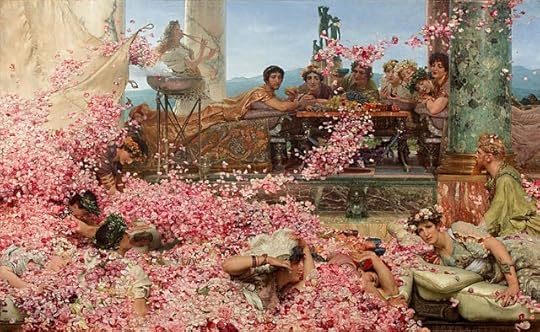
"There was a rainfall of roses in the sky"
The symbolic use of roses are employed very often by D'Annunzio,
"The recurring references to roses in this novel are significant. Roses have many meanings, but with regard to this novel, there are two that are most significant: that of symbolizing the female sex organs, and that of being associated with the Virgin Mary. In this novel, which frequently juxtaposes the sacred and the profane, the rose could be seen to be the most representative symbol of this juxtaposition."
and both the book and painting are set in Rome; although perhaps the main character would object, preferring a more modern depiction of the eternal city:
"Rome was his great love: not the Rome of the Caesars but that of the popes; not the Rome of the arches, of the thermal baths, of the forums, but the Rome of the villas, of the fountains, of the churches. He would have given the entire Colosseum for Villa Medici, Campo Vaccino for Piazza della Spagna, the Arch of Titus for the Fountain delle Tartarughe. The princely magnificence of the Colonnas, of the Dorias, of the Barberinis attracted him vastly more than the ruins of imperial grandeur."
"The world that D'Annunzio describes is the Rome of the nineteenth century, only recently the capital of Italy, with one foot in the old papal Rome, a sleepy, provincial, but extravagantly beautiful city dominated by the old aristocracy, and a newer world of lawyers, politicians, and a rising bourgeoisie. D'Annunzio—the lover of beauty—sides clearly with the first over the second."
__________
I enjoyed this a lot and it's one of my favourite novels.
"The young man felt his soul overcome by it."
D'Annunzio's writing is a joy to read; it has a beautiful, flowing quality which washes over you:
"Have you ever seen certain sweetmeats from Constantinople, as soft as dough, made from bergamot, orange blossom, and roses, which perfume your breath for the rest of your life?"
But I enjoyed the story on various levels,
"Oh, the story . . . is a marvel! Anabasis was nothing compared with this!"
and for multiple reasons. One of which is the immersive scenes he conjures up with his meticulously detailed descriptions of objects and people.
"My eyes were mistaken, drunk on perfumes."
Another is that it combines two things very close to my heart: aesthetics
"Art! Art! Here was the faithful Lover, always young, immortal; here was the Source of pure joy, forbidden to the multitude, conceded to the elect; here was the precious Food, which makes man similar to a god. How could he have drunk from other cups after bringing his lips to that one?
and the city of Rome.
"Divine Rome!"
"How marvelous! You are right to be so in love with Rome."
_____
I also feel like Andrea and I have a little in common
"By nature of his taste, he sought out multiple aspects of enjoyment . . . the complex delight of all the senses, intense intellectual emotion, abandons of sentiment, impulses of brutality. And because he sought out these things with skill, like an aesthete, he naturally drew from the world of objects a great part of his exhilaration."
__________
I could go on and on, but for the sake of brevity, I'll leave you with some information about the author from the Introduction:
"Having imbibed some Nietzsche, D'Annunzio saw himself as a kind of superman and was not content with mere literary fame . . . "The world . . . must be persuaded that I am capable of anything," he wrote during his first electoral campaign."
"The creation of his persona was D'Annunzio's principal vocation in life and art. He regarded life itself as a work of art. "Life imitates Art, far more than Art imitates Life", wrote Oscar Wilde, with whom D'Annunzio had much in common. In Pleasure, published in 1889 when D'Annunzio was only twenty-six, he created an exceptionally complex game of life and art imitating each other in infinite regression, like a pair of opposing mirroprs in which it is impossible to distinguish the object from the reflection."
__________
"The true reader is not really the one who buys me, but the one who loves me."
"True glory is posthumous, and therefore not able to be enjoyed."
___________
"I like it!"

September 19, 2021
Il piacere ovvero le avventure di un nobile mascalzone. Ovvero, come scambiare l’ Amore per il Piacere, ovvero ‘ma esiste poi questo Amore così tanto declamato e invocato oppure… ?
Sarei tentata di spoilerare la trama perché D’Annunzio è autore controverso, per quel poco che mi consta. Ha scrittura barocca con punte involute, ma sa sempre a che punto è la psicologia e il sentire intimo dei suoi protagonisti, anche di quelli minori e soprattutto sa descrivere un’epoca e un ambiente fatto di frivolezze, rose gettate sulla neve una notte, velluti e carrozze dove dare una carezza tra polsino e guanto a signore ricche e nobili, libere viaggiatrici gaudenti. (Oh, quanti aggettivi, troppi, me ne duole). Poi ci sono donne come Maria, romantiche, appassionate, di una purezza virginale nonostante sia sposata. Maria, che nell’ora suprema dell’orgasmo di Andrea Sperelli viene invocata come Elena e lì il sogno si infrange, tutto si frantuma sullo scoglio della realtà che siamo noi esseri umani, destinati al Piacere di vivere solo una vita, la più piena e la più miserabile possibile se non interviene il ben dell’intelletto, che pare freno ma è salvezza. Solo per alcuni, aggiungo io.
Leggerò ancora D’’Annunzio per il suo essere fino in fondo Gabriele. Per il suo descrivere l’animo umano fino alla più piccola piega nascosta da regole e convenzioni e lo leggerò ancora perché non lo giudico, giudicare lui come scrittore sarebbe come giudicare le sue creature che, se pure di carta sempre fatti di carne sangue e sogno.

August 5, 2017
Divina Roma, divino Gabriele!
Riletto dopo quasi vent’anni, questo romanzo conserva intatto tutto il suo fascino.
Gabriele d’Annunzio, nella giusta considerazione della sua arte e dell’epoca cui apparteneva, rimane un grande maestro di scrittura e di stile nella poesia come nella prosa. Mirabile la caratterizzazione dei personaggi, voluttuose le descrizioni delle alcove degli amanti, impietose quelle dell’aristocrazia di fin de siècle, decadente e annoiata dalle proprie miserie morali.
Al pari di Andrea Sperelli, Roma è l’altra grande protagonista di queste pagine: con le sue piazze e fontane, i suoi palazzi storici, le vedute dal Pincio, i suoi tramonti e le notti d’infinite malinconiche stagioni, la struggente bellezza dei paesaggi dell’anima… Divina Roma!
Chi li cerca, può trovarli ancora lì, quegli stessi luoghi, sebbene appesantiti dal tempo e dai frastuoni dell’oggi, ma pur sempre immersi nella poesia della città eterna.
Riletto dopo quasi vent’anni, questo romanzo conserva intatto tutto il suo fascino.
Gabriele d’Annunzio, nella giusta considerazione della sua arte e dell’epoca cui apparteneva, rimane un grande maestro di scrittura e di stile nella poesia come nella prosa. Mirabile la caratterizzazione dei personaggi, voluttuose le descrizioni delle alcove degli amanti, impietose quelle dell’aristocrazia di fin de siècle, decadente e annoiata dalle proprie miserie morali.
Al pari di Andrea Sperelli, Roma è l’altra grande protagonista di queste pagine: con le sue piazze e fontane, i suoi palazzi storici, le vedute dal Pincio, i suoi tramonti e le notti d’infinite malinconiche stagioni, la struggente bellezza dei paesaggi dell’anima… Divina Roma!
Chi li cerca, può trovarli ancora lì, quegli stessi luoghi, sebbene appesantiti dal tempo e dai frastuoni dell’oggi, ma pur sempre immersi nella poesia della città eterna.

February 9, 2020
Ho iniziato a leggere questo libro dopo aver cercato un libro in lingua italiana per rispolverare irriducibile in italiano. La trama sembra catturare il mio interesse e non sono rimasto deluso. Ho amato lo stile di scrittura, l'amore e la connessione dei personaggi principali. Alla fine mi sono innamorato di loro. Sono così felice di aver trovato questo libro.

August 9, 2017
Sublime
Un libro voluttuoso, per il quale si prova una immediata repulsione oppure, altrettanto immediatamente, se ne rimane avviluppati e avvinti. Ma la sensualità non è data tanto dalla storia d'amore in sé, quanto dagli accenti lirici e dalla poesia del testo, che scivola via avvolgendoci come un manto. Alla fine del romanzo al lettore non resta altro che farsi dolcemente cullare fra nostalgia e desiderio; la nostalgia per un mondo che non c'è più, spazzato via dalle mitragliatrici della Grande Guerra, ed il desiderio di partire per Roma, per percorrere le vie, le piazze, i fastosi saloni e i lussureggianti giardini dei meravigliosi palazzi magistralmente descritti da D'Annunzio.
Un libro voluttuoso, per il quale si prova una immediata repulsione oppure, altrettanto immediatamente, se ne rimane avviluppati e avvinti. Ma la sensualità non è data tanto dalla storia d'amore in sé, quanto dagli accenti lirici e dalla poesia del testo, che scivola via avvolgendoci come un manto. Alla fine del romanzo al lettore non resta altro che farsi dolcemente cullare fra nostalgia e desiderio; la nostalgia per un mondo che non c'è più, spazzato via dalle mitragliatrici della Grande Guerra, ed il desiderio di partire per Roma, per percorrere le vie, le piazze, i fastosi saloni e i lussureggianti giardini dei meravigliosi palazzi magistralmente descritti da D'Annunzio.

September 12, 2024
Non credevo che avrei mai letto un romanzo di D'Annunzio, temevo di farmi condizionare dalla mia non altissima opinione sull'autore, ma soprattutto ne temevo lo stile. La sua penna difatti è talmente virtuosa, ricca e poetica, da non aver affatto facilitato la lettura. Eppure forse è stato proprio grazie all'accuratezza dei particolari, allo sfoggio di una vastissima cultura, e alla ricerca maniacale delle parole selezionate, che mi sono fatta trasportare nel mondo di Andrea Sperelli, in questo vortice di passioni decadenti che ci dimostra quanto la natura meschina e narcisa dell'uomo, possa non solo nuocere ad altri, ma persino ritorcerglisi contro. Assolutamente soddisfatta di averlo letto.

January 30, 2015
Ho letto questo libro come parte del programma scolastico nelle letture consigliate dal mio professore.
Non posso dire che il romanzo mi sia pienamente piaciuto. La prima parte è stata l'unica in grado di coinvolgermi davvero, sebbene non mi siano dispiaciute parti del terzo e del quarto libro. Il secondo è stato una vera e propria Odissea: sono riuscita ad andare avanti solo perché mi sono imposta di non staccare gli occhi dal libro fino a che non avessi visto la scritta "terzo libro" (e sono riuscita a farlo solo perché la mattinata a scuola sarebbe stata più noiosa del libro stesso, altrimenti).
I personaggi sono vanesi, effimeri, per lo più egoisti; perseguono un ideale di vita estetica fine a se stesso, in grado di mettere in luce -a mio parere- solo le loro qualità peggiori, anziché elevarli spiritualmente. Andrea Sperelli ne è l'emblema, sebbene non sia migliore o peggiore degli altri, in fin dei conti. Inizialmente non mi dispiaceva (bisogna pur sempre considerare i personaggi all'interno del loro ambiente e come espressione di questo, al di là dell'essere d'accordo o meno con il loro stile di vita), tuttavia, soprattutto nella parte finale, non ho approvato affatto le sue scelte, e la sua incapacità di prendere una decisione definitiva.
Ma, d'altronde, è proprio questa così accurata descrizione della società romana del XIX secolo che mi ha colpito maggiormente, la capacità di G. d'Annunzio di descriverne le virtù, ma sopratutto i vizi. Ne sono rimasta favorevolmente impressionata, ed è per questo che ho deciso di dare 3 stelline a questo libro.
Per quanto riguarda lo stile, è facilmente individuabile la grande raffinatezza e ricercatezza che caratterizza d'Annunzio e che, nonostante sia a volte eccessivamente prosaico per i miei gusti, tutto sommato ho apprezzato per tutta la durata del romanzo. Sono rimasta colpita dal così esplicito riferimento alla vita sessuale dei personaggi: ero consapevole che le svolte principali del romanzo fossero dovute proprio a questa, ma non immaginavo che sarebbe descritta così. È un elemento d'innovazione che mi ha colpito, che sancisce definitivamente, credo, il superamento della letteratura italiana precedente.
Non è un romanzo accessibile a tutti, tuttavia credo che, essendo un classico della letteratura nostrana, debba essere letto.
Non posso dire che il romanzo mi sia pienamente piaciuto. La prima parte è stata l'unica in grado di coinvolgermi davvero, sebbene non mi siano dispiaciute parti del terzo e del quarto libro. Il secondo è stato una vera e propria Odissea: sono riuscita ad andare avanti solo perché mi sono imposta di non staccare gli occhi dal libro fino a che non avessi visto la scritta "terzo libro" (e sono riuscita a farlo solo perché la mattinata a scuola sarebbe stata più noiosa del libro stesso, altrimenti).
I personaggi sono vanesi, effimeri, per lo più egoisti; perseguono un ideale di vita estetica fine a se stesso, in grado di mettere in luce -a mio parere- solo le loro qualità peggiori, anziché elevarli spiritualmente. Andrea Sperelli ne è l'emblema, sebbene non sia migliore o peggiore degli altri, in fin dei conti. Inizialmente non mi dispiaceva (bisogna pur sempre considerare i personaggi all'interno del loro ambiente e come espressione di questo, al di là dell'essere d'accordo o meno con il loro stile di vita), tuttavia, soprattutto nella parte finale, non ho approvato affatto le sue scelte, e la sua incapacità di prendere una decisione definitiva.
Ma, d'altronde, è proprio questa così accurata descrizione della società romana del XIX secolo che mi ha colpito maggiormente, la capacità di G. d'Annunzio di descriverne le virtù, ma sopratutto i vizi. Ne sono rimasta favorevolmente impressionata, ed è per questo che ho deciso di dare 3 stelline a questo libro.
Per quanto riguarda lo stile, è facilmente individuabile la grande raffinatezza e ricercatezza che caratterizza d'Annunzio e che, nonostante sia a volte eccessivamente prosaico per i miei gusti, tutto sommato ho apprezzato per tutta la durata del romanzo. Sono rimasta colpita dal così esplicito riferimento alla vita sessuale dei personaggi: ero consapevole che le svolte principali del romanzo fossero dovute proprio a questa, ma non immaginavo che sarebbe descritta così. È un elemento d'innovazione che mi ha colpito, che sancisce definitivamente, credo, il superamento della letteratura italiana precedente.
Non è un romanzo accessibile a tutti, tuttavia credo che, essendo un classico della letteratura nostrana, debba essere letto.

April 17, 2019
There are certain books, such as Pleasure, that reach inside, grab you by the heart, and show you the commonality of your most touching life experiences...that drop-dead feeling you get when pure beauty seems to magically appear before your eyes; the look you unexpectedly receive from a person that captures your heart from across the room; the elation that is yours upon finding out that a love is mutually shared. These are some of the genuine human pleasures that D'Annunzio brings to life throughout this novel.
Layered upon that feel-good notion, D'Annunzio also illuminates pleasure as being an emotional commodity. While pleasure can be exchanged to the mutual enjoyment of those involved, if taken by one, the deficit of pleasure experienced by the other is among the most painful experiences in human existence. It’s D'Annunzio’s insistence on including this pain in his story that keeps the novel grounded and true.
And throughout the novel, D'Annunzio gives us one more dimension to pleasure. In this form, pleasure manifests itself as something that’s synthetic, almost counterfeit or fake. This type of pleasure can be had with personal achievements such as buying a coveted item or creating something with pride. However, D'Annunzio also points out that this type of pleasure is fleeting. It seems to dissipate almost as soon as it’s experienced leaving behind the desire for another hit in its wake.
All of these nuances of pleasure are explored by D'Annunzio in this novel that’s titled with that one solitary word. Considering that the completed work is a seamless tapestry of life, D'Annunzio’s study of this emotional concept is indeed a work of art.
Layered upon that feel-good notion, D'Annunzio also illuminates pleasure as being an emotional commodity. While pleasure can be exchanged to the mutual enjoyment of those involved, if taken by one, the deficit of pleasure experienced by the other is among the most painful experiences in human existence. It’s D'Annunzio’s insistence on including this pain in his story that keeps the novel grounded and true.
And throughout the novel, D'Annunzio gives us one more dimension to pleasure. In this form, pleasure manifests itself as something that’s synthetic, almost counterfeit or fake. This type of pleasure can be had with personal achievements such as buying a coveted item or creating something with pride. However, D'Annunzio also points out that this type of pleasure is fleeting. It seems to dissipate almost as soon as it’s experienced leaving behind the desire for another hit in its wake.
All of these nuances of pleasure are explored by D'Annunzio in this novel that’s titled with that one solitary word. Considering that the completed work is a seamless tapestry of life, D'Annunzio’s study of this emotional concept is indeed a work of art.

July 16, 2012
This book reminds of the movie Dangerous Liaisons except it takes place in late 19th century Rome and not late 18th century France. It tells the story of a man who lives a life devoted to the pursuit of his own pleasure and how it never brings him happiness. And he cannot understand why he isn't happy. The author does a good job of sympathetically portraying the protagonist, however he is the creater of his own misery, so I don't feel too sorry for him. He also makes the lives of the people around him miserable as well and so my sympathy lies with them.
I kept waiting for a dramatic climax, but the author simply illustrates how lonely the protagonist is. Even if he does find another lover, he will still push them away. And I suppose that is very sad and like-life. However, I sincerely wanted him to DIE. I suppose we could call that a merciful request for an end to his suffering....really, I'm just blood thirsty.
The saving grace of this book is the lovely way it is written. I don't imagine that there is another author who could do a better job of describing how bewitching and enchanting Rome can be during the different seasons. He also does a wonderful job of describing the opulent splendour in which the protagonist surrounds himself. Just simply lovely to envisage and read.
I kept waiting for a dramatic climax, but the author simply illustrates how lonely the protagonist is. Even if he does find another lover, he will still push them away. And I suppose that is very sad and like-life. However, I sincerely wanted him to DIE. I suppose we could call that a merciful request for an end to his suffering....really, I'm just blood thirsty.
The saving grace of this book is the lovely way it is written. I don't imagine that there is another author who could do a better job of describing how bewitching and enchanting Rome can be during the different seasons. He also does a wonderful job of describing the opulent splendour in which the protagonist surrounds himself. Just simply lovely to envisage and read.

May 6, 2019
L’Enfant de Volupté – Il Piacere
By Gabriele d’Annunzio (1863-1938)
D’Annunzio was an Italian Romantic poet, novelist and dramatist.
“The Child of Pleasure” was published in 1898.
It is the story of André, Count Sperelli-Fieschi d’Ugenta.
He is a rich young heir, exceptionally well educated young man and his life among the Roman high society are animated by social events, dinners, auction sales, club meetings, horse racings and more of the sort.
In his enviable position, it is an easy game for him to seduce every single or married lady he sets his eyes on.
He is known as a playboy and dandy.
All goes well until he meets a beautiful widow, Helen, with whom he seriously falls in love.
However, after several months of this intense love affair, Helen leaves him, and Rome without explanation.
André is destroyed and seeks to forget while throwing himself into countless short love makings with whoever crosses his path.
Meanwhile, after having provoked a rival in one of these encounters, he gets seriously wounded in a duel and is out of action for a long time.
While in convalescence at a lady friend’s summer palace, he meets the woman he needed to help him get over his downfall and bring him back to life, Donna Marie.
She is a married woman who is there on a summer holiday accompanied only by her little daughter Delphine.
Slowly the two protagonists approach each other as they exchange their many common interests in art and music.
As Donna Marie is very secretive, the author reaches to a witty tool to keep the reader informed.
He opens the diary where Marie writes down her secrets every day.
Thus we know that she has also fallen in love but will not admit it for a long time.
This adventure ends without immediate fulfilment as the summer holidays come to an end and all return to routine life.
André is now back in Rome. He quickly recovers his spirits and is looking for new candidates
for his ever insatiate appetite for the seduction of the opposite sex.
Slowly, as the reader turns pages, André’s character appears in a different light.
From the former young flirtatious dandy, he is becoming an experienced serial seducer.
Cynical and immoral. He uses his diabolical eloquence to create a spiderweb of sacred promises, sly excuses, admirative poems and luminous illusions.
From one romantic meeting to another, he follows a scheme of progress with one final object, possession of yet another female.
Such a system, however, is including the danger for the perpetrator of getting tangled up and become himself a victim.
The Roman society of that time seems to have been void of any civil or religious morals.
The only condition to be one of them was the appearance of wealth and success.
No one talks of money matters; you just have to have it.
The outstanding quality of the author's exceptional style, unusual rich vocabulary, detailed knowledge of all arts like painting, music, poetry, as well as the beauty of the Roman architecture and background makes this a remarkable book.
By Gabriele d’Annunzio (1863-1938)
D’Annunzio was an Italian Romantic poet, novelist and dramatist.
“The Child of Pleasure” was published in 1898.
It is the story of André, Count Sperelli-Fieschi d’Ugenta.
He is a rich young heir, exceptionally well educated young man and his life among the Roman high society are animated by social events, dinners, auction sales, club meetings, horse racings and more of the sort.
In his enviable position, it is an easy game for him to seduce every single or married lady he sets his eyes on.
He is known as a playboy and dandy.
All goes well until he meets a beautiful widow, Helen, with whom he seriously falls in love.
However, after several months of this intense love affair, Helen leaves him, and Rome without explanation.
André is destroyed and seeks to forget while throwing himself into countless short love makings with whoever crosses his path.
Meanwhile, after having provoked a rival in one of these encounters, he gets seriously wounded in a duel and is out of action for a long time.
While in convalescence at a lady friend’s summer palace, he meets the woman he needed to help him get over his downfall and bring him back to life, Donna Marie.
She is a married woman who is there on a summer holiday accompanied only by her little daughter Delphine.
Slowly the two protagonists approach each other as they exchange their many common interests in art and music.
As Donna Marie is very secretive, the author reaches to a witty tool to keep the reader informed.
He opens the diary where Marie writes down her secrets every day.
Thus we know that she has also fallen in love but will not admit it for a long time.
This adventure ends without immediate fulfilment as the summer holidays come to an end and all return to routine life.
André is now back in Rome. He quickly recovers his spirits and is looking for new candidates
for his ever insatiate appetite for the seduction of the opposite sex.
Slowly, as the reader turns pages, André’s character appears in a different light.
From the former young flirtatious dandy, he is becoming an experienced serial seducer.
Cynical and immoral. He uses his diabolical eloquence to create a spiderweb of sacred promises, sly excuses, admirative poems and luminous illusions.
From one romantic meeting to another, he follows a scheme of progress with one final object, possession of yet another female.
Such a system, however, is including the danger for the perpetrator of getting tangled up and become himself a victim.
The Roman society of that time seems to have been void of any civil or religious morals.
The only condition to be one of them was the appearance of wealth and success.
No one talks of money matters; you just have to have it.
The outstanding quality of the author's exceptional style, unusual rich vocabulary, detailed knowledge of all arts like painting, music, poetry, as well as the beauty of the Roman architecture and background makes this a remarkable book.

April 2, 2016
(opinione da leggere con Mussoliniana cadenza)
l'italica lettrice me medesima si è accostata fiduciosa alle avventure amor~perigliose del virilissimo Andrea Sperelli, ma ahimè, nonostante le fulgide premesse, a trionfare tra i vari sentimenti scaturiti è stato netto e spavaldo uno sconfinato... tedio. :-)
l'italica lettrice me medesima si è accostata fiduciosa alle avventure amor~perigliose del virilissimo Andrea Sperelli, ma ahimè, nonostante le fulgide premesse, a trionfare tra i vari sentimenti scaturiti è stato netto e spavaldo uno sconfinato... tedio. :-)

May 19, 2016
Probabilmente ho apprezzato più il romanzo che l'autore stesso. Non sono una grande fan del D'Annunzio, ma è stata una lettura abbastanza piacevole, non una delle mie preferite, ma se avessi del tempo libero probabilmente riprenderei questo libro.

December 31, 2014
Pleasure (Il Piacere) was D’Annunzio’s first novel (1889). The world it depicts is one of aristocratic decadence in late nineteenth century Rome. Andrea Sperelli, the central character of the novel and usually identified as D’Annunzio’s alter-ego, is a man of hyper-refined taste whose life revolves around writing poetry, acquiring precious objects, and seducing beautiful women. This makes for a novel that can at times be tediously precious and deeply disturbing, as women are constantly reduced to aesthetic objects admired largely for their capacity to evoke cherished objects: “ . . . the incomparable abdomen of Giulia Moceto, as polished as an ivory goblet, as pure as that of a statue” (109). Sperelli’s problem, however, is that, unlike the objects he collects, the women he would collect are human beings and so possess independent will. Seduction is the art of eroding the resistant will, and Pleasure provides entry into the mind of an artful and obsessive seducer. There is no masking what Sperelli is about: “The basis of his power lay in this: that in the art of love, he had no repugnance for any pretense, for any falseness, for any lie. A great part of his strength lay in his hypocrisy.” What characterizes his brand of seduction is the power of transference, of brushing a thick veneer of the sacred and artful over a fairly common human emotion: “And he took pleasure imagining for a long time the profane event amid the sacred events; and once again aesthetic sense and the refinement of sensuality overwhelmed and falsified in him the frank and human sentiment of love” (213). Eventually, though, Sperelli is trapped between two lovers, the sensual Elena and the spiritual Maria, each caught in circumstances Sperelli can’t control; they to some extent elude his considerable power. And, of course, any resistance to his desire brings an exaggerated and entirely selfish sense of tragedy: “I will never be able to tell you about all my suffering, all my desolation” (281). Pleasure paints a world that is both very, very far away—an aristocratic, decadent, hyper-aestheticized world now thankfully for the most part gone—and at the same time frightening close—at a certain stage in life don’t we all take hormone-soaked emotions just a bit too seriously? Mercifully, though, we typically lack the aesthetic resources to cover straightforward emotions with such a tiringly rich layer of self-serving verbiage.

October 20, 2019
D'Annunzio sputa versi come un drago. Sulle sue pagine fiamme, non parole. Inutile dirlo, ma lo dico lo stesso: davvero un vanto per la letteratura italiana (e abruzzese).

August 24, 2020
Non mi è piaciuto, leggerlo è stata una tortura. La trama è lenta ed esageratamente arricchita di descrizioni ridondanti, ad esempio il termine "adamantino" o "diafano" (sospetto che il produttore del testo ritenesse cosa colta o ricercata) è ripetuto spesso, i paesaggi o le stanze dove si svolgono i fatti vengono descritti, male, e spesso in modo drammaticamente ripetitivo.
Il contenuto è poco, ma molto poco. Un giorno per curiosità di lettore decisi di leggere un romanzo rosa da euro 2,99 acquistato su Kindle, aveva più da raccontare.
Dispiace molto che si sia data molta importanza a costui, vabbè che il periodo era quel che era 🤭, ma in Italia abbiamo esempi a non finire per non andare addirittura a confrontare questa "cosa" con Flaubert, così per dirne una.
Andrea Sperelli, noto sfaccendato, trascorre un periodo in un luogo chiamato "Schifanoia", ecco nel subconscio il "compilatore di fogli" aveva intuito il valore di questa "cosa".
Fatevi una passeggiata, andate a bere un caffè ma vi consiglio di non perdere tempo con questo libro.
P.s. il buon Fantozzi secondo me avrebbe espresso un giudizio non molto distante da quello sulla mitica "Corazzata Potemkin".
Il contenuto è poco, ma molto poco. Un giorno per curiosità di lettore decisi di leggere un romanzo rosa da euro 2,99 acquistato su Kindle, aveva più da raccontare.
Dispiace molto che si sia data molta importanza a costui, vabbè che il periodo era quel che era 🤭, ma in Italia abbiamo esempi a non finire per non andare addirittura a confrontare questa "cosa" con Flaubert, così per dirne una.
Andrea Sperelli, noto sfaccendato, trascorre un periodo in un luogo chiamato "Schifanoia", ecco nel subconscio il "compilatore di fogli" aveva intuito il valore di questa "cosa".
Fatevi una passeggiata, andate a bere un caffè ma vi consiglio di non perdere tempo con questo libro.
P.s. il buon Fantozzi secondo me avrebbe espresso un giudizio non molto distante da quello sulla mitica "Corazzata Potemkin".

April 6, 2023
Io ho un problema con la scrittura di D’Annunzio. Il piacere poi non mi è piaciuto per niente. Le due stelle sono per la scrittura che sicuramente è pregevole non lo metto in dubbio, ma io ricordo come un trauma ancora la descrizione di Piazza di Spagna di Roma. Capisco che chi non ci vive non può conoscerlo, ma io che sono di Roma, ho vissuto quella descrizione (come altre) come qualcosa di estenuante e noiosissimo.
November 8, 2024
Fascists know decadence like no other. This novel is so rich that after reading a few chapters, it induces nausea, and then suddenly lethargy takes over. The same as when one eats too much chocolate. I liked this one :)
"My eyes were mistaken, drunk on perfumes."
"My eyes were mistaken, drunk on perfumes."

March 9, 2021
Dovremmo cercare tutti di essere più Elena Muti e meno Maria Ferres.
Displaying 1 - 30 of 432 reviews