

What do you think?
Outremer. Studies in the Crusades and the Latin East
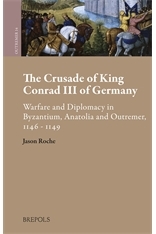
The Crusade of King Conrad III of Germany: Warfare and Diplomacy in Byzantium, Anatolia and Outremer, 1146 - 1149
This book represents the first work of history dedicated to the crusade of King Conrad III of Germany (1146-49), emperor-elect of the western Roman Empire and the most powerful man yet to assume the Cross. Even so, many of the people following the king on the Second Crusade were dead before they reached Constantinople and their ranks were devastated in Anatolia. Yet he went on to join with his fellow kings, Louis VII of France and Baldwin III of Jerusalem, in an attempt to capture the city of Damascus, the most powerful Muslim stronghold in southern Syria. Their unsuccessful attack lasted just five days. The recriminations for the many privations and problems the Germans suffered and encountered in Byzantium, Anatolia and Outremer were long and loud and have echoed down the ages: German indiscipline and poor leadership, Byzantine deceit and duplicity, and the self-serving interests of a Latin Jerusalemite nobility were and still are blamed for the various failings of the expedition. Scrutinising the original source evidence to an unprecedented degree and employing a range of innovative, multi-disciplinary approaches this work challenges the traditional and more recent historiography at every turn leading to a significantly clearer and fundamentally different understanding of the expedition's complex and much maligned history.
300 pages, Hardcover
First published June 15, 2019
Ratings & Reviews
Friends & Following
Create a free account to discover what your friends think of this book!
Community Reviews
Displaying 1 - 2 of 2 reviews

June 4, 2022
Excellent history of the Second Crusade. Offers an entirely updated appraisal of the German expedition to the East.
The Second Crusade was an enormous undertaking, taken up by the kings of both Germany and France. The professed goal was the reconquest of Edessa, the first Crusader State which fell to the Muslims. Each monarch led his own army across Europe to Byzantium, and into Asia. The crusade almost came to nothing, when first the German and shortly thereafter the French army were severely mauled by Turkmen forces, and some large parts entirely annihilated. In the end, the crusaders managed to reach Jerusalem but were unable to inflict any kind of blow on the Muslims. This has been explained by historians of the nineteenth century as a result of Conrads weak and vacillating personality.
Roche takes an entirely new approach to evaluating the Second Crusade; most modern scholars have accepted the nineteenth century depictions of both the events of the crusade and the actions of Conrad himself. By going back to the three foremost primary sources (John Kinnamos and Niketas Choniates from the Byzantine perspective and Odo of Deuil from the French perspective), he gives us an entirely new evaluation. He does this by looking at the sources with a critical eye. He establishes their biases, and with those in mind paints us a different picture of events. For instance, John Kinnamos has a severe bias against anything western, equating all non-Greeks with barbarians. The reason for writing his work is to shift attention away from the (then) recent military defeats of the Byzantine emperor by shining a light on his successful management of the German attack on Constantinople. This supposed attack was a chimaera, a trope of the Byzantine worldview. It is in Johns interest to portray the Germans in general and Conrad in particular as aggressive oafs, and the Byzantine emperor as a shrewd general. Niketas Choniates (re)wrote his work after the fall of Constantinople in 1204, and attempted to explain the fall by painting a picture of Byzantine iniquity in regards to the sincere and faithful crusaders. Odo of Deuil was a propagandist – in the service of abbot Suger – for the narrative of the sacred link between the House of Capet and St. Denis. His work was intended to be part of Sugers larger work. He was at pains to describe the failure of the undertaking, without linking it in some way to the failing of the French and their leader. To circumvent that, he blames the Germans and Byzantines.
Next to the critical appraisal of the main primary sources comes the evidence of other, more remote sources. Quite a number of German writers have parts of witness-reports, and of course the monarch’s letters give us some insights. An essential part of the reappraisal is the close association between Conrad and Manuel Komnenos, the Byzantine emperor. Apparently co-operation between the Byzantines and the Germans went much further than was previously assumed. And what I found very inventive was Roches use of a theoretical model to roughly calculate the needs of the army in the way of provisions, and the economy of the Byzantine hinterland. This sets us on the path of “an army marches on its stomach”, and gives us the final piece of the puzzle. This model serves very well to explain the difficulty of acquiring foodstuffs on the way, and how much could be carried as baggage – and at what extra cost in fodder.
Loved it.
The Second Crusade was an enormous undertaking, taken up by the kings of both Germany and France. The professed goal was the reconquest of Edessa, the first Crusader State which fell to the Muslims. Each monarch led his own army across Europe to Byzantium, and into Asia. The crusade almost came to nothing, when first the German and shortly thereafter the French army were severely mauled by Turkmen forces, and some large parts entirely annihilated. In the end, the crusaders managed to reach Jerusalem but were unable to inflict any kind of blow on the Muslims. This has been explained by historians of the nineteenth century as a result of Conrads weak and vacillating personality.
Roche takes an entirely new approach to evaluating the Second Crusade; most modern scholars have accepted the nineteenth century depictions of both the events of the crusade and the actions of Conrad himself. By going back to the three foremost primary sources (John Kinnamos and Niketas Choniates from the Byzantine perspective and Odo of Deuil from the French perspective), he gives us an entirely new evaluation. He does this by looking at the sources with a critical eye. He establishes their biases, and with those in mind paints us a different picture of events. For instance, John Kinnamos has a severe bias against anything western, equating all non-Greeks with barbarians. The reason for writing his work is to shift attention away from the (then) recent military defeats of the Byzantine emperor by shining a light on his successful management of the German attack on Constantinople. This supposed attack was a chimaera, a trope of the Byzantine worldview. It is in Johns interest to portray the Germans in general and Conrad in particular as aggressive oafs, and the Byzantine emperor as a shrewd general. Niketas Choniates (re)wrote his work after the fall of Constantinople in 1204, and attempted to explain the fall by painting a picture of Byzantine iniquity in regards to the sincere and faithful crusaders. Odo of Deuil was a propagandist – in the service of abbot Suger – for the narrative of the sacred link between the House of Capet and St. Denis. His work was intended to be part of Sugers larger work. He was at pains to describe the failure of the undertaking, without linking it in some way to the failing of the French and their leader. To circumvent that, he blames the Germans and Byzantines.
Next to the critical appraisal of the main primary sources comes the evidence of other, more remote sources. Quite a number of German writers have parts of witness-reports, and of course the monarch’s letters give us some insights. An essential part of the reappraisal is the close association between Conrad and Manuel Komnenos, the Byzantine emperor. Apparently co-operation between the Byzantines and the Germans went much further than was previously assumed. And what I found very inventive was Roches use of a theoretical model to roughly calculate the needs of the army in the way of provisions, and the economy of the Byzantine hinterland. This sets us on the path of “an army marches on its stomach”, and gives us the final piece of the puzzle. This model serves very well to explain the difficulty of acquiring foodstuffs on the way, and how much could be carried as baggage – and at what extra cost in fodder.
Loved it.

Read
July 26, 2021he dont know what he get in to!!! go back to germany silly man
Displaying 1 - 2 of 2 reviews