

What do you think?

Astra Black #1
Sweep of Stars
Maurice Broaddus's Sweep of Stars is the first in a trilogy that explores the struggles of an empire. Epic in scope and intimate in voice, it follows members of the Muungano empire – a far-reaching coalition of city-states that stretches from O.E. (original earth) to Titan – as it faces an escalating series of threats.
"The beauty in blackness is its ability to transform. Like energy we are neither created nor destroyed, though many try." - West African Proverb
The Muungano empire strived and struggled to form a utopia when they split away from old earth. Freeing themselves from the endless wars and oppression of their home planet in order to shape their own futures and create a far-reaching coalition of city-states that stretched from Earth and Mars to Titan.
With the wisdom of their ancestors, the leadership of their elders, the power and vision of their scientists and warriors they charted a course to a better future. But the old powers could not allow them to thrive and have now set in motion new plots to destroy all that they've built.
In the fire to come they will face down their greatest struggle yet.
Amachi Adisa and other young leaders will contend with each other for the power to galvanize their people and chart the next course for the empire.
Fela Buhari and her elite unit will take the fight to regions not seen by human eyes, but no training will be enough to bring them all home.
Stacia Chikeke, captain of the starship Cypher, will face down enemies across the stars, and within her own vessel, as she searches for the answers that could save them all.
The only way is forward.
"The beauty in blackness is its ability to transform. Like energy we are neither created nor destroyed, though many try." - West African Proverb
The Muungano empire strived and struggled to form a utopia when they split away from old earth. Freeing themselves from the endless wars and oppression of their home planet in order to shape their own futures and create a far-reaching coalition of city-states that stretched from Earth and Mars to Titan.
With the wisdom of their ancestors, the leadership of their elders, the power and vision of their scientists and warriors they charted a course to a better future. But the old powers could not allow them to thrive and have now set in motion new plots to destroy all that they've built.
In the fire to come they will face down their greatest struggle yet.
Amachi Adisa and other young leaders will contend with each other for the power to galvanize their people and chart the next course for the empire.
Fela Buhari and her elite unit will take the fight to regions not seen by human eyes, but no training will be enough to bring them all home.
Stacia Chikeke, captain of the starship Cypher, will face down enemies across the stars, and within her own vessel, as she searches for the answers that could save them all.
The only way is forward.
368 pages, Kindle Edition
First published March 29, 2022
Ratings & Reviews
Friends & Following
Create a free account to discover what your friends think of this book!
Community Reviews
Displaying 1 - 30 of 80 reviews

April 18, 2022
3.5 Stars
As the title suggests, this is a sweeping piece of epic science fiction. The worldbuilding is complex and rich.
I always appreciate reading ownvoices African futurist literature. In terms of the narrative structure, this novel reminded me a bit of N. K. Jemisin. In regards to worldbuilding, I got Nnedi Okorafor vibes. Yet, this author certainly held up on his own as a talented, strong voice.
Yet, I must acknowledge that I never became fully immersed in this novel. The narrative structure was very unique but also made it hard to connect with the characters. I just found myself distanced from the story that kept me from getting lost in the narrative.
I would recommend this book to readers looking for a fresh new sci fi epic series filled with complex, diverse characters and lush futuristic worlds to explore.
Disclaimer I received a copy of this book from the publisher.
As the title suggests, this is a sweeping piece of epic science fiction. The worldbuilding is complex and rich.
I always appreciate reading ownvoices African futurist literature. In terms of the narrative structure, this novel reminded me a bit of N. K. Jemisin. In regards to worldbuilding, I got Nnedi Okorafor vibes. Yet, this author certainly held up on his own as a talented, strong voice.
Yet, I must acknowledge that I never became fully immersed in this novel. The narrative structure was very unique but also made it hard to connect with the characters. I just found myself distanced from the story that kept me from getting lost in the narrative.
I would recommend this book to readers looking for a fresh new sci fi epic series filled with complex, diverse characters and lush futuristic worlds to explore.
Disclaimer I received a copy of this book from the publisher.

April 14, 2022
An afrofuturist novel that Muungano is a space-based African-centered nation with population centers on the Moon, Titan and asteroid mining colonies. It's also a young society growing into different values than those of the Earth (OE for Original Earth) which is still riven with greed and religious extremism. When an artificial wormhole is discovered in orbit around Saturn, Muungano begins to suffer setbacks on multiple fronts, including terrorist attacks, the death of a charismatic leader and other setbacks.
There's a great story in here. A great story that is viciously strangled by chapters on chapters of Muungano characters speaking and reciting poetry about how utopian and different their society is and how important community is. Seriously, one of the different values that this society appreciates is apparently beat poetry ...
It's also not helped by having a large number of point of view characters, small sections of narrative given to each and a lack of exposition in important areas. Far too much exposition on the nature of utopian society and almost no exposition on things like what it means to be HOVA for instance. From context HOVA are the military arm of Muungano, and they've got some sort of cybernetic and biological augmentation (two sets of mitochondria are mentioned for instance), but there's just far too little said about them, even though they're actually a major part of the book.
But the idea of Muungano under attack by OE forces that see them as a breakaway lesser branch of humanity that must be reunited to deal with the alien threat posed by the wormhole is a clever one. And would have been compelling in a book half this size.
There's a great story in here. A great story that is viciously strangled by chapters on chapters of Muungano characters speaking and reciting poetry about how utopian and different their society is and how important community is. Seriously, one of the different values that this society appreciates is apparently beat poetry ...
It's also not helped by having a large number of point of view characters, small sections of narrative given to each and a lack of exposition in important areas. Far too much exposition on the nature of utopian society and almost no exposition on things like what it means to be HOVA for instance. From context HOVA are the military arm of Muungano, and they've got some sort of cybernetic and biological augmentation (two sets of mitochondria are mentioned for instance), but there's just far too little said about them, even though they're actually a major part of the book.
But the idea of Muungano under attack by OE forces that see them as a breakaway lesser branch of humanity that must be reunited to deal with the alien threat posed by the wormhole is a clever one. And would have been compelling in a book half this size.

May 26, 2022
Check out my Booktube channel at: The Obsessive Bookseller
[2.5/5 stars] Sweep of Stars was an interesting read.
The first half of the book was very much all about the characters – establishing the many POVs and introducing the reader to their society. My favorite thing about the book was this inspiring sense of community the group created – one where looking out for one another and doing things in the interest of the people rather than the self was commonplace. A place where everyone genuinely cared about one another and found this familial unity because of it. I think our world could use a bit more of the Muungano spirit. Granted, some characters were better at upholding the “Muungano way” more than others, but that’s where the story’s conflicts start to trickle in.
It took a while for the driving plot/purpose of the story to become evident – almost 50% through the book. I was wondering well before that if there WAS going to be an external conflict or if we’d be getting a more B.Chambers-style novel. Craving a bit more from the story, I thought the conflicts sparked a bit of life back into it and provided some decent momentum through the end of the book.
Because the novel was so character-driven from the start, I’m surprised that I didn’t have more of a connection to them. I think part of the problem was the shear number of POVs (7 or 8), so it took a long time to get back to any one character, effectively killing all the momentum. By the time the conflicts started hitting, I cared about what happened, but didn’t feel more than an arms-distance investment in the story as a whole. I think fewer characters and a quicker inciting (a clear one, anyway) moment would’ve gone a long way to improving my experience.
While most of the characters were written in the third person, one was written in second person, one in first, and one in (I believe) first person plural (like, “we do this, we do that”). I’m generally a lot more welcoming than many readers when it comes to authors playing with perspectives in books, especially if it’s incorporated for a purpose. It can lead to some cool payoffs, like the reason for the second-person perspective in N.K. Jemisin’s Broken Earth trilogy (which is brilliant, and still one of my favorite reveals of anything I’ve read). In this case, I imagine the variety of perspectives was fun for the author to play around with, but I didn’t see evidence in this first book indicating it was any more than just a novelty.
To that end, and I’m by no means an expert on this, some of the perspective dynamics didn’t make sense to me. For example, if you have both an “I” (first person) and a “you” (second person) character, doesn’t that usually indicate that it’s the “I” character narrating both perspectives? Like, “I do this and you do that?” And if the two were to come together in the same scene, the “I” (let’s call him Bob) character wouldn’t say “you look at Bob,” he would say, “you look at ME.” … only, that didn’t happen in the book when the characters met, indicating that there are perhaps two “I” perspectives (or three, counting the “we” perspective) and we just haven’t met the third “I” yet? Lol are you confused yet?! I’m still trying to make the POV math add up in my head. The discrepancy wasn’t a huge detraction from the story, but thoughts about it did pull me out a lot more than I wish they had.
Creative POVs aside, the writing was very artfully done. The prose flowed well and some of the basic sentence construction choices screamed to me of a writer who knows his voice and conveys it well. Even though I didn’t always feel connected to the characters and the story, I still appreciated the writing.
As a minor note, I attempted to switch to audio several chapters in for my commute and found it a wildly different experience. The cultural cadence of the narrator put pauses into sentences that weren’t present in the text – giving the narrative a very disjointed feel that I don’t think served the beautiful writing style very well. Because of that I’d suggest going the text route with this one.
Recommendations: this is an interesting Scifi with some great initial ideas. If you enjoy more character-driven Scifi and don’t mind some creative perspectives infusions, this might be a great pick. To get the most out of the prose, skip the audio on this one.
Via The Obsessive Bookseller at www.NikiHawkes.com
Other books you might like:


[2.5/5 stars] Sweep of Stars was an interesting read.
The first half of the book was very much all about the characters – establishing the many POVs and introducing the reader to their society. My favorite thing about the book was this inspiring sense of community the group created – one where looking out for one another and doing things in the interest of the people rather than the self was commonplace. A place where everyone genuinely cared about one another and found this familial unity because of it. I think our world could use a bit more of the Muungano spirit. Granted, some characters were better at upholding the “Muungano way” more than others, but that’s where the story’s conflicts start to trickle in.
It took a while for the driving plot/purpose of the story to become evident – almost 50% through the book. I was wondering well before that if there WAS going to be an external conflict or if we’d be getting a more B.Chambers-style novel. Craving a bit more from the story, I thought the conflicts sparked a bit of life back into it and provided some decent momentum through the end of the book.
Because the novel was so character-driven from the start, I’m surprised that I didn’t have more of a connection to them. I think part of the problem was the shear number of POVs (7 or 8), so it took a long time to get back to any one character, effectively killing all the momentum. By the time the conflicts started hitting, I cared about what happened, but didn’t feel more than an arms-distance investment in the story as a whole. I think fewer characters and a quicker inciting (a clear one, anyway) moment would’ve gone a long way to improving my experience.
While most of the characters were written in the third person, one was written in second person, one in first, and one in (I believe) first person plural (like, “we do this, we do that”). I’m generally a lot more welcoming than many readers when it comes to authors playing with perspectives in books, especially if it’s incorporated for a purpose. It can lead to some cool payoffs, like the reason for the second-person perspective in N.K. Jemisin’s Broken Earth trilogy (which is brilliant, and still one of my favorite reveals of anything I’ve read). In this case, I imagine the variety of perspectives was fun for the author to play around with, but I didn’t see evidence in this first book indicating it was any more than just a novelty.
To that end, and I’m by no means an expert on this, some of the perspective dynamics didn’t make sense to me. For example, if you have both an “I” (first person) and a “you” (second person) character, doesn’t that usually indicate that it’s the “I” character narrating both perspectives? Like, “I do this and you do that?” And if the two were to come together in the same scene, the “I” (let’s call him Bob) character wouldn’t say “you look at Bob,” he would say, “you look at ME.” … only, that didn’t happen in the book when the characters met, indicating that there are perhaps two “I” perspectives (or three, counting the “we” perspective) and we just haven’t met the third “I” yet? Lol are you confused yet?! I’m still trying to make the POV math add up in my head. The discrepancy wasn’t a huge detraction from the story, but thoughts about it did pull me out a lot more than I wish they had.
Creative POVs aside, the writing was very artfully done. The prose flowed well and some of the basic sentence construction choices screamed to me of a writer who knows his voice and conveys it well. Even though I didn’t always feel connected to the characters and the story, I still appreciated the writing.
As a minor note, I attempted to switch to audio several chapters in for my commute and found it a wildly different experience. The cultural cadence of the narrator put pauses into sentences that weren’t present in the text – giving the narrative a very disjointed feel that I don’t think served the beautiful writing style very well. Because of that I’d suggest going the text route with this one.
Recommendations: this is an interesting Scifi with some great initial ideas. If you enjoy more character-driven Scifi and don’t mind some creative perspectives infusions, this might be a great pick. To get the most out of the prose, skip the audio on this one.
Via The Obsessive Bookseller at www.NikiHawkes.com
Other books you might like:

February 18, 2022
Man... I did not enjoy this. A lot of the minor issues I think are due to the fact that this is an in corrected ARC, so I won’t hold those against it. But there were a lot of major problems for me.
First, the chapters are from various characters’ POV—which isn’t a problem at all. HOWEVER, Broadus switches voices. So while most chapters are told in third person, one character is told in SECOND person, and two are first person. And one of the first person characters refers to himself as “we”... except for when he doesn’t. And I can’t tell if that’s intentional or an editing error to be corrected later. It happens way too often I think to be a minor mistake, though.
The second big thing is that while the overarching outline of the story is pretty cool, the details don’t make sense, or really match up with the rest of the story. There are some really big logical jumps that I just can’t get my head around. And some character decisions that just don’t seem to make any sense.
Third, the characters mostly felt flat. It was very difficult to tell them apart. I feel like you could mix up some of the dialog, assign it to different characters, and no one would be able to tell. Unless it was one of those odd times for a weird POV.
Those major problems were enough to completely drop my interest and boot me from the story. And it really is too bad. I went in to this one very excited to get a different sort of story from a different viewpoint. Unfortunately it just did not work very well for me.
First, the chapters are from various characters’ POV—which isn’t a problem at all. HOWEVER, Broadus switches voices. So while most chapters are told in third person, one character is told in SECOND person, and two are first person. And one of the first person characters refers to himself as “we”... except for when he doesn’t. And I can’t tell if that’s intentional or an editing error to be corrected later. It happens way too often I think to be a minor mistake, though.
The second big thing is that while the overarching outline of the story is pretty cool, the details don’t make sense, or really match up with the rest of the story. There are some really big logical jumps that I just can’t get my head around. And some character decisions that just don’t seem to make any sense.
Third, the characters mostly felt flat. It was very difficult to tell them apart. I feel like you could mix up some of the dialog, assign it to different characters, and no one would be able to tell. Unless it was one of those odd times for a weird POV.
Those major problems were enough to completely drop my interest and boot me from the story. And it really is too bad. I went in to this one very excited to get a different sort of story from a different viewpoint. Unfortunately it just did not work very well for me.

February 26, 2024
Sweep of Stars (Astra Black #1) by Maurice Broaddus was pretty cool. Don't skip this if you're looking for Afrofuturism or space opera reads! I really appreciated that it includes a list of families and a glossary even. I'll have to keep my eyes open for the sequel, Breathe of Oblivion, which will be released on August 27th of this year. If you like N.K. Jemisin and James S.A. Corey, you'll have to read this sci-fi series opener.

to-read-so-bad-it-hurts
March 31, 2019A debut space opera trilogy that explores an intergalactic Afrofuturist empire, like yesssssssss!

November 6, 2021
1 star, too far out there
SWEEP OF STARS
by Maurice Broaddus
This book was too far out into fantasy land for me. I tried repeatedly from different sections of the book, simply was unable to get interested in the story.
I received a complimentary copy of #sweepofstars from #tor I was not required to post a review.
SWEEP OF STARS
by Maurice Broaddus
This book was too far out into fantasy land for me. I tried repeatedly from different sections of the book, simply was unable to get interested in the story.
I received a complimentary copy of #sweepofstars from #tor I was not required to post a review.

July 6, 2022
I got lots of love in my heart for some authors. Although we only hung out in the flesh once, Maurice Broaddus and I grew an hour's drive away from each other. We grew up on the same TV horror host and the thing is he is an amazing and one of kind author I have read and reviewed over and over. When the deal was made for this trilogy, it was sold as an Afrofuturist take on The Expanse. These kinds of marketing comparisons are often reductive but, in this case, I think that is a fair take. I mean I was totally sold on that. It is not hard SF in the way The Expanse has wormholes, but Sweep also has time travel, and other light fantastical elements.
When writing about his short story collection I said this. “The Voices of Martyrs will largely be overlooked because short story collections rarely sell as much as novels. This finely-tuned collection is a must-read for anyone interested in high-quality dark literature. The most powerful collection I have read since Brian Evenson's A Collapse of Horses. Both are important reads however Voice of Martyrs goes beyond just being good, it is a book of deep meaning.”
I bring this up because if you want to know how good of a writer Broaddus is that is the best example. That being said this is the most fun I have had reading a MB book. That is saying something as he has a series that is “The Wire” -ish retelling of King Arthur and award-winning Steampunk novellas. My feeling is once the trilogy comes together the strength of the greater narrative will only increase. This book will lose some lazy readers, but hey I have been told by lots of people they couldn’t get into Dune. Those people are wrong but it is understandable I suppose as Dune is dense as gluten-free bread. As a fan of intense world-building, it works for me but sometimes it is unexplainable alchemy. There were times I was a little lost on who was where, and who was who but that doesn’t always turn me off. I am along for the ride until I figure it out.
Thankfully this book came with a handy list of families and a timeline in the opening and a glossary in the closing pages. I tried not to refer to these but I read the timeline at the open and checked in on it a couple of times. This novel is set against the backdrop of The Muungano Empire, an African Diaspora set after post ecological collapse of the earth spread through the solar system mostly on the Moon, Mars, and Titan. LISC represents O.E. (Old Earth) interests. There is a bit of a cold war stalemate until in 2120 the Orun Gate wormhole is discovered.
This opening to another star system is firmly in control of The Muungano Empire and that is the jumping-off for the novel that takes place in 2121. Before I go deep into the story where minor spoilers might exist let's say that this is a 5-star book to me and a recommendation. MB does a great job of World-building what feels to this outsider like a credible solar system spanning neo-African culture. Their dominance is a result of a time travel accident that gave the crew a chance with modern tech extra time to re-build in the past but they spent most of that time hiding on the moon creating “The Dreaming City” and positioning themselves to become a dominant power. Considering the colonial history Africa dealt with this new culture is trying something different
A Sweep of Stars mixes deep cultural mythology and African vibes with characters who keep it real. Characters who give their family members shit and curse like normal people. That really helped me relate to the characters. I made the mistake of reading some of the reviews and I couldn’t help but notice how many of the reviewers failed to comment on many of the social-political commentaries that is dripping off the pages of this book. There is some lip-service #ownvoices in some of the reviews folks need to slow down and look a little closer at what Sweep of Stars is laying down.
Sweep of Stars is Space Opera with an African feeling, it is an epic tale with lots of characters, narrative shifts, and twists and at the heart is a story that is entertaining for the events we witness as much as the radical ideas that get a subtle introduction. I found the novel well written, some readers had a hard time that certain chapters slipped into second person. I will be interviewing MB for the podcast soon so we will the exact reason. I suspected this was a way for the narrative to express the idea that you are a part of the future. Maybe I am overthinking it.
So yeah big thumbs up. That may sound highbrow and snooty but there are space marines, battles, aliens, pirates, rasta Jedis, and murder mystery as well. Let's get into details.
Of course, I dug that MB gave a shout-out to his hometown of Indianapolis which is apparently the capital of Old Earth. In this future. Shout out to my future Hoosiers.
“Several figures wearing light scattering masks designed to defeat facial-recognition algorithm stormed about. Some toted phase EMP carronades. The international district of Indianapolis was once the side of town that suffered from benign neglect of city officials. Property values plummeted, money enough to rebrand the area and immigrants moved in. And flourished. Through LISC, the city found money enough to rebrand the area the International District. This grew into the international marketplace, which soon housed several embassies once the nation’s capital shifted to the booming metropolis.”
There is a scene with the panting of the learning tree that seemed like an even more direct shout-out to real folks in the author’s life. Muungano culture is an interesting one, a somewhat Anarchist culture. The character of Xola who is murdered as head of a family is a goofball who loves telling stories and embarrassing his family. Sound like someone who has his picture on the dust jacket?
Muungano culture doesn’t fit neatly into western political boxes, collectivist and anarchist in many ways, but is structured on traditions deeply rooted in family legacy.
“All of Muungano’s Territory lit up as a hologram projection, from the Dreaming City to Mars to the mining outpost. No borders, per se, not the way O.E. might define them. Only communities of alliance. This was what they had all fought so hard to forge. They needed a new vocabulary to describe the experiment they embarked on. Empire wasn’t it. A budding cooperative cradled in a sweep of stars.”
This is one of the first elements I have seen ignored in almost all the reviews I have read. This may seem like simple world-building and MB does it subtle and right. These moments are not over-explained, they are naturally told in the midst of the story. You will of course notice the title of the book so it is not a stretch to think this passage is part of the mission statement of this story.
Leguin and Spinrad are some of the most well-known genre anarchists and I am not saying this book goes that far but it is clear MB is suggesting a divorce from western culture and standard capitalist monoculture. At the same time, this future while vastly different and divergent from our timeline is connected by characters like the Hellfighters soldiers who make a point not to forget the struggles the African diaspora had in our times.
This was highlighted in a fun exchange when a soldier who was called the keeper of the belt explained that he was wearing the belt of the Notorious B.I.G.
“It’s true. When you set your eyes on it again, you need to realize that you’re looking at a piece of hip-hop history. A holy relic.”
“You’re ridiculous.”
Their generation, not-quite-affectionately called neoniks, loved the late-twentieth-century era as part of what they called The Remember Revolution. They committed themselves to never forget the tragedies of O.E., from Black Wall Street to MOVE to First World. Admirable in philosophy, though in practice, they basically just adopted the era’s slang.”
I like how this scene begins amusing but ends with a powerful statement letting the reader know that the issues of racism and colonialism are not forgotten in this radically changed future. While the main focus of the story is the intrigue, the action, and the characters it was the ideas I found radically moving. Don’t get me wrong I enjoyed the story but asides like this spoke to me.
“We’ became slaves to wheat,” Stacia said.
“Yes. Wheat, the technology and systematic impact of agriculture, tricked us into serving it and spreading it around the world. Similarly, you don’t own the wormhole and you certainly don’t control it.”
I can’t really say at this point that this is a deeply intentionally radical book. It is however a science fiction novel of radical ideas. Some of the mainstream science fiction fandoms may have a problem with this but fuck a whole bunch of that. The novel speaks to this…
“…We stand in opposition to their entire way of life. We created ways of being and moving. Of valuing and celebrating one another. Allowing our systems – political and economic – to grow out of our humanity. Seeking only the best for one another and our community. That’s why we’re a threat. And will always be seen as one.”
Or…
“As you can imagine, all of this only fueled O.E.’s paranoia of us, stoking their fears that we plotted against them. They came to believe that it was only a matter of time before we unleashed the destructive force of our military might. Because history has told us that is what they would have done.”
Damn, I love Sweep of Stars. As a piece of space opera, it is fun, every bit as filled with intrigue and action as The Expanse. As a piece of World-building, it is every bit as thought out as Dune. As a work of thoughtful speculation, it is as mindful and literary as Hyperion As a work of radical science fiction, it is every bit as radical as The Dispossessed. Hyperbole, maybe but Sweep of Stars earned it with me.
When writing about his short story collection I said this. “The Voices of Martyrs will largely be overlooked because short story collections rarely sell as much as novels. This finely-tuned collection is a must-read for anyone interested in high-quality dark literature. The most powerful collection I have read since Brian Evenson's A Collapse of Horses. Both are important reads however Voice of Martyrs goes beyond just being good, it is a book of deep meaning.”
I bring this up because if you want to know how good of a writer Broaddus is that is the best example. That being said this is the most fun I have had reading a MB book. That is saying something as he has a series that is “The Wire” -ish retelling of King Arthur and award-winning Steampunk novellas. My feeling is once the trilogy comes together the strength of the greater narrative will only increase. This book will lose some lazy readers, but hey I have been told by lots of people they couldn’t get into Dune. Those people are wrong but it is understandable I suppose as Dune is dense as gluten-free bread. As a fan of intense world-building, it works for me but sometimes it is unexplainable alchemy. There were times I was a little lost on who was where, and who was who but that doesn’t always turn me off. I am along for the ride until I figure it out.
Thankfully this book came with a handy list of families and a timeline in the opening and a glossary in the closing pages. I tried not to refer to these but I read the timeline at the open and checked in on it a couple of times. This novel is set against the backdrop of The Muungano Empire, an African Diaspora set after post ecological collapse of the earth spread through the solar system mostly on the Moon, Mars, and Titan. LISC represents O.E. (Old Earth) interests. There is a bit of a cold war stalemate until in 2120 the Orun Gate wormhole is discovered.
This opening to another star system is firmly in control of The Muungano Empire and that is the jumping-off for the novel that takes place in 2121. Before I go deep into the story where minor spoilers might exist let's say that this is a 5-star book to me and a recommendation. MB does a great job of World-building what feels to this outsider like a credible solar system spanning neo-African culture. Their dominance is a result of a time travel accident that gave the crew a chance with modern tech extra time to re-build in the past but they spent most of that time hiding on the moon creating “The Dreaming City” and positioning themselves to become a dominant power. Considering the colonial history Africa dealt with this new culture is trying something different
A Sweep of Stars mixes deep cultural mythology and African vibes with characters who keep it real. Characters who give their family members shit and curse like normal people. That really helped me relate to the characters. I made the mistake of reading some of the reviews and I couldn’t help but notice how many of the reviewers failed to comment on many of the social-political commentaries that is dripping off the pages of this book. There is some lip-service #ownvoices in some of the reviews folks need to slow down and look a little closer at what Sweep of Stars is laying down.
Sweep of Stars is Space Opera with an African feeling, it is an epic tale with lots of characters, narrative shifts, and twists and at the heart is a story that is entertaining for the events we witness as much as the radical ideas that get a subtle introduction. I found the novel well written, some readers had a hard time that certain chapters slipped into second person. I will be interviewing MB for the podcast soon so we will the exact reason. I suspected this was a way for the narrative to express the idea that you are a part of the future. Maybe I am overthinking it.
So yeah big thumbs up. That may sound highbrow and snooty but there are space marines, battles, aliens, pirates, rasta Jedis, and murder mystery as well. Let's get into details.
Of course, I dug that MB gave a shout-out to his hometown of Indianapolis which is apparently the capital of Old Earth. In this future. Shout out to my future Hoosiers.
“Several figures wearing light scattering masks designed to defeat facial-recognition algorithm stormed about. Some toted phase EMP carronades. The international district of Indianapolis was once the side of town that suffered from benign neglect of city officials. Property values plummeted, money enough to rebrand the area and immigrants moved in. And flourished. Through LISC, the city found money enough to rebrand the area the International District. This grew into the international marketplace, which soon housed several embassies once the nation’s capital shifted to the booming metropolis.”
There is a scene with the panting of the learning tree that seemed like an even more direct shout-out to real folks in the author’s life. Muungano culture is an interesting one, a somewhat Anarchist culture. The character of Xola who is murdered as head of a family is a goofball who loves telling stories and embarrassing his family. Sound like someone who has his picture on the dust jacket?
Muungano culture doesn’t fit neatly into western political boxes, collectivist and anarchist in many ways, but is structured on traditions deeply rooted in family legacy.
“All of Muungano’s Territory lit up as a hologram projection, from the Dreaming City to Mars to the mining outpost. No borders, per se, not the way O.E. might define them. Only communities of alliance. This was what they had all fought so hard to forge. They needed a new vocabulary to describe the experiment they embarked on. Empire wasn’t it. A budding cooperative cradled in a sweep of stars.”
This is one of the first elements I have seen ignored in almost all the reviews I have read. This may seem like simple world-building and MB does it subtle and right. These moments are not over-explained, they are naturally told in the midst of the story. You will of course notice the title of the book so it is not a stretch to think this passage is part of the mission statement of this story.
Leguin and Spinrad are some of the most well-known genre anarchists and I am not saying this book goes that far but it is clear MB is suggesting a divorce from western culture and standard capitalist monoculture. At the same time, this future while vastly different and divergent from our timeline is connected by characters like the Hellfighters soldiers who make a point not to forget the struggles the African diaspora had in our times.
This was highlighted in a fun exchange when a soldier who was called the keeper of the belt explained that he was wearing the belt of the Notorious B.I.G.
“It’s true. When you set your eyes on it again, you need to realize that you’re looking at a piece of hip-hop history. A holy relic.”
“You’re ridiculous.”
Their generation, not-quite-affectionately called neoniks, loved the late-twentieth-century era as part of what they called The Remember Revolution. They committed themselves to never forget the tragedies of O.E., from Black Wall Street to MOVE to First World. Admirable in philosophy, though in practice, they basically just adopted the era’s slang.”
I like how this scene begins amusing but ends with a powerful statement letting the reader know that the issues of racism and colonialism are not forgotten in this radically changed future. While the main focus of the story is the intrigue, the action, and the characters it was the ideas I found radically moving. Don’t get me wrong I enjoyed the story but asides like this spoke to me.
“We’ became slaves to wheat,” Stacia said.
“Yes. Wheat, the technology and systematic impact of agriculture, tricked us into serving it and spreading it around the world. Similarly, you don’t own the wormhole and you certainly don’t control it.”
I can’t really say at this point that this is a deeply intentionally radical book. It is however a science fiction novel of radical ideas. Some of the mainstream science fiction fandoms may have a problem with this but fuck a whole bunch of that. The novel speaks to this…
“…We stand in opposition to their entire way of life. We created ways of being and moving. Of valuing and celebrating one another. Allowing our systems – political and economic – to grow out of our humanity. Seeking only the best for one another and our community. That’s why we’re a threat. And will always be seen as one.”
Or…
“As you can imagine, all of this only fueled O.E.’s paranoia of us, stoking their fears that we plotted against them. They came to believe that it was only a matter of time before we unleashed the destructive force of our military might. Because history has told us that is what they would have done.”
Damn, I love Sweep of Stars. As a piece of space opera, it is fun, every bit as filled with intrigue and action as The Expanse. As a piece of World-building, it is every bit as thought out as Dune. As a work of thoughtful speculation, it is as mindful and literary as Hyperion As a work of radical science fiction, it is every bit as radical as The Dispossessed. Hyperbole, maybe but Sweep of Stars earned it with me.

April 18, 2022
This is a solar-system-spanning space opera that is centered on African culture, mythology and experience, and as such it is a breath of fresh air. It opens a century from now, when the Muungano Empire has spread from the Dreaming City on the moon, to the Bronzeville settlement on Mars, to Saturn's moon Titan and the asteroid belt. Some people may say it resembles James S.A. Corey's The Expanse, but that would be a superficial comparison. For one thing, there's no alien protomolecule (though there is an artificial wormhole) and for another, the focus on the Black experience lends this book an edge that is lacking in the Corey series.
There's a fairly large cast of characters, but each chapter is clearly labeled with the featured character and that character's location and the various storylines are easy to follow. There's also some interesting work done with the characters' points of view: for example, one character, Amachi Adisa, whose chapters open and close the book, is told with the second-person POA; another, Wachiru Adisa, is told in first person plural (which took a little getting used to). More standard third person and first person singular POVs adorn the other chapters. This actually helped me in getting into the characters' heads and differentiating their voices.
The only knock I have against this book is that the stated timeline, with the most important events happening this century, seems a bit...far-fetched, to say the least. I would say at least a hundred years needs to be added to every incident to make it feel more realistic. For instance, the author has "ecological collapse on Earth and climate terraforming" taking place in 2030, and really, the chance of that happening is nil. At least the "climate terraforming" part, although sadly the "ecological collapse" is already in our sights. But I very much doubt the outcome will be anything close to this book, Elon Musk's prattling about Mars notwithstanding.
Still, this is an absorbing, worthwhile read, and a gratifying one, in that it challenges the boundaries of the genre. It's the first in a trilogy, and I will definitely be seeking out the other books in the series.
There's a fairly large cast of characters, but each chapter is clearly labeled with the featured character and that character's location and the various storylines are easy to follow. There's also some interesting work done with the characters' points of view: for example, one character, Amachi Adisa, whose chapters open and close the book, is told with the second-person POA; another, Wachiru Adisa, is told in first person plural (which took a little getting used to). More standard third person and first person singular POVs adorn the other chapters. This actually helped me in getting into the characters' heads and differentiating their voices.
The only knock I have against this book is that the stated timeline, with the most important events happening this century, seems a bit...far-fetched, to say the least. I would say at least a hundred years needs to be added to every incident to make it feel more realistic. For instance, the author has "ecological collapse on Earth and climate terraforming" taking place in 2030, and really, the chance of that happening is nil. At least the "climate terraforming" part, although sadly the "ecological collapse" is already in our sights. But I very much doubt the outcome will be anything close to this book, Elon Musk's prattling about Mars notwithstanding.
Still, this is an absorbing, worthwhile read, and a gratifying one, in that it challenges the boundaries of the genre. It's the first in a trilogy, and I will definitely be seeking out the other books in the series.

March 4, 2022
The remarkable Sweep of Stars, first volume of the Astra Black trilogy by Maurice Broaddus, begins with a naming ceremony, one that draws together the community and traditions of Muungano, the new civilization in space fought for by people of Africa and its diaspora. And what a civilization it is – based on the Moon, Mars and Titan and rooted in community values quite opposite to those on Original Earth, which is still in the grip of power building, exploitation of resources and religious extremism. In Muungano, poetry and song infuse the minds of the characters, visual artwork is everywhere and the clothes people wear celebrate their individuality as well as their family colors and station among their peers.
The naming ceremony for the young leader, Amachi Adisa, brings out all her conflicting emotions, self-doubt, rivalries and excitement at accepting a new level of responsibility in her family and community. It is a skillful portrait of a strong young woman, but that is followed immediately by a reminder of the harsher reality of life for Muungano. An attack at the embassy on Original Earth throws the governing council or Ijo into turmoil.
.....
Sweep of Stars moves from this brilliant opening, that dramatically weaves together many of the key dimensions of this new civilization still maturing only seventy years after its founding, to a complex series of events that test the ability of several key leaders and institutions to survive under new attacks.
.....
By the midpoint of the book the story flows powerfully through several dimensions of action, relationships and politics. A bomb nearly kills the Muungano elder visiting OE, a child sickens from a mysterious illness, a leader suddenly dies, another elder disappears while on board a space ship, a troop of Muungano warriors come under fierce attack on a strange planet. There are multiple mysteries, and the search for answers pushes at the limits of the community spirit so carefully cultivated in this world. Is Original Earth trying to undermine Muungano from within or seek outright war?
.....
The Muungano culture may prize dreaming about the future and what it should be but it’s also a culture that has fought to be free of Original Earth and its oppressive ideologies and internalized colonial attitudes of superior and inferior peoples. Broaddus’ world is full of hip-hop, jazz and references to dozens of heroes of the African and African-American diaspora experience. But these all help anchor the characters who are searching out their own futures and doing it as fiercely and as well as they can.
.....
So the story of Sweep of Stars is about a culture of the future but told through the powerful experiences and confrontations of individuals struggling to understand their own agency. Ever mindful of their debt to the past, their imposter syndromes, their undeniable talents and their sheer force to live a life on their own terms, they struggle not only to define themselves but to protect their new tradition of community that gives them full scope to be who they are.
Broaddus is the kind of writer who puts everything he wants to put into his story and manages to make it all work and flow together into a compelling whole. It’s inspiring to dream with him of what the future could hold (and also kind of damning that the world as it is falls so far short of what it might be). The Astra Black series promises to clear a wide field for dreaming and action that can be truly transformative. Sweep of Stars is the brilliant beginning of a major series.
Read the full review at SciFi Mind.
The naming ceremony for the young leader, Amachi Adisa, brings out all her conflicting emotions, self-doubt, rivalries and excitement at accepting a new level of responsibility in her family and community. It is a skillful portrait of a strong young woman, but that is followed immediately by a reminder of the harsher reality of life for Muungano. An attack at the embassy on Original Earth throws the governing council or Ijo into turmoil.
.....
Sweep of Stars moves from this brilliant opening, that dramatically weaves together many of the key dimensions of this new civilization still maturing only seventy years after its founding, to a complex series of events that test the ability of several key leaders and institutions to survive under new attacks.
.....
By the midpoint of the book the story flows powerfully through several dimensions of action, relationships and politics. A bomb nearly kills the Muungano elder visiting OE, a child sickens from a mysterious illness, a leader suddenly dies, another elder disappears while on board a space ship, a troop of Muungano warriors come under fierce attack on a strange planet. There are multiple mysteries, and the search for answers pushes at the limits of the community spirit so carefully cultivated in this world. Is Original Earth trying to undermine Muungano from within or seek outright war?
.....
The Muungano culture may prize dreaming about the future and what it should be but it’s also a culture that has fought to be free of Original Earth and its oppressive ideologies and internalized colonial attitudes of superior and inferior peoples. Broaddus’ world is full of hip-hop, jazz and references to dozens of heroes of the African and African-American diaspora experience. But these all help anchor the characters who are searching out their own futures and doing it as fiercely and as well as they can.
.....
So the story of Sweep of Stars is about a culture of the future but told through the powerful experiences and confrontations of individuals struggling to understand their own agency. Ever mindful of their debt to the past, their imposter syndromes, their undeniable talents and their sheer force to live a life on their own terms, they struggle not only to define themselves but to protect their new tradition of community that gives them full scope to be who they are.
Broaddus is the kind of writer who puts everything he wants to put into his story and manages to make it all work and flow together into a compelling whole. It’s inspiring to dream with him of what the future could hold (and also kind of damning that the world as it is falls so far short of what it might be). The Astra Black series promises to clear a wide field for dreaming and action that can be truly transformative. Sweep of Stars is the brilliant beginning of a major series.
Read the full review at SciFi Mind.

December 7, 2022
Rich in Concept
In a work of Science Fiction, written in the second person point of view, author Maurice Broaddus moves the unified continent of Africa ahead into the future... in space. The concept of a united Africa has been revisited numerous times in real life. This concept is not new, but transforming the scrambled continent into a leader in the space community is an immensely novel approach. And, that is not all that is new here. The work can be called world-building in the sense that life does not exist only on Earth. Other colonies have been placed throughout the Solar System. But, in the strictest sense, we are dealing with humans in space.
The story is problematic for the casual reader and will usually have a high entry point. For me, the second person POV made it hard to enjoy. I didn't feel like I knew the main character, despite the fact that it was me, if that makes sense. I struggled to finish the story. I think there would have been more suspense if told in the first person. Few books are written from this second person point of view. Instead of reading about what the character is doing, or about what I myself am doing and seeing, the author chose to write as if he was someone else telling you what you are doing and thinking. It broke the fourth wall for me, drawing attention to the fact that I was not really in the story. The result is a slow reading encyclopedic look at the possible future in space, with the execution of a Wikipedia entry. What makes the book important is the science fiction and the scope of the concept.
The author has created a fascinating world of high tech gadgets and artificial intelligence that is mezmerizing. I loved seeing much of this. If you've watched a child playing with action figures, you know the figures are incapable of action or movement in and of themselves. They are fascinating model figures that intrigue the imagination of the child, and the child then moves the action figure with his imagination, creating a world within his head to match that figure. That happens here with this story for me. The storyline didn't really move me, but it moved my imagination to imagine what the world would be like with that type of tech.
I think the author is possibly a genius with a big imagination, but the work as written is unrelatable. It is a wonderful concept that needs to be written. Perhaps his future books will work toward that goal, or sometimes books like these just need a co-writer for a more rounded approach, and a more readable book. The narration was extremely annoying and I was unable to use that, so I stuck with the hardback. The narrator attempts to use a voice school inflection, but changes her tone and emphasis in random places, so that it doesn't match up with what is being read. Some of the voices she uses are exagerated to the point of unrealistic.
The book is worth reading for the world-building and setting. Descriptions often can't be visualized because they are written poorly. Plot and pacing is poor. Character development leaves a lot to be desired, though that would probably be the book's second best aspect with setting and world-building at the top. I would love to find books by other authors with a similar concpet, and see how other authors could handle that. But, as a whole I think many readers will want to pass on this work.
In a work of Science Fiction, written in the second person point of view, author Maurice Broaddus moves the unified continent of Africa ahead into the future... in space. The concept of a united Africa has been revisited numerous times in real life. This concept is not new, but transforming the scrambled continent into a leader in the space community is an immensely novel approach. And, that is not all that is new here. The work can be called world-building in the sense that life does not exist only on Earth. Other colonies have been placed throughout the Solar System. But, in the strictest sense, we are dealing with humans in space.
The story is problematic for the casual reader and will usually have a high entry point. For me, the second person POV made it hard to enjoy. I didn't feel like I knew the main character, despite the fact that it was me, if that makes sense. I struggled to finish the story. I think there would have been more suspense if told in the first person. Few books are written from this second person point of view. Instead of reading about what the character is doing, or about what I myself am doing and seeing, the author chose to write as if he was someone else telling you what you are doing and thinking. It broke the fourth wall for me, drawing attention to the fact that I was not really in the story. The result is a slow reading encyclopedic look at the possible future in space, with the execution of a Wikipedia entry. What makes the book important is the science fiction and the scope of the concept.
The author has created a fascinating world of high tech gadgets and artificial intelligence that is mezmerizing. I loved seeing much of this. If you've watched a child playing with action figures, you know the figures are incapable of action or movement in and of themselves. They are fascinating model figures that intrigue the imagination of the child, and the child then moves the action figure with his imagination, creating a world within his head to match that figure. That happens here with this story for me. The storyline didn't really move me, but it moved my imagination to imagine what the world would be like with that type of tech.
I think the author is possibly a genius with a big imagination, but the work as written is unrelatable. It is a wonderful concept that needs to be written. Perhaps his future books will work toward that goal, or sometimes books like these just need a co-writer for a more rounded approach, and a more readable book. The narration was extremely annoying and I was unable to use that, so I stuck with the hardback. The narrator attempts to use a voice school inflection, but changes her tone and emphasis in random places, so that it doesn't match up with what is being read. Some of the voices she uses are exagerated to the point of unrealistic.
The book is worth reading for the world-building and setting. Descriptions often can't be visualized because they are written poorly. Plot and pacing is poor. Character development leaves a lot to be desired, though that would probably be the book's second best aspect with setting and world-building at the top. I would love to find books by other authors with a similar concpet, and see how other authors could handle that. But, as a whole I think many readers will want to pass on this work.

March 30, 2024
Intriguing premise and complex world building bogged down by dense writing and way, WAY too many POVs. One of the POVs was in second person, one was in first person plural (but also a single perspective because this person used “we/our” pronouns), and the rest was in third, until towards the end we got yet another POV in first. Some of the characters/storylines were much more compelling than others (I loved spending time with the Hellfighters and loathed Wachiru), and from the beginning I really wanted to find out where we were headed, so I persisted in spite of what a slog I found it. The world building was also not smooth, and I felt like I only understood partial context for events by the end. In the beginning, I was flipping back and forth between the story and the reference material at front and back like crazy, trying to keep track of what was going on, never with full success. I’m not totally sure that the payoff was worth it, or that I’ll read the next book when it comes out (probably about 50% on that, 75% if someone told me there would be no Wachiru narrative).
On the plus side, this is a new-to-me male author and he provided a diverse array of female characters who were all written as human beings, and the male characters weren’t introduced with details of their masturbatory habits (how I wish I were making that example up, or that I’d only seen it once) so I’m adding him without reservation to the safe male author list.
On the plus side, this is a new-to-me male author and he provided a diverse array of female characters who were all written as human beings, and the male characters weren’t introduced with details of their masturbatory habits (how I wish I were making that example up, or that I’d only seen it once) so I’m adding him without reservation to the safe male author list.

September 25, 2024
This is a fascinating and original look at a future Pan-African society/community (Muungano) that operates on a completely different interpersonal paradigm than I'm used to seeing in fiction. It really packs a lot into one book (the first of a trilogy), yet still operates more as setup novel than a complete story (at least in terms of plot). We're in a strange place where the author both throws us into the depths of narrative confusion and also infodumps a bunch about how society works. I'm not interested enough to continue on with the series as it is, but I'm also quite willing to recommend this to the right person. I've read a few things from Broaddus before, and it's either freakin' cool or incomprehensible to me, and here we get both versions.

March 29, 2022
I'm a big fan of Maurice Broaddus' writings in other genres (horror, steamfunk, urban fantasy, YA), so I was really looking forward to reading his science fiction. For the most part, this was an enjoyable read. He switches viewpoints between characters from chapter to chapter, and while most are written in third person, two are in first person and one is in second person, which I found disconcerting. The characters can be hard to follow at times. Overall, though, this is a novel well worth reading, and I think this has the potential to be the first novel in a grand epic series. I was glad to read a space opera from an Afrofuturist viewpoint.

July 27, 2023
Going into this novel I really had no expectations, though that might be a commentary on how wary I am of late when it comes to stories that you can describe as being space opera. Be that as it may, I have a number of issues. The big one is that the dialogue seems so stilted to me for much of the book, as every conversation turns into a lecture on ideology. I was well aware that this was an exercise in Afro-Futurism, and I was cool with that, but people just don't talk that way on a regular basis.
Two, so much of what is happening in the novel seems divorced from internal context. Events just happen willy-nilly and they don't seem to matter all that much. This is particularly the case when the antagonists of the community Broaddus has sketched make their play, and they feel really cardboard.
So, if I had stuck to the "50-page" rule I probably would have set this book aside, but I did skim through to a point where things started to improve, particularly when one is following the soldier Fela Buhari; but that's about 100 pages in when I started to sense some narrative coherence begin to emerge. I finished the book liking what I was reading just enough that I'm willing to give the follow-on works a try. Though if this work doesn't turn out to be a trilogy that will be problematic; I can't see only two books (totaling about 700 pages) being sufficient to develop all the concepts that Broaddus is throwing at the reader.
Two, so much of what is happening in the novel seems divorced from internal context. Events just happen willy-nilly and they don't seem to matter all that much. This is particularly the case when the antagonists of the community Broaddus has sketched make their play, and they feel really cardboard.
So, if I had stuck to the "50-page" rule I probably would have set this book aside, but I did skim through to a point where things started to improve, particularly when one is following the soldier Fela Buhari; but that's about 100 pages in when I started to sense some narrative coherence begin to emerge. I finished the book liking what I was reading just enough that I'm willing to give the follow-on works a try. Though if this work doesn't turn out to be a trilogy that will be problematic; I can't see only two books (totaling about 700 pages) being sufficient to develop all the concepts that Broaddus is throwing at the reader.

February 28, 2023
In the relatively near future, one of the major powers in the solar system is the Muungano empire, a coalition of city-states based on utopian ideals and largely descended from African cultures, and struggling to maintain its independence from other societies of Earth that resemble the powers of the present-day era, only worse, and as the struggle both with internal disagreements, espionage from other states, and possible extra-terrestrial threats, things start to get tense in a way that threatens this young empire.
This book gave me a bad first impression, in that when I started I was immediately thrown into a second-person point-of-view, my most hated perspective. And I flipped to somewhere in the middle of the book to see how prevalent it was, and it was still second-person where I flipped. So I took a deep breath and said a dubious 'here we go.' But it turns out, I was just unlucky, because the book actually has several viewpoint characters, and only one is told in second person... and it's not even one of the most common ones they jump to. Far less than the one in, say, the Fifth Season and its sequel. Of course, the abundance of POVs (sometimes in third person, sometimes first or second, and in one case, using the royal-style 'we') does itself pose a problem in that it can be hard to latch on to any particular story and connect with them, but it's certainly better than second person narration throughout.
I liked certain things about the book, and the general look at the society and those in it was interesting, but on the whole, it hit a few too many of my turn-off points, even aside from the second-person sections. I can look past that when it's not the whole book. I can also look past the timescale that has us starting to actively colonize the solar system within a decade or two which seems... ambitious, at this point. But there comes a time when characters interact with aliens they've never met before and... can almost instantly understand them. I accept that in movies and televised SF, as a convenience, but when you just got through telling me nobody's ever met aliens before, it's a stretch (there is a slightly-plausible-chain-of-connection here that might partially explain it, and in all fairness maybe it was made explicit and I just missed it, but I feel like the problem remains because the characters don't seem to think it's odd, even though you just got through telling me that even though you know aliens exist because of artificial wormholes discovered and such nobody's ever met any). That was the big thing, once that happened it broke my connection with the book, and from then on, well, I kept reading but it was hard to get the interest back... especially since at that point I was, conceptually, far more interested in this first contact with an alien culture, except they barely even actually touched on it. That was kind of a running theme for the book, there'd be something interesting going on that tantalized me, but then it would swiftly be revealed that this wasn't the main focus, just a seasoning.
I didn't hate the book. Or even especially dislike it, one or two things aside. It passed the hours easily enough. It just wasn't really for me... though I also acknowledge that it may not have entirely been aimed at me, which is fine. I doubt I'll be continuing on to future books in the series, but I can see how others would. For me, personally, I'd put it around 2.5 stars. I'll round up to three because there was enough stuff I did like to counteract the bad first impression.
This book gave me a bad first impression, in that when I started I was immediately thrown into a second-person point-of-view, my most hated perspective. And I flipped to somewhere in the middle of the book to see how prevalent it was, and it was still second-person where I flipped. So I took a deep breath and said a dubious 'here we go.' But it turns out, I was just unlucky, because the book actually has several viewpoint characters, and only one is told in second person... and it's not even one of the most common ones they jump to. Far less than the one in, say, the Fifth Season and its sequel. Of course, the abundance of POVs (sometimes in third person, sometimes first or second, and in one case, using the royal-style 'we') does itself pose a problem in that it can be hard to latch on to any particular story and connect with them, but it's certainly better than second person narration throughout.
I liked certain things about the book, and the general look at the society and those in it was interesting, but on the whole, it hit a few too many of my turn-off points, even aside from the second-person sections. I can look past that when it's not the whole book. I can also look past the timescale that has us starting to actively colonize the solar system within a decade or two which seems... ambitious, at this point. But there comes a time when characters interact with aliens they've never met before and... can almost instantly understand them. I accept that in movies and televised SF, as a convenience, but when you just got through telling me nobody's ever met aliens before, it's a stretch (there is a slightly-plausible-chain-of-connection here that might partially explain it, and in all fairness maybe it was made explicit and I just missed it, but I feel like the problem remains because the characters don't seem to think it's odd, even though you just got through telling me that even though you know aliens exist because of artificial wormholes discovered and such nobody's ever met any). That was the big thing, once that happened it broke my connection with the book, and from then on, well, I kept reading but it was hard to get the interest back... especially since at that point I was, conceptually, far more interested in this first contact with an alien culture, except they barely even actually touched on it. That was kind of a running theme for the book, there'd be something interesting going on that tantalized me, but then it would swiftly be revealed that this wasn't the main focus, just a seasoning.
I didn't hate the book. Or even especially dislike it, one or two things aside. It passed the hours easily enough. It just wasn't really for me... though I also acknowledge that it may not have entirely been aimed at me, which is fine. I doubt I'll be continuing on to future books in the series, but I can see how others would. For me, personally, I'd put it around 2.5 stars. I'll round up to three because there was enough stuff I did like to counteract the bad first impression.

October 24, 2023
Muungano isn’t an empire, at least not yet. It’s a strongly connected group of communities including the Dreaming City on the Moon, Bronzeville on Mars, Titan, and the far flung Oyigiyigi mining outpost. They’re tired together by a shared weusi culture dominated by peoples from the African countries that were, and those of African descent that were in the diaspora. In the year 2121 C.E., they are on the brink of interstellar travel. But there are forces from Original Earth that are dedicated to bringing Muungano under their control, problems within their own borders, and perhaps other problems. A time of crisis is approaching.
While it’s not made clear on the cover, this Afrofuturist novel is in fact the first book in a trilogy. It’s a “mosaic” story following multiple characters, cutting between them frequently and revealing the overall story only gradually. It also slips back and forth between first, second and third person narration, depending on the character in the spotlight.
The starting character is Amachi Adisa, previously Leah Adisa, who is “you” in narration. She’s been adopted into the Adisa family, the patriarch of which, Xola, is current Camara (speaker) of the Ijo (people of Muungano.) It’s her naming day, when she will take her place as a full member of her people. (It’s made clear a bit later that she’s not a teenager, one of her contemporaries is a starship captain with an adolescent son.) The ceremony loses its party aspect when it’s learned that Muungano’s Earth embassy has been bombed.
This begins a series of attacks, setbacks and other problems, some of which are connected, and a few of which might not be traced to enemy action.
The culture of Muungano is both the book’s strongest and weakest point. The author needs to have the characters demonstrate how it works and what the culture considers important, since in many ways it’s different from what the reader might be used to. This produces rich passages of interaction. In Muungano, it seems, everyone is always learning, everyone is creative, everyone is musical, everyone is working in community.
However utopian it is, the culture is also shown to have some glitches. Some important people have…difficult personalities and strong opinions, and often need to be navigated to get things done or have your own ideas heard. And the system throws up malcontents who find that Muungano isn’t as inclusive as it thinks, and are easy prey for someone who will “appreciate” them more.
But this level of detail sometimes bogs down the action and renders dialogue more of a mishmash of ideas than a means of conveying information. I was relieved to have some soldiers in a combat situation that requires them to be direct and relatively economical in speech.
One thing I noticed was a certain amount of “black and white”, and not quite in the way that might sound. (There’s a token Thai-heritage character among the viewpoints.) But everyone we meet in the novel who works for “Original Earth” is a confirmed puppy-kicker.
I do appreciate that there is a glossary in the back, both for words from various African languages and future slang.
Time travel is a background event–happened once by accident, may be happening again.
Since this is only the first volume of a trilogy, there are plot elements that don’t join up properly by the end. It remains to be seen if those are deliberate mysteries or not. There’s a lot of pieces in play.
Of most interest to those interested in Afrofuturism as a movement, and the possibilities it looks into.
While it’s not made clear on the cover, this Afrofuturist novel is in fact the first book in a trilogy. It’s a “mosaic” story following multiple characters, cutting between them frequently and revealing the overall story only gradually. It also slips back and forth between first, second and third person narration, depending on the character in the spotlight.
The starting character is Amachi Adisa, previously Leah Adisa, who is “you” in narration. She’s been adopted into the Adisa family, the patriarch of which, Xola, is current Camara (speaker) of the Ijo (people of Muungano.) It’s her naming day, when she will take her place as a full member of her people. (It’s made clear a bit later that she’s not a teenager, one of her contemporaries is a starship captain with an adolescent son.) The ceremony loses its party aspect when it’s learned that Muungano’s Earth embassy has been bombed.
This begins a series of attacks, setbacks and other problems, some of which are connected, and a few of which might not be traced to enemy action.
The culture of Muungano is both the book’s strongest and weakest point. The author needs to have the characters demonstrate how it works and what the culture considers important, since in many ways it’s different from what the reader might be used to. This produces rich passages of interaction. In Muungano, it seems, everyone is always learning, everyone is creative, everyone is musical, everyone is working in community.
However utopian it is, the culture is also shown to have some glitches. Some important people have…difficult personalities and strong opinions, and often need to be navigated to get things done or have your own ideas heard. And the system throws up malcontents who find that Muungano isn’t as inclusive as it thinks, and are easy prey for someone who will “appreciate” them more.
But this level of detail sometimes bogs down the action and renders dialogue more of a mishmash of ideas than a means of conveying information. I was relieved to have some soldiers in a combat situation that requires them to be direct and relatively economical in speech.
One thing I noticed was a certain amount of “black and white”, and not quite in the way that might sound. (There’s a token Thai-heritage character among the viewpoints.) But everyone we meet in the novel who works for “Original Earth” is a confirmed puppy-kicker.
I do appreciate that there is a glossary in the back, both for words from various African languages and future slang.
Time travel is a background event–happened once by accident, may be happening again.
Since this is only the first volume of a trilogy, there are plot elements that don’t join up properly by the end. It remains to be seen if those are deliberate mysteries or not. There’s a lot of pieces in play.
Of most interest to those interested in Afrofuturism as a movement, and the possibilities it looks into.

August 10, 2023
Sweep of Stars is the first book in a space opera trilogy by Maurice Broaddus. It explores the struggles of the Muungano empire to remain independent of their home planet and live up to their ideals of a utopian community of city-states stretching from Mars to Titan.
I struggled with this book, mainly due to the changes in the point of view. Not because there are many characters, but because the author chose to explore different approaches to storytelling for different characters.
I found the book to be unbalanced in regard to characterization, plot, and, pacing.
I tried repeatedly to like this book but simply could not get interested in the story.
I don't wish to discourage anyone from reading this book. I simply didn't care for it but it has received several very positive reviews so if it sounds like a book you would enjoy give it a try.
I struggled with this book, mainly due to the changes in the point of view. Not because there are many characters, but because the author chose to explore different approaches to storytelling for different characters.
I found the book to be unbalanced in regard to characterization, plot, and, pacing.
I tried repeatedly to like this book but simply could not get interested in the story.
I don't wish to discourage anyone from reading this book. I simply didn't care for it but it has received several very positive reviews so if it sounds like a book you would enjoy give it a try.

April 21, 2022
i love huge sprawling political speculative fiction, and had such high hopes for this. unfortunately it was a huge, sprawling epic that tried to do so much that it became unwieldy. the syntax was slippery and choppy, and the multiple pov characters wouldn’t have been so overwhelming if they had all been in one style: first, second, third, all were here and i never got used to it. none of the characters stood out; they blended together.
the worldbuilding of the societies, their histories, and how they interacted with each other were all obviously so clear and well thought out, but it was always released in a flood of information, and only ever when the information was immediately relevant to a scene or plot twist. another round with an editor was needed here.
the worldbuilding of the societies, their histories, and how they interacted with each other were all obviously so clear and well thought out, but it was always released in a flood of information, and only ever when the information was immediately relevant to a scene or plot twist. another round with an editor was needed here.
June 17, 2022
Good ideas but a lack of narrative consistency (constantly switching between 1st, 2nd and 3rd person, for instance) makes it hard to follow.
It's a shame because I was totally sold on the "Black Panther meets The Expanse" premise: the Muungano civilisation, built as an alternative to the predatory and capitalistic one at work on Earth, sounds absolutely amazing.
However, the setting is told, not shown, and in lore drops that often happen at the worst possible moment. A missed opportunity for me, but it didn't help that I had to read it very fast. Still think it would be better if it was 100 pages shorter.
It's a shame because I was totally sold on the "Black Panther meets The Expanse" premise: the Muungano civilisation, built as an alternative to the predatory and capitalistic one at work on Earth, sounds absolutely amazing.
However, the setting is told, not shown, and in lore drops that often happen at the worst possible moment. A missed opportunity for me, but it didn't help that I had to read it very fast. Still think it would be better if it was 100 pages shorter.

March 15, 2022
Science Fiction fans are going to like this. It's hard for me to appreciate Outerspace stories, but I decided to give "Sweep of Stars" a try. It's about a new civilization in Muungano, with a futuristic culture that is nothing like that of the planet called Original Earth. The residents define life on their own terms with new traditions. They have to fight for the life they have envisioned away from Original Earth. I had a difficult time finishing "Sweep of Stars".

March 14, 2022
A space opera with so much crazy and weird shit happening making it literally so far out there.

August 6, 2023
Had some good ideas, but way too wordy. Found my self skimming over whole chapters of uninteresting dialog. I know its the first in a trilogy, but book ended with no reward.

August 22, 2023
A story about the African diaspora into space. A nice change up, many of these tend towards the Captain Anglo and the Saxon Boys. A decent read and it does have a space opera feel to it.

April 8, 2024
Sweep of Stars is truly epic: it spans an alliance of multiple worlds, features many POV characters, and includes a wormhole, secret agents and spies, conspiring, and really well thought out political dynamics. There is a glossary included, but I didn't find I needed it - most of the terms in it are not 'made up' but rather actual phrases/words that were familiar to me, and context makes things clear enough. Broaddus is a great writer, and he accomplishes a lot here with a very ambitious book - it includes first, second, and third person POVs all while reading as fairly linear and clear, and the world-building is fantastic, rich and detailed. I will definitely pick up the sequel.
Content warnings: violence, gun violence, murder, death, torture, racism, war. Nothing particularly graphic or hard to read.
Content warnings: violence, gun violence, murder, death, torture, racism, war. Nothing particularly graphic or hard to read.
March 9, 2026
Too much magic and mysticism. The world building is of interest, as is the central issue of whether a formerly oppressed people can ever be free, but it gets clouded by their "specialness".

Did Not Finish
March 8, 2022I downloaded a pre-publication copy from NetGalley. I tried hard, even re-reading some sections, but could not finish. It just isn't my cup of science fiction tea.
The multiple points of view, going from first- to third-person, sometimes even second-person for certain characters, didn't bother me to the extent it did other Goodreads reviewers. What did were the endlessly long, action-less conversations between characters, and the lavishly detailed descriptions of Muungano costumes, hairstyles, and court manners. The author's use of unexplained African-rooted terms was a minor problem; most of those terms became clear in context, rather like the nautical language in a Patrick O'Brian novel.
The author's doting on African culture, customs, and manners, which overwhelms plot and narrative at times, feels like an attempt to school non-Black readers — fair enough considering all the white European culture Maurice Broaddus has had crammed down his throat — but still feels, at least to me, like being schooled. It starts with the first family name in the cast list at the beginning of the book:
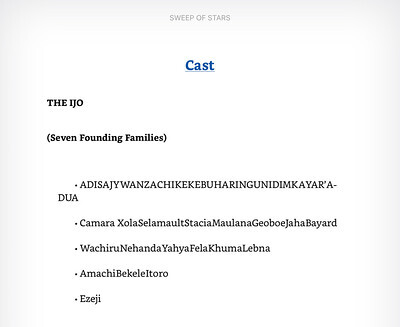
You can probably imagine why I took a screen shot rather than type it out. Although I may save it for use as an unbreakable password.
The science in this science fiction novel is never explained, to me a major fault. Just one example: the modified and enhanced human warriors of the HOVA team encounter alien life on a planet on the other side of a wormhole. Somehow — and this was one of the chapters I re-read to make sure — the HOVA team is instantly able to converse with aliens in a previously-unknown, not-even-human language, with no explanation as to how that might be possible. Earlier, aboard the spaceship transiting the wormhole, Broaddus describes living conditions on the ship, a settlement of kraals spread out in traditional African village fashion, leaving readers to posit either a massive spinning drum or artificial gravity. Either way, he needs to tell the reader how it is the kraals, along with their human occupants, aren't just floating around. See how reading and watching The Expanse has spoiled me for other forms of science fiction?
The multiple points of view, going from first- to third-person, sometimes even second-person for certain characters, didn't bother me to the extent it did other Goodreads reviewers. What did were the endlessly long, action-less conversations between characters, and the lavishly detailed descriptions of Muungano costumes, hairstyles, and court manners. The author's use of unexplained African-rooted terms was a minor problem; most of those terms became clear in context, rather like the nautical language in a Patrick O'Brian novel.
The author's doting on African culture, customs, and manners, which overwhelms plot and narrative at times, feels like an attempt to school non-Black readers — fair enough considering all the white European culture Maurice Broaddus has had crammed down his throat — but still feels, at least to me, like being schooled. It starts with the first family name in the cast list at the beginning of the book:
You can probably imagine why I took a screen shot rather than type it out. Although I may save it for use as an unbreakable password.
The science in this science fiction novel is never explained, to me a major fault. Just one example: the modified and enhanced human warriors of the HOVA team encounter alien life on a planet on the other side of a wormhole. Somehow — and this was one of the chapters I re-read to make sure — the HOVA team is instantly able to converse with aliens in a previously-unknown, not-even-human language, with no explanation as to how that might be possible. Earlier, aboard the spaceship transiting the wormhole, Broaddus describes living conditions on the ship, a settlement of kraals spread out in traditional African village fashion, leaving readers to posit either a massive spinning drum or artificial gravity. Either way, he needs to tell the reader how it is the kraals, along with their human occupants, aren't just floating around. See how reading and watching The Expanse has spoiled me for other forms of science fiction?
March 29, 2022
Sweep of Stars is the first book in a new space opera trilogy by Maurice Broaddus. It explores the struggles of the Muungano empire to remain independent of their home planet and live up to their ideals of a utopian community of city-states stretching from Mars to Titan.
When a wormhole gate is discovered in Muungano space, they face not only intrigues from beyond the wormhole, but from the Earth they left behind. Treachery unfolds throughout the empire, and fates are left in the balance when Sweep of Stars ends. It is definitely a cliff-hanger.
I struggled with this book, mainly due to the changes in point of view. Not because there are many characters, but because Broaddus chose to explore different approaches to storytelling for different characters. It may not bother anyone else, but it was jarring for me, and I had to readjust after every chapter. Broaddus switches from first person point of view, to third person, to second, and back, depending on the character. I’ve never experienced that before, and I didn’t like it.
I did love, however, that he uses the title’s phrase, ‘sweep of stars” several times throughout the book. I found that delightful. I also loved the characters themselves, and cared about their fates. The plot is engaging, the writing has depth and beauty, and the concept is lovely.
So while this book wasn’t particularly my favorite, it has much to recommend it.
When a wormhole gate is discovered in Muungano space, they face not only intrigues from beyond the wormhole, but from the Earth they left behind. Treachery unfolds throughout the empire, and fates are left in the balance when Sweep of Stars ends. It is definitely a cliff-hanger.
I struggled with this book, mainly due to the changes in point of view. Not because there are many characters, but because Broaddus chose to explore different approaches to storytelling for different characters. It may not bother anyone else, but it was jarring for me, and I had to readjust after every chapter. Broaddus switches from first person point of view, to third person, to second, and back, depending on the character. I’ve never experienced that before, and I didn’t like it.
I did love, however, that he uses the title’s phrase, ‘sweep of stars” several times throughout the book. I found that delightful. I also loved the characters themselves, and cared about their fates. The plot is engaging, the writing has depth and beauty, and the concept is lovely.
So while this book wasn’t particularly my favorite, it has much to recommend it.

Read
October 30, 2025The first 75% of the book had me worried. The politics seemed inconsistent, the book seemed terribly convinced of its utopias utopianness despite them calling themselves an empire. This was, gratefully resolved in the final 25%. However the books writing was bland and most of the POV characters were uninteresting and sounded too similar to each other to really track. Fela was the best.

June 22, 2022
Seemed like a really interesting sci-fi setting here, and cool plots, but I just could not keep track of what was going on. There was a glossary in the back but it was missing some essential stuff.
Then the inconsistent ... person tenses??... was really irritating. There was a guy who spoke like "We accept" (instead of 'I accept') and that was fine except that randomly he used "I" instead of "We" and it made it really hard to follow his conversations.
Then there was a native on another planet who was 'gender fluid' (...obviously the most important thing about an alien people...) and was referred to as 'they' or 'them' most of the time... except when he randomly became a 'he'. SO CONFUSING. I think this book needed some heavier editing.
Then the inconsistent ... person tenses??... was really irritating. There was a guy who spoke like "We accept" (instead of 'I accept') and that was fine except that randomly he used "I" instead of "We" and it made it really hard to follow his conversations.
Then there was a native on another planet who was 'gender fluid' (...obviously the most important thing about an alien people...) and was referred to as 'they' or 'them' most of the time... except when he randomly became a 'he'. SO CONFUSING. I think this book needed some heavier editing.
Displaying 1 - 30 of 80 reviews