

What do you think?

La Guerre d'Alan #1-3
La guerra de Alan
Arquetipo del antihéroe que ni siquiera merece un pie de página en los anales de la Historia, Alan Ingram Cope fue un soldado anodino más entre los cientos de miles de jóvenes llamados a filas para combatir en la segunda guerra mundial.
Medio siglo después, a la edad de sesenta y nueve años, su encuentro fortuito con el joven Emmanuel Guibert en la isla de Ré fue el germen de esta maravillosa historia. Fascinado por la profunda autenticidad del relato de Alan, Guibert se propuso plasmar en imágenes las vivencias de este veterano combatiente. Así, en interminables paseos por la playa, Alan habla y el artista escucha, y el resultado son estas hermosas páginas sobre la vida de un hombre sencillo y común cuya existencia estuvo marcada por el capricho del destino.
Las tres partes que componen los recuerdos sobre su participación en la guerra se han reunido por primera vez en castellano en este volumen que da inicio al espléndido fresco que Emmanuel Guibert le dedicó a Alan. El azar quiso que Alan Ingram Cope muriera siete meses antes del lanzamiento del primer libro de la trilogía —que Guibert completó más tarde con La infancia de Alan y Martha y Alan, éste último publicado recientemente con este sello editorial—, pero su memoria permanece viva en esta magistral novela gráfica.
Medio siglo después, a la edad de sesenta y nueve años, su encuentro fortuito con el joven Emmanuel Guibert en la isla de Ré fue el germen de esta maravillosa historia. Fascinado por la profunda autenticidad del relato de Alan, Guibert se propuso plasmar en imágenes las vivencias de este veterano combatiente. Así, en interminables paseos por la playa, Alan habla y el artista escucha, y el resultado son estas hermosas páginas sobre la vida de un hombre sencillo y común cuya existencia estuvo marcada por el capricho del destino.
Las tres partes que componen los recuerdos sobre su participación en la guerra se han reunido por primera vez en castellano en este volumen que da inicio al espléndido fresco que Emmanuel Guibert le dedicó a Alan. El azar quiso que Alan Ingram Cope muriera siete meses antes del lanzamiento del primer libro de la trilogía —que Guibert completó más tarde con La infancia de Alan y Martha y Alan, éste último publicado recientemente con este sello editorial—, pero su memoria permanece viva en esta magistral novela gráfica.
328 pages, Paperback
First published January 1, 2000
About the author
Emmanuel Guibert
166 books150 followersEmmanuel Guibert has written a great many graphic novels for readers young and old, among them the Sardine in Outer Space series and The Professor’s Daughter with Joann Sfar.
In 1994, a chance encounter with an American World War II veteran named Alan Cope marked the beginning of a deep friendship and the birth of a great biographical epic.
Another of Guibert's recent works is The Photographer. Showered with awards, translated around the world and soon to come from First Second books, it relates a Doctors Without Borders mission in 1980’s Afghanistan through the eyes of a great reporter, the late Didier Lefèvre.
Guibert lives in Paris with his wife and daughter.
In 1994, a chance encounter with an American World War II veteran named Alan Cope marked the beginning of a deep friendship and the birth of a great biographical epic.
Another of Guibert's recent works is The Photographer. Showered with awards, translated around the world and soon to come from First Second books, it relates a Doctors Without Borders mission in 1980’s Afghanistan through the eyes of a great reporter, the late Didier Lefèvre.
Guibert lives in Paris with his wife and daughter.
Ratings & Reviews
Friends & Following
Create a free account to discover what your friends think of this book!
Community Reviews
Displaying 1 - 30 of 214 reviews

November 25, 2015

One of the biggest hurdles of autobiography and memoir is that by virtue of the author’s life not being complete, the character portrayed must be a fiction. The author’s avatar is a fiction because the author, not having a perspective outside himself, has not really the ability to determine plot and direction and who his character actually is or will be. Because a reader is primarily prompted to read biographical non-fiction for its interaction with real life and real events,[1] the story loses its most powerful draw by fictionalizing its subject. Removing true character arcing in this manner usually guts the biograph of its luster, turning the youthful memoir into a singular evidence of the author’s arrogance—a twenty-year-old man who tells you where his story is headed is full-up on the kind of hubris that pretends that we are the masters of our destinies’ directions.[2]
Alan’s War, while avoiding this pitfall, provides pretty strong evidence for why autobiography is often foolish. As it is narrated by Alan Cope but edited and compiled and recounted by Emanuel Guibert after Cope’s death, we are greeted with a long-lens view of Cope’s life (even if much of the content comes from Cope himself). As with most all of us, Cope in his teens is different from Cope in his twenties and Cope in his thirties is different from Cope in his forties. And so on throughout his life. Alan’s War collects a handful of completely different Alan Copes. If the book was a Blankets-style memoir penned by a twenty-three-year-old Cope, it’s a sure bet that fifty-year-old Cope would reject it entirely. He understands why he was the person he was but also understands that Young Cope could never have imagined Old Cope.
Cope’s life was built of experiences, and the intimate intercourse with those historical meetings and states and phenomena altered him—as experiences always will. I’m not really any kind of determinist, but it’s easy to see how we are all forged by the moments we survive. I have not become who I am without the things that have happened to and around me. And neither are you.
In my late twenties, on my fourth trip to Europe, I spent several days wandering around Budapest. I stayed in a dive hostel (where I was nearly impaled through the chest with a wooden stake). I met a pod of three young women who were traveling Europe separately on extended vacations from Australia, Britain, and New Zealand respectively. I had been traveling alone and had largely taken in the sights and adventured without sharing any of my experiences with others. Merely polite back-and-forth with other travelers and locals. Yet here in Budapest I made friends with these three.

We had a good time seeing the sights, doing pub crawls, being touristy. Eventually, two had to catch their trains and flights, leaving me and the remainder of the pod a day to take in the city once more, only by ourselves. We had a grand time. Museums, gardens, public baths, dancing, a cellar-level restaurant. I even pooped my pants accidentally (due to the cellar-level restaurant), and that just added to the fantastic spontaneity of the day. It was a colossal experience and one that stays with me even a decade and a half later.[3] And one that went totally against my nature as an entrenched introvert.
And that’s part of what makes G.I. Cope’s story so fascinating for me. His entire life during WWII is essentially my few days in Budapest lived over and over, only in hundreds of places with hundreds of people. Cope talks to everybody and makes friends with everybody. He does as he will because the call of adventure is his lodestone. I wish sometimes I could live as Cope does, but I would sadly be in a perpetual state of exhaustion from all that lovely human contact. It is a true thing that later in the day after saying farewell to the final member of the pod, I was drained of all power and was overwhelmed in an uncharacteristic sort of homesickness (which contributed to me cutting short my European adventure by a full week). But Cope, he gets to know everybody and it’s marvelous.
He makes friends with men and women of all nationalities and backgrounds. And because of those friendships, Alan’s War is tremendous for offering a number of perspectives and beliefs and approaches to living. Cope becomes an effervescent and participatory fly on the wall of many families across Europe and gets to see a kind of world that none of his G.I. comrades would ever have known. For that alone Alan’s War would be something of a treasure, but beautifully, the book holds far more bounty.

Now it may be the weaver’s privilege to edit his own history to portray himself in more contemporary terms, but Cope throughout his narration is almost entirely free from prejudice and any of the distasteful bad opinions that we commonly associate with our grandparents’ era. He even goes so far as to express disapproval and bewilderment at his parents’ occasional classist tendencies. The one point on which he represents himself in less than glowing terms is in evaluating his religious beliefs and evolution. In fact, it’s perhaps his relationship to his faith state that most governs the book.
When I said earlier that Cope’s story couldn’t properly be told by stopping at the end of WWII, it was primarily his religious condition I had in mind. The war on the European front (the only piece of the war that Cope saw action in) concludes halfway through the book. This was strange to me, and at first I felt that the second half was just an extremely extended epilogue. After all, it was about Alan’s War, right?—about his involvement in WWII. Why then spend so much ink and sweat on filling in the blanks of the rest of his life? My suspicion is that the book’s title doesn’t actually aim toward describing Cope’s experience of WWII but instead advises the wary reader about something more cosmic going on. Cope as it turns out is participant, victim, belligerent, casualty, strategist, and beneficiary of the internal war within himself with God and religion and the concatenated ideologies of all the world.
Cope begins his story as a faithful if minorly disaffected Christian young man. He is eventually assigned to duty with a chaplain but lets us know he was fine with it because—at that time—he agreed with the beliefs and practice of the minister. Eventually he is so taken with the man that he believes himself called to become a minister himself. Later, after the war, he begins a journey of apostasy, abruptly distancing himself from the church in the midst of one of his seminary classes. His antagonism toward religion only sharpens through time and puts impassable obstacles between himself and a number of his former relationships. Finally, on the outward edge of middle age, his dissatisfaction with theological structures transitions to an existential rejection of most social structures and he comes to something near a whole-life-repurposement. The world system, he decides, has governed and abused him for too long, so he hopes to find a way to win free from that.

That the bulk of the second half of the book directly concerns this journey of enlightenment solidifies the interpretation that this is Cope’s (or Guibert’s) purpose in the book. In the concluding matter, Cope relates a little diversion about stories:
Pygmies have a tradition I like. They gather around a storyteller and yell out topics. For instance, when someone in the group says “Love!” the storyteller responds: “Love? It’s like this.” Or: “Hate? It’s like this.” And then he develops his story. You could call my story: “War? It’s like this.”
I suspect when Cope says “you could call my story…” he’s not speaking to the episode in which he went to Europe as part of an armoured car crew. Instead, he’s talking about his life. His life as a very particular kind of war story. It’s a good story and hits any number of the expected high and low beats. And readers will be able to exult in and live vicariously through a young man who for all his inexperience was something of a man of the world.

Cope’s stories are almost exclusively engaging and worth the time you’ll spend in reading them. And collapsed together into a single volume, they absolutely merit the couple to few hours it will cost to read them in their entirety. Cope’s life presents the reader with numerous points for self-realization and self-examination. It’s a good and thorough work and I enjoyed it immensely. There is now a sequel, How the World Was, that is being billed as a companion. I’ll tackle it in my next review, but as a minor spoiler, I’ll go on record as saying that it is also completely worth the reader’s time. Guibert is a lovely talent and I hope more of his work will arrive on American shores.
_______
[Review courtesy of Good Ok Bad.]
_______
Footnotes
1) Ignoring wholly the more philosophical question of whether there really is such a thing as Real Events.
2) I mean, unless he’s just ingested a bucket of arsenic. Then he’s got a pretty good idea when his story will peter out.
3) We, like summer camp friends, promised to keep in touch. We exchanged email addresses on the backs of postcards but mine, stuffed in the back pocket of my jeans, was accidentally washed as soon as I got home and her contact info banished to the Oblivion.

December 30, 2008
The French graphic artist met the expatriate Alan Cope by chance, and was so captivated by his World War II experiences that he produced a rather substantial graphic biography of the man, with a second volume to follow about Alan's childhood. It's unusual to read even a partial life of someone who has no automatic claim to our interest — even his war adventures are, for the most part, rather mundane — apart from the quality of his storytelling. But his talent in conveying his life is a rare and wonderful thing, all the more so because he speaks with what comes across as unvarnished honesty. In this regard, he is not unlike the early (pre-fame) Harvey Pekar, and if you enjoy Pekar, you should like this book, too.
Actually, I liked it more. Pekar is the proverbial Sad Sack; Alan Cope is curious, adventurous, and impulsive, willing to bend some rules to get the most out of his time in the army, especially overseas, where he fraternizes with the enemy, makes a lot of friends, and, after a brief attempt at a normal life in the US after demobilization (including a stab at marriage), returns to Europe and lives the rest of his life there. At bottom, Cope is an acute observer with a warm heart, and registers and retains experiences that most of us would shove into memory's trash bin, either out of embarrassment or shame. Cope doesn't flaunt these things; he meditates on them, seeking to discover what they tell him about himself, his life. This, in the end, makes him a very unusual person, and, in his very quiet way, quite remarkable.
Actually, I liked it more. Pekar is the proverbial Sad Sack; Alan Cope is curious, adventurous, and impulsive, willing to bend some rules to get the most out of his time in the army, especially overseas, where he fraternizes with the enemy, makes a lot of friends, and, after a brief attempt at a normal life in the US after demobilization (including a stab at marriage), returns to Europe and lives the rest of his life there. At bottom, Cope is an acute observer with a warm heart, and registers and retains experiences that most of us would shove into memory's trash bin, either out of embarrassment or shame. Cope doesn't flaunt these things; he meditates on them, seeking to discover what they tell him about himself, his life. This, in the end, makes him a very unusual person, and, in his very quiet way, quite remarkable.

February 21, 2012
The first half of this book deals with Alan Cope's experiences serving in a tank during WWII. It reminded me of Another River, Another Town: A Teenage Tank Gunner Comes of Age in Combat--1945 by John P. Irwin, though I think on the whole, Irwin's book is much better.
I enjoyed Cope's adventures in basic training, and though his combat exploits are not very exciting - he gets a Purple Heart (for falling off a ladder!) - I found them interesting.
The Good War came to an end, but unfortunately, Cope's story continued. The last part of the book is devoted to his post-war experiences. My eyes began to glaze over as I read detailed accounts of mountain climbing, Cope's attempts to "find himself", and one particular couple who are of interest only because they knew famous people. I had to force myself to finish.
On the plus side, I liked the layout of the book. It had sort of a scrapbooky feel to it, and the photo album at the end was a nice touch.
It did make me wonder about the strangers we meet on a daily basis and what stories they might have to tell.
I enjoyed Cope's adventures in basic training, and though his combat exploits are not very exciting - he gets a Purple Heart (for falling off a ladder!) - I found them interesting.
The Good War came to an end, but unfortunately, Cope's story continued. The last part of the book is devoted to his post-war experiences. My eyes began to glaze over as I read detailed accounts of mountain climbing, Cope's attempts to "find himself", and one particular couple who are of interest only because they knew famous people. I had to force myself to finish.
On the plus side, I liked the layout of the book. It had sort of a scrapbooky feel to it, and the photo album at the end was a nice touch.
It did make me wonder about the strangers we meet on a daily basis and what stories they might have to tell.

March 27, 2015
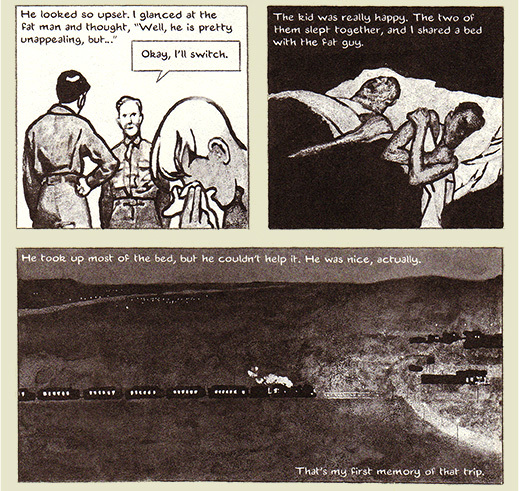
Artwork: Superb. It’s my favorite thing about this book. A lot of these illustrations look like photographs out of focus or as if they were 3D. That being said, it also makes for an impersonal graphic account of Alan’s story. As beautiful as the artwork is, you never get a sense of who Alan is. You don’t get those facial expressions to convey what’s going on at that particular moment. This really is more like sitting down with an older person as they tell you the story behind an album of old photographs, interesting, but without allowing you to invest a personal stake in the memories.
The printed text is also beautiful to look at. I’ve read some graphic novels where it was so hard to read the text either because it was so jumbled together, too dark, or illegible print. This font is not only beautiful, but is neat and color appropriate, dark against light background and light against dark background. I never had to squint or struggle to figure out what the text said. I’m very critical of illegible handwriting. I cannot help it. There was a time when kids were actually graded on their penmanship and if our papers looked messy or were hard to read we were made to erase it all and start again. It was part of our report card. Handwriting is a hobby of mine (can you call it that?), so the print in this book really stuck out for me, in a good way.
The story for me lacked substance. I failed to get a sense of what being in the war was. I hate to downplay someone’s role in such a historical event, but what I got from this was a somewhat cushioned involvement in the war. We don’t see much of the fighting, the deprivations, that Alan may have gone through. He earns a Purple Heart medal only because his sergeant insistently asked Alan if he’d gotten hurt in the war. When Alan tells him no, the sergeant keeps insisting. Perhaps a scratch or a bruise, he asks. Well, Alan did fall off a ladder once (his fault). Good enough for the sergeant. Alan gets a medal.
It was a lot of socializing and meeting people and forging friendships with lots of males, which brings me to this point now. I felt like the author did not dare ask Alan about his sexuality. He alluded several time in the book that Alan may have been gay. This may not have been relevant to the story of war, but it would have been interesting to see how this may have been handled back then. We see a couple of instances where something may have been revealed. We see the excitement Alan has when talking about a new male friend, but never the same excitement with females. At one point, Alan mentions that after the war he moves to France, then asks Why France? Well, Alan decides not to tell the reader because that’s his adult secret life. Huh? Then why bring it up? At another point in time, he wonders whether his refusal to kiss a male friend provoked the man to commit suicide. He “regrets” not helping out by obliging. If the author chose to include these tidbits, he certainly felt no need to address them, which makes for a glossed over recollection of a life, where one chooses to only show what’s good, but not what’s bad.
The printed text is also beautiful to look at. I’ve read some graphic novels where it was so hard to read the text either because it was so jumbled together, too dark, or illegible print. This font is not only beautiful, but is neat and color appropriate, dark against light background and light against dark background. I never had to squint or struggle to figure out what the text said. I’m very critical of illegible handwriting. I cannot help it. There was a time when kids were actually graded on their penmanship and if our papers looked messy or were hard to read we were made to erase it all and start again. It was part of our report card. Handwriting is a hobby of mine (can you call it that?), so the print in this book really stuck out for me, in a good way.
The story for me lacked substance. I failed to get a sense of what being in the war was. I hate to downplay someone’s role in such a historical event, but what I got from this was a somewhat cushioned involvement in the war. We don’t see much of the fighting, the deprivations, that Alan may have gone through. He earns a Purple Heart medal only because his sergeant insistently asked Alan if he’d gotten hurt in the war. When Alan tells him no, the sergeant keeps insisting. Perhaps a scratch or a bruise, he asks. Well, Alan did fall off a ladder once (his fault). Good enough for the sergeant. Alan gets a medal.
It was a lot of socializing and meeting people and forging friendships with lots of males, which brings me to this point now. I felt like the author did not dare ask Alan about his sexuality. He alluded several time in the book that Alan may have been gay. This may not have been relevant to the story of war, but it would have been interesting to see how this may have been handled back then. We see a couple of instances where something may have been revealed. We see the excitement Alan has when talking about a new male friend, but never the same excitement with females. At one point, Alan mentions that after the war he moves to France, then asks Why France? Well, Alan decides not to tell the reader because that’s his adult secret life. Huh? Then why bring it up? At another point in time, he wonders whether his refusal to kiss a male friend provoked the man to commit suicide. He “regrets” not helping out by obliging. If the author chose to include these tidbits, he certainly felt no need to address them, which makes for a glossed over recollection of a life, where one chooses to only show what’s good, but not what’s bad.

October 9, 2013
Eh. The first half was quite interesting. I would rate that as probably 4 stars, no question. It details Cope's time as an armored car driver in the last couple years of WWII. He apparently saw no combat, which isn't a big deal, since MANY soldiers saw no combat. He served mostly in the occupying forces in southern Germany and Czechoslovakia. An interesting look into military life, and all the usual soldierly hijinks.
But yeah. Then he left the service. From that point on, it was like a 6 year old was telling the story. "I met this guy, and he was really nice, but then I didn't know where he was, which is sad, and then I met this family, and they were nice, and then I met this girl that was nice and I should have married her instead of my first wife, and then I met another girl who I should have married instead of my first wife, and then I climbed a mountain, and then I tried to find myself through interpretive dance (really), then I had a gay friend, then I got married a second time, then I got a divorce the end." (Sorry for spoilers...)
Ugh. It was a narrative-free list of people he had met and why they were cool. There's a reason everyone doesn't get a biography. Because sometimes people live boring lives. And that's fine! I sure have. But if they had trimmed it to his war experiences, and immediate post-war stuff, it would have been an interesting, valuable look at a different angle of the war experience. As it was.... meh.
The art was ok, I guess, nothing fantastic. And frankly, even great art couldn't have saved the last 1/3rd of the book.
But yeah. Then he left the service. From that point on, it was like a 6 year old was telling the story. "I met this guy, and he was really nice, but then I didn't know where he was, which is sad, and then I met this family, and they were nice, and then I met this girl that was nice and I should have married her instead of my first wife, and then I met another girl who I should have married instead of my first wife, and then I climbed a mountain, and then I tried to find myself through interpretive dance (really), then I had a gay friend, then I got married a second time, then I got a divorce the end." (Sorry for spoilers...)
Ugh. It was a narrative-free list of people he had met and why they were cool. There's a reason everyone doesn't get a biography. Because sometimes people live boring lives. And that's fine! I sure have. But if they had trimmed it to his war experiences, and immediate post-war stuff, it would have been an interesting, valuable look at a different angle of the war experience. As it was.... meh.
The art was ok, I guess, nothing fantastic. And frankly, even great art couldn't have saved the last 1/3rd of the book.

October 10, 2020
It's hard to clearly articulate why reading Alan's War was so pleasurable for me. I read the "prequel" this past summer, How the World Was: A California Childhood, and enjoyed it thoroughly, so I assumed Alan's War would scratch a similar itch. But this memoir/biography takes the conceit of How the World Was and amplifies it considerably with a long, soothing, fascinating meditation on 20th century life.
The primary focus of the book is on Alan Cope's experiences during World War II. Basically, he was just kinda there, and not even to a Zelig degree, popping up at key moments or corresponding with bold-font names. His memories are detailed (oh my god, so detailed), but never truly exciting or interesting. He passes through training, passes through Europe, doesn't get much sleep, works with a chaplain, has some minor adventures. The book is extremely low-key - but in the best way. Perhaps Candide is a good comparison. Events occur around and to Alan and he presses through them with aplomb, barely a hair askew.
Though it might seem boring to some, I found Alan's War deeply meditative. The ending certainly reinforces this notion, as Cope describes how he fell out of favor with religion (and fell in love with sequoias). Mostly, I think I enjoyed Alan's War purely as an extremely detailed look at 20th century life. It wasn't that long ago, but in Alan's telling, it seems like ancient history. People writing letters? Losing each other for years? Just wandering into someone's home in Germany and befriending them? These elements of common humanity seem like the far distant past in our digital age. In that way, reading Alan's War is a holistic, cleansing experience, and highly recommended.
The primary focus of the book is on Alan Cope's experiences during World War II. Basically, he was just kinda there, and not even to a Zelig degree, popping up at key moments or corresponding with bold-font names. His memories are detailed (oh my god, so detailed), but never truly exciting or interesting. He passes through training, passes through Europe, doesn't get much sleep, works with a chaplain, has some minor adventures. The book is extremely low-key - but in the best way. Perhaps Candide is a good comparison. Events occur around and to Alan and he presses through them with aplomb, barely a hair askew.
Though it might seem boring to some, I found Alan's War deeply meditative. The ending certainly reinforces this notion, as Cope describes how he fell out of favor with religion (and fell in love with sequoias). Mostly, I think I enjoyed Alan's War purely as an extremely detailed look at 20th century life. It wasn't that long ago, but in Alan's telling, it seems like ancient history. People writing letters? Losing each other for years? Just wandering into someone's home in Germany and befriending them? These elements of common humanity seem like the far distant past in our digital age. In that way, reading Alan's War is a holistic, cleansing experience, and highly recommended.

July 20, 2019
日本漫畫看多了
看看法國的漫畫有什麼不一樣
傳主其實挺幸運的,到了歐陸沒碰到什麼大戰
根本沒有在前線待幾天就終戰了
而且一個小兵怎麼那麼容易碰到世界級的名人
還有不淺的交情,這運氣也是不同凡響
後半本講戰後人生,以前說要去異國長居就去了
好像比現在容易很多
可是感覺還有很多事情沒講
人老了大概這些事都雲淡風輕了吧
看看法國的漫畫有什麼不一樣
傳主其實挺幸運的,到了歐陸沒碰到什麼大戰
根本沒有在前線待幾天就終戰了
而且一個小兵怎麼那麼容易碰到世界級的名人
還有不淺的交情,這運氣也是不同凡響
後半本講戰後人生,以前說要去異國長居就去了
好像比現在容易很多
可是感覺還有很多事情沒講
人老了大概這些事都雲淡風輕了吧

June 15, 2013
A memoir of Alan Cope's experience as a soldier in WW II in Europe, illustrated by amazingly talented artist Emmanuel Guibert, who elevates and honors a common man's simple, mostly joyful life. Likeable guy, unremarkable, not sensational in the least, with no accounts of great battles, only the every day away from the front, mostly positive experiences which led him to keep connected with the military after the war. If you like stories of Macbeth or Patton, skip this book, this is the story of an every day foot soldier, a nice guy who makes many life long friends through the experience. Sort of a non-historian's view of the war. I liked it a lot. There's one sort of sub-motif, unstated, though I see other reviewers also were curious: is Alan gay? He hints at it, but never reveals. Is this important? Nah, but it gets hinted at. Sex and soldiering is discussed, but Cope's sexual experiences (with the exception of a couple failed experiences and indication of a later failed marriage) are not discussed, though hinted at in a way that makes the reader curious, I think.
One other issue that is interesting is why Cope decides to not live in America after the war; his family didn't send him off warmly, which hurt him, and he comes to prefer Europe as "deeper" than the US... He seems to make friends with people who are talented and who have friends who are famous people, but we don't see Cope as having a particular talent for anything! Yet I turn the pages, find him likeable and engaging, a historian of the every day.
Guibert listens to Cope's story and draws what HE sees, and this impressionistic result, with plenty of space for reader imagination/construction, works for Cope--Cope likes it even if the places Guibert imagines are nothing like the ones in Cope's memory--and for me. Guibert has the same level of forgiveness for Cope's obvious little mistakes--who cares? Leave it as he said, it's not important, etc., what's important is his storytelling....
Guibert is a French non-fiction graphic biographer, journalist (The Journalist is his much acclaimed work but I liked this better for its intimacy and charm and for the friendship it gives evidence to) of pretty amazing talent. I liked this much more than I thought I would. I have just read Onward Toward our Noble Death, a Japanese soldier anti-war memoir by Mizuki, and taken together, both help you reflect on the experience of the every day soldier (an experience my Dad, both brothers and I avoided, thank goodness)...I also just finished A Chinese Life by Li and it is also a compelling story of an unremarkable guy, also documenting a life that covers those (but for Li, non-soldier) years, also just a regular guy, and all three memoirs show us the buffonery (and in Mizuki's case the tragedy) of bureaucracy, of thinking like a state. All three people come off as more interesting than any "superior" officer, for sure. And the art is terrific.
One other issue that is interesting is why Cope decides to not live in America after the war; his family didn't send him off warmly, which hurt him, and he comes to prefer Europe as "deeper" than the US... He seems to make friends with people who are talented and who have friends who are famous people, but we don't see Cope as having a particular talent for anything! Yet I turn the pages, find him likeable and engaging, a historian of the every day.
Guibert listens to Cope's story and draws what HE sees, and this impressionistic result, with plenty of space for reader imagination/construction, works for Cope--Cope likes it even if the places Guibert imagines are nothing like the ones in Cope's memory--and for me. Guibert has the same level of forgiveness for Cope's obvious little mistakes--who cares? Leave it as he said, it's not important, etc., what's important is his storytelling....
Guibert is a French non-fiction graphic biographer, journalist (The Journalist is his much acclaimed work but I liked this better for its intimacy and charm and for the friendship it gives evidence to) of pretty amazing talent. I liked this much more than I thought I would. I have just read Onward Toward our Noble Death, a Japanese soldier anti-war memoir by Mizuki, and taken together, both help you reflect on the experience of the every day soldier (an experience my Dad, both brothers and I avoided, thank goodness)...I also just finished A Chinese Life by Li and it is also a compelling story of an unremarkable guy, also documenting a life that covers those (but for Li, non-soldier) years, also just a regular guy, and all three memoirs show us the buffonery (and in Mizuki's case the tragedy) of bureaucracy, of thinking like a state. All three people come off as more interesting than any "superior" officer, for sure. And the art is terrific.

May 27, 2012
La guerre d'Alan est la retranscription en bande dessinée du récit d'Alan Ingram Cope un jeune soldat de l'armée des Etats-Unis pendant la deuxième guerre mondiale. Ce travail a été réalisé par Emmanuel Guibert à qui l'on doit notamment la très bonne série Le Photographe.Le dessin est simple, beau et épuré fait de traits proches de la ligne claire peints au lavis sépia. Cette technique, en plus de donner un résultat magnifique, procure un sensation de calme et de sérénité et donne un côté agréablement vieilli à l'ensemble.
La narration reproduit fidèlement les digressions qu'à dû employer Alan Ingram Cope en racontant son histoire (il y a souvent des sauts dans le temps). Ce procédé renforce l'impression que l’histoire est réellement racontée par la personne d’une manière un peu désordonnée donc naturelle. Dans la première partie, la naïveté du personnage à la frontière de l'âge adulte est parfaitement retranscrite grâce aux textes habilement tournés.
Ce roman graphique met en avant le brassage culturel engendré par la mobilisation militaire liée à la guerre. Il s'emploie à nous décrire les amitiés extrêmement fortes qui pouvaient se nouer dans de tels contextes de déracinement total. Les amitiés avec les camarades mais aussi celles nouées avec la population locale baignée dans une culture très différente. Le récit est construit comme une suite d'anecdotes tantôt cocasses tantôt plus sérieuses mais toujours intéressantes et sincères, comme celles que raconterait un grand-père à son petit-fils.
Attention, ce n'est pas un récit de guerre classique où l'on se trouve plongé dans l'enfer des batailles, le sang et l'horreur. Alan a la chance de poser le pied sur le territoire français le jour de ses 20 ans, le 19 février 1945. A cette période, la guerre est pratiquement terminée et la mission qui va être confiée à sa compagnie revêt un caractère bien particulier. Le récit se poursuit ensuite jusqu'aux vieux jours d'Alan. Il retrace sa vie ou une partie - une partie est volontairement occultée - et nous suivons avec intérêt le cheminement de ce jeune homme vers l'âge adulte, les choix qu'il devra faire et les rencontres qui changeront sa vie.
Un roman graphique de très grande qualité beau, riche et sensible à lire sans hésitation.
Il est publié en trois tomes ainsi qu'en édition intégrale par l’Association. https://www.aubonroman.com/2012/05/la...
La narration reproduit fidèlement les digressions qu'à dû employer Alan Ingram Cope en racontant son histoire (il y a souvent des sauts dans le temps). Ce procédé renforce l'impression que l’histoire est réellement racontée par la personne d’une manière un peu désordonnée donc naturelle. Dans la première partie, la naïveté du personnage à la frontière de l'âge adulte est parfaitement retranscrite grâce aux textes habilement tournés.
Quant à moi, je n'avais aucune idée de ce c'était que Pearl Harbor. Je n'avais pas le temps de lire le journal avant de le livrer.
Ce roman graphique met en avant le brassage culturel engendré par la mobilisation militaire liée à la guerre. Il s'emploie à nous décrire les amitiés extrêmement fortes qui pouvaient se nouer dans de tels contextes de déracinement total. Les amitiés avec les camarades mais aussi celles nouées avec la population locale baignée dans une culture très différente. Le récit est construit comme une suite d'anecdotes tantôt cocasses tantôt plus sérieuses mais toujours intéressantes et sincères, comme celles que raconterait un grand-père à son petit-fils.
Attention, ce n'est pas un récit de guerre classique où l'on se trouve plongé dans l'enfer des batailles, le sang et l'horreur. Alan a la chance de poser le pied sur le territoire français le jour de ses 20 ans, le 19 février 1945. A cette période, la guerre est pratiquement terminée et la mission qui va être confiée à sa compagnie revêt un caractère bien particulier. Le récit se poursuit ensuite jusqu'aux vieux jours d'Alan. Il retrace sa vie ou une partie - une partie est volontairement occultée - et nous suivons avec intérêt le cheminement de ce jeune homme vers l'âge adulte, les choix qu'il devra faire et les rencontres qui changeront sa vie.
Je n'avais pas vécu la vie de la personne que je suis. J'avais vécu la vie de la personne que l'on voulait que je sois, c'est différent.
Un roman graphique de très grande qualité beau, riche et sensible à lire sans hésitation.
Il est publié en trois tomes ainsi qu'en édition intégrale par l’Association. https://www.aubonroman.com/2012/05/la...

May 27, 2011
Written and Illustrated by Emmanuel, this graphic memoir reads like you are sitting and talking to an old uncle about his life. Cope, a WWII vet, tells of his experience in the service during WWII and his life after the war. The black and white illustrations are beautiful and really help tell the story, giving you a feel for the people and places which pass through Cope's life. That is what it feels like too, Cope is just passing through life, he has no real friends, no real attachment to a person or a place, he is adrift with no direction. While the look at service during WWII is interesting and worth the read, Cope's life after the war left me with a depressing feeling that brought down my enjoyment of this memoir.

July 31, 2019
I read this in one sitting. It was pleasant, not perfect, but I like that it exists. There's something very charming about an illustrator who happens to become friends with a World War 2 veteran, especially when that veteran spills his guts on anything and everything from his youth.
Cope includes many things that aren't typically revealed in war memoirs from the '90s, like his (nearly) being sexually assaulted by men from his own unit, and the many philosophical revelations he goes through post-war. It is just truly gratifying that this exists and that you get to read about this man who honestly seems like the nicest guy ever.
It isn't a perfect product, but it gave me goosebumps when I finished it. It's quite good.
Cope includes many things that aren't typically revealed in war memoirs from the '90s, like his (nearly) being sexually assaulted by men from his own unit, and the many philosophical revelations he goes through post-war. It is just truly gratifying that this exists and that you get to read about this man who honestly seems like the nicest guy ever.
It isn't a perfect product, but it gave me goosebumps when I finished it. It's quite good.

April 10, 2016
It's remarkable how boring WWII can be when you spend 300+ pages memorializing the experiences of a GI who saw no combat, saw very little suffering or death, and spent most of his time fraternizing with civilians. He seems to be clueless about the consequences of the war, the war crimes committed, the nazis, etc. He doesn't seem to be curious about Germany or the war itself. He disobeys orders and fraternizes with enemies because they feed him good food and play classical music on their piano. Utterly stupid. Its like a boy scout encampment where the only thing he wonders about is whether his bunkmates are gay.

July 25, 2011
This is a wonderful book. The English edition compiles the three volumes of the original French, which were written years apart. Books 1 & 2 focus on the young Alan being sent to fight in Europe. Book 3 is about the post-war years and all the relationships he formed over the years. This is a very wordy graphic novel, reading like a monologue. Alan is a deeply observant and sensitive young man and we can't help but identify with his experiences and daily struggles. The drawings are economic but very efective.

October 30, 2023
Sade bir hayat. Genelde yazılan savaş hatıralarından farklı olarak, normal bir kimsenin normal anılarını okuyoruz. Bu sadelik hem iyi geliyor hem de bir sürü dersi de yanında getiriyor. Kara karga yayınları bu eserleri iyi buluyor. Teşekkürler.

January 29, 2009
I confess to not finishing this. I'm afraid that Alan's war was too personal, too microcosmic to hold my interest for long enough to hook me. I wanted to like it more than I did.

June 3, 2023
Vuonna 1994 sarjakuvataiteilija Emmanuel Guibert tutustui Ranskaan emigroituneeseen amerikkalaiseen Alan Copeen. Miehet ystävystyivät. Kuunneltuaan aikansa Copen tarinoita hän päätti tehdä hänen elämästään sarjakuvan - ja tässäpä sitten lopputulos, kehuttu sarjakuvaromaani "Alan's War: The Memores of G.I. Alan Cope" (First Second, 2008).
Sarjakuvan nimi ja kansikuva saattavat johtaa harhaan, sillä kyseessä ei ole oikeastaan sotasarjakuva. Loppuvaiheessa rintamalle komennettu Cope ei oikeastaan kokenut taisteluja, ja albumi kertookin enemmän hänen tapaamistaan ihmisistä, ympäröivästä luonnosta ja elämänfilosofiastaan.
Sarjakuva on hetkittäin hyvin mielenkiintoinen. Cope vaikuttaa mielenkiintoiselta hahmolta, ja hänen äänensä pääsee hyvin kuuluviin. Hetkittäin tuntuu siltä kuin istuisi saman pöydän ääressä kuuntelemassa vanhan veteraanin tarinointia! Loppua kohti albumi käy kyllä pikkuisen pitkäveteiseksi, etenkin kun osa henkilöistä tuntuu vain piipahtavan tarinassa, ilman mitään sen suurempaa merkitystä. Lievä tiivistäminen olisi voinut tehdä näiltä osin hyvää, mutta ehkä tekijän ideana oli kertoa Alanin elämästä juuri sellaisena kuin hän sen on halunnut kertoa.
Guibertin piirrosta on kehuttu suuresti, mutta itse en sille ihan niin kauheasti lämmennyt. Kannatti lukea joka tapauksessa!
Sarjakuvan nimi ja kansikuva saattavat johtaa harhaan, sillä kyseessä ei ole oikeastaan sotasarjakuva. Loppuvaiheessa rintamalle komennettu Cope ei oikeastaan kokenut taisteluja, ja albumi kertookin enemmän hänen tapaamistaan ihmisistä, ympäröivästä luonnosta ja elämänfilosofiastaan.
Sarjakuva on hetkittäin hyvin mielenkiintoinen. Cope vaikuttaa mielenkiintoiselta hahmolta, ja hänen äänensä pääsee hyvin kuuluviin. Hetkittäin tuntuu siltä kuin istuisi saman pöydän ääressä kuuntelemassa vanhan veteraanin tarinointia! Loppua kohti albumi käy kyllä pikkuisen pitkäveteiseksi, etenkin kun osa henkilöistä tuntuu vain piipahtavan tarinassa, ilman mitään sen suurempaa merkitystä. Lievä tiivistäminen olisi voinut tehdä näiltä osin hyvää, mutta ehkä tekijän ideana oli kertoa Alanin elämästä juuri sellaisena kuin hän sen on halunnut kertoa.
Guibertin piirrosta on kehuttu suuresti, mutta itse en sille ihan niin kauheasti lämmennyt. Kannatti lukea joka tapauksessa!

Read
December 11, 2023Olmadı olamadı. Pes ettim. Kitap yaklaşık 2 ay elimde süründü. Günde 4 çizgi roman okuyan ben, bu kitapla adeta savaşa girdim. Kitap feleğimle güreş tuttu. Ve sonunda bıraktım. Yarıda kaldı.
Alan Cope abimizin asla ilginç olmayan, yer yer eğlenceli, çoğu zaman -benim açımdan- sıkıcı hikayelerini okuyoruz. Başta çok eğlenceli geliyor ve ilk 80 sayfa akıyor gidiyor. Kitap zaten Alan Cope'un ağzından yazılmış çizilmiş. Sanki karşı iskemlede oturan Alan dayıdan hatıratını dinliyor gibiyiz. Ama bi noktadan sonra hikayenin bir ivme kazanmasını, bir yere gitmesini bekliyorsunuz. Olmuyor.
Belki yakın bir gelecekte, daha kafam rahatken tekrar okumayı denerim ama bu aralar yo dostum yo.
Alan Cope abimizin asla ilginç olmayan, yer yer eğlenceli, çoğu zaman -benim açımdan- sıkıcı hikayelerini okuyoruz. Başta çok eğlenceli geliyor ve ilk 80 sayfa akıyor gidiyor. Kitap zaten Alan Cope'un ağzından yazılmış çizilmiş. Sanki karşı iskemlede oturan Alan dayıdan hatıratını dinliyor gibiyiz. Ama bi noktadan sonra hikayenin bir ivme kazanmasını, bir yere gitmesini bekliyorsunuz. Olmuyor.
Belki yakın bir gelecekte, daha kafam rahatken tekrar okumayı denerim ama bu aralar yo dostum yo.
October 24, 2019
I remember reading this in 5th grade. I loved reading this book and would recommend it to almost anyone. It seems like it is just a war story but it really is more about Alan Cope. You get to learn about what happened in his life and it is very interesting. I also like how you get to hear about his life after war. It shows how war changed him and I think that is very interesting to see.

March 4, 2026
je suis pas trop fan de récits de guerre, mais ça tombe bien globalement on la voit pas. y’a ce truc d’expérience de vie à la fois très sociale et super dépolitisée qui rend assez touchant,
et sa manière d’utiliser les blancs qui est assez géniale, quand y’a rien ou trop à signifier (je préfère L’Enfance d’Alan là dessus (et de manière générale) m’enfin).
c’était vraiment super.
et sa manière d’utiliser les blancs qui est assez géniale, quand y’a rien ou trop à signifier (je préfère L’Enfance d’Alan là dessus (et de manière générale) m’enfin).
c’était vraiment super.

October 8, 2020
C'est la première fois que je lis une récit de guerre. Alan Cope m'a ému, énervé et émerveille .

October 29, 2024
in my war era ig


August 9, 2019
Con mucha habilidad el autor consigue que un relato de guerra se convierta en algo entrañable y hasta encantador.

January 11, 2024
A ground level view of American campaigns in World War II from a seemingly thoughtful and open minded man. Illustrations and text are clear and easy to understand.

February 20, 2021
Personalment, m'ha semblat intranscendent. Entenc que és la màgia de l'antiheroi, però el cómic acaba sent feixuc. Visqué una vida a priori senzilla, però plena d'experiències arreu del món. M'ha semblat romàntic aquest desig de recuperar per correspondència tota aquella gent s'havia creuat al llarg dels anys en diferents indrets del món. La modernitat ha matat aquest anhel de rebre una carta d'altri que potser mai arriba.

January 20, 2009
I've just finished reading (and re-reading a bit also) Alan's war, in its original French edition. It's a great piece of work, being both Art and documentary. When you know the second world war and you've enjoyed the great novels that satirize it (by Evelyn Waugh and many others) by staying close to the truth, you can probably laugh through the first two thirds of this book. It isn't meant to be a satire, but it points out the absurdities of war so well, and with such a delicate, gentle touch, that I couldn't help smiling.
The last third of this work covers the post-war era and it's much less coherent than the first two thirds. It's also less funny, since the absurdities of military life have gone away. But it's when things get serious that you realize that this is after all a biography of sorts. That's when you want to re-read the first two thirds again, in light of what you've learned about the character, the hero, Alan Ingram Cope.
I read this graphic novel at the same time that I was reading about another Alan in "Alanna: The First Adventure" a very good adventure story for young girls. In it the heroine, Alanna, passes as a boy in order to become a knight. Of course, she has everyone call her Alan, as she learns sword play and other aspects of the art of war. It was a nice contrast with the adventures of that other Alan, who was learning how to drive tanks, shoot rifle grenades and use field cipher machines.
I wonder how it feels to read all this in English. One day I'll have to take a look a the English version.
The last third of this work covers the post-war era and it's much less coherent than the first two thirds. It's also less funny, since the absurdities of military life have gone away. But it's when things get serious that you realize that this is after all a biography of sorts. That's when you want to re-read the first two thirds again, in light of what you've learned about the character, the hero, Alan Ingram Cope.
I read this graphic novel at the same time that I was reading about another Alan in "Alanna: The First Adventure" a very good adventure story for young girls. In it the heroine, Alanna, passes as a boy in order to become a knight. Of course, she has everyone call her Alan, as she learns sword play and other aspects of the art of war. It was a nice contrast with the adventures of that other Alan, who was learning how to drive tanks, shoot rifle grenades and use field cipher machines.
I wonder how it feels to read all this in English. One day I'll have to take a look a the English version.

January 17, 2015
This is the story of one man's war. It is not the story of WWII, but the story of one man (Alan Cope) and his personal day to day life as he lived through those years in France. Alan didn't fight in any famous battles or according to himself, show any acts of bravery. His war could be called mundane, but no one can go through fighting and surviving a world war without having tales to tell and these are Alan's tales in his own words illustrated by Emmanuel Guibert. The book was good and I enjoyed my time with it. There are a few things that made it not a five-star read for me. It drags a bit, being overly long. Guibert doesn't do as much of his photograph/illustration mixture artwork for a good portion of the book, which I can understand because of the lack of photos taken during the actual combat years, but still I felt their absence. Finally, I simply didn't like Alan. I had a small inking after reading the story of his childhood that as an adult he might rub me the wrong way, and this book certainly confirmed that. I didn't like his worldview, outlook, or opinions. So that does take away from the enjoyment of reading the minutia of his life. But all told I did like this quiet, personal look at one man's war.

December 7, 2016
Short Review: This is my year of graphic novels. I have been really enjoying how the graphic novel can tell a story in a different way. This was a recommendation from Seth Hahne (blogger responsible for the incredible graphic novel review blog http://goodokbad.com ).
Alan's War is the story of Alan Cope, a US soldier in World War II as told to the artist and author of the book. Roughly half of the book is Cope's story from being drafted and trained and then deployed at the very end of the war. He continued to serve for a little while after the war in Europe before returning home for college and to prepare for the ministry. He eventually lost his faith and returned to Europe where he spent the rest of his life without ever returning to the US.
The book is filled with humor and lots of good story telling. But also a thread of sadness. I picked up a second volume that was written after Alan's War was published about Cope's growing up years during the depression.
My full review is on my blog at http://bookwi.se/alans-war/
Alan's War is the story of Alan Cope, a US soldier in World War II as told to the artist and author of the book. Roughly half of the book is Cope's story from being drafted and trained and then deployed at the very end of the war. He continued to serve for a little while after the war in Europe before returning home for college and to prepare for the ministry. He eventually lost his faith and returned to Europe where he spent the rest of his life without ever returning to the US.
The book is filled with humor and lots of good story telling. But also a thread of sadness. I picked up a second volume that was written after Alan's War was published about Cope's growing up years during the depression.
My full review is on my blog at http://bookwi.se/alans-war/
March 22, 2016
Generally when there is a book taking place during World War II it is a book about World War II, however Alan’s war proves this doesn’t have to be the case. Alan is a soldier during World War II who never sees combat and barely has any direct influence on the war efforts. It may seem like a waste of time to show Alan’s life when it could be about the actual war, however because the book doesn’t focus on the war the reader is able to see the effects of the war and what life was like for the people who weren’t involved. It’s great to see a completely different perspective on an event that has hundreds of books written about it. I won’t say just how everything looks when people aren’t focused on the war because I highly recommend it, it is very enjoyable to read and you can learn a lot from it. It doesn’t have the best drawings but it is very well written and the story progresses at a good pace to remain interesting without getting confusing.
This entire review has been hidden because of spoilers.

December 22, 2013
Alright. I really enjoyed the graphic novel presentation of this type of story. The artist does an excellent job of grabbing emotion with pen and ink. But like many other reviews, I perhaps had higher expectations. There's an M8 Greyhound on the front, I expected perhaps more of a war story. And Alan Cope's war story is in there, but it was rather anti-climactic. As was the whole story. What, exactly, was "Alan's War"? He wasn't really fighting against anything... or if he was, it goes unmentioned. One reviewer suggested he thought Cope was going to reveal at some point that he was gay. I felt that this is what it was leading up to as well, but ... well, that didn't happen either.
So, all in all, it was a good graphic novel. Worth the week I spent with it. Great graphics and illustrations for a somewhat ho hum story.
So, all in all, it was a good graphic novel. Worth the week I spent with it. Great graphics and illustrations for a somewhat ho hum story.
Displaying 1 - 30 of 214 reviews