Straggling behind the mild 2003 success of cartoonist Chris Ware's first facsimile collection of his miscellaneous sketches, notes, and adolescent fantasies arrives this second volume, updating weary readers with Ware's clichéd and outmoded insights from the late twentieth century.
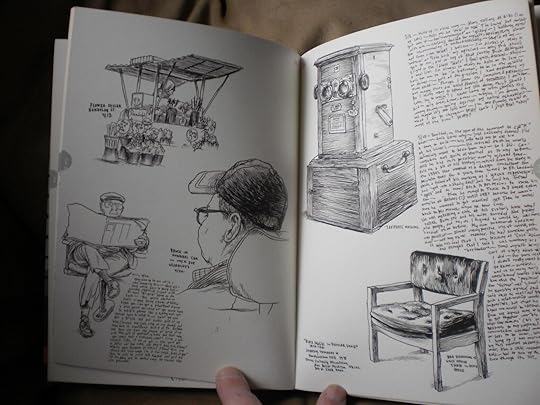
Working directly in pen and ink, watercolor, and white-out whenever he makes a mistake, Ware has cannily edited out all legally sensitive and personally incriminating material from his private journals, carefully recomposing each page to simulate the appearance of an ordered mind and established aesthetic directive. All phone numbers, references to ex-girlfriends, "false starts," and embarrassing experiments with unfamiliar drawing media have been generously excised to present the reader with the most pleasant and colorful sketchbook reading experience available. Included are Ware's frustrated doodles for his book covers, angry personal assaults on friends, half-finished comic strips, and lengthy and tiresome fulminations of personal disappointments both social and sexual, as well as his now-beloved drawings of the generally miserable inhabitants of the city of Chicago. All in all, a necessary volume for fans of fine art, water-based media, and personal diatribe. This hardcover is attractively designed and easy to resell.
Chris Ware is an American cartoonist acclaimed for redefining the visual and narrative possibilities of the graphic novel, known especially for his long-running Acme Novelty Library series and major works including Jimmy Corrigan, the Smartest Kid on Earth, Building Stories, and Rusty Brown. His work is distinguished by its emotional depth, frequently exploring loneliness, memory, regret, and the quieter forms of pain that shape ordinary lives, rendered with extreme visual precision, intricate page designs, and a style that evokes early twentieth-century American illustration, advertising, and architecture. Raised in Omaha and later based in the Chicago area, Ware first attracted attention through his strips for The Daily Texan, where an invitation from Art Spiegelman to contribute to Raw helped encourage him toward an ambitious, self-publishing approach that would define his career. Acme Novelty Library disrupted conventions of comic book production in both format and tone, presenting characters such as Quimby the Mouse and later Rusty Brown in narratives that blend autobiography, satire, and psychological portraiture. Building Stories further expanded his formal experimentation, released as a boxed set of interconnected printed pieces that require the reader to assemble meaning from varied physical formats. Ware’s artistic influences range from early newspaper cartoonists like Winsor McCay and Frank King to the collage and narrative play of Joseph Cornell, and he has spoken about using typography-like logic in his drawing to mirror the fragmented, associative way memory works. His practice remains largely analog, relying on hand drawing and careful layout, though he uses computers for color preparation. Ware has also been active as an editor, designer, and curator, contributing to volumes reprinting historic comic strips, serving as editor of The Best American Comics 2007, and organizing exhibitions such as UnInked at the Phoenix Art Museum. His work has extended into multimedia collaborations, including illustrated documentary materials for This American Life and visual designs for film posters, book covers, and music projects. His later projects include The Last Saturday, serialized online for The Guardian, and Monograph, a retrospective volume combining autobiography with archival material. Widely recognized for his influence, Ware’s books have received numerous honors, including multiple Eisner and Harvey Awards, and Jimmy Corrigan became the first graphic novel to win the Guardian First Book Award. He has exhibited at major institutions including the Whitney Museum of American Art and Museum of Contemporary Art Chicago, and his contributions to the medium have led many peers and critics to regard him as one of the most significant cartoonists of his generation.
This is essentially Ware's artist's journal, with amazing sketches and notes throughout. A datebook, okay! A sketchbook. One might have a tendency to think of his formal qualities, his almost obsessive attention to detail and forget what a great artist he really is, and what a warm and funny guy he is, as well. I had looked through it before, but it was a pleasure to look at it again.
Druga część szkicownika Chrisa Ware, gdzie fantastyczne grafiki przeplatają się z jego notatkami i paskami. Dominuje dosyć męczący depresyjny ton, w którym autor udowadnia jakim jest zerem i jak ciężko mu przychodzi stworzenie czegokolwiek. Nie wiem ile w tym autokreacji, a ile ironii czy swoistego katharsis, ale wiem, że format i czcionka mówią czytelnikowi bardzo wyraźnie, że ta książka nie chce być czytana. Momentami przedzieranie się przez ściany mikrotekstu faktycznie nie ma sensu i chyba lepiej patrzeć na to bardziej całościowo, skupiając się na obrazach. Dla wiernych fanów jednego z najlepszych współczesnych twórców komiksu
My main problem with this book is its size. I would have had to get out a magnifying glass in order to read a lot of the cartoon text from Ware's sketchbook pages, and it simply wasn't worth the effort, so many of the intricate cartoons were left unread.
What was left was a wealth of incredible illustrations, and a wealth of Ware whining about his art, his life, and anything that came to mind. The guy is as bad as Brunetti, at times, but for some reason I find it funny with Brunetti, but sad with Ware. I'd give up a mistress for half of Ware's talent, and once I had that half-share of talent I'd let everyone know that I was the Greatest Artist to Ever Grace Earth with His Illustrative Genius but Ware spends most of the book complaining about what a failure he is. I found myself vacillating between thinking that Ware should spend less time whining and more time art-ing, and wondering if it was these delusions of failure that fuel his genius in the first place.
Still...genius it is, and I'll slap four stars on the table.
Ware's huge hardcover sketchbook, filled with tons of life drawings, a few short cartoons (several unfinished), and lots of long-hand journal entries.
The good: the artwork. Even when it's rough, you can see what a talented illustrator Ware is, and his design sense is terrific.
The bad: the journal entries. I really loved the somber tone of Jimmy Corrigan, but I found slogging through Ware's "I have no talent or insights" lamentations extremely tedious. I couldn't read them all- I just haven't the willpower to subject myself to that degree of self-flagellation.
Ware is the most talented and exceptional comic artist of his generation. As with any outstanding artist, it is a delight to have access to their insights and sketches.Sure, his self doubt is sometimes bizarre if not irritating (as other reviewers have said) but it is even more to his credit that he was prepared to share something so personal. And ultimately it is the art that is important and these sketches are entirely worthy of publication.
I fucking hate Chris Ware. This book is filled with page after page of exquisite drawings, whether they be careful observational sketches, diary comics, or careful reproduction of a vintage add or book cover. And page of page of Ware's unbearable, whiny scrawl: "This drawing sucks! I'm terrible! I hate my life!" Fuck you Chris Ware.
Best read in small doses - otherwise you'll get a headache trying to read the very tiny lettering (I admit there were a few items I skipped that really needed a magnifying glass for viewing) and from the amount of self-hatred expressed by Ware. But definitely worth checking out if you are a Ware fan.
Truly fascinating to delve into Ware's sketchbook(s?). His normal, minimalist, and highly controlled style, gives way to quick life sketches and more playful versions of himself. Drawings are often mixed with journal-type entries that are incredibly raw and often quite self-loathing (he frequently chastises his work, his work ethic, or just his plain existence). Even with my glasses, I found a lot of this hard to read at such a small size, which I'm assuming is reflective of the original handwritten text size. And there was too much of it for me to read it all with that level of focus and concentration. I more than related to the frequent, failed promises to draw everyday and even some of the self-criticism, but the gap between our drawing lives is about the size of the Grand Canyon, so it mostly just made me feel bad for Ware. He illustrates himself as the poster child in need of daily affirmations and positive self-talk. I'm not sure how any illustrator or comics artist keeps up this type of pace without losing whatever flake of sanity with which they started.
Felt like a much better version of what Ware was trying to do in his earlier collected sketchbook. The diary entries pick up to give readers a better sense of where Ware was at the time, both in prose and comics form.
This really puts things in perspective. An artist like Chris Ware saying he can't draw. It was almost funny, but mostly sad. It made me think of all the times I have shit on something I've done - is it just in my head? Ware does these perfect sketches of faces and hands and the majority of the time he writes next to the sketch, "This is shockingly bad," or "I cannot draw. What is wrong with me?" He just needs a good slap in the face. Or, as Tweedy would say, 'maybe all he needs is a shot in the arm.'
I find it heartbreaking the way this man doubts his abilities and beats himself up and I recognize that feeling myself with my own work sometimes. I don't know how many times I said out loud while reading this book, "Dude, are you kidding? You so do NOT suck, where do you get that idea?" I adore his work and have idolized him for a long time. I wish he weren't so hard on himself. I love seeing his creative process and he has been such an inspiration to me.